Introduction to
the Solar System
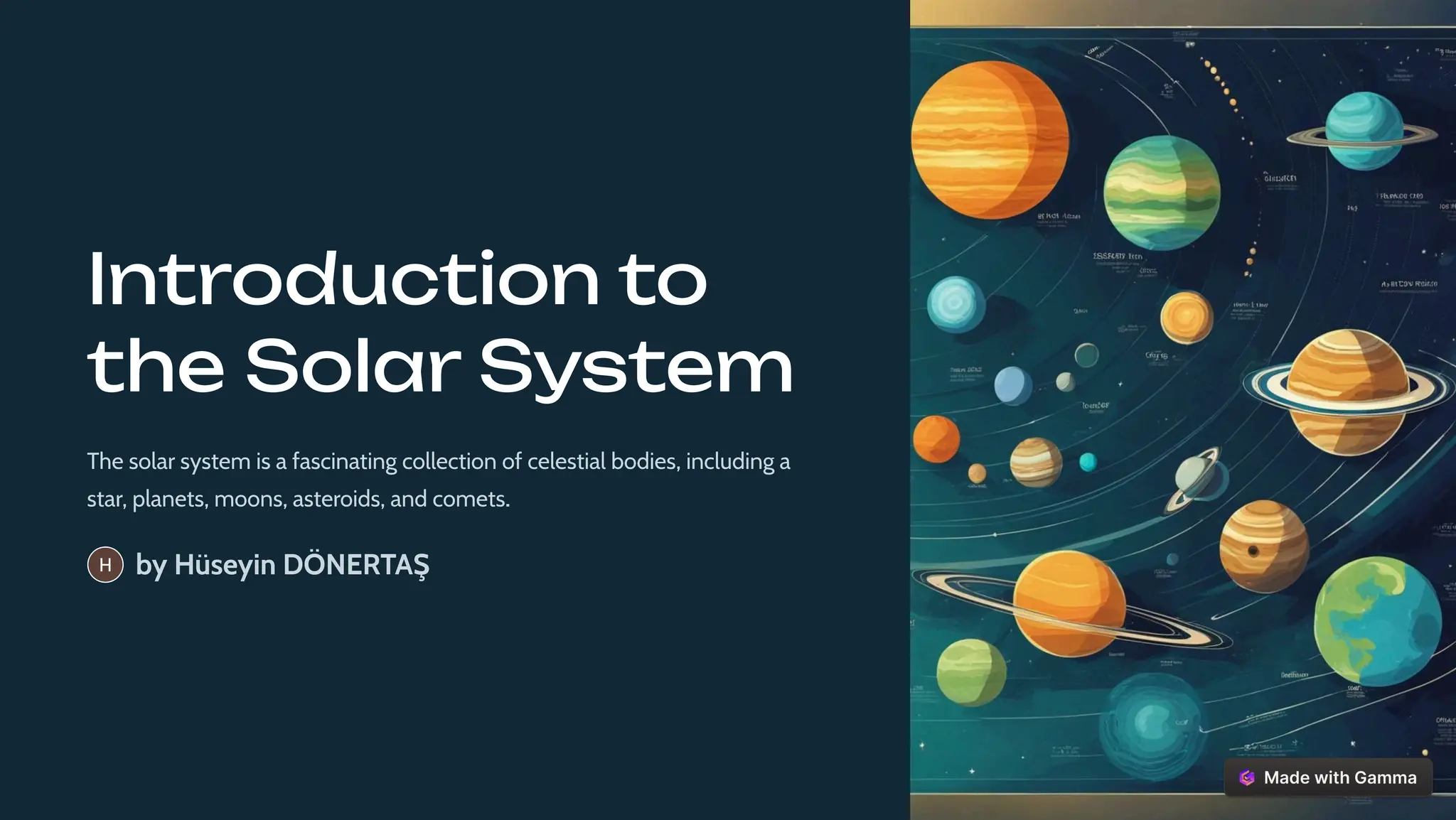
The solar system is a fascinating collection of celestial bodies, including a
star, planets, moons, asteroids, and comets.
by Hüseyin DÖNERTAŞ
The Sun: Center of the Solar
System
Solar Flares
The sun emits powerful bursts
of energy called solar flares,
which can impact space
weather and communication
systems on Earth.
Sunspots
Dark spots on the sun's surface,
sunspots are cooler regions
caused by magnetic activity.
Solar Wind
The sun continuously releases a
stream of charged particles
known as solar wind, which
influences the entire solar
system.
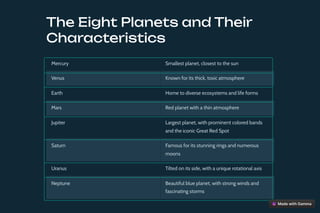
The Eight Planets and Their
Characteristics
Mercury Smallest planet, closest to the sun
Venus Known for its thick, toxic atmosphere
Earth Home to diverse ecosystems and life forms
Mars Red planet with a thin atmosphere
Jupiter Largest planet, with prominent colored bands
and the iconic Great Red Spot
Saturn Famous for its stunning rings and numerous
moons
Uranus Tilted on its side, with a unique rotational axis
Neptune Beautiful blue planet, with strong winds and
fascinating storms
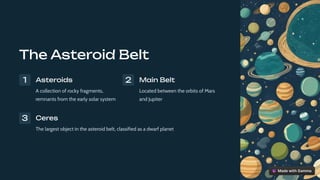
The Asteroid Belt
1 Asteroids
A collection of rocky fragments,
remnants from the early solar system
2 Main Belt
Located between the orbits of Mars
and Jupiter
3 Ceres
The largest object in the asteroid belt, classified as a dwarf planet
Kuiper Belt and Oort Cloud
Kuiper Belt
Home to icy bodies including Pluto and other
dwarf planets
Oort Cloud
Source of long-period comets, located at the
outer reaches of the solar system
Moons of the Solar System
Natural Satellites
Acting as companions to planets,
moons exhibit an incredible
diversity of sizes and surface
features.
Geological
Activity
Many moons showcase active
geological processes such as
volcanism, tectonics, and
cryovolcanism.
Potential for Life
Some moons may harbor
subsurface oceans, raising
questions about the possibility of
extraterrestrial life.
Comets and Meteoroids
6K
Comets
Known for their beautiful tails, composed of dust
and gas released as they approach the sun
50
Meteoroids
Small rocky or metallic objects that travel through
space, with some becoming meteors upon entering
a planet's atmosphere
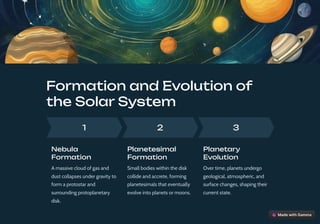
Formation and Evolution of
the Solar System
1
Nebula
Formation
A massive cloud of gas and
dust collapses under gravity to
form a protostar and
surrounding protoplanetary
disk.
2
Planetesimal
Formation
Small bodies within the disk
collide and accrete, forming
planetesimals that eventually
evolve into planets or moons.
3
Planetary
Evolution
Over time, planets undergo
geological, atmospheric, and
surface changes, shaping their
current state.
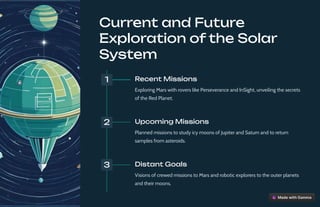
Current and Future
Exploration of the Solar
System
1 Recent Missions
Exploring Mars with rovers like Perseverance and InSight, unveiling the secrets
of the Red Planet.
2 Upcoming Missions
Planned missions to study icy moons of Jupiter and Saturn and to return
samples from asteroids.
3 Distant Goals
Visions of crewed missions to Mars and robotic explorers to the outer planets
and their moons.

. General information about solar system.

  • 1.
    Introduction to the SolarSystem The solar system is a fascinating collection of celestial bodies, including a star, planets, moons, asteroids, and comets. by Hüseyin DÖNERTAŞ
  • 2.
    The Sun: Centerof the Solar System Solar Flares The sun emits powerful bursts of energy called solar flares, which can impact space weather and communication systems on Earth. Sunspots Dark spots on the sun's surface, sunspots are cooler regions caused by magnetic activity. Solar Wind The sun continuously releases a stream of charged particles known as solar wind, which influences the entire solar system.
  • 3.
    The Eight Planetsand Their Characteristics Mercury Smallest planet, closest to the sun Venus Known for its thick, toxic atmosphere Earth Home to diverse ecosystems and life forms Mars Red planet with a thin atmosphere Jupiter Largest planet, with prominent colored bands and the iconic Great Red Spot Saturn Famous for its stunning rings and numerous moons Uranus Tilted on its side, with a unique rotational axis Neptune Beautiful blue planet, with strong winds and fascinating storms
  • 4.
    The Asteroid Belt 1Asteroids A collection of rocky fragments, remnants from the early solar system 2 Main Belt Located between the orbits of Mars and Jupiter 3 Ceres The largest object in the asteroid belt, classified as a dwarf planet
  • 5.
    Kuiper Belt andOort Cloud Kuiper Belt Home to icy bodies including Pluto and other dwarf planets Oort Cloud Source of long-period comets, located at the outer reaches of the solar system
  • 6.
    Moons of theSolar System Natural Satellites Acting as companions to planets, moons exhibit an incredible diversity of sizes and surface features. Geological Activity Many moons showcase active geological processes such as volcanism, tectonics, and cryovolcanism. Potential for Life Some moons may harbor subsurface oceans, raising questions about the possibility of extraterrestrial life.
  • 7.
    Comets and Meteoroids 6K Comets Knownfor their beautiful tails, composed of dust and gas released as they approach the sun 50 Meteoroids Small rocky or metallic objects that travel through space, with some becoming meteors upon entering a planet's atmosphere
  • 8.
    Formation and Evolutionof the Solar System 1 Nebula Formation A massive cloud of gas and dust collapses under gravity to form a protostar and surrounding protoplanetary disk. 2 Planetesimal Formation Small bodies within the disk collide and accrete, forming planetesimals that eventually evolve into planets or moons. 3 Planetary Evolution Over time, planets undergo geological, atmospheric, and surface changes, shaping their current state.
  • 9.
    Current and Future Explorationof the Solar System 1 Recent Missions Exploring Mars with rovers like Perseverance and InSight, unveiling the secrets of the Red Planet. 2 Upcoming Missions Planned missions to study icy moons of Jupiter and Saturn and to return samples from asteroids. 3 Distant Goals Visions of crewed missions to Mars and robotic explorers to the outer planets and their moons.