General Guide to Determining
PHIVOLCS
EARTHQUAKE
INTENSITY
JIMDANDY S. LUCINE
Project Development Officer II (DRRM)
jimdandy.lucine@deped.gov.ph
Note to the audience/reader
• Most of the contents in the slides are copied from the webinar
PHIVOLCS Earthquake Intensity Scale conducted by DOST PHIVOLCS.
The resource speaker is Joan Salcedo, Supervising Science Research
Specialist, Geologic Disaster Awareness and Preparedness Division.
• There were slides inserted by the author of this presentation to fit in
the DepEd context.

• No copyright infringement intended. This is just for wider awareness
as the author sees that earthquake intensity is as important as
earthquake magnitude.
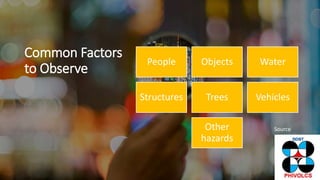
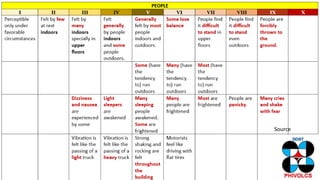
Common Factors
to Observe
People Objects Water
Structures Trees Vehicles
Other
hazards
Source
Source
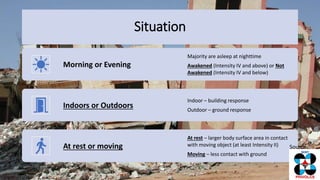
Situation
Morning or Evening
Majority are asleep at nighttime
Awakened (Intensity IV and above) or Not
Awakened (Intensity IV and below)
Indoors or Outdoors
Indoor – building response
Outdoor – ground response
At rest or moving
At rest – larger body surface area in contact
with moving object (at least Intensity II)
Moving – less contact with ground
Source
Source
This Photo by Unknown Author is licensed under CC BY
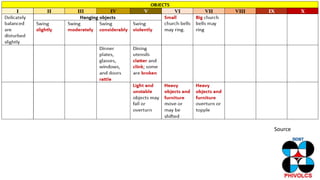
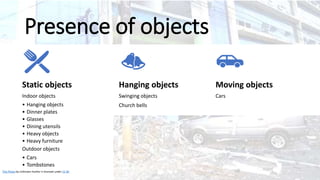
Presence of objects
Static objects
Indoor objects
• Hanging objects
• Dinner plates
• Glasses
• Dining utensils
• Heavy objects
• Heavy furniture
Outdoor objects
• Cars
• Tombstones
Hanging objects
Swinging objects
Church bells
Moving objects
Cars
Source
Source
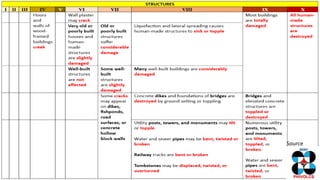
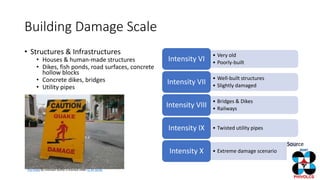
Building Damage Scale
• Structures & Infrastructures
• Houses & human-made structures
• Dikes, fish ponds, road surfaces, concrete
hollow blocks
• Concrete dikes, bridges
• Utility pipes
• Very old
• Poorly-built
Intensity VI
• Well-built structures
• Slightly damaged
Intensity VII
• Bridges & Dikes
• Railways
Intensity VIII
• Twisted utility pipes
Intensity IX
• Extreme damage scenario
Intensity X
Source
This Photo by Unknown Author is licensed under CC BY-SA-NC
Source
Source
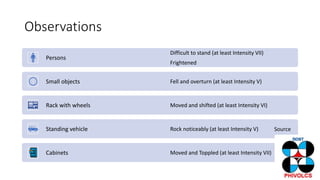
Observations
Persons
Difficult to stand (at least Intensity VII)
Frightened
Small objects Fell and overturn (at least Intensity V)
Rack with wheels Moved and shifted (at least Intensity VI)
Standing vehicle Rock noticeably (at least Intensity V)
Cabinets Moved and Toppled (at least Intensity VII)
Source
Source
Observations
Person
• Sleeping and awakened
(At least Intensity V)
• Frightened
Hanging objects
• Swing violently (at least
Intensity V)
Small objects
• Fell and overturn (at
least Intensity V)
Wheeled CPU &
chairs
• Moved and shifted (at
least Intensity V)
Furniture with
wheels
• Moved and shifted (at
least Intensity VI)
Television sets
• Toppled and fell (at
least VII)
Cabinets
• Toppled (at least
Intensity VII)
Source
When to evacuate?
At what
intensity?
Let us suspend the classes when it is at least Intensity V.
When to evacuate?
During or
after?
After the
shaking
After the
shaking!

General Guide to Determining Earthquake Intensity.pptx

  • 1.
    General Guide toDetermining PHIVOLCS EARTHQUAKE INTENSITY JIMDANDY S. LUCINE Project Development Officer II (DRRM) jimdandy.lucine@deped.gov.ph
  • 2.
    Note to theaudience/reader • Most of the contents in the slides are copied from the webinar PHIVOLCS Earthquake Intensity Scale conducted by DOST PHIVOLCS. The resource speaker is Joan Salcedo, Supervising Science Research Specialist, Geologic Disaster Awareness and Preparedness Division. • There were slides inserted by the author of this presentation to fit in the DepEd context. • No copyright infringement intended. This is just for wider awareness as the author sees that earthquake intensity is as important as earthquake magnitude.
  • 3.
    Common Factors to Observe PeopleObjects Water Structures Trees Vehicles Other hazards Source
  • 4.
  • 5.
    Situation Morning or Evening Majorityare asleep at nighttime Awakened (Intensity IV and above) or Not Awakened (Intensity IV and below) Indoors or Outdoors Indoor – building response Outdoor – ground response At rest or moving At rest – larger body surface area in contact with moving object (at least Intensity II) Moving – less contact with ground Source
  • 6.
  • 7.
    This Photo byUnknown Author is licensed under CC BY Presence of objects Static objects Indoor objects • Hanging objects • Dinner plates • Glasses • Dining utensils • Heavy objects • Heavy furniture Outdoor objects • Cars • Tombstones Hanging objects Swinging objects Church bells Moving objects Cars Source
  • 8.
  • 9.
    Building Damage Scale •Structures & Infrastructures • Houses & human-made structures • Dikes, fish ponds, road surfaces, concrete hollow blocks • Concrete dikes, bridges • Utility pipes • Very old • Poorly-built Intensity VI • Well-built structures • Slightly damaged Intensity VII • Bridges & Dikes • Railways Intensity VIII • Twisted utility pipes Intensity IX • Extreme damage scenario Intensity X Source This Photo by Unknown Author is licensed under CC BY-SA-NC
  • 10.
  • 12.
  • 13.
    Observations Persons Difficult to stand(at least Intensity VII) Frightened Small objects Fell and overturn (at least Intensity V) Rack with wheels Moved and shifted (at least Intensity VI) Standing vehicle Rock noticeably (at least Intensity V) Cabinets Moved and Toppled (at least Intensity VII) Source
  • 14.
  • 15.
    Observations Person • Sleeping andawakened (At least Intensity V) • Frightened Hanging objects • Swing violently (at least Intensity V) Small objects • Fell and overturn (at least Intensity V) Wheeled CPU & chairs • Moved and shifted (at least Intensity V) Furniture with wheels • Moved and shifted (at least Intensity VI) Television sets • Toppled and fell (at least VII) Cabinets • Toppled (at least Intensity VII) Source
  • 16.
    When to evacuate? Atwhat intensity?
  • 18.
    Let us suspendthe classes when it is at least Intensity V.
  • 19.
  • 20.