OUTLINES
After this lessonyou should be able to :
• Provide an introduction to the basic quantities and idealizations of mechanics.
• Give a statement of Newton’s Laws of Motion and Gravitation.
• Review the principles for applying the SI system of units.
• Examine the standard procedures for performing numerical calculations.
• Present a general guide for solving problems.
4.
MECHANICS
• Mechanics isa branch of the physical sciences that is concerned with the state of
rest or motion of bodies that are subjected to the action of forces.
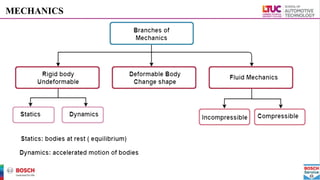
• In general, this subject can be subdivided into three branches:
• rigid-body mechanics
• deformable-body mechanics
• fluid mechanics.
• In this course we will study rigid-body mechanics since it is a basic requirement
for the study of the mechanics of deformable bodies and the mechanics of fluids.
5.
RIGID-BODY MECHANICS
• Rigid-bodymechanics is divided into two areas: statics and dynamics.
• Statics deals with the equilibrium of bodies, that is, those that are either at rest or
move with a constant velocity
• Dynamics is concerned with the accelerated motion of bodies. We can consider
statics as a special case of dynamics, in which the acceleration is zero
FUNDAMENTAL CONCEPTS
Basic Quantities:
•Length: Length is used to locate the position of a point in space and thereby describe the
physical system.
• Time: Time is conceived as a succession of events. Although the principles of statics
are time independent, this quantity plays an important role in the study of dynamics.
• Mass: Mass is a measure of a quantity of matter.
• Force: In general, force is considered as a “push” or “pull” exerted by one body on
another.
• Idealizations: Models or idealizations are used in mechanics in order to simplify application
of the theory. Here we will consider three important idealizations.
8.
FUNDAMENTAL CONCEPTS
Idealizations:
• Particle:
Aparticle has a mass, but a size that can be neglected. For example, the size of the earth is
insignificant compared to the size of its orbit, and therefore the earth can be modeled as a
particle when studying its orbital motion. When a body is idealized as a particle, the
principles of mechanics reduce to a rather simplified form since the geometry of the body
will not be involved in the analysis of the problem.
9.
FUNDAMENTAL CONCEPTS
Idealizations:
• RigidBody:
A rigid body can be considered as a combination of a large number of particles in which
all the particles remain at a fixed distance from one another, both before and after
applying a load. This model is important because the body’s shape does not change when a
load is applied, and so we do not have to consider the type of material from which the
body is made. In most cases the actual deformations occurring in structures, machines,
mechanisms, and the like are relatively small, and the rigid-body assumption is suitable for
analysis.
10.
FUNDAMENTAL CONCEPTS
Idealizations:
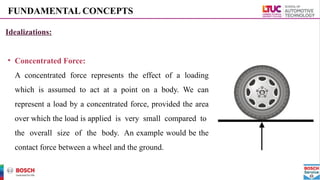
• ConcentratedForce:
A concentrated force represents the effect of a loading
which is assumed to act at a point on a body. We can
represent a load by a concentrated force, provided the area
over which the load is applied is very small compared to
the overall size of the body. An example would be the
contact force between a wheel and the ground.
11.
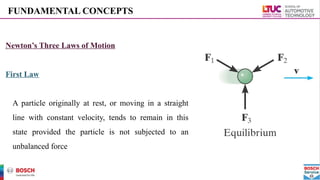
Newton’s Three Lawsof Motion
First Law
A particle originally at rest, or moving in a straight
line with constant velocity, tends to remain in this
state provided the particle is not subjected to an
unbalanced force
FUNDAMENTAL CONCEPTS
12.
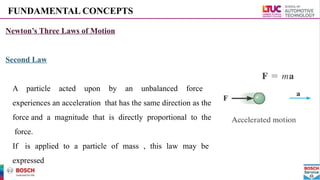
Newton’s Three Lawsof Motion
Second Law
A particle acted upon by an unbalanced force
experiences an acceleration that has the same direction as the
force and a magnitude that is directly proportional to the
force.
If is applied to a particle of mass , this law may be
expressed
FUNDAMENTAL CONCEPTS
13.
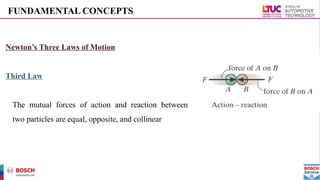
Newton’s Three Lawsof Motion
Third Law
The mutual forces of action and reaction between
two particles are equal, opposite, and collinear
FUNDAMENTAL CONCEPTS
14.
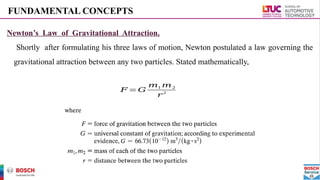
Newton’s Law ofGravitational Attraction.
Shortly after formulating his three laws of motion, Newton postulated a law governing the
gravitational attraction between any two particles. Stated mathematically,
FUNDAMENTAL CONCEPTS
𝐹 =𝐺
𝑚1 𝑚2
𝑟2
15.
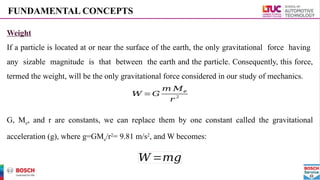
Weight
If a particleis located at or near the surface of the earth, the only gravitational force having
any sizable magnitude is that between the earth and the particle. Consequently, this force,
termed the weight, will be the only gravitational force considered in our study of mechanics.
G, Me, and r are constants, we can replace them by one constant called the gravitational
acceleration (g), where g=GMe/r2
= 9.81 m/s2
, and W becomes:
FUNDAMENTAL CONCEPTS
𝑊 =𝐺
𝑚 𝑀𝑒
𝑟
2
𝑊 =𝑚𝑔
16.
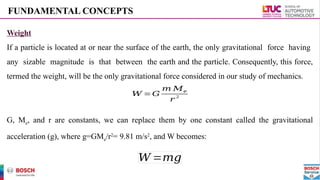
Weight
If a particleis located at or near the surface of the earth, the only gravitational force having
any sizable magnitude is that between the earth and the particle. Consequently, this force,
termed the weight, will be the only gravitational force considered in our study of mechanics.
G, Me, and r are constants, we can replace them by one constant called the gravitational
acceleration (g), where g=GMe/r2
= 9.81 m/s2
, and W becomes:
FUNDAMENTAL CONCEPTS
𝑊 =𝐺
𝑚 𝑀𝑒
𝑟
2
𝑊 =𝑚𝑔