G EN D ER A N D ED UCATIO N
Dr. Nisanth.P.M, Assistant Professor, Dept of Education, RGU
U N IT III
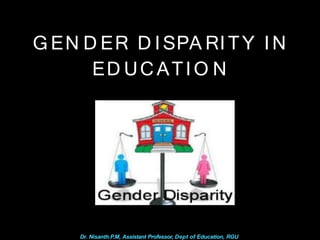
G EN D ER D ISPA RITY IN
ED UCATIO N
Dr. Nisanth.P.M, Assistant Professor, Dept of Education, RGU
PSYCH O A N A LYTICA L TH EO RY
SO CIA L LEA RN IN G TH EO RY
Dr. Nisanth.P.M, Assistant Professor, Dept of Education, RGU
CO G N ITIVE D EVELO PM EN T TH EO RY
PSYCH O A N A LYTICA L TH EO RY
Sigmund Freud
Dr. Nisanth.P.M, Assistant Professor, Dept of Education, RGU
PSYCH O A N A LYTICA L TH EO RY
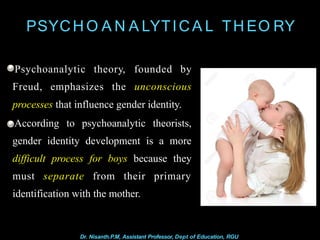
Freud, emphasizes the
Psychoanalytic theory, founded by
unconscious
processes that influence gender identity.
According to psychoanalytic theorists,
gender identity development is a more
difficult process for boys because they
must separate from their primary
identification with the mother.
Dr. Nisanth.P.M, Assistant Professor, Dept of Education, RGU
PSYCH O A N A LYTICA L TH EO RY
Boys learn to define maleness as the negation of the feminine
Dr. Nisanth.P.M, Assistant Professor, Dept of Education, RGU
PSYCH O A N A LYTICA L TH EO RY
Dr. Nisanth.P.M, Assistant Professor, Dept of Education, RGU
The psychoanalytic approach was founded by Sigmund Freud, but
its application to gender socialization was more fully outlined in the
late 1970s by Nancy Chodorow.
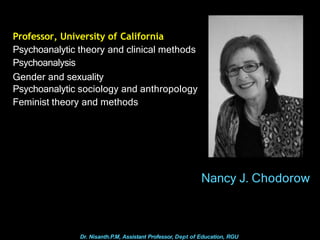
Nancy J. Chodorow
Professor, University of California
Psychoanalytic theory and clinical methods
Psychoanalysis
Dr. Nisanth.P.M, Assistant Professor, Dept of Education, RGU
Gender and sexuality
Psychoanalytic sociology and anthropology
Feminist theory and methods
PSYCH O A N A LYTICA L TH EO RY
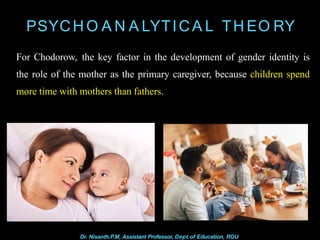
For Chodorow, the key factor in the development of gender identity is
the role of the mother as the primary caregiver, because children spend
more time with mothers than fathers.
Dr. Nisanth.P.M, Assistant Professor, Dept of Education, RGU
PSYCH O A N A LYTICA L TH EO RY
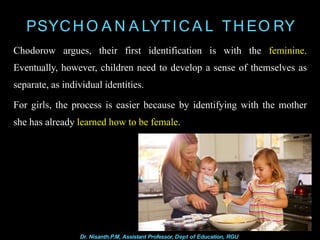
Chodorow argues, their first identification is with the feminine.
Eventually, however, children need to develop a sense of themselves as
separate, as individual identities.
For girls, the process is easier because by identifying with the mother
she has already learned how to be female.
Dr. Nisanth.P.M, Assistant Professor, Dept of Education, RGU
PSYCH O A N A LYTICA L TH EO RY
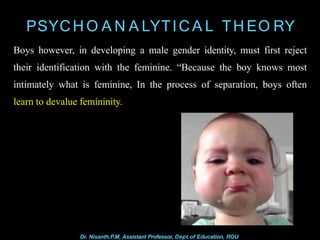
Boys however, in developing a male gender identity, must first reject
their identification with the feminine. “Because the boy knows most
intimately what is feminine, In the process of separation, boys often
learn to devalue femininity.
Dr. Nisanth.P.M, Assistant Professor, Dept of Education, RGU
PSYCH O A N A LYTICA L TH EO RY
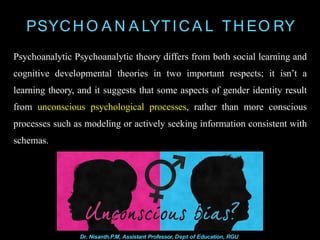
Psychoanalytic Psychoanalytic theory differs from both social learning and
cognitive developmental theories in two important respects; it isn’t a
learning theory, and it suggests that some aspects of gender identity result
from unconscious psychological processes, rather than more conscious
processes such as modeling or actively seeking information consistent with
schemas.
Dr. Nisanth.P.M, Assistant Professor, Dept of Education, RGU
PSYCH O A N A LYTICA L TH EO RY
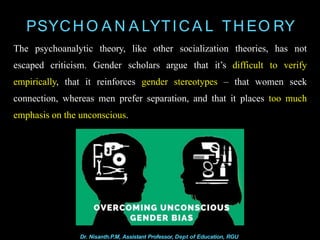
The psychoanalytic theory, like other socialization theories, has not
escaped criticism. Gender scholars argue that it’s difficult to verify
empirically, that it reinforces gender stereotypes – that women seek
connection, whereas men prefer separation, and that it places too much
emphasis on the unconscious.
Dr. Nisanth.P.M, Assistant Professor, Dept of Education, RGU
SO CIA L LEA RN IN G TH EO RY
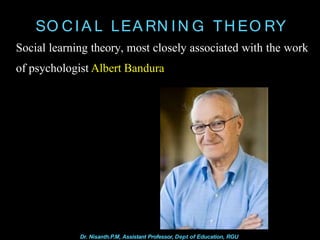
Social learning theory, most closely associated with the work
of psychologist Albert Bandura
Dr. Nisanth.P.M, Assistant Professor, Dept of Education, RGU
SO CIA L LEA RN IN G TH EO RY
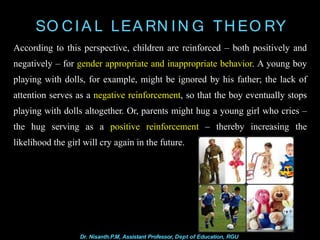
According to this perspective, children are reinforced – both positively and
negatively – for gender appropriate and inappropriate behavior. A young boy
playing with dolls, for example, might be ignored by his father; the lack of
attention serves as a negative reinforcement, so that the boy eventually stops
playing with dolls altogether. Or, parents might hug a young girl who cries –
the hug serving as a positive reinforcement – thereby increasing the
likelihood the girl will cry again in the future.
Dr. Nisanth.P.M, Assistant Professor, Dept of Education, RGU
SO CIA L LEA RN IN G TH EO RY
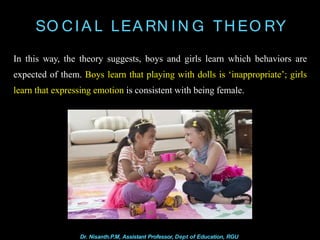
In this way, the theory suggests, boys and girls learn which behaviors are
expected of them. Boys learn that playing with dolls is ‘inappropriate’; girls
learn that expressing emotion is consistent with being female.
Dr. Nisanth.P.M, Assistant Professor, Dept of Education, RGU
SO CIA L LEA RN IN G TH EO RY
Social learning theory also suggests that children learn by observing and
imitating the behavior of same-sex adults. A young girl learns what it means to
be female by observing her mother, whereas a boy learns what it means to be
male by observing his father.
Dr. Nisanth.P.M, Assistant Professor, Dept of Education, RGU
CO G N ITIVE D EVELO PM EN T TH EO RY
Dr. Nisanth.P.M, Assistant Professor, Dept of Education, RGU
Kohlberg’s cognitive developmental theory
Gender schema theory
KO HLB E RG ’S C O G N ITIVE
D E VE LO P M E N TA L THE O RY
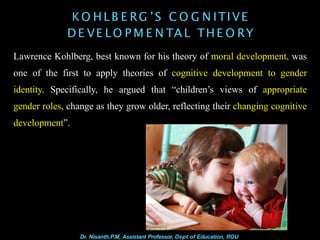
Lawrence Kohlberg, best known for his theory of moral development, was
one of the first to apply theories of cognitive development to gender
identity. Specifically, he argued that “children’s views of appropriate
gender roles, change as they grow older, reflecting their changing cognitive
development”.
Dr. Nisanth.P.M, Assistant Professor, Dept of Education, RGU
K O H L B E R G ’ S C O G N I T I V E D E V E L O P M E N TAL T H E O R Y
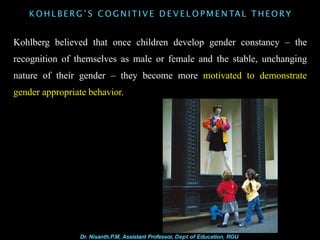
Kohlberg believed that once children develop gender constancy – the
recognition of themselves as male or female and the stable, unchanging
nature of their gender – they become more motivated to demonstrate
gender appropriate behavior.
Dr. Nisanth.P.M, Assistant Professor, Dept of Education, RGU
K O H L B E R G ’ S C O G N I T I V E D E V E L O P M E N TAL T H E O RY
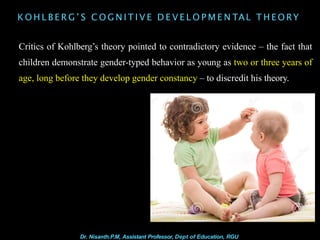
Critics of Kohlberg’s theory pointed to contradictory evidence – the fact that
children demonstrate gender-typed behavior as young as two or three years of
age, long before they develop gender constancy – to discredit his theory.
Dr. Nisanth.P.M, Assistant Professor, Dept of Education, RGU
G E N D E R S C HE M A THE O RY
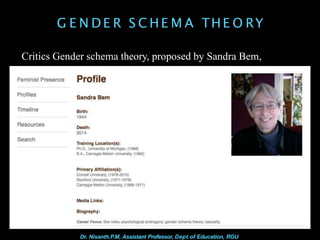
Critics Gender schema theory, proposed by Sandra Bem,
Dr. Nisanth.P.M, Assistant Professor, Dept of Education, RGU
G E N D E R S C HE M A THE O RY
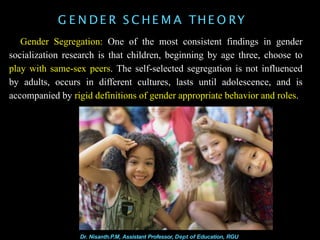
Gender Segregation: One of the most consistent findings in gender
socialization research is that children, beginning by age three, choose to
play with same-sex peers. The self-selected segregation is not influenced
by adults, occurs in different cultures, lasts until adolescence, and is
accompanied by rigid definitions of gender appropriate behavior and roles.
Dr. Nisanth.P.M, Assistant Professor, Dept of Education, RGU
G E N D E R S C HE M A THE O RY
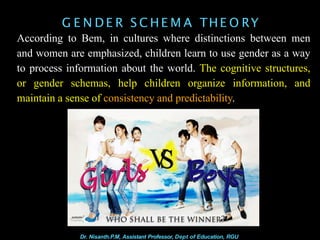
According to Bem, in cultures where distinctions between men
and women are emphasized, children learn to use gender as a way
to process information about the world. The cognitive structures,
or gender schemas, help children organize information, and
maintain a sense of consistency and predictability.
Dr. Nisanth.P.M, Assistant Professor, Dept of Education, RGU
G E N D E R S C HE M A THE O RY
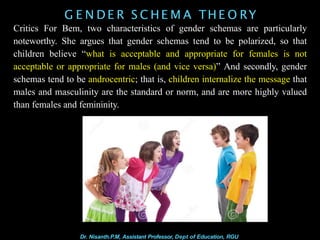
Critics For Bem, two characteristics of gender schemas are particularly
noteworthy. She argues that gender schemas tend to be polarized, so that
children believe “what is acceptable and appropriate for females is not
acceptable or appropriate for males (and vice versa)” And secondly, gender
schemas tend to be androcentric; that is, children internalize the message that
males and masculinity are the standard or norm, and are more highly valued
than females and femininity.
Dr. Nisanth.P.M, Assistant Professor, Dept of Education, RGU
G EN D ER D ISPA RITY IN
ED UCATIO N
Dr. Nisanth.P.M, Assistant Professor, Dept of Education, RGU
IN F RA S TRU C TU RE
School should provide equal infrastructural facilities to all the
students without any discrimination based on the gender. Special
attention must be given for students with special needs.
Dr. Nisanth.P.M, Assistant Professor, Dept of Education, RGU
A D M IS S IO N TO A LL G E N D E RS
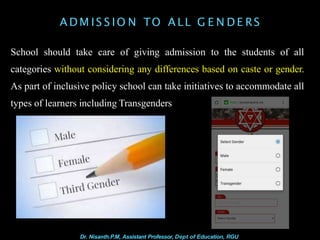
School should take care of giving admission to the students of all
categories without considering any differences based on caste or gender.
As part of inclusive policy school can take initiatives to accommodate all
types of learners including Transgenders
Dr. Nisanth.P.M, Assistant Professor, Dept of Education, RGU
P RO VID IN G TE X T B O O K
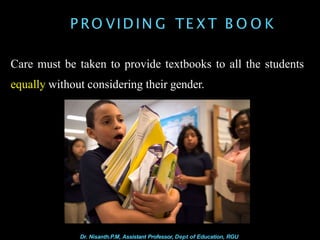
Care must be taken to provide textbooks to all the students
equally without considering their gender.
Dr. Nisanth.P.M, Assistant Professor, Dept of Education, RGU
S C HO LA RS HIP S
Scholarships must be provided to the needful without
considering their gender, caste, or their status in the society.
Dr. Nisanth.P.M, Assistant Professor, Dept of Education, RGU
S P O RTS E Q U IP M E N TS
No discrimination in distributing / making available of the sports
equipments to the students. Sports equipments must be provided to all
the students based on their taste and interest but not based on gender
Dr. Nisanth.P.M, Assistant Professor, Dept of Education, RGU
S C HO O L P RO G RA M M E S
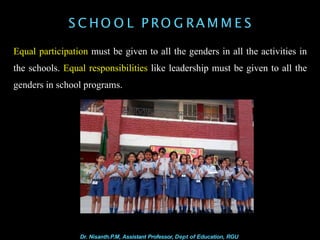
Equal participation must be given to all the genders in all the activities in
the schools. Equal responsibilities like leadership must be given to all the
genders in school programs.
Dr. Nisanth.P.M, Assistant Professor, Dept of Education, RGU
P RO M O TE E D U C ATIO N F O R G IRLS IN
RU RA L A N D RE M O TE A RE A S
In most of the remote and rural parts of our nation, there is a huge
restriction for girl children to go to school. This must be taken up as
serious issue and steps must be taken to make them accessible to
education.
Dr. Nisanth.P.M, Assistant Professor, Dept of Education, RGU
M IX E D S C HO O LS
Mixed schools must be promoted to develop a healthy
relationship between all the genders. This will not only ensure
gender equality but will also helpful in developing respect for
the other gender in future.
Dr. Nisanth.P.M, Assistant Professor, Dept of Education, RGU
A W A RE N E S S P RO G RA M S
Schools can arrange awareness programs for Teachers,
students as well as for the parents on gender equality
and also for the need of educating girls.
Dr. Nisanth.P.M, Assistant Professor, Dept of Education, RGU

Gender-Disparity-in-Education- pptx

  • 1.
    G EN DER A N D ED UCATIO N Dr. Nisanth.P.M, Assistant Professor, Dept of Education, RGU U N IT III
  • 2.
    G EN DER D ISPA RITY IN ED UCATIO N Dr. Nisanth.P.M, Assistant Professor, Dept of Education, RGU
  • 3.
    PSYCH O AN A LYTICA L TH EO RY SO CIA L LEA RN IN G TH EO RY Dr. Nisanth.P.M, Assistant Professor, Dept of Education, RGU CO G N ITIVE D EVELO PM EN T TH EO RY
  • 4.
    PSYCH O AN A LYTICA L TH EO RY Sigmund Freud Dr. Nisanth.P.M, Assistant Professor, Dept of Education, RGU
  • 5.
    PSYCH O AN A LYTICA L TH EO RY Freud, emphasizes the Psychoanalytic theory, founded by unconscious processes that influence gender identity. According to psychoanalytic theorists, gender identity development is a more difficult process for boys because they must separate from their primary identification with the mother. Dr. Nisanth.P.M, Assistant Professor, Dept of Education, RGU
  • 6.
    PSYCH O AN A LYTICA L TH EO RY Boys learn to define maleness as the negation of the feminine Dr. Nisanth.P.M, Assistant Professor, Dept of Education, RGU
  • 7.
    PSYCH O AN A LYTICA L TH EO RY Dr. Nisanth.P.M, Assistant Professor, Dept of Education, RGU The psychoanalytic approach was founded by Sigmund Freud, but its application to gender socialization was more fully outlined in the late 1970s by Nancy Chodorow.
  • 8.
    Nancy J. Chodorow Professor,University of California Psychoanalytic theory and clinical methods Psychoanalysis Dr. Nisanth.P.M, Assistant Professor, Dept of Education, RGU Gender and sexuality Psychoanalytic sociology and anthropology Feminist theory and methods
  • 9.
    PSYCH O AN A LYTICA L TH EO RY For Chodorow, the key factor in the development of gender identity is the role of the mother as the primary caregiver, because children spend more time with mothers than fathers. Dr. Nisanth.P.M, Assistant Professor, Dept of Education, RGU
  • 10.
    PSYCH O AN A LYTICA L TH EO RY Chodorow argues, their first identification is with the feminine. Eventually, however, children need to develop a sense of themselves as separate, as individual identities. For girls, the process is easier because by identifying with the mother she has already learned how to be female. Dr. Nisanth.P.M, Assistant Professor, Dept of Education, RGU
  • 11.
    PSYCH O AN A LYTICA L TH EO RY Boys however, in developing a male gender identity, must first reject their identification with the feminine. “Because the boy knows most intimately what is feminine, In the process of separation, boys often learn to devalue femininity. Dr. Nisanth.P.M, Assistant Professor, Dept of Education, RGU
  • 12.
    PSYCH O AN A LYTICA L TH EO RY Psychoanalytic Psychoanalytic theory differs from both social learning and cognitive developmental theories in two important respects; it isn’t a learning theory, and it suggests that some aspects of gender identity result from unconscious psychological processes, rather than more conscious processes such as modeling or actively seeking information consistent with schemas. Dr. Nisanth.P.M, Assistant Professor, Dept of Education, RGU
  • 13.
    PSYCH O AN A LYTICA L TH EO RY The psychoanalytic theory, like other socialization theories, has not escaped criticism. Gender scholars argue that it’s difficult to verify empirically, that it reinforces gender stereotypes – that women seek connection, whereas men prefer separation, and that it places too much emphasis on the unconscious. Dr. Nisanth.P.M, Assistant Professor, Dept of Education, RGU
  • 14.
    SO CIA LLEA RN IN G TH EO RY Social learning theory, most closely associated with the work of psychologist Albert Bandura Dr. Nisanth.P.M, Assistant Professor, Dept of Education, RGU
  • 15.
    SO CIA LLEA RN IN G TH EO RY According to this perspective, children are reinforced – both positively and negatively – for gender appropriate and inappropriate behavior. A young boy playing with dolls, for example, might be ignored by his father; the lack of attention serves as a negative reinforcement, so that the boy eventually stops playing with dolls altogether. Or, parents might hug a young girl who cries – the hug serving as a positive reinforcement – thereby increasing the likelihood the girl will cry again in the future. Dr. Nisanth.P.M, Assistant Professor, Dept of Education, RGU
  • 16.
    SO CIA LLEA RN IN G TH EO RY In this way, the theory suggests, boys and girls learn which behaviors are expected of them. Boys learn that playing with dolls is ‘inappropriate’; girls learn that expressing emotion is consistent with being female. Dr. Nisanth.P.M, Assistant Professor, Dept of Education, RGU
  • 17.
    SO CIA LLEA RN IN G TH EO RY Social learning theory also suggests that children learn by observing and imitating the behavior of same-sex adults. A young girl learns what it means to be female by observing her mother, whereas a boy learns what it means to be male by observing his father. Dr. Nisanth.P.M, Assistant Professor, Dept of Education, RGU
  • 18.
    CO G NITIVE D EVELO PM EN T TH EO RY Dr. Nisanth.P.M, Assistant Professor, Dept of Education, RGU Kohlberg’s cognitive developmental theory Gender schema theory
  • 19.
    KO HLB ERG ’S C O G N ITIVE D E VE LO P M E N TA L THE O RY Lawrence Kohlberg, best known for his theory of moral development, was one of the first to apply theories of cognitive development to gender identity. Specifically, he argued that “children’s views of appropriate gender roles, change as they grow older, reflecting their changing cognitive development”. Dr. Nisanth.P.M, Assistant Professor, Dept of Education, RGU
  • 20.
    K O HL B E R G ’ S C O G N I T I V E D E V E L O P M E N TAL T H E O R Y Kohlberg believed that once children develop gender constancy – the recognition of themselves as male or female and the stable, unchanging nature of their gender – they become more motivated to demonstrate gender appropriate behavior. Dr. Nisanth.P.M, Assistant Professor, Dept of Education, RGU
  • 21.
    K O HL B E R G ’ S C O G N I T I V E D E V E L O P M E N TAL T H E O RY Critics of Kohlberg’s theory pointed to contradictory evidence – the fact that children demonstrate gender-typed behavior as young as two or three years of age, long before they develop gender constancy – to discredit his theory. Dr. Nisanth.P.M, Assistant Professor, Dept of Education, RGU
  • 22.
    G E ND E R S C HE M A THE O RY Critics Gender schema theory, proposed by Sandra Bem, Dr. Nisanth.P.M, Assistant Professor, Dept of Education, RGU
  • 23.
    G E ND E R S C HE M A THE O RY Gender Segregation: One of the most consistent findings in gender socialization research is that children, beginning by age three, choose to play with same-sex peers. The self-selected segregation is not influenced by adults, occurs in different cultures, lasts until adolescence, and is accompanied by rigid definitions of gender appropriate behavior and roles. Dr. Nisanth.P.M, Assistant Professor, Dept of Education, RGU
  • 24.
    G E ND E R S C HE M A THE O RY According to Bem, in cultures where distinctions between men and women are emphasized, children learn to use gender as a way to process information about the world. The cognitive structures, or gender schemas, help children organize information, and maintain a sense of consistency and predictability. Dr. Nisanth.P.M, Assistant Professor, Dept of Education, RGU
  • 25.
    G E ND E R S C HE M A THE O RY Critics For Bem, two characteristics of gender schemas are particularly noteworthy. She argues that gender schemas tend to be polarized, so that children believe “what is acceptable and appropriate for females is not acceptable or appropriate for males (and vice versa)” And secondly, gender schemas tend to be androcentric; that is, children internalize the message that males and masculinity are the standard or norm, and are more highly valued than females and femininity. Dr. Nisanth.P.M, Assistant Professor, Dept of Education, RGU
  • 26.
    G EN DER D ISPA RITY IN ED UCATIO N Dr. Nisanth.P.M, Assistant Professor, Dept of Education, RGU
  • 27.
    IN F RAS TRU C TU RE School should provide equal infrastructural facilities to all the students without any discrimination based on the gender. Special attention must be given for students with special needs. Dr. Nisanth.P.M, Assistant Professor, Dept of Education, RGU
  • 28.
    A D MIS S IO N TO A LL G E N D E RS School should take care of giving admission to the students of all categories without considering any differences based on caste or gender. As part of inclusive policy school can take initiatives to accommodate all types of learners including Transgenders Dr. Nisanth.P.M, Assistant Professor, Dept of Education, RGU
  • 29.
    P RO VIDIN G TE X T B O O K Care must be taken to provide textbooks to all the students equally without considering their gender. Dr. Nisanth.P.M, Assistant Professor, Dept of Education, RGU
  • 30.
    S C HOLA RS HIP S Scholarships must be provided to the needful without considering their gender, caste, or their status in the society. Dr. Nisanth.P.M, Assistant Professor, Dept of Education, RGU
  • 31.
    S P ORTS E Q U IP M E N TS No discrimination in distributing / making available of the sports equipments to the students. Sports equipments must be provided to all the students based on their taste and interest but not based on gender Dr. Nisanth.P.M, Assistant Professor, Dept of Education, RGU
  • 32.
    S C HOO L P RO G RA M M E S Equal participation must be given to all the genders in all the activities in the schools. Equal responsibilities like leadership must be given to all the genders in school programs. Dr. Nisanth.P.M, Assistant Professor, Dept of Education, RGU
  • 33.
    P RO MO TE E D U C ATIO N F O R G IRLS IN RU RA L A N D RE M O TE A RE A S In most of the remote and rural parts of our nation, there is a huge restriction for girl children to go to school. This must be taken up as serious issue and steps must be taken to make them accessible to education. Dr. Nisanth.P.M, Assistant Professor, Dept of Education, RGU
  • 34.
    M IX ED S C HO O LS Mixed schools must be promoted to develop a healthy relationship between all the genders. This will not only ensure gender equality but will also helpful in developing respect for the other gender in future. Dr. Nisanth.P.M, Assistant Professor, Dept of Education, RGU
  • 35.
    A W ARE N E S S P RO G RA M S Schools can arrange awareness programs for Teachers, students as well as for the parents on gender equality and also for the need of educating girls. Dr. Nisanth.P.M, Assistant Professor, Dept of Education, RGU