Gender Inequality in AdvertisingBy: Christel Amidon
Why I Chose This Topic		I have always been fascinated by the impact of advertising. I have researched and written other papers on different areas of this topic, however this time I wanted to use this opportunity to observe my peers. This project gave me a chance analyze data that I have collected from people of both genders and of all ages to see how advertising has affected their views.
BackgroundAnalyzed Heiko Motschenbacher’s article, Speaking the Gendered Body: The Performative Construction of Commercial femininities and masculinities via body-part vocabularyMotschenbacher discusses howAdvertisements use more than just imagery to send body messagesThese written advertisements are “clearly structured in accordance with dominant gender discourses that are strategically deployed to normatively construct female and male bodies” (Motschenbacher, 2009)
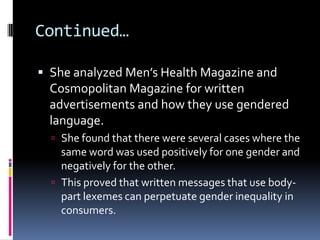
Continued…She analyzed Men’s Health Magazine and Cosmopolitan Magazinefor written advertisements and how they use gendered language.She found that there were several cases where the same word was used positively for one gender and negatively for the other.This proved that written messages that use body-part lexemes can perpetuate gender inequality in consumers.
Hypothesis:American Media has been the leading influence on gender inequality in American culture. These images are perpetuated by making the gender differences seem natural even though they are not naturally produced in society. These media outlets are slowing America’s progress toward gender equality.
Method	I created a survey that would allow the participants to fill in their answer so that they could make the connection with the first image that came to mind.I surveyed 10 people ages 17-55Six questions total4 multipart questions2 single part questionsQuestions were answered with Male/Female/Both
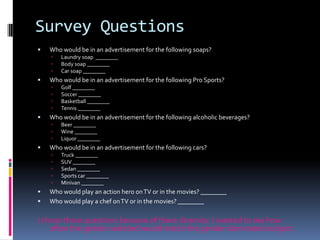
Survey QuestionsWho would be in an advertisement for the following soaps?Laundry soap  ________Body soap ________Car soap ________Who would be in an advertisement for the following Pro Sports?Golf ________Soccer ________Basketball ________Tennis ________Who would be in an advertisement for the following alcoholic beverages?Beer ________Wine ________Liquor ________Who would be in an advertisement for the following cars?Truck ________SUV ________Sedan ________Sports car ________Minivan ________Who would play an action hero on TV or in the movies? ________ Who would play a chef on TV or in the movies? ________I chose these questions because of there diversity. I wanted to see how often the gender selected would match the gender dominated subject.
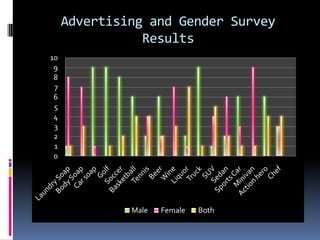
Advertising and Gender Survey Results
ResultsAnalyzing each group of questions shows how most participants chose the gender that fits within the stereotype.It created a spectrum; women on one side men on the other. This allowed some subjects to fall in the middle as both male and female.         Female------------------Both------------------Male     Minivan                           SUV                            Truck                                               Sedan                                            Sports carThis shows how influential images and vocabulary are in advertising.
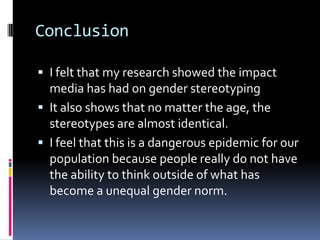
Advertising repeats gendered stereotypes so often that it has become a societal norm.ConclusionI felt that my research showed the impact media has had on gender stereotypingIt also shows that no matter the age, the stereotypes are almost identical. I feel that this is a dangerous epidemic for our population because people really do not have the ability to think outside of what has become a unequal gender norm.
Kimmel, M. (2008). The Gendered Society. New York: Oxford 	university Press Inc.Motschenbacher, H. (2009). Speaking the Gendered body; The PerformativeConstruction of Commercial Femininities 	and Masculinities via body-part Vocabulary. Camberage	University Press, 1-22. References

Gender inequality in advertising

  • 1.
    Gender Inequality inAdvertisingBy: Christel Amidon
  • 2.
    Why I ChoseThis Topic I have always been fascinated by the impact of advertising. I have researched and written other papers on different areas of this topic, however this time I wanted to use this opportunity to observe my peers. This project gave me a chance analyze data that I have collected from people of both genders and of all ages to see how advertising has affected their views.
  • 3.
    BackgroundAnalyzed Heiko Motschenbacher’sarticle, Speaking the Gendered Body: The Performative Construction of Commercial femininities and masculinities via body-part vocabularyMotschenbacher discusses howAdvertisements use more than just imagery to send body messagesThese written advertisements are “clearly structured in accordance with dominant gender discourses that are strategically deployed to normatively construct female and male bodies” (Motschenbacher, 2009)
  • 4.
    Continued…She analyzed Men’sHealth Magazine and Cosmopolitan Magazinefor written advertisements and how they use gendered language.She found that there were several cases where the same word was used positively for one gender and negatively for the other.This proved that written messages that use body-part lexemes can perpetuate gender inequality in consumers.
  • 5.
    Hypothesis:American Media hasbeen the leading influence on gender inequality in American culture. These images are perpetuated by making the gender differences seem natural even though they are not naturally produced in society. These media outlets are slowing America’s progress toward gender equality.
  • 6.
    Method I created asurvey that would allow the participants to fill in their answer so that they could make the connection with the first image that came to mind.I surveyed 10 people ages 17-55Six questions total4 multipart questions2 single part questionsQuestions were answered with Male/Female/Both
  • 7.
    Survey QuestionsWho wouldbe in an advertisement for the following soaps?Laundry soap ________Body soap ________Car soap ________Who would be in an advertisement for the following Pro Sports?Golf ________Soccer ________Basketball ________Tennis ________Who would be in an advertisement for the following alcoholic beverages?Beer ________Wine ________Liquor ________Who would be in an advertisement for the following cars?Truck ________SUV ________Sedan ________Sports car ________Minivan ________Who would play an action hero on TV or in the movies? ________ Who would play a chef on TV or in the movies? ________I chose these questions because of there diversity. I wanted to see how often the gender selected would match the gender dominated subject.
  • 8.
  • 9.
    ResultsAnalyzing each groupof questions shows how most participants chose the gender that fits within the stereotype.It created a spectrum; women on one side men on the other. This allowed some subjects to fall in the middle as both male and female. Female------------------Both------------------Male Minivan SUV Truck Sedan Sports carThis shows how influential images and vocabulary are in advertising.
  • 10.
    Advertising repeats genderedstereotypes so often that it has become a societal norm.ConclusionI felt that my research showed the impact media has had on gender stereotypingIt also shows that no matter the age, the stereotypes are almost identical. I feel that this is a dangerous epidemic for our population because people really do not have the ability to think outside of what has become a unequal gender norm.
  • 11.
    Kimmel, M. (2008).The Gendered Society. New York: Oxford university Press Inc.Motschenbacher, H. (2009). Speaking the Gendered body; The PerformativeConstruction of Commercial Femininities and Masculinities via body-part Vocabulary. Camberage University Press, 1-22. References

Editor's Notes

  • #7 I wanted the participants to have the opportunity to fill in their answer so that their answer would not be affected by a predetermined list.