Gel Electrophoresis
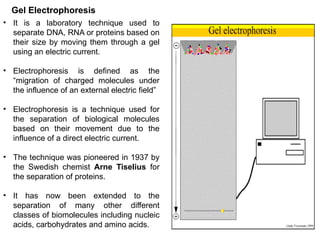
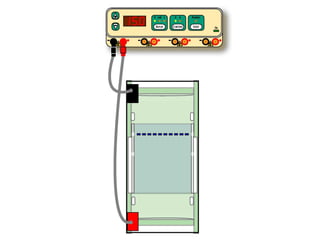
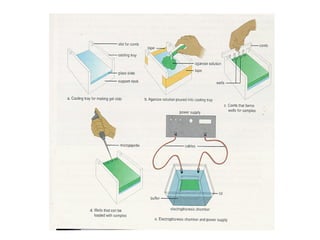
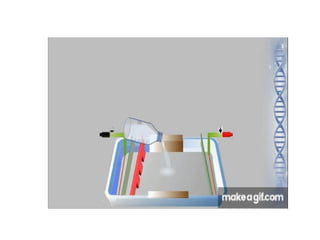
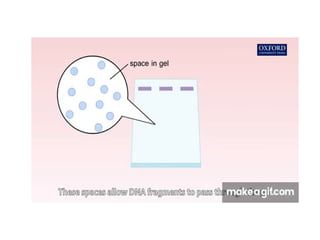
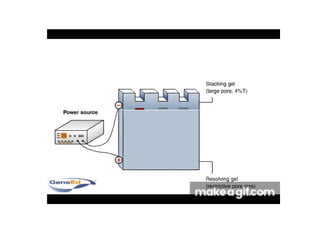
• Itis a laboratory technique used to
separate DNA, RNA or proteins based on
their size by moving them through a gel
using an electric current.
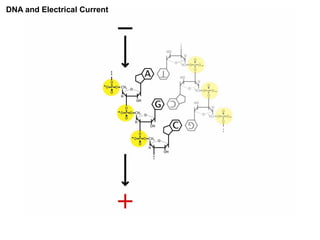
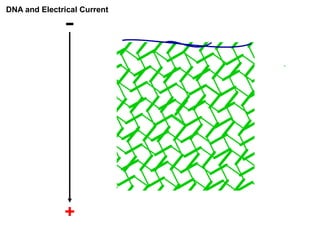
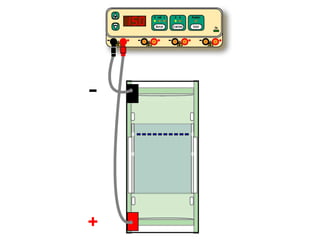
• Electrophoresis is defined as the
“migration of charged molecules under
the influence of an external electric field”
• Electrophoresis is a technique used for
the separation of biological molecules
based on their movement due to the
influence of a direct electric current.
• The technique was pioneered in 1937 by
the Swedish chemist Arne Tiselius for
the separation of proteins.
• It has now been extended to the
separation of many other different
classes of biomolecules including nucleic
acids, carbohydrates and amino acids.
3.
PRINCIPLE
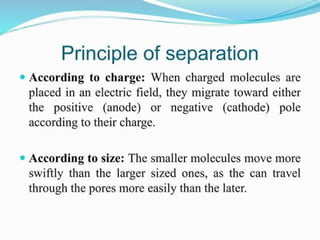
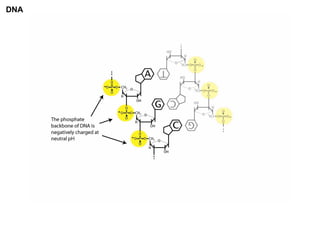
Any charged ionor molecule migrates when
placed in an electric field. The rate of
migration depend upon its net charge, size,
shape and the applied electric current.
Can be represented by following eq.
E * q
v = ---------------
f
4.
• v =velocity of migration of the molecule.
• E = electric field in volts per cm
• q = net electric charge on the molecule
• f = frictional coefficient
The movement of charged particle in an electric field is
expressed in terms of electrophoretic mobility ,denoted
by µ.
where,
µ = v/E OR
µ = q/f
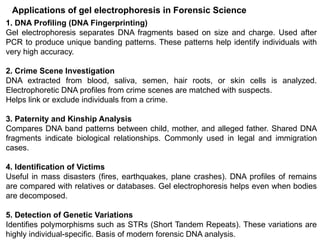
1. DNA Profiling(DNA Fingerprinting)
Gel electrophoresis separates DNA fragments based on size and charge. Used after
PCR to produce unique banding patterns. These patterns help identify individuals with
very high accuracy.
2. Crime Scene Investigation
DNA extracted from blood, saliva, semen, hair roots, or skin cells is analyzed.
Electrophoretic DNA profiles from crime scenes are matched with suspects.
Helps link or exclude individuals from a crime.
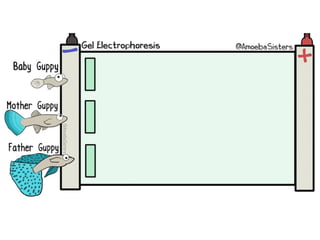
3. Paternity and Kinship Analysis
Compares DNA band patterns between child, mother, and alleged father. Shared DNA
fragments indicate biological relationships. Commonly used in legal and immigration
cases.
4. Identification of Victims
Useful in mass disasters (fires, earthquakes, plane crashes). DNA profiles of remains
are compared with relatives or databases. Gel electrophoresis helps even when bodies
are decomposed.
5. Detection of Genetic Variations
Identifies polymorphisms such as STRs (Short Tandem Repeats). These variations are
highly individual-specific. Basis of modern forensic DNA analysis.
Applications of gel electrophoresis in Forensic Science
29.
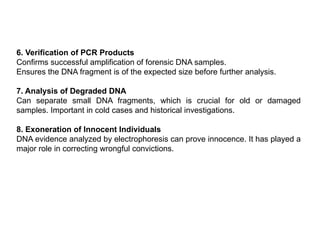
6. Verification ofPCR Products
Confirms successful amplification of forensic DNA samples.
Ensures the DNA fragment is of the expected size before further analysis.
7. Analysis of Degraded DNA
Can separate small DNA fragments, which is crucial for old or damaged
samples. Important in cold cases and historical investigations.
8. Exoneration of Innocent Individuals
DNA evidence analyzed by electrophoresis can prove innocence. It has played a
major role in correcting wrongful convictions.