DepED Vision
We dream of Filipinos
who passionately love their country
and whose values and competencies
enable them to realize their full potential
and contribute meaningfully to building the
nation.
As a learner-centered public institution,
the Department of Education
consistently improves itself
to better serve its stakeholders.
-2013
DepED Mission
To protect and promote the right of every Filipino to
quality, equitable, culture-based and complete basic
education where:
 Students learn in a child-friendly, gender-
sensitive,
safe and motivating environment
 Teachers facilitate learning and constantly
nurture every learner
-2013
 Administrators and staff, as stewards of the
institution,
ensure an enabling and supportive environment
for effective learning to happen.
 Family, community and other stakeholders are
actively engaged and share responsibility for
developing life-long learners.
-2013
DepED Core Values
Maka-
Diyos
Maka-
tao
Maka-
kalikasan
Maka-
bansa
Pananampalatay
a
Pagdama at
pag-unawa sa
damdamin ng iba
Pagpapahalaga
sa kalikasan
Pananagutang
panlipunan
Pag-asa Paggalang
Pangangalaga
ng kapaligiran
Pagkakapantay
-pantay ng
lahat ng tao
Pagmamahal Kabutihan
Pagmamalasak
it sa kabutihan
ng nakararami
Espirituwalidad
Pagmamalasakit
sa kapwa
-2013
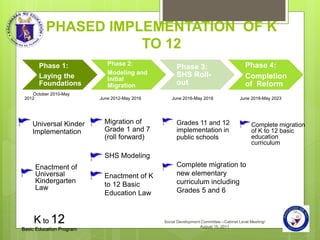
PHASED IMPLEMENTATION OF K
TO 12
Phase 1:
Laying the
Foundations
Phase 2:
Modeling and
Initial
Migration
Phase 3:
SHS Roll-
out
Phase 4:
Completion
of Reform
October 2010-May
2012 June 2018-May 2023
June 2016-May 2018
June 2012-May 2016
Universal Kinder
Implementation
Enactment of
Universal
Kindergarten
Law
Migration of
Grade 1 and 7
(roll forward)
SHS Modeling
Enactment of K
to 12 Basic
Education Law
Complete migration
of K to 12 basic
education
curriculum
Complete migration to
new elementary
curriculum including
Grades 5 and 6
Grades 11 and 12
implementation in
public schools
K to 12
Basic Education Program
Social Development Committee—Cabinet Level Meeting/
August 15, 2011
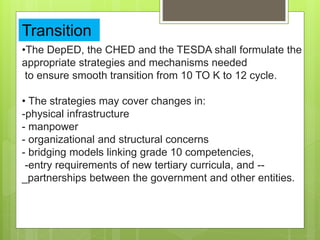
Transition
•The DepED, the CHED and the TESDA shall formulate the
appropriate strategies and mechanisms needed
to ensure smooth transition from 10 TO K to 12 cycle.
• The strategies may cover changes in:
-physical infrastructure
- manpower
- organizational and structural concerns
- bridging models linking grade 10 competencies,
-entry requirements of new tertiary curricula, and --
_partnerships between the government and other entities.
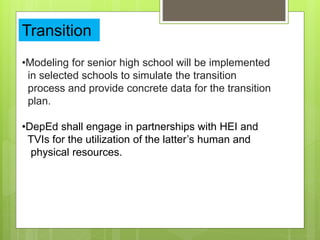
Transition
•Modeling for senior high school will be implemented
in selected schools to simulate the transition
process and provide concrete data for the transition
plan.
•DepEd shall engage in partnerships with HEI and
TVIs for the utilization of the latter’s human and
physical resources.
Transition
 The faculty of HEIs and TVIs allowed to
teach students of secondary education
shall be given priority in hiring for the
duration of the transition period.
RA No. 10533 or Enhanced Basic
Education Act : full enhancement and
lengthening of Basic Education in the
country
 School Year 2016-2017 – official
implementation of SHS nationwide
 Core Curriculum and Tracks
- Academic
- Technical-Vocational-Livelihood
- Sports and Arts
FY 2015 BUDGET PLANNING CYCLE
& PRE-PLANNING FOR SHS
The Department was able to start
transitioning into a more strategic,
bottom-up budgeting approach for FY
2014
 By the end of 2013 – Preparations and
planning were done in the Central,
Regional and Division Offices
 January – April 2014 – plan
consolidation and budget requirements
 SHS Planning Guide – starting point and
input for Regions and Divisions to go
through the DepED Planning Process for
FY 2015
GEARING UP FOR SHS IMPLEMENTATION
 Conduct internal and external
assessment to ensure proper
understanding of supply and
demand
 Assessments’ important
factors: internal & absorptive
capacities and market realities
 Assessments are the
foundation of the
Infrastructure Plan
5 POLICY DECISIONS
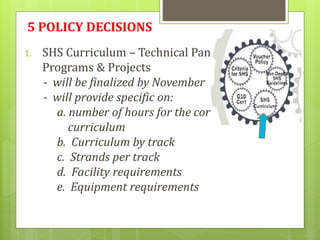
1. SHS Curriculum – Technical Panels,
Programs & Projects
- will be finalized by November
- will provide specific on:
a. number of hours for the core
curriculum
b. Curriculum by track
c. Strands per track
d. Facility requirements
e. Equipment requirements
5 POLICY DECISIONS
2. Non-DepED SHS Guidelines - Programs
and Projects
- will guide the non-DepED
schools in transitioning to SHS or
in their decision to offer SHS
- will guide partnership creation and
pave way for clear arrangements with
with potential external providers
5 POLICY DECISIONS
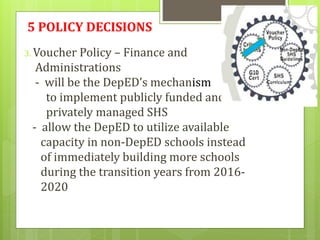
3. Voucher Policy – Finance and
Administrations
- will be the DepED’s mechanism
to implement publicly funded and
privately managed SHS
- allow the DepED to utilize available
capacity in non-DepED schools instead
of immediately building more schools
during the transition years from 2016-
2020
5 POLICY DECISIONS
4. Grade 10 Certificate, Grade 12
Certificate/Diploma and TESD
Implications– EXECOM and ProgCom
- will affect demand for SHS and is still
being reviewed
5 POLICY DECISIONS
5. Criteria for locating DepED SHS-
Regional Operations
- will depend on whether the SHS will
be an existing school or in a new school
- Factors to consider:
a. Internal capacity of the school
b. Strategic location, accessibility,
commute time, and distance
c. Potential partnerships and potential
demand creation
d. Whether certain existing schools
can still accommodate more
enrolment
5 POLICY DECISIONS
e. Locating potential new school sites
f. Faculty availability
g. Facility requirement and revisiting
classroom
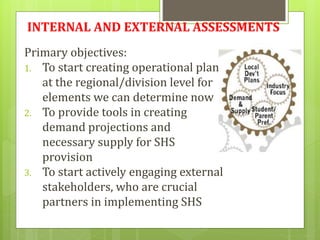
INTERNAL AND EXTERNAL ASSESSMENTS
Primary objectives:
1. To start creating operational plan
at the regional/division level for
elements we can determine now
2. To provide tools in creating
demand projections and
necessary supply for SHS
provision
3. To start actively engaging external
stakeholders, who are crucial
partners in implementing SHS
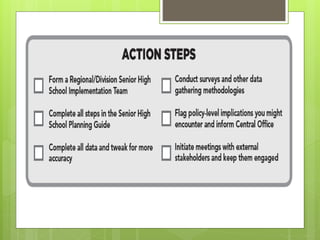
TIMELINE & ACTION
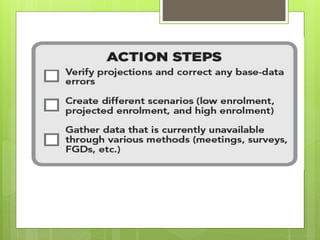
STEPS
SHS PRE-PLANNING INTEGRATED WITH
THE FY 2015 PLANNING CYCLE
SHS PRE-PLANNING INTEGRATED WITH THE FY
2015 PLANNING CYCLE
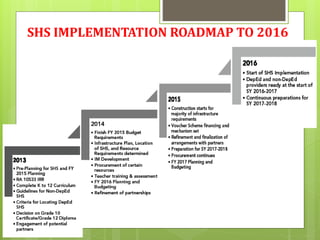
SHS IMPLEMENTATION ROADMAP TO 2016
KEY QUESTIONS FOR INTERNAL ASSESSMENT
SENIOR HIGH SCHOOL PROJECTIONS
(Pro) TOOL
OTHER DATA & ACTION STEPS
Refer to ASEC Reynaldo D. Laguda’s letter to ICT Coordinators
(next slide)
BUILDABLE SPACE
Table C of Gov’t. Elementary School Profile for the EBEIS, is
the buildable space viable for building SHS? Can each school
still absorb incremental enrolment?
Identify a list of existing schools with buildable space that are
viable for SHS placement while considering factors like
present enrolment, classroom deterioration, disaster risks,
etc.
Table C6. BUILDABLE SPACE FOR ADDITIONAL 7x9 CLASSROOMS,
SY 2012-2013 (As of March 31, 2013)
Does the school have available buildable space for additional 7x9
classrooms on a vacant lot?
Yes No
If Yes, how many additional 7x9 classrooms can be
constructed? ________
BUILDABLE SPACE FOR ADDITIONAL 7x9 CLASSROOMS (Table C6)
Indicate the number of 7x9 classrooms that can be constructed in the available space
in the school site.
POTENTIAL NEW SCHOOL SITES
Are there potential new school sites where the Department can
build SHS? Are these areas optimal and in good proximity to
our learners?
Tabulate the following data
KEY QUESTIONS FOR EXTERNAL ASSESSMENT
SPECIFIC QUESTIONS TO EXTERNAL
STAKEHOLDERS?
Gearing_up_for_enhanced_Basic_Education_-_Roadmap_to_2016_DEPED.pptx

Gearing_up_for_enhanced_Basic_Education_-_Roadmap_to_2016_DEPED.pptx

  • 2.
    DepED Vision We dreamof Filipinos who passionately love their country and whose values and competencies enable them to realize their full potential and contribute meaningfully to building the nation. As a learner-centered public institution, the Department of Education consistently improves itself to better serve its stakeholders. -2013
  • 3.
    DepED Mission To protectand promote the right of every Filipino to quality, equitable, culture-based and complete basic education where:  Students learn in a child-friendly, gender- sensitive, safe and motivating environment  Teachers facilitate learning and constantly nurture every learner -2013
  • 4.
     Administrators andstaff, as stewards of the institution, ensure an enabling and supportive environment for effective learning to happen.  Family, community and other stakeholders are actively engaged and share responsibility for developing life-long learners. -2013
  • 5.
    DepED Core Values Maka- Diyos Maka- tao Maka- kalikasan Maka- bansa Pananampalatay a Pagdamaat pag-unawa sa damdamin ng iba Pagpapahalaga sa kalikasan Pananagutang panlipunan Pag-asa Paggalang Pangangalaga ng kapaligiran Pagkakapantay -pantay ng lahat ng tao Pagmamahal Kabutihan Pagmamalasak it sa kabutihan ng nakararami Espirituwalidad Pagmamalasakit sa kapwa -2013
  • 9.
    PHASED IMPLEMENTATION OFK TO 12 Phase 1: Laying the Foundations Phase 2: Modeling and Initial Migration Phase 3: SHS Roll- out Phase 4: Completion of Reform October 2010-May 2012 June 2018-May 2023 June 2016-May 2018 June 2012-May 2016 Universal Kinder Implementation Enactment of Universal Kindergarten Law Migration of Grade 1 and 7 (roll forward) SHS Modeling Enactment of K to 12 Basic Education Law Complete migration of K to 12 basic education curriculum Complete migration to new elementary curriculum including Grades 5 and 6 Grades 11 and 12 implementation in public schools K to 12 Basic Education Program Social Development Committee—Cabinet Level Meeting/ August 15, 2011
  • 10.
    Transition •The DepED, theCHED and the TESDA shall formulate the appropriate strategies and mechanisms needed to ensure smooth transition from 10 TO K to 12 cycle. • The strategies may cover changes in: -physical infrastructure - manpower - organizational and structural concerns - bridging models linking grade 10 competencies, -entry requirements of new tertiary curricula, and -- _partnerships between the government and other entities.
  • 11.
    Transition •Modeling for seniorhigh school will be implemented in selected schools to simulate the transition process and provide concrete data for the transition plan. •DepEd shall engage in partnerships with HEI and TVIs for the utilization of the latter’s human and physical resources.
  • 12.
    Transition  The facultyof HEIs and TVIs allowed to teach students of secondary education shall be given priority in hiring for the duration of the transition period.
  • 14.
    RA No. 10533or Enhanced Basic Education Act : full enhancement and lengthening of Basic Education in the country  School Year 2016-2017 – official implementation of SHS nationwide  Core Curriculum and Tracks - Academic - Technical-Vocational-Livelihood - Sports and Arts
  • 15.
    FY 2015 BUDGETPLANNING CYCLE & PRE-PLANNING FOR SHS The Department was able to start transitioning into a more strategic, bottom-up budgeting approach for FY 2014  By the end of 2013 – Preparations and planning were done in the Central, Regional and Division Offices  January – April 2014 – plan consolidation and budget requirements  SHS Planning Guide – starting point and input for Regions and Divisions to go through the DepED Planning Process for FY 2015
  • 16.
    GEARING UP FORSHS IMPLEMENTATION  Conduct internal and external assessment to ensure proper understanding of supply and demand  Assessments’ important factors: internal & absorptive capacities and market realities  Assessments are the foundation of the Infrastructure Plan
  • 17.
    5 POLICY DECISIONS 1.SHS Curriculum – Technical Panels, Programs & Projects - will be finalized by November - will provide specific on: a. number of hours for the core curriculum b. Curriculum by track c. Strands per track d. Facility requirements e. Equipment requirements
  • 18.
    5 POLICY DECISIONS 2.Non-DepED SHS Guidelines - Programs and Projects - will guide the non-DepED schools in transitioning to SHS or in their decision to offer SHS - will guide partnership creation and pave way for clear arrangements with with potential external providers
  • 19.
    5 POLICY DECISIONS 3.Voucher Policy – Finance and Administrations - will be the DepED’s mechanism to implement publicly funded and privately managed SHS - allow the DepED to utilize available capacity in non-DepED schools instead of immediately building more schools during the transition years from 2016- 2020
  • 20.
    5 POLICY DECISIONS 4.Grade 10 Certificate, Grade 12 Certificate/Diploma and TESD Implications– EXECOM and ProgCom - will affect demand for SHS and is still being reviewed
  • 21.
    5 POLICY DECISIONS 5.Criteria for locating DepED SHS- Regional Operations - will depend on whether the SHS will be an existing school or in a new school - Factors to consider: a. Internal capacity of the school b. Strategic location, accessibility, commute time, and distance c. Potential partnerships and potential demand creation d. Whether certain existing schools can still accommodate more enrolment
  • 22.
    5 POLICY DECISIONS e.Locating potential new school sites f. Faculty availability g. Facility requirement and revisiting classroom
  • 23.
    INTERNAL AND EXTERNALASSESSMENTS Primary objectives: 1. To start creating operational plan at the regional/division level for elements we can determine now 2. To provide tools in creating demand projections and necessary supply for SHS provision 3. To start actively engaging external stakeholders, who are crucial partners in implementing SHS
  • 24.
  • 25.
    SHS PRE-PLANNING INTEGRATEDWITH THE FY 2015 PLANNING CYCLE
  • 26.
    SHS PRE-PLANNING INTEGRATEDWITH THE FY 2015 PLANNING CYCLE
  • 27.
  • 29.
    KEY QUESTIONS FORINTERNAL ASSESSMENT
  • 30.
    SENIOR HIGH SCHOOLPROJECTIONS (Pro) TOOL
  • 33.
    OTHER DATA &ACTION STEPS Refer to ASEC Reynaldo D. Laguda’s letter to ICT Coordinators (next slide)
  • 35.
    BUILDABLE SPACE Table Cof Gov’t. Elementary School Profile for the EBEIS, is the buildable space viable for building SHS? Can each school still absorb incremental enrolment? Identify a list of existing schools with buildable space that are viable for SHS placement while considering factors like present enrolment, classroom deterioration, disaster risks, etc.
  • 36.
    Table C6. BUILDABLESPACE FOR ADDITIONAL 7x9 CLASSROOMS, SY 2012-2013 (As of March 31, 2013) Does the school have available buildable space for additional 7x9 classrooms on a vacant lot? Yes No If Yes, how many additional 7x9 classrooms can be constructed? ________ BUILDABLE SPACE FOR ADDITIONAL 7x9 CLASSROOMS (Table C6) Indicate the number of 7x9 classrooms that can be constructed in the available space in the school site.
  • 37.
    POTENTIAL NEW SCHOOLSITES Are there potential new school sites where the Department can build SHS? Are these areas optimal and in good proximity to our learners? Tabulate the following data
  • 39.
    KEY QUESTIONS FOREXTERNAL ASSESSMENT
  • 40.
    SPECIFIC QUESTIONS TOEXTERNAL STAKEHOLDERS?

Editor's Notes

  • #4 <read> Include points if the speaker wants to elaborate.
  • #5 <read> Include points if the speaker wants to elaborate.
  • #6 4 major core values of the department that all stakeholders can relate to and be accountable for. The words or phrases below each value are components, reiterations of the above value.