The
Material
Self
GE 111
What is Material
Self?
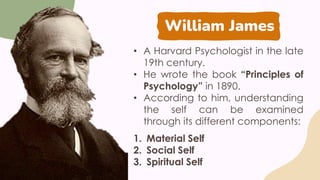
William James
• A Harvard Psychologist in the late
19th century.
• He wrote the book “Principles of
Psychology” in 1890.
• According to him, understanding
the self can be examined
through its different components:
1. Material Self
2. Social Self
3. Spiritual Self
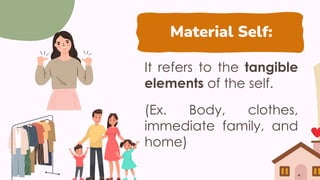
Material Self:
It refers to the tangible
elements of the self.
(Ex. Body, clothes,
immediate family, and
home)
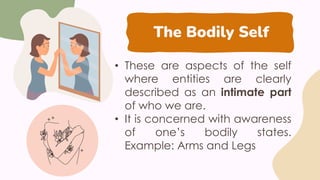
The Bodily Self
• These are aspects of the self
where entities are clearly
described as an intimate part
of who we are.
• It is concerned with awareness
of one’s bodily states.
Example: Arms and Legs
Extracorporeal Self
(Beyond the body)
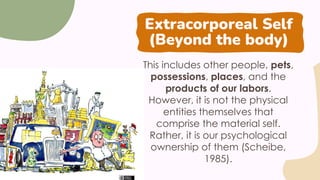
This includes other people, pets,
possessions, places, and the
products of our labors.
However, it is not the physical
entities themselves that
comprise the material self.
Rather, it is our psychological
ownership of them (Scheibe,
1985).
Extracorporeal Self
(Beyond the body)
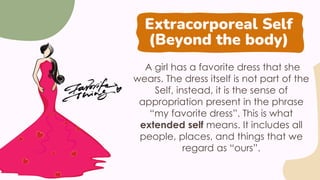
A girl has a favorite dress that she
wears. The dress itself is not part of the
Self, instead, it is the sense of
appropriation present in the phrase
“my favorite dress”. This is what
extended self means. It includes all
people, places, and things that we
regard as “ours”.
“We are what
we have.”
What is
Materialism?
Is a form of philosophical monism
that holds that matter is the
fundamental substance in
nature, and that all things,
including mental states and
consciousness, are results of
material interactions.
Materialism
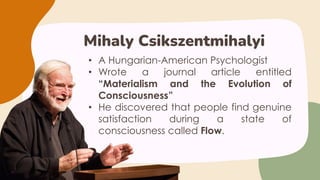
• A Hungarian-American Psychologist
• Wrote a journal article entitled
“Materialism and the Evolution of
Consciousness”
• He discovered that people find genuine
satisfaction during a state of
consciousness called Flow.
Mihaly Csikszentmihalyi
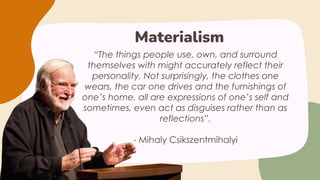
“The things people use, own, and surround
themselves with might accurately reflect their
personality. Not surprisingly, the clothes one
wears, the car one drives and the furnishings of
one’s home, all are expressions of one’s self and
sometimes, even act as disguises rather than as
reflections”.
- Mihaly Csikszentmihalyi
Materialism
Effects of Material
Possessions
Regardless of how much or
how little material things
people have, they will
always be interested in
material possessions.
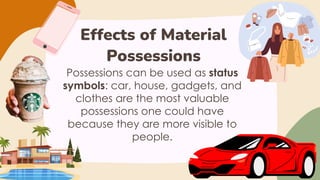
Effects of Material
Possessions
Possessions can be used as status
symbols: car, house, gadgets, and
clothes are the most valuable
possessions one could have
because they are more visible to
people.
Material Possessions
Material possessions
can also be a reflection
of hard work and
success.
Material Possessions
Material possessions can
make people more
motivated to work harder
to achieve them.
Two types of
Investment
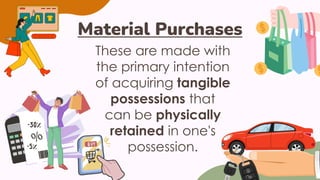
These are made with
the primary intention
of acquiring tangible
possessions that
can be physically
retained in one's
possession.
Material Purchases
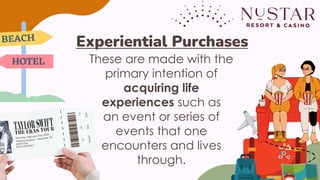
These are made with the
primary intention of
acquiring life
experiences such as
an event or series of
events that one
encounters and lives
through.
Experiential Purchases
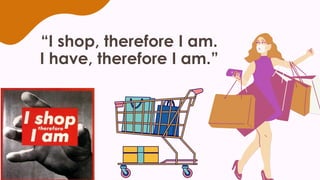
“I shop, therefore I am.
I have, therefore I am.”
What is
Consumerism?
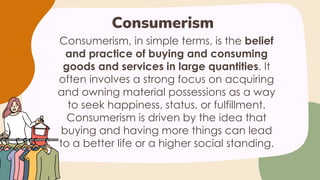
Consumerism, in simple terms, is the belief
and practice of buying and consuming
goods and services in large quantities. It
often involves a strong focus on acquiring
and owning material possessions as a way
to seek happiness, status, or fulfillment.
Consumerism is driven by the idea that
buying and having more things can lead
to a better life or a higher social standing.
Consumerism
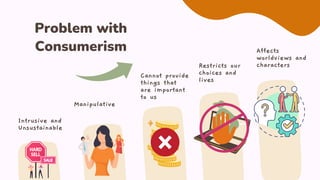
Intrusive and
Unsustainable
Manipulative
Cannot provide
things that
are important
to us
Restricts our
choices and
lives
Affects
worldviews and
characters
Problem with
Consumerism
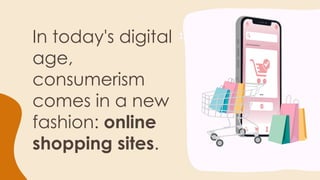
In today's digital
age,
consumerism
comes in a new
fashion: online
shopping sites.
1
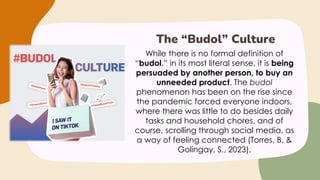
While there is no formal definition of
“budol,” in its most literal sense, it is being
persuaded by another person, to buy an
unneeded product. The budol
phenomenon has been on the rise since
the pandemic forced everyone indoors,
where there was little to do besides daily
tasks and household chores, and of
course, scrolling through social media, as
a way of feeling connected (Torres, B. &
Golingay, S., 2023).
The “Budol” Culture
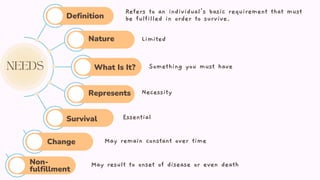
Refers to an individual's basic requirement that must
be fulfilled in order to survive.
Definition
Nature
What Is It?
Represents
Survival
Change
Non-
fulfillment
Limited
Something you must have
Necessity
Essential
May remain constant over time
May result to onset of disease or even death
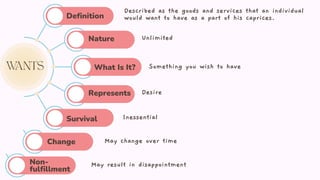
Described as the goods and services that an individual
would want to have as a part of his caprices.
Definition
Nature
What Is It?
Represents
Survival
Change
Non-
fulfillment
Unlimited
Something you wish to have
Desire
Inessential
May change over time
May result in disappointment
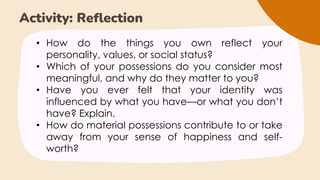
Activity: Reflection
• How do the things you own reflect your
personality, values, or social status?
• Which of your possessions do you consider most
meaningful, and why do they matter to you?
• Have you ever felt that your identity was
influenced by what you have—or what you don’t
have? Explain.
• How do material possessions contribute to or take
away from your sense of happiness and self-
worth?
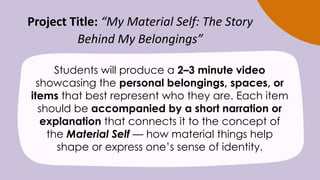
Project Title: “My Material Self: The Story
Behind My Belongings”
Students will produce a 2–3 minute video
showcasing the personal belongings, spaces, or
items that best represent who they are. Each item
should be accompanied by a short narration or
explanation that connects it to the concept of
the Material Self — how material things help
shape or express one’s sense of identity.
Video Guidelines:
1. Introduce yourself and state the purpose of your
video.
2. Show 3–5 items or spaces that represent your
identity or values.
3. Explain briefly why each item is important and
what it says about you.
4. End with a reflection on what you learned about
your Material Self.
5. Keep your narration clear and your video simple
and meaningful.
Consume less, live
more.
Thank you!
To be happy in life, you must
learn the difference between
what you want and what you
need.
“The most valuable things in life
cannot be bought with
money.”~ Philip Nover

GE111 Week 13 Lesson The Material Self .pdf

  • 1.
  • 2.
  • 3.
    William James • AHarvard Psychologist in the late 19th century. • He wrote the book “Principles of Psychology” in 1890. • According to him, understanding the self can be examined through its different components: 1. Material Self 2. Social Self 3. Spiritual Self
  • 4.
    Material Self: It refersto the tangible elements of the self. (Ex. Body, clothes, immediate family, and home)
  • 5.
    The Bodily Self •These are aspects of the self where entities are clearly described as an intimate part of who we are. • It is concerned with awareness of one’s bodily states. Example: Arms and Legs
  • 6.
    Extracorporeal Self (Beyond thebody) This includes other people, pets, possessions, places, and the products of our labors. However, it is not the physical entities themselves that comprise the material self. Rather, it is our psychological ownership of them (Scheibe, 1985).
  • 7.
    Extracorporeal Self (Beyond thebody) A girl has a favorite dress that she wears. The dress itself is not part of the Self, instead, it is the sense of appropriation present in the phrase “my favorite dress”. This is what extended self means. It includes all people, places, and things that we regard as “ours”.
  • 8.
  • 9.
  • 10.
    Is a formof philosophical monism that holds that matter is the fundamental substance in nature, and that all things, including mental states and consciousness, are results of material interactions. Materialism
  • 11.
    • A Hungarian-AmericanPsychologist • Wrote a journal article entitled “Materialism and the Evolution of Consciousness” • He discovered that people find genuine satisfaction during a state of consciousness called Flow. Mihaly Csikszentmihalyi
  • 12.
    “The things peopleuse, own, and surround themselves with might accurately reflect their personality. Not surprisingly, the clothes one wears, the car one drives and the furnishings of one’s home, all are expressions of one’s self and sometimes, even act as disguises rather than as reflections”. - Mihaly Csikszentmihalyi Materialism
  • 13.
    Effects of Material Possessions Regardlessof how much or how little material things people have, they will always be interested in material possessions.
  • 14.
    Effects of Material Possessions Possessionscan be used as status symbols: car, house, gadgets, and clothes are the most valuable possessions one could have because they are more visible to people.
  • 15.
    Material Possessions Material possessions canalso be a reflection of hard work and success.
  • 16.
    Material Possessions Material possessionscan make people more motivated to work harder to achieve them.
  • 17.
  • 18.
    These are madewith the primary intention of acquiring tangible possessions that can be physically retained in one's possession. Material Purchases
  • 19.
    These are madewith the primary intention of acquiring life experiences such as an event or series of events that one encounters and lives through. Experiential Purchases
  • 20.
    “I shop, thereforeI am. I have, therefore I am.”
  • 21.
  • 22.
    Consumerism, in simpleterms, is the belief and practice of buying and consuming goods and services in large quantities. It often involves a strong focus on acquiring and owning material possessions as a way to seek happiness, status, or fulfillment. Consumerism is driven by the idea that buying and having more things can lead to a better life or a higher social standing. Consumerism
  • 23.
    Intrusive and Unsustainable Manipulative Cannot provide thingsthat are important to us Restricts our choices and lives Affects worldviews and characters Problem with Consumerism
  • 24.
    In today's digital age, consumerism comesin a new fashion: online shopping sites. 1
  • 25.
    While there isno formal definition of “budol,” in its most literal sense, it is being persuaded by another person, to buy an unneeded product. The budol phenomenon has been on the rise since the pandemic forced everyone indoors, where there was little to do besides daily tasks and household chores, and of course, scrolling through social media, as a way of feeling connected (Torres, B. & Golingay, S., 2023). The “Budol” Culture
  • 26.
    Refers to anindividual's basic requirement that must be fulfilled in order to survive. Definition Nature What Is It? Represents Survival Change Non- fulfillment Limited Something you must have Necessity Essential May remain constant over time May result to onset of disease or even death
  • 27.
    Described as thegoods and services that an individual would want to have as a part of his caprices. Definition Nature What Is It? Represents Survival Change Non- fulfillment Unlimited Something you wish to have Desire Inessential May change over time May result in disappointment
  • 28.
    Activity: Reflection • Howdo the things you own reflect your personality, values, or social status? • Which of your possessions do you consider most meaningful, and why do they matter to you? • Have you ever felt that your identity was influenced by what you have—or what you don’t have? Explain. • How do material possessions contribute to or take away from your sense of happiness and self- worth?
  • 29.
    Project Title: “MyMaterial Self: The Story Behind My Belongings” Students will produce a 2–3 minute video showcasing the personal belongings, spaces, or items that best represent who they are. Each item should be accompanied by a short narration or explanation that connects it to the concept of the Material Self — how material things help shape or express one’s sense of identity.
  • 30.
    Video Guidelines: 1. Introduceyourself and state the purpose of your video. 2. Show 3–5 items or spaces that represent your identity or values. 3. Explain briefly why each item is important and what it says about you. 4. End with a reflection on what you learned about your Material Self. 5. Keep your narration clear and your video simple and meaningful.
  • 31.
  • 32.
    Thank you! To behappy in life, you must learn the difference between what you want and what you need. “The most valuable things in life cannot be bought with money.”~ Philip Nover