MATERIAL
SELF
Torlao Versano Bungay
Table of contents
01
04
02
05
03
Explain the
aspects of
material self.
Describe the basic
components of the
material self.
Discuss the
influence of
media in people’s
acquisition of
material
possessions.
Assess the role of
consumer culture
in your sense of
self and identity.
Differentiate
Between
needs and
wants.
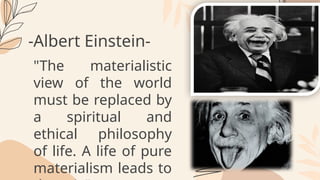
-Albert Einstein-
"The materialistic
view of the world
must be replaced by
a spiritual and
ethical philosophy
of life. A life of pure
materialism leads to
Material self
- refers to the tangible aspects of an individual’s
identity, including their body, possessions, clothing,
and immediate relationships.
- it suggests that people derive a sense of self-
worth and identity from their material belongings,
often viewing them as extensions of themselves.
- it is an attachment of items that can significantly
influence their self-perception and overall
sense of well-being.
Material self
- (including the body) and
possessions are part of the
created order,
but they must be viewed
within the larger context of
the soul's relationship with
God.
St. Augustine
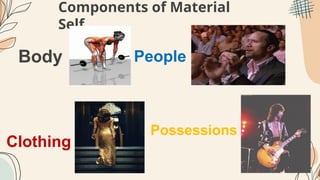
Components of Material
Self
Body
Clothing
People
Possessions
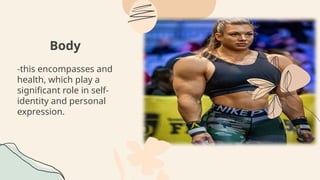
Body
-this encompasses and
health, which play a
significant role in self-
identity and personal
expression.
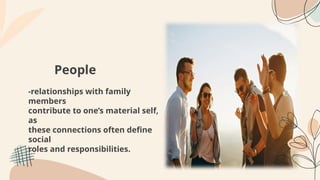
People
-relationships with family
members
contribute to one’s material self,
as
these connections often define
social
roles and responsibilities.
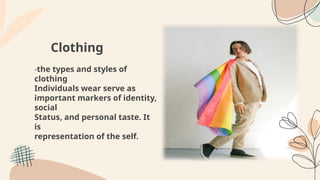
Clothing
-the types and styles of
clothing
Individuals wear serve as
important markers of identity,
social
Status, and personal taste. It
is
representation of the self.
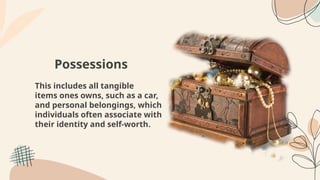
Possessions
This includes all tangible
items ones owns, such as a car,
and personal belongings, which
individuals often associate with
their identity and self-worth.
Defining self through
material possessions can
enhance of this two
concepts.
1.Sense of personal growth
2.Purpose or meaning of life
1. Sense of personal growth
-the feeling of developing new skills, attitudes, and
behaviors that improve your life.
2. Purpose or meaning of life
-a personal intention that gives direction
to your life and motivates you.
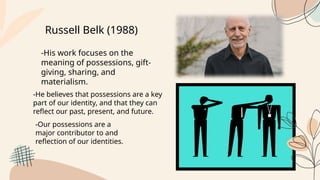
Russell Belk (1988)
-His work focuses on the
meaning of possessions, gift-
giving, sharing, and
materialism.
-He believes that possessions are a key
part of our identity, and that they can
reflect our past, present, and future.
-Our possessions are a
major contributor to and
reflection of our identities.
Development Aspects of Materialism
• Materialism – refers to giving more
importance to material possessions than
intangible values.
• Materialistic Person – is excessively
focused on acquiring material possessions.
• Identification with material possessions
begins early in life and persists as people seek
happiness. (Belk ,1988)
• Lack or loss of material possessions can result
in anxiety, insecurity, and depression for
overly materialistic individuals.
Role of Material possessions in
self and Identity
o Material possessions – symbolize
social status regardless of quantity.
o Visible possessions (cars, houses,
gadgets, clothes) are often deemed
most valuable.
o Higher value items tend to impress
others.
o Owning possessions drives
individuals to achieve higher levels of
success.
NEEDS AND WANTS
Needs – is
something that a
person must have
in order to live.
Wants – is
something that a
person desires to
have but can live
without.
Consumer Buying Behaviors:
Impulse Buyers – buying
anything without giving
much thought to what they
buy and the consequences
that may come later on.
Compulsive Buying Disorder
(CBD) – is characterized by an
obsession with shopping and
buying behaviors.
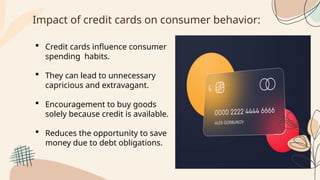
Impact of credit cards on consumer behavior:
 Credit cards influence consumer
spending habits.
 They can lead to unnecessary
capricious and extravagant.
 Encouragement to buy goods
solely because credit is available.
 Reduces the opportunity to save
money due to debt obligations.
Consumer Culture
 Consumer Culture – is a system in which consumption
is dominated by the consumption of commercial
products. (Arnold, 2010)
 Consumption of Market – made commodities and
marketing symbols is central to consumer culture.
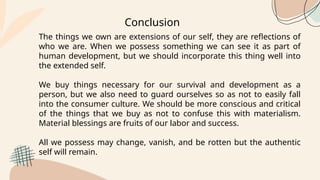
(Arnold & Craig, 2005)
 Consumerist Society – is one in which people spend a
great deal of time, money, and energy to “consume”
commercial products, goods, and services.
 Consumerism – is the consumption of material goods
and services in excess of one’s basic needs. Closely
related to materialism, both shaping individuals’ self-
perception.
Conclusion
The things we own are extensions of our self, they are reflections of
who we are. When we possess something we can see it as part of
human development, but we should incorporate this thing well into
the extended self.
We buy things necessary for our survival and development as a
person, but we also need to guard ourselves so as not to easily fall
into the consumer culture. We should be more conscious and critical

of the things that we buy as not to confuse this with materialism.
Material blessings are fruits of our labor and success.
All we possess may change, vanish, and be rotten but the authentic
self will remain.
Thank you
“GRATIAS”

a COMPREHENSIVE REPORT ON MATERIAL SELF.pptx

  • 2.
  • 3.
    Table of contents 01 04 02 05 03 Explainthe aspects of material self. Describe the basic components of the material self. Discuss the influence of media in people’s acquisition of material possessions. Assess the role of consumer culture in your sense of self and identity. Differentiate Between needs and wants.
  • 4.
    -Albert Einstein- "The materialistic viewof the world must be replaced by a spiritual and ethical philosophy of life. A life of pure materialism leads to
  • 5.
    Material self - refersto the tangible aspects of an individual’s identity, including their body, possessions, clothing, and immediate relationships. - it suggests that people derive a sense of self- worth and identity from their material belongings, often viewing them as extensions of themselves. - it is an attachment of items that can significantly influence their self-perception and overall sense of well-being.
  • 6.
    Material self - (includingthe body) and possessions are part of the created order, but they must be viewed within the larger context of the soul's relationship with God. St. Augustine
  • 7.
  • 8.
    Body -this encompasses and health,which play a significant role in self- identity and personal expression.
  • 9.
    People -relationships with family members contributeto one’s material self, as these connections often define social roles and responsibilities.
  • 10.
    Clothing -the types andstyles of clothing Individuals wear serve as important markers of identity, social Status, and personal taste. It is representation of the self.
  • 11.
    Possessions This includes alltangible items ones owns, such as a car, and personal belongings, which individuals often associate with their identity and self-worth.
  • 12.
    Defining self through materialpossessions can enhance of this two concepts. 1.Sense of personal growth 2.Purpose or meaning of life
  • 13.
    1. Sense ofpersonal growth -the feeling of developing new skills, attitudes, and behaviors that improve your life.
  • 14.
    2. Purpose ormeaning of life -a personal intention that gives direction to your life and motivates you.
  • 15.
    Russell Belk (1988) -Hiswork focuses on the meaning of possessions, gift- giving, sharing, and materialism. -He believes that possessions are a key part of our identity, and that they can reflect our past, present, and future. -Our possessions are a major contributor to and reflection of our identities.
  • 16.
    Development Aspects ofMaterialism • Materialism – refers to giving more importance to material possessions than intangible values. • Materialistic Person – is excessively focused on acquiring material possessions. • Identification with material possessions begins early in life and persists as people seek happiness. (Belk ,1988) • Lack or loss of material possessions can result in anxiety, insecurity, and depression for overly materialistic individuals.
  • 17.
    Role of Materialpossessions in self and Identity o Material possessions – symbolize social status regardless of quantity. o Visible possessions (cars, houses, gadgets, clothes) are often deemed most valuable. o Higher value items tend to impress others. o Owning possessions drives individuals to achieve higher levels of success.
  • 18.
    NEEDS AND WANTS Needs– is something that a person must have in order to live. Wants – is something that a person desires to have but can live without. Consumer Buying Behaviors: Impulse Buyers – buying anything without giving much thought to what they buy and the consequences that may come later on. Compulsive Buying Disorder (CBD) – is characterized by an obsession with shopping and buying behaviors.
  • 19.
    Impact of creditcards on consumer behavior:  Credit cards influence consumer spending habits.  They can lead to unnecessary capricious and extravagant.  Encouragement to buy goods solely because credit is available.  Reduces the opportunity to save money due to debt obligations.
  • 20.
    Consumer Culture  ConsumerCulture – is a system in which consumption is dominated by the consumption of commercial products. (Arnold, 2010)  Consumption of Market – made commodities and marketing symbols is central to consumer culture. (Arnold & Craig, 2005)  Consumerist Society – is one in which people spend a great deal of time, money, and energy to “consume” commercial products, goods, and services.  Consumerism – is the consumption of material goods and services in excess of one’s basic needs. Closely related to materialism, both shaping individuals’ self- perception.
  • 21.
    Conclusion The things weown are extensions of our self, they are reflections of who we are. When we possess something we can see it as part of human development, but we should incorporate this thing well into the extended self. We buy things necessary for our survival and development as a person, but we also need to guard ourselves so as not to easily fall into the consumer culture. We should be more conscious and critical of the things that we buy as not to confuse this with materialism. Material blessings are fruits of our labor and success. All we possess may change, vanish, and be rotten but the authentic self will remain.
  • 22.

Editor's Notes

  • #2 Materialistic View of the World: This perspective emphasizes the importance of physical objects, wealth, and tangible achievements. Spiritual and Ethical Philosophy: This approach focuses on deeper values and principles, including love, kindness, purpose, and a sense of belonging. Overall, the statement advocates for a shift from focusing merely on material gain to embracing a broader, more meaningful approach to life that fosters emotional well-being, community connection, and a sense of purpose.
  • #4 Materialistic View of the World: This perspective emphasizes the importance of physical objects, wealth, and tangible achievements.
  • #5 Connection to Happiness: While possessions can bring temporary satisfaction In essence, the material self highlights the influence of material factors on identity, while also underscoring the limitations and potential drawbacks of defining oneself primarily through possessions and physical appearance.
  • #8 The material self emphasizes how our identity is shaped by our possessions and physical appearance. However, it also points out the limitations of relying solely on these factors for self-worth, as this can lead to superficiality and a lack of deeper fulfillment. Defining oneself mainly through material aspects can result in an emptiness or dissatisfaction that may drive individuals to seek more meaningful connections and values beyond material wealth.
  • #9 Relationships with family members significantly contribute to one's material self, as they often shape social roles and responsibilities. Family dynamics influence individual identity, values, and expectations regarding material possessions and status. For example, cultural or familial norms may dictate behaviors related to providing for others, achieving certain lifestyle standards, or maintaining family traditions, all of which impact how one perceives themselves and their material standing in society.
  • #10 Clothing serves as a key marker of identity, social status, and personal taste, reflecting an individual’s values, lifestyle, and cultural background. The types and styles of clothing people choose to wear convey messages about their personality and can influence how they are perceived by others. Thus, clothing acts as a representation of the self, allowing individuals to express their uniqueness and place within social hierarchies.
  • #11 Possessions, including tangible items like cars and personal belongings, play a significant role in shaping an individual's identity and self-worth. People often associate their possessions with personal values, achievements, and social status, using them as symbols to express who they are and how they fit into society. The things one owns can reflect lifestyle choices, aspirations, and even cultural background, further influencing how individuals perceive themselves and how they are perceived by others.
  • #13 The sense of personal growth refers to the ongoing process of self-improvement where individuals acquire new skills, adopt positive attitudes, and modify behaviors that enhance their overall well-being and quality of life. This journey often involves stepping out of comfort zones, embracing challenges, and cultivating a mindset of learning and resilience. As people grow personally, they typically experience increased confidence, better relationships, and a greater sense of purpose and fulfillment in their lives.
  • #14 The purpose or meaning of life is a personal intention that provides direction and motivation in an individual's life. It encompasses the values, goals, and beliefs that guide decisions and actions, fostering a sense of fulfillment and significance. A clear sense of purpose helps people navigate challenges, make meaningful connections, and pursue passions, ultimately leading to a more satisfying and intentional existence.
  • #16 Materialism is a belief system that prioritizes the acquisition of physical possessions and wealth as the main source of happiness and fulfillment. It emphasizes the value of tangible goods and financial success, often equating one's self-worth or social status with their material assets. Critics of materialism argue that it can lead to superficiality, dissatisfaction, and an emphasis on consumption over deeper, more meaningful aspects of life such as relationships, experiences, and personal growth. A materialistic person prioritizes the accumulation of physical possessions and wealth, often believing that material goods and financial success are key to happiness and fulfillment. Such individuals may focus on brand-name items, luxury experiences, and visible status symbols, sometimes at the expense of deeper emotional connections or personal growth. This mindset can lead to a constant desire for more, as they equate their self-worth and identity with their material possessions.
  • #17 Material possessions refer to physical items that individuals own, such as clothing, electronics, furniture, and other tangible goods. These possessions can provide comfort, convenience, and a sense of identity.
  • #18 Needs refer to the essential requirements necessary for a person's survival and well-being, including physical, emotional, and psychological necessities such as: Basic physiological needs: food, water, shelter, sleep, and health. Safety needs: security, stability, and protection. Love and belonging needs: relationships, social connections, and a sense of community. Esteem needs: self-respect, self-esteem, and recognition. Self-actualization needs: personal growth, achievement, and fulfillment. Meeting these needs is crucial for individuals to feel grounded, content, and motivated. Wants are desires or wishes for specific experiences, possessions, or outcomes that extend beyond basic needs. They are not essential for survival but can enhance comfort, enjoyment, and quality of life. An impulse buyer is someone who purchases a product or service on a sudden whim or emotional decision, often without fully considering the consequences or needs. They may be influenced by factors such as: Emotional appeal: Attractive packaging, appealing advertisements, or social pressure. Instant gratification: The desire for immediate satisfaction or pleasure. Lack of planning: Buying without a clear plan or budget. Impulse buying can lead to overspending, clutter, and regret, as individuals may not fully think through their purchasing decisions. An impulse buyer is someone who purchases a product or service on a sudden whim or emotional decision, often without fully considering the consequences or needs. They may be influenced by factors such as: Emotional appeal: Attractive packaging, appealing advertisements, or social pressure. Instant gratification: The desire for immediate satisfaction or pleasure. Lack of planning: Buying without a clear plan or budget. Impulse buying can lead to overspending, clutter, and regret, as individuals may not fully think through their purchasing decisions. Compulsive Buying Disorder (CBD) is a behavioral addiction characterized by an uncontrollable urge to shop and spend money, often resulting in financial distress, emotional turmoil, and significant disruptions to daily life. Individuals with this disorder may experience a temporary sense of happiness or relief while shopping but often feel guilt or regret afterward. CBD can lead to accumulating excessive debt and strained relationships, as compulsive shoppers struggle to manage their impulses and control their buying habits. Needs and wants are relative to each individual. One person’s wants may be another person’s need.
  • #19 A credit card is a type of loan that allows an individual to borrow money from a financial institution to make purchases or pay for services, with the promise to repay the amount borrowed, plus interest and fees, within a specified term (usually a billing cycle). The cardholder is required to make regular payments, known as minimum payments or full payments, to settle the balance in order to avoid interest charges and penalties. Credit cards offer various benefits, such as: Convenience: making purchases online, in-store, or abroad Rewards: earning points, cashback, or other benefits for spending Building credit: making timely payments can improve credit scores Purchase protection: insurance for damaged, stolen, or returned items However, excessive credit card usage can lead to debt and financial difficulties if not managed responsibly.
  • #20 Consumer culture refers to a societal framework where the acquisition and consumption of goods and services play a central role in individuals' lives and identities. In this culture, material possessions often symbolize status, success, and personal fulfillment. Advertising, branding, and social influences shape consumer desires and behaviors, promoting the idea that happiness and self-worth are closely linked to what one owns. This culture can lead to a focus on consumption over sustainability and meaningful experiences, often resulting in overconsumption and environmental concerns. The consumption of the market refers to the process by which consumers purchase and use goods and services offered by businesses within an economy. It reflects the demands, preferences, and behaviors of consumers, influencing market trends, production, and pricing. High levels of market consumption stimulate economic growth, while shifts in consumer behavior can signal changes in economic conditions, societal values, and technological advancements. Understanding market consumption is essential for businesses to effectively meet consumer needs and for policymakers to gauge economic health. A consumerist society is one characterized by the emphasis on the acquisition and consumption of goods and services as a primary means of achieving happiness and social status. In such societies, consumer choices are often driven by advertising, trends, and a desire for material wealth, leading to behaviors focused on purchasing and accumulating possessions. This mindset can promote economic growth but may also result in environmental degradation, social inequality, and a diminished sense of community and personal fulfillment as individuals prioritize material goods over deeper values and relationships. Consumerism is the cultural and economic phenomenon that encourages the acquisition of goods and services in ever-increasing amounts. It emphasizes the importance of consumption as a means of personal happiness and social status, often promoting the idea that buying more leads to greater fulfillment. While consumerism can drive economic growth, it is also criticized for promoting materialism, environmental degradation, and a neglect of alternative values, such as community and sustainability.