Gcse Ocr Computer Science Knowledge Organiser
Cgp Books download
https://ebookbell.com/product/gcse-ocr-computer-science-
knowledge-organiser-cgp-books-49843678
Explore and download more ebooks at ebookbell.com
Here are some recommended products that we believe you will be
interested in. You can click the link to download.
Gcse Ocr Computer Science Knowledge Retriever Cgp Books
https://ebookbell.com/product/gcse-ocr-computer-science-knowledge-
retriever-cgp-books-49843680
Ocr Gcse Computer Science 2nd Edition Gavin Craddock Lorne Pearcey
George Rouse
https://ebookbell.com/product/ocr-gcse-computer-science-2nd-edition-
gavin-craddock-lorne-pearcey-george-rouse-12317680
Ocr Gcse Computer Science 2nd Revised Edition Sean Obyrne
https://ebookbell.com/product/ocr-gcse-computer-science-2nd-revised-
edition-sean-obyrne-5850136
New Gcse Computer Science Ocr 10minute Tests For Exams In 2022 And
Beyond Includes Answers Cgp Books
https://ebookbell.com/product/new-gcse-computer-science-ocr-10minute-
tests-for-exams-in-2022-and-beyond-includes-answers-cgp-books-49843676
Ocr Gcse 91 Business Fourth Edition 4th Mike Schofield Alan Williams
https://ebookbell.com/product/ocr-gcse-91-business-fourth-edition-4th-
mike-schofield-alan-williams-43013000
Ocr Gcse 91 Economics 2nd Edition 2nd Jan Mileskingston
https://ebookbell.com/product/ocr-gcse-91-economics-2nd-edition-2nd-
jan-mileskingston-43616136
My Revision Notes Ocr Gcse 91 Economics Jan Mileskingston
https://ebookbell.com/product/my-revision-notes-ocr-gcse-91-economics-
jan-mileskingston-44582032
My Revision Notes Ocr Gcse 91 Psychology Paperback Mark Billingham
https://ebookbell.com/product/my-revision-notes-ocr-
gcse-91-psychology-paperback-mark-billingham-10642266
My Revision Notes Ocr Gcse 91 2nd Sarah Powell
https://ebookbell.com/product/my-revision-notes-ocr-gcse-91-2nd-sarah-
powell-7001486
CGP
GCSE
Knowledge
Organiser
Computer Science
For OCR
Nail all the essential
GCSE facts with CGP!
CGP
CGP
Chexnisti CGP CGP
GCSE
CGP
Geography
Retriever
Spanish
ForAOA
GCSE
Knowledge
Retriever
GCSE
Knowledge
Retriever
Maths
For Edexcel -Higher Level
K-^ever
GCSE
Knowledge
Organiser
GCSE
—
Knowledge
Organiser
Physics
GCSE
Knowledge
Organiser
WE
French
For AOA
Knowledge
Organiser
Computer Science
ForOCR
Our Knowledge Organisers and matching Knowledge Retrievers
help all the key GCSE facts stick firmly in your brain!
Out now at cgpbooks.co.uk
Learn all the key facts with CGP!
Want to remember all the crucial facts for OCR GCSE Computer Science?
This CGP Knowledge Organiser is here to help!
We've condensed every topic down to the vital definitions,
facts and diagrams, making it all easy to memorise.
To check you've really got your facts straight, there's also a matching
Knowledge Retriever book that'll test you on every page.
CGP —still the best! ©
Our sole aim here at CGP is to produce the highest quality books —
carefully written, immaculately presented and dangerously close to being funny.
Then we work our socks off to get them out to you
— at the cheapest possible prices.
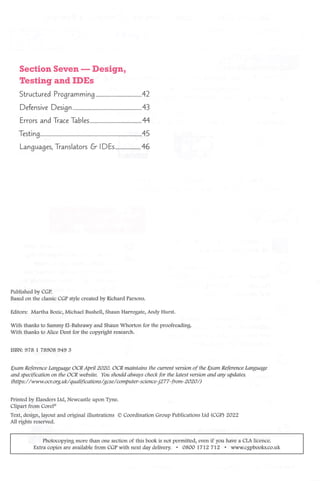
Contents
Component 01 —
Computer Systems
Section One —Components
of a Computer System
Computer Systems and The CPU 2
How The CPU Works 3
Memory .4
Secondary Storage 5
System Software — The OS 6
System Software — Utilities 7
SectionTwo —Data
Representation
Number Systems 8
Converting Hexadecimal 9
Using Binary 1O
Units and Compression 11
Characters 12
Storing Images 13
Storing Sound 14
SectionThree —Networks
Types of Network 15
Network Hardware 16
Networks and Topologies 17
Network Protocols 18
Internet Services 19
Network Security Threats 20
Network Security Measures 21
Section Four —Issues
Privacy and Ethical Issues 22
Cultural Issues and Wellbeing 23
Environmental Issues 24
Legislation and Licensing 25
Component 02
—Computational Thinking,
Algorithms and Programming
Section Five —Algorithms
Computational Thinking
&■ Pseudocode 26
Flowcharts 27
Search Algorithms 28
Bubble Sort and Insertion Sort 29
Merge Sort 30
Section Six —Programming
Data Types &- Random Numbers 31
Operators 32
Boolean Logic 33
Variables and Strings 34
Selection 35
Iteration 36
Checking Multiple Conditions 37
Arrays 38
File Handling 39
Storing and Searching Data .40
Sub Programs 41
Section Seven —Design,
Testing and IDEs
Structured Programming 42
Defensive Design 43
Errors and Trace Tables 44
Testing 45
Languages, Translators IDEs 46
Published by CGP.
Based on the classic CGP style created by Richard Parsons.
Editors: Martha Bozic, Michael Bushell, Shaun Harrogate, Andy Hurst.
With thanks to Sammy El-Bahrawy and Shaun Whorton for the proofreading.
With thanks to Alice Dent for the copyright research.
ISBN: 978 1 78908 949 3
Exam Reference Language OCR April 2020. OCR maintains the current version of the Exam Reference Language
and specification on the OCR website. You should always check for the latest version and any updates,
(https:/ /www.ocr.org.uk/qualifications/gcse/computer-science-j277-from-2020/)
Printed by Elanders Ltd, Newcastle upon Tyne.
Clipart from Corel®
Text, design, layout and original illustrations © Coordination Group Publications Ltd (CGP) 2022
All rights reserved.
Photocopying more than one section of this book is not permitted, even if you have a CLA licence.
Extra copies are available from CGP with next day delivery. • 0800 1712 712 • www.cgpbooks.co.uk
2 Section One —Components of a Computer System
Computer Systems and The CPU
Computer Systems
HARDWARE — the physical stuff in a computer system, e.g. keyboard, CPU, etc.
SOFTWARE — the programs that a computer system runs,
e.g. operating system, games, web browser, etc.
EMBEDDED SYSTEMS — computers built into other devices,
usually as control systems. E.g. they could control:
Dishwashers Microwaves Sat navs
1 1 1 1 1 1 1 1 1 1 1 1 11/„
- External pieces C
~ of hardware like -
- a keyboard or -
; mouse are called Z
~ peripherals. -
x/|l I I l l l I I l I II
They're usually easier to design, cheaper to produce, and
more efficient at their task than general purpose systems.
Four Common CPU Components
CENTRAL PROCESSING UNIT (CPU)
— where a computer processes
all data and instructions.
(2) if (CU) — controls the
flow of data in and out of the CPU.
Manages the fetching, decoding
and execution of instructions.
(Bb Arithmetic Logic Unit (ALU)
— does calculations including
addition, subtraction, multiplication
and division. Also performs binary
shifts and logic operations.
(22) — stores regularly used data
for quick access. Low capacity and
expensive. There are three levels
of cache memory:
L1
=
L2 -£>L3
Decreasing speed, increasing capacity
— temporarily hold
small amounts of data. They're
extremely fast to read/write to.
Three Factors Affecting
CPU Performance
o Number of cores — each core
processes data independently,
so more cores means more
instructions can be carried out
per second. Some software is
designed to take advantage of
multicore processing.
Clock speed — the number of
instructions a single processor
core can carry out per second.
Cache size — a larger CPU
cache gives the CPU faster
access to more data.
l III I I II I IIIII
S Generally, CPUs -
- with more cores, —
- higher clock speeds -
~
and larger caches 2
- will have better 3
~ performance, but -
~ cost more. r
/ 1 1 1 1 1 1 1 1 1 1 1 n 1 1 M
Section One —Components of a Computer System
Random documents with unrelated
content Scribd suggests to you:
America, Africa, and Asia. In the absence of palæontological
evidence as to the former history of the Megalæmidæ, we are unable
to say positively, whether it owes its present distribution to a former
closer union between these continents in intertropical latitudes, or to
a much greater northern range of the group at the period when a
luxuriant sub-tropical vegetation extended far toward the Arctic
regions; but the discovery of Trogon in the Miocene deposits of the
South of France renders it almost certain that the latter is the true
explanation in the case of both these families.
The Neotropical region, owing to its enormous family of humming-
birds, is by far the richest in Picariæ, possessing nearly half the total
number of species, and a still larger proportion of genera. Three
families, the Bucerotidæ, Meropidæ and Coraciidæ are equally
characteristic of the Oriental and Ethiopian regions, a few outlying
species only entering the Australian or the Palæarctic regions. One
family (Todidæ) is confined to the West Indian Islands; and another
(Leptosomidæ) consisting of but a single species, to Madagascar;
parallel cases to the Drepanididæ among the Passeres, peculiar to
the Sandwich Islands, and the Apterygidæ among the Struthiones,
peculiar to New Zealand.
Order III.—PSITTACI.
The Parrots have been the subject of much difference of opinion
among ornithologists, and no satisfactory arrangement of the order
into families and genera has yet been reached. Professor Garrod has
lately examined certain points in the anatomy of a large number of
genera, and proposes to revolutionize the ordinary classifications.
Until, however, a general examination of their whole anatomy,
internal and external, has been made by some competent authority,
it will be unsafe to adopt the new system, as we have as yet no
guide to the comparative value of the characters made use of. I
therefore keep as much as possible to the old groups, founded on
external characters, only using the indications furnished by Professor
Garrod's paper, to determine the position of doubtful genera.
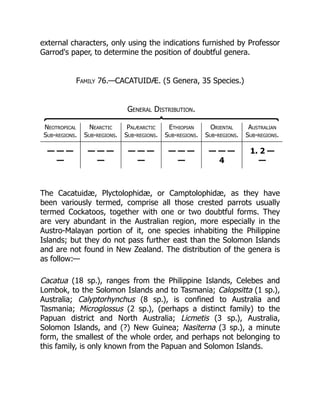
Family 76.—CACATUIDÆ. (5 Genera, 35 Species.)
General Distribution.
Neotropical
Sub-regions.
Nearctic
Sub-regions.
Palæarctic
Sub-regions.
Ethiopian
Sub-regions.
Oriental
Sub-regions.
Australian
Sub-regions.
— — —
—
— — —
—
— — —
—
— — —
—
— — —
4
1. 2 —
—
The Cacatuidæ, Plyctolophidæ, or Camptolophidæ, as they have
been variously termed, comprise all those crested parrots usually
termed Cockatoos, together with one or two doubtful forms. They
are very abundant in the Australian region, more especially in the
Austro-Malayan portion of it, one species inhabiting the Philippine
Islands; but they do not pass further east than the Solomon Islands
and are not found in New Zealand. The distribution of the genera is
as follow:—
Cacatua (18 sp.), ranges from the Philippine Islands, Celebes and
Lombok, to the Solomon Islands and to Tasmania; Calopsitta (1 sp.),
Australia; Calyptorhynchus (8 sp.), is confined to Australia and
Tasmania; Microglossus (2 sp.), (perhaps a distinct family) to the
Papuan district and North Australia; Licmetis (3 sp.), Australia,
Solomon Islands, and (?) New Guinea; Nasiterna (3 sp.), a minute
form, the smallest of the whole order, and perhaps not belonging to
this family, is only known from the Papuan and Solomon Islands.
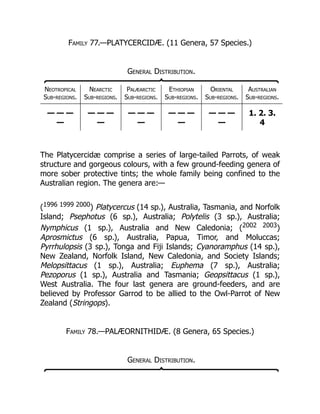
Family 77.—PLATYCERCIDÆ. (11 Genera, 57 Species.)
General Distribution.
Neotropical
Sub-regions.
Nearctic
Sub-regions.
Palæarctic
Sub-regions.
Ethiopian
Sub-regions.
Oriental
Sub-regions.
Australian
Sub-regions.
— — —
—
— — —
—
— — —
—
— — —
—
— — —
—
1. 2. 3.
4
The Platycercidæ comprise a series of large-tailed Parrots, of weak
structure and gorgeous colours, with a few ground-feeding genera of
more sober protective tints; the whole family being confined to the
Australian region. The genera are:—
(1996 1999 2000) Platycercus (14 sp.), Australia, Tasmania, and Norfolk
Island; Psephotus (6 sp.), Australia; Polytelis (3 sp.), Australia;
Nymphicus (1 sp.), Australia and New Caledonia; (2002 2003)
Aprosmictus (6 sp.), Australia, Papua, Timor, and Moluccas;
Pyrrhulopsis (3 sp.), Tonga and Fiji Islands; Cyanoramphus (14 sp.),
New Zealand, Norfolk Island, New Caledonia, and Society Islands;
Melopsittacus (1 sp.), Australia; Euphema (7 sp.), Australia;
Pezoporus (1 sp.), Australia and Tasmania; Geopsittacus (1 sp.),
West Australia. The four last genera are ground-feeders, and are
believed by Professor Garrod to be allied to the Owl-Parrot of New
Zealand (Stringops).
Family 78.—PALÆORNITHIDÆ. (8 Genera, 65 Species.)
General Distribution.
Neotropical
Sub-regions.
Nearctic
Sub-regions.
Palæarctic
Sub-regions.
Ethiopian
Sub-regions.
Oriental
Sub-regions.
Australian
Sub-regions.
— — —
—
— — —
—
— — —
—
1. 2 — 4 1. 2. 3.
4
1. 2 —
—
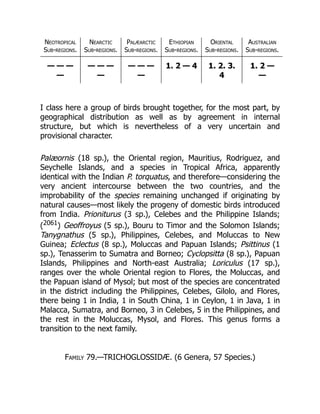
I class here a group of birds brought together, for the most part, by
geographical distribution as well as by agreement in internal
structure, but which is nevertheless of a very uncertain and
provisional character.
Palæornis (18 sp.), the Oriental region, Mauritius, Rodriguez, and
Seychelle Islands, and a species in Tropical Africa, apparently
identical with the Indian P. torquatus, and therefore—considering the
very ancient intercourse between the two countries, and the
improbability of the species remaining unchanged if originating by
natural causes—most likely the progeny of domestic birds introduced
from India. Prioniturus (3 sp.), Celebes and the Philippine Islands;
(2061) Geoffroyus (5 sp.), Bouru to Timor and the Solomon Islands;
Tanygnathus (5 sp.), Philippines, Celebes, and Moluccas to New
Guinea; Eclectus (8 sp.), Moluccas and Papuan Islands; Psittinus (1
sp.), Tenasserim to Sumatra and Borneo; Cyclopsitta (8 sp.), Papuan
Islands, Philippines and North-east Australia; Loriculus (17 sp.),
ranges over the whole Oriental region to Flores, the Moluccas, and
the Papuan island of Mysol; but most of the species are concentrated
in the district including the Philippines, Celebes, Gilolo, and Flores,
there being 1 in India, 1 in South China, 1 in Ceylon, 1 in Java, 1 in
Malacca, Sumatra, and Borneo, 3 in Celebes, 5 in the Philippines, and
the rest in the Moluccas, Mysol, and Flores. This genus forms a
transition to the next family.
Family 79.—TRICHOGLOSSIDÆ. (6 Genera, 57 Species.)
General Distribution.
Neotropical
Sub-regions.
Nearctic
Sub-regions.
Palæarctic
Sub-regions.
Ethiopian
Sub-regions.
Oriental
Sub-regions.
Australian
Sub-regions.
— — —
—
— — —
—
— — —
—
— — —
—
— — —
—
1. 2. 3
—
The Trichoglossidæ, or Brush-tongued Paroquets, including the
Lories, are exclusively confined to the Australian region, where they
extend from Celebes to the Marquesas Islands, and south to
Tasmania. The genus Nanodes (= Lathamus) has been shown by
Professor Garrod to differ from Trichoglossus in the position of the
carotid arteries. I therefore make it a distinct genus but do not
consider that it should be placed in another family. The genera here
admitted are as follows:—
Trichoglossus (29 sp.), ranges over the whole Austro-Malay and
Australian sub-regions, and to the Society Islands; (2047) Nanodes (1
sp.), Australia and Tasmania; Charmosyna (1 sp.), New Guinea (Plate
X. Vol. I. p. 414); Eos (9 sp.), Bouru and Sanguir Island north of
Celebes, to the Solomon Islands, and in Puynipet Island to the north-
east of New Ireland; (2039 2040) Lorius (13 sp.), Bouru and the
Solomon Islands; (2041 2043) Coriphilus (4 sp.), Samoa, Tonga,
Society and Marquesas Islands.
Family 80.—CONURIDÆ. (7 Genera, 79 Species.)
General Distribution.
Neotropical
Sub-regions.
Nearctic
Sub-regions.
Palæarctic
Sub-regions.
Ethiopian
Sub-regions.
Oriental
Sub-regions.
Australian
Sub-regions.
1. 2. 3.
4
— — 3
—
— — —
—
— — —
—
— — —
—
— — —
—
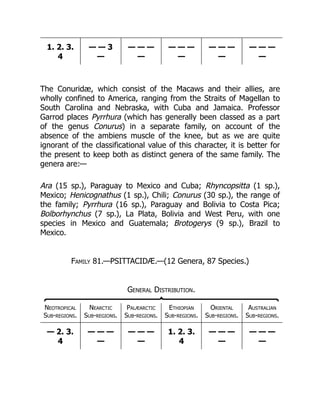
The Conuridæ, which consist of the Macaws and their allies, are
wholly confined to America, ranging from the Straits of Magellan to
South Carolina and Nebraska, with Cuba and Jamaica. Professor
Garrod places Pyrrhura (which has generally been classed as a part
of the genus Conurus) in a separate family, on account of the
absence of the ambiens muscle of the knee, but as we are quite
ignorant of the classificational value of this character, it is better for
the present to keep both as distinct genera of the same family. The
genera are:—
Ara (15 sp.), Paraguay to Mexico and Cuba; Rhyncopsitta (1 sp.),
Mexico; Henicognathus (1 sp.), Chili; Conurus (30 sp.), the range of
the family; Pyrrhura (16 sp.), Paraguay and Bolivia to Costa Pica;
Bolborhynchus (7 sp.), La Plata, Bolivia and West Peru, with one
species in Mexico and Guatemala; Brotogerys (9 sp.), Brazil to
Mexico.
Family 81.—PSITTACIDÆ.—(12 Genera, 87 Species.)
General Distribution.
Neotropical
Sub-regions.
Nearctic
Sub-regions.
Palæarctic
Sub-regions.
Ethiopian
Sub-regions.
Oriental
Sub-regions.
Australian
Sub-regions.
— 2. 3.
4
— — —
—
— — —
—
1. 2. 3.
4
— — —
—
— — —
—
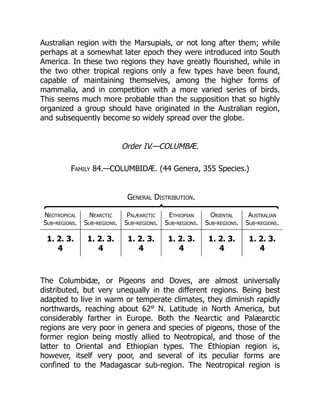
The Psittacidæ comprise a somewhat heterogeneous assemblage of
Parrots and Paroquets of the Neotropical and Ethiopian regions,
which are combined here more for convenience than because they
are believed to form a natural group. The genera Chrysotis and
Pionus have no oil-gland, while Psittacula and Agapornis have lost
the furcula, but neither of these characters are probably of more
than generic value. The genera are:—
Psittacus (2 sp.), West Africa; Coracopsis (5 sp.), Madagascar,
Comoro, and Seychelle Islands; Pæocephalus (9 sp.), all Tropical and
South Africa; (2063—2066) Caica (9 sp.), Mexico to Amazonia;
Chrysotis (32 sp.), Paraguay to Mexico and the West Indian Islands;
Triclaria (1 sp.), Brazil; Deroptyus (1 sp.), Amazonia; Pionus (9 sp.),
Paraguay to Mexico; Urochroma (7 sp.), Tropical South America;
Psittacula (6 sp.), Brazil to Mexico; Poliopsitta (2 sp.), Madagascar
and West Africa; Agapornis (4 sp.), Tropical and South Africa.
Family 82.—NESTORIDÆ. (? 2 Genera, 6 Species.)
General Distribution.
Neotropical
Sub-regions.
Nearctic
Sub-regions.
Palæarctic
Sub-regions.
Ethiopian
Sub-regions.
Oriental
Sub-regions.
Australian
Sub-regions.
— — —
—
— — —
—
— — —
—
— — —
—
— — —
—
1 — — 4
The present family is formed to receive the genus Nestor (5 sp.),
confined to New Zealand and Norfolk Island. Its affinities are
doubtful, but it appears to have relations with the American
Conuridæ and the Australian Trichoglossidæ. With it is placed the
rare and remarkable Dasyptilus (1 sp.), of New Guinea, of which
however very little is known.
Family 83.—STRINGOPIDÆ. (1 Genus, 2 Species.)
General Distribution.
Neotropical
Sub-regions.
Nearctic
Sub-regions.
Palæarctic
Sub-regions.
Ethiopian
Sub-regions.
Oriental
Sub-regions.
Australian
Sub-regions.
— — —
—
— — —
—
— — —
—
— — —
—
— — —
—
— — —
4
This family contains only the curious owl-like nocturnal Parrot of New
Zealand, Stringops habroptilus (Plate XIII. Vol. I. p. 455). An allied
species is said to inhabit the Chatham Islands, if not now extinct.
General Remarks on the Distribution of the Psittaci.
Although the Parrots are now generally divided into several distinct
families, yet they form so well marked and natural a group, and are
so widely separated from all other birds, that we may best discuss
their peculiarities of geographical distribution by treating them as a
whole. By the preceding enumeration we find that there are about
386 species of known parrots, which are divided into 52 genera.
They are pre-eminently a tropical group, for although a few species
extend a considerable distance into the temperate zone, these are
marked exceptions to the rule which limits the parrot tribe to the
tropical and sub-tropical regions, roughly defined as extending about
30° on each side of the equator. In America a species of Conurus
reaches the straits of Magellan on the south, while another inhabits
the United States, and once extended to the great lakes, although
now confined to the south-eastern districts. In Africa parrots do not
reach the northern tropic, owing to the desert nature of the country;
and in the south they barely reach the Orange River. In India they
extend to about 35° N. in the western Himalayas; and in the
Australian region, not only to New Zealand but to Macquarie Islands
in 54° S., the farthest point from the equator reached by the group.
But although found in all the tropical regions they are most unequally
distributed. Africa is poorest, possessing only 6 genera and 25
species; the Oriental region is also very poor, having but 6 genera
and 29 species; the Neotropical region is much richer, having 14
genera and 141 species; while the smallest in area and the least
tropical in climate—the Australian region, possesses 31 genera and
176 species, and it also possesses exclusively 5 of the families,
Trichoglossidæ, Platycercidæ, Cacatuidæ, Nestoridæ, and
Stringopidæ. The portion of the earth's surface that contains the
largest number of parrots in proportion to its area is, undoubtedly,
the Austro-Malayan sub-region, including the islands from Celebes to
the Solomon Islands. The area of these islands is probably not one-
fifteenth of that of the four tropical regions, yet they contain from
one-fifth to one-fourth of all the known parrots. In this area too are
found many of the most remarkable forms,—all the crimson lories,
the great black Cockatoos, the pigmy Nasiterna, the raquet-tailed
Prioniturus, and the bareheaded Dasyptilus.
The almost universal distribution of Parrots wherever the climate is
sufficiently mild or uniform to furnish them with a perennial supply of
food, no less than their varied details of organization, combined with
a great uniformity of general type,—tell us, in unmistakable
language, of a very remote antiquity. The only early record of extinct
parrots is, however, in the Miocene of France, where remains
apparently allied to the West African Psittacus, have been found. But
the origin of so widespread, isolated, and varied a group, must be far
earlier than this, and not improbably dates back beyond the dawn of
the Tertiary period. Some primeval forms may have entered the
Australian region with the Marsupials, or not long after them; while
perhaps at a somewhat later epoch they were introduced into South
America. In these two regions they have greatly flourished, while in
the two other tropical regions only a few types have been found,
capable of maintaining themselves, among the higher forms of
mammalia, and in competition with a more varied series of birds.
This seems much more probable than the supposition that so highly
organized a group should have originated in the Australian region,
and subsequently become so widely spread over the globe.
Order IV.—COLUMBÆ.
Family 84.—COLUMBIDÆ. (44 Genera, 355 Species.)
General Distribution.
Neotropical
Sub-regions.
Nearctic
Sub-regions.
Palæarctic
Sub-regions.
Ethiopian
Sub-regions.
Oriental
Sub-regions.
Australian
Sub-regions.
1. 2. 3.
4
1. 2. 3.
4
1. 2. 3.
4
1. 2. 3.
4
1. 2. 3.
4
1. 2. 3.
4
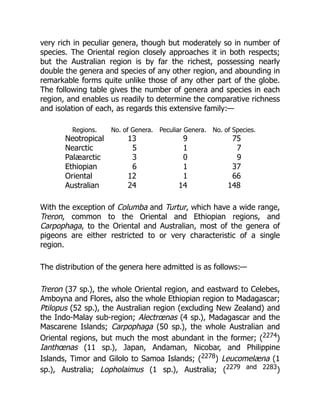
The Columbidæ, or Pigeons and Doves, are almost universally
distributed, but very unequally in the different regions. Being best
adapted to live in warm or temperate climates, they diminish rapidly
northwards, reaching about 62° N. Latitude in North America, but
considerably farther in Europe. Both the Nearctic and Palæarctic
regions are very poor in genera and species of pigeons, those of the
former region being mostly allied to Neotropical, and those of the
latter to Oriental and Ethiopian types. The Ethiopian region is,
however, itself very poor, and several of its peculiar forms are
confined to the Madagascar sub-region. The Neotropical region is
very rich in peculiar genera, though but moderately so in number of
species. The Oriental region closely approaches it in both respects;
but the Australian region is by far the richest, possessing nearly
double the genera and species of any other region, and abounding in
remarkable forms quite unlike those of any other part of the globe.
The following table gives the number of genera and species in each
region, and enables us readily to determine the comparative richness
and isolation of each, as regards this extensive family:—
Regions. No. of Genera. Peculiar Genera. No. of Species.
Neotropical 13 9 75
Nearctic 5 1 7
Palæarctic 3 0 9
Ethiopian 6 1 37
Oriental 12 1 66
Australian 24 14 148
With the exception of Columba and Turtur, which have a wide range,
Treron, common to the Oriental and Ethiopian regions, and
Carpophaga, to the Oriental and Australian, most of the genera of
pigeons are either restricted to or very characteristic of a single
region.
The distribution of the genera here admitted is as follows:—
Treron (37 sp.), the whole Oriental region, and eastward to Celebes,
Amboyna and Flores, also the whole Ethiopian region to Madagascar;
Ptilopus (52 sp.), the Australian region (excluding New Zealand) and
the Indo-Malay sub-region; Alectrœnas (4 sp.), Madagascar and the
Mascarene Islands; Carpophaga (50 sp.), the whole Australian and
Oriental regions, but much the most abundant in the former; (2274)
Ianthœnas (11 sp.), Japan, Andaman, Nicobar, and Philippine
Islands, Timor and Gilolo to Samoa Islands; (2278) Leucomelæna (1
sp.), Australia; Lopholaimus (1 sp.), Australia; (2279 and 2283)
Alsæcomus (2 sp.), Himalayas to Ceylon and Tenasserim; Columba
(46 sp.), generally distributed over all the regions except the
Australian, one species however in the Fiji Islands; Ectopistes (1 sp.),
east of North America with British Columbia; Zenaidura (2 sp.),
Veragua to Canada and British Columbia; Œna (1 sp.), Tropical and
South Africa; Geopelia (6 sp.), Philippine Islands and Java to
Australia; Macropygia (14 sp.), Nepal, Hainan, Nicobar, Java, and
Philippines to Australia and New Ireland; Turacœna (3 sp.), Celebes,
Timor, and Solomon Islands; Reinwardtœnas (1 sp.), Celebes to New
Guinea; Turtur (24 sp.), Palæarctic, Ethiopian and Oriental regions
with Austro-Malaya; Chæmepelia (7 sp.), Brazil and Bolivia to
Jamaica, California, and South-east United States; Columbula (2 sp.),
Brazil and La Plata to Chili; Scardafella (2 sp.), Brazil and Guatemala;
Zenaida (10 sp.), Chili and La Plata to Columbia and the Antilles,
Fernando Noronha; Melopelia (2 sp.), Chili to Mexico and California;
Peristera (4 sp.), Brazil to Mexico; Metriopelia (2 sp.), West America
from Ecuador to Chili; Gymnopelia (1 sp.), West Peru and Bolivia;
Leptoptila (11 sp.), Paraguay to Mexico and the Antilles; (2317 2318
and 2820) Geotrygon (14 sp.), Paraguay to Mexico and the Antilles;
Aplopelia (5 sp.), Tropical and South Africa, St. Thomas and Princes
Island; Chalocopelia (4 sp.), Tropical and South Africa; Starnœnas (1
sp.), Cuba; Ocyphaps (1 sp.), Australia (Plate XII. Vol. I. p. 441);
Petrophassa (1 sp.), North-west Australia; Chalocophaps (8 sp.), the
Oriental region to New Guinea and Australia; Trugon (1 sp.), New
Guinea; Henicophaps (1 sp.), Waigiou and New Guinea; Phaps (3
sp.), Australia and Tasmania; Leucosarcia (1 sp.), East Australia;
Phapitreron (2 sp.), Philippine Islands; Geophaps (2 sp.), North and
East Australia; Lophophaps (3 sp.), Australia; Calœnas (1 sp.),
scattered on the smaller islands from the Nicobars and Philippines to
New Guinea; Otidiphaps (1 sp.), New Guinea; Phlogœnas (7 sp.),
Philippine Islands and Celebes to the Marquesas Islands; Goura (2
sp.), New Guinea and the islands on the north-east (Plate X. Vol. I. p.
414).
Family 84a.—DIDUNCULIDÆ. (1 Genus, 1 Species.)
General Distribution.
Neotropical
Sub-regions.
Nearctic
Sub-regions.
Palæarctic
Sub-regions.
Ethiopian
Sub-regions.
Oriental
Sub-regions.
Australian
Sub-regions.
— — —
—
— — —
—
— — —
—
— — —
—
— — —
—
— — 3
—
The Didunculus stigirostris, a hook-billed ground-pigeon, found only
in the Samoa Islands, is so peculiar in its structure that it is
considered to form a distinct family.
Family 85.—DIDIDÆ.—(2 Genera, 3 Species.)
General Distribution.
Neotropical
Sub-regions.
Nearctic
Sub-regions.
Palæarctic
Sub-regions.
Ethiopian
Sub-regions.
Oriental
Sub-regions.
Australian
Sub-regions.
— — —
—
— — —
—
— — —
—
— — —
4
— — —
—
— — —
—
The birds which constitute this family are now all extinct; but as
numerous drawings are in existence, taken from living birds some of
which were exhibited in Europe, and a stuffed specimen, fragments
of which still remain, was in the Ashmolean Museum at Oxford down
to 1755, they must be classed among recent, as opposed to
geologically extinct species. The Dodo (Didus ineptus) a large,
unwieldy, flightless bird, inhabited Mauritius down to the latter part
of the 17th century; and an allied form, the Solitaire (Pezophaps
solitaria), was found only in the island of Rodriguez, where it
survived about a century later. Old voyagers mention a Dodo also in
Bourbon, and a rude figure of it exists; but no remains of this bird
have been found. Almost complete skeletons of the Dodo and
Solitaire have, however, been recovered from the swamps of
Mauritius and the caves of Rodriguez, proving that they were both
extremely modified forms of pigeon. These large birds were formerly
very abundant, and being excellent eating and readily captured, the
early voyagers to these islands used them largely for food. As they
could be caught by man, and very easily by dogs, they were soon
greatly diminished in numbers; and the introduction of swine, which
ran wild in the forests and fed on the eggs and young birds,
completed their extermination.
The existence in the Mascarene Islands of a group of such
remarkable terrestrial birds, with aborted wings, is parallel to that of
the Apteryx and Dinornis in New Zealand, the Cassowaries of Austro-
Malaya, and the short-winged Rails of New Zealand, Tristan
d'Acunha, and other oceanic islands; and the phenomenon is clearly
dependent on the long-continued absence of enemies, which allowed
of great increase of bulk and the total loss of the power of flight,
without injury. In some few cases (the Ostrich for example) birds
incapable of flight co-exist with large carnivorous mammalia; but
these birds are large and powerful, as well as very swift, and are
thus able to escape from some enemies and defend themselves
against others. The entire absence of the smaller and more
defenceless ground-birds from the adjacent island of Madagascar, is
quite in accordance with this view, because that island has several
small but destructive carnivorous animals.
General Remarks on the Distribution of the Columbæ.
The striking preponderance of Pigeons, both as to genera and
species, in the Australian region, would seem to indicate that at
some former period it possessed a more extensive land area in which
this form of bird-life took its rise. But there are other considerations
which throw doubt upon this view. The western half of the Malay
Archipelago, belonging to the Oriental region, is also rich in pigeons,
since it has 43 species belonging to 11 genera, rather more than are
found in all the rest of the Oriental region. Again, we find that the
Mascarene Islands and the Antilles both possess more pigeons than
we should expect, in proportion to those of the regions to which they
belong, and to their total amount of bird-life. This looks as if islands
were more favourable to pigeon-development than continents; and if
we group together the Pacific and the Malayan Islands, the
Mascarene group and the Antilles, we find that they contain together
about 170 species of pigeons belonging to 24 out of the 47 genera
here adopted; while all the great continents united only produce
about the same number of species belonging (if we omit those
peculiar to Australia) to only 20 genera. The great development of
the group in the Australian region may, therefore, be due to its
consisting mainly of islands, and not to the order having originated
there, and thus having had a longer period in which to develop. I
have elsewhere suggested (Ibis 1865, p. 366) a physical cause for
this peculiarity of distribution. Pigeons build rude, open nests, and
their young remain helpless for a considerable period. They are thus
exposed to the attacks of such arboreal quadrupeds or other animals
as feed on eggs or young birds. Monkeys are very destructive in this
respect; and it is a noteworthy fact that over the whole Australian
region, the Mascarene Islands and the Antilles, monkeys are
unknown. In the Indo-Malay sub-region, where monkeys are
generally plentiful, the greatest variety of pigeons occurs in the
Philippines, where there is but a single species in one island; and in
Java, where monkeys are far less numerous than in Sumatra or
Borneo. If we add to this consideration the fact, that mammalia and
rapacious birds are, as a rule, far less abundant in islands than on
continents; and that the extreme development of pigeon-life is
reached in the Papuan group of islands, in which mammalia (except
a few marsupials, bats, and pigs) are wholly absent, we see further
reason to adopt this view. It is also to be noted that in America,
comparatively few pigeons are found in the rich forests (comparable
to those of the Australian insular region in which they abound), but
are mostly confined to the open campos, the high Andes, and the
western coast districts, from which the monkey-tribe are wholly
absent.
This view is further supported by the great development of colour
that is found in the pigeons of these insular regions, culminating in
the golden-yellow fruit-dove of the Fiji Islands, the metallic green
Nicobar-pigeon of Malaya, and the black and crimson Alectrœnas of
Mauritius. Here also, alone, we meet with crested pigeons, rendering
the possessors more conspicuous; such as the Lopholaimus of
Australia and the crowned Goura of New Guinea; and here too are
more peculiar forms of terrestrial pigeons than elsewhere, though
none have completely lost the power of flight but the now extinct
Dididæ.
The curious liking of pigeons for an insular habitat is well shown in
the genera Ianthœnas and Calœnas. The former, containing 11
species, ranges over a hundred degrees of longitude, and forty-five
of latitude, extending into three regions, yet nowhere inhabits a
continent or even a large island. It is found in the Andaman and
Nicobar Islands; in the Philippines, Gilolo, and the smaller Papuan
Islands, and in Japan; yet not in any of the large Malay Islands or in
Australia. The other genus, Calœnas, consists of but a single species,
yet this ranges from the Nicobar Islands to New Guinea. It is not,
however, as far as known, found on any of the large islands, but
seems to prefer the smaller islands which surround them. We here
have the general preference of pigeons for islands, further developed
in these two genera into a preference for small islands; and it is
probable that the same cause—the greater freedom from danger—
has produced both phenomena.
Of the geological antiquity of the Columbæ we have no evidence;
but their wide distribution, their varied forms, and their great
isolation, all point to an origin, at least as far back as that we have
assigned as probable in the case of the Parrots.
Order V.—GALLINÆ.
Family 86.—PTEROCLIDÆ. (2 Genera, 16 Species.)
General Distribution.
Neotropical
Sub-regions.
Nearctic
Sub-regions.
Palæarctic
Sub-regions.
Ethiopian
Sub-regions.
Oriental
Sub-regions.
Australian
Sub-regions.
— — —
—
— — —
—
— 2. 3.
4
1 — 3. 4 1 — —
—
— — —
—
The Pteroclidæ, or Sand-grouse, are elegantly formed birds with
pointed tails, and plumage of beautifully varied protective tints,
characteristic of the Ethiopian region and Central Asia, though
extending into Southern Europe and Hindostan. Being pre-eminently
desert-birds, they avoid the forest-districts of all these countries, but
abound in the most arid situations and on the most open and barren
plains. The distribution of the genera is as follows:—
Pterocles (14 sp.), has the same range as the family; Syrrhaptes (2
sp.), normally inhabits Tartary, Thibet, and Mongolia to the country
around Pekin, and occasionally visits Eastern Europe. But a few years
back (1863) great numbers suddenly appeared in Europe and
extended westward to the shores of the Atlantic, while some even
reached Ireland and the Færoes. (Plate III. Vol. I. p. 226.)
Family 87.—TETRAONIDÆ. (29 Genera, 170 Species.)
General Distribution.
Neotropical
Sub-regions.
Nearctic
Sub-regions.
Palæarctic
Sub-regions.
Ethiopian
Sub-regions.
Oriental
Sub-regions.
Australian
Sub-regions.
— 2. 3.
4
1. 2. 3.
4
1. 2. 3.
4
1. 2. 3.
4
1. 2. 3.
4
1. 2 —
4.
The Tetraonidæ, including the Grouse, Partridges, Quails, and allied
forms, abound in all parts of the Eastern continents; they are less
plentiful in North America and comparatively scarce in South
America, more than half the Neotropical species being found north of
Panama; and in the Australian region there are only a few of small
size. The Ethiopian region probably contains most species; next
comes the Oriental—India proper from the Himalayas to Ceylon
having twenty; while the Australian region, with 15 species, is the
poorest. These facts render it probable that the Tetraonidæ are
essentially denizens of the great northern continents, and that their
entrance into South America, Australia, and even South Africa, is,
comparatively speaking, recent. They have developed into forms
equally suited to the tropical plains and the arctic regions, some of
them being among the few denizens of the extreme north, as well as
of the highest alpine snows. The genera are somewhat unsettled,
and there is even some uncertainty as to the limits between this
family and the next; but the following are those now generally
admitted:—
Ptilopachus (1 sp.), West Africa; Francolinus (34 sp.), all Africa,
South Europe, India to Ceylon, and South China; Ortygornis (3 sp.),
Himalayas to Ceylon, Sumatra, and Borneo; Peliperdix (1 sp.), West
Africa; Perdix (3 sp.), the whole Continental Palæarctic region;
Margaroperdix (1 sp.), Madagascar; Oreoperdix (1 sp.), Formosa;
Arborophila (8 sp.), the Oriental Continent and the Philippines;
Peloperdix (4 sp.), Tenasserim and Malaya; Coturnix (21 sp.),
Temperate Palæarctic, Ethiopian and Oriental regions, and the
Australian to New Zealand; Rollulus (2 sp.), Siam to Sumatra,
Borneo, and Philippines; Caloperdix (1 sp.), Malacca and Sumatra;
Odontophorus (17 sp.), Brazil and Peru to Mexico; Dendrortyx (3
sp.), Guatemala and Mexico; Cyrtonyx (3 sp.), Guatemala to New
Mexico; Ortyx (8 sp.), Honduras and Cuba to Canada; Eupsychortyx
(6 sp.), Brazil and Ecuador to Mexico; Callipepla (3 sp.), Mexico to
California; Lophortyx (2 sp.), Arizona and California; Oreortyx (1 sp.),
California and Oregon (Plate XVIII., Vol. II. p. 128); Lerwa (1 sp.),
Snowy Himalayas and East Thibet; Caccabis (10 sp.), Palæarctic
region to Abyssinia, Arabia and the Punjaub; Tetraogallus (4 sp.),
Caucasus and Himalayas to Altai Mountains; Tetrao (7 sp.), northern
parts of Palæarctic and Nearctic regions; Centrocercus (1 sp.), Rocky
Mountains; Pediocætes (2 sp.), North and North-west America (Plate
XVIII. Vol. II. p. 128); Cupidonia (1 sp.), East and North-Central
United States and Canada; Bonasa (3 sp.), north of Nearctic and
Palæarctic regions; Lagopus (6 sp.), Arctic Zone and northern parts
of Nearctic and Palæarctic regions.
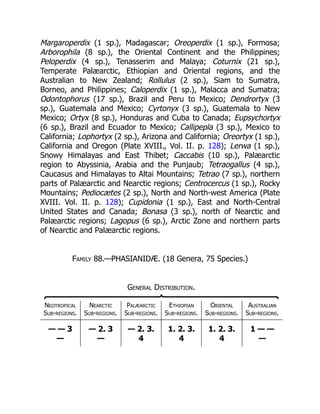
Family 88.—PHASIANIDÆ. (18 Genera, 75 Species.)
General Distribution.
Neotropical
Sub-regions.
Nearctic
Sub-regions.
Palæarctic
Sub-regions.
Ethiopian
Sub-regions.
Oriental
Sub-regions.
Australian
Sub-regions.
— — 3
—
— 2. 3
—
— 2. 3.
4
1. 2. 3.
4
1. 2. 3.
4
1 — —
—
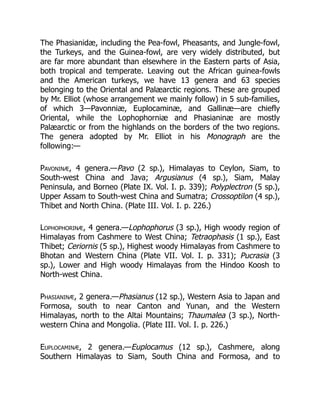
The Phasianidæ, including the Pea-fowl, Pheasants, and Jungle-fowl,
the Turkeys, and the Guinea-fowl, are very widely distributed, but
are far more abundant than elsewhere in the Eastern parts of Asia,
both tropical and temperate. Leaving out the African guinea-fowls
and the American turkeys, we have 13 genera and 63 species
belonging to the Oriental and Palæarctic regions. These are grouped
by Mr. Elliot (whose arrangement we mainly follow) in 5 sub-families,
of which 3—Pavonniæ, Euplocaminæ, and Gallinæ—are chiefly
Oriental, while the Lophophorniæ and Phasianinæ are mostly
Palæarctic or from the highlands on the borders of the two regions.
The genera adopted by Mr. Elliot in his Monograph are the
following:—
Pavoninæ, 4 genera.—Pavo (2 sp.), Himalayas to Ceylon, Siam, to
South-west China and Java; Argusianus (4 sp.), Siam, Malay
Peninsula, and Borneo (Plate IX. Vol. I. p. 339); Polyplectron (5 sp.),
Upper Assam to South-west China and Sumatra; Crossoptilon (4 sp.),
Thibet and North China. (Plate III. Vol. I. p. 226.)
Lophophorinæ, 4 genera.—Lophophorus (3 sp.), High woody region of
Himalayas from Cashmere to West China; Tetraophasis (1 sp.), East
Thibet; Ceriornis (5 sp.), Highest woody Himalayas from Cashmere to
Bhotan and Western China (Plate VII. Vol. I. p. 331); Pucrasia (3
sp.), Lower and High woody Himalayas from the Hindoo Koosh to
North-west China.
Phasianinæ, 2 genera.—Phasianus (12 sp.), Western Asia to Japan and
Formosa, south to near Canton and Yunan, and the Western
Himalayas, north to the Altai Mountains; Thaumalea (3 sp.), North-
western China and Mongolia. (Plate III. Vol. I. p. 226.)
Euplocaminæ, 2 genera.—Euplocamus (12 sp.), Cashmere, along
Southern Himalayas to Siam, South China and Formosa, and to
Welcome to our website – the perfect destination for book lovers and
knowledge seekers. We believe that every book holds a new world,
offering opportunities for learning, discovery, and personal growth.
That’s why we are dedicated to bringing you a diverse collection of
books, ranging from classic literature and specialized publications to
self-development guides and children's books.
More than just a book-buying platform, we strive to be a bridge
connecting you with timeless cultural and intellectual values. With an
elegant, user-friendly interface and a smart search system, you can
quickly find the books that best suit your interests. Additionally,
our special promotions and home delivery services help you save time
and fully enjoy the joy of reading.
Join us on a journey of knowledge exploration, passion nurturing, and
personal growth every day!
ebookbell.com


Gcse Ocr Computer Science Knowledge Organiser Cgp Books

  • 1.
    Gcse Ocr ComputerScience Knowledge Organiser Cgp Books download https://ebookbell.com/product/gcse-ocr-computer-science- knowledge-organiser-cgp-books-49843678 Explore and download more ebooks at ebookbell.com
  • 2.
    Here are somerecommended products that we believe you will be interested in. You can click the link to download. Gcse Ocr Computer Science Knowledge Retriever Cgp Books https://ebookbell.com/product/gcse-ocr-computer-science-knowledge- retriever-cgp-books-49843680 Ocr Gcse Computer Science 2nd Edition Gavin Craddock Lorne Pearcey George Rouse https://ebookbell.com/product/ocr-gcse-computer-science-2nd-edition- gavin-craddock-lorne-pearcey-george-rouse-12317680 Ocr Gcse Computer Science 2nd Revised Edition Sean Obyrne https://ebookbell.com/product/ocr-gcse-computer-science-2nd-revised- edition-sean-obyrne-5850136 New Gcse Computer Science Ocr 10minute Tests For Exams In 2022 And Beyond Includes Answers Cgp Books https://ebookbell.com/product/new-gcse-computer-science-ocr-10minute- tests-for-exams-in-2022-and-beyond-includes-answers-cgp-books-49843676
  • 3.
    Ocr Gcse 91Business Fourth Edition 4th Mike Schofield Alan Williams https://ebookbell.com/product/ocr-gcse-91-business-fourth-edition-4th- mike-schofield-alan-williams-43013000 Ocr Gcse 91 Economics 2nd Edition 2nd Jan Mileskingston https://ebookbell.com/product/ocr-gcse-91-economics-2nd-edition-2nd- jan-mileskingston-43616136 My Revision Notes Ocr Gcse 91 Economics Jan Mileskingston https://ebookbell.com/product/my-revision-notes-ocr-gcse-91-economics- jan-mileskingston-44582032 My Revision Notes Ocr Gcse 91 Psychology Paperback Mark Billingham https://ebookbell.com/product/my-revision-notes-ocr- gcse-91-psychology-paperback-mark-billingham-10642266 My Revision Notes Ocr Gcse 91 2nd Sarah Powell https://ebookbell.com/product/my-revision-notes-ocr-gcse-91-2nd-sarah- powell-7001486
  • 5.
  • 6.
    Nail all theessential GCSE facts with CGP! CGP CGP Chexnisti CGP CGP GCSE CGP Geography Retriever Spanish ForAOA GCSE Knowledge Retriever GCSE Knowledge Retriever Maths For Edexcel -Higher Level K-^ever GCSE Knowledge Organiser GCSE — Knowledge Organiser Physics GCSE Knowledge Organiser WE French For AOA Knowledge Organiser Computer Science ForOCR Our Knowledge Organisers and matching Knowledge Retrievers help all the key GCSE facts stick firmly in your brain! Out now at cgpbooks.co.uk
  • 7.
    Learn all thekey facts with CGP! Want to remember all the crucial facts for OCR GCSE Computer Science? This CGP Knowledge Organiser is here to help! We've condensed every topic down to the vital definitions, facts and diagrams, making it all easy to memorise. To check you've really got your facts straight, there's also a matching Knowledge Retriever book that'll test you on every page. CGP —still the best! © Our sole aim here at CGP is to produce the highest quality books — carefully written, immaculately presented and dangerously close to being funny. Then we work our socks off to get them out to you — at the cheapest possible prices.
  • 8.
    Contents Component 01 — ComputerSystems Section One —Components of a Computer System Computer Systems and The CPU 2 How The CPU Works 3 Memory .4 Secondary Storage 5 System Software — The OS 6 System Software — Utilities 7 SectionTwo —Data Representation Number Systems 8 Converting Hexadecimal 9 Using Binary 1O Units and Compression 11 Characters 12 Storing Images 13 Storing Sound 14 SectionThree —Networks Types of Network 15 Network Hardware 16 Networks and Topologies 17 Network Protocols 18 Internet Services 19 Network Security Threats 20 Network Security Measures 21 Section Four —Issues Privacy and Ethical Issues 22 Cultural Issues and Wellbeing 23 Environmental Issues 24 Legislation and Licensing 25 Component 02 —Computational Thinking, Algorithms and Programming Section Five —Algorithms Computational Thinking &■ Pseudocode 26 Flowcharts 27 Search Algorithms 28 Bubble Sort and Insertion Sort 29 Merge Sort 30 Section Six —Programming Data Types &- Random Numbers 31 Operators 32 Boolean Logic 33 Variables and Strings 34 Selection 35 Iteration 36 Checking Multiple Conditions 37 Arrays 38 File Handling 39 Storing and Searching Data .40 Sub Programs 41
  • 9.
    Section Seven —Design, Testingand IDEs Structured Programming 42 Defensive Design 43 Errors and Trace Tables 44 Testing 45 Languages, Translators IDEs 46 Published by CGP. Based on the classic CGP style created by Richard Parsons. Editors: Martha Bozic, Michael Bushell, Shaun Harrogate, Andy Hurst. With thanks to Sammy El-Bahrawy and Shaun Whorton for the proofreading. With thanks to Alice Dent for the copyright research. ISBN: 978 1 78908 949 3 Exam Reference Language OCR April 2020. OCR maintains the current version of the Exam Reference Language and specification on the OCR website. You should always check for the latest version and any updates, (https:/ /www.ocr.org.uk/qualifications/gcse/computer-science-j277-from-2020/) Printed by Elanders Ltd, Newcastle upon Tyne. Clipart from Corel® Text, design, layout and original illustrations © Coordination Group Publications Ltd (CGP) 2022 All rights reserved. Photocopying more than one section of this book is not permitted, even if you have a CLA licence. Extra copies are available from CGP with next day delivery. • 0800 1712 712 • www.cgpbooks.co.uk
  • 10.
    2 Section One—Components of a Computer System Computer Systems and The CPU Computer Systems HARDWARE — the physical stuff in a computer system, e.g. keyboard, CPU, etc. SOFTWARE — the programs that a computer system runs, e.g. operating system, games, web browser, etc. EMBEDDED SYSTEMS — computers built into other devices, usually as control systems. E.g. they could control: Dishwashers Microwaves Sat navs 1 1 1 1 1 1 1 1 1 1 1 1 11/„ - External pieces C ~ of hardware like - - a keyboard or - ; mouse are called Z ~ peripherals. - x/|l I I l l l I I l I II They're usually easier to design, cheaper to produce, and more efficient at their task than general purpose systems. Four Common CPU Components CENTRAL PROCESSING UNIT (CPU) — where a computer processes all data and instructions. (2) if (CU) — controls the flow of data in and out of the CPU. Manages the fetching, decoding and execution of instructions. (Bb Arithmetic Logic Unit (ALU) — does calculations including addition, subtraction, multiplication and division. Also performs binary shifts and logic operations. (22) — stores regularly used data for quick access. Low capacity and expensive. There are three levels of cache memory: L1 = L2 -£>L3 Decreasing speed, increasing capacity — temporarily hold small amounts of data. They're extremely fast to read/write to. Three Factors Affecting CPU Performance o Number of cores — each core processes data independently, so more cores means more instructions can be carried out per second. Some software is designed to take advantage of multicore processing. Clock speed — the number of instructions a single processor core can carry out per second. Cache size — a larger CPU cache gives the CPU faster access to more data. l III I I II I IIIII S Generally, CPUs - - with more cores, — - higher clock speeds - ~ and larger caches 2 - will have better 3 ~ performance, but - ~ cost more. r / 1 1 1 1 1 1 1 1 1 1 1 n 1 1 M Section One —Components of a Computer System
  • 11.
    Random documents withunrelated content Scribd suggests to you:
  • 12.
    America, Africa, andAsia. In the absence of palæontological evidence as to the former history of the Megalæmidæ, we are unable to say positively, whether it owes its present distribution to a former closer union between these continents in intertropical latitudes, or to a much greater northern range of the group at the period when a luxuriant sub-tropical vegetation extended far toward the Arctic regions; but the discovery of Trogon in the Miocene deposits of the South of France renders it almost certain that the latter is the true explanation in the case of both these families. The Neotropical region, owing to its enormous family of humming- birds, is by far the richest in Picariæ, possessing nearly half the total number of species, and a still larger proportion of genera. Three families, the Bucerotidæ, Meropidæ and Coraciidæ are equally characteristic of the Oriental and Ethiopian regions, a few outlying species only entering the Australian or the Palæarctic regions. One family (Todidæ) is confined to the West Indian Islands; and another (Leptosomidæ) consisting of but a single species, to Madagascar; parallel cases to the Drepanididæ among the Passeres, peculiar to the Sandwich Islands, and the Apterygidæ among the Struthiones, peculiar to New Zealand. Order III.—PSITTACI. The Parrots have been the subject of much difference of opinion among ornithologists, and no satisfactory arrangement of the order into families and genera has yet been reached. Professor Garrod has lately examined certain points in the anatomy of a large number of genera, and proposes to revolutionize the ordinary classifications. Until, however, a general examination of their whole anatomy, internal and external, has been made by some competent authority, it will be unsafe to adopt the new system, as we have as yet no guide to the comparative value of the characters made use of. I therefore keep as much as possible to the old groups, founded on
  • 13.
    external characters, onlyusing the indications furnished by Professor Garrod's paper, to determine the position of doubtful genera. Family 76.—CACATUIDÆ. (5 Genera, 35 Species.) General Distribution. Neotropical Sub-regions. Nearctic Sub-regions. Palæarctic Sub-regions. Ethiopian Sub-regions. Oriental Sub-regions. Australian Sub-regions. — — — — — — — — — — — — — — — — — — — 4 1. 2 — — The Cacatuidæ, Plyctolophidæ, or Camptolophidæ, as they have been variously termed, comprise all those crested parrots usually termed Cockatoos, together with one or two doubtful forms. They are very abundant in the Australian region, more especially in the Austro-Malayan portion of it, one species inhabiting the Philippine Islands; but they do not pass further east than the Solomon Islands and are not found in New Zealand. The distribution of the genera is as follow:— Cacatua (18 sp.), ranges from the Philippine Islands, Celebes and Lombok, to the Solomon Islands and to Tasmania; Calopsitta (1 sp.), Australia; Calyptorhynchus (8 sp.), is confined to Australia and Tasmania; Microglossus (2 sp.), (perhaps a distinct family) to the Papuan district and North Australia; Licmetis (3 sp.), Australia, Solomon Islands, and (?) New Guinea; Nasiterna (3 sp.), a minute form, the smallest of the whole order, and perhaps not belonging to this family, is only known from the Papuan and Solomon Islands.
  • 14.
    Family 77.—PLATYCERCIDÆ. (11Genera, 57 Species.) General Distribution. Neotropical Sub-regions. Nearctic Sub-regions. Palæarctic Sub-regions. Ethiopian Sub-regions. Oriental Sub-regions. Australian Sub-regions. — — — — — — — — — — — — — — — — — — — — 1. 2. 3. 4 The Platycercidæ comprise a series of large-tailed Parrots, of weak structure and gorgeous colours, with a few ground-feeding genera of more sober protective tints; the whole family being confined to the Australian region. The genera are:— (1996 1999 2000) Platycercus (14 sp.), Australia, Tasmania, and Norfolk Island; Psephotus (6 sp.), Australia; Polytelis (3 sp.), Australia; Nymphicus (1 sp.), Australia and New Caledonia; (2002 2003) Aprosmictus (6 sp.), Australia, Papua, Timor, and Moluccas; Pyrrhulopsis (3 sp.), Tonga and Fiji Islands; Cyanoramphus (14 sp.), New Zealand, Norfolk Island, New Caledonia, and Society Islands; Melopsittacus (1 sp.), Australia; Euphema (7 sp.), Australia; Pezoporus (1 sp.), Australia and Tasmania; Geopsittacus (1 sp.), West Australia. The four last genera are ground-feeders, and are believed by Professor Garrod to be allied to the Owl-Parrot of New Zealand (Stringops). Family 78.—PALÆORNITHIDÆ. (8 Genera, 65 Species.) General Distribution.
  • 15.
    Neotropical Sub-regions. Nearctic Sub-regions. Palæarctic Sub-regions. Ethiopian Sub-regions. Oriental Sub-regions. Australian Sub-regions. — — — — —— — — — — — — 1. 2 — 4 1. 2. 3. 4 1. 2 — — I class here a group of birds brought together, for the most part, by geographical distribution as well as by agreement in internal structure, but which is nevertheless of a very uncertain and provisional character. Palæornis (18 sp.), the Oriental region, Mauritius, Rodriguez, and Seychelle Islands, and a species in Tropical Africa, apparently identical with the Indian P. torquatus, and therefore—considering the very ancient intercourse between the two countries, and the improbability of the species remaining unchanged if originating by natural causes—most likely the progeny of domestic birds introduced from India. Prioniturus (3 sp.), Celebes and the Philippine Islands; (2061) Geoffroyus (5 sp.), Bouru to Timor and the Solomon Islands; Tanygnathus (5 sp.), Philippines, Celebes, and Moluccas to New Guinea; Eclectus (8 sp.), Moluccas and Papuan Islands; Psittinus (1 sp.), Tenasserim to Sumatra and Borneo; Cyclopsitta (8 sp.), Papuan Islands, Philippines and North-east Australia; Loriculus (17 sp.), ranges over the whole Oriental region to Flores, the Moluccas, and the Papuan island of Mysol; but most of the species are concentrated in the district including the Philippines, Celebes, Gilolo, and Flores, there being 1 in India, 1 in South China, 1 in Ceylon, 1 in Java, 1 in Malacca, Sumatra, and Borneo, 3 in Celebes, 5 in the Philippines, and the rest in the Moluccas, Mysol, and Flores. This genus forms a transition to the next family. Family 79.—TRICHOGLOSSIDÆ. (6 Genera, 57 Species.)
  • 16.
    General Distribution. Neotropical Sub-regions. Nearctic Sub-regions. Palæarctic Sub-regions. Ethiopian Sub-regions. Oriental Sub-regions. Australian Sub-regions. — —— — — — — — — — — — — — — — — — — — 1. 2. 3 — The Trichoglossidæ, or Brush-tongued Paroquets, including the Lories, are exclusively confined to the Australian region, where they extend from Celebes to the Marquesas Islands, and south to Tasmania. The genus Nanodes (= Lathamus) has been shown by Professor Garrod to differ from Trichoglossus in the position of the carotid arteries. I therefore make it a distinct genus but do not consider that it should be placed in another family. The genera here admitted are as follows:— Trichoglossus (29 sp.), ranges over the whole Austro-Malay and Australian sub-regions, and to the Society Islands; (2047) Nanodes (1 sp.), Australia and Tasmania; Charmosyna (1 sp.), New Guinea (Plate X. Vol. I. p. 414); Eos (9 sp.), Bouru and Sanguir Island north of Celebes, to the Solomon Islands, and in Puynipet Island to the north- east of New Ireland; (2039 2040) Lorius (13 sp.), Bouru and the Solomon Islands; (2041 2043) Coriphilus (4 sp.), Samoa, Tonga, Society and Marquesas Islands. Family 80.—CONURIDÆ. (7 Genera, 79 Species.) General Distribution. Neotropical Sub-regions. Nearctic Sub-regions. Palæarctic Sub-regions. Ethiopian Sub-regions. Oriental Sub-regions. Australian Sub-regions.
  • 17.
    1. 2. 3. 4 —— 3 — — — — — — — — — — — — — — — — — The Conuridæ, which consist of the Macaws and their allies, are wholly confined to America, ranging from the Straits of Magellan to South Carolina and Nebraska, with Cuba and Jamaica. Professor Garrod places Pyrrhura (which has generally been classed as a part of the genus Conurus) in a separate family, on account of the absence of the ambiens muscle of the knee, but as we are quite ignorant of the classificational value of this character, it is better for the present to keep both as distinct genera of the same family. The genera are:— Ara (15 sp.), Paraguay to Mexico and Cuba; Rhyncopsitta (1 sp.), Mexico; Henicognathus (1 sp.), Chili; Conurus (30 sp.), the range of the family; Pyrrhura (16 sp.), Paraguay and Bolivia to Costa Pica; Bolborhynchus (7 sp.), La Plata, Bolivia and West Peru, with one species in Mexico and Guatemala; Brotogerys (9 sp.), Brazil to Mexico. Family 81.—PSITTACIDÆ.—(12 Genera, 87 Species.) General Distribution. Neotropical Sub-regions. Nearctic Sub-regions. Palæarctic Sub-regions. Ethiopian Sub-regions. Oriental Sub-regions. Australian Sub-regions. — 2. 3. 4 — — — — — — — — 1. 2. 3. 4 — — — — — — — —
  • 18.
    The Psittacidæ comprisea somewhat heterogeneous assemblage of Parrots and Paroquets of the Neotropical and Ethiopian regions, which are combined here more for convenience than because they are believed to form a natural group. The genera Chrysotis and Pionus have no oil-gland, while Psittacula and Agapornis have lost the furcula, but neither of these characters are probably of more than generic value. The genera are:— Psittacus (2 sp.), West Africa; Coracopsis (5 sp.), Madagascar, Comoro, and Seychelle Islands; Pæocephalus (9 sp.), all Tropical and South Africa; (2063—2066) Caica (9 sp.), Mexico to Amazonia; Chrysotis (32 sp.), Paraguay to Mexico and the West Indian Islands; Triclaria (1 sp.), Brazil; Deroptyus (1 sp.), Amazonia; Pionus (9 sp.), Paraguay to Mexico; Urochroma (7 sp.), Tropical South America; Psittacula (6 sp.), Brazil to Mexico; Poliopsitta (2 sp.), Madagascar and West Africa; Agapornis (4 sp.), Tropical and South Africa. Family 82.—NESTORIDÆ. (? 2 Genera, 6 Species.) General Distribution. Neotropical Sub-regions. Nearctic Sub-regions. Palæarctic Sub-regions. Ethiopian Sub-regions. Oriental Sub-regions. Australian Sub-regions. — — — — — — — — — — — — — — — — — — — — 1 — — 4 The present family is formed to receive the genus Nestor (5 sp.), confined to New Zealand and Norfolk Island. Its affinities are doubtful, but it appears to have relations with the American Conuridæ and the Australian Trichoglossidæ. With it is placed the
  • 19.
    rare and remarkableDasyptilus (1 sp.), of New Guinea, of which however very little is known. Family 83.—STRINGOPIDÆ. (1 Genus, 2 Species.) General Distribution. Neotropical Sub-regions. Nearctic Sub-regions. Palæarctic Sub-regions. Ethiopian Sub-regions. Oriental Sub-regions. Australian Sub-regions. — — — — — — — — — — — — — — — — — — — — — — — 4 This family contains only the curious owl-like nocturnal Parrot of New Zealand, Stringops habroptilus (Plate XIII. Vol. I. p. 455). An allied species is said to inhabit the Chatham Islands, if not now extinct. General Remarks on the Distribution of the Psittaci. Although the Parrots are now generally divided into several distinct families, yet they form so well marked and natural a group, and are so widely separated from all other birds, that we may best discuss their peculiarities of geographical distribution by treating them as a whole. By the preceding enumeration we find that there are about 386 species of known parrots, which are divided into 52 genera. They are pre-eminently a tropical group, for although a few species extend a considerable distance into the temperate zone, these are marked exceptions to the rule which limits the parrot tribe to the tropical and sub-tropical regions, roughly defined as extending about 30° on each side of the equator. In America a species of Conurus reaches the straits of Magellan on the south, while another inhabits
  • 20.
    the United States,and once extended to the great lakes, although now confined to the south-eastern districts. In Africa parrots do not reach the northern tropic, owing to the desert nature of the country; and in the south they barely reach the Orange River. In India they extend to about 35° N. in the western Himalayas; and in the Australian region, not only to New Zealand but to Macquarie Islands in 54° S., the farthest point from the equator reached by the group. But although found in all the tropical regions they are most unequally distributed. Africa is poorest, possessing only 6 genera and 25 species; the Oriental region is also very poor, having but 6 genera and 29 species; the Neotropical region is much richer, having 14 genera and 141 species; while the smallest in area and the least tropical in climate—the Australian region, possesses 31 genera and 176 species, and it also possesses exclusively 5 of the families, Trichoglossidæ, Platycercidæ, Cacatuidæ, Nestoridæ, and Stringopidæ. The portion of the earth's surface that contains the largest number of parrots in proportion to its area is, undoubtedly, the Austro-Malayan sub-region, including the islands from Celebes to the Solomon Islands. The area of these islands is probably not one- fifteenth of that of the four tropical regions, yet they contain from one-fifth to one-fourth of all the known parrots. In this area too are found many of the most remarkable forms,—all the crimson lories, the great black Cockatoos, the pigmy Nasiterna, the raquet-tailed Prioniturus, and the bareheaded Dasyptilus. The almost universal distribution of Parrots wherever the climate is sufficiently mild or uniform to furnish them with a perennial supply of food, no less than their varied details of organization, combined with a great uniformity of general type,—tell us, in unmistakable language, of a very remote antiquity. The only early record of extinct parrots is, however, in the Miocene of France, where remains apparently allied to the West African Psittacus, have been found. But the origin of so widespread, isolated, and varied a group, must be far earlier than this, and not improbably dates back beyond the dawn of the Tertiary period. Some primeval forms may have entered the
  • 21.
    Australian region withthe Marsupials, or not long after them; while perhaps at a somewhat later epoch they were introduced into South America. In these two regions they have greatly flourished, while in the two other tropical regions only a few types have been found, capable of maintaining themselves, among the higher forms of mammalia, and in competition with a more varied series of birds. This seems much more probable than the supposition that so highly organized a group should have originated in the Australian region, and subsequently become so widely spread over the globe. Order IV.—COLUMBÆ. Family 84.—COLUMBIDÆ. (44 Genera, 355 Species.) General Distribution. Neotropical Sub-regions. Nearctic Sub-regions. Palæarctic Sub-regions. Ethiopian Sub-regions. Oriental Sub-regions. Australian Sub-regions. 1. 2. 3. 4 1. 2. 3. 4 1. 2. 3. 4 1. 2. 3. 4 1. 2. 3. 4 1. 2. 3. 4 The Columbidæ, or Pigeons and Doves, are almost universally distributed, but very unequally in the different regions. Being best adapted to live in warm or temperate climates, they diminish rapidly northwards, reaching about 62° N. Latitude in North America, but considerably farther in Europe. Both the Nearctic and Palæarctic regions are very poor in genera and species of pigeons, those of the former region being mostly allied to Neotropical, and those of the latter to Oriental and Ethiopian types. The Ethiopian region is, however, itself very poor, and several of its peculiar forms are confined to the Madagascar sub-region. The Neotropical region is
  • 22.
    very rich inpeculiar genera, though but moderately so in number of species. The Oriental region closely approaches it in both respects; but the Australian region is by far the richest, possessing nearly double the genera and species of any other region, and abounding in remarkable forms quite unlike those of any other part of the globe. The following table gives the number of genera and species in each region, and enables us readily to determine the comparative richness and isolation of each, as regards this extensive family:— Regions. No. of Genera. Peculiar Genera. No. of Species. Neotropical 13 9 75 Nearctic 5 1 7 Palæarctic 3 0 9 Ethiopian 6 1 37 Oriental 12 1 66 Australian 24 14 148 With the exception of Columba and Turtur, which have a wide range, Treron, common to the Oriental and Ethiopian regions, and Carpophaga, to the Oriental and Australian, most of the genera of pigeons are either restricted to or very characteristic of a single region. The distribution of the genera here admitted is as follows:— Treron (37 sp.), the whole Oriental region, and eastward to Celebes, Amboyna and Flores, also the whole Ethiopian region to Madagascar; Ptilopus (52 sp.), the Australian region (excluding New Zealand) and the Indo-Malay sub-region; Alectrœnas (4 sp.), Madagascar and the Mascarene Islands; Carpophaga (50 sp.), the whole Australian and Oriental regions, but much the most abundant in the former; (2274) Ianthœnas (11 sp.), Japan, Andaman, Nicobar, and Philippine Islands, Timor and Gilolo to Samoa Islands; (2278) Leucomelæna (1 sp.), Australia; Lopholaimus (1 sp.), Australia; (2279 and 2283)
  • 23.
    Alsæcomus (2 sp.),Himalayas to Ceylon and Tenasserim; Columba (46 sp.), generally distributed over all the regions except the Australian, one species however in the Fiji Islands; Ectopistes (1 sp.), east of North America with British Columbia; Zenaidura (2 sp.), Veragua to Canada and British Columbia; Œna (1 sp.), Tropical and South Africa; Geopelia (6 sp.), Philippine Islands and Java to Australia; Macropygia (14 sp.), Nepal, Hainan, Nicobar, Java, and Philippines to Australia and New Ireland; Turacœna (3 sp.), Celebes, Timor, and Solomon Islands; Reinwardtœnas (1 sp.), Celebes to New Guinea; Turtur (24 sp.), Palæarctic, Ethiopian and Oriental regions with Austro-Malaya; Chæmepelia (7 sp.), Brazil and Bolivia to Jamaica, California, and South-east United States; Columbula (2 sp.), Brazil and La Plata to Chili; Scardafella (2 sp.), Brazil and Guatemala; Zenaida (10 sp.), Chili and La Plata to Columbia and the Antilles, Fernando Noronha; Melopelia (2 sp.), Chili to Mexico and California; Peristera (4 sp.), Brazil to Mexico; Metriopelia (2 sp.), West America from Ecuador to Chili; Gymnopelia (1 sp.), West Peru and Bolivia; Leptoptila (11 sp.), Paraguay to Mexico and the Antilles; (2317 2318 and 2820) Geotrygon (14 sp.), Paraguay to Mexico and the Antilles; Aplopelia (5 sp.), Tropical and South Africa, St. Thomas and Princes Island; Chalocopelia (4 sp.), Tropical and South Africa; Starnœnas (1 sp.), Cuba; Ocyphaps (1 sp.), Australia (Plate XII. Vol. I. p. 441); Petrophassa (1 sp.), North-west Australia; Chalocophaps (8 sp.), the Oriental region to New Guinea and Australia; Trugon (1 sp.), New Guinea; Henicophaps (1 sp.), Waigiou and New Guinea; Phaps (3 sp.), Australia and Tasmania; Leucosarcia (1 sp.), East Australia; Phapitreron (2 sp.), Philippine Islands; Geophaps (2 sp.), North and East Australia; Lophophaps (3 sp.), Australia; Calœnas (1 sp.), scattered on the smaller islands from the Nicobars and Philippines to New Guinea; Otidiphaps (1 sp.), New Guinea; Phlogœnas (7 sp.), Philippine Islands and Celebes to the Marquesas Islands; Goura (2 sp.), New Guinea and the islands on the north-east (Plate X. Vol. I. p. 414).
  • 24.
    Family 84a.—DIDUNCULIDÆ. (1Genus, 1 Species.) General Distribution. Neotropical Sub-regions. Nearctic Sub-regions. Palæarctic Sub-regions. Ethiopian Sub-regions. Oriental Sub-regions. Australian Sub-regions. — — — — — — — — — — — — — — — — — — — — — — 3 — The Didunculus stigirostris, a hook-billed ground-pigeon, found only in the Samoa Islands, is so peculiar in its structure that it is considered to form a distinct family. Family 85.—DIDIDÆ.—(2 Genera, 3 Species.) General Distribution. Neotropical Sub-regions. Nearctic Sub-regions. Palæarctic Sub-regions. Ethiopian Sub-regions. Oriental Sub-regions. Australian Sub-regions. — — — — — — — — — — — — — — — 4 — — — — — — — — The birds which constitute this family are now all extinct; but as numerous drawings are in existence, taken from living birds some of which were exhibited in Europe, and a stuffed specimen, fragments of which still remain, was in the Ashmolean Museum at Oxford down to 1755, they must be classed among recent, as opposed to geologically extinct species. The Dodo (Didus ineptus) a large, unwieldy, flightless bird, inhabited Mauritius down to the latter part
  • 25.
    of the 17thcentury; and an allied form, the Solitaire (Pezophaps solitaria), was found only in the island of Rodriguez, where it survived about a century later. Old voyagers mention a Dodo also in Bourbon, and a rude figure of it exists; but no remains of this bird have been found. Almost complete skeletons of the Dodo and Solitaire have, however, been recovered from the swamps of Mauritius and the caves of Rodriguez, proving that they were both extremely modified forms of pigeon. These large birds were formerly very abundant, and being excellent eating and readily captured, the early voyagers to these islands used them largely for food. As they could be caught by man, and very easily by dogs, they were soon greatly diminished in numbers; and the introduction of swine, which ran wild in the forests and fed on the eggs and young birds, completed their extermination. The existence in the Mascarene Islands of a group of such remarkable terrestrial birds, with aborted wings, is parallel to that of the Apteryx and Dinornis in New Zealand, the Cassowaries of Austro- Malaya, and the short-winged Rails of New Zealand, Tristan d'Acunha, and other oceanic islands; and the phenomenon is clearly dependent on the long-continued absence of enemies, which allowed of great increase of bulk and the total loss of the power of flight, without injury. In some few cases (the Ostrich for example) birds incapable of flight co-exist with large carnivorous mammalia; but these birds are large and powerful, as well as very swift, and are thus able to escape from some enemies and defend themselves against others. The entire absence of the smaller and more defenceless ground-birds from the adjacent island of Madagascar, is quite in accordance with this view, because that island has several small but destructive carnivorous animals. General Remarks on the Distribution of the Columbæ.
  • 26.
    The striking preponderanceof Pigeons, both as to genera and species, in the Australian region, would seem to indicate that at some former period it possessed a more extensive land area in which this form of bird-life took its rise. But there are other considerations which throw doubt upon this view. The western half of the Malay Archipelago, belonging to the Oriental region, is also rich in pigeons, since it has 43 species belonging to 11 genera, rather more than are found in all the rest of the Oriental region. Again, we find that the Mascarene Islands and the Antilles both possess more pigeons than we should expect, in proportion to those of the regions to which they belong, and to their total amount of bird-life. This looks as if islands were more favourable to pigeon-development than continents; and if we group together the Pacific and the Malayan Islands, the Mascarene group and the Antilles, we find that they contain together about 170 species of pigeons belonging to 24 out of the 47 genera here adopted; while all the great continents united only produce about the same number of species belonging (if we omit those peculiar to Australia) to only 20 genera. The great development of the group in the Australian region may, therefore, be due to its consisting mainly of islands, and not to the order having originated there, and thus having had a longer period in which to develop. I have elsewhere suggested (Ibis 1865, p. 366) a physical cause for this peculiarity of distribution. Pigeons build rude, open nests, and their young remain helpless for a considerable period. They are thus exposed to the attacks of such arboreal quadrupeds or other animals as feed on eggs or young birds. Monkeys are very destructive in this respect; and it is a noteworthy fact that over the whole Australian region, the Mascarene Islands and the Antilles, monkeys are unknown. In the Indo-Malay sub-region, where monkeys are generally plentiful, the greatest variety of pigeons occurs in the Philippines, where there is but a single species in one island; and in Java, where monkeys are far less numerous than in Sumatra or Borneo. If we add to this consideration the fact, that mammalia and rapacious birds are, as a rule, far less abundant in islands than on continents; and that the extreme development of pigeon-life is reached in the Papuan group of islands, in which mammalia (except
  • 27.
    a few marsupials,bats, and pigs) are wholly absent, we see further reason to adopt this view. It is also to be noted that in America, comparatively few pigeons are found in the rich forests (comparable to those of the Australian insular region in which they abound), but are mostly confined to the open campos, the high Andes, and the western coast districts, from which the monkey-tribe are wholly absent. This view is further supported by the great development of colour that is found in the pigeons of these insular regions, culminating in the golden-yellow fruit-dove of the Fiji Islands, the metallic green Nicobar-pigeon of Malaya, and the black and crimson Alectrœnas of Mauritius. Here also, alone, we meet with crested pigeons, rendering the possessors more conspicuous; such as the Lopholaimus of Australia and the crowned Goura of New Guinea; and here too are more peculiar forms of terrestrial pigeons than elsewhere, though none have completely lost the power of flight but the now extinct Dididæ. The curious liking of pigeons for an insular habitat is well shown in the genera Ianthœnas and Calœnas. The former, containing 11 species, ranges over a hundred degrees of longitude, and forty-five of latitude, extending into three regions, yet nowhere inhabits a continent or even a large island. It is found in the Andaman and Nicobar Islands; in the Philippines, Gilolo, and the smaller Papuan Islands, and in Japan; yet not in any of the large Malay Islands or in Australia. The other genus, Calœnas, consists of but a single species, yet this ranges from the Nicobar Islands to New Guinea. It is not, however, as far as known, found on any of the large islands, but seems to prefer the smaller islands which surround them. We here have the general preference of pigeons for islands, further developed in these two genera into a preference for small islands; and it is probable that the same cause—the greater freedom from danger— has produced both phenomena.
  • 28.
    Of the geologicalantiquity of the Columbæ we have no evidence; but their wide distribution, their varied forms, and their great isolation, all point to an origin, at least as far back as that we have assigned as probable in the case of the Parrots. Order V.—GALLINÆ. Family 86.—PTEROCLIDÆ. (2 Genera, 16 Species.) General Distribution. Neotropical Sub-regions. Nearctic Sub-regions. Palæarctic Sub-regions. Ethiopian Sub-regions. Oriental Sub-regions. Australian Sub-regions. — — — — — — — — — 2. 3. 4 1 — 3. 4 1 — — — — — — — The Pteroclidæ, or Sand-grouse, are elegantly formed birds with pointed tails, and plumage of beautifully varied protective tints, characteristic of the Ethiopian region and Central Asia, though extending into Southern Europe and Hindostan. Being pre-eminently desert-birds, they avoid the forest-districts of all these countries, but abound in the most arid situations and on the most open and barren plains. The distribution of the genera is as follows:— Pterocles (14 sp.), has the same range as the family; Syrrhaptes (2 sp.), normally inhabits Tartary, Thibet, and Mongolia to the country around Pekin, and occasionally visits Eastern Europe. But a few years back (1863) great numbers suddenly appeared in Europe and extended westward to the shores of the Atlantic, while some even reached Ireland and the Færoes. (Plate III. Vol. I. p. 226.)
  • 29.
    Family 87.—TETRAONIDÆ. (29Genera, 170 Species.) General Distribution. Neotropical Sub-regions. Nearctic Sub-regions. Palæarctic Sub-regions. Ethiopian Sub-regions. Oriental Sub-regions. Australian Sub-regions. — 2. 3. 4 1. 2. 3. 4 1. 2. 3. 4 1. 2. 3. 4 1. 2. 3. 4 1. 2 — 4. The Tetraonidæ, including the Grouse, Partridges, Quails, and allied forms, abound in all parts of the Eastern continents; they are less plentiful in North America and comparatively scarce in South America, more than half the Neotropical species being found north of Panama; and in the Australian region there are only a few of small size. The Ethiopian region probably contains most species; next comes the Oriental—India proper from the Himalayas to Ceylon having twenty; while the Australian region, with 15 species, is the poorest. These facts render it probable that the Tetraonidæ are essentially denizens of the great northern continents, and that their entrance into South America, Australia, and even South Africa, is, comparatively speaking, recent. They have developed into forms equally suited to the tropical plains and the arctic regions, some of them being among the few denizens of the extreme north, as well as of the highest alpine snows. The genera are somewhat unsettled, and there is even some uncertainty as to the limits between this family and the next; but the following are those now generally admitted:— Ptilopachus (1 sp.), West Africa; Francolinus (34 sp.), all Africa, South Europe, India to Ceylon, and South China; Ortygornis (3 sp.), Himalayas to Ceylon, Sumatra, and Borneo; Peliperdix (1 sp.), West Africa; Perdix (3 sp.), the whole Continental Palæarctic region;
  • 30.
    Margaroperdix (1 sp.),Madagascar; Oreoperdix (1 sp.), Formosa; Arborophila (8 sp.), the Oriental Continent and the Philippines; Peloperdix (4 sp.), Tenasserim and Malaya; Coturnix (21 sp.), Temperate Palæarctic, Ethiopian and Oriental regions, and the Australian to New Zealand; Rollulus (2 sp.), Siam to Sumatra, Borneo, and Philippines; Caloperdix (1 sp.), Malacca and Sumatra; Odontophorus (17 sp.), Brazil and Peru to Mexico; Dendrortyx (3 sp.), Guatemala and Mexico; Cyrtonyx (3 sp.), Guatemala to New Mexico; Ortyx (8 sp.), Honduras and Cuba to Canada; Eupsychortyx (6 sp.), Brazil and Ecuador to Mexico; Callipepla (3 sp.), Mexico to California; Lophortyx (2 sp.), Arizona and California; Oreortyx (1 sp.), California and Oregon (Plate XVIII., Vol. II. p. 128); Lerwa (1 sp.), Snowy Himalayas and East Thibet; Caccabis (10 sp.), Palæarctic region to Abyssinia, Arabia and the Punjaub; Tetraogallus (4 sp.), Caucasus and Himalayas to Altai Mountains; Tetrao (7 sp.), northern parts of Palæarctic and Nearctic regions; Centrocercus (1 sp.), Rocky Mountains; Pediocætes (2 sp.), North and North-west America (Plate XVIII. Vol. II. p. 128); Cupidonia (1 sp.), East and North-Central United States and Canada; Bonasa (3 sp.), north of Nearctic and Palæarctic regions; Lagopus (6 sp.), Arctic Zone and northern parts of Nearctic and Palæarctic regions. Family 88.—PHASIANIDÆ. (18 Genera, 75 Species.) General Distribution. Neotropical Sub-regions. Nearctic Sub-regions. Palæarctic Sub-regions. Ethiopian Sub-regions. Oriental Sub-regions. Australian Sub-regions. — — 3 — — 2. 3 — — 2. 3. 4 1. 2. 3. 4 1. 2. 3. 4 1 — — —
  • 31.
    The Phasianidæ, includingthe Pea-fowl, Pheasants, and Jungle-fowl, the Turkeys, and the Guinea-fowl, are very widely distributed, but are far more abundant than elsewhere in the Eastern parts of Asia, both tropical and temperate. Leaving out the African guinea-fowls and the American turkeys, we have 13 genera and 63 species belonging to the Oriental and Palæarctic regions. These are grouped by Mr. Elliot (whose arrangement we mainly follow) in 5 sub-families, of which 3—Pavonniæ, Euplocaminæ, and Gallinæ—are chiefly Oriental, while the Lophophorniæ and Phasianinæ are mostly Palæarctic or from the highlands on the borders of the two regions. The genera adopted by Mr. Elliot in his Monograph are the following:— Pavoninæ, 4 genera.—Pavo (2 sp.), Himalayas to Ceylon, Siam, to South-west China and Java; Argusianus (4 sp.), Siam, Malay Peninsula, and Borneo (Plate IX. Vol. I. p. 339); Polyplectron (5 sp.), Upper Assam to South-west China and Sumatra; Crossoptilon (4 sp.), Thibet and North China. (Plate III. Vol. I. p. 226.) Lophophorinæ, 4 genera.—Lophophorus (3 sp.), High woody region of Himalayas from Cashmere to West China; Tetraophasis (1 sp.), East Thibet; Ceriornis (5 sp.), Highest woody Himalayas from Cashmere to Bhotan and Western China (Plate VII. Vol. I. p. 331); Pucrasia (3 sp.), Lower and High woody Himalayas from the Hindoo Koosh to North-west China. Phasianinæ, 2 genera.—Phasianus (12 sp.), Western Asia to Japan and Formosa, south to near Canton and Yunan, and the Western Himalayas, north to the Altai Mountains; Thaumalea (3 sp.), North- western China and Mongolia. (Plate III. Vol. I. p. 226.) Euplocaminæ, 2 genera.—Euplocamus (12 sp.), Cashmere, along Southern Himalayas to Siam, South China and Formosa, and to
  • 32.
    Welcome to ourwebsite – the perfect destination for book lovers and knowledge seekers. We believe that every book holds a new world, offering opportunities for learning, discovery, and personal growth. That’s why we are dedicated to bringing you a diverse collection of books, ranging from classic literature and specialized publications to self-development guides and children's books. More than just a book-buying platform, we strive to be a bridge connecting you with timeless cultural and intellectual values. With an elegant, user-friendly interface and a smart search system, you can quickly find the books that best suit your interests. Additionally, our special promotions and home delivery services help you save time and fully enjoy the joy of reading. Join us on a journey of knowledge exploration, passion nurturing, and personal growth every day! ebookbell.com