HEALTH, SAFETY &
ENVIRONMENT.
ORIENTATION PRESENTATION
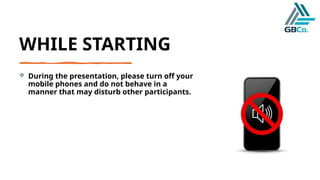
WHILE STARTING
 During the presentation, please turn off your
mobile phones and do not behave in a
manner that may disturb other participants.
3
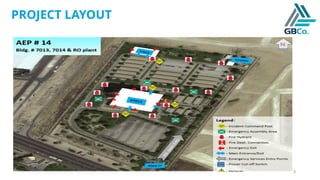
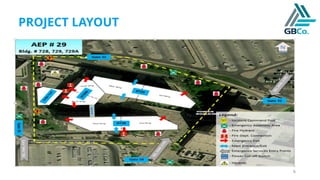
PROJECT LAYOUT
4
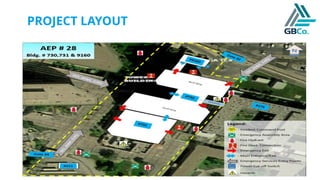
PROJECT LAYOUT
5
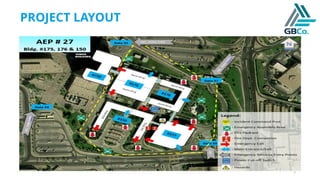
PROJECT LAYOUT
6
PROJECT LAYOUT
GOALS OF TRAINING
Ensuring that all employees in the project are aware of the
dangers and Risk in the environment:
 Raising awareness of the dangers in our project.
 Health, Safety & Environment (HSE) Standards of the
Project.
 Ensuring Employees' adherence to Life Saving Standards
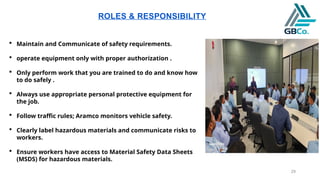
and Keeping the Project Free from ACCIDENTS and
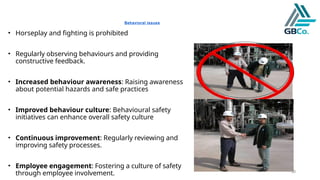
INJURIES.
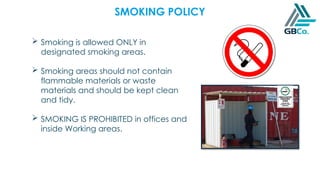
 Muhammad Saad Al-Ghurairy & Bro. is committed to providing a safe and
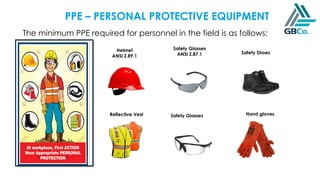
healthy workplace, carrying out its business activities in a way that
protects the environment and acting in accordance with the following
principles:
 Be responsible for Health, Safety, Environment and Quality at all levels of
the organization and comply with relevant legislation, regulations,
standards and customer satisfaction.
 It tries to increase the contribution, competence, participation and
motivation of its employees in order to provide a safe working
environment and presents projects to customers with the highest quality
and durability standards within the framework of sustainable solutions.
 Takes all necessary precautions to prevent Accidents, Injuries and
Occupational Diseases.
OUR HSE POLICY
EMERGENCY RESPONSE PROCEDURE
Accident/Incident and Near Miss Notification
All Accidents/Incidents and Near Misses must be reported.
Accident: An unplanned event that results in personal injury or
property damage.
Incident: An unplanned and undesirable event that adversely
affects the completion of a task.
Near Miss: An unplanned event that does not result in injury,
illness, or damage – but has the potential to do so.
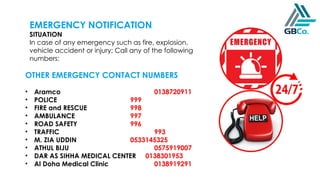
EMERGENCY NOTIFICATION
SITUATION
In case of any emergency such as fire, explosion,
vehicle accident or injury; Call any of the following
numbers:
OTHER EMERGENCY CONTACT NUMBERS
• Aramco 0138720911
• POLICE 999
• FIRE and RESCUE 998
• AMBULANCE 997
• ROAD SAFETY 996
• TRAFFIC 993
• M. ZIA UDDIN 0533145325
• ATHUL BIJU 0575919007
• DAR AS SIHHA MEDICAL CENTER 0138301953
• Al Doha Medical Clinic 0138919291
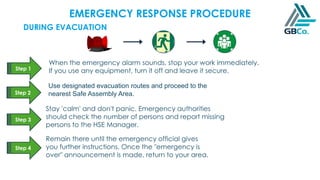
DURING EVACUATION
When the emergency alarm sounds, stop your work immediately.
If you use any equipment, turn it off and leave it secure.
Step 1
Use designated evacuation routes and proceed to the
nearest Safe Assembly Area.
Step 2
Stay 'calm' and don't panic. Emergency authorities
should check the number of persons and report missing
persons to the HSE Manager.
Step 3
Remain there until the emergency official gives
you further instructions. Once the "emergency is
over" announcement is made, return to your area.
Step 4
EMERGENCY RESPONSE PROCEDURE
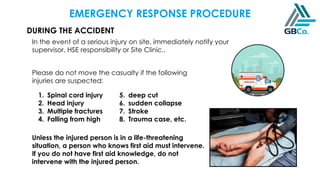
DURING THE ACCIDENT
In the event of a serious injury on site, immediately notify your
supervisor, HSE responsibility or Site Clinic..
Please do not move the casualty if the following
injuries are suspected:
1. Spinal cord injury
2. Head injury
3. Multiple fractures
4. Falling from high
5. deep cut
6. sudden collapse
7. Stroke
8. Trauma case, etc.
Unless the injured person is in a life-threatening
situation, a person who knows first aid must intervene.
If you do not have first aid knowledge, do not
intervene with the injured person.
EMERGENCY RESPONSE PROCEDURE
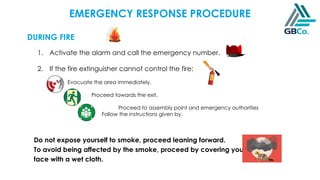
DURING FIRE
1. Activate the alarm and call the emergency number..
2. If the fire extinguisher cannot control the fire;
Evacuate the area immediately.
Proceed towards the exit.
Proceed to assembly point and emergency authorities
Follow the instructions given by.
Do not expose yourself to smoke, proceed leaning forward.
To avoid being affected by the smoke, proceed by covering your
face with a wet cloth.
EMERGENCY RESPONSE PROCEDURE
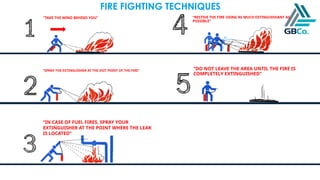
FIRE FIGHTING TECHNIQUES
“IN CASE OF FUEL FIRES, SPRAY YOUR
EXTINGUISHER AT THE POINT WHERE THE LEAK
IS LOCATED”
“SPRAY THE EXTINGUISHER AT THE EXIT POINT OF THE FIRE”
“TAKE THE WIND BEHIND YOU” “RESTIVE THE FIRE USING AS MUCH EXTINGUISHANT AS
POSSIBLE”
“DO NOT LEAVE THE AREA UNTIL THE FIRE IS
COMPLETELY EXTINGUISHED”
22
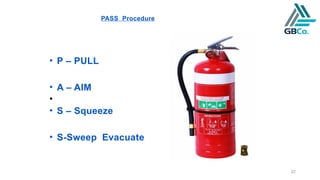
PASS Procedure
• P – PULL
• A – AIM
•
• S – Squeeze
• S-Sweep Evacuate
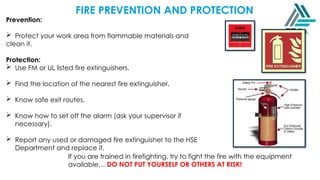
FIRE PREVENTION AND PROTECTION
Prevention:
 Protect your work area from flammable materials and
clean it.
Protection:
 Use FM or UL listed fire extinguishers.
 Find the location of the nearest fire extinguisher.
 Know safe exit routes.
 Know how to set off the alarm (ask your supervisor if
necessary).
 Report any used or damaged fire extinguisher to the HSE
Department and replace it.
If you are trained in firefighting, try to fight the fire with the equipment
available… DO NOT PUT YOURSELF OR OTHERS AT RISK!
24
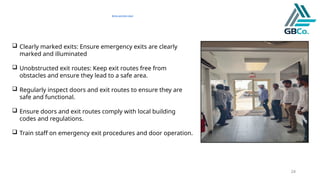
Entry and Exit door
 Clearly marked exits: Ensure emergency exits are clearly
marked and illuminated
 Unobstructed exit routes: Keep exit routes free from
obstacles and ensure they lead to a safe area.
 Regularly inspect doors and exit routes to ensure they are
safe and functional.
 Ensure doors and exit routes comply with local building
codes and regulations.
 Train staff on emergency exit procedures and door operation.
25
Emergency Response Procedures
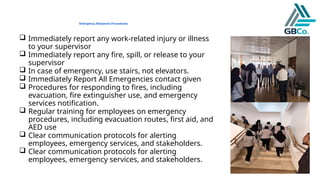
 Immediately report any work-related injury or illness
to your supervisor
 Immediately report any fire, spill, or release to your
supervisor
 In case of emergency, use stairs, not elevators.
 Immediately Report All Emergencies contact given
 Procedures for responding to fires, including
evacuation, fire extinguisher use, and emergency
services notification.
 Regular training for employees on emergency
procedures, including evacuation routes, first aid, and
AED use
 Clear communication protocols for alerting
employees, emergency services, and stakeholders.
 Clear communication protocols for alerting
employees, emergency services, and stakeholders.
26
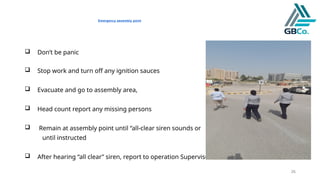
Emergency assembly point
 Don’t be panic
 Stop work and turn off any ignition sauces
 Evacuate and go to assembly area,
 Head count report any missing persons
 Remain at assembly point until “all-clear siren sounds or
until instructed
 After hearing “all clear” siren, report to operation Supervisor
27
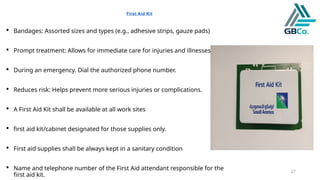
First Aid Kit
 Bandages: Assorted sizes and types (e.g., adhesive strips, gauze pads)
 Prompt treatment: Allows for immediate care for injuries and illnesses.
 During an emergency. Dial the authorized phone number.
 Reduces risk: Helps prevent more serious injuries or complications.
 A First Aid Kit shall be available at all work sites
 first aid kit/cabinet designated for those supplies only.
 First aid supplies shall be always kept in a sanitary condition
 Name and telephone number of the First Aid attendant responsible for the
first aid kit.
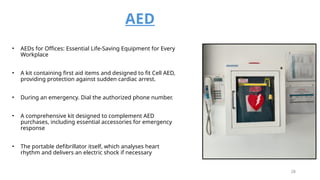
AED
• AEDs for Offices: Essential Life-Saving Equipment for Every
Workplace
• A kit containing first aid items and designed to fit Cell AED,
providing protection against sudden cardiac arrest.
• During an emergency. Dial the authorized phone number.
• A comprehensive kit designed to complement AED
purchases, including essential accessories for emergency
response
• The portable defibrillator itself, which analyses heart
rhythm and delivers an electric shock if necessary
28
29
ROLES & RESPONSIBILITY
 Maintain and Communicate of safety requirements.
 operate equipment only with proper authorization .
 Only perform work that you are trained to do and know how
to do safely .
 Always use appropriate personal protective equipment for
the job.
 Follow traffic rules; Aramco monitors vehicle safety.
 Clearly label hazardous materials and communicate risks to
workers.
 Ensure workers have access to Material Safety Data Sheets
(MSDS) for hazardous materials.
30
Behavioral issues
• Horseplay and fighting is prohibited
• Regularly observing behaviours and providing
constructive feedback.
• Increased behaviour awareness: Raising awareness
about potential hazards and safe practices
• Improved behaviour culture: Behavioural safety
initiatives can enhance overall safety culture
• Continuous improvement: Regularly reviewing and
improving safety processes.
• Employee engagement: Fostering a culture of safety
through employee involvement.
SMOKING POLICY
 Smoking is allowed ONLY in
designated smoking areas.
 Smoking areas should not contain
flammable materials or waste
materials and should be kept clean
and tidy.
 SMOKING IS PROHIBITED in offices and
inside Working areas.
PPE – PERSONAL PROTECTIVE EQUIPMENT
The minimum PPE required for personnel in the field is as follows:
Helmet
ANSI Z.89.1
Safety Glasses
ANSI Z.87.1 Safety Shoes
Reflective Vest Safety Glasses Hand gloves
JOB SPECIFIC PPE FOR JANITORIAL SERVICE
35
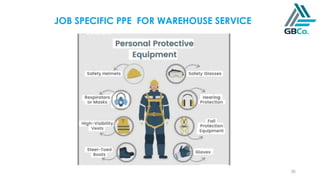
JOB SPECIFIC PPE FOR WAREHOUSE SERVICE
36
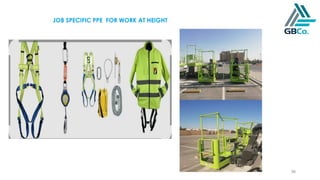
JOB SPECIFIC PPE FOR WORK AT HEIGHT
38
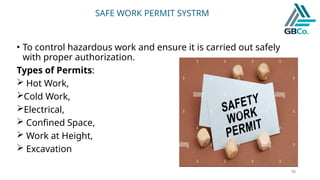
SAFE WORK PERMIT SYSTRM
• To control hazardous work and ensure it is carried out safely
with proper authorization.
Types of Permits:
 Hot Work,
Cold Work,
Electrical,
 Confined Space,
 Work at Height,
 Excavation
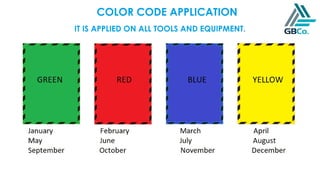
COLOR CODE APPLICATION
IT IS APPLIED ON ALL TOOLS AND EQUIPMENT.
WHICH TOOL DO
YOU USE MOST
WHILE
WORKING?
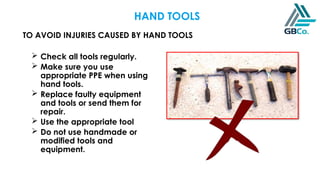
HAND TOOLS
TO AVOID INJURIES CAUSED BY HAND TOOLS
HAND TOOLS
 Check all tools regularly.
 Make sure you use
appropriate PPE when using
hand tools.
 Replace faulty equipment
and tools or send them for
repair.
 Use the appropriate tool
 Do not use handmade or
modified tools and
equipment.
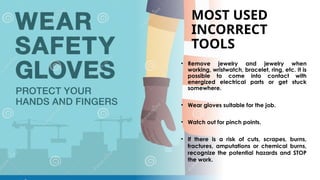
MOST USED
INCORRECT
TOOLS
• Remove jewelry and jewelry when
working, wristwatch, bracelet, ring, etc. It is
possible to come into contact with
energized electrical parts or get stuck
somewhere.
• Wear gloves suitable for the job.
• Watch out for pinch points.
• If there is a risk of cuts, scrapes, burns,
fractures, amputations or chemical burns,
recognize the potential hazards and STOP
the work.
HOT WORK
Hot Work is any activity that can create sparks, flames, or heat
(energy) sufficient to ignite flammable atmospheres or flammable
materials.
Welding, cutting, soldering and grinding activities are examples of
hot work.
Welding Cutting Soldering
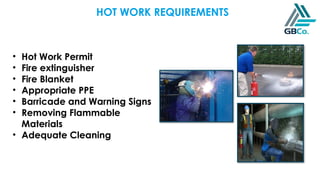
HOT WORK REQUIREMENTS
• Hot Work Permit
• Fire extinguisher
• Fire Blanket
• Appropriate PPE
• Barricade and Warning Signs
• Removing Flammable
Materials
• Adequate Cleaning
WORKING WITH CHEMICALS
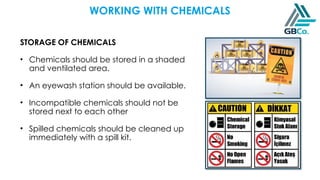
STORAGE OF CHEMICALS
• Chemicals should be stored in a shaded
and ventilated area.
• An eyewash station should be available.
• Incompatible chemicals should not be
stored next to each other
• Spilled chemicals should be cleaned up
immediately with a spill kit.
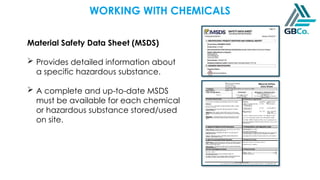
Material Safety Data Sheet (MSDS)
 Provides detailed information about
a specific hazardous substance.
 A complete and up-to-date MSDS
must be available for each chemical
or hazardous substance stored/used
on site.
WORKING WITH CHEMICALS
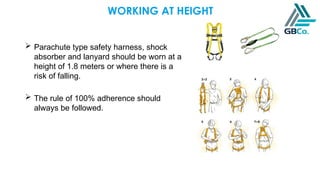
WORKING AT HEIGHT
 Parachute type safety harness, shock
absorber and lanyard should be worn at a
height of 1.8 meters or where there is a
risk of falling.
 The rule of 100% adherence should
always be followed.
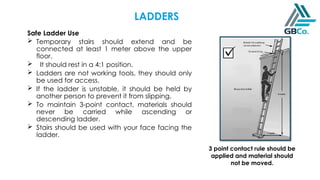
Safe Ladder Use
 Temporary stairs should extend and be
connected at least 1 meter above the upper
floor.
 It should rest in a 4:1 position.
 Ladders are not working tools, they should only
be used for access.
 If the ladder is unstable, it should be held by
another person to prevent it from slipping.
 To maintain 3-point contact, materials should
never be carried while ascending or
descending ladder.
 Stairs should be used with your face facing the
ladder.
3 point contact rule should be
applied and material should
not be moved.
LADDERS
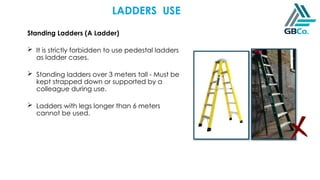
Standing Ladders (A Ladder)
 It is strictly forbidden to use pedestal ladders
as ladder cases.
 Standing ladders over 3 meters tall - Must be
kept strapped down or supported by a
colleague during use.
 Ladders with legs longer than 6 meters
cannot be used.
LADDERS USE
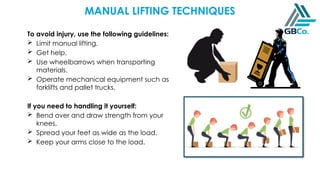
To avoid injury, use the following guidelines:
 Limit manual lifting.
 Get help.
 Use wheelbarrows when transporting
materials.
 Operate mechanical equipment such as
forklifts and pallet trucks.
If you need to handling it yourself:
 Bend over and draw strength from your
knees.
 Spread your feet as wide as the load.
 Keep your arms close to the load.
MANUAL LIFTING TECHNIQUES
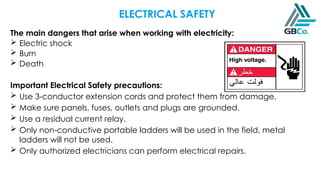
ELECTRICAL SAFETY
The main dangers that arise when working with electricity:
 Electric shock
 Burn
 Death
Important Electrical Safety precautions:
 Use 3-conductor extension cords and protect them from damage.
 Make sure panels, fuses, outlets and plugs are grounded.
 Use a residual current relay.
 Only non-conductive portable ladders will be used in the field, metal
ladders will not be used.
 Only authorized electricians can perform electrical repairs.
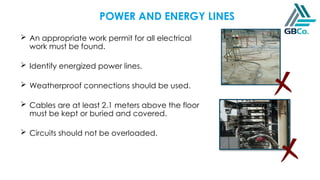
POWER AND ENERGY LINES
 An appropriate work permit for all electrical
work must be found.
 Identify energized power lines.
 Weatherproof connections should be used.
 Cables are at least 2.1 meters above the floor
must be kept or buried and covered.
 Circuits should not be overloaded.
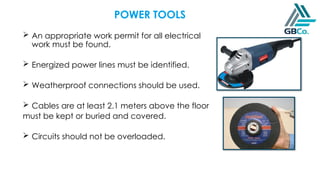
POWER TOOLS
 An appropriate work permit for all electrical
work must be found.
 Energized power lines must be identified.
 Weatherproof connections should be used.
 Cables are at least 2.1 meters above the floor
must be kept or buried and covered.
 Circuits should not be overloaded.
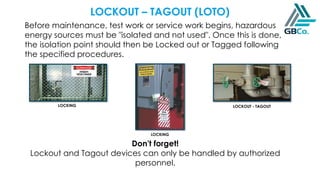
LOCKOUT – TAGOUT (LOTO)
Before maintenance, test work or service work begins, hazardous
energy sources must be "isolated and not used". Once this is done,
the isolation point should then be Locked out or Tagged following
the specified procedures.
Don't forget!
Lockout and Tagout devices can only be handled by authorized
personnel.
LOCKING
LOCKING
LOCKOUT - TAGOUT
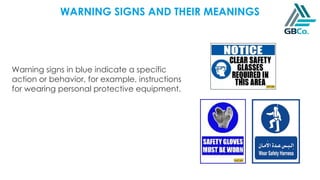
WARNING SIGNS AND THEIR MEANINGS
Warning signs in blue indicate a specific
action or behavior, for example, instructions
for wearing personal protective equipment.
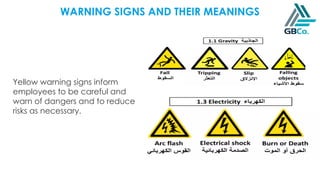
Yellow warning signs inform
employees to be careful and
warn of dangers and to reduce
risks as necessary.
WARNING SIGNS AND THEIR MEANINGS
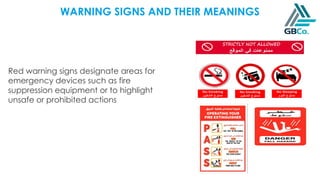
Red warning signs designate areas for
emergency devices such as fire
suppression equipment or to highlight
unsafe or prohibited actions
WARNING SIGNS AND THEIR MEANINGS
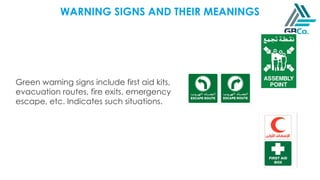
Green warning signs include first aid kits,
evacuation routes, fire exits, emergency
escape, etc. Indicates such situations.
WARNING SIGNS AND THEIR MEANINGS
63
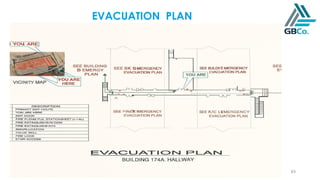
EVACUATION PLAN
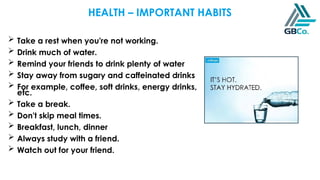
 Take a rest when you're not working.
 Drink much of water.
 Remind your friends to drink plenty of water
 Stay away from sugary and caffeinated drinks
 For example, coffee, soft drinks, energy drinks,
etc.
 Take a break.
 Don't skip meal times.
 Breakfast, lunch, dinner
 Always study with a friend.
 Watch out for your friend.
HEALTH – IMPORTANT HABITS
HEAT STRESS
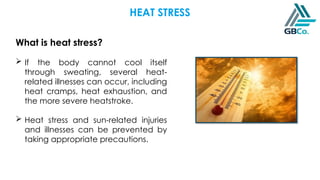
What is heat stress?
 If the body cannot cool itself
through sweating, several heat-
related illnesses can occur, including
heat cramps, heat exhaustion, and
the more severe heatstroke.
 Heat stress and sun-related injuries
and illnesses can be prevented by
taking appropriate precautions.
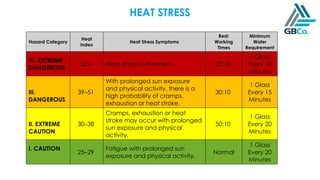
Hazard Category
Heat
index
Heat Stress Symptoms
Rest:
Working
Times
Minimum
Water
Requirement
IV. EXTREME
DANGEROUS
52> Heat stroke is imminent. 20:10
1 Glass
Every 10
Minutes
III.
DANGEROUS
39–51
With prolonged sun exposure
and physical activity, there is a
high probability of cramps,
exhaustion or heat stroke.
30:10
1 Glass
Every 15
Minutes
II. EXTREME
CAUTION
30–38
Cramps, exhaustion or heat
stroke may occur with prolonged
sun exposure and physical
activity.
50:10
1 Glass
Every 20
Minutes
I. CAUTION
25–29
Fatigue with prolonged sun
exposure and physical activity.
Normal
1 Glass
Every 20
Minutes
HEAT STRESS
Any Question ?
FOR LISTENING
THANKS.
73
We conveyed information in
English, Hindi and Bengali.

GBCO_Safety_orientation_PPT CA & DA 1 (1).pptx

  • 1.
  • 2.
    WHILE STARTING  Duringthe presentation, please turn off your mobile phones and do not behave in a manner that may disturb other participants.
  • 3.
  • 4.
  • 5.
  • 6.
  • 7.
    GOALS OF TRAINING Ensuringthat all employees in the project are aware of the dangers and Risk in the environment:  Raising awareness of the dangers in our project.  Health, Safety & Environment (HSE) Standards of the Project.  Ensuring Employees' adherence to Life Saving Standards and Keeping the Project Free from ACCIDENTS and INJURIES.
  • 8.
     Muhammad SaadAl-Ghurairy & Bro. is committed to providing a safe and healthy workplace, carrying out its business activities in a way that protects the environment and acting in accordance with the following principles:  Be responsible for Health, Safety, Environment and Quality at all levels of the organization and comply with relevant legislation, regulations, standards and customer satisfaction.  It tries to increase the contribution, competence, participation and motivation of its employees in order to provide a safe working environment and presents projects to customers with the highest quality and durability standards within the framework of sustainable solutions.  Takes all necessary precautions to prevent Accidents, Injuries and Occupational Diseases. OUR HSE POLICY
  • 9.
    EMERGENCY RESPONSE PROCEDURE Accident/Incidentand Near Miss Notification All Accidents/Incidents and Near Misses must be reported. Accident: An unplanned event that results in personal injury or property damage. Incident: An unplanned and undesirable event that adversely affects the completion of a task. Near Miss: An unplanned event that does not result in injury, illness, or damage – but has the potential to do so.
  • 10.
    EMERGENCY NOTIFICATION SITUATION In caseof any emergency such as fire, explosion, vehicle accident or injury; Call any of the following numbers: OTHER EMERGENCY CONTACT NUMBERS • Aramco 0138720911 • POLICE 999 • FIRE and RESCUE 998 • AMBULANCE 997 • ROAD SAFETY 996 • TRAFFIC 993 • M. ZIA UDDIN 0533145325 • ATHUL BIJU 0575919007 • DAR AS SIHHA MEDICAL CENTER 0138301953 • Al Doha Medical Clinic 0138919291
  • 11.
    DURING EVACUATION When theemergency alarm sounds, stop your work immediately. If you use any equipment, turn it off and leave it secure. Step 1 Use designated evacuation routes and proceed to the nearest Safe Assembly Area. Step 2 Stay 'calm' and don't panic. Emergency authorities should check the number of persons and report missing persons to the HSE Manager. Step 3 Remain there until the emergency official gives you further instructions. Once the "emergency is over" announcement is made, return to your area. Step 4 EMERGENCY RESPONSE PROCEDURE
  • 12.
    DURING THE ACCIDENT Inthe event of a serious injury on site, immediately notify your supervisor, HSE responsibility or Site Clinic.. Please do not move the casualty if the following injuries are suspected: 1. Spinal cord injury 2. Head injury 3. Multiple fractures 4. Falling from high 5. deep cut 6. sudden collapse 7. Stroke 8. Trauma case, etc. Unless the injured person is in a life-threatening situation, a person who knows first aid must intervene. If you do not have first aid knowledge, do not intervene with the injured person. EMERGENCY RESPONSE PROCEDURE
  • 13.
    DURING FIRE 1. Activatethe alarm and call the emergency number.. 2. If the fire extinguisher cannot control the fire; Evacuate the area immediately. Proceed towards the exit. Proceed to assembly point and emergency authorities Follow the instructions given by. Do not expose yourself to smoke, proceed leaning forward. To avoid being affected by the smoke, proceed by covering your face with a wet cloth. EMERGENCY RESPONSE PROCEDURE
  • 14.
    FIRE FIGHTING TECHNIQUES “INCASE OF FUEL FIRES, SPRAY YOUR EXTINGUISHER AT THE POINT WHERE THE LEAK IS LOCATED” “SPRAY THE EXTINGUISHER AT THE EXIT POINT OF THE FIRE” “TAKE THE WIND BEHIND YOU” “RESTIVE THE FIRE USING AS MUCH EXTINGUISHANT AS POSSIBLE” “DO NOT LEAVE THE AREA UNTIL THE FIRE IS COMPLETELY EXTINGUISHED”
  • 15.
    22 PASS Procedure • P– PULL • A – AIM • • S – Squeeze • S-Sweep Evacuate
  • 16.
    FIRE PREVENTION ANDPROTECTION Prevention:  Protect your work area from flammable materials and clean it. Protection:  Use FM or UL listed fire extinguishers.  Find the location of the nearest fire extinguisher.  Know safe exit routes.  Know how to set off the alarm (ask your supervisor if necessary).  Report any used or damaged fire extinguisher to the HSE Department and replace it. If you are trained in firefighting, try to fight the fire with the equipment available… DO NOT PUT YOURSELF OR OTHERS AT RISK!
  • 17.
    24 Entry and Exitdoor  Clearly marked exits: Ensure emergency exits are clearly marked and illuminated  Unobstructed exit routes: Keep exit routes free from obstacles and ensure they lead to a safe area.  Regularly inspect doors and exit routes to ensure they are safe and functional.  Ensure doors and exit routes comply with local building codes and regulations.  Train staff on emergency exit procedures and door operation.
  • 18.
    25 Emergency Response Procedures Immediately report any work-related injury or illness to your supervisor  Immediately report any fire, spill, or release to your supervisor  In case of emergency, use stairs, not elevators.  Immediately Report All Emergencies contact given  Procedures for responding to fires, including evacuation, fire extinguisher use, and emergency services notification.  Regular training for employees on emergency procedures, including evacuation routes, first aid, and AED use  Clear communication protocols for alerting employees, emergency services, and stakeholders.  Clear communication protocols for alerting employees, emergency services, and stakeholders.
  • 19.
    26 Emergency assembly point Don’t be panic  Stop work and turn off any ignition sauces  Evacuate and go to assembly area,  Head count report any missing persons  Remain at assembly point until “all-clear siren sounds or until instructed  After hearing “all clear” siren, report to operation Supervisor
  • 20.
    27 First Aid Kit Bandages: Assorted sizes and types (e.g., adhesive strips, gauze pads)  Prompt treatment: Allows for immediate care for injuries and illnesses.  During an emergency. Dial the authorized phone number.  Reduces risk: Helps prevent more serious injuries or complications.  A First Aid Kit shall be available at all work sites  first aid kit/cabinet designated for those supplies only.  First aid supplies shall be always kept in a sanitary condition  Name and telephone number of the First Aid attendant responsible for the first aid kit.
  • 21.
    AED • AEDs forOffices: Essential Life-Saving Equipment for Every Workplace • A kit containing first aid items and designed to fit Cell AED, providing protection against sudden cardiac arrest. • During an emergency. Dial the authorized phone number. • A comprehensive kit designed to complement AED purchases, including essential accessories for emergency response • The portable defibrillator itself, which analyses heart rhythm and delivers an electric shock if necessary 28
  • 22.
    29 ROLES & RESPONSIBILITY Maintain and Communicate of safety requirements.  operate equipment only with proper authorization .  Only perform work that you are trained to do and know how to do safely .  Always use appropriate personal protective equipment for the job.  Follow traffic rules; Aramco monitors vehicle safety.  Clearly label hazardous materials and communicate risks to workers.  Ensure workers have access to Material Safety Data Sheets (MSDS) for hazardous materials.
  • 23.
    30 Behavioral issues • Horseplayand fighting is prohibited • Regularly observing behaviours and providing constructive feedback. • Increased behaviour awareness: Raising awareness about potential hazards and safe practices • Improved behaviour culture: Behavioural safety initiatives can enhance overall safety culture • Continuous improvement: Regularly reviewing and improving safety processes. • Employee engagement: Fostering a culture of safety through employee involvement.
  • 24.
    SMOKING POLICY  Smokingis allowed ONLY in designated smoking areas.  Smoking areas should not contain flammable materials or waste materials and should be kept clean and tidy.  SMOKING IS PROHIBITED in offices and inside Working areas.
  • 25.
    PPE – PERSONALPROTECTIVE EQUIPMENT The minimum PPE required for personnel in the field is as follows: Helmet ANSI Z.89.1 Safety Glasses ANSI Z.87.1 Safety Shoes Reflective Vest Safety Glasses Hand gloves
  • 26.
    JOB SPECIFIC PPEFOR JANITORIAL SERVICE
  • 27.
    35 JOB SPECIFIC PPEFOR WAREHOUSE SERVICE
  • 28.
    36 JOB SPECIFIC PPEFOR WORK AT HEIGHT
  • 29.
    38 SAFE WORK PERMITSYSTRM • To control hazardous work and ensure it is carried out safely with proper authorization. Types of Permits:  Hot Work, Cold Work, Electrical,  Confined Space,  Work at Height,  Excavation
  • 30.
    COLOR CODE APPLICATION ITIS APPLIED ON ALL TOOLS AND EQUIPMENT.
  • 31.
    WHICH TOOL DO YOUUSE MOST WHILE WORKING? HAND TOOLS
  • 32.
    TO AVOID INJURIESCAUSED BY HAND TOOLS HAND TOOLS  Check all tools regularly.  Make sure you use appropriate PPE when using hand tools.  Replace faulty equipment and tools or send them for repair.  Use the appropriate tool  Do not use handmade or modified tools and equipment.
  • 33.
    MOST USED INCORRECT TOOLS • Removejewelry and jewelry when working, wristwatch, bracelet, ring, etc. It is possible to come into contact with energized electrical parts or get stuck somewhere. • Wear gloves suitable for the job. • Watch out for pinch points. • If there is a risk of cuts, scrapes, burns, fractures, amputations or chemical burns, recognize the potential hazards and STOP the work.
  • 34.
    HOT WORK Hot Workis any activity that can create sparks, flames, or heat (energy) sufficient to ignite flammable atmospheres or flammable materials. Welding, cutting, soldering and grinding activities are examples of hot work. Welding Cutting Soldering
  • 35.
    HOT WORK REQUIREMENTS •Hot Work Permit • Fire extinguisher • Fire Blanket • Appropriate PPE • Barricade and Warning Signs • Removing Flammable Materials • Adequate Cleaning
  • 36.
    WORKING WITH CHEMICALS STORAGEOF CHEMICALS • Chemicals should be stored in a shaded and ventilated area. • An eyewash station should be available. • Incompatible chemicals should not be stored next to each other • Spilled chemicals should be cleaned up immediately with a spill kit.
  • 37.
    Material Safety DataSheet (MSDS)  Provides detailed information about a specific hazardous substance.  A complete and up-to-date MSDS must be available for each chemical or hazardous substance stored/used on site. WORKING WITH CHEMICALS
  • 38.
    WORKING AT HEIGHT Parachute type safety harness, shock absorber and lanyard should be worn at a height of 1.8 meters or where there is a risk of falling.  The rule of 100% adherence should always be followed.
  • 39.
    Safe Ladder Use Temporary stairs should extend and be connected at least 1 meter above the upper floor.  It should rest in a 4:1 position.  Ladders are not working tools, they should only be used for access.  If the ladder is unstable, it should be held by another person to prevent it from slipping.  To maintain 3-point contact, materials should never be carried while ascending or descending ladder.  Stairs should be used with your face facing the ladder. 3 point contact rule should be applied and material should not be moved. LADDERS
  • 40.
    Standing Ladders (ALadder)  It is strictly forbidden to use pedestal ladders as ladder cases.  Standing ladders over 3 meters tall - Must be kept strapped down or supported by a colleague during use.  Ladders with legs longer than 6 meters cannot be used. LADDERS USE
  • 41.
    To avoid injury,use the following guidelines:  Limit manual lifting.  Get help.  Use wheelbarrows when transporting materials.  Operate mechanical equipment such as forklifts and pallet trucks. If you need to handling it yourself:  Bend over and draw strength from your knees.  Spread your feet as wide as the load.  Keep your arms close to the load. MANUAL LIFTING TECHNIQUES
  • 42.
    ELECTRICAL SAFETY The maindangers that arise when working with electricity:  Electric shock  Burn  Death Important Electrical Safety precautions:  Use 3-conductor extension cords and protect them from damage.  Make sure panels, fuses, outlets and plugs are grounded.  Use a residual current relay.  Only non-conductive portable ladders will be used in the field, metal ladders will not be used.  Only authorized electricians can perform electrical repairs.
  • 43.
    POWER AND ENERGYLINES  An appropriate work permit for all electrical work must be found.  Identify energized power lines.  Weatherproof connections should be used.  Cables are at least 2.1 meters above the floor must be kept or buried and covered.  Circuits should not be overloaded.
  • 44.
    POWER TOOLS  Anappropriate work permit for all electrical work must be found.  Energized power lines must be identified.  Weatherproof connections should be used.  Cables are at least 2.1 meters above the floor must be kept or buried and covered.  Circuits should not be overloaded.
  • 45.
    LOCKOUT – TAGOUT(LOTO) Before maintenance, test work or service work begins, hazardous energy sources must be "isolated and not used". Once this is done, the isolation point should then be Locked out or Tagged following the specified procedures. Don't forget! Lockout and Tagout devices can only be handled by authorized personnel. LOCKING LOCKING LOCKOUT - TAGOUT
  • 46.
    WARNING SIGNS ANDTHEIR MEANINGS Warning signs in blue indicate a specific action or behavior, for example, instructions for wearing personal protective equipment.

  • 47.
    Yellow warning signsinform employees to be careful and warn of dangers and to reduce risks as necessary. WARNING SIGNS AND THEIR MEANINGS
  • 48.
    Red warning signsdesignate areas for emergency devices such as fire suppression equipment or to highlight unsafe or prohibited actions WARNING SIGNS AND THEIR MEANINGS
  • 49.
    Green warning signsinclude first aid kits, evacuation routes, fire exits, emergency escape, etc. Indicates such situations. WARNING SIGNS AND THEIR MEANINGS
  • 50.
  • 51.
     Take arest when you're not working.  Drink much of water.  Remind your friends to drink plenty of water  Stay away from sugary and caffeinated drinks  For example, coffee, soft drinks, energy drinks, etc.  Take a break.  Don't skip meal times.  Breakfast, lunch, dinner  Always study with a friend.  Watch out for your friend. HEALTH – IMPORTANT HABITS
  • 52.
    HEAT STRESS What isheat stress?  If the body cannot cool itself through sweating, several heat- related illnesses can occur, including heat cramps, heat exhaustion, and the more severe heatstroke.  Heat stress and sun-related injuries and illnesses can be prevented by taking appropriate precautions.
  • 53.
    Hazard Category Heat index Heat StressSymptoms Rest: Working Times Minimum Water Requirement IV. EXTREME DANGEROUS 52> Heat stroke is imminent. 20:10 1 Glass Every 10 Minutes III. DANGEROUS 39–51 With prolonged sun exposure and physical activity, there is a high probability of cramps, exhaustion or heat stroke. 30:10 1 Glass Every 15 Minutes II. EXTREME CAUTION 30–38 Cramps, exhaustion or heat stroke may occur with prolonged sun exposure and physical activity. 50:10 1 Glass Every 20 Minutes I. CAUTION 25–29 Fatigue with prolonged sun exposure and physical activity. Normal 1 Glass Every 20 Minutes HEAT STRESS
  • 54.
  • 55.
    FOR LISTENING THANKS. 73 We conveyedinformation in English, Hindi and Bengali.