1
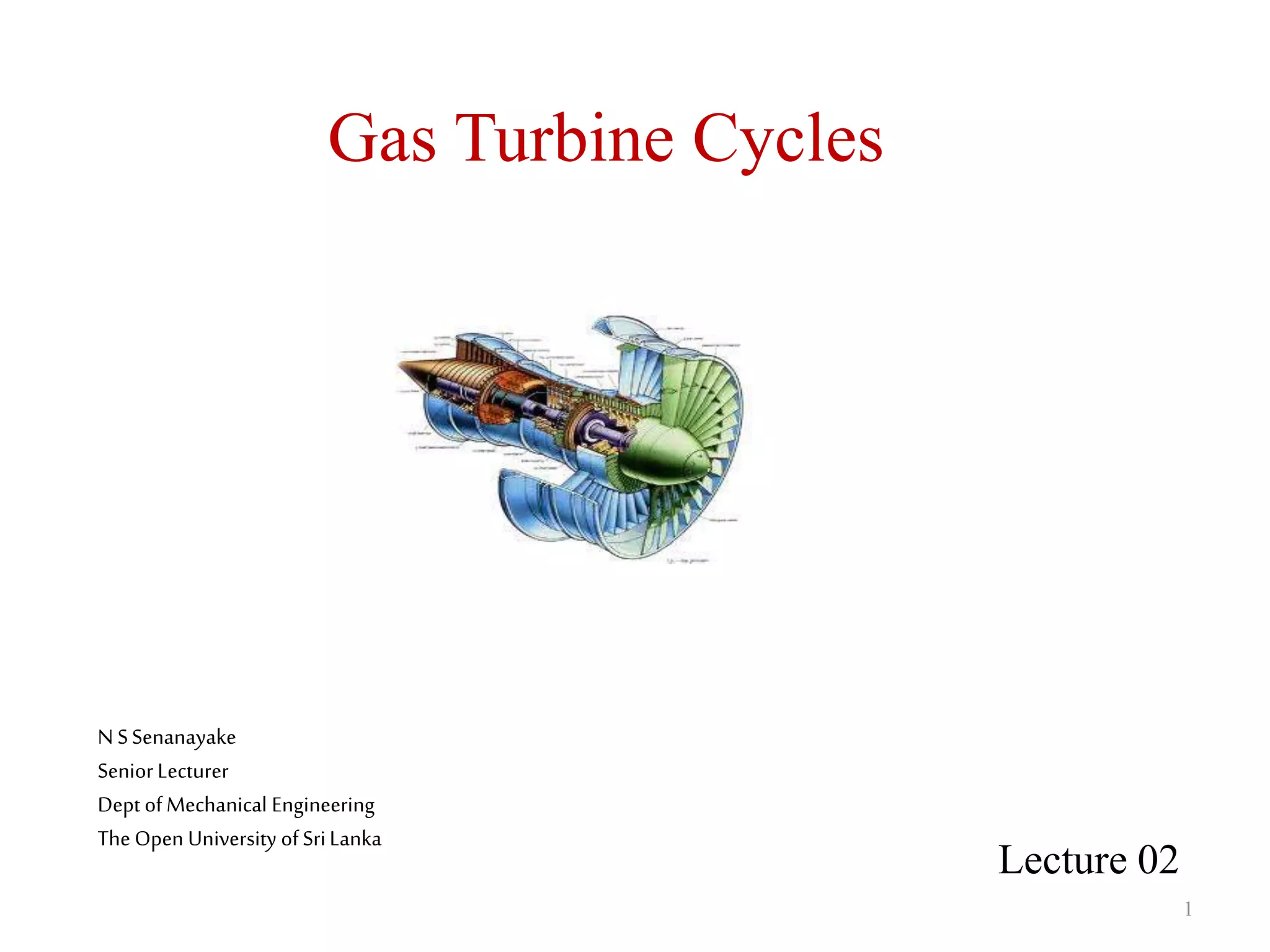
Gas Turbine Cycles
N SSenanayake
Senior Lecturer
Dept ofMechanical Engineering
The Open University ofSriLanka
Lecture 02
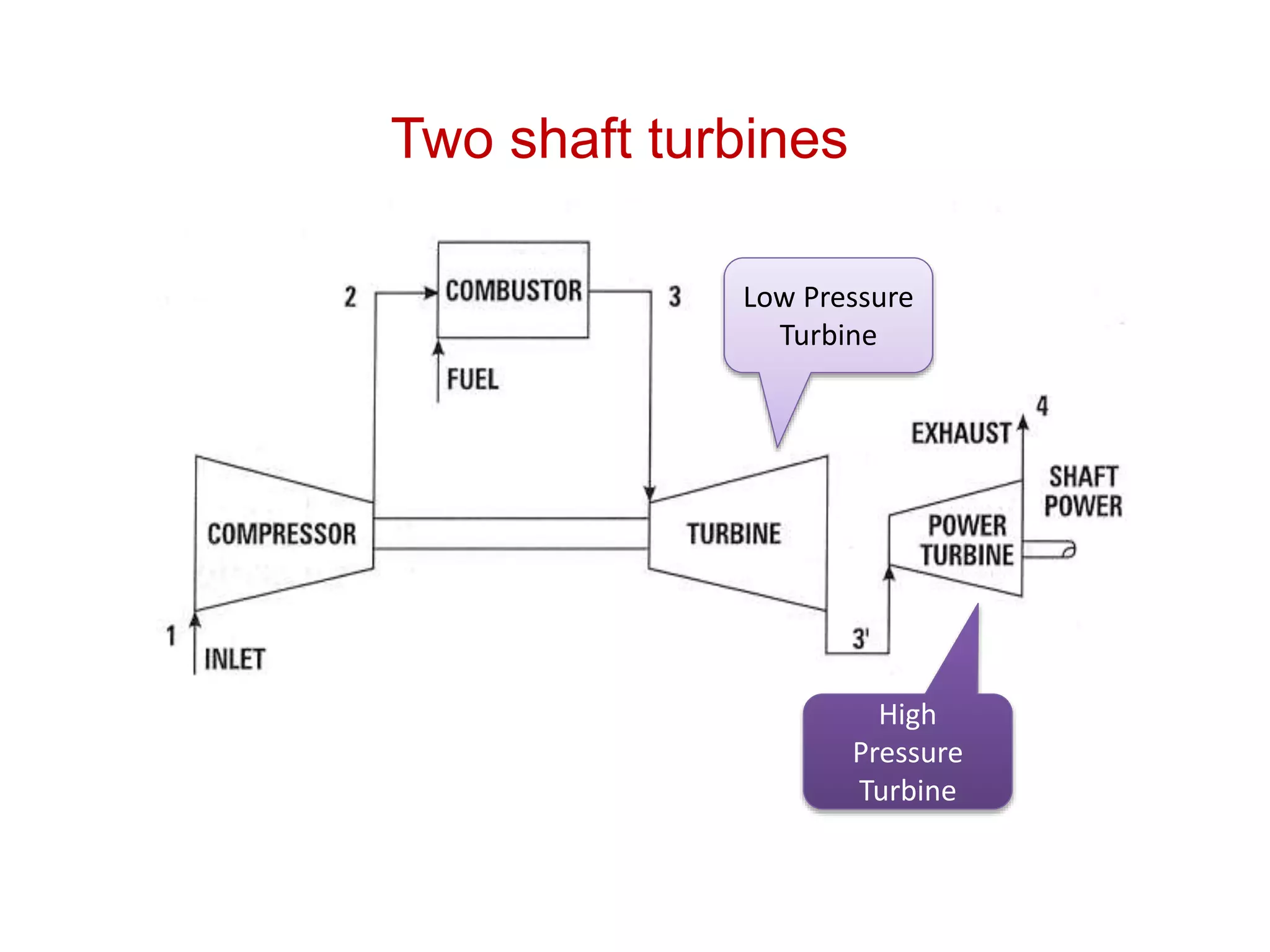
Two shaft turbines
Low Pressure
Turbine
High
Pressure
Turbine
3
 In a single shaft arrangement , the turbine is arranged to
drive the compressor as well as to develop network.
 It is sometimes more convenient to have two separate
turbines .
 one to drive the compressor and
 other provides the power output
 The first or high pressure (HP) turbine is known as the
compressor turbine
 The second or low pressure (LP)turbine is called the
power turbine
4
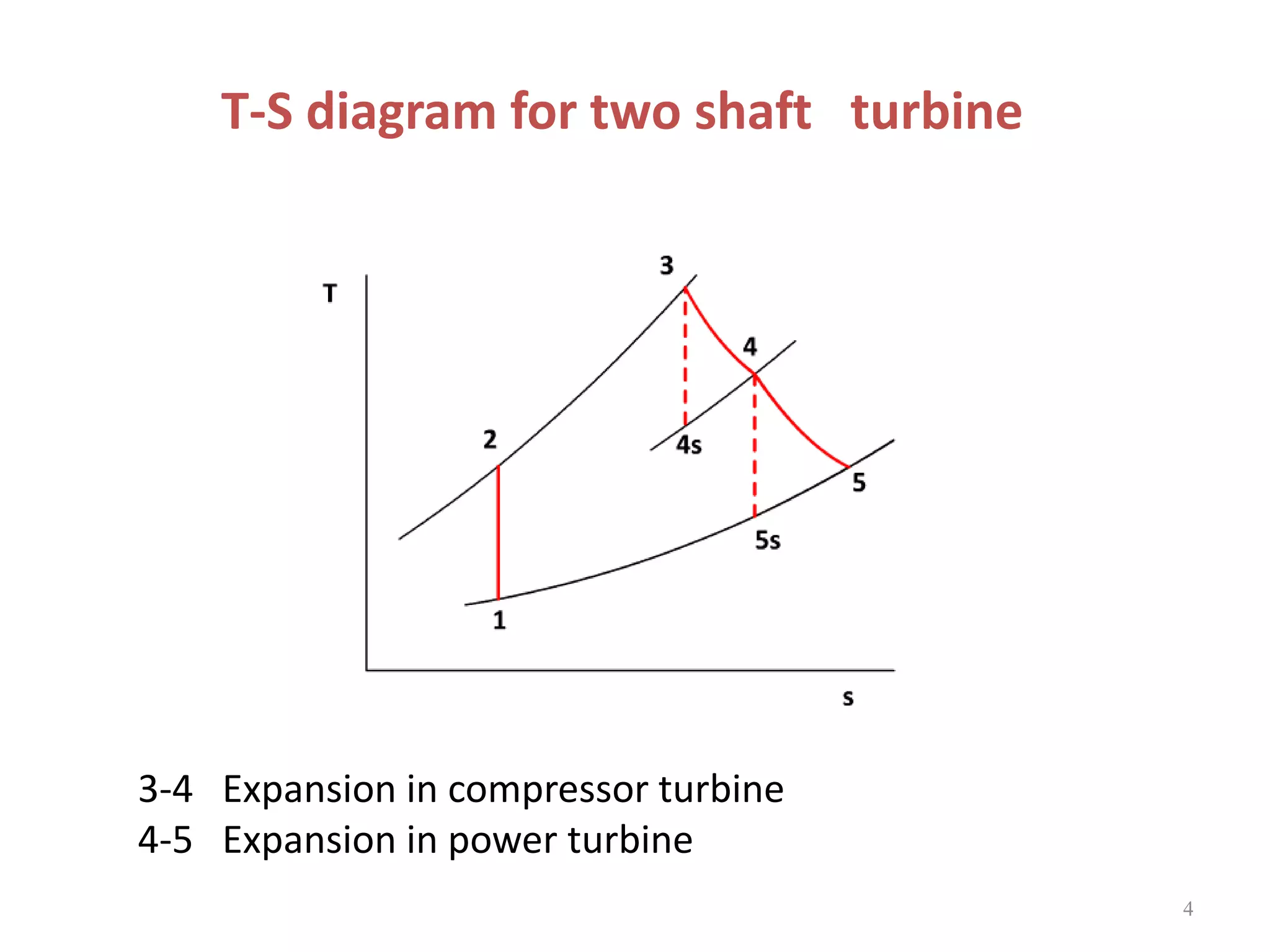
T-S diagram for two shaft turbine
3-4 Expansion in compressor turbine
4-5 Expansion in power turbine
Gas Turbine Improvements
Modifications to the basic gas turbine thermodynamic
cycle:
Regeneration (With Heat Exchanger)
Inter cooling
Reheating
6
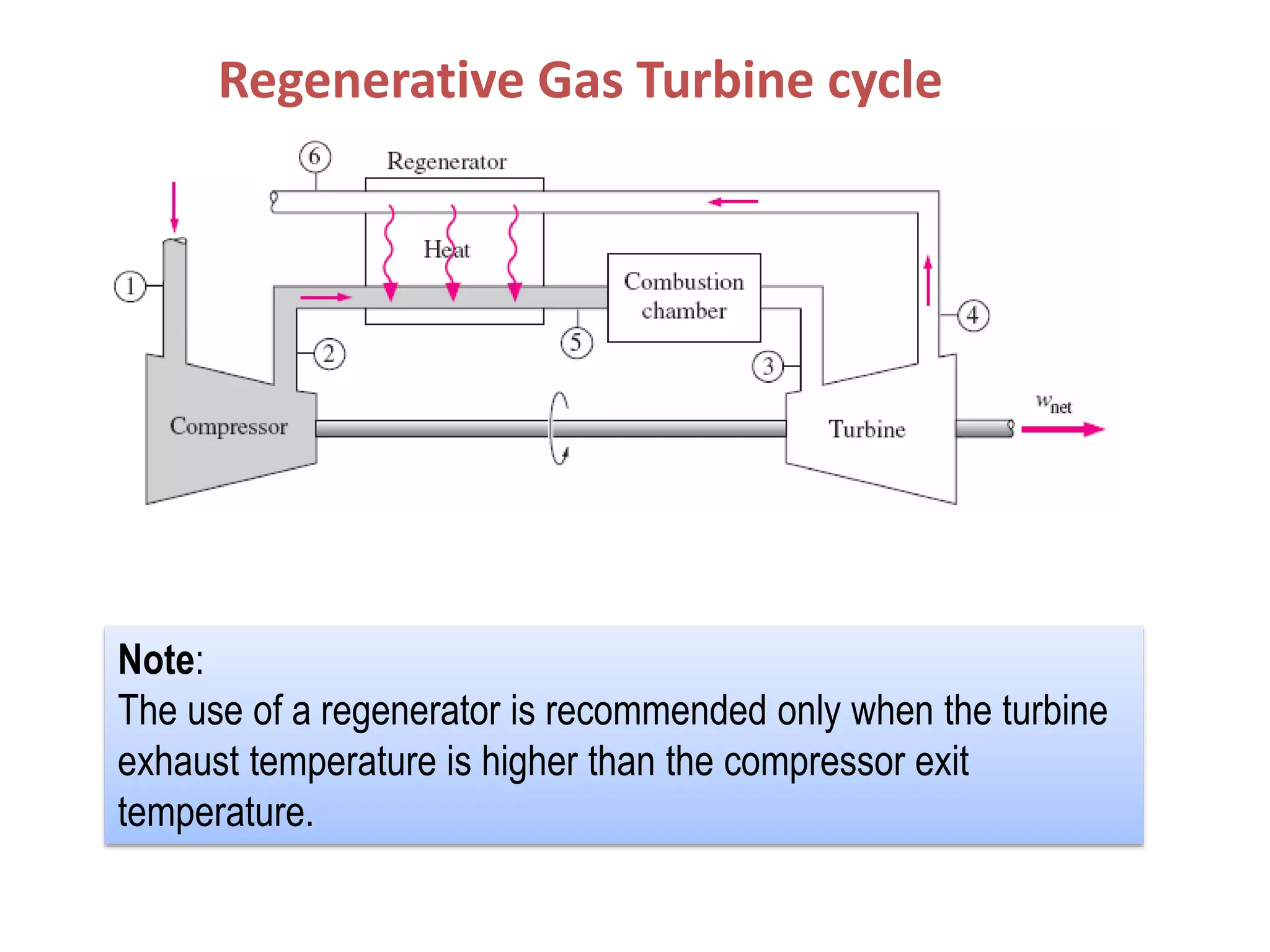
Note:
The use of a regenerator is recommended only when the turbine
exhaust temperature is higher than the compressor exit
temperature.
Regenerative Gas Turbine cycle
7
 Temperature of the exhaust gas leaving the turbine is
higher than the temperature of the air leaving the
compressor.
 The air leaving the compressor can be heated by the
hot exhaust gases in a counter-flow heat exchanger
(a regenerator or recuperator) – a process called
regeneration
 The thermal efficiency of the Brayton cycle increases
due to regeneration since less fuel is used for the
same work output.
Regenerative Gas Turbine cycle
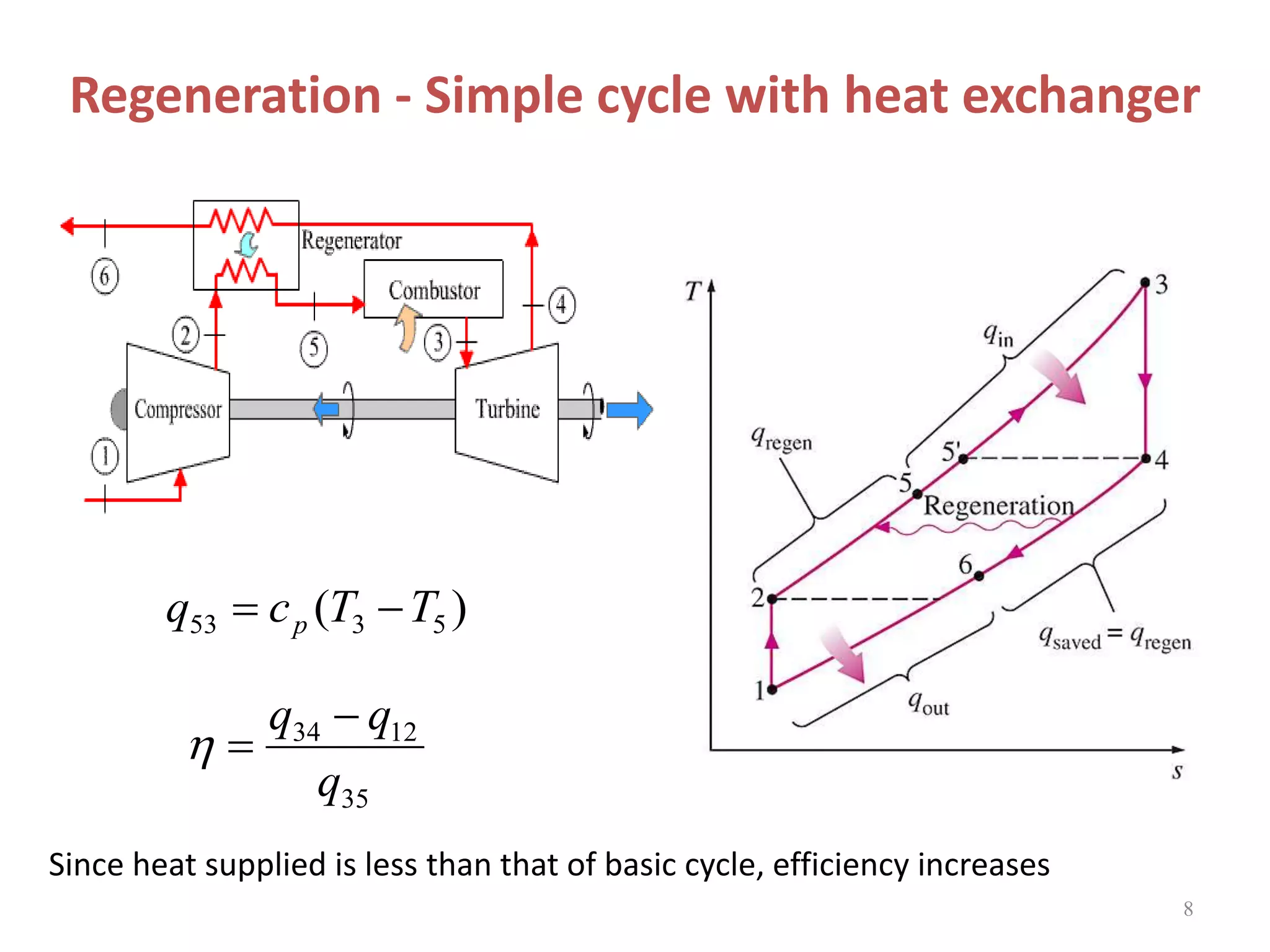
Regeneration - Simple cycle with heat exchanger
8
)( 5353 TTcq p 
35
1234
q
qq 

Since heat supplied is less than that of basic cycle, efficiency increases
9
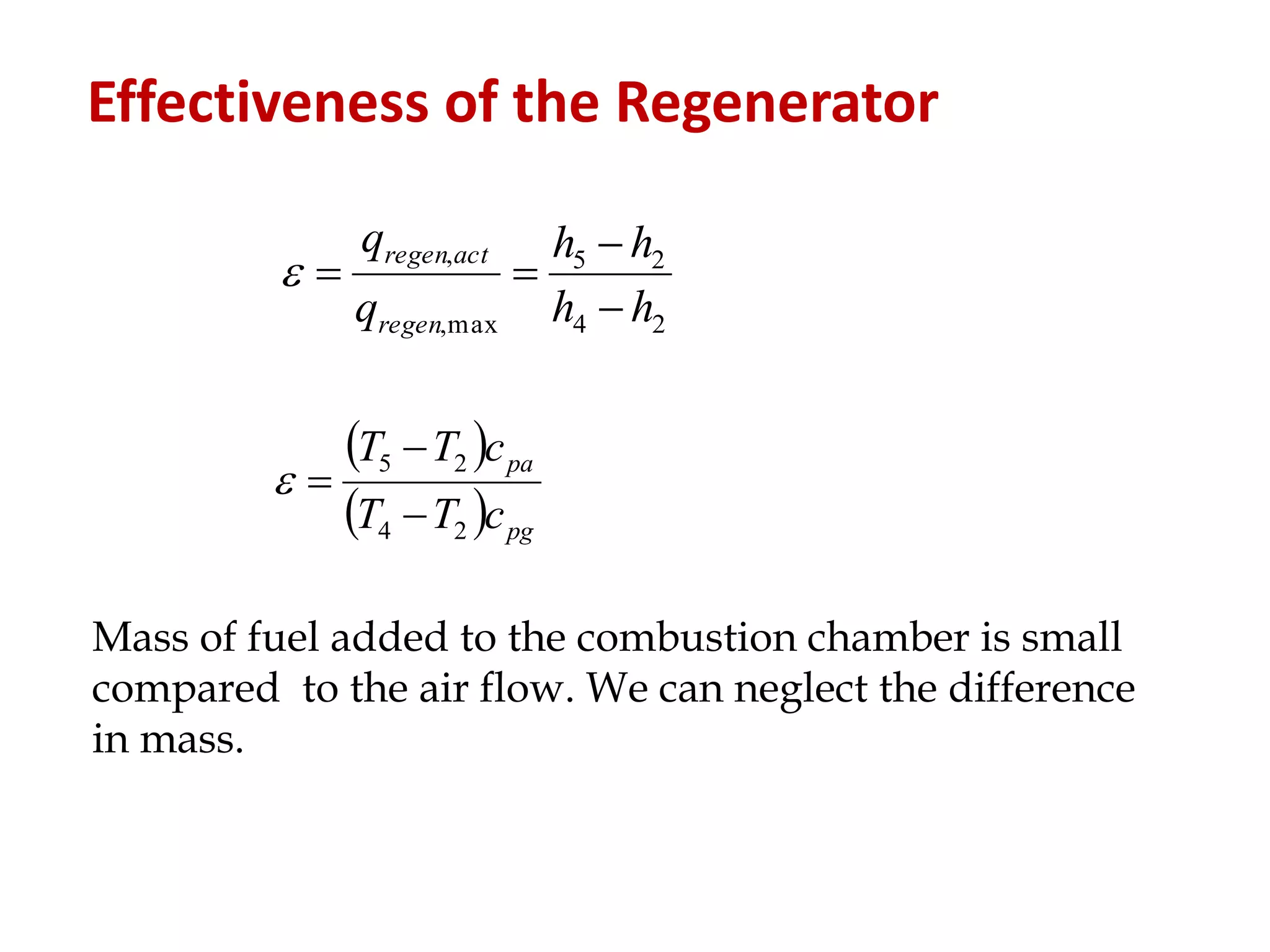
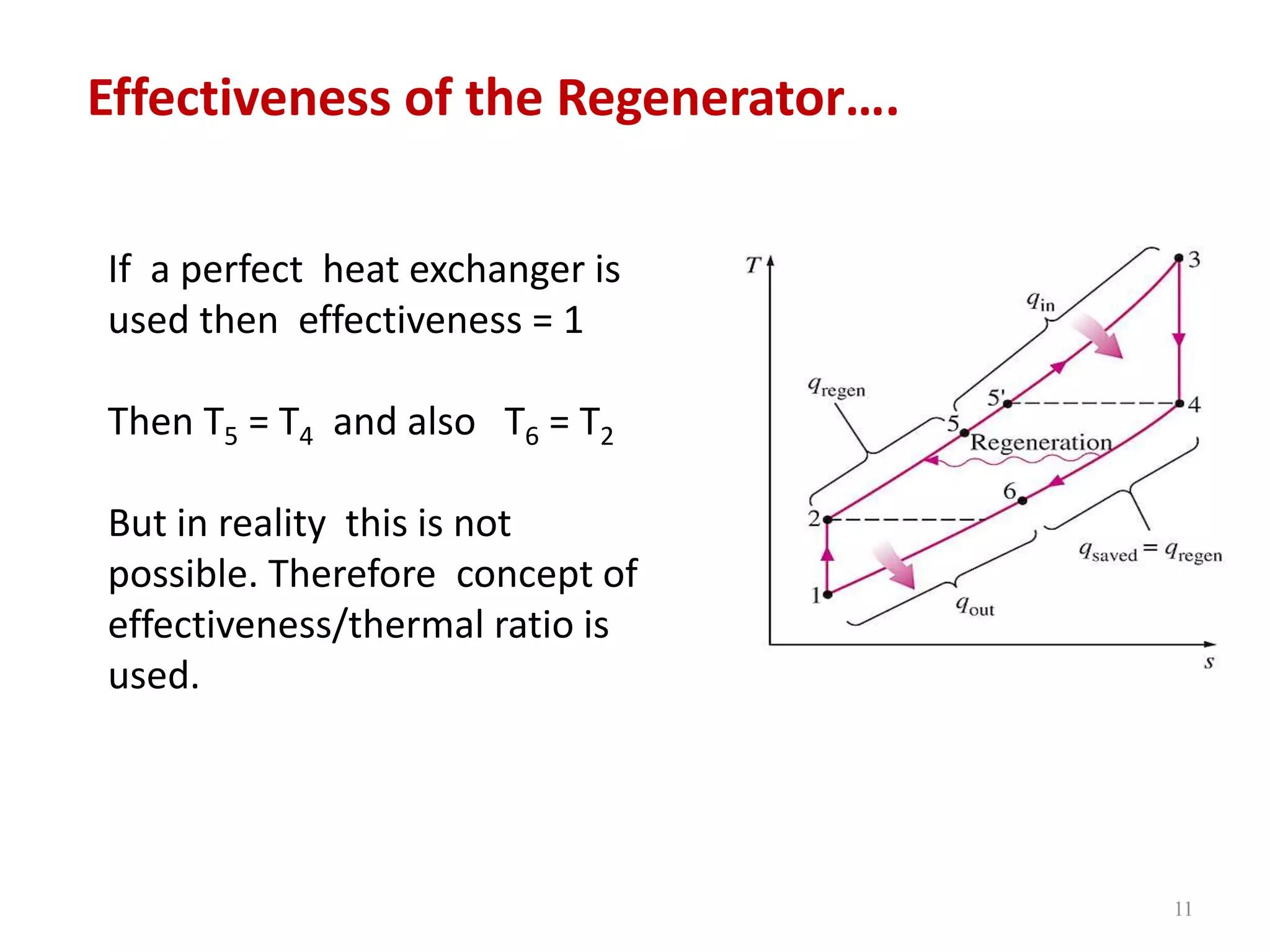
Effectiveness of the Regenerator
Assuming the regenerator is
well insulated and changes in
kinetic and potential energies
are negligible, the actual and
maximum heat transfers from
the exhaust gases to the air can
be expressed as follows.
enthalpyavailableMax
enthalpyinIncrease
rregeneratoofessEffectiven
.

25, hhq actregen 
10
Effectiveness of the Regenerator
Mass of fuel added to the combustion chamber is small
compared to the air flow. We can neglect the difference
in mass.
 
  pg
pa
cTT
cTT
24
25



24
25
max,
,
hh
hh
q
q
regen
actregen



11
Effectiveness of the Regenerator….
If a perfect heat exchanger is
used then effectiveness = 1
Then T5 = T4 and also T6 = T2
But in reality this is not
possible. Therefore concept of
effectiveness/thermal ratio is
used.
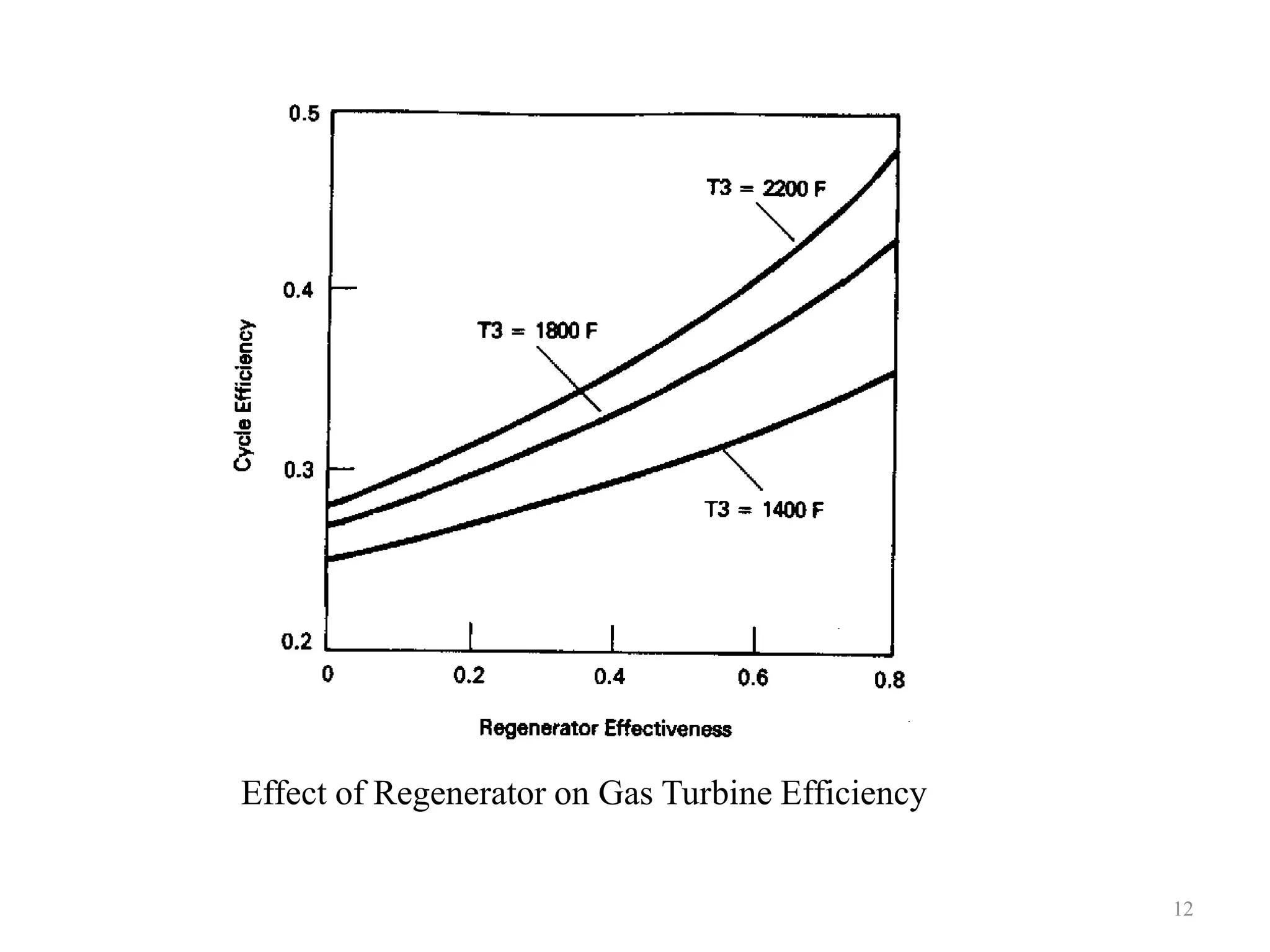
12
Effect of Regenerator on Gas Turbine Efficiency
Efficiency of Regenerative cycle

 /)1(
3
1
1 
 pr
T
T


 1
1
1 

p
th
r
For simple cycle
Assume an ideal regenerator regen = 1 and constant specific heats
   433 hhhhq xin 
   1243 hhhhwnet 
43
12
43
12
11
TT
TT
hh
hh






Same equation for the
work ratio for basic cycle
14
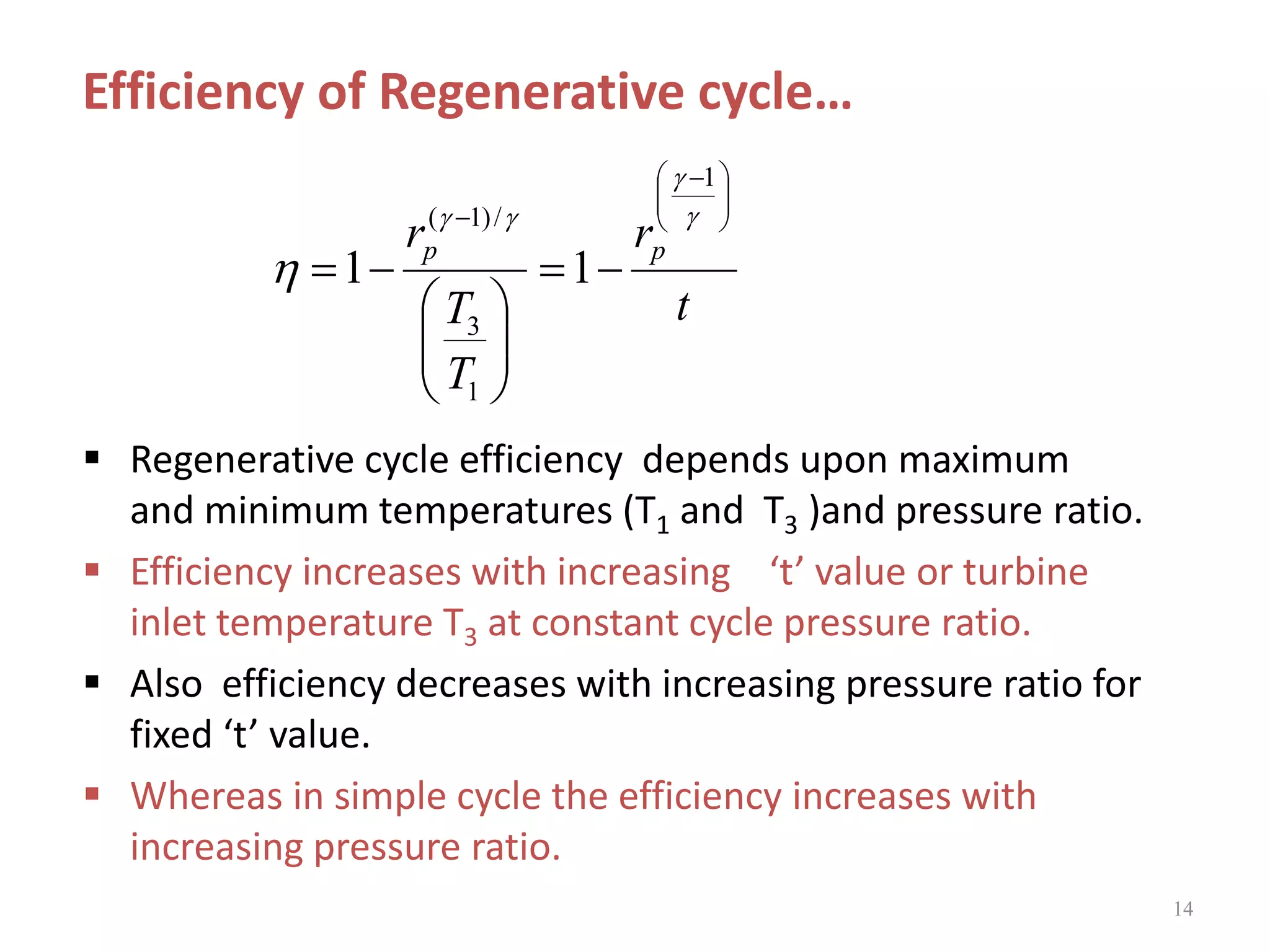
 Regenerative cycle efficiency depends upon maximum
and minimum temperatures (T1 and T3 )and pressure ratio.
 Efficiency increases with increasing ‘t’ value or turbine
inlet temperature T3 at constant cycle pressure ratio.
 Also efficiency decreases with increasing pressure ratio for
fixed ‘t’ value.
 Whereas in simple cycle the efficiency increases with
increasing pressure ratio.
t
r
T
T
r pp





 













1
1
3
/)1(
11
Efficiency of Regenerative cycle…
15
Thermal efficiency of
Brayton cycle with
regeneration depends on:
 Ratio of the minimum to
maximum temperatures
 Pressure ratio
Regeneration is most
effective at lower pressure
ratios and small minimum-
to-maximum temperature
ratios.
Factors Affecting Thermal Efficiency
16
The addition of a heat exchanger only improves the
cycle efficiency, but does not change the net work
output.
The net work can be increased either by reducing the
compressor work or by increasing the turbine work output
Heat exchanger
17
Gas turbine regenerators
are usually constructed as
shell-and-tube type heat
exchangers using very
small diameter tubes, with
the high pressure air inside
the tubes and low
pressure exhaust gas in
multiple passes outside
the tubes
Intercooling in compression
18
The state 1 is the
atmospheric condition
Ideally, it is possible to cool
the air to the atmospheric
temperature and in this case
inter cooling is said to be
complete inter cooling.
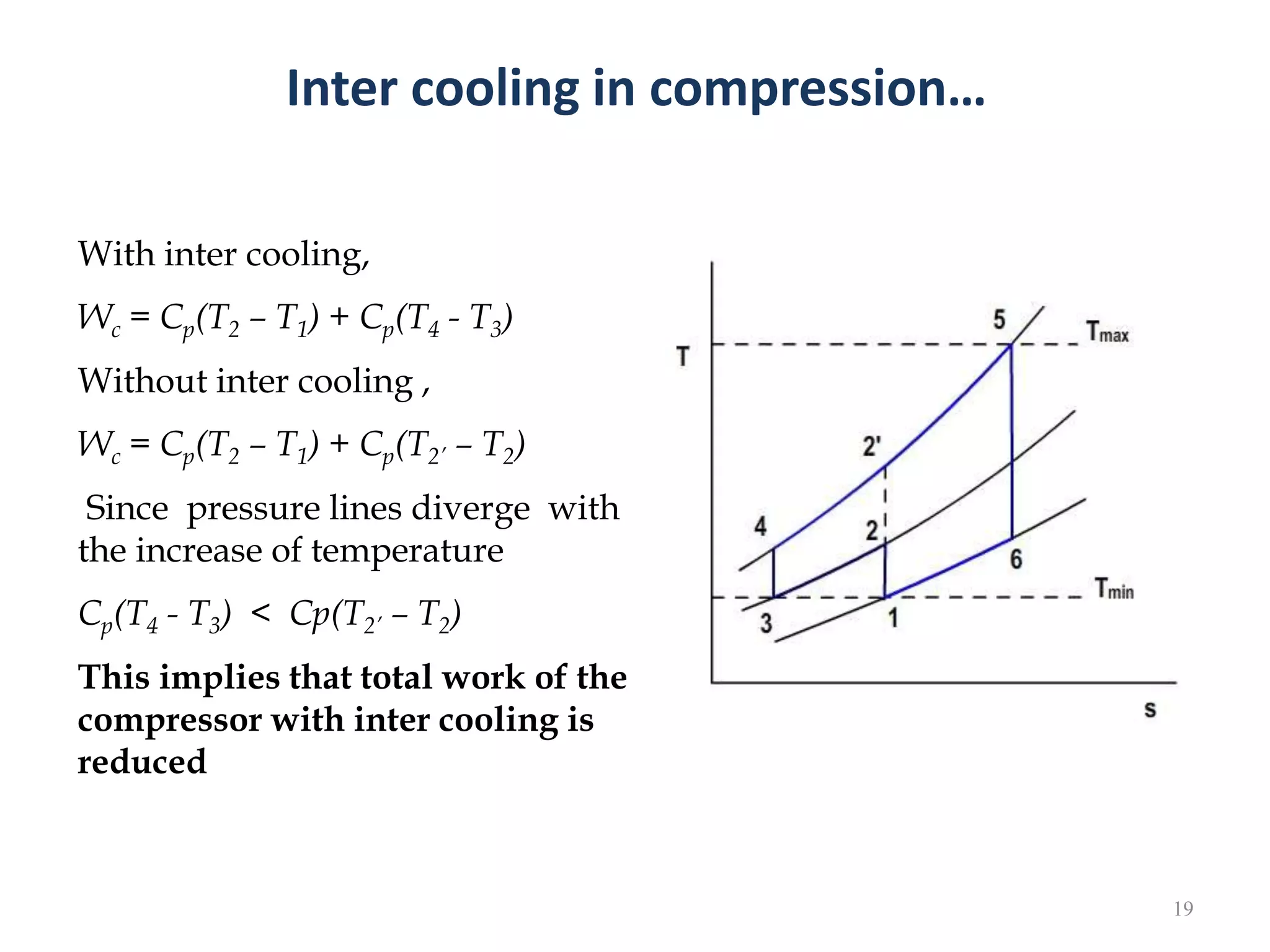
Inter cooling in compression…
19
With inter cooling,
Wc = Cp(T2 – T1) + Cp(T4 - T3)
Without inter cooling ,
Wc = Cp(T2 – T1) + Cp(T2’ – T2)
Since pressure lines diverge with
the increase of temperature
Cp(T4 - T3) < Cp(T2’ – T2)
This implies that total work of the
compressor with inter cooling is
reduced
20
Therefore if the compression is carried out to high pressure (state 2 )
in two stages, 1 -2 and 3- 4 with the air cooled at constant pressure pi
between the stages, a reduction of compressor work can be obtained.
Net work is increased. Hence Work ratio is increased.
Also when compression is done at lower temperatures, the work
input to the compressor is reduced. Thus increases net work and
hence increase the thermal efficiency
The back work ratio of a gas- turbine improves as a result of inter
cooling and reheating. However, inter cooling and reheating
decreases thermal efficiency unless they are accompanied with
regeneration.
Inter cooling in compression…
21
With isentropic compression and complete inter cooling the
compression work is given by the following expression
)()( 3412 TTcTTcw ppcomp 
 /)1(
'2
3
4
/)1(
11
2














i
i
p
p
T
T
and
p
p
T
T
Also we know that,
Intermediate pressure for min. compressor work































1
'
1
/)1(
2
1
/)1(
1
1

i
p
i
pcomp
p
p
Tc
p
p
Tcw
22
The saving of work depends on the choice of the intermediate
pressure pi.
By equating dW/dpi to zero the condition for minimum work can be
proved to be;
)( '21 pppi 
ppi r
p
p
r 






1
'2
pi
i
i
r
p
p
p
p
 '2
1
Therefore we can write
rpi = compression ratio at each stage
Intermediate pressure for min. compressor work..
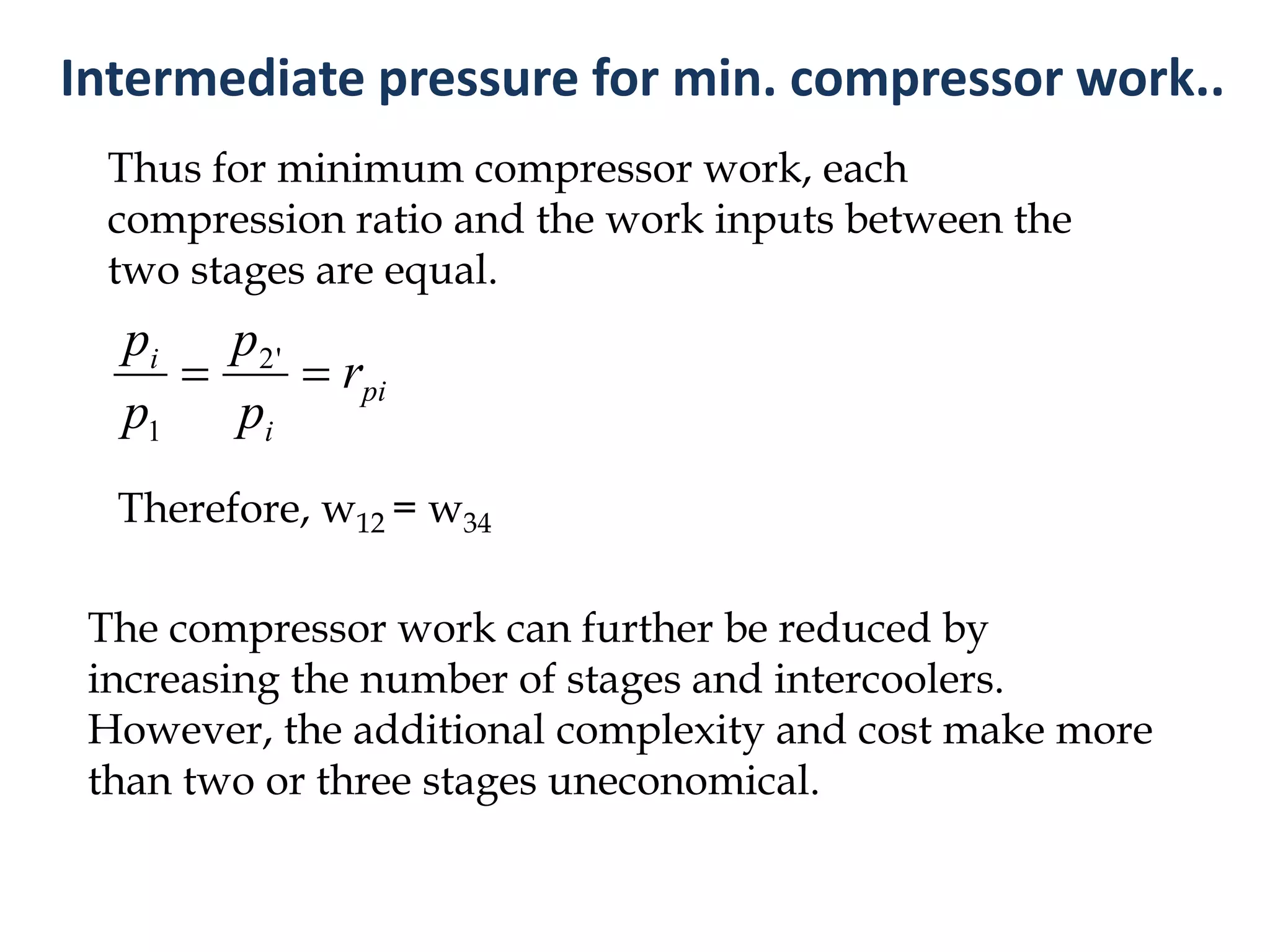
Thus for minimum compressor work, each
compression ratio and the work inputs between the
two stages are equal.
The compressor work can further be reduced by
increasing the number of stages and intercoolers.
However, the additional complexity and cost make more
than two or three stages uneconomical.
pi
i
i
r
p
p
p
p
 '2
1
Therefore, w12 = w34
Intermediate pressure for min. compressor work..
24
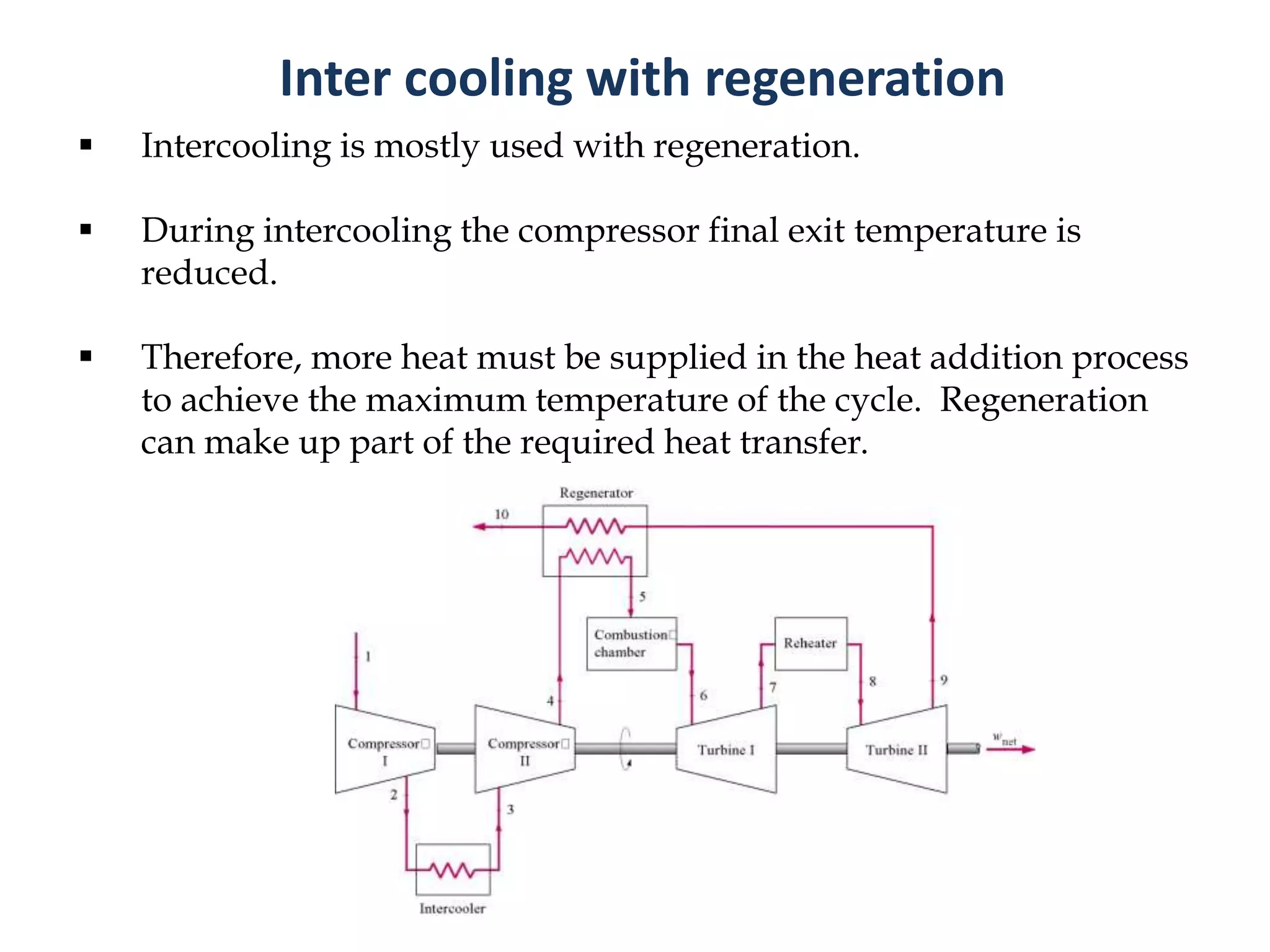
 Intercooling is mostly used with regeneration.
 During intercooling the compressor final exit temperature is
reduced.
 Therefore, more heat must be supplied in the heat addition process
to achieve the maximum temperature of the cycle. Regeneration
can make up part of the required heat transfer.
Inter cooling with regeneration
Summary of equations - Intercooling in
compression
25
)( '21 pppi 
)()( 341214 TTcTTcww ppcomp 
     
 45
341265
TTc
TTcTTcTTc
inputheat
workNet
p
ppp



     
 45
341265
TT
TTTTTT



Example 1 – Two shaft plant
26
Air is drawn in a gas turbine unit at 15°C and 1.01 bar and pressure ratio is
7 :1. The compressor is driven by the HP turbine and LP turbine drives a
separate power shaft. The isentropic efficiencies of compressor, and the HP
and LP turbines are 0.82, 0.85 and 0.85 respectively. If the maximum cycle
temperature is 610oC, Calculate:
(i) The pressure and temperature of the gases are entering the power
turbine.
(ii) The net power developed by the unit per kg/s, mass flow.
(iii) The work ratio
(iv) The thermal efficiency of the unit.
Neglect the mass of fuel and assume the following
For compression process Cpa = 1.005 kJ/kgK γ = 1.4
For combustion and expansion process Cpg = 1.15kJ/kgK and γ = 1.333
27
In a gas turbine plant, air is compressed from 1.01 bar and 15°C
through a pressure ratio of 4:1. It is then heated to 650°C in a
combustion chamber and expanded back to original pressure of
1.01 bar.
Calculate the cycle efficiency and the specific power output if a
perfect heat exchanger is employed. The isentropic efficiencies
of the turbine and compressor are 0.85 and 0.8 respectively.
Example 2 – Regeneration with perfect HE
28
In a gas turbine installation air is supplied at 1bar, 25°C into compressor.
The pressure after compression is 7.2 bar. The gas leaves the
combustion chamber at 1100°C. A heat exchanger having effectiveness
of 0.8 is fitted at exit of turbine for heating the air before its inlet into
combustion chamber. Isentropic efficiency of the compressor and
turbine are 0.8 and 0.85 respectively. The heat transfer rate to the
combustion chamber is 1.48MW
The adiabatic index is 1.4 for air and 1.33 for the gas produced by
combustion. The specific heat Cp is 1.005 kJ/kgK for air and 1.15kJ/kgK
for the gas. Determine the following.
 mass flow rate
 net power output
 thermal efficiency of the cycle
Example 3 – Regeneration with non perfect HE
29
In a gas turbine plant working on the Brayton cycle the air at
inlet is at 27ºC, 0.1 MPa. Compression is divided into two
stage , each of pressure ratio 2.5 and efficiency 80% with inter
cooling to 27ºC.The maximum temperature of the cycle is
800ºC. Turbine isentropic efficiency is 80%.
Find
The cycle efficiency
The turbine exhaust temperature
Example 4 – Inter cooling
30
The air supplied to a gas turbine plant is 10 kg/s. The pressure
ratio is 6 and pressure at the inlet of the compressor is 1 bar. The
compressor is two stage and provided with perfect intercooler.
The inlet temperature is 300K and maximum temperature of the
cycle is limited to 1073K.
Isentropic efficiency of compressor stage is 80% and turbine
stage is 85%. A regenerator having effectiveness of 0.7. is
included. Neglecting the mass of fuel determine the power
output and the thermal efficiency of the plant.
Example 5 – Inter cooling and regeneration
31
The air in a gas turbine plant is taken in LP compressor at
293K and 1.05 bar and after compression it is passed through
intercooler where its temperature is reduced to 300K. The
cooled air is further compressed in HP unit and then passed
in the combustion chamber where its temperature is
increased to 750°C by burning the fuel. The combustion
products expand in HP turbine which runs the compressor
and further expansion is continued in LP turbine which runs
the alternator. The gases coming out from LP turbine are
used for heating the incoming air from HP compressor and
then expanded to atmosphere pressure.
Example 6 – Inter cooling and regeneration with two shafts
32
Pressure ratio of each compressor - 2.
Isentropic efficiency of each turbine and compressor - 82%
Effectiveness of Heat exchanger- 0.72
Air flow – 16 kg/s
Calorific value of fuel – 42000 kJ/kg
Cp for air – 1.005 kJ/kg K
Cp for gas - 1.12 kJ/kg K
γ for air - 1.4
γ for gas – 1.33
Neglecting the mechanical, pressure and heat losses of the
system, determine the following
 The power output
 Specific fuel consumption
 Thermal efficiency
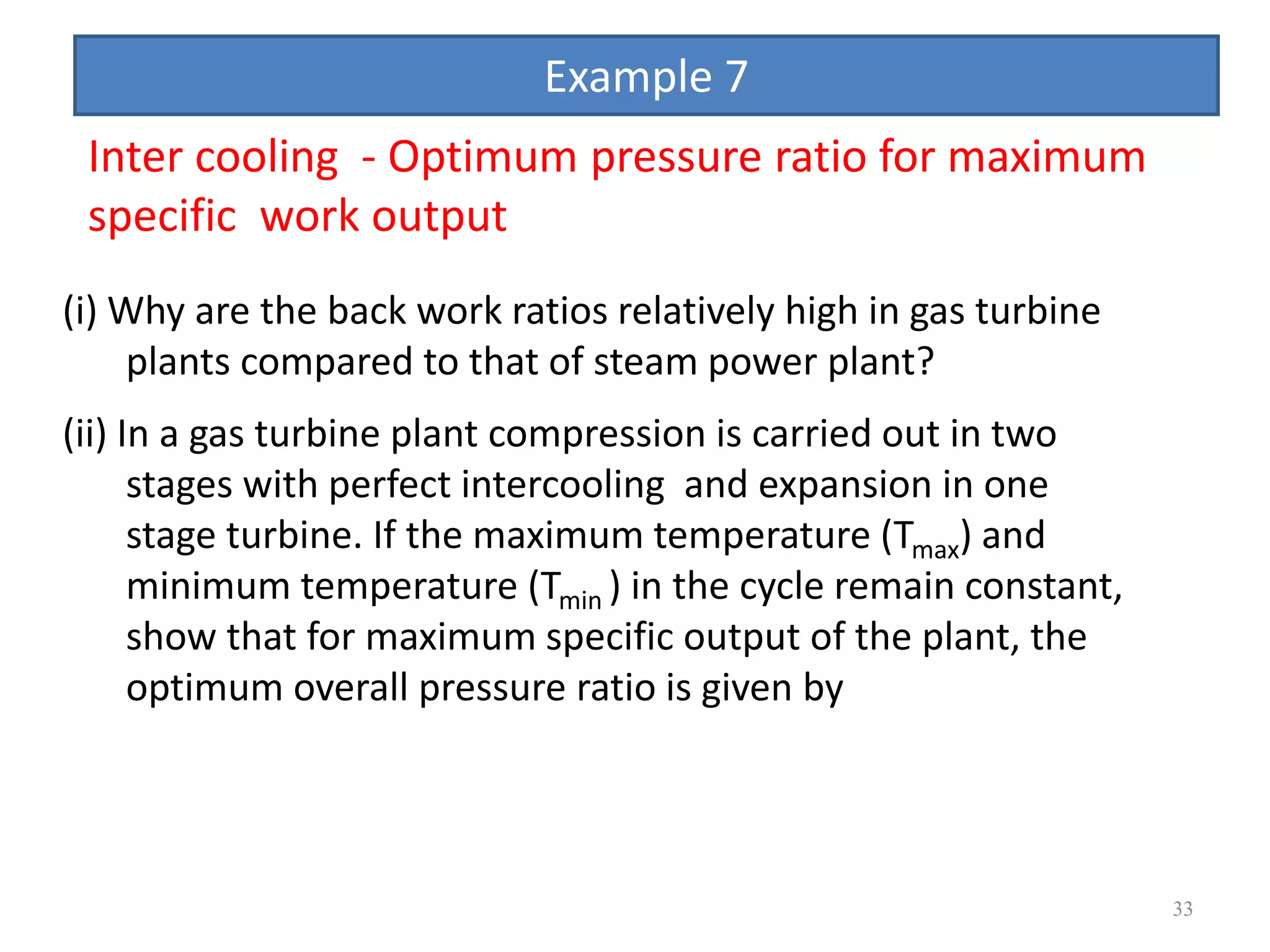
33
(i) Why are the back work ratios relatively high in gas turbine
plants compared to that of steam power plant?
(ii) In a gas turbine plant compression is carried out in two
stages with perfect intercooling and expansion in one
stage turbine. If the maximum temperature (Tmax) and
minimum temperature (Tmin ) in the cycle remain constant,
show that for maximum specific output of the plant, the
optimum overall pressure ratio is given by
Inter cooling - Optimum pressure ratio for maximum
specific work output
Example 7
34
Where γ = adiabatic index
ηT = Isentropic efficiency of the turbine
ηC = Isentropic efficiency of the turbine
35
(iii) In a Brayton cycle gas turbine power plant the minimum
and maximum temperature of the cycle are 300K and
1200K. The compression is carried out in two stages of
equal pressure ratio with inter cooling of the working fluid
to the minimum temperature of the cycle after the first
stage of compression. The entire expansion is carried out in
one stage only. The isentropic efficiency of both
compressors is 0.8 and that of the turbine is 0.9.
Determine the overall pressure ratio that would give the
maximum work per kg working fluid . Take γ = 1.4.

Gas turbine 2 - regeneration and intercooling

  • 1.
    1 Gas Turbine Cycles NSSenanayake Senior Lecturer Dept ofMechanical Engineering The Open University ofSriLanka Lecture 02
  • 2.
    Two shaft turbines LowPressure Turbine High Pressure Turbine
  • 3.
    3  In asingle shaft arrangement , the turbine is arranged to drive the compressor as well as to develop network.  It is sometimes more convenient to have two separate turbines .  one to drive the compressor and  other provides the power output  The first or high pressure (HP) turbine is known as the compressor turbine  The second or low pressure (LP)turbine is called the power turbine
  • 4.
    4 T-S diagram fortwo shaft turbine 3-4 Expansion in compressor turbine 4-5 Expansion in power turbine
  • 5.
    Gas Turbine Improvements Modificationsto the basic gas turbine thermodynamic cycle: Regeneration (With Heat Exchanger) Inter cooling Reheating
  • 6.
    6 Note: The use ofa regenerator is recommended only when the turbine exhaust temperature is higher than the compressor exit temperature. Regenerative Gas Turbine cycle
  • 7.
    7  Temperature ofthe exhaust gas leaving the turbine is higher than the temperature of the air leaving the compressor.  The air leaving the compressor can be heated by the hot exhaust gases in a counter-flow heat exchanger (a regenerator or recuperator) – a process called regeneration  The thermal efficiency of the Brayton cycle increases due to regeneration since less fuel is used for the same work output. Regenerative Gas Turbine cycle
  • 8.
    Regeneration - Simplecycle with heat exchanger 8 )( 5353 TTcq p  35 1234 q qq   Since heat supplied is less than that of basic cycle, efficiency increases
  • 9.
    9 Effectiveness of theRegenerator Assuming the regenerator is well insulated and changes in kinetic and potential energies are negligible, the actual and maximum heat transfers from the exhaust gases to the air can be expressed as follows. enthalpyavailableMax enthalpyinIncrease rregeneratoofessEffectiven .  25, hhq actregen 
  • 10.
    10 Effectiveness of theRegenerator Mass of fuel added to the combustion chamber is small compared to the air flow. We can neglect the difference in mass.     pg pa cTT cTT 24 25    24 25 max, , hh hh q q regen actregen   
  • 11.
    11 Effectiveness of theRegenerator…. If a perfect heat exchanger is used then effectiveness = 1 Then T5 = T4 and also T6 = T2 But in reality this is not possible. Therefore concept of effectiveness/thermal ratio is used.
  • 12.
    12 Effect of Regeneratoron Gas Turbine Efficiency
  • 13.
    Efficiency of Regenerativecycle   /)1( 3 1 1   pr T T    1 1 1   p th r For simple cycle Assume an ideal regenerator regen = 1 and constant specific heats    433 hhhhq xin     1243 hhhhwnet  43 12 43 12 11 TT TT hh hh       Same equation for the work ratio for basic cycle
  • 14.
    14  Regenerative cycleefficiency depends upon maximum and minimum temperatures (T1 and T3 )and pressure ratio.  Efficiency increases with increasing ‘t’ value or turbine inlet temperature T3 at constant cycle pressure ratio.  Also efficiency decreases with increasing pressure ratio for fixed ‘t’ value.  Whereas in simple cycle the efficiency increases with increasing pressure ratio. t r T T r pp                     1 1 3 /)1( 11 Efficiency of Regenerative cycle…
  • 15.
    15 Thermal efficiency of Braytoncycle with regeneration depends on:  Ratio of the minimum to maximum temperatures  Pressure ratio Regeneration is most effective at lower pressure ratios and small minimum- to-maximum temperature ratios. Factors Affecting Thermal Efficiency
  • 16.
    16 The addition ofa heat exchanger only improves the cycle efficiency, but does not change the net work output. The net work can be increased either by reducing the compressor work or by increasing the turbine work output
  • 17.
    Heat exchanger 17 Gas turbineregenerators are usually constructed as shell-and-tube type heat exchangers using very small diameter tubes, with the high pressure air inside the tubes and low pressure exhaust gas in multiple passes outside the tubes
  • 18.
    Intercooling in compression 18 Thestate 1 is the atmospheric condition Ideally, it is possible to cool the air to the atmospheric temperature and in this case inter cooling is said to be complete inter cooling.
  • 19.
    Inter cooling incompression… 19 With inter cooling, Wc = Cp(T2 – T1) + Cp(T4 - T3) Without inter cooling , Wc = Cp(T2 – T1) + Cp(T2’ – T2) Since pressure lines diverge with the increase of temperature Cp(T4 - T3) < Cp(T2’ – T2) This implies that total work of the compressor with inter cooling is reduced
  • 20.
    20 Therefore if thecompression is carried out to high pressure (state 2 ) in two stages, 1 -2 and 3- 4 with the air cooled at constant pressure pi between the stages, a reduction of compressor work can be obtained. Net work is increased. Hence Work ratio is increased. Also when compression is done at lower temperatures, the work input to the compressor is reduced. Thus increases net work and hence increase the thermal efficiency The back work ratio of a gas- turbine improves as a result of inter cooling and reheating. However, inter cooling and reheating decreases thermal efficiency unless they are accompanied with regeneration. Inter cooling in compression…
  • 21.
    21 With isentropic compressionand complete inter cooling the compression work is given by the following expression )()( 3412 TTcTTcw ppcomp   /)1( '2 3 4 /)1( 11 2               i i p p T T and p p T T Also we know that, Intermediate pressure for min. compressor work                                1 ' 1 /)1( 2 1 /)1( 1 1  i p i pcomp p p Tc p p Tcw
  • 22.
    22 The saving ofwork depends on the choice of the intermediate pressure pi. By equating dW/dpi to zero the condition for minimum work can be proved to be; )( '21 pppi  ppi r p p r        1 '2 pi i i r p p p p  '2 1 Therefore we can write rpi = compression ratio at each stage Intermediate pressure for min. compressor work..
  • 23.
    Thus for minimumcompressor work, each compression ratio and the work inputs between the two stages are equal. The compressor work can further be reduced by increasing the number of stages and intercoolers. However, the additional complexity and cost make more than two or three stages uneconomical. pi i i r p p p p  '2 1 Therefore, w12 = w34 Intermediate pressure for min. compressor work..
  • 24.
    24  Intercooling ismostly used with regeneration.  During intercooling the compressor final exit temperature is reduced.  Therefore, more heat must be supplied in the heat addition process to achieve the maximum temperature of the cycle. Regeneration can make up part of the required heat transfer. Inter cooling with regeneration
  • 25.
    Summary of equations- Intercooling in compression 25 )( '21 pppi  )()( 341214 TTcTTcww ppcomp         45 341265 TTc TTcTTcTTc inputheat workNet p ppp           45 341265 TT TTTTTT   
  • 26.
    Example 1 –Two shaft plant 26 Air is drawn in a gas turbine unit at 15°C and 1.01 bar and pressure ratio is 7 :1. The compressor is driven by the HP turbine and LP turbine drives a separate power shaft. The isentropic efficiencies of compressor, and the HP and LP turbines are 0.82, 0.85 and 0.85 respectively. If the maximum cycle temperature is 610oC, Calculate: (i) The pressure and temperature of the gases are entering the power turbine. (ii) The net power developed by the unit per kg/s, mass flow. (iii) The work ratio (iv) The thermal efficiency of the unit. Neglect the mass of fuel and assume the following For compression process Cpa = 1.005 kJ/kgK γ = 1.4 For combustion and expansion process Cpg = 1.15kJ/kgK and γ = 1.333
  • 27.
    27 In a gasturbine plant, air is compressed from 1.01 bar and 15°C through a pressure ratio of 4:1. It is then heated to 650°C in a combustion chamber and expanded back to original pressure of 1.01 bar. Calculate the cycle efficiency and the specific power output if a perfect heat exchanger is employed. The isentropic efficiencies of the turbine and compressor are 0.85 and 0.8 respectively. Example 2 – Regeneration with perfect HE
  • 28.
    28 In a gasturbine installation air is supplied at 1bar, 25°C into compressor. The pressure after compression is 7.2 bar. The gas leaves the combustion chamber at 1100°C. A heat exchanger having effectiveness of 0.8 is fitted at exit of turbine for heating the air before its inlet into combustion chamber. Isentropic efficiency of the compressor and turbine are 0.8 and 0.85 respectively. The heat transfer rate to the combustion chamber is 1.48MW The adiabatic index is 1.4 for air and 1.33 for the gas produced by combustion. The specific heat Cp is 1.005 kJ/kgK for air and 1.15kJ/kgK for the gas. Determine the following.  mass flow rate  net power output  thermal efficiency of the cycle Example 3 – Regeneration with non perfect HE
  • 29.
    29 In a gasturbine plant working on the Brayton cycle the air at inlet is at 27ºC, 0.1 MPa. Compression is divided into two stage , each of pressure ratio 2.5 and efficiency 80% with inter cooling to 27ºC.The maximum temperature of the cycle is 800ºC. Turbine isentropic efficiency is 80%. Find The cycle efficiency The turbine exhaust temperature Example 4 – Inter cooling
  • 30.
    30 The air suppliedto a gas turbine plant is 10 kg/s. The pressure ratio is 6 and pressure at the inlet of the compressor is 1 bar. The compressor is two stage and provided with perfect intercooler. The inlet temperature is 300K and maximum temperature of the cycle is limited to 1073K. Isentropic efficiency of compressor stage is 80% and turbine stage is 85%. A regenerator having effectiveness of 0.7. is included. Neglecting the mass of fuel determine the power output and the thermal efficiency of the plant. Example 5 – Inter cooling and regeneration
  • 31.
    31 The air ina gas turbine plant is taken in LP compressor at 293K and 1.05 bar and after compression it is passed through intercooler where its temperature is reduced to 300K. The cooled air is further compressed in HP unit and then passed in the combustion chamber where its temperature is increased to 750°C by burning the fuel. The combustion products expand in HP turbine which runs the compressor and further expansion is continued in LP turbine which runs the alternator. The gases coming out from LP turbine are used for heating the incoming air from HP compressor and then expanded to atmosphere pressure. Example 6 – Inter cooling and regeneration with two shafts
  • 32.
    32 Pressure ratio ofeach compressor - 2. Isentropic efficiency of each turbine and compressor - 82% Effectiveness of Heat exchanger- 0.72 Air flow – 16 kg/s Calorific value of fuel – 42000 kJ/kg Cp for air – 1.005 kJ/kg K Cp for gas - 1.12 kJ/kg K γ for air - 1.4 γ for gas – 1.33 Neglecting the mechanical, pressure and heat losses of the system, determine the following  The power output  Specific fuel consumption  Thermal efficiency
  • 33.
    33 (i) Why arethe back work ratios relatively high in gas turbine plants compared to that of steam power plant? (ii) In a gas turbine plant compression is carried out in two stages with perfect intercooling and expansion in one stage turbine. If the maximum temperature (Tmax) and minimum temperature (Tmin ) in the cycle remain constant, show that for maximum specific output of the plant, the optimum overall pressure ratio is given by Inter cooling - Optimum pressure ratio for maximum specific work output Example 7
  • 34.
    34 Where γ =adiabatic index ηT = Isentropic efficiency of the turbine ηC = Isentropic efficiency of the turbine
  • 35.
    35 (iii) In aBrayton cycle gas turbine power plant the minimum and maximum temperature of the cycle are 300K and 1200K. The compression is carried out in two stages of equal pressure ratio with inter cooling of the working fluid to the minimum temperature of the cycle after the first stage of compression. The entire expansion is carried out in one stage only. The isentropic efficiency of both compressors is 0.8 and that of the turbine is 0.9. Determine the overall pressure ratio that would give the maximum work per kg working fluid . Take γ = 1.4.