STEAM POWER PLANT
INTRODUCTION
• Two important area of application of thermodynamics are power generation and
refrigeration.
• Both power generation and refrigeration are usually accomplished by a system that
operates on a thermodynamics cycle.
• Thermodynamics cycles can be divided into two generation categories :
A. Power Cycles
B. Refrigeration Cycles
• Thermodynamic cycles can be categorized as :
a) Power cycles or Refrigeration cycles
b) Gas Cycles or Vapor Cycles
c) Closed Cycles or Open Cycles
BASIC CONSIDERATION IN THE
ANALYSIS OF POWER CYCLES
• Actual Cycle
The cycles encountered in actual devices are difficult to analyze because of the presence of complicating
effects, such as friction and the absence of sufficient time for establishment of the equilibrium conditions
during the cycle.
• Ideal Cycle
When the actual cycle is stripped of all the internal irreversibilities and complexities, we end up with a
cycle that resembles the actual cycle closely but is made up totally of internally reversible processes. Such a
cycle is called an Ideal cycle.
o The Idealization and Simplification
 The cycle does not involve any friction.
 All expansion and compression process take place in a quasi-equilibrium manner.
 The pipe connecting the various component of a system are well insulated and heat transfer
and pressure drop through them are negligible.
Carnot Vapour cycle
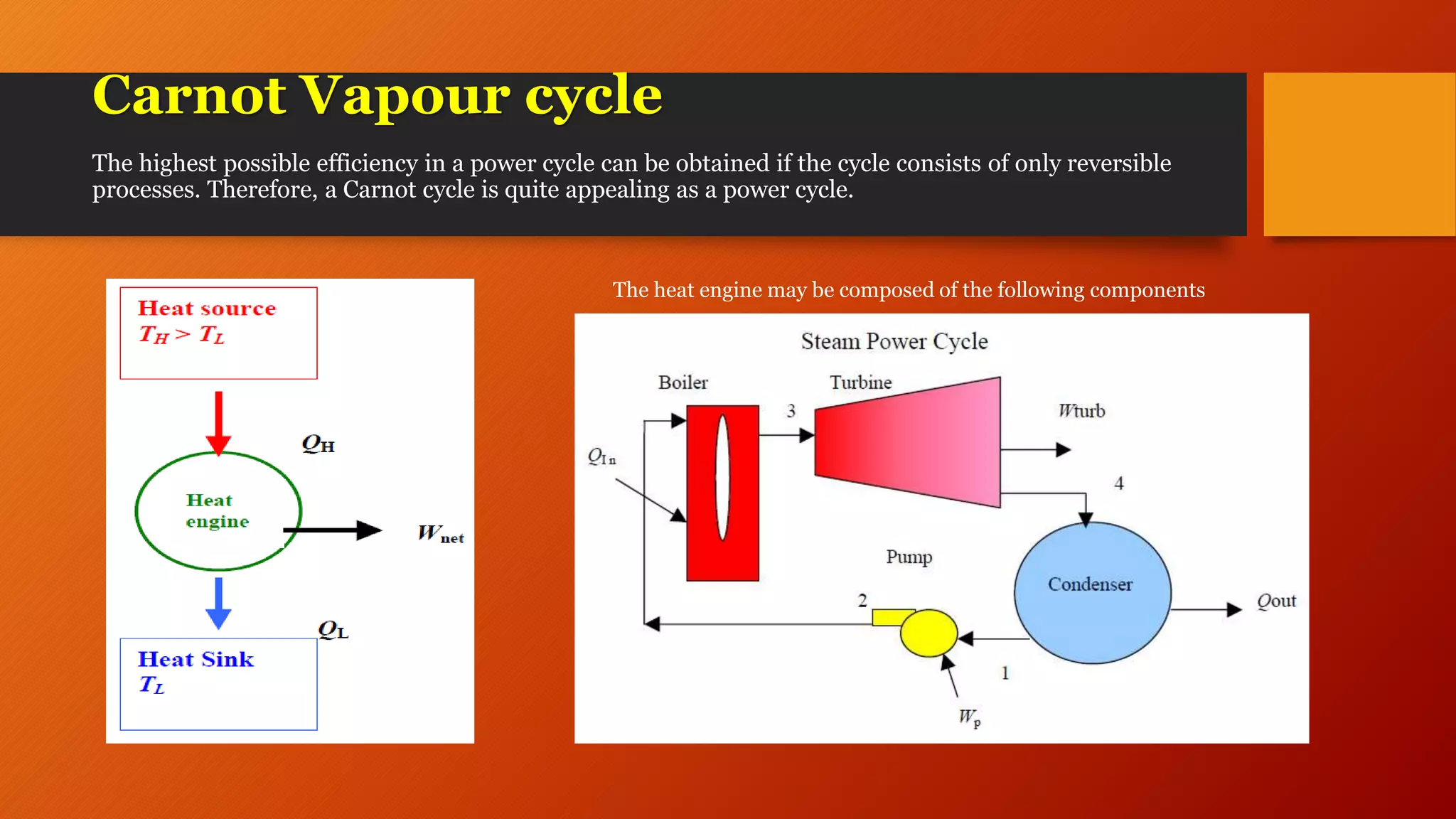
The highest possible efficiency in a power cycle can be obtained if the cycle consists of only reversible
processes. Therefore, a Carnot cycle is quite appealing as a power cycle.
The heat engine may be composed of the following components
Carnot Vapour cycle
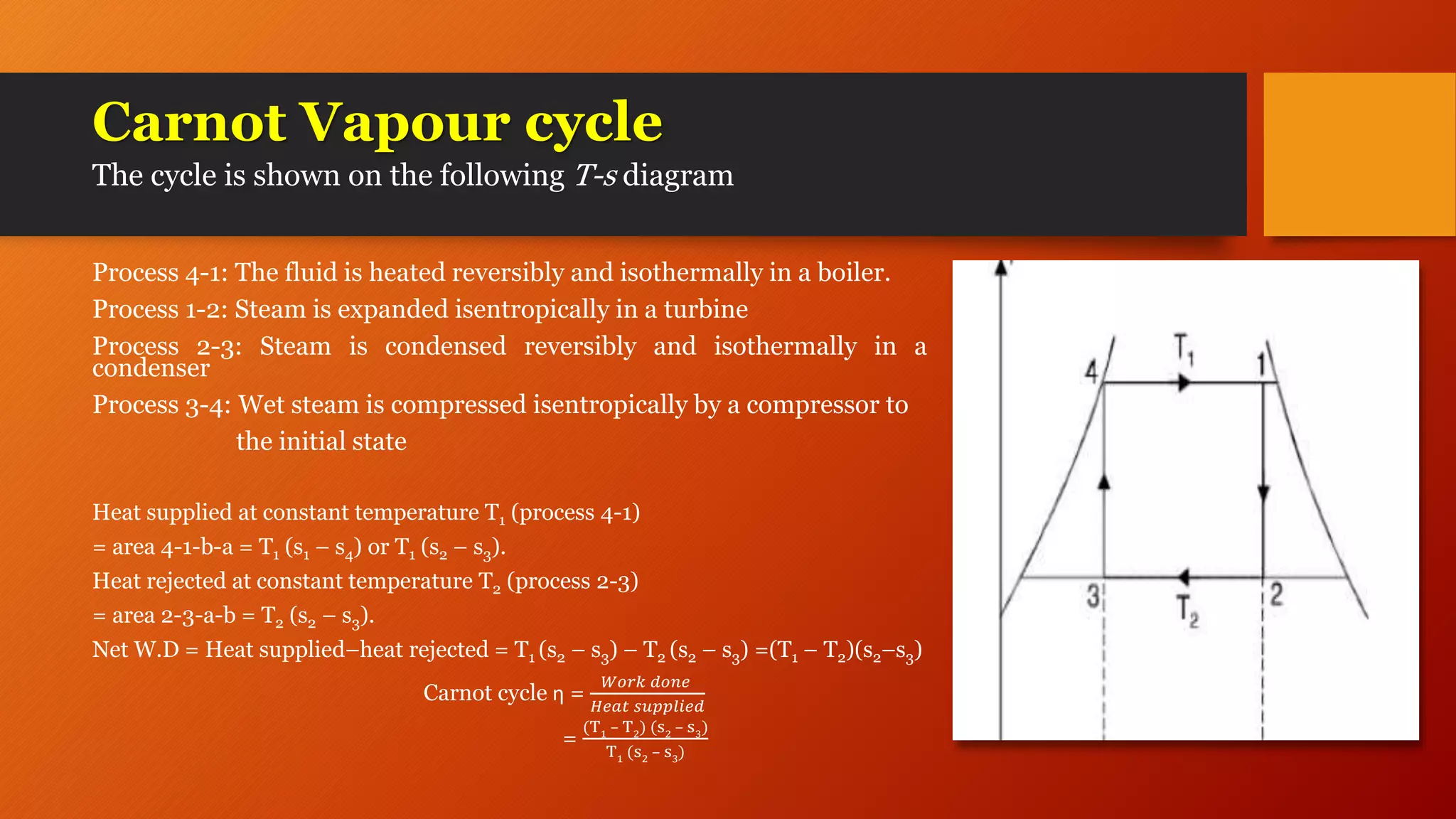
The cycle is shown on the following T-s diagram
Process 4-1: The fluid is heated reversibly and isothermally in a boiler.
Process 1-2: Steam is expanded isentropically in a turbine
Process 2-3: Steam is condensed reversibly and isothermally in a
condenser
Process 3-4: Wet steam is compressed isentropically by a compressor to
the initial state
Heat supplied at constant temperature T1 (process 4-1)
= area 4-1-b-a = T1 (s1 – s4) or T1 (s2 – s3).
Heat rejected at constant temperature T2 (process 2-3)
= area 2-3-a-b = T2 (s2 – s3).
Net W.D = Heat supplied–heat rejected = T1 (s2 – s3) – T2 (s2 – s3) =(T1 – T2)(s2–s3)
Carnot cycle η =
𝑊𝑜𝑟𝑘 𝑑𝑜𝑛𝑒
𝐻𝑒𝑎𝑡 𝑠𝑢𝑝𝑝𝑙𝑖𝑒𝑑
=
(T1 – T2) (s2 – s3)
T1 (s2 – s3)
Limitations of Carnot Cycle
• It is difficult to compress a wet vapour isentropically to
the saturated state as required by the process 3-4
• It is difficult to control the quality of the condensate
coming out of the condenser so that the state ‘3’ is
exactly obtained.
• The efficiency of the Carnot cycle is greatly affected by
the temperature T1 at which heat is transferred to the
working fluid. Since the critical temperature for steam is
only 374°C, therefore, if the cycle is to be operated in the
wet region, the maximum possible temperature is
severely limited.
Rankine Cycle
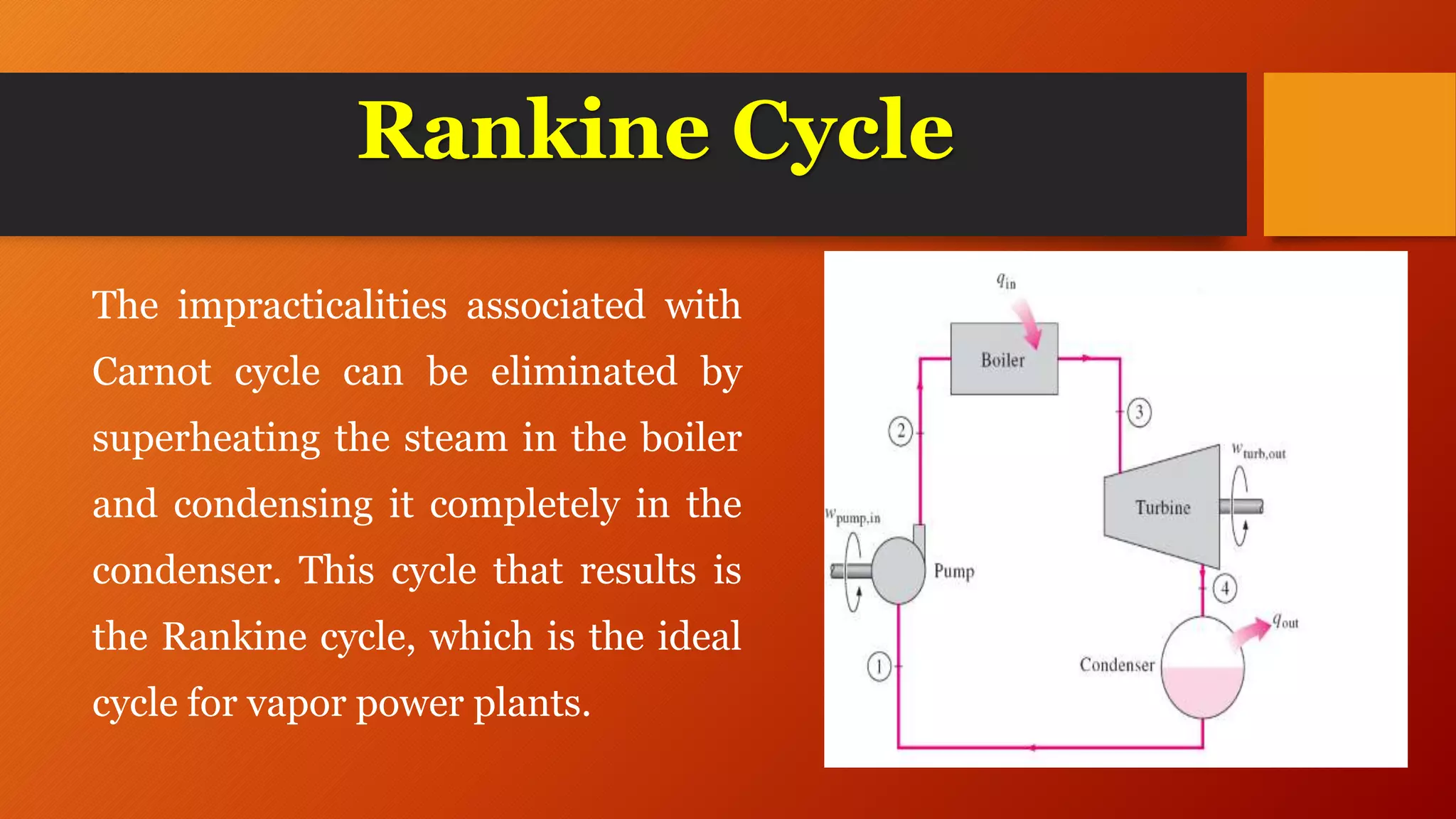
The impracticalities associated with
Carnot cycle can be eliminated by
superheating the steam in the boiler
and condensing it completely in the
condenser. This cycle that results is
the Rankine cycle, which is the ideal
cycle for vapor power plants.
Rankine Cycle
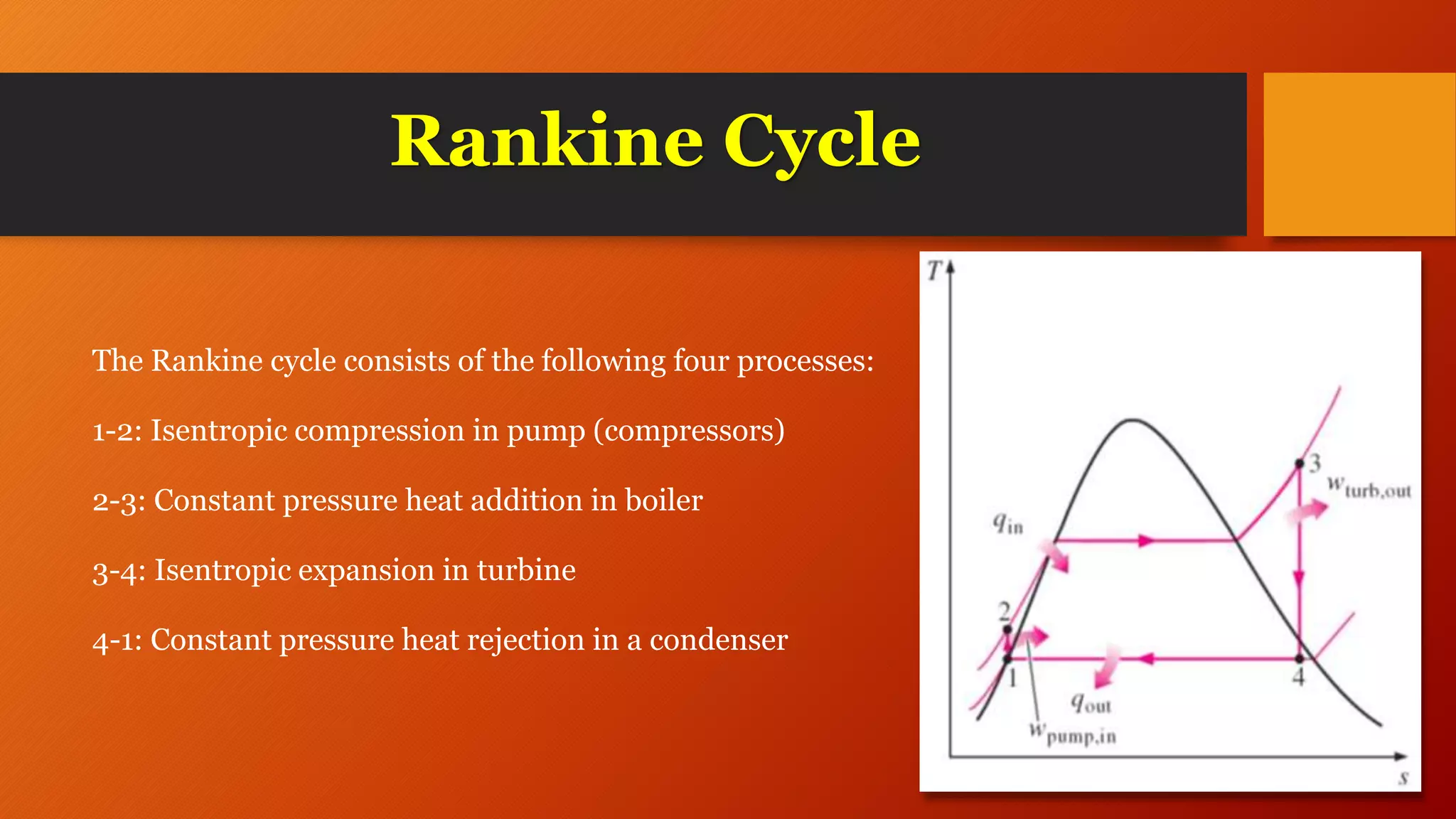
The Rankine cycle consists of the following four processes:
1-2: Isentropic compression in pump (compressors)
2-3: Constant pressure heat addition in boiler
3-4: Isentropic expansion in turbine
4-1: Constant pressure heat rejection in a condenser
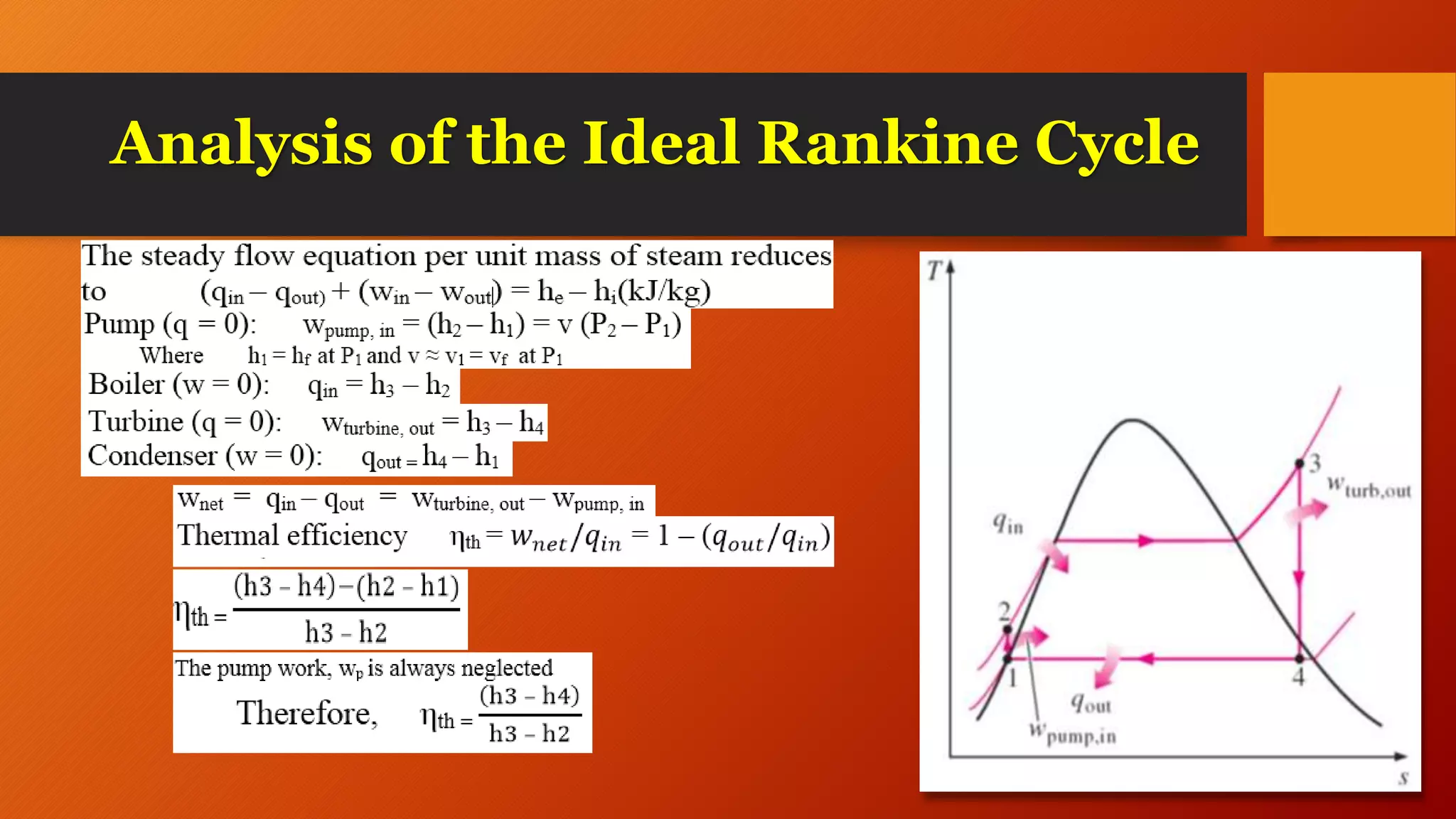
Analysis of the Ideal Rankine Cycle
Actual Vapor Power Cycle
• The actual vapor power cycle differs from the ideal Rankine cycle, as a result of irreversibility’s
in various components. Fluid friction and heat loss to the surroundings are the two common
sources of irreversibility’s.
(a) Deviation of actual vapor power cycle from the ideal Rankine cycle.
(b) The effect of pump and turbine irreversibilities on the ideal Rankine cycle
Increasing the Efficiency of Rankine Cycle
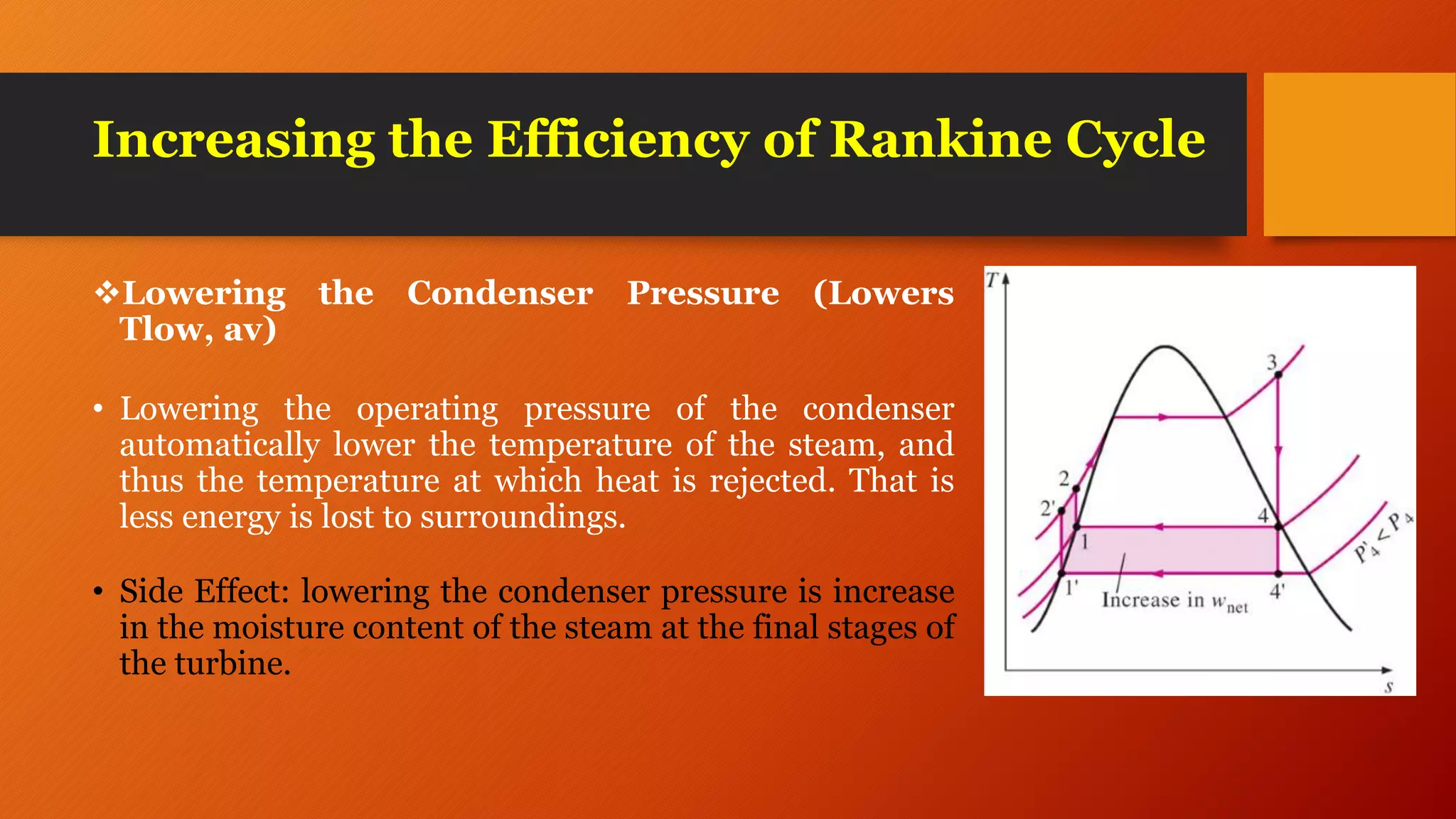
Lowering the Condenser Pressure (Lowers
Tlow, av)
• Lowering the operating pressure of the condenser
automatically lower the temperature of the steam, and
thus the temperature at which heat is rejected. That is
less energy is lost to surroundings.
• Side Effect: lowering the condenser pressure is increase
in the moisture content of the steam at the final stages of
the turbine.
Increasing the Efficiency of Rankine Cycle
Superheating the Steam to High Temperatures
(Increases Thigh, av)
• Both the net work and heat input increase as a result
of superheating the steam to a higher temperature.
The overall effect is an increase in thermal efficiency
since the average temperature at which heat is added
increases.
• Superheating to higher temperatures decreases the
moisture content of the steam at the turbine exit,
which is desirable.
• The temperature is limited by metallurgical
considerations. Presently the highest steam
temperature allowed at the turbine inlet is about
620°C.
Increasing the Efficiency of Rankine Cycle
Increasing the Boiler Pressure
(Increases Thigh, av)
• Increasing the operating pressure of the boiler
leads to an increase in the temperature at
which heat is transferred to the steam and thus
raises the efficiency of the cycle.
• The increase in boiler pressure increases the
moisture content of the steam at the turbine
exit.
Ideal Reheat Rankine Cycle
How can we take advantage of the increased efficiencies at higher boiler pressures
without facing t he problem of excessive moisture at the final stages of the turbine?
1. Superheat the steam to very high temperatures. It is limited metallurgically.
2. Expand the steam in the turbine in two stages, and reheat it in between (reheat)
3. The single reheat in a modern power plant improves the cycle efficiency by 4 to 5% by
increasing the average temperature at which heat is transferred to the steam
Methods of Reheating
1. Gas Reheating
• The steam extracted from H.P. turbine is
sent back to reheater, arranged in a boiler
where the steam is normally reheated to
its initial throttle temperature.
• The disadvantage of gas reheating is it
requires long and large pipe connections.
Therefore, the cost is more as well as
pressure drop is higher.
Methods of Reheating
2. Live-Steam Reheating
• The high pressure steam from the boiler is used for reheating the steam coming out from H.P.
turbine in a specially designed heat exchanger.
• The disadvantage of live steam reheating is the steam cannot be reheated to its initial throttle
temperature.
Methods of Reheating
3. Combined Gas and Live Steam Reheater
• The live steam heating system is placed in series with the gas reheater. The steam
coming out from H.P. turbine is first passed through the live steam reheater and
then to gas reheater.
Ideal Regenerative Rankine Cycle
• In steam power plants, steam is extracted
from the turbine at various points. This
steam, which could have produced more
work by expanding further in the turbine,
is used to heat the feed water instead. The
device where the feed water is heated by
regeneration is called a regenerator, or
a feed water heater (FWH).
• A feed water heater is basically a heat
exchanger where heat is transferred from
the steam to the feed water either by
mixing the two fluid streams (open feed
water heaters) or without mixing them
(closed feed water heaters).
Ideal Regenerative Rankine Cycle
Types of Feed water heaters
1. Open Feed water Heater:
• An open (or direct-contact) feed
water heater is basically a mixing
chamber, where the steam
extracted from the turbine mixes
with the feed water exiting the
pump.
• Ideally, the mixture leaves the
heater as a saturated liquid at the
heater pressure.
Types of Feed water heaters
2.Closed Feed water Heaters
• Another type of feed water heater
used is steam power plants is the
closed feed water heater in which
heat is transferred from the
extracted steam to the feed water
without any mixing taking place.
• The two streams now can be at
different pressure, since they do not
mix.
“
”
A hypothetical theory is necessary, as a
preliminary step, to reduce the expression of
the phenomena to simplicity and order before
it is possible to make any progress in framing
an abstractive theory.
Thank You
-William John Macquorn Rankine

Vapour power cycles

  • 1.
    STEAM POWER PLANT INTRODUCTION •Two important area of application of thermodynamics are power generation and refrigeration. • Both power generation and refrigeration are usually accomplished by a system that operates on a thermodynamics cycle. • Thermodynamics cycles can be divided into two generation categories : A. Power Cycles B. Refrigeration Cycles • Thermodynamic cycles can be categorized as : a) Power cycles or Refrigeration cycles b) Gas Cycles or Vapor Cycles c) Closed Cycles or Open Cycles
  • 2.
    BASIC CONSIDERATION INTHE ANALYSIS OF POWER CYCLES • Actual Cycle The cycles encountered in actual devices are difficult to analyze because of the presence of complicating effects, such as friction and the absence of sufficient time for establishment of the equilibrium conditions during the cycle. • Ideal Cycle When the actual cycle is stripped of all the internal irreversibilities and complexities, we end up with a cycle that resembles the actual cycle closely but is made up totally of internally reversible processes. Such a cycle is called an Ideal cycle. o The Idealization and Simplification  The cycle does not involve any friction.  All expansion and compression process take place in a quasi-equilibrium manner.  The pipe connecting the various component of a system are well insulated and heat transfer and pressure drop through them are negligible.
  • 3.
    Carnot Vapour cycle Thehighest possible efficiency in a power cycle can be obtained if the cycle consists of only reversible processes. Therefore, a Carnot cycle is quite appealing as a power cycle. The heat engine may be composed of the following components
  • 4.
    Carnot Vapour cycle Thecycle is shown on the following T-s diagram Process 4-1: The fluid is heated reversibly and isothermally in a boiler. Process 1-2: Steam is expanded isentropically in a turbine Process 2-3: Steam is condensed reversibly and isothermally in a condenser Process 3-4: Wet steam is compressed isentropically by a compressor to the initial state Heat supplied at constant temperature T1 (process 4-1) = area 4-1-b-a = T1 (s1 – s4) or T1 (s2 – s3). Heat rejected at constant temperature T2 (process 2-3) = area 2-3-a-b = T2 (s2 – s3). Net W.D = Heat supplied–heat rejected = T1 (s2 – s3) – T2 (s2 – s3) =(T1 – T2)(s2–s3) Carnot cycle η = 𝑊𝑜𝑟𝑘 𝑑𝑜𝑛𝑒 𝐻𝑒𝑎𝑡 𝑠𝑢𝑝𝑝𝑙𝑖𝑒𝑑 = (T1 – T2) (s2 – s3) T1 (s2 – s3)
  • 5.
    Limitations of CarnotCycle • It is difficult to compress a wet vapour isentropically to the saturated state as required by the process 3-4 • It is difficult to control the quality of the condensate coming out of the condenser so that the state ‘3’ is exactly obtained. • The efficiency of the Carnot cycle is greatly affected by the temperature T1 at which heat is transferred to the working fluid. Since the critical temperature for steam is only 374°C, therefore, if the cycle is to be operated in the wet region, the maximum possible temperature is severely limited.
  • 6.
    Rankine Cycle The impracticalitiesassociated with Carnot cycle can be eliminated by superheating the steam in the boiler and condensing it completely in the condenser. This cycle that results is the Rankine cycle, which is the ideal cycle for vapor power plants.
  • 7.
    Rankine Cycle The Rankinecycle consists of the following four processes: 1-2: Isentropic compression in pump (compressors) 2-3: Constant pressure heat addition in boiler 3-4: Isentropic expansion in turbine 4-1: Constant pressure heat rejection in a condenser
  • 8.
    Analysis of theIdeal Rankine Cycle
  • 9.
    Actual Vapor PowerCycle • The actual vapor power cycle differs from the ideal Rankine cycle, as a result of irreversibility’s in various components. Fluid friction and heat loss to the surroundings are the two common sources of irreversibility’s. (a) Deviation of actual vapor power cycle from the ideal Rankine cycle. (b) The effect of pump and turbine irreversibilities on the ideal Rankine cycle
  • 10.
    Increasing the Efficiencyof Rankine Cycle Lowering the Condenser Pressure (Lowers Tlow, av) • Lowering the operating pressure of the condenser automatically lower the temperature of the steam, and thus the temperature at which heat is rejected. That is less energy is lost to surroundings. • Side Effect: lowering the condenser pressure is increase in the moisture content of the steam at the final stages of the turbine.
  • 11.
    Increasing the Efficiencyof Rankine Cycle Superheating the Steam to High Temperatures (Increases Thigh, av) • Both the net work and heat input increase as a result of superheating the steam to a higher temperature. The overall effect is an increase in thermal efficiency since the average temperature at which heat is added increases. • Superheating to higher temperatures decreases the moisture content of the steam at the turbine exit, which is desirable. • The temperature is limited by metallurgical considerations. Presently the highest steam temperature allowed at the turbine inlet is about 620°C.
  • 12.
    Increasing the Efficiencyof Rankine Cycle Increasing the Boiler Pressure (Increases Thigh, av) • Increasing the operating pressure of the boiler leads to an increase in the temperature at which heat is transferred to the steam and thus raises the efficiency of the cycle. • The increase in boiler pressure increases the moisture content of the steam at the turbine exit.
  • 13.
    Ideal Reheat RankineCycle How can we take advantage of the increased efficiencies at higher boiler pressures without facing t he problem of excessive moisture at the final stages of the turbine? 1. Superheat the steam to very high temperatures. It is limited metallurgically. 2. Expand the steam in the turbine in two stages, and reheat it in between (reheat) 3. The single reheat in a modern power plant improves the cycle efficiency by 4 to 5% by increasing the average temperature at which heat is transferred to the steam
  • 14.
    Methods of Reheating 1.Gas Reheating • The steam extracted from H.P. turbine is sent back to reheater, arranged in a boiler where the steam is normally reheated to its initial throttle temperature. • The disadvantage of gas reheating is it requires long and large pipe connections. Therefore, the cost is more as well as pressure drop is higher.
  • 15.
    Methods of Reheating 2.Live-Steam Reheating • The high pressure steam from the boiler is used for reheating the steam coming out from H.P. turbine in a specially designed heat exchanger. • The disadvantage of live steam reheating is the steam cannot be reheated to its initial throttle temperature.
  • 16.
    Methods of Reheating 3.Combined Gas and Live Steam Reheater • The live steam heating system is placed in series with the gas reheater. The steam coming out from H.P. turbine is first passed through the live steam reheater and then to gas reheater.
  • 17.
    Ideal Regenerative RankineCycle • In steam power plants, steam is extracted from the turbine at various points. This steam, which could have produced more work by expanding further in the turbine, is used to heat the feed water instead. The device where the feed water is heated by regeneration is called a regenerator, or a feed water heater (FWH). • A feed water heater is basically a heat exchanger where heat is transferred from the steam to the feed water either by mixing the two fluid streams (open feed water heaters) or without mixing them (closed feed water heaters).
  • 18.
  • 19.
    Types of Feedwater heaters 1. Open Feed water Heater: • An open (or direct-contact) feed water heater is basically a mixing chamber, where the steam extracted from the turbine mixes with the feed water exiting the pump. • Ideally, the mixture leaves the heater as a saturated liquid at the heater pressure.
  • 20.
    Types of Feedwater heaters 2.Closed Feed water Heaters • Another type of feed water heater used is steam power plants is the closed feed water heater in which heat is transferred from the extracted steam to the feed water without any mixing taking place. • The two streams now can be at different pressure, since they do not mix.
  • 21.
    “ ” A hypothetical theoryis necessary, as a preliminary step, to reduce the expression of the phenomena to simplicity and order before it is possible to make any progress in framing an abstractive theory. Thank You -William John Macquorn Rankine