


Ji-Lung Hsieh Advisor: Chuen-Tsai Sun
Virtual worlds What is  a “virtual world”? Difficulties studying virtual worlds Advantages of information science Approaches Current results Future works
Users Self-contained  inhabitants—players Virtual worlds are shared by multiple users Interaction happens in  real time Environment Implemented by a computer or network of computers that  simulates an environment Ongoing  environment, and changing very fast Usually  game-based  environment R. Bartle,  Designing virtual worlds . Indianapolis: New Riders Publishing, 2004.
Definition of information science Discipline which studying information’s properties and behaviors Power to control information flow Making information more usable and amiable Virtual worlds hold large percentage of information and knowledge  Human behaviors in real world are hard to be recorded H. Borko,  “Information Science: What is it? ” . American Documentation, 1968.
Properties of virtual worlds Virtual worlds are ongoing and change very fast Users interact from physically separated computer terminals Ex. Guild combining and separating Virtual world controlled by game companies Difficult to obtain data – design and accessibility controlled by game companies Difficult to design experiments Ex. Player’s motivations and his/her avatar’s behaviors A. F. Seay, et al., "Project Massive: A study of online gaming communities,"  Proceedings of CHI 2004 , pp.1421-1424, 2004.
Qualitative: off-game and described by players In-depth individual or group interviews Online/offline surveys Secondary data Quantitative : in-game and observed by researchers Digital video recorder for recording player’s behavior in real world Computer monitor for recording in-game activities in virtual worlds
Lack of representability Interview and survey samples can be biased Lack of generality Players hide behind physically separated computer terminals Lack of consistency Virtual worlds are ongoing in real time Flow and Immersion Gap between in-game motivations and off-game descriptions A. F. Seay, et al., "Project Massive: A study of online gaming communities,"  Proceedings of CHI 2004 , pp.1421-1424, 2004.
Virtual worlds Advantages of information (computer and IT) science Client-designed user interface(UI) trend Player-designed game content trend Available action (or query) log trend Approaches Current results Future works
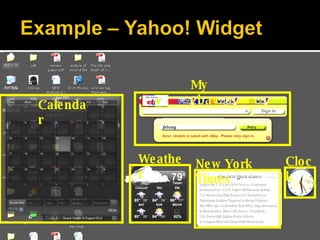
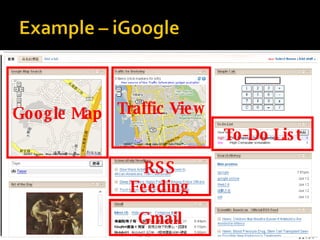
Origins Web 2.0 and open source – sharing and peer-production Blurring boundaries between content providers and consumers or game developers and players Examples - Widgets, extensions, add-ons Yahoo! Widget ,  iGoogle ,  Firefox extension ,  MSN Messenger  API,  World of Warcraft  UI Characteristics Service providers create engines and APIs Users can design their own tools and agents Main agent function is grabbing online information Data accessibility is still limited  by service providers
Calendar My ebay Clock New York Times Weather
Gmail To-Do List RSS Feeding Google Map Traffic View
2 . Save and Print 1.Clip
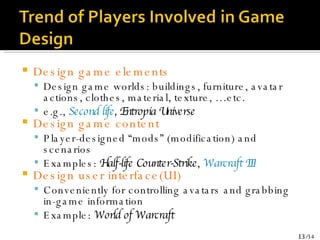
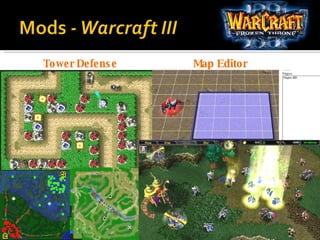
Design game elements Design game worlds: buildings, furniture, avatar actions, clothes, material, texture, …etc. e.g.,  Second life , Entropia Universe Design game content  Player-designed “mods” (modification) and scenarios Examples:  Half-life Counter-Strike ,  Warcraft III Design user interface(UI) Conveniently for controlling avatars and grabbing in-game information Example:  World of Warcraft
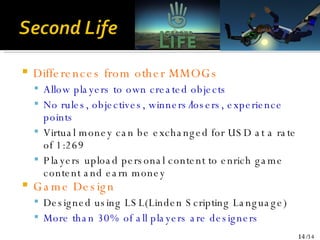
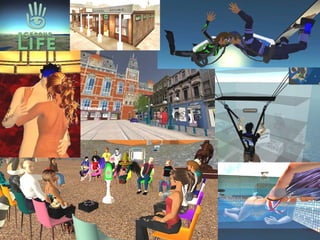
Differences from other MMOGs Allow players to own created objects No rules, objectives, winners/losers, experience points Virtual money can be exchanged for USD at a rate of 1:269 Players upload personal content to enrich game content and earn money Game Design Designed using LSL(Linden Scripting Language) More than 30% of all players are designers
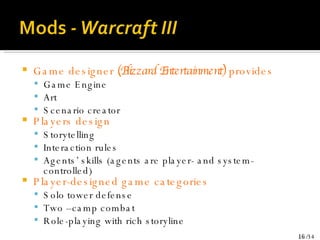
Game designer  (Blizzard Entertainment)  provides Game Engine Art Scenario creator Players design Storytelling Interaction rules Agents’ skills (agents are player- and system-controlled) Player-designed game categories Solo tower defense Two –camp combat Role-playing with rich storyline
Tower Defense Map Editor
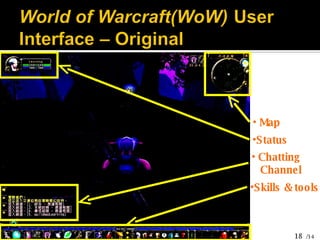
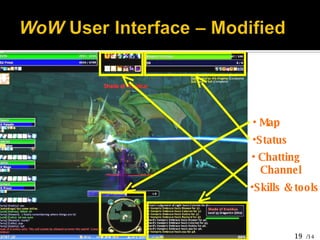
Status Map Skills & tools Chatting  Channel
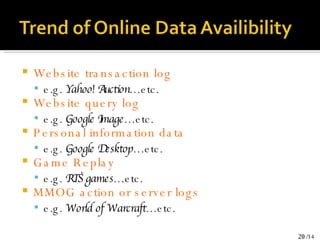
Website transaction log e.g.  Yahoo! Auction …etc. Website query log e.g.  Google Image …etc. Personal information data e.g.  Google Desktop …etc. Game Replay e.g.  RTS games …etc. MMOG action or server logs e.g.  World of Warcraft …etc.
Virtual worlds Advantages of information science Approaches WoW  client-designed  user interface feature Current results Future works
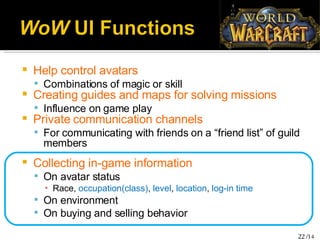
Help control avatars Combinations of magic or skill Creating guides and maps for solving missions Influence on game play Private communication channels For communicating with friends on a “friend list” of guild members Collecting in-game information On avatar status Race,  occupation(class) ,  level ,  location ,  log-in time  On environment On buying and selling behavior
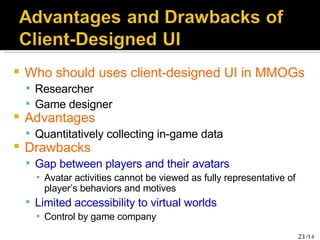
Who should uses client-designed UI in MMOGs Researcher Game designer Advantages Quantitatively collecting in-game data Drawbacks Gap between players and their avatars Avatar activities cannot be viewed as fully representative of player’s behaviors and motives Limited accessibility to virtual worlds Control by game company
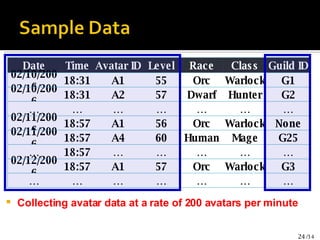
Collecting avatar data at a rate of 200 avatars per minute Date Time Avatar ID Level Race Class Guild ID 02/10/2006 18:31 A1 55 Orc Warlock G1 02/10/2006 18:31 A2 57 Dwarf Hunter G2 … … … … … … … 02/11/2006 18:57 A1 56 Orc Warlock None 02/11/2006 18:57 A4 60 Human Mage G25 … 18:57 … … … … … 02/12/2006 18:57 A1 57 Orc Warlock G3 … … … … … … …
Communities How  guilds (well-structured formal organization) emerge and decline How various communities co-evolve and influence each other Player behavior Player cooperation and coordination to solve difficult missions Comparing player behaviors in different cultures Game design How game design affects game play, social network, and community dynamics
Virtual worlds Advantages of information science Approaches Current results Topic1: Guild dynamics Topic2: Comparisons of different gaming cultures Future works
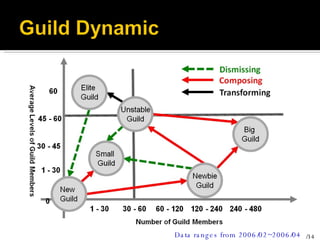
In-game guild dynamics Creation, decline, transformation, and separation of spontaneous player-organized communities Chen, C.H.,  Hsieh, J.L.,  & Sun, C.T. (unpublished manuscript).  “Player Guild Dynamics and Evolution in Massively Multiplayer Online Games.” Submitted to  Cyberpsychology & Behavior  (SSCI), March, 2007. Cross-cultural comparisons Comparing Taiwanese and American gaming culture Sun, C.T ., Hsieh, J.L.,  & Chen, C.H.  "Comparing Taiwanese and American  WoW  Player Cultures in Terms of Achievement,"  to be presented at the  2007 Digital Games Research Association Conference , Tokyo, Japan.
Motives (Why and )how players join and leave guilds Effects of game design on guild dynamics Guild properties Formal, permanent, and hierarchical  organizations Players can join and leave at will Each avatar can join only one guild, hence avatars are viewed as guild resources Players manages guilds by themselves Game companies provide and support mechanisms for guild management Chen, C.H.,  Hsieh, J.L.,  & Sun, C.T. (unpublished manuscript).  “Player Guild Dynamics and Evolution in Massively Multiplayer Online Games.” Submitted to  Cyberpsychology & Behavior  (SSCI), March, 2007.
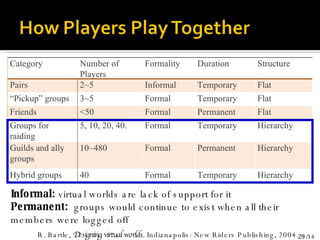
Informal:  virtual worlds are lack of support for it Permanent:  groups would continue to exist when all their members were logged off R. Bartle,  Designing virtual worlds . Indianapolis: New Riders Publishing, 2004. Category Number of Players Formality Duration Structure Pairs 2~5 Informal Temporary Flat “ Pickup” groups 3~5 Formal  Temporary Flat Friends <50 Formal Permanent Flat Groups for raiding 5, 10, 20, 40. Formal Temporary Hierarchy Guilds and ally groups 10~480 Formal Permanent Hierarchy Hybrid groups 40 Formal Temporary Hierarchy
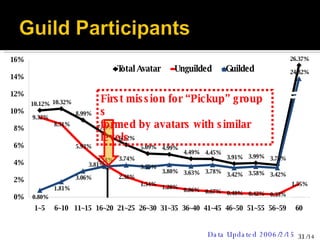
Level First mission for “Pickup” group s  formed by avatars with similar levels  Data Updated 2006/2/15
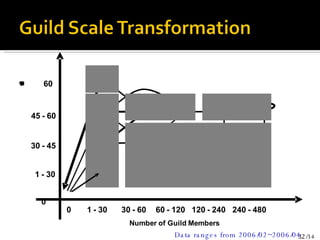
Data ranges from 2006/02~2006/04
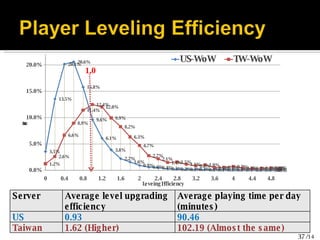
Motive Verify stories commonly heard in Taiwanese game communities Do Taiwanese players emphasize achievement more than American players? Experiments Efficient player leveling How players routinely attend guild schedule Sun, C.T.,  Hsieh, J.L.,  Chen, C.H. &quot;  Comparing Taiwanese and American WoW Player Cultures in Terms of Achievement ,&quot;  Accepted by the 2007 Digital Games Research Association Conference .
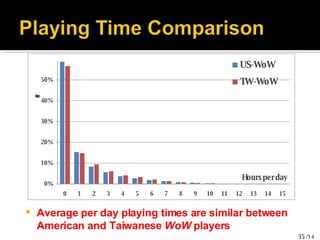
Average per day playing times are similar between American and Taiwanese  WoW  players
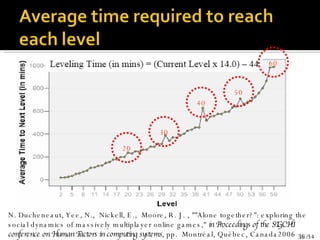
30 40 50 20 60 N. Ducheneaut, Yee, N.,  Nickell, E.,  Moore, R. J. , &quot;&quot;Alone together?&quot;: exploring the social dynamics of massively multiplayer online games,&quot;  in Proceedings of the SIGCHI conference on Human Factors in computing systems , pp.  Montréal, Québec, Canada2006 ACM Press.
Server Average level upgrading efficiency Average playing time per day (minutes) US 0.93 90.46 Taiwan 1.62 (Higher) 102.19 (Almost the same)
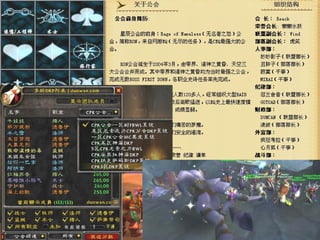
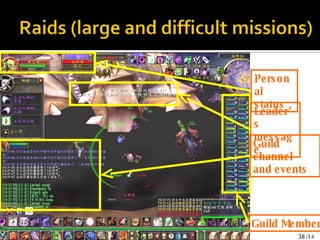
Guild channel  and events Personal  status Guild Member Leader’s  message
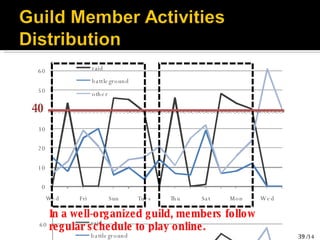
People In a well-organized guild, members follow regular schedule to play online.
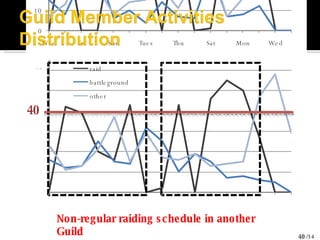
People Non-regular raiding schedule in another Guild
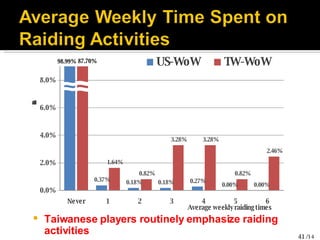
Taiwanese players routinely emphasize raiding activities
How users play together: in-game communities How players cooperate in game communities Playing together Cooperation Coordination during large and difficult missions How game design affects game play
Communities on different types of server Player vs. Player servers: avatars from different camps are allowed to engage in combat Player vs. Environment servers Analysis of player social networks Membership relationships: friends joining the same guild Co-play relationships: solving missions together
Chen, C.H.,  Hsieh, J.L.,  Sun, C.T. “ Player Guild Dynamics and Evolution in Massively Multiplayer Online Games,  ” Submitted to  Cyberpsychology & Behavior(SSCI), March, 2007. Sun, C.T.,  Hsieh, J.L.,  Chen, C.H. &quot;  Comparing Taiwanese and American WoW Player Cultures in Terms of Achievement, &quot; to be presented at the  2007 Digital Games Research Association Conference,  Tokyo, Japan, September, 2007.
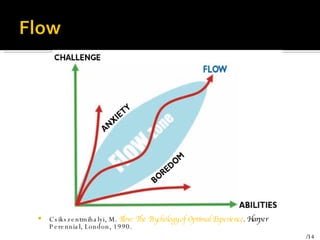
Csikszentmihalyi, M.  Flow: The Psychology of Optimal Experience . Harper  Perennial, London, 1990.
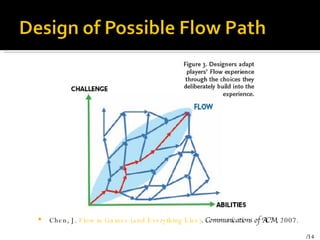
Chen, J.  Flow in Games (and Everything Else) . Communications of ACM , 2007.

Game Researches

  • 1.
    Ji-Lung Hsieh Advisor:Chuen-Tsai Sun
  • 2.
    Virtual worlds Whatis a “virtual world”? Difficulties studying virtual worlds Advantages of information science Approaches Current results Future works
  • 3.
    Users Self-contained inhabitants—players Virtual worlds are shared by multiple users Interaction happens in real time Environment Implemented by a computer or network of computers that simulates an environment Ongoing environment, and changing very fast Usually game-based environment R. Bartle, Designing virtual worlds . Indianapolis: New Riders Publishing, 2004.
  • 4.
    Definition of informationscience Discipline which studying information’s properties and behaviors Power to control information flow Making information more usable and amiable Virtual worlds hold large percentage of information and knowledge Human behaviors in real world are hard to be recorded H. Borko, “Information Science: What is it? ” . American Documentation, 1968.
  • 5.
    Properties of virtualworlds Virtual worlds are ongoing and change very fast Users interact from physically separated computer terminals Ex. Guild combining and separating Virtual world controlled by game companies Difficult to obtain data – design and accessibility controlled by game companies Difficult to design experiments Ex. Player’s motivations and his/her avatar’s behaviors A. F. Seay, et al., &quot;Project Massive: A study of online gaming communities,&quot; Proceedings of CHI 2004 , pp.1421-1424, 2004.
  • 6.
    Qualitative: off-game anddescribed by players In-depth individual or group interviews Online/offline surveys Secondary data Quantitative : in-game and observed by researchers Digital video recorder for recording player’s behavior in real world Computer monitor for recording in-game activities in virtual worlds
  • 7.
    Lack of representabilityInterview and survey samples can be biased Lack of generality Players hide behind physically separated computer terminals Lack of consistency Virtual worlds are ongoing in real time Flow and Immersion Gap between in-game motivations and off-game descriptions A. F. Seay, et al., &quot;Project Massive: A study of online gaming communities,&quot; Proceedings of CHI 2004 , pp.1421-1424, 2004.
  • 8.
    Virtual worlds Advantagesof information (computer and IT) science Client-designed user interface(UI) trend Player-designed game content trend Available action (or query) log trend Approaches Current results Future works
  • 9.
    Origins Web 2.0and open source – sharing and peer-production Blurring boundaries between content providers and consumers or game developers and players Examples - Widgets, extensions, add-ons Yahoo! Widget , iGoogle , Firefox extension , MSN Messenger API, World of Warcraft UI Characteristics Service providers create engines and APIs Users can design their own tools and agents Main agent function is grabbing online information Data accessibility is still limited by service providers
  • 10.
    Calendar My ebayClock New York Times Weather
  • 11.
    Gmail To-Do ListRSS Feeding Google Map Traffic View
  • 12.
    2 . Saveand Print 1.Clip
  • 13.
    Design game elementsDesign game worlds: buildings, furniture, avatar actions, clothes, material, texture, …etc. e.g., Second life , Entropia Universe Design game content Player-designed “mods” (modification) and scenarios Examples: Half-life Counter-Strike , Warcraft III Design user interface(UI) Conveniently for controlling avatars and grabbing in-game information Example: World of Warcraft
  • 14.
    Differences from otherMMOGs Allow players to own created objects No rules, objectives, winners/losers, experience points Virtual money can be exchanged for USD at a rate of 1:269 Players upload personal content to enrich game content and earn money Game Design Designed using LSL(Linden Scripting Language) More than 30% of all players are designers
  • 16.
    Game designer (Blizzard Entertainment) provides Game Engine Art Scenario creator Players design Storytelling Interaction rules Agents’ skills (agents are player- and system-controlled) Player-designed game categories Solo tower defense Two –camp combat Role-playing with rich storyline
  • 17.
  • 18.
    Status Map Skills& tools Chatting Channel
  • 19.
    Status Map Skills& tools Chatting Channel
  • 20.
    Website transaction loge.g. Yahoo! Auction …etc. Website query log e.g. Google Image …etc. Personal information data e.g. Google Desktop …etc. Game Replay e.g. RTS games …etc. MMOG action or server logs e.g. World of Warcraft …etc.
  • 21.
    Virtual worlds Advantagesof information science Approaches WoW client-designed user interface feature Current results Future works
  • 22.
    Help control avatarsCombinations of magic or skill Creating guides and maps for solving missions Influence on game play Private communication channels For communicating with friends on a “friend list” of guild members Collecting in-game information On avatar status Race, occupation(class) , level , location , log-in time On environment On buying and selling behavior
  • 23.
    Who should usesclient-designed UI in MMOGs Researcher Game designer Advantages Quantitatively collecting in-game data Drawbacks Gap between players and their avatars Avatar activities cannot be viewed as fully representative of player’s behaviors and motives Limited accessibility to virtual worlds Control by game company
  • 24.
    Collecting avatar dataat a rate of 200 avatars per minute Date Time Avatar ID Level Race Class Guild ID 02/10/2006 18:31 A1 55 Orc Warlock G1 02/10/2006 18:31 A2 57 Dwarf Hunter G2 … … … … … … … 02/11/2006 18:57 A1 56 Orc Warlock None 02/11/2006 18:57 A4 60 Human Mage G25 … 18:57 … … … … … 02/12/2006 18:57 A1 57 Orc Warlock G3 … … … … … … …
  • 25.
    Communities How guilds (well-structured formal organization) emerge and decline How various communities co-evolve and influence each other Player behavior Player cooperation and coordination to solve difficult missions Comparing player behaviors in different cultures Game design How game design affects game play, social network, and community dynamics
  • 26.
    Virtual worlds Advantagesof information science Approaches Current results Topic1: Guild dynamics Topic2: Comparisons of different gaming cultures Future works
  • 27.
    In-game guild dynamicsCreation, decline, transformation, and separation of spontaneous player-organized communities Chen, C.H., Hsieh, J.L., & Sun, C.T. (unpublished manuscript). “Player Guild Dynamics and Evolution in Massively Multiplayer Online Games.” Submitted to Cyberpsychology & Behavior (SSCI), March, 2007. Cross-cultural comparisons Comparing Taiwanese and American gaming culture Sun, C.T ., Hsieh, J.L., & Chen, C.H. &quot;Comparing Taiwanese and American WoW Player Cultures in Terms of Achievement,&quot; to be presented at the 2007 Digital Games Research Association Conference , Tokyo, Japan.
  • 28.
    Motives (Why and)how players join and leave guilds Effects of game design on guild dynamics Guild properties Formal, permanent, and hierarchical organizations Players can join and leave at will Each avatar can join only one guild, hence avatars are viewed as guild resources Players manages guilds by themselves Game companies provide and support mechanisms for guild management Chen, C.H., Hsieh, J.L., & Sun, C.T. (unpublished manuscript). “Player Guild Dynamics and Evolution in Massively Multiplayer Online Games.” Submitted to Cyberpsychology & Behavior (SSCI), March, 2007.
  • 29.
    Informal: virtualworlds are lack of support for it Permanent: groups would continue to exist when all their members were logged off R. Bartle, Designing virtual worlds . Indianapolis: New Riders Publishing, 2004. Category Number of Players Formality Duration Structure Pairs 2~5 Informal Temporary Flat “ Pickup” groups 3~5 Formal Temporary Flat Friends <50 Formal Permanent Flat Groups for raiding 5, 10, 20, 40. Formal Temporary Hierarchy Guilds and ally groups 10~480 Formal Permanent Hierarchy Hybrid groups 40 Formal Temporary Hierarchy
  • 31.
    Level First missionfor “Pickup” group s formed by avatars with similar levels Data Updated 2006/2/15
  • 32.
    Data ranges from2006/02~2006/04
  • 33.
    Data ranges from2006/02~2006/04
  • 34.
    Motive Verify storiescommonly heard in Taiwanese game communities Do Taiwanese players emphasize achievement more than American players? Experiments Efficient player leveling How players routinely attend guild schedule Sun, C.T., Hsieh, J.L., Chen, C.H. &quot; Comparing Taiwanese and American WoW Player Cultures in Terms of Achievement ,&quot; Accepted by the 2007 Digital Games Research Association Conference .
  • 35.
    Average per dayplaying times are similar between American and Taiwanese WoW players
  • 36.
    30 40 5020 60 N. Ducheneaut, Yee, N., Nickell, E., Moore, R. J. , &quot;&quot;Alone together?&quot;: exploring the social dynamics of massively multiplayer online games,&quot; in Proceedings of the SIGCHI conference on Human Factors in computing systems , pp. Montréal, Québec, Canada2006 ACM Press.
  • 37.
    Server Average levelupgrading efficiency Average playing time per day (minutes) US 0.93 90.46 Taiwan 1.62 (Higher) 102.19 (Almost the same)
  • 38.
    Guild channel and events Personal status Guild Member Leader’s message
  • 39.
    People In awell-organized guild, members follow regular schedule to play online.
  • 40.
    People Non-regular raidingschedule in another Guild
  • 41.
    Taiwanese players routinelyemphasize raiding activities
  • 42.
    How users playtogether: in-game communities How players cooperate in game communities Playing together Cooperation Coordination during large and difficult missions How game design affects game play
  • 43.
    Communities on differenttypes of server Player vs. Player servers: avatars from different camps are allowed to engage in combat Player vs. Environment servers Analysis of player social networks Membership relationships: friends joining the same guild Co-play relationships: solving missions together
  • 44.
    Chen, C.H., Hsieh, J.L., Sun, C.T. “ Player Guild Dynamics and Evolution in Massively Multiplayer Online Games, ” Submitted to Cyberpsychology & Behavior(SSCI), March, 2007. Sun, C.T., Hsieh, J.L., Chen, C.H. &quot; Comparing Taiwanese and American WoW Player Cultures in Terms of Achievement, &quot; to be presented at the 2007 Digital Games Research Association Conference, Tokyo, Japan, September, 2007.
  • 47.
    Csikszentmihalyi, M. Flow: The Psychology of Optimal Experience . Harper Perennial, London, 1990.
  • 48.
    Chen, J. Flow in Games (and Everything Else) . Communications of ACM , 2007.

Editor's Notes

  • #2 目前 MMOGs 的玩家越來越多,更產生了許多跨界共玩的現象,因此值得探討(可以引用 Why game studies now 的系列論文。) 目前有兩大趨勢使得資訊學門可以在不重新開發遊戲的狀態下,介入或探索遊戲世界 Flexible UI 的出現 玩家設計遊戲內容的趨勢(設計介面、設計情景 design game context 、設計遊戲內容 design game content – second life )是否可以用 GameAI 的四層談法來討論他? WoW 和以往遊戲的不同。 Second life 和以往遊戲的不同。