Grade 3 Mathematics Unit Preview
         Quarter 1: Algebra, Patterns, and Functions, and Problem Solving

 Objectives: (Your student will be able to)

     • Identify, describe and extend patterns with numbers. For example, 4, 7, 10, 13 follows the rule n + 3.
       The numbers are increasing by 3.
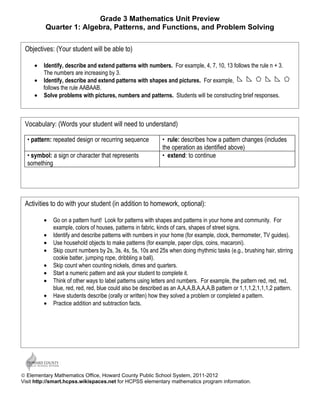
     • Identify, describe and extend patterns with shapes and pictures. For example,
       follows the rule AABAAB.
     • Solve problems with pictures, numbers and patterns. Students will be constructing brief responses.


 Vocabulary: (Words your student will need to understand)

  • pattern: repeated design or recurring sequence           • rule: describes how a pattern changes (includes
                                                             the operation as identified above)
  • symbol: a sign or character that represents              • extend: to continue
  something


 Activities to do with your student (in addition to homework, optional):

         •   Go on a pattern hunt! Look for patterns with shapes and patterns in your home and community. For
             example, colors of houses, patterns in fabric, kinds of cars, shapes of street signs.
         •   Identify and describe patterns with numbers in your home (for example, clock, thermometer, TV guides).
         •   Use household objects to make patterns (for example, paper clips, coins, macaroni).
         •   Skip count numbers by 2s, 3s, 4s, 5s, 10s and 25s when doing rhythmic tasks (e.g., brushing hair, stirring
             cookie batter, jumping rope, dribbling a ball).
         •   Skip count when counting nickels, dimes and quarters.
         •   Start a numeric pattern and ask your student to complete it.
         •   Think of other ways to label patterns using letters and numbers. For example, the pattern red, red, red,
             blue, red, red, red, blue could also be described as an A,A,A,B,A,A,A,B pattern or 1,1,1,2,1,1,1,2 pattern.
         •   Have students describe (orally or written) how they solved a problem or completed a pattern.
         •   Practice addition and subtraction facts.


© Elementary Mathematics Office, Howard County Public School System, 2011-2012
Visit http://smart.hcpss.wikispaces.net for HCPSS elementary mathematics program information.

G3 q1algpattfuncpreview

  • 1.
    Grade 3 MathematicsUnit Preview Quarter 1: Algebra, Patterns, and Functions, and Problem Solving Objectives: (Your student will be able to) • Identify, describe and extend patterns with numbers. For example, 4, 7, 10, 13 follows the rule n + 3. The numbers are increasing by 3. • Identify, describe and extend patterns with shapes and pictures. For example, follows the rule AABAAB. • Solve problems with pictures, numbers and patterns. Students will be constructing brief responses. Vocabulary: (Words your student will need to understand) • pattern: repeated design or recurring sequence • rule: describes how a pattern changes (includes the operation as identified above) • symbol: a sign or character that represents • extend: to continue something Activities to do with your student (in addition to homework, optional): • Go on a pattern hunt! Look for patterns with shapes and patterns in your home and community. For example, colors of houses, patterns in fabric, kinds of cars, shapes of street signs. • Identify and describe patterns with numbers in your home (for example, clock, thermometer, TV guides). • Use household objects to make patterns (for example, paper clips, coins, macaroni). • Skip count numbers by 2s, 3s, 4s, 5s, 10s and 25s when doing rhythmic tasks (e.g., brushing hair, stirring cookie batter, jumping rope, dribbling a ball). • Skip count when counting nickels, dimes and quarters. • Start a numeric pattern and ask your student to complete it. • Think of other ways to label patterns using letters and numbers. For example, the pattern red, red, red, blue, red, red, red, blue could also be described as an A,A,A,B,A,A,A,B pattern or 1,1,1,2,1,1,1,2 pattern. • Have students describe (orally or written) how they solved a problem or completed a pattern. • Practice addition and subtraction facts. © Elementary Mathematics Office, Howard County Public School System, 2011-2012 Visit http://smart.hcpss.wikispaces.net for HCPSS elementary mathematics program information.