The Future of Artificial Intelligence
• Opportunities and Challenges in a Rapidly
Evolving World
• Presented by: Your Name
• Date: June 2025
Why AI Matters Now More Than
Ever
• - AI is reshaping industries and human
interaction.
• - From automation to personalized services –
it's everywhere.
• - Understanding AI's path is essential for
navigating the future.
What is Artificial Intelligence?
• - AI refers to machines mimicking human
cognitive functions.
• - Includes machine learning, NLP, computer
vision, etc.
• - Examples: Chatbots, self-driving cars,
recommendation engines.
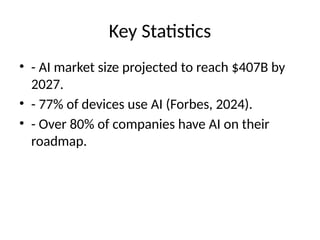
Key Statistics
• - AI market size projected to reach $407B by
2027.
• - 77% of devices use AI (Forbes, 2024).
• - Over 80% of companies have AI on their
roadmap.
Opportunities
• - Improved healthcare diagnostics
• - Smarter cities and infrastructure
• - Enhanced education with personalized
learning
• - Boosting business efficiency
Real-World Case Studies
• - Healthcare: IBM Watson detecting rare
diseases
• - Retail: Amazon’s AI-driven logistics and
personalization
• - Agriculture: Precision farming using AI and
IoT
Ethical and Social Challenges
• - Data privacy concerns
• - Algorithmic bias and discrimination
• - Job displacement and automation anxiety
• - AI in surveillance and warfare
The Future Ahead
• - Explainable AI and transparency
• - AI regulation and governance
• - Human-AI collaboration over replacement
• - AI for social good (e.g., climate modeling)
What Can We Do Today?
• - Upskill in AI-related domains
• - Support ethical AI initiatives
• - Encourage open conversations and policies
• - Think critically about AI’s role in society
Thank You / Q&A
• “The best way to predict the future is to create
it.”
• Questions and discussion welcome!

Future_of_AI_Presentation as on 2025.pptx

  • 1.
    The Future ofArtificial Intelligence • Opportunities and Challenges in a Rapidly Evolving World • Presented by: Your Name • Date: June 2025
  • 2.
    Why AI MattersNow More Than Ever • - AI is reshaping industries and human interaction. • - From automation to personalized services – it's everywhere. • - Understanding AI's path is essential for navigating the future.
  • 3.
    What is ArtificialIntelligence? • - AI refers to machines mimicking human cognitive functions. • - Includes machine learning, NLP, computer vision, etc. • - Examples: Chatbots, self-driving cars, recommendation engines.
  • 4.
    Key Statistics • -AI market size projected to reach $407B by 2027. • - 77% of devices use AI (Forbes, 2024). • - Over 80% of companies have AI on their roadmap.
  • 5.
    Opportunities • - Improvedhealthcare diagnostics • - Smarter cities and infrastructure • - Enhanced education with personalized learning • - Boosting business efficiency
  • 6.
    Real-World Case Studies •- Healthcare: IBM Watson detecting rare diseases • - Retail: Amazon’s AI-driven logistics and personalization • - Agriculture: Precision farming using AI and IoT
  • 7.
    Ethical and SocialChallenges • - Data privacy concerns • - Algorithmic bias and discrimination • - Job displacement and automation anxiety • - AI in surveillance and warfare
  • 8.
    The Future Ahead •- Explainable AI and transparency • - AI regulation and governance • - Human-AI collaboration over replacement • - AI for social good (e.g., climate modeling)
  • 9.
    What Can WeDo Today? • - Upskill in AI-related domains • - Support ethical AI initiatives • - Encourage open conversations and policies • - Think critically about AI’s role in society
  • 10.
    Thank You /Q&A • “The best way to predict the future is to create it.” • Questions and discussion welcome!