Artificial Intelligence – Description
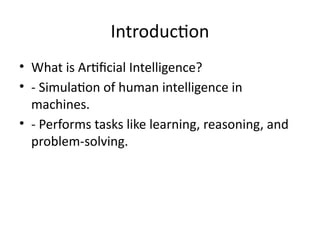
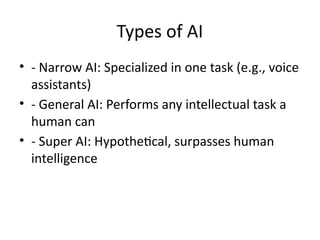
This presentation provides a comprehensive introduction to Artificial Intelligence (AI) — the simulation of human intelligence by machines. It begins with the definition and classification of AI into Narrow AI (task-specific), General AI (human-level), and Super AI (theoretical future intelligence surpassing humans).
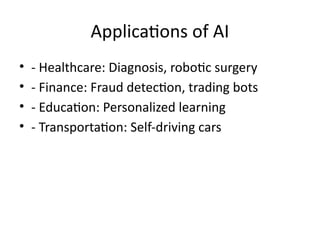
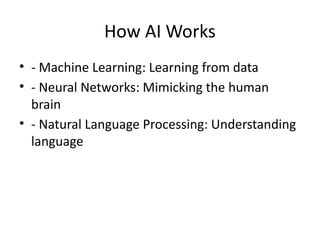
Real-world applications are highlighted across sectors like healthcare, finance, education, and transportation, showcasing AI’s transformative impact. The presentation explains key components of AI, such as Machine Learning, Neural Networks, and Natural Language Processing, which enable machines to learn and interact like humans.
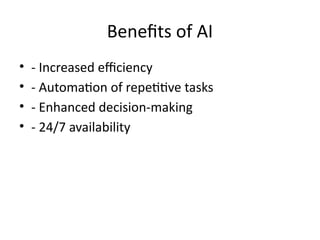
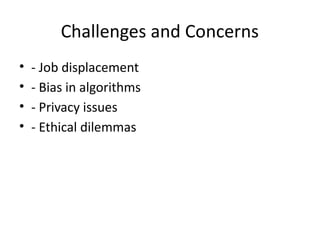
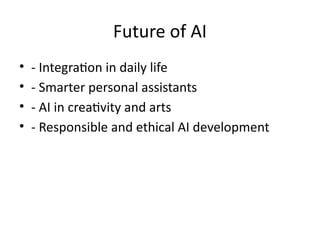
The benefits of AI include increased efficiency, task automation, and better decision-making. However, the presentation also discusses critical challenges like job loss, data privacy concerns, and algorithmic bias. It concludes with a forward-looking view on AI’s integration into everyday life and the importance of ethical and responsible AI development.
Let me know if you’d like this exported to Word or added to a full project report. Artificial Intelligence – Description
This presentation provides a comprehensive introduction to Artificial Intelligence (AI) — the simulation of human intelligence by machines. It begins with the definition and classification of AI into Narrow AI (task-specific), General AI (human-level), and Super AI (theoretical future intelligence surpassing humans).
Real-world applications are highlighted across sectors like healthcare, finance, education, and transportation, showcasing AI’s transformative impact. The presentation explains key components of AI, such as Machine Learning, Neural Networks, and Natural Language Processing, which enable machines to learn and interact like humans.
The benefits of AI include increased efficiency, task automation, and better decision-making. However, the presentation also discusses critical challenges like job loss, data privacy concerns, and algorithmic bias. It concludes with a forward-looking view on AI’s integration into everyday life and the importance of ethical and responsible AI development.
Let me know if you’d like this exported to Word or added to a full project report. Artificial Intelligence – Description
This presentation provides a comprehensive introduction to Artificial Intelligence (AI) — the simulation of human intelligence by machines. It begins with the definition and classification of AI into Narrow AI (task-specific), General AI (human-level), and Super AI (theoretical future intelligence surpassing humans).
Real-world applications are highlighted across sectors like healthcare, finance, education, and transportation, showcasing AI’s transformative impact. The presentation explains key components of AI, such as Machine Learning, Neural Networks, and Natural Language Processing, which enable machines to learn and interact like humans.
The benefits of AI include increased efficien



![5G Explained! A High Level Overview [Introduction]](https://cdn.slidesharecdn.com/ss_thumbnails/5gexplainedahighleveloverview-260119165306-cc137a3e-thumbnail.jpg?width=640&height=640&fit=bounds)


