

FUTURE OF FUNDS
How Technology and Social Media are Disrupting
and Opening new Opportunities for the Fund
Industry
Dinis Guarda
CEO and Founder HedgeThink.com IntelligentHQ.com ForexThink.com
“In short, software is eating the world. (...)
we are in the middle of a dramatic and broad
technological and economic shift in which
software companies are poised to take over
large swathes of the economy.”
Marc Andreessen, WSJ
“The financial services industry has been visibly
transformed by software over the last 30 years.
Practically every financial transaction, from
someone buying a cup of coffee to someone
trading a trillion dollars of credit default
derivatives, is done in software. And many of the
leading innovators in financial services are
software companies (…).”
Marc Andreesen, WSJ
Every individual =
Media + Financial “Company”
Every Business =
Media Publishing + Financial
Innovation Company!
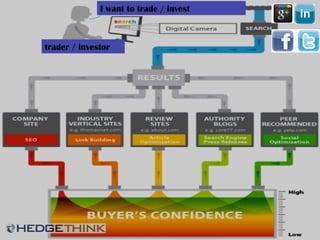
I want to trade / invest
trader / investor
“(…) the world lacks enough leaders who understand the
potential for new, technology-driven solutions for global
problems. (…) But even there, an understanding of tech’s
potential is disturbingly uneven. Some companies thrive by
embracing new methods of marketing, managing,
developing products, and engaging with society.”
David Kirkpatrick, Forbes
Perhaps the biggest change that online
trading technology has brought about is to
democratise access to the markets, allowing
individuals to make their own trades without
the costs and time lag that were associated
with the old way of doing this
Produces	
  premium	
  content	
  that	
  bridges	
  The funds industry, are facing a new world
where investors now have the option of
placing their own trades rather than trusting
in the performance of professional investors
– a trust that has been eroded somewhat in
the wake of the financial crisis of 2008.
Produces	
  premium	
  content	
  that	
  bridges	
  
The rapid evolution of trading platforms has also
provided new technologies for professional traders, too,
and this process has also provided new alternatives in
terms of liquidity solutions and ways to connect with the
markets – in particular, high-end protocols such as DMA
(Direct Market Access) and STP (Straight Through
Processing).
When social media first came along, it was strongly
resisted by the financial services industry, and
particularly the traditionally ultra-secretive world of
hedge funds. The ideals of transparency and open
sharing of information that it promoted seemed to be
anathema to the behind-closed-doors world of
alternative investments.
The ‘Damascus moment’ with social media came with the
so-called ‘hack crash’ of April 2013, when a hoax tweet
coming from the Associated Press Twitter account
claimed that there had been an explosion at the White
House.
Markets went into a tailspin, with billions of dollars being
wiped off the Dow Jones index, only for the markets to
recover only a few minutes later when the tweet was
revealed as a hoax, perpetrated by hackers. Nonetheless,
the damage was done, and traders realised that they
could no longer afford to ignore social media.
A 2014 study by Agecroft Partners has identified trends
in the increased use of social media by hedge funds to
enhance their marketing campaigns.
The main network, from a hedge fund perspective, is
LinkedIn, used by approximately 90 per cent of the
hedge funds that have more than USD100 million in
assets under management.
This followed, somewhat distantly, by Twitter.
1.  61% of alternative funds with less than $100 million
AUM have no marketing, PR, content or PR in place.
2.  As the Hedge Fund industry grows and creates more
footprint its brands need increased visibility. It is
fundamental to create both an asset for their
business and marketing efforts and a platform with
a profile of digital content / social media, that can
augment their business and audience reach.
3.  There is as well a need to create platforms to
support professionals working with Hedge Funds,
and alternative funds.
4.  They need to work as startups in this new world of
technology and social media
10 Trends to look:
1.  Peer to peer investment, trading and funding are going
to be more powerful for Hedge Funds and the
Investment industry;
2.  Retail Vs. Institutional investment / trading
communities;
3.  Proliferation of trading and investing niche influence
communities;
4.  The advent of digital currencies and global software
money;
5.  Social Media disruption, platforms and social
technologies;
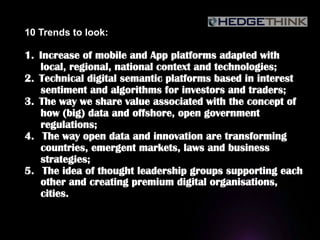
10 Trends to look:
1.  Increase of mobile and App platforms adapted with
local, regional, national context and technologies;
2.  Technical digital semantic platforms based in interest
sentiment and algorithms for investors and traders;
3.  The way we share value associated with the concept of
how (big) data and offshore, open government
regulations;
4.  The way open data and innovation are transforming
countries, emergent markets, laws and business
strategies;
5.  The idea of thought leadership groups supporting each
other and creating premium digital organisations,
cities.
Thank you
Dinis Guarda
@dinisguarda
HedgeThink.com

Future of funds: How Technology and Social Media are Disrupting and Opening new Opportunities for the Fund Industry

  • 1.
    FUTURE OF FUNDS HowTechnology and Social Media are Disrupting and Opening new Opportunities for the Fund Industry Dinis Guarda CEO and Founder HedgeThink.com IntelligentHQ.com ForexThink.com
  • 2.
    “In short, softwareis eating the world. (...) we are in the middle of a dramatic and broad technological and economic shift in which software companies are poised to take over large swathes of the economy.” Marc Andreessen, WSJ
  • 3.
    “The financial servicesindustry has been visibly transformed by software over the last 30 years. Practically every financial transaction, from someone buying a cup of coffee to someone trading a trillion dollars of credit default derivatives, is done in software. And many of the leading innovators in financial services are software companies (…).” Marc Andreesen, WSJ
  • 4.
    Every individual = Media+ Financial “Company” Every Business = Media Publishing + Financial Innovation Company!
  • 5.
    I want totrade / invest trader / investor
  • 7.
    “(…) the worldlacks enough leaders who understand the potential for new, technology-driven solutions for global problems. (…) But even there, an understanding of tech’s potential is disturbingly uneven. Some companies thrive by embracing new methods of marketing, managing, developing products, and engaging with society.” David Kirkpatrick, Forbes
  • 8.
    Perhaps the biggestchange that online trading technology has brought about is to democratise access to the markets, allowing individuals to make their own trades without the costs and time lag that were associated with the old way of doing this
  • 9.
    Produces  premium  content  that  bridges  The funds industry, are facing a new world where investors now have the option of placing their own trades rather than trusting in the performance of professional investors – a trust that has been eroded somewhat in the wake of the financial crisis of 2008.
  • 10.
    Produces  premium  content  that  bridges   The rapid evolution of trading platforms has also provided new technologies for professional traders, too, and this process has also provided new alternatives in terms of liquidity solutions and ways to connect with the markets – in particular, high-end protocols such as DMA (Direct Market Access) and STP (Straight Through Processing).
  • 11.
    When social mediafirst came along, it was strongly resisted by the financial services industry, and particularly the traditionally ultra-secretive world of hedge funds. The ideals of transparency and open sharing of information that it promoted seemed to be anathema to the behind-closed-doors world of alternative investments.
  • 12.
    The ‘Damascus moment’with social media came with the so-called ‘hack crash’ of April 2013, when a hoax tweet coming from the Associated Press Twitter account claimed that there had been an explosion at the White House. Markets went into a tailspin, with billions of dollars being wiped off the Dow Jones index, only for the markets to recover only a few minutes later when the tweet was revealed as a hoax, perpetrated by hackers. Nonetheless, the damage was done, and traders realised that they could no longer afford to ignore social media.
  • 13.
    A 2014 studyby Agecroft Partners has identified trends in the increased use of social media by hedge funds to enhance their marketing campaigns. The main network, from a hedge fund perspective, is LinkedIn, used by approximately 90 per cent of the hedge funds that have more than USD100 million in assets under management. This followed, somewhat distantly, by Twitter.
  • 14.
    1.  61% ofalternative funds with less than $100 million AUM have no marketing, PR, content or PR in place. 2.  As the Hedge Fund industry grows and creates more footprint its brands need increased visibility. It is fundamental to create both an asset for their business and marketing efforts and a platform with a profile of digital content / social media, that can augment their business and audience reach. 3.  There is as well a need to create platforms to support professionals working with Hedge Funds, and alternative funds. 4.  They need to work as startups in this new world of technology and social media
  • 17.
    10 Trends tolook: 1.  Peer to peer investment, trading and funding are going to be more powerful for Hedge Funds and the Investment industry; 2.  Retail Vs. Institutional investment / trading communities; 3.  Proliferation of trading and investing niche influence communities; 4.  The advent of digital currencies and global software money; 5.  Social Media disruption, platforms and social technologies;
  • 18.
    10 Trends tolook: 1.  Increase of mobile and App platforms adapted with local, regional, national context and technologies; 2.  Technical digital semantic platforms based in interest sentiment and algorithms for investors and traders; 3.  The way we share value associated with the concept of how (big) data and offshore, open government regulations; 4.  The way open data and innovation are transforming countries, emergent markets, laws and business strategies; 5.  The idea of thought leadership groups supporting each other and creating premium digital organisations, cities.
  • 19.