Future of Data Center
ASSIGNMENT -1
ADITYA PANWAR
02.4.2016
Future of Data Center
Table of Contents
Abstract ........................................................................................ 3
Trends reshaping the future of Data Center .............................. 3
 Software Driven Infrastructure............................................................................................................................. 3
 Hyperconverged systems......................................................................................................................................... 3
 Colocation........................................................................................................................................................................ 3
 Automation..................................................................................................................................................................... 3
 Data centers harness IoT (Internet of Things) Technologies................................................................... 4
Keeping the Data Center competitive ........................................ 4
Methodology................................................................................ 5
Future of Data Center
Abstract
Data center service providers are under constant threats to provide the fastest, most reliable
data possible while balancing demands for higher computing power and efficiency.
Organizations need to more effectively support mobile, cloud, business integrated analytics,
and the Internet of Things services that are changing workloads in corporate datacenters
and driving greater use of service provider datacenters. While IT managers are sourcing and
deploying IT infrastructure in new ways, datacenter managers are increasingly concerned
with limiting factors, such as floor space, power and cooling, datacenter life-cycle
management, and staffing. There is a constant pressure of achieving economies of scale by
shifting to cloud automation and simplifying complex IT processes.
Trends reshaping the future of Data Center
Enterprise data centers are going through an evolutionary transformation. Both technology
and business factors are influencing this transformation. The following are the data center
trends that will reshape the future of data centers:
 Software Driven Infrastructure -The datacenter is becoming more software-driven,
with infrastructure management systems increasingly integrating with IT
management systems. This will make DCIM (data center infrastructure
management) software more effective and more useful, including in hybrid
datacenter environments – but will force companies and suppliers to innovate more
and to focus on integration. This enables increased levels of automation and
flexibility that will underpin business agility through the increased adoption of cloud
services and enable modern IT approaches such as DevOps
 Hyperconverged systems - it will bring together key IT system components into one
box, or system, that’s managed through a software layer, will take on a larger role
within data center infrastructures. Business requirements drive simplification of
infrastructure and time to value within IT departments. Virtualization will become a
driving force for hyperconvergence. Prefabricated modular (PFM) datacenter
designs are rapidly evolving. We expect PFM datacenters will become the new
benchmark to beat for virtually all use cases, giving operators new options – and with
greater speed, predictability and agility than traditional approaches.
 Colocation - A purpose-built data center provides a safe and stable physical
environment for a company’s critical computing systems, with sufficient power,
cooling, and connectivity to guarantee server uptime and availability.
 Automation – Automation of data center management activities will become the
norm to reduce the work load and human errors, and to speed up responsiveness to
equipment failures. There will be a shift in how infrastructure and operations teams
administer the IT environment with the introduction of fool proof instructions such
as using IP discovery for automatic validation. In this new environment,
Future of Data Center
Dedicated servers frequently have
utilization rates of less than 10
percent, whereas servers run
virtually can often more than double
those rates.
European data centers currently consume more
energy than the entire country of Denmark; by
2019 they are expected to use more than the
Netherlands
administrators will need to embrace new skills and get comfortable shedding the
mundane and repetitive tasks, such as provisioning storage.
 Data centers harness IoT (Internet of Things) Technologies - By incorporating
smart technologies into the data center, facility managers will be able to keep track
of real time status of components and environmental measurements to keep
operations flowing smoothly. The role of datacenters as passive users of energy is
slowly beginning to change, with some progressive facilities finding more effective
ways to interact with, and understand, established and emerging energy suppliers.
Over time, the real-time power feed from the grid will become just one of many
power sources, rather than the default option.
Keeping the Data Center competitive
Managers of data centers should look at six areas in which their operations can be improved.
The greatest potential savings lie in improved utilization
of data center assets, through server and storage
virtualization and by making better use of the data
center facility itself—including a careful analysis of the
total worldwide footprint of data center facilities as well
as how operations are organized.
Understanding how and when data center resources are consumed can further improve
asset utilization and save energy. Restructuring
the data center’s operating model can increase
efficiency, as can devising a global sourcing
strategy for data center services. Finally, moving
to a demand-driven model that rationalizes platforms and products will help set the stage for
the creation of the data center of the future, one that can give corporate customers what
they want: efficient and flexible computing capacity.
Future of Data Center
Methodology
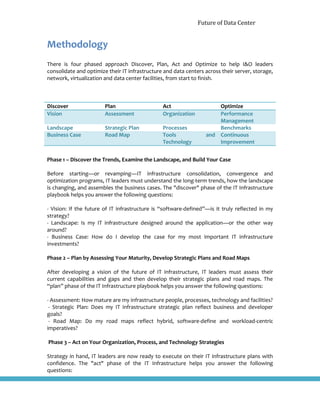
There is four phased approach Discover, Plan, Act and Optimize to help I&O leaders
consolidate and optimize their IT infrastructure and data centers across their server, storage,
network, virtualization and data center facilities, from start to finish.
Discover Plan Act Optimize
Vision Assessment Organization Performance
Management
Landscape Strategic Plan Processes Benchmarks
Business Case Road Map Tools and
Technology
Continuous
Improvement
Phase 1 – Discover the Trends, Examine the Landscape, and Build Your Case
Before starting—or revamping—IT infrastructure consolidation, convergence and
optimization programs, IT leaders must understand the long-term trends, how the landscape
is changing, and assembles the business cases. The "discover" phase of the IT Infrastructure
playbook helps you answer the following questions:
- Vision: If the future of IT infrastructure is “software-defined”—is it truly reflected in my
strategy?
- Landscape: Is my IT infrastructure designed around the application—or the other way
around?
- Business Case: How do I develop the case for my most important IT infrastructure
investments?
Phase 2 – Plan by Assessing Your Maturity, Develop Strategic Plans and Road Maps
After developing a vision of the future of IT infrastructure, IT leaders must assess their
current capabilities and gaps and then develop their strategic plans and road maps. The
“plan” phase of the IT Infrastructure playbook helps you answer the following questions:
- Assessment: How mature are my infrastructure people, processes, technology and facilities?
- Strategic Plan: Does my IT infrastructure strategic plan reflect business and developer
goals?
- Road Map: Do my road maps reflect hybrid, software-define and workload-centric
imperatives?
Phase 3 – Act on Your Organization, Process, and Technology Strategies
Strategy in hand, IT leaders are now ready to execute on their IT infrastructure plans with
confidence. The "act" phase of the IT Infrastructure helps you answer the following
questions:
Future of Data Center
- Organization: What new skills does my team need to thrive in a "hybrid" cloud world?
- Process: What processes can I learn from the cloud giants who operate infrastructure at
scale?
- Tools and Technology: Should I build or buy? Which vendors and providers should I
evaluate?
Phase 4 – Optimize Your Performance, Benchmark Your Strategy, and Improve
Planning and investing in new or improved people, process and technology is just the first
step to a more consolidated, converged and optimized IT infrastructure practice. The
“optimize” phase of the IT Infrastructure playbook helps answer the following questions:
- Performance Metrics: How do I develop my Balanced Scorecard for IT infrastructure?
- Benchmarks: How do my strategic IT infrastructure benchmarks compare to my peers?
- Continuous Improvement: How do I instill a culture of continuous improvement?
Future of Data Center
THANK YOU.
FOR MORE INFORMATION CONTACT: ADITYA PANWAR
ADITYAPANWAR007@GMAIL.COM

Future of data center

  • 1.
    Future of DataCenter Future of Data Center ASSIGNMENT -1 ADITYA PANWAR 02.4.2016
  • 2.
    Future of DataCenter Table of Contents Abstract ........................................................................................ 3 Trends reshaping the future of Data Center .............................. 3  Software Driven Infrastructure............................................................................................................................. 3  Hyperconverged systems......................................................................................................................................... 3  Colocation........................................................................................................................................................................ 3  Automation..................................................................................................................................................................... 3  Data centers harness IoT (Internet of Things) Technologies................................................................... 4 Keeping the Data Center competitive ........................................ 4 Methodology................................................................................ 5
  • 3.
    Future of DataCenter Abstract Data center service providers are under constant threats to provide the fastest, most reliable data possible while balancing demands for higher computing power and efficiency. Organizations need to more effectively support mobile, cloud, business integrated analytics, and the Internet of Things services that are changing workloads in corporate datacenters and driving greater use of service provider datacenters. While IT managers are sourcing and deploying IT infrastructure in new ways, datacenter managers are increasingly concerned with limiting factors, such as floor space, power and cooling, datacenter life-cycle management, and staffing. There is a constant pressure of achieving economies of scale by shifting to cloud automation and simplifying complex IT processes. Trends reshaping the future of Data Center Enterprise data centers are going through an evolutionary transformation. Both technology and business factors are influencing this transformation. The following are the data center trends that will reshape the future of data centers:  Software Driven Infrastructure -The datacenter is becoming more software-driven, with infrastructure management systems increasingly integrating with IT management systems. This will make DCIM (data center infrastructure management) software more effective and more useful, including in hybrid datacenter environments – but will force companies and suppliers to innovate more and to focus on integration. This enables increased levels of automation and flexibility that will underpin business agility through the increased adoption of cloud services and enable modern IT approaches such as DevOps  Hyperconverged systems - it will bring together key IT system components into one box, or system, that’s managed through a software layer, will take on a larger role within data center infrastructures. Business requirements drive simplification of infrastructure and time to value within IT departments. Virtualization will become a driving force for hyperconvergence. Prefabricated modular (PFM) datacenter designs are rapidly evolving. We expect PFM datacenters will become the new benchmark to beat for virtually all use cases, giving operators new options – and with greater speed, predictability and agility than traditional approaches.  Colocation - A purpose-built data center provides a safe and stable physical environment for a company’s critical computing systems, with sufficient power, cooling, and connectivity to guarantee server uptime and availability.  Automation – Automation of data center management activities will become the norm to reduce the work load and human errors, and to speed up responsiveness to equipment failures. There will be a shift in how infrastructure and operations teams administer the IT environment with the introduction of fool proof instructions such as using IP discovery for automatic validation. In this new environment,
  • 4.
    Future of DataCenter Dedicated servers frequently have utilization rates of less than 10 percent, whereas servers run virtually can often more than double those rates. European data centers currently consume more energy than the entire country of Denmark; by 2019 they are expected to use more than the Netherlands administrators will need to embrace new skills and get comfortable shedding the mundane and repetitive tasks, such as provisioning storage.  Data centers harness IoT (Internet of Things) Technologies - By incorporating smart technologies into the data center, facility managers will be able to keep track of real time status of components and environmental measurements to keep operations flowing smoothly. The role of datacenters as passive users of energy is slowly beginning to change, with some progressive facilities finding more effective ways to interact with, and understand, established and emerging energy suppliers. Over time, the real-time power feed from the grid will become just one of many power sources, rather than the default option. Keeping the Data Center competitive Managers of data centers should look at six areas in which their operations can be improved. The greatest potential savings lie in improved utilization of data center assets, through server and storage virtualization and by making better use of the data center facility itself—including a careful analysis of the total worldwide footprint of data center facilities as well as how operations are organized. Understanding how and when data center resources are consumed can further improve asset utilization and save energy. Restructuring the data center’s operating model can increase efficiency, as can devising a global sourcing strategy for data center services. Finally, moving to a demand-driven model that rationalizes platforms and products will help set the stage for the creation of the data center of the future, one that can give corporate customers what they want: efficient and flexible computing capacity.
  • 5.
    Future of DataCenter Methodology There is four phased approach Discover, Plan, Act and Optimize to help I&O leaders consolidate and optimize their IT infrastructure and data centers across their server, storage, network, virtualization and data center facilities, from start to finish. Discover Plan Act Optimize Vision Assessment Organization Performance Management Landscape Strategic Plan Processes Benchmarks Business Case Road Map Tools and Technology Continuous Improvement Phase 1 – Discover the Trends, Examine the Landscape, and Build Your Case Before starting—or revamping—IT infrastructure consolidation, convergence and optimization programs, IT leaders must understand the long-term trends, how the landscape is changing, and assembles the business cases. The "discover" phase of the IT Infrastructure playbook helps you answer the following questions: - Vision: If the future of IT infrastructure is “software-defined”—is it truly reflected in my strategy? - Landscape: Is my IT infrastructure designed around the application—or the other way around? - Business Case: How do I develop the case for my most important IT infrastructure investments? Phase 2 – Plan by Assessing Your Maturity, Develop Strategic Plans and Road Maps After developing a vision of the future of IT infrastructure, IT leaders must assess their current capabilities and gaps and then develop their strategic plans and road maps. The “plan” phase of the IT Infrastructure playbook helps you answer the following questions: - Assessment: How mature are my infrastructure people, processes, technology and facilities? - Strategic Plan: Does my IT infrastructure strategic plan reflect business and developer goals? - Road Map: Do my road maps reflect hybrid, software-define and workload-centric imperatives? Phase 3 – Act on Your Organization, Process, and Technology Strategies Strategy in hand, IT leaders are now ready to execute on their IT infrastructure plans with confidence. The "act" phase of the IT Infrastructure helps you answer the following questions:
  • 6.
    Future of DataCenter - Organization: What new skills does my team need to thrive in a "hybrid" cloud world? - Process: What processes can I learn from the cloud giants who operate infrastructure at scale? - Tools and Technology: Should I build or buy? Which vendors and providers should I evaluate? Phase 4 – Optimize Your Performance, Benchmark Your Strategy, and Improve Planning and investing in new or improved people, process and technology is just the first step to a more consolidated, converged and optimized IT infrastructure practice. The “optimize” phase of the IT Infrastructure playbook helps answer the following questions: - Performance Metrics: How do I develop my Balanced Scorecard for IT infrastructure? - Benchmarks: How do my strategic IT infrastructure benchmarks compare to my peers? - Continuous Improvement: How do I instill a culture of continuous improvement?
  • 7.
    Future of DataCenter THANK YOU. FOR MORE INFORMATION CONTACT: ADITYA PANWAR ADITYAPANWAR007@GMAIL.COM