SIMPLE FUTURE
-FORMS-
Teachers:
Ariadna V. Petit
26.814.014
Marco A. Bracho
26.677.305
February, 2021
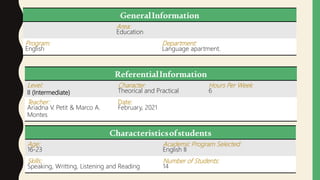
GeneralInformation
Area:
Education
Program:
English
Department:
Language apartment.
ReferentialInformation
Level:
II (Intermediate)
Character:
Theorical and Practical
Hours Per Week:
6
Teacher:
Ariadna V. Petit & Marco A.
Montes
Date:
February, 2021
Characteristicsofstudents
Age:
16-23
Academic Program Selected:
English II
Skills:
Speaking, Writting, Listening and Reading
Number of Students:
14
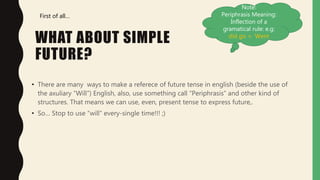
WHAT ABOUT SIMPLE
FUTURE?
• There are many ways to make a referece of future tense in english (beside the use of
the axuliary “Will”) English, also, use something call “Periphrasis” and other kind of
structures. That means we can use, even, present tense to express future,.
• So… Stop to use “will” every-single time!!! ;)
First of all…
Note:
Periphrasis Meaning:
Inflection of a
gramatical rule: e.g:
did go = Went
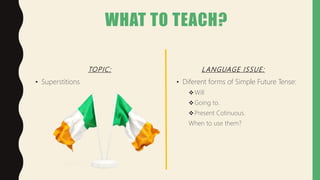
WHAT TO TEACH?
LANGUAGE ISSUE:
• Superstitions
TOPIC:
• Diferent forms of Simple Future Tense:
Will
Going to.
Present Cotinuous.
When to use them?
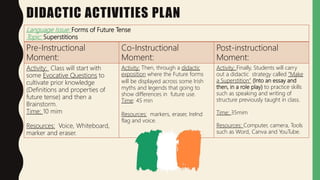
DIDACTIC ACTIVITIES PLAN
Language Issue: Forms of Future Tense
Topic: Superstitions
Pre-Instructional
Moment:
Co-Instructional
Moment:
Post-instructional
Moment:
Activity: Class will start with
some Evocative Questions to
cultivate prior knowledge
(Definitions and properties of
future tense) and then a
Brainstorm.
Time: 10 mim
Resources: Voice, Whiteboard,
marker and eraser.
Activity: Then, through a didactic
exposition where the Future forms
will be displayed across some Irish
myths and legends that going to
show differences in future use.
Time: 45 min
Resources: markers, eraser, Irelnd
flag and voice.
Activity: Finally, Students will carry
out a didactic strategy called “Make
a Superstition” (Into an essay and
then, in a role play) to practice skills
such as speaking and writing of
structure previously taught in class.
Time: 35mim
Resources: Computer, camera, Tools
such as Word, Canva and YouTube.
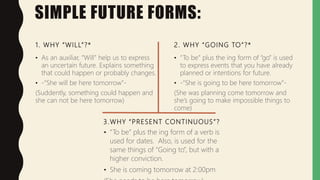
SIMPLE FUTURE FORMS:
1. WHY “WILL”?*
• As an auxiliar, “Will” help us to express
an uncertain future. Explains something
that could happen or probably changes.
• -“She will be here tomorrow”-
(Suddently, something could happen and
she can not be here tomorrow)
2. WHY “GOING TO”?*
• “To be” plus the ing form of “go” is used
to express events that you have already
planned or intentions for future.
• -“She is going to be here tomorrow”-
(She was planning come tomorrow and
she’s going to make impossible things to
come)
3.WHY “PRESENT CONTINUOUS”?
• “To be” plus the ing form of a verb is
used for dates. Also, is used for the
same things of “Going to”, but with a
higher conviction.
• She is coming tomorrow at 2:00pm
DRAFT
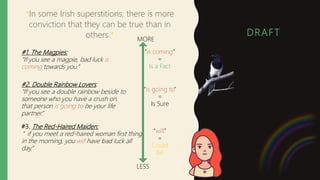
*In some Irish superstitions, there is more
conviction that they can be true than in
others.*
#3. The Red-Haired Maiden:
” if you meet a red-haired woman first thing
in the morning, you will have bad luck all
day.”
#2. Double Rainbow Lovers:
“If you see a double rainbow beside to
someone who you have a crush on,
that person is going to be your life
partner.”
#1. The Magpies:
“If you see a magpie, bad luck is
coming towards you.”
MORE
LESS
“is coming”
=
Is a Fact
“is going to”
=
Is Sure
“will”
=
Could
be
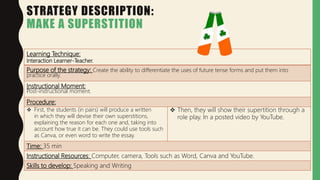
STRATEGY DESCRIPTION:
MAKE A SUPERSTITION
Learning Technique:
Interaction Learner-Teacher.
Purpose of the strategy: Create the ability to differentiate the uses of future tense forms and put them into
practice orally.
Instructional Moment:
Post-instructional moment.
Procedure:
 First, the students (in pairs) will produce a written
in which they will devise their own superstitions,
explaining the reason for each one and, taking into
account how true it can be. They could use tools such
as Canva, or even word to write the essay.
 Then, they will show their supertition through a
role play. In a posted video by YouTube.
Time: 35 min
Instructional Resources: Computer, camera, Tools such as Word, Canva and YouTube.
Skills to develop: Speaking and Writing

Future

  • 1.
    SIMPLE FUTURE -FORMS- Teachers: Ariadna V.Petit 26.814.014 Marco A. Bracho 26.677.305 February, 2021
  • 2.
    GeneralInformation Area: Education Program: English Department: Language apartment. ReferentialInformation Level: II (Intermediate) Character: Theoricaland Practical Hours Per Week: 6 Teacher: Ariadna V. Petit & Marco A. Montes Date: February, 2021 Characteristicsofstudents Age: 16-23 Academic Program Selected: English II Skills: Speaking, Writting, Listening and Reading Number of Students: 14
  • 3.
    WHAT ABOUT SIMPLE FUTURE? •There are many ways to make a referece of future tense in english (beside the use of the axuliary “Will”) English, also, use something call “Periphrasis” and other kind of structures. That means we can use, even, present tense to express future,. • So… Stop to use “will” every-single time!!! ;) First of all… Note: Periphrasis Meaning: Inflection of a gramatical rule: e.g: did go = Went
  • 4.
    WHAT TO TEACH? LANGUAGEISSUE: • Superstitions TOPIC: • Diferent forms of Simple Future Tense: Will Going to. Present Cotinuous. When to use them?
  • 5.
    DIDACTIC ACTIVITIES PLAN LanguageIssue: Forms of Future Tense Topic: Superstitions Pre-Instructional Moment: Co-Instructional Moment: Post-instructional Moment: Activity: Class will start with some Evocative Questions to cultivate prior knowledge (Definitions and properties of future tense) and then a Brainstorm. Time: 10 mim Resources: Voice, Whiteboard, marker and eraser. Activity: Then, through a didactic exposition where the Future forms will be displayed across some Irish myths and legends that going to show differences in future use. Time: 45 min Resources: markers, eraser, Irelnd flag and voice. Activity: Finally, Students will carry out a didactic strategy called “Make a Superstition” (Into an essay and then, in a role play) to practice skills such as speaking and writing of structure previously taught in class. Time: 35mim Resources: Computer, camera, Tools such as Word, Canva and YouTube.
  • 6.
    SIMPLE FUTURE FORMS: 1.WHY “WILL”?* • As an auxiliar, “Will” help us to express an uncertain future. Explains something that could happen or probably changes. • -“She will be here tomorrow”- (Suddently, something could happen and she can not be here tomorrow) 2. WHY “GOING TO”?* • “To be” plus the ing form of “go” is used to express events that you have already planned or intentions for future. • -“She is going to be here tomorrow”- (She was planning come tomorrow and she’s going to make impossible things to come) 3.WHY “PRESENT CONTINUOUS”? • “To be” plus the ing form of a verb is used for dates. Also, is used for the same things of “Going to”, but with a higher conviction. • She is coming tomorrow at 2:00pm
  • 7.
    DRAFT *In some Irishsuperstitions, there is more conviction that they can be true than in others.* #3. The Red-Haired Maiden: ” if you meet a red-haired woman first thing in the morning, you will have bad luck all day.” #2. Double Rainbow Lovers: “If you see a double rainbow beside to someone who you have a crush on, that person is going to be your life partner.” #1. The Magpies: “If you see a magpie, bad luck is coming towards you.” MORE LESS “is coming” = Is a Fact “is going to” = Is Sure “will” = Could be
  • 8.
    STRATEGY DESCRIPTION: MAKE ASUPERSTITION Learning Technique: Interaction Learner-Teacher. Purpose of the strategy: Create the ability to differentiate the uses of future tense forms and put them into practice orally. Instructional Moment: Post-instructional moment. Procedure:  First, the students (in pairs) will produce a written in which they will devise their own superstitions, explaining the reason for each one and, taking into account how true it can be. They could use tools such as Canva, or even word to write the essay.  Then, they will show their supertition through a role play. In a posted video by YouTube. Time: 35 min Instructional Resources: Computer, camera, Tools such as Word, Canva and YouTube. Skills to develop: Speaking and Writing