By Manish Shrivastava
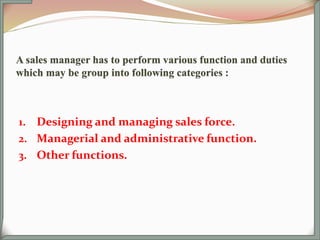
1. Designing and managing sales force.
2. Managerial and administrative function.
3. Other functions.
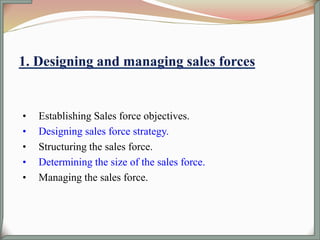
• Establishing Sales force objectives.
• Designing sales force strategy.
• Structuring the sales force.
• Determining the size of the sales force.
• Managing the sales force.
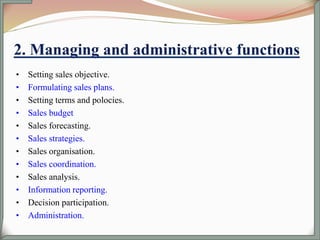
• Setting sales objective.
• Formulating sales plans.
• Setting terms and polocies.
• Sales budget
• Sales forecasting.
• Sales strategies.
• Sales organisation.
• Sales coordination.
• Sales analysis.
• Information reporting.
• Decision participation.
• Administration.
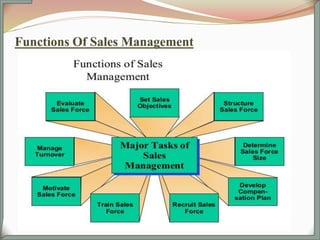
The general functions of sales management are as follows:
1. Preparing the Sales Plan.
2. Recruiting the right people to execute the sales plan.
3. Training the people selected to build competency in achieving the targets
set and fulfilling the organization’s objectives.
4. Defining the sales territories.
5. Specifying the sales quota to be achieved for each territory.
6. Defining the remuneration and reward system for the sales force.
7. Providing welfare and healthcare facilities to the sales force.
8. Devising a sales force development program.
9. Analyzing past performance with the current performance and making
predictions on demand.
10. Coordinating with the marketing department and the consumers.
11. Sales planning and sales policies.
12. Pricing policy and price fixing.
13. Advertising and sales promotion.
14. Scientific salespersonship, management and control of sales force.
15. Marketing research.
16. Planning and control of sales operations and control of sales costs.
17. Selection and management of channels of distribution.
18. Branding, packing and labeling.
19. After sales service, if necessary.
20. Integration and coordination of all functions.
Classified of sales management on different basis –
1. Sales programing
2. Sales oranization
3. Sales product
4. Markets
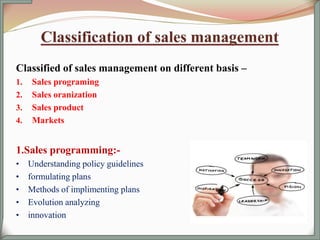
1.Sales programming:-
• Understanding policy guidelines
• formulating plans
• Methods of implimenting plans
• Evolution analyzing
• innovation
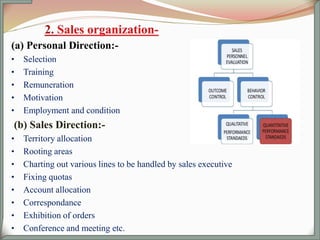
(a) Personal Direction:-
• Selection
• Training
• Remuneration
• Motivation
• Employment and condition
(b) Sales Direction:-
• Territory allocation
• Rooting areas
• Charting out various lines to be handled by sales executive
• Fixing quotas
• Account allocation
• Correspondance
• Exhibition of orders
• Conference and meeting etc.
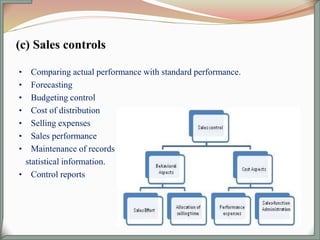
• Comparing actual performance with standard performance.
• Forecasting
• Budgeting control
• Cost of distribution
• Selling expenses
• Sales performance
• Maintenance of records
statistical information.
• Control reports
(a) Product development:-
• Testing and studying of products.
• Suggesting standardization.
• Extra efforts for new products eg. Bajaj pulsar
• Suggesting modification of product and packing or packaging.
(b) Price, terms and condition:-
• The price structure: offers, quotation selling terms, trade discount, cash
discount and special discount.
• Mode of payments: credit system, selling under higher purchase
installments, checks or cash.
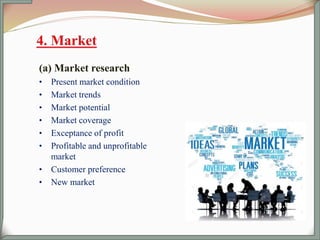
(a) Market research
• Present market condition
• Market trends
• Market potential
• Market coverage
• Exceptance of profit
• Profitable and unprofitable
market
• Customer preference
• New market
Continue…
(b) Competitor products :-
• Problem of industries .
• Trade association methods.
• Methods and other details about competitors products.
(c) Distribution :-
• Channels and outlets.
• Location size and no. of distribution.
• Relative profitability.
(d) Relationship with customer :-
• Service provider.
• Dealing with companies.
• Goodwill.
(e) Development of business :-
1. Advertising :
• Appropriate budget
• Brand estaiblishment
• Compaigning
• Media
• Use of advertising agent.
2. Promotion :
• Display
• Exhibition
• Charity on missionary
• Sales compaigning
• Contest
• Sales kits and samples.
functions and classification of SM.pptx

functions and classification of SM.pptx

  • 1.
  • 3.
    1. Designing andmanaging sales force. 2. Managerial and administrative function. 3. Other functions.
  • 4.
    • Establishing Salesforce objectives. • Designing sales force strategy. • Structuring the sales force. • Determining the size of the sales force. • Managing the sales force.
  • 5.
    • Setting salesobjective. • Formulating sales plans. • Setting terms and polocies. • Sales budget • Sales forecasting. • Sales strategies. • Sales organisation. • Sales coordination. • Sales analysis. • Information reporting. • Decision participation. • Administration.
  • 6.
    The general functionsof sales management are as follows: 1. Preparing the Sales Plan. 2. Recruiting the right people to execute the sales plan. 3. Training the people selected to build competency in achieving the targets set and fulfilling the organization’s objectives. 4. Defining the sales territories. 5. Specifying the sales quota to be achieved for each territory. 6. Defining the remuneration and reward system for the sales force. 7. Providing welfare and healthcare facilities to the sales force. 8. Devising a sales force development program.
  • 7.
    9. Analyzing pastperformance with the current performance and making predictions on demand. 10. Coordinating with the marketing department and the consumers. 11. Sales planning and sales policies. 12. Pricing policy and price fixing. 13. Advertising and sales promotion. 14. Scientific salespersonship, management and control of sales force. 15. Marketing research. 16. Planning and control of sales operations and control of sales costs. 17. Selection and management of channels of distribution. 18. Branding, packing and labeling. 19. After sales service, if necessary. 20. Integration and coordination of all functions.
  • 8.
    Classified of salesmanagement on different basis – 1. Sales programing 2. Sales oranization 3. Sales product 4. Markets 1.Sales programming:- • Understanding policy guidelines • formulating plans • Methods of implimenting plans • Evolution analyzing • innovation
  • 9.
    (a) Personal Direction:- •Selection • Training • Remuneration • Motivation • Employment and condition (b) Sales Direction:- • Territory allocation • Rooting areas • Charting out various lines to be handled by sales executive • Fixing quotas • Account allocation • Correspondance • Exhibition of orders • Conference and meeting etc.
  • 10.
    • Comparing actualperformance with standard performance. • Forecasting • Budgeting control • Cost of distribution • Selling expenses • Sales performance • Maintenance of records statistical information. • Control reports
  • 11.
    (a) Product development:- •Testing and studying of products. • Suggesting standardization. • Extra efforts for new products eg. Bajaj pulsar • Suggesting modification of product and packing or packaging. (b) Price, terms and condition:- • The price structure: offers, quotation selling terms, trade discount, cash discount and special discount. • Mode of payments: credit system, selling under higher purchase installments, checks or cash.
  • 12.
    (a) Market research •Present market condition • Market trends • Market potential • Market coverage • Exceptance of profit • Profitable and unprofitable market • Customer preference • New market
  • 13.
    Continue… (b) Competitor products:- • Problem of industries . • Trade association methods. • Methods and other details about competitors products. (c) Distribution :- • Channels and outlets. • Location size and no. of distribution. • Relative profitability. (d) Relationship with customer :- • Service provider. • Dealing with companies. • Goodwill.
  • 14.
    (e) Development ofbusiness :- 1. Advertising : • Appropriate budget • Brand estaiblishment • Compaigning • Media • Use of advertising agent. 2. Promotion : • Display • Exhibition • Charity on missionary • Sales compaigning • Contest • Sales kits and samples.