Functional Programming 
in Python 
Reuven M. Lerner, PhD • reuven@lerner.co.il 
October 22nd, 2014
Who am I? 
• Programmer, consultant, developer, trainer 
• Long-time Python (+Ruby) user 
• Linux Journal columnist 
• Author Practice Makes Python! 
• PhD in Learning Sciences from Northwestern 
• Read (lots) more at http://lerner.co.il/ 
2
Functional programming 
• A different way of thinking about programming 
• A different way of writing programs 
• A different way of approaching problems 
• Often provides new, clean, elegant solutions… 
• … but again, it requires that you think about things 
very differently. 
4
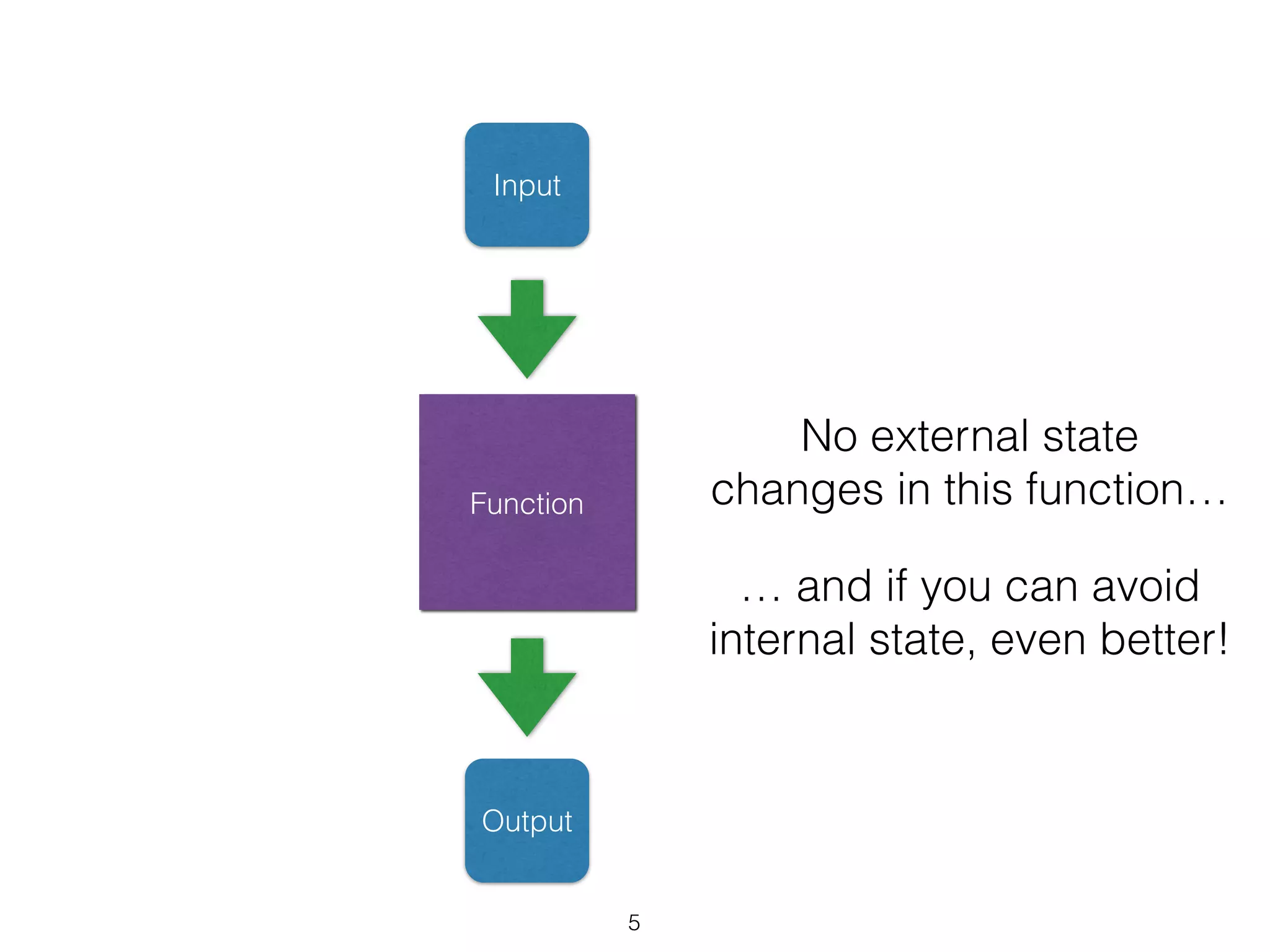
5 
Input 
Function 
Output 
No external state 
changes in this function… 
… and if you can avoid 
internal state, even better!
Why work this way? 
• Simpler functions — easier to write and maintain 
• Easer to test functions, and predict their results 
• Easier to combine functions in new, different ways 
• You can split work across threads, processors, or 
even machines without any ill effects 
• Certain things can be expressed easily, elegantly 
6
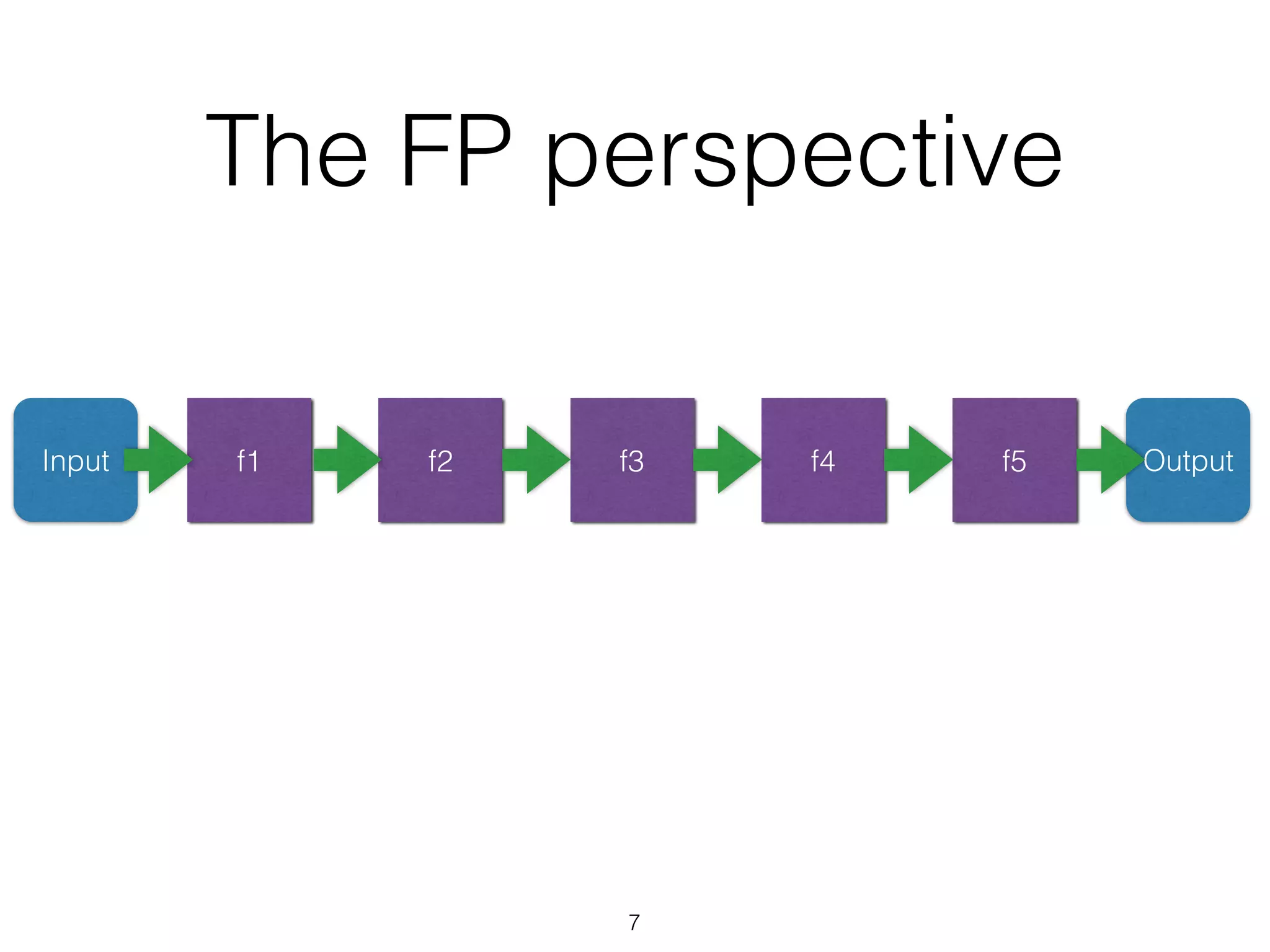
The FP perspective 
Input f1 f2 f3 f4 f5 Output 
7
OO or functional? 
• Python supports both styles 
• It’s common to mix them in one program 
• My current approach: Use objects in general, but 
functional techniques inside of methods 
8
Sequences and iterables 
• There are three built-in sequences in Python: 
strings, tuples, and lists 
• Many other objects are "iterable," meaning that you 
can stick them into a "for" loop and get one item at 
a time 
• Examples: files and dicts 
• This discussion mainly has to do with iterables 
9
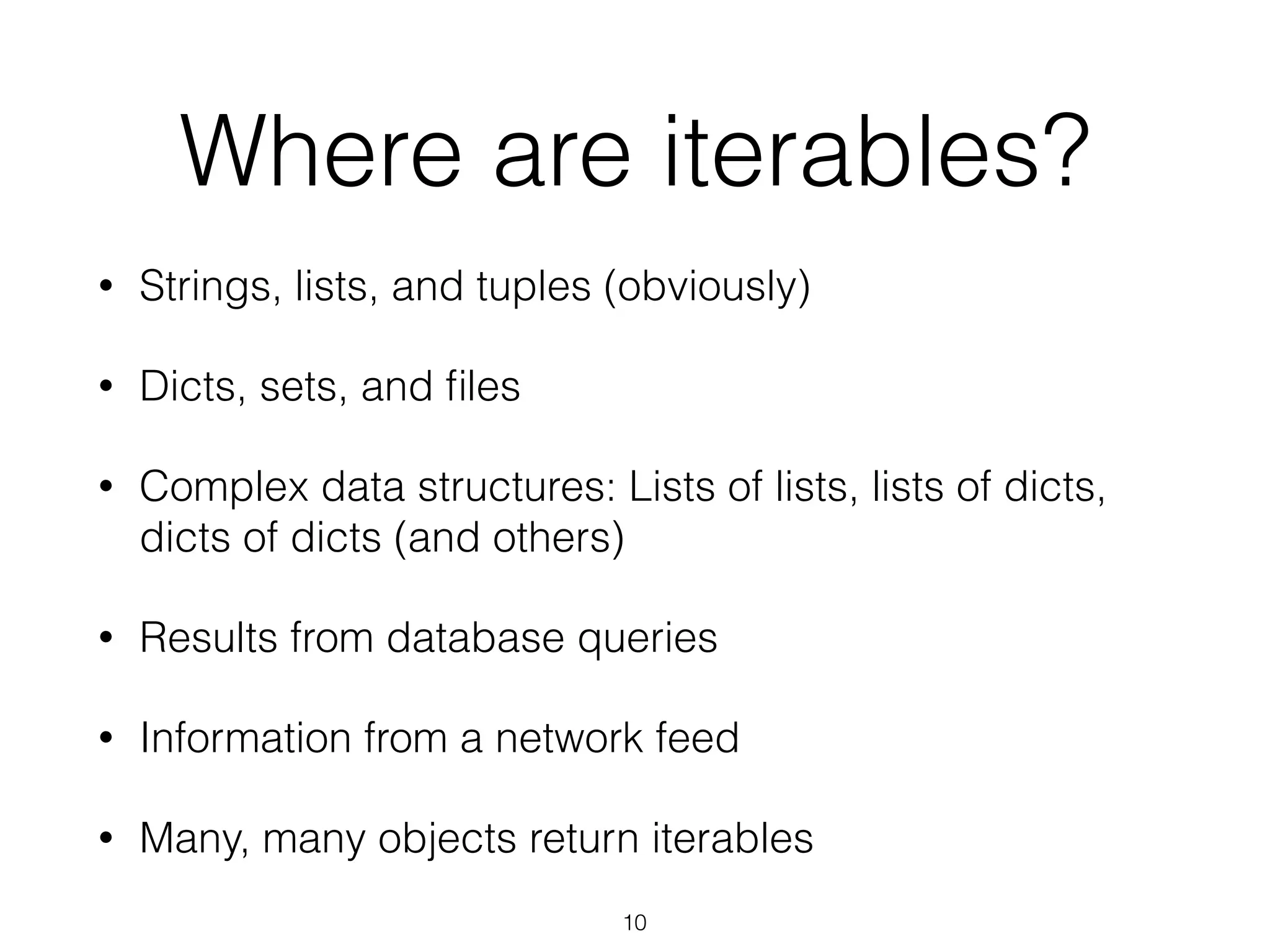
Where are iterables? 
• Strings, lists, and tuples (obviously) 
• Dicts, sets, and files 
• Complex data structures: Lists of lists, lists of dicts, 
dicts of dicts (and others) 
• Results from database queries 
• Information from a network feed 
• Many, many objects return iterables 
10
Transformation 
• You often want to turn one iterable into another 
• For example, you might want to turn the list 
[0,1,2,3,4] # range(5) 
• into the list 
[0,1,4,9,16] 
• We can transform the first list into the other by 
applying a Python function. 
11
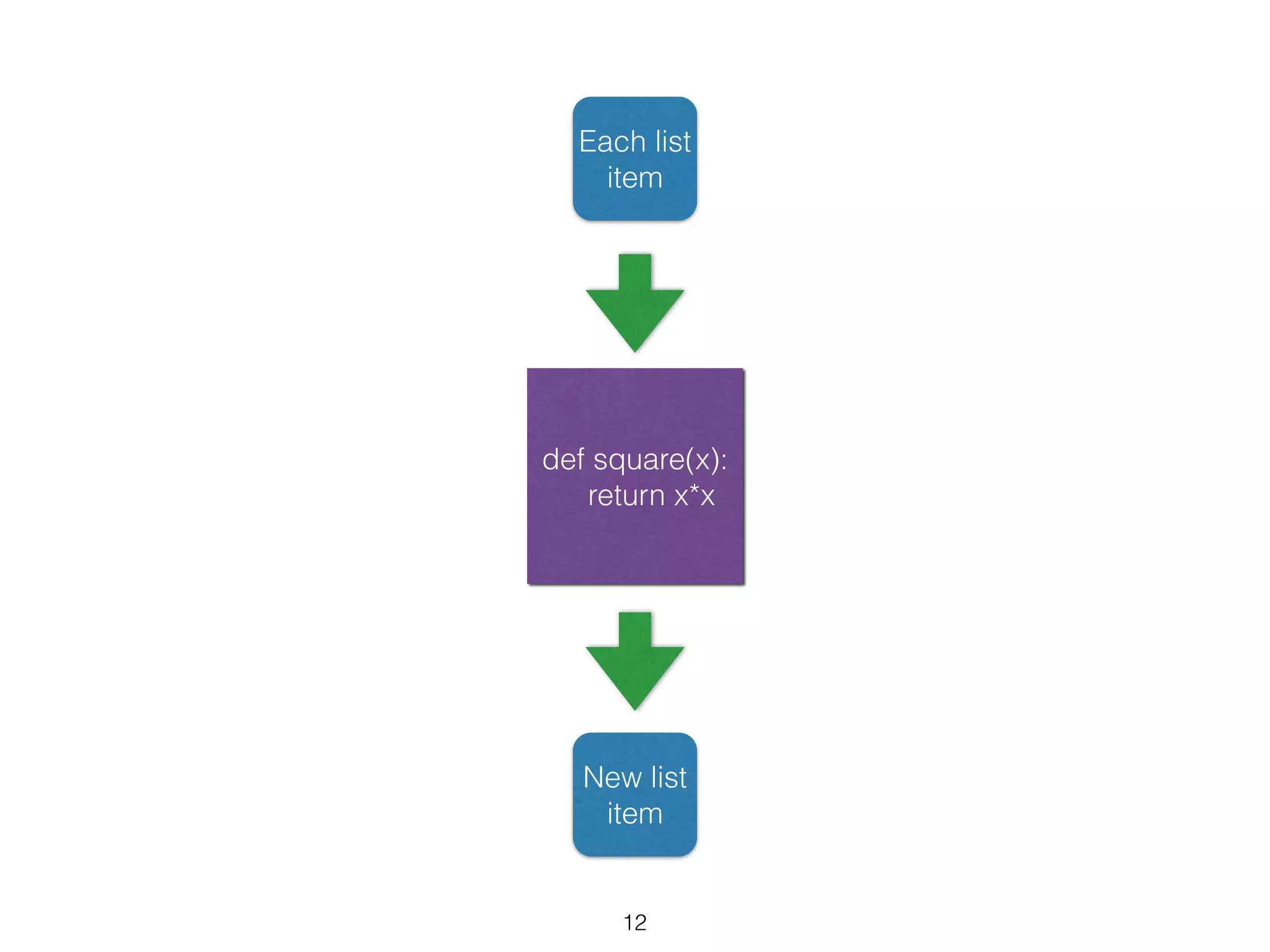
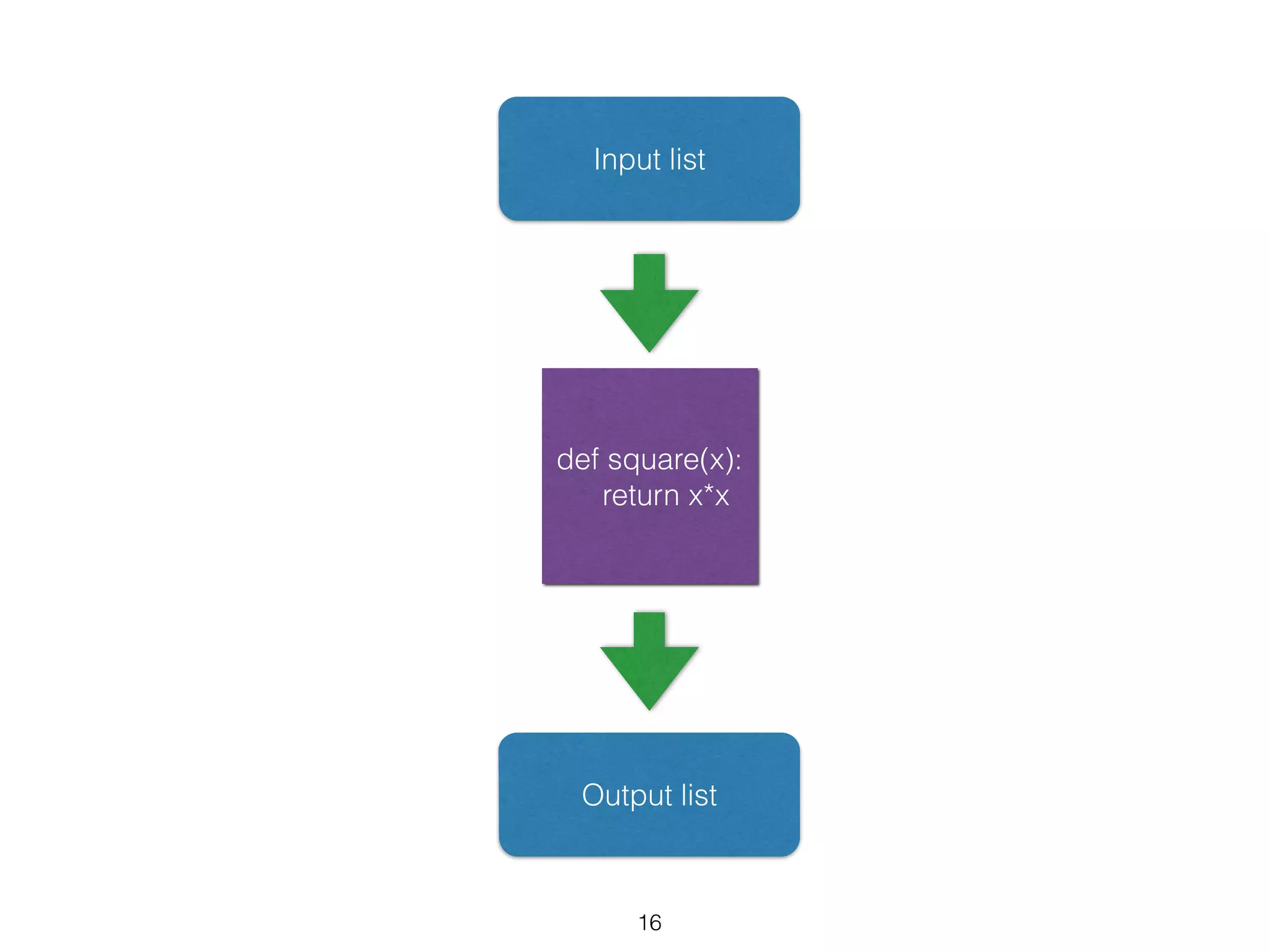
Each list 
item 
def square(x): 
return x*x 
New list 
item 
12
The usual solution 
>>>> input = range(5) 
>>>> def square(x): 
return x*x 
>>> output = [ ] 
>>> for x in input: 
output.append(square(x)) 
>>> output 
[0, 1, 4, 9, 16] 
13
What's wrong with this? 
• Nothing is wrong. 
• But functional programming looks at this, and says: 
• Why create a new variable ("output")? 
• Why are you building it, one step at a time? 
• Why are you modifying the state of "output"? 
• Why do it in such a clumsy way? 
14
The elegant way 
"I want to apply my function, square, to each and 
every element of the input list, and get a list back." 
15
Input list 
def square(x): 
return x*x 
Output list 
16
List comprehensions 
• In Python, we do this with a "list comprehension": 
[square(x) for x in range(5)] 
• Or if you prefer: 
[x*x for x in range(5)] 
17
Ints to strings 
• I can't say 
', '.join(range(5)) 
• because str.join's input must contain strings. 
• Solution: 
', '.join([str(x) for x in range(5)]) 
18
Lowercase all words 
• I can transform a sentence into all lowercase: 
words = 'This is a sentence for my Python 
class'.split() 
[word.lower() for word in words] 
• Or even: 
' '.join([word.lower() for word in words]) 
19
Filenames to files 
• I can get a list of filenames from os.listdir: 
os.listdir('/etc') 
• I can get a file object for each of these: 
[open('/etc/' + filename) 
for filename in os.listdir('/etc')] 
20
File contents 
• If I want to get the names of users on my Unix 
system, I can say 
[ line.split(":")[0] 
for line in open('/etc/passwd') ] 
21
Filtering 
• If I want to get the names of users on my Unix 
system, I can say 
[ line.split(":")[0] 
for line in open('/etc/passwd') 
if line[0] != '#' ] 
22
Pig Latin! 
def plword(word): 
vowels = 'aeiou' 
if word[0] in vowels: 
return word + 'way' 
else: 
return word[1:] + word[0] + 'ay' 
23
Translation 
' '.join([plword(word) 
for word in open('column-215') ]) 
24
Bottom line 
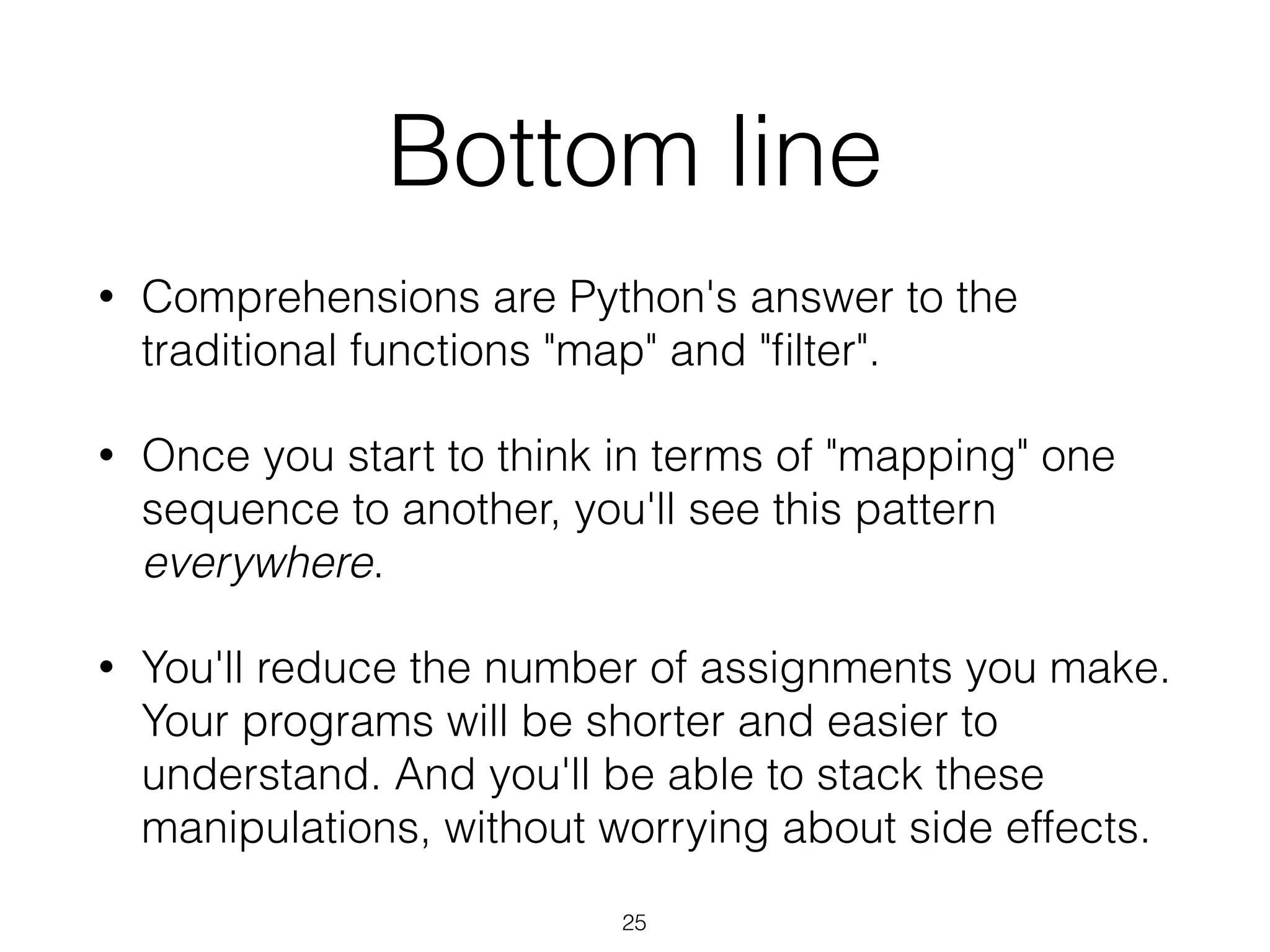
• Comprehensions are Python's answer to the 
traditional functions "map" and "filter". 
• Once you start to think in terms of "mapping" one 
sequence to another, you'll see this pattern 
everywhere. 
• You'll reduce the number of assignments you make. 
Your programs will be shorter and easier to 
understand. And you'll be able to stack these 
manipulations, without worrying about side effects. 
25
Functions 
• Where are the functions in functional programming? 
• Let's write some functions! Let's use some 
functions! 
26
Calling functions 
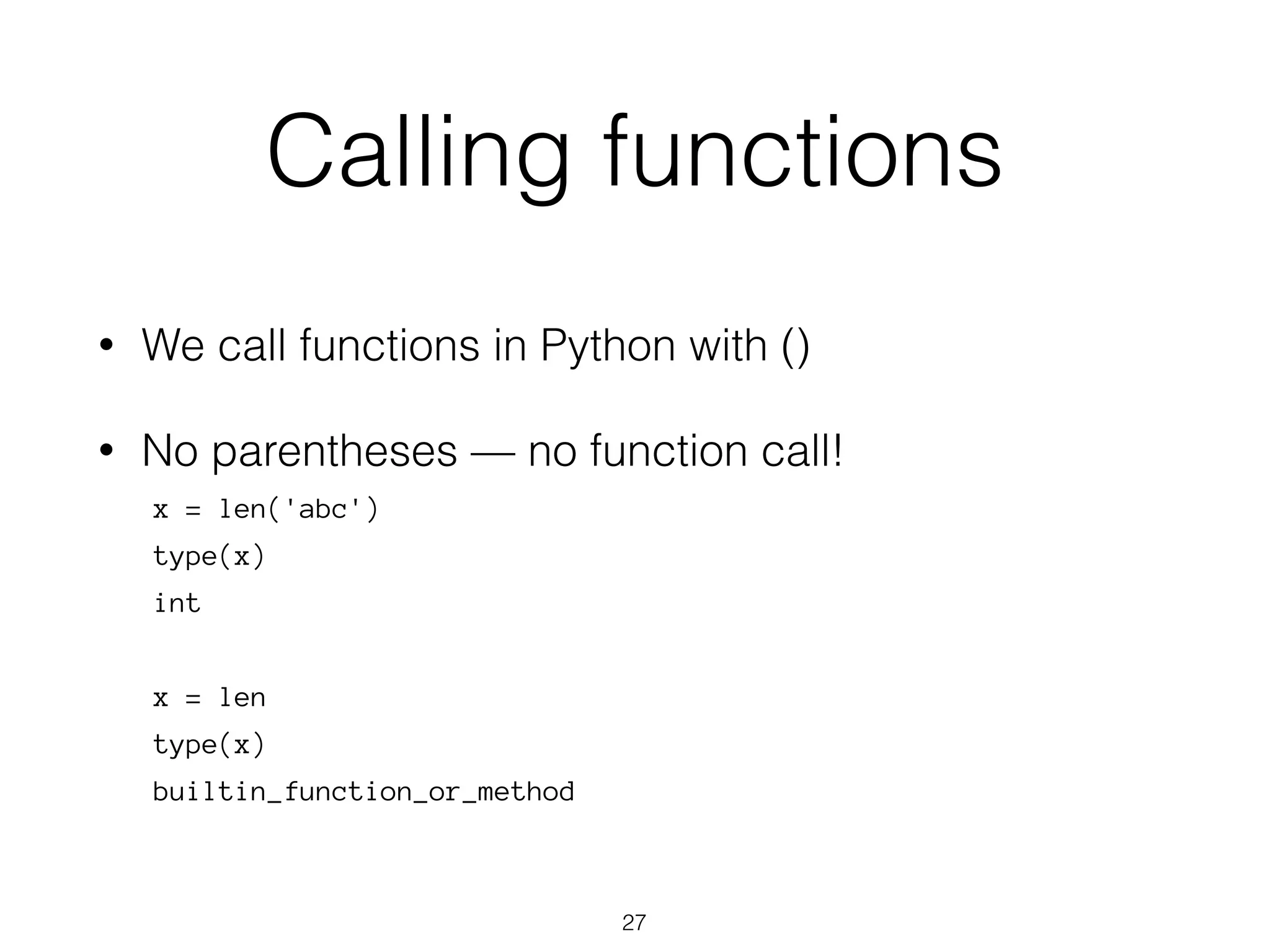
• We call functions in Python with () 
• No parentheses — no function call! 
x = len('abc') 
type(x) 
int 
x = len 
type(x) 
builtin_function_or_method 
27
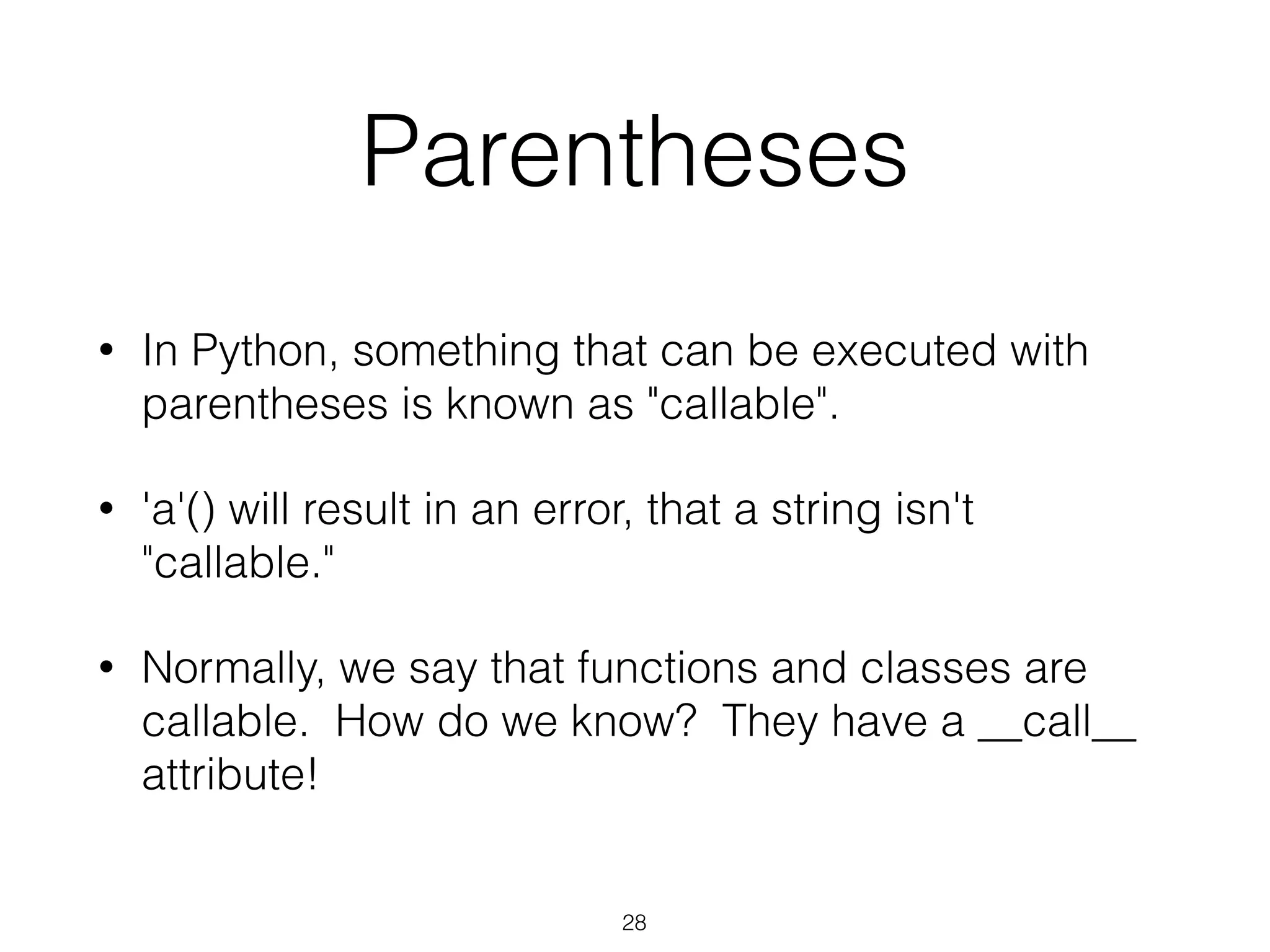
Parentheses 
• In Python, something that can be executed with 
parentheses is known as "callable". 
• 'a'() will result in an error, that a string isn't 
"callable." 
• Normally, we say that functions and classes are 
callable. How do we know? They have a __call__ 
attribute! 
28
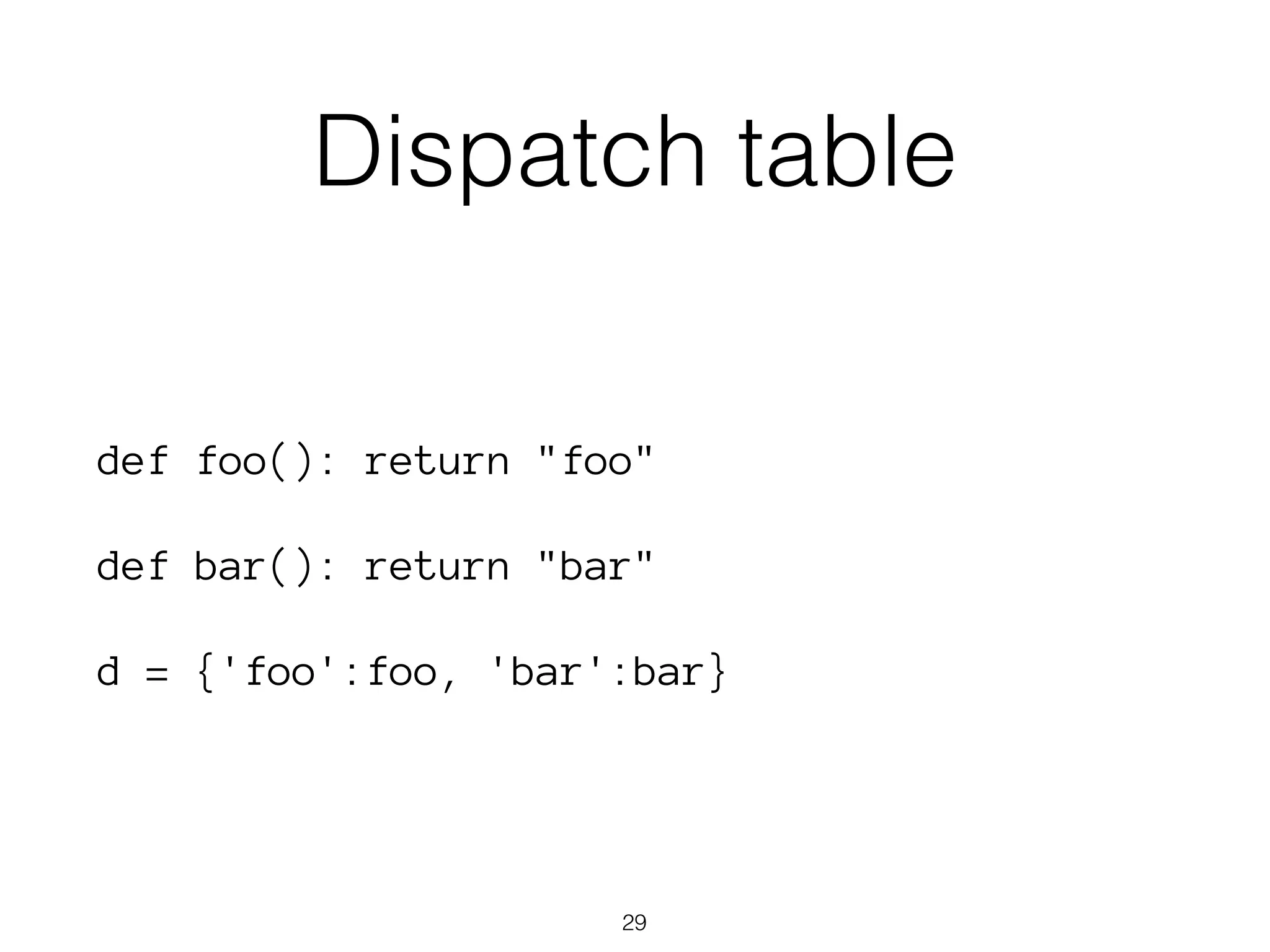
Dispatch table 
def foo(): return "foo" 
def bar(): return "bar" 
d = {'foo':foo, 'bar':bar} 
29
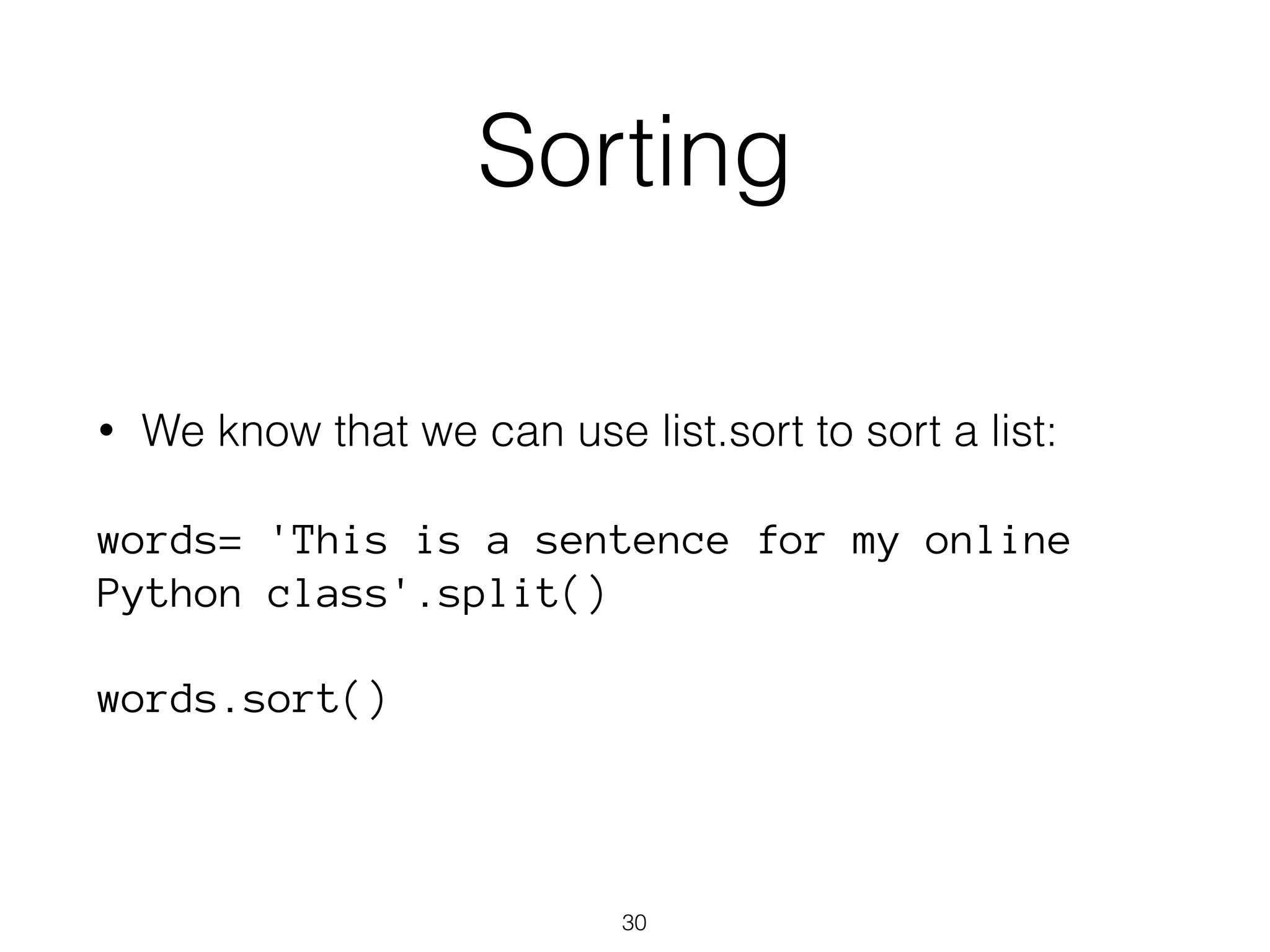
Sorting 
• We know that we can use list.sort to sort a list: 
words= 'This is a sentence for my online 
Python class'.split() 
words.sort() 
30
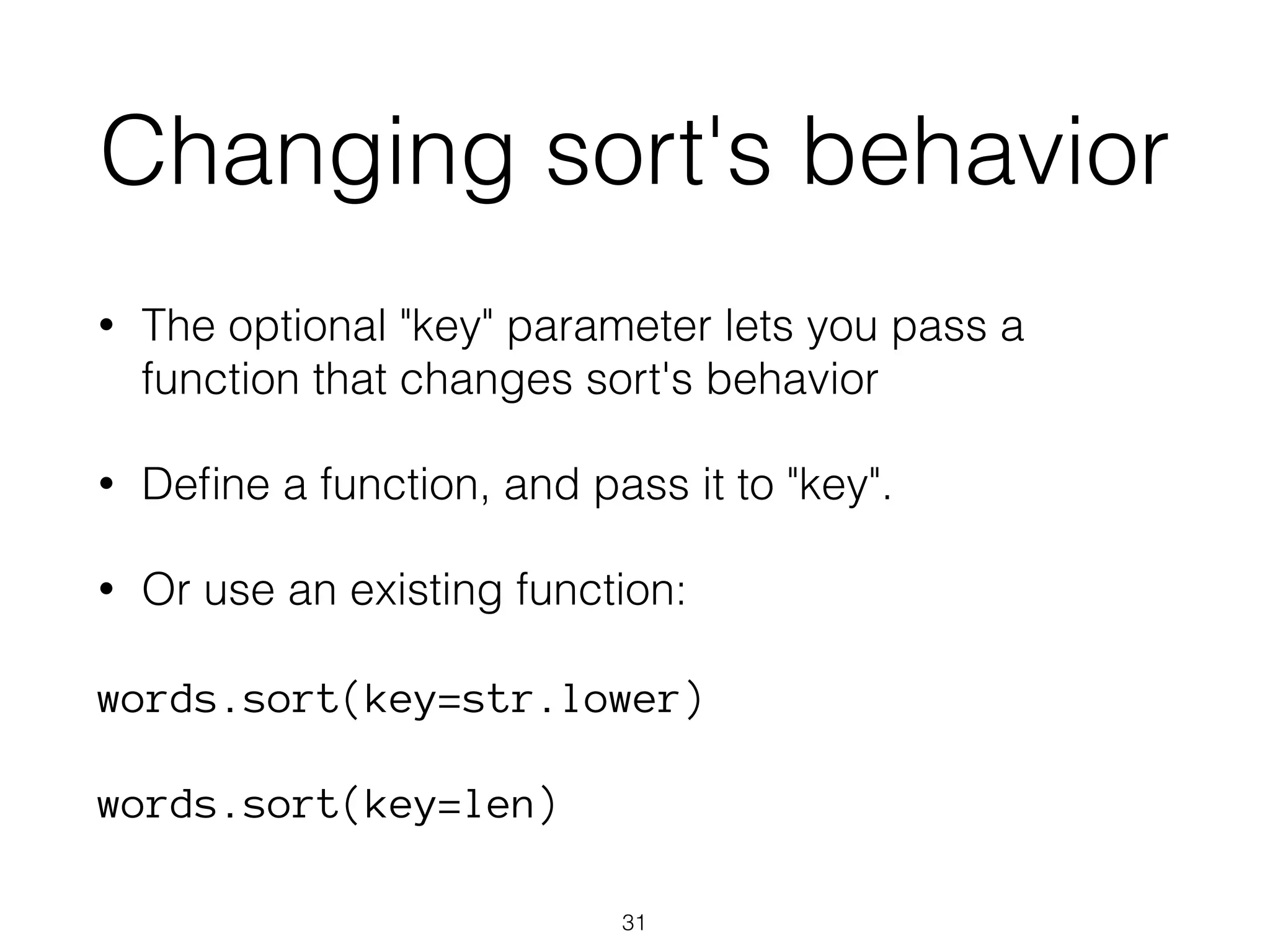
Changing sort's behavior 
• The optional "key" parameter lets you pass a 
function that changes sort's behavior 
• Define a function, and pass it to "key". 
• Or use an existing function: 
words.sort(key=str.lower) 
words.sort(key=len) 
31
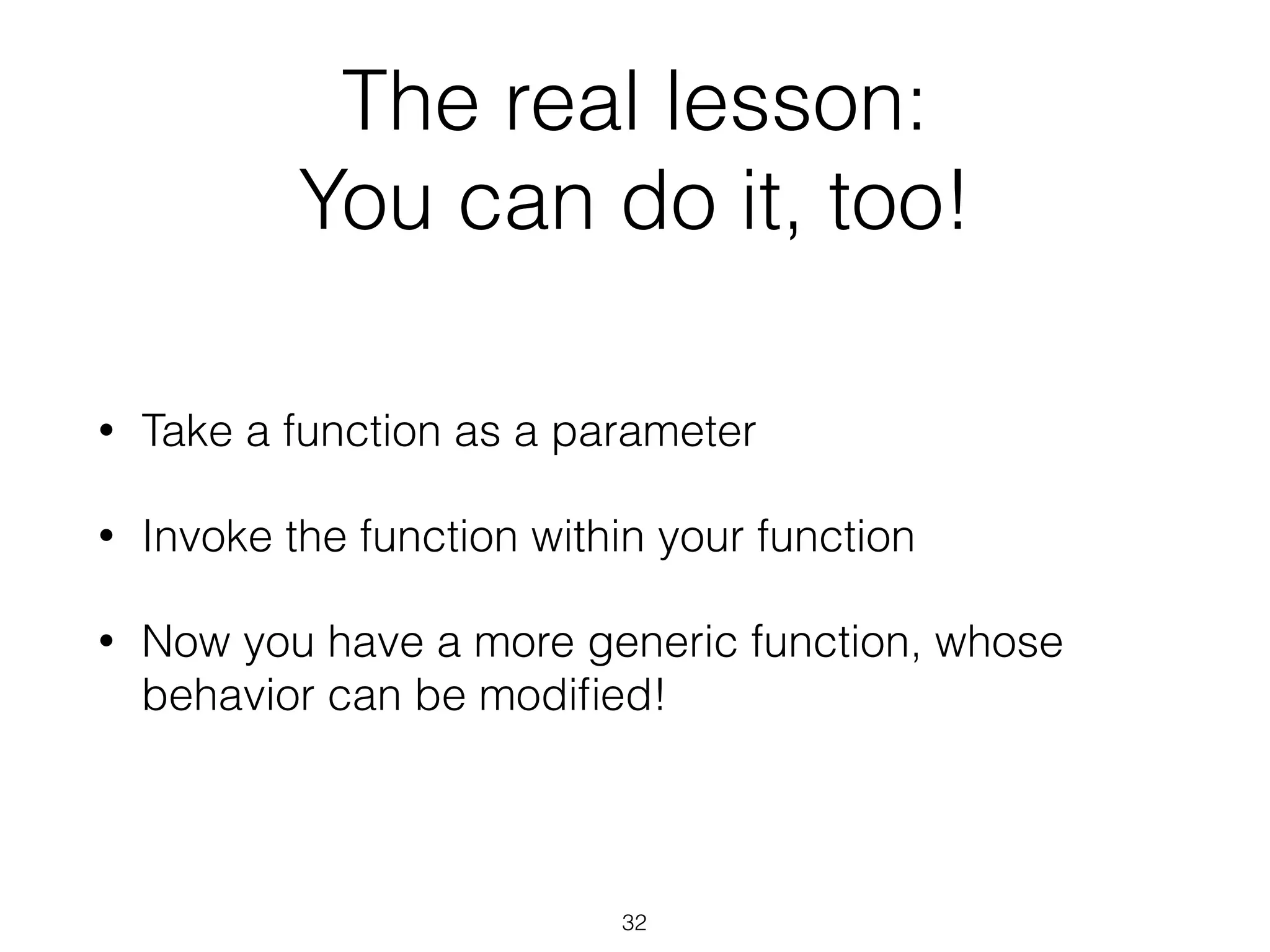
The real lesson: 
You can do it, too! 
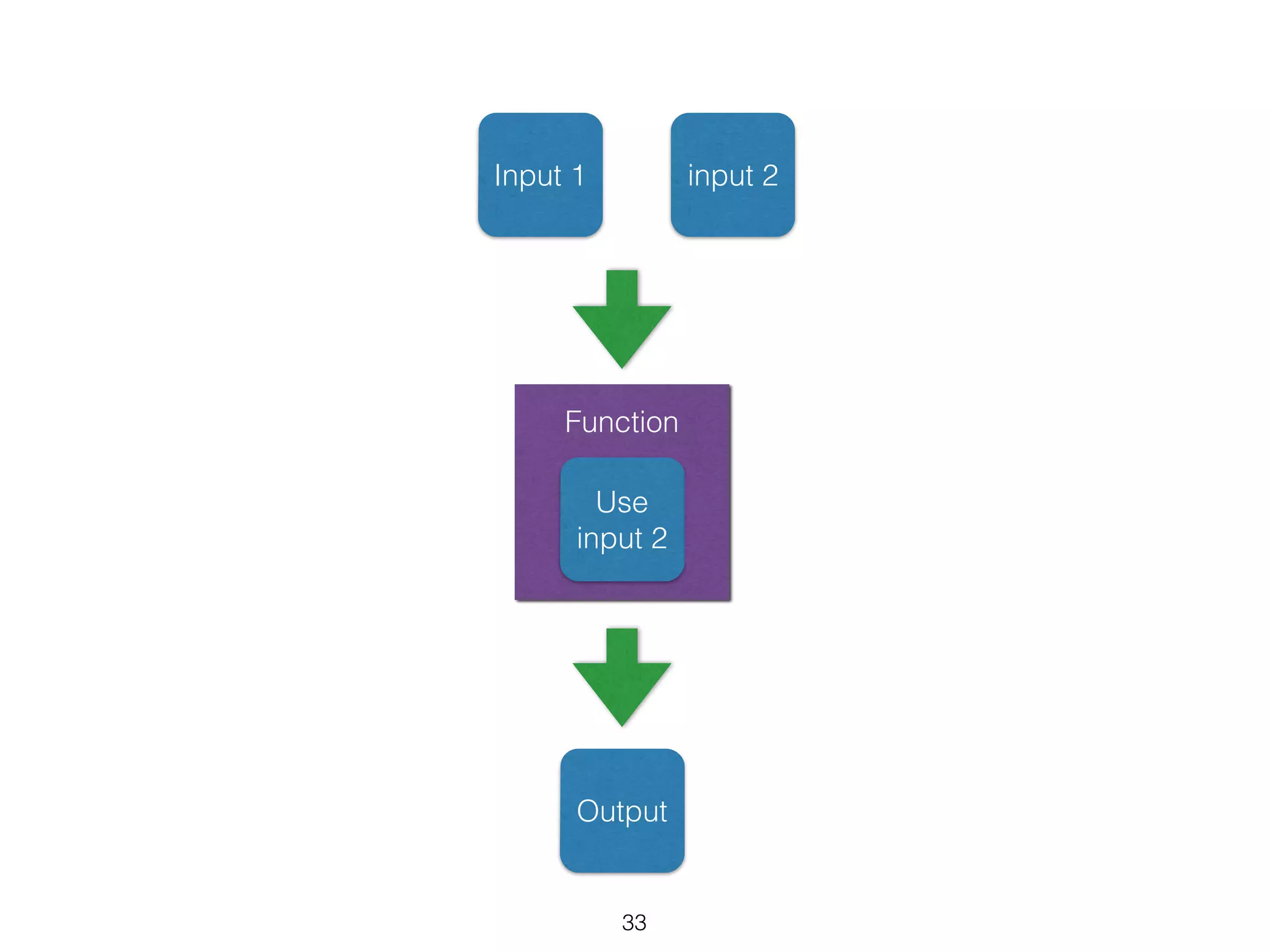
• Take a function as a parameter 
• Invoke the function within your function 
• Now you have a more generic function, whose 
behavior can be modified! 
32
Function 
Use 
input 2 
33 
Input 1 
Output 
input 2
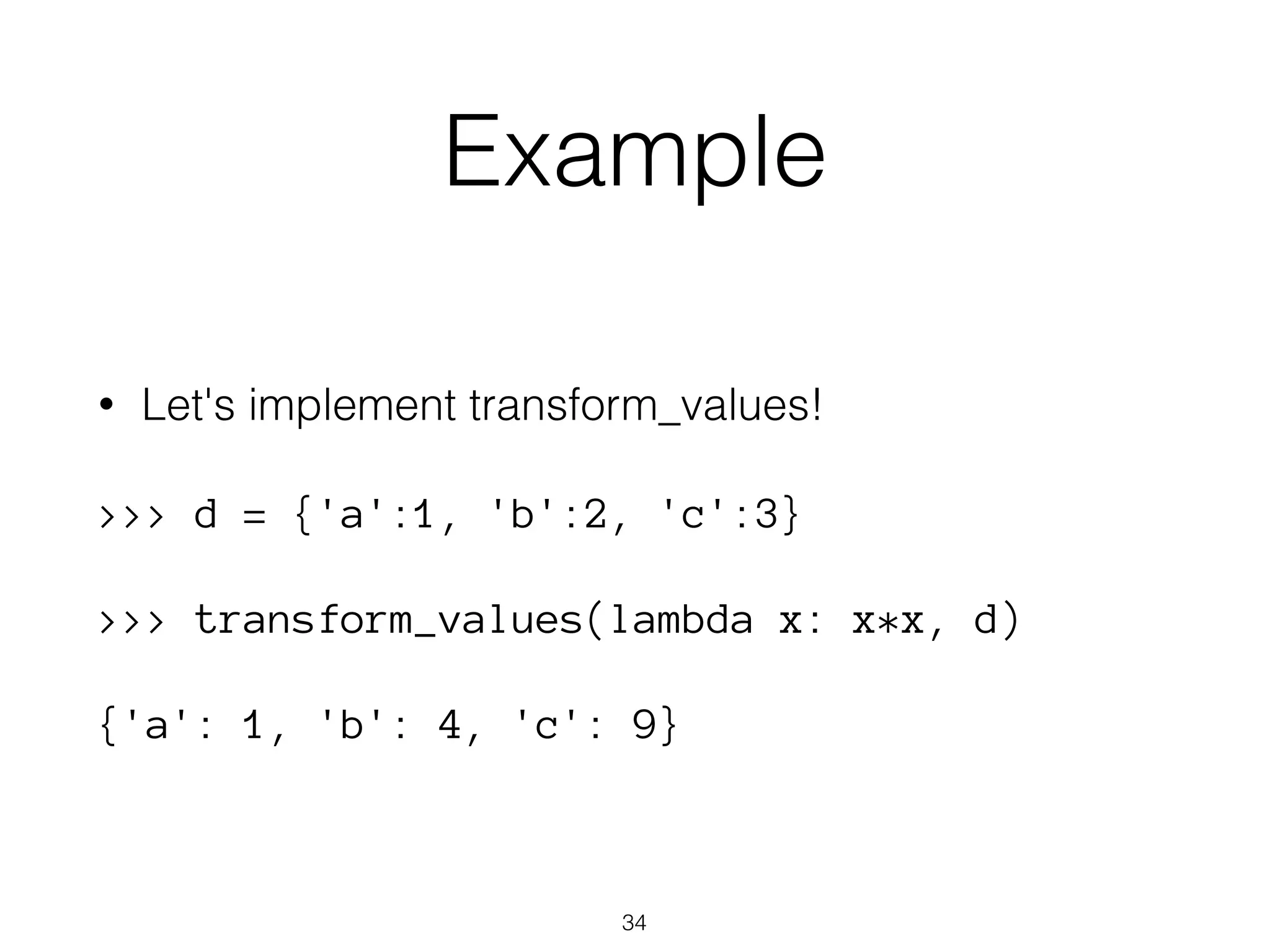
Example 
• Let's implement transform_values! 
>>> d = {'a':1, 'b':2, 'c':3} 
>>> transform_values(lambda x: x*x, d) 
{'a': 1, 'b': 4, 'c': 9} 
34
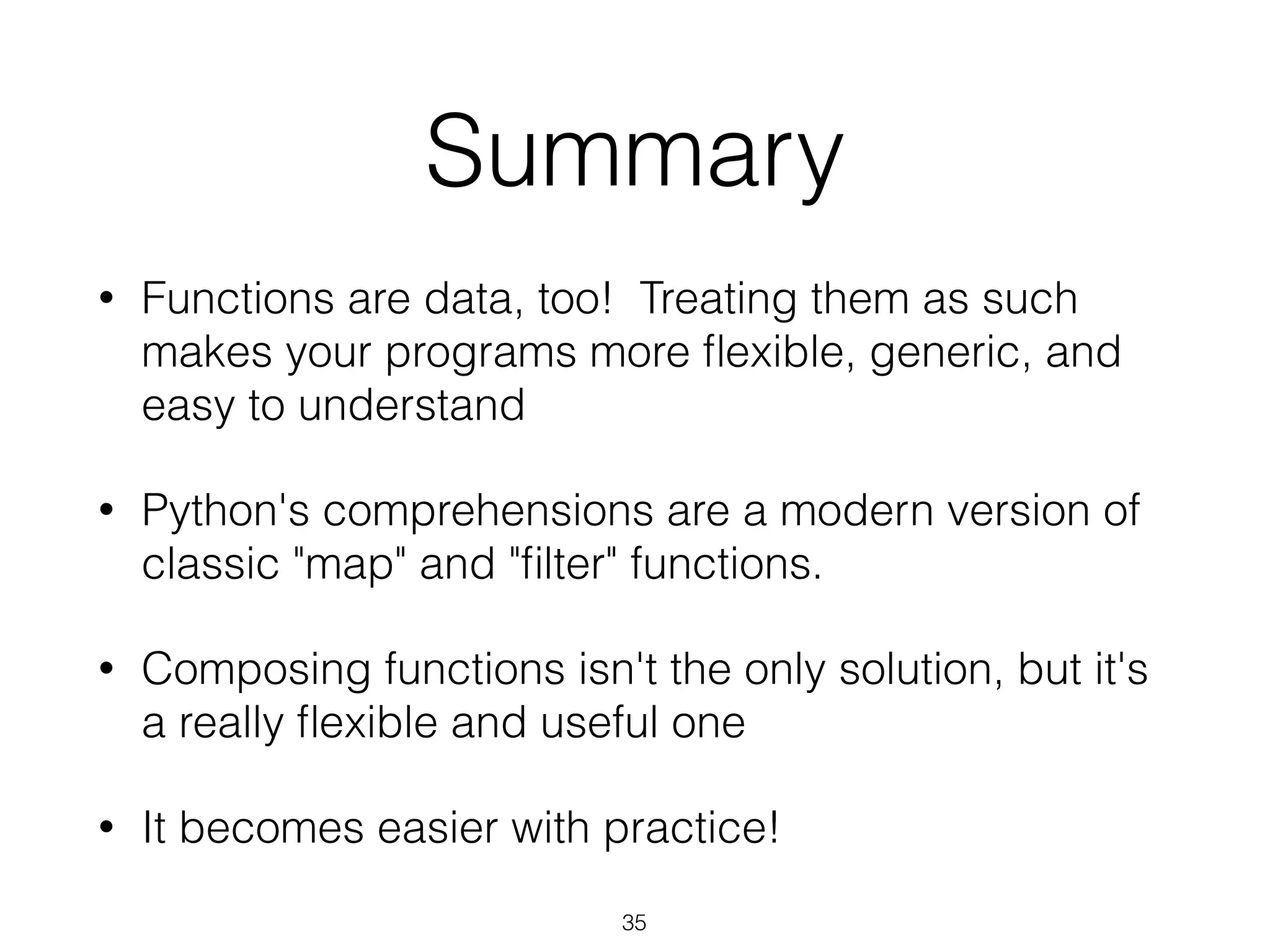
Summary 
• Functions are data, too! Treating them as such 
makes your programs more flexible, generic, and 
easy to understand 
• Python's comprehensions are a modern version of 
classic "map" and "filter" functions. 
• Composing functions isn't the only solution, but it's 
a really flexible and useful one 
• It becomes easier with practice! 
35
Questions? Comments? 
And remember… 
• Early-bird discount on my book! 
• http://lerner.co.il/practice-makes-python 
• Use the WEBINAR coupon code for 10% off! 
• Courses are at http://lerner.co.il/courses 
• Contact me: reuven@lerner.co.il 
• Follow me: @reuvenmlerner 
36

Functional Python Webinar from October 22nd, 2014

  • 1.
    Functional Programming inPython Reuven M. Lerner, PhD • reuven@lerner.co.il October 22nd, 2014
  • 2.
    Who am I? • Programmer, consultant, developer, trainer • Long-time Python (+Ruby) user • Linux Journal columnist • Author Practice Makes Python! • PhD in Learning Sciences from Northwestern • Read (lots) more at http://lerner.co.il/ 2
  • 4.
    Functional programming •A different way of thinking about programming • A different way of writing programs • A different way of approaching problems • Often provides new, clean, elegant solutions… • … but again, it requires that you think about things very differently. 4
  • 5.
    5 Input Function Output No external state changes in this function… … and if you can avoid internal state, even better!
  • 6.
    Why work thisway? • Simpler functions — easier to write and maintain • Easer to test functions, and predict their results • Easier to combine functions in new, different ways • You can split work across threads, processors, or even machines without any ill effects • Certain things can be expressed easily, elegantly 6
  • 7.
    The FP perspective Input f1 f2 f3 f4 f5 Output 7
  • 8.
    OO or functional? • Python supports both styles • It’s common to mix them in one program • My current approach: Use objects in general, but functional techniques inside of methods 8
  • 9.
    Sequences and iterables • There are three built-in sequences in Python: strings, tuples, and lists • Many other objects are "iterable," meaning that you can stick them into a "for" loop and get one item at a time • Examples: files and dicts • This discussion mainly has to do with iterables 9
  • 10.
    Where are iterables? • Strings, lists, and tuples (obviously) • Dicts, sets, and files • Complex data structures: Lists of lists, lists of dicts, dicts of dicts (and others) • Results from database queries • Information from a network feed • Many, many objects return iterables 10
  • 11.
    Transformation • Youoften want to turn one iterable into another • For example, you might want to turn the list [0,1,2,3,4] # range(5) • into the list [0,1,4,9,16] • We can transform the first list into the other by applying a Python function. 11
  • 12.
    Each list item def square(x): return x*x New list item 12
  • 13.
    The usual solution >>>> input = range(5) >>>> def square(x): return x*x >>> output = [ ] >>> for x in input: output.append(square(x)) >>> output [0, 1, 4, 9, 16] 13
  • 14.
    What's wrong withthis? • Nothing is wrong. • But functional programming looks at this, and says: • Why create a new variable ("output")? • Why are you building it, one step at a time? • Why are you modifying the state of "output"? • Why do it in such a clumsy way? 14
  • 15.
    The elegant way "I want to apply my function, square, to each and every element of the input list, and get a list back." 15
  • 16.
    Input list defsquare(x): return x*x Output list 16
  • 17.
    List comprehensions •In Python, we do this with a "list comprehension": [square(x) for x in range(5)] • Or if you prefer: [x*x for x in range(5)] 17
  • 18.
    Ints to strings • I can't say ', '.join(range(5)) • because str.join's input must contain strings. • Solution: ', '.join([str(x) for x in range(5)]) 18
  • 19.
    Lowercase all words • I can transform a sentence into all lowercase: words = 'This is a sentence for my Python class'.split() [word.lower() for word in words] • Or even: ' '.join([word.lower() for word in words]) 19
  • 20.
    Filenames to files • I can get a list of filenames from os.listdir: os.listdir('/etc') • I can get a file object for each of these: [open('/etc/' + filename) for filename in os.listdir('/etc')] 20
  • 21.
    File contents •If I want to get the names of users on my Unix system, I can say [ line.split(":")[0] for line in open('/etc/passwd') ] 21
  • 22.
    Filtering • IfI want to get the names of users on my Unix system, I can say [ line.split(":")[0] for line in open('/etc/passwd') if line[0] != '#' ] 22
  • 23.
    Pig Latin! defplword(word): vowels = 'aeiou' if word[0] in vowels: return word + 'way' else: return word[1:] + word[0] + 'ay' 23
  • 24.
    Translation ' '.join([plword(word) for word in open('column-215') ]) 24
  • 25.
    Bottom line •Comprehensions are Python's answer to the traditional functions "map" and "filter". • Once you start to think in terms of "mapping" one sequence to another, you'll see this pattern everywhere. • You'll reduce the number of assignments you make. Your programs will be shorter and easier to understand. And you'll be able to stack these manipulations, without worrying about side effects. 25
  • 26.
    Functions • Whereare the functions in functional programming? • Let's write some functions! Let's use some functions! 26
  • 27.
    Calling functions •We call functions in Python with () • No parentheses — no function call! x = len('abc') type(x) int x = len type(x) builtin_function_or_method 27
  • 28.
    Parentheses • InPython, something that can be executed with parentheses is known as "callable". • 'a'() will result in an error, that a string isn't "callable." • Normally, we say that functions and classes are callable. How do we know? They have a __call__ attribute! 28
  • 29.
    Dispatch table deffoo(): return "foo" def bar(): return "bar" d = {'foo':foo, 'bar':bar} 29
  • 30.
    Sorting • Weknow that we can use list.sort to sort a list: words= 'This is a sentence for my online Python class'.split() words.sort() 30
  • 31.
    Changing sort's behavior • The optional "key" parameter lets you pass a function that changes sort's behavior • Define a function, and pass it to "key". • Or use an existing function: words.sort(key=str.lower) words.sort(key=len) 31
  • 32.
    The real lesson: You can do it, too! • Take a function as a parameter • Invoke the function within your function • Now you have a more generic function, whose behavior can be modified! 32
  • 33.
    Function Use input2 33 Input 1 Output input 2
  • 34.
    Example • Let'simplement transform_values! >>> d = {'a':1, 'b':2, 'c':3} >>> transform_values(lambda x: x*x, d) {'a': 1, 'b': 4, 'c': 9} 34
  • 35.
    Summary • Functionsare data, too! Treating them as such makes your programs more flexible, generic, and easy to understand • Python's comprehensions are a modern version of classic "map" and "filter" functions. • Composing functions isn't the only solution, but it's a really flexible and useful one • It becomes easier with practice! 35
  • 36.
    Questions? Comments? Andremember… • Early-bird discount on my book! • http://lerner.co.il/practice-makes-python • Use the WEBINAR coupon code for 10% off! • Courses are at http://lerner.co.il/courses • Contact me: reuven@lerner.co.il • Follow me: @reuvenmlerner 36