+ =f(x)
???
Geison Goes
● Senior Consultant na Thoughtworks
● Software Engineer for 12 years
● Husband
● Father
● Dog trainer
● Read more at about.me/geisonfgf
Functional Swift
Functional Programming by Wikipidia:
“Functional programming is a programming paradigm that treats computation as the
evaluation of mathematical functions and avoids state and mutable data". In other
words, functional programming promotes code with no side effects, no change of
value in variables. It oposes to imperative programming, which emphasizes change of
state”.
What this means?
Functional Swift
What this means?
● No mutable data (no side effect).
Functional Swift
What this means?
● No mutable data (no side effect).
● No state (no implicit, hidden state).
Once assigned (value binding), a variable (a symbol) does not change its value.
Functional Swift
What this means?
● No mutable data (no side effect).
● No state (no implicit, hidden state).
Once assigned (value binding), a variable (a symbol) does not change its value.
All state is bad? No, hidden, implicit state is bad.
Functional Swift
What this means?
● No mutable data (no side effect).
● No state (no implicit, hidden state).
Once assigned (value binding), a variable (a symbol) does not change its value.
All state is bad? No, hidden, implicit state is bad.
Functional programming do not eliminate state, it just make it visible and explicit (at least when programmers
want it to be).
Functional Swift
What this means?
● No mutable data (no side effect).
● No state (no implicit, hidden state).
Once assigned (value binding), a variable (a symbol) does not change its value.
All state is bad? No, hidden, implicit state is bad.
Functional programming do not eliminate state, it just make it visible and explicit (at least when programmers
want it to be).
● Functions are pure functions in the mathematical sense: their output depend only in their inputs, there is
not “environment”.
Functional Swift
What this means?
● No mutable data (no side effect).
● No state (no implicit, hidden state).
Once assigned (value binding), a variable (a symbol) does not change its value.
All state is bad? No, hidden, implicit state is bad.
Functional programming do not eliminate state, it just make it visible and explicit (at least when programmers
want it to be).
● Functions are pure functions in the mathematical sense: their output depend only in their inputs, there is
not “environment”.
● Same result returned by functions called with the same inputs.
Functional Swift
What are the advantages?
Functional Swift
What are the advantages?
● Cleaner code: "variables" are not modified once defined, so we don't have to follow the change of state
to comprehend what a function, a, method, a class, a whole project works.
Functional Swift
What are the advantages?
● Cleaner code: "variables" are not modified once defined, so we don't have to follow the change of state
to comprehend what a function, a, method, a class, a whole project works.
● Referential transparency: Expressions can be replaced by its values. If we call a function with the same
parameters, we know for sure the output will be the same (there is no state anywhere that would
change it).
Functional Swift
What are the advantages?
● Cleaner code: "variables" are not modified once defined, so we don't have to follow the change of state
to comprehend what a function, a, method, a class, a whole project works.
● Referential transparency: Expressions can be replaced by its values. If we call a function with the same
parameters, we know for sure the output will be the same (there is no state anywhere that would
change it).
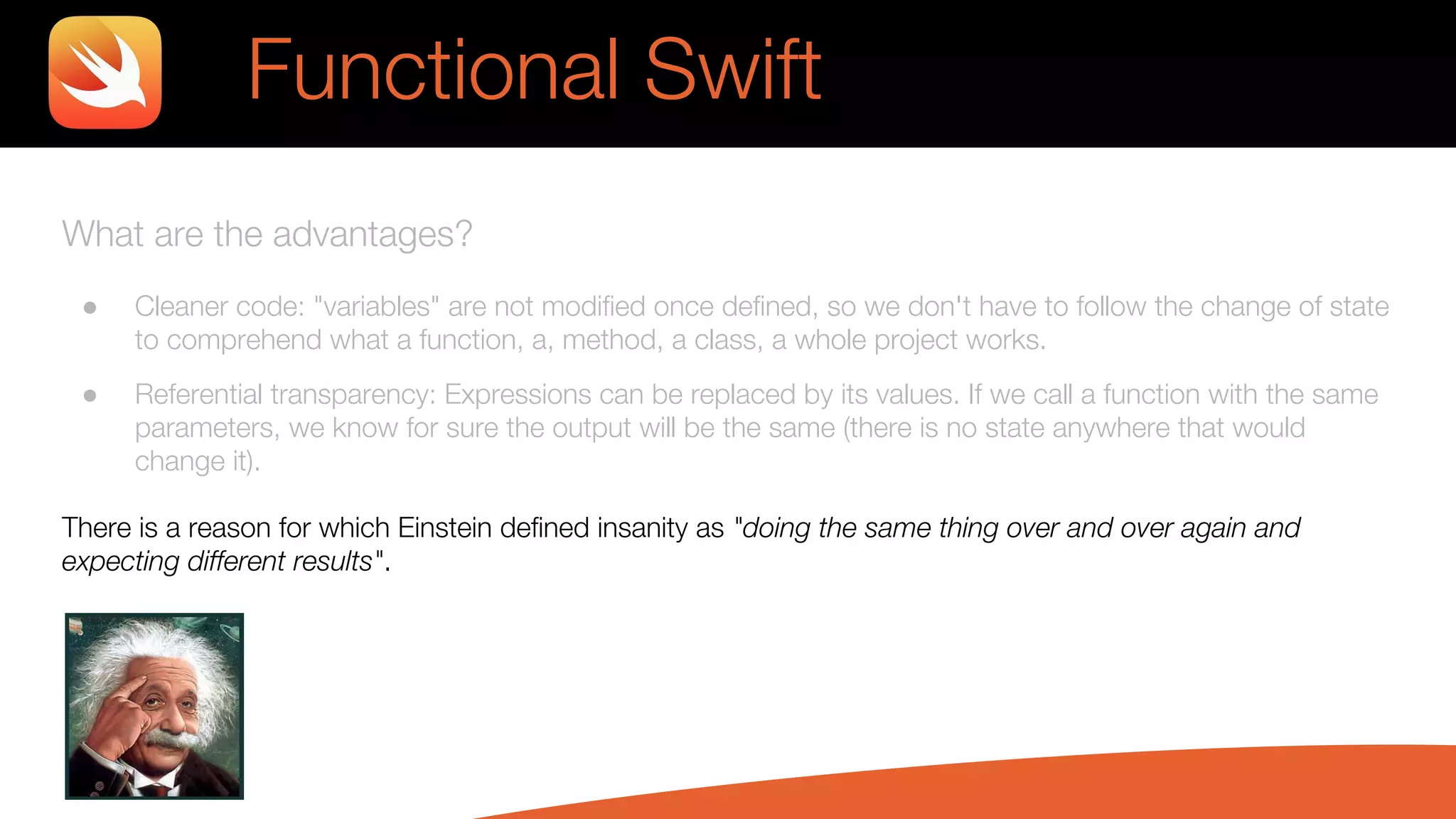
There is a reason for which Einstein defined insanity as "doing the same thing over and over again and
expecting different results".
Functional Swift
Advantages enabled by referential transparency
Functional Swift
Advantages enabled by referential transparency
● Memoization
○ Cache results for previous function calls.
Functional Swift
Advantages enabled by referential transparency
● Memoization
○ Cache results for previous function calls.
● Idempotence
○ Same results regardless how many times you call a function.
Functional Swift
Advantages enabled by referential transparency
● Memoization
○ Cache results for previous function calls.
● Idempotence
○ Same results regardless how many times you call a function.
● Modularization
○ We have no state that pervades the whole code, so we build our project with small, black boxes
that we tie together, so it promotes bottom-up programming.
Functional Swift
Advantages enabled by referential transparency
● Memoization
○ Cache results for previous function calls.
● Idempotence
○ Same results regardless how many times you call a function.
● Modularization
○ We have no state that pervades the whole code, so we build our project with small, black boxes
that we tie together, so it promotes bottom-up programming.
● Ease of debugging
○ Functions are isolated, they only depend on their input and their output, so they are very easy to
debug.
Functional Swift
Advantages enabled by referential transparency
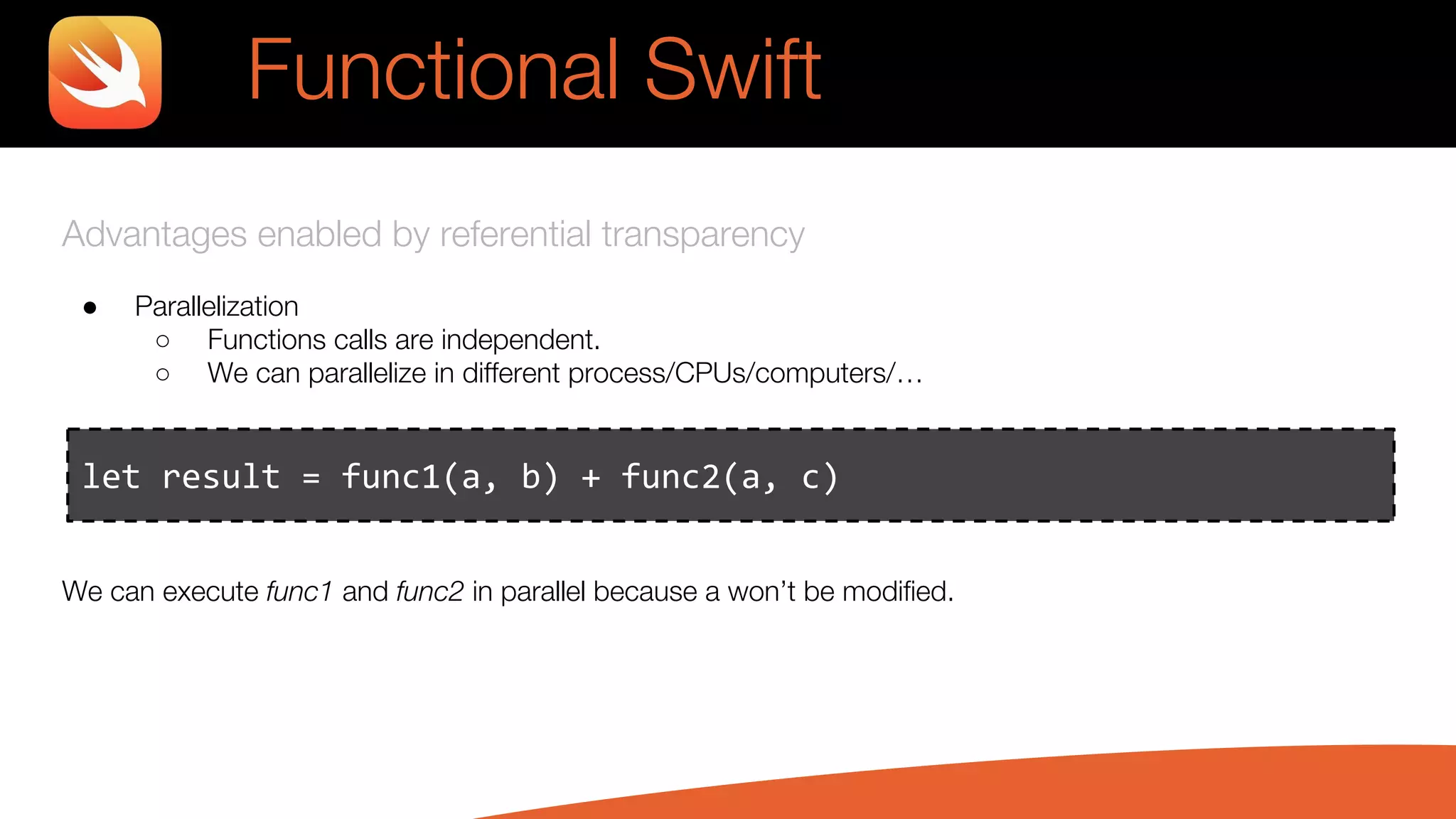
● Parallelization
○ Functions calls are independent.
○ We can parallelize in different process/CPUs/computers/…
Functional Swift
Advantages enabled by referential transparency
● Parallelization
○ Functions calls are independent.
○ We can parallelize in different process/CPUs/computers/…
We can execute func1 and func2 in parallel because a won’t be modified.
let result = func1(a, b) + func2(a, c)
Functional Swift
Advantages enabled by referential transparency
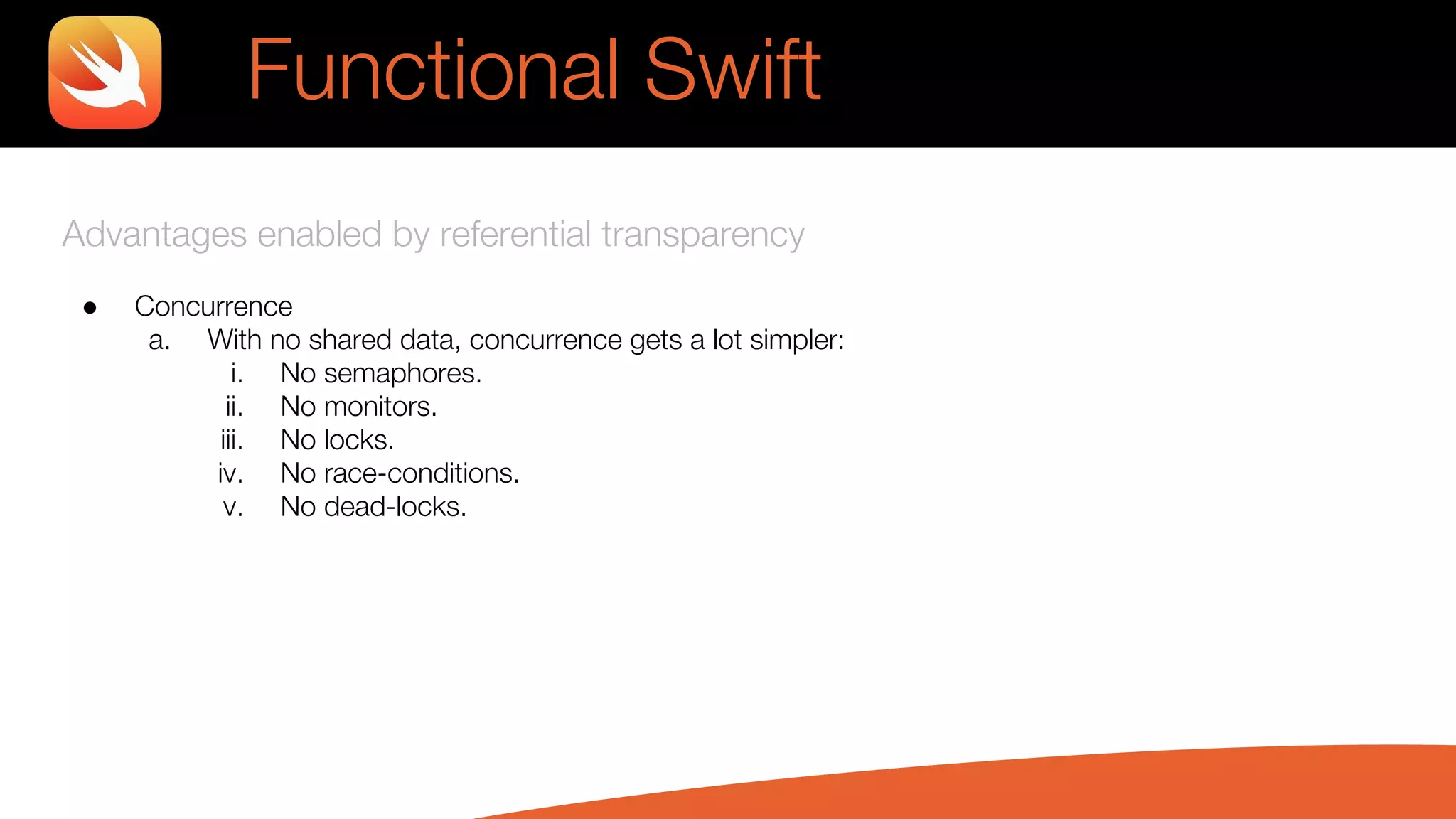
● Concurrence
a. With no shared data, concurrence gets a lot simpler:
i. No semaphores.
ii. No monitors.
iii. No locks.
iv. No race-conditions.
v. No dead-locks.
Functional Swift
Immutable Objects
Functional Swift
Immutable Objects
● An OO pattern that was originated in FP world.
Functional Swift
Immutable Objects
● An OO pattern that was originated in FP world.
● When changing a data structure, don’t modify in place but create a new object.
Functional Swift
Immutable Objects
● An OO pattern that was originated in FP world.
● When changing a data structure, don’t modify in place but create a new object.
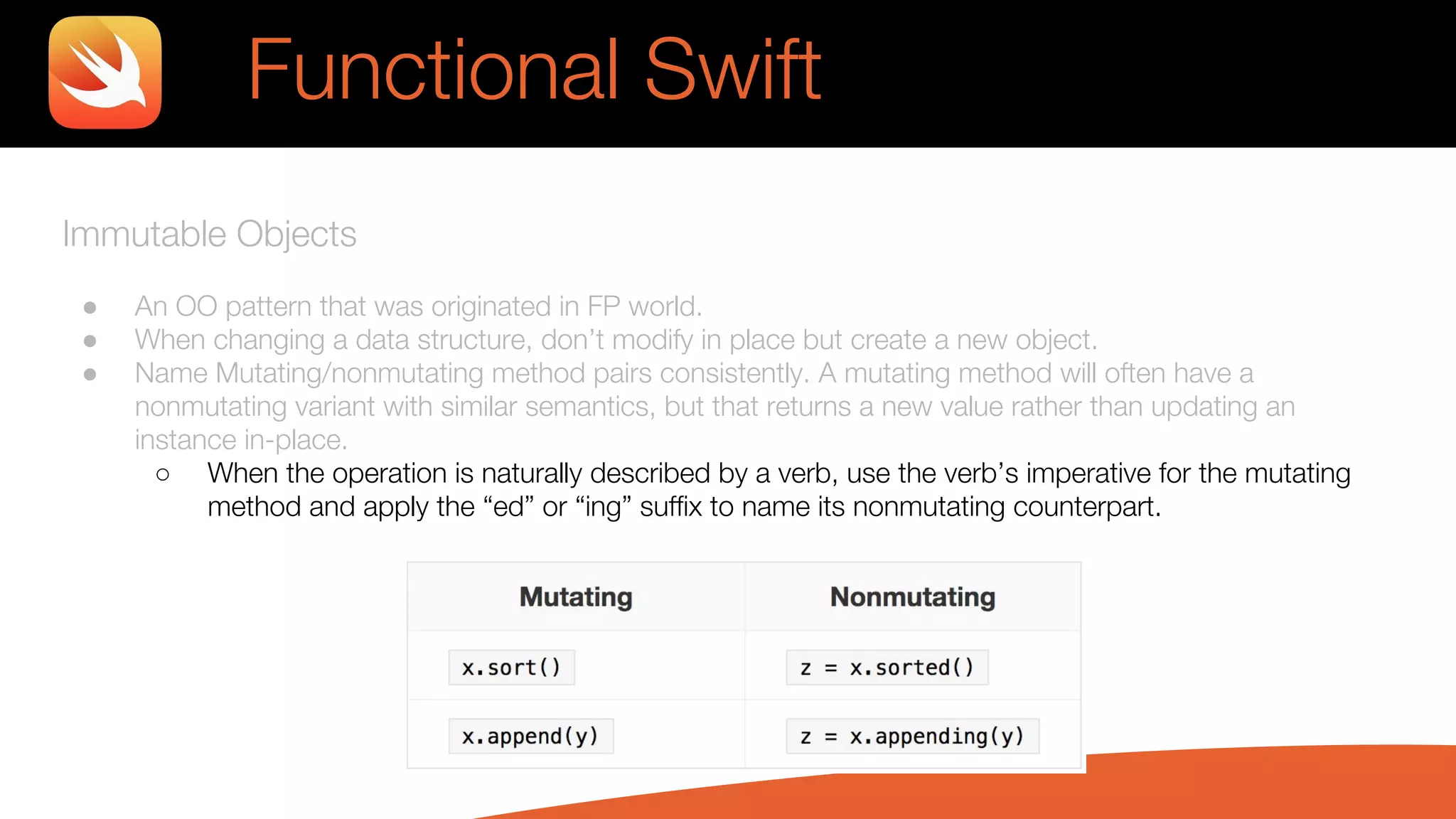
● Name Mutating/nonmutating method pairs consistently. A mutating method will often have a
nonmutating variant with similar semantics, but that returns a new value rather than updating an
instance in-place.
Functional Swift
Immutable Objects
● An OO pattern that was originated in FP world.
● When changing a data structure, don’t modify in place but create a new object.
● Name Mutating/nonmutating method pairs consistently. A mutating method will often have a
nonmutating variant with similar semantics, but that returns a new value rather than updating an
instance in-place.
○ When the operation is naturally described by a verb, use the verb’s imperative for the mutating
method and apply the “ed” or “ing” suffix to name its nonmutating counterpart.
Functional Swift
Functional Swift
Ok so let's play a little with functional programming?
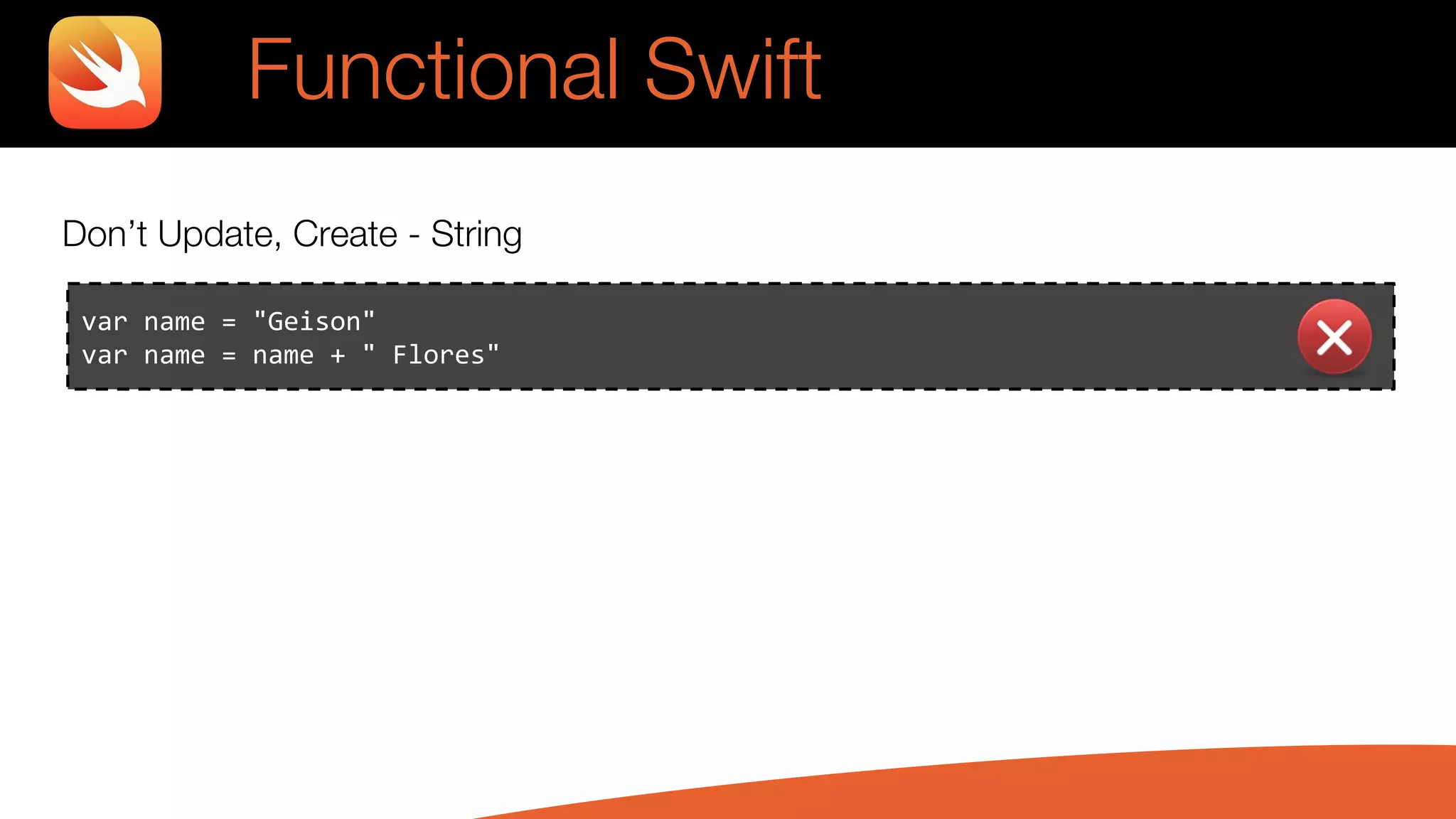
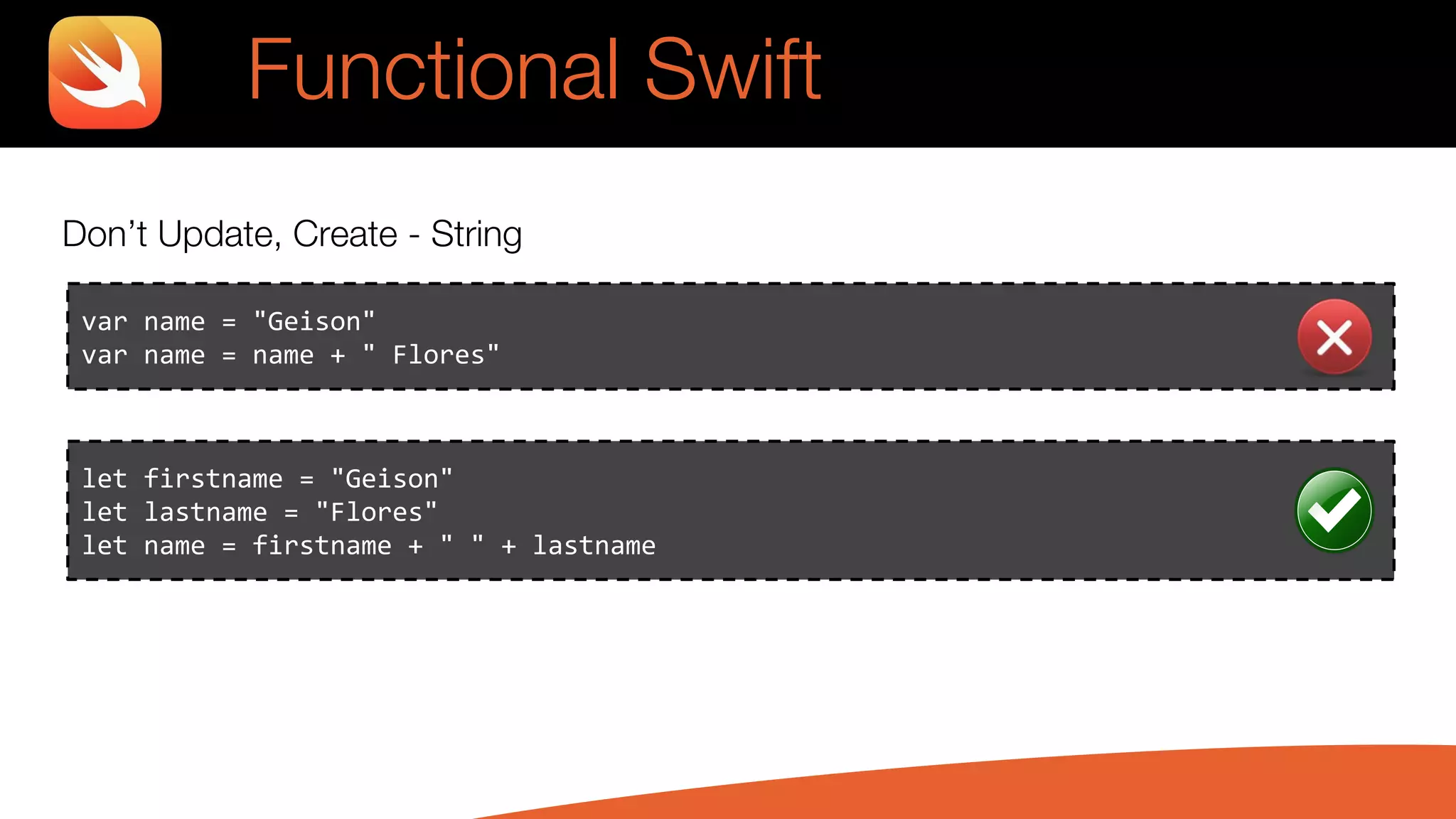
Don’t Update, Create - String
var name = "Geison"
var name = name + " Flores"
Functional Swift
Don’t Update, Create - String
var name = "Geison"
var name = name + " Flores"
let firstname = "Geison"
let lastname = "Flores"
let name = firstname + " " + lastname
Functional Swift
Don’t Update, Create - Arrays
var years: [Int] = [2001, 2002]
years.append(2003)
years.append(2004)
print(years) // [2001, 2002, 2003, 2004]
Functional Swift
Don’t Update, Create - Arrays
var years: [Int] = [2001, 2002]
years.append(2003)
years.append(2004)
print(years) // [2001, 2002, 2003, 2004]
let years: [Int] = [2001, 2001]
let allYears = years + [2003] + [2004, 2005]
print(allYears) // [2001, 2002, 2003, 2004, 2005]
Functional Swift
Don’t Update, Create - Dictionaries
var ages = ["John": 30]
ages["Mary"] = 28
print(ages) // ["Mary": 28, "John": 30]
Functional Swift
Don’t Update, Create - Dictionaries
var ages = ["John": 30]
ages["Mary"] = 28
print(ages) // ["Mary": 28, "John": 30]
Functional Swift
let johnAges = ["John": 30]
let maryAges = ["Mary": 28]
func +<Key, Value> (lhs: [Key: Value], rhs: [Key: Value]) -> [Key: Value] {
var result = lhs
rhs.forEach{ result[$0] = $1 }
return result
}
let ages = johnAges + maryAges
print(ages) // ["Mary": 28, "John": 30]
Higher Order Functions
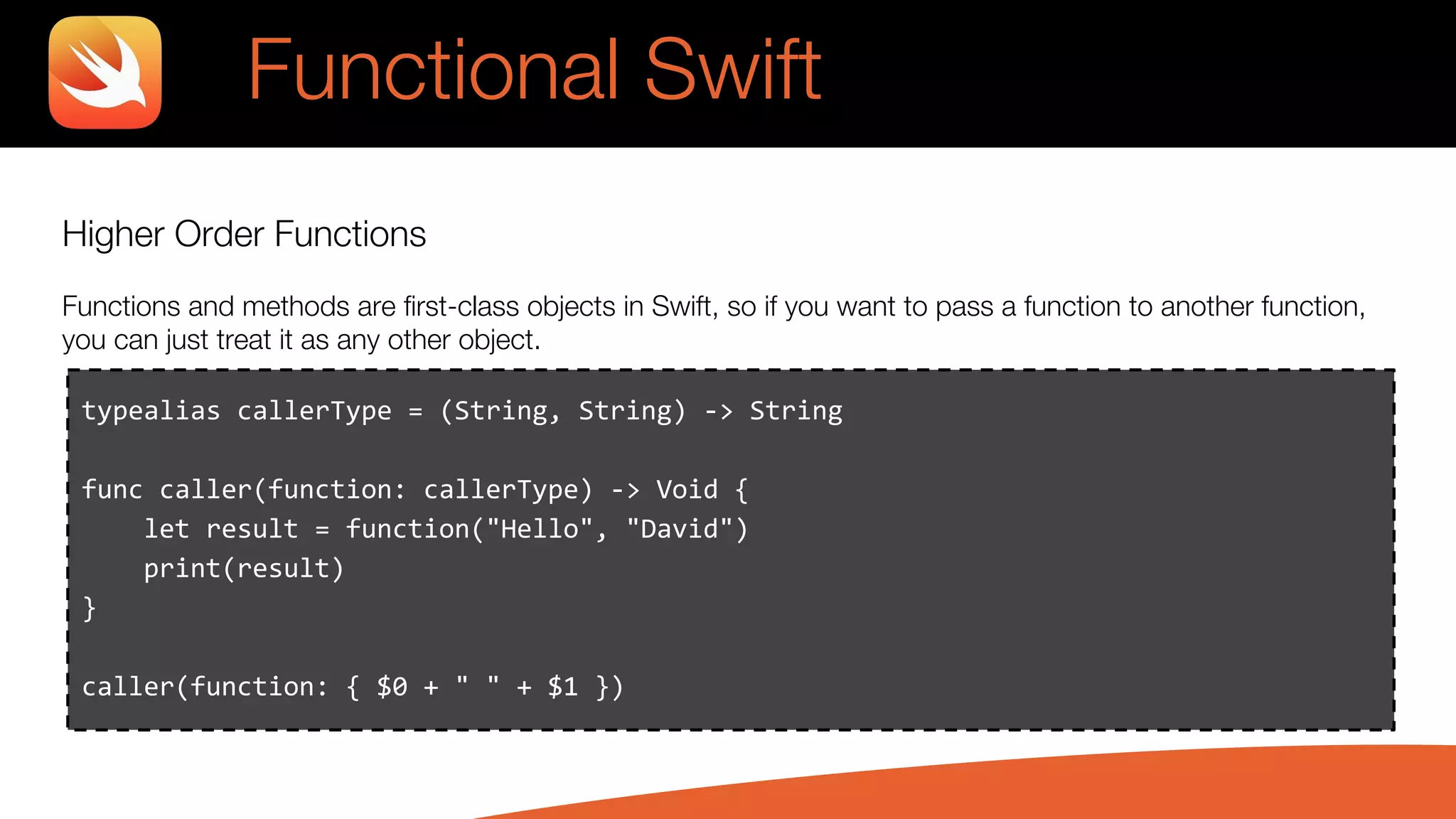
Functions and methods are first-class objects in Swift, so if you want to pass a function to another function,
you can just treat it as any other object.
typealias callerType = (String, String) -> String
func caller(function: callerType) -> Void {
let result = function("Hello", "David")
print(result)
}
caller(function: { $0 + " " + $1 })
Functional Swift
Higher Order Functions - Map
let names = ["milu", "rantanplan"]
let namesInUppercase = names.map { $0.uppercased() }
print(namesInUppercase) //["MILU", "RANTANPLAN"]
Functional Swift
Higher Order Functions - Filter
let numbers = [1, 2, 3, 4, 5, 6, 7, 8, 9, 10]
let oddNumbers = numbers.filter { $0 % 2 != 0 }
print(oddNumbers) //[1, 3, 5, 9]
Functional Swift
Higher Order Functions - Reduce
let numbers = [1, 2, 3, 4, 5]
let total = numbers.reduce(0, +)
print(total) //15
Functional Swift
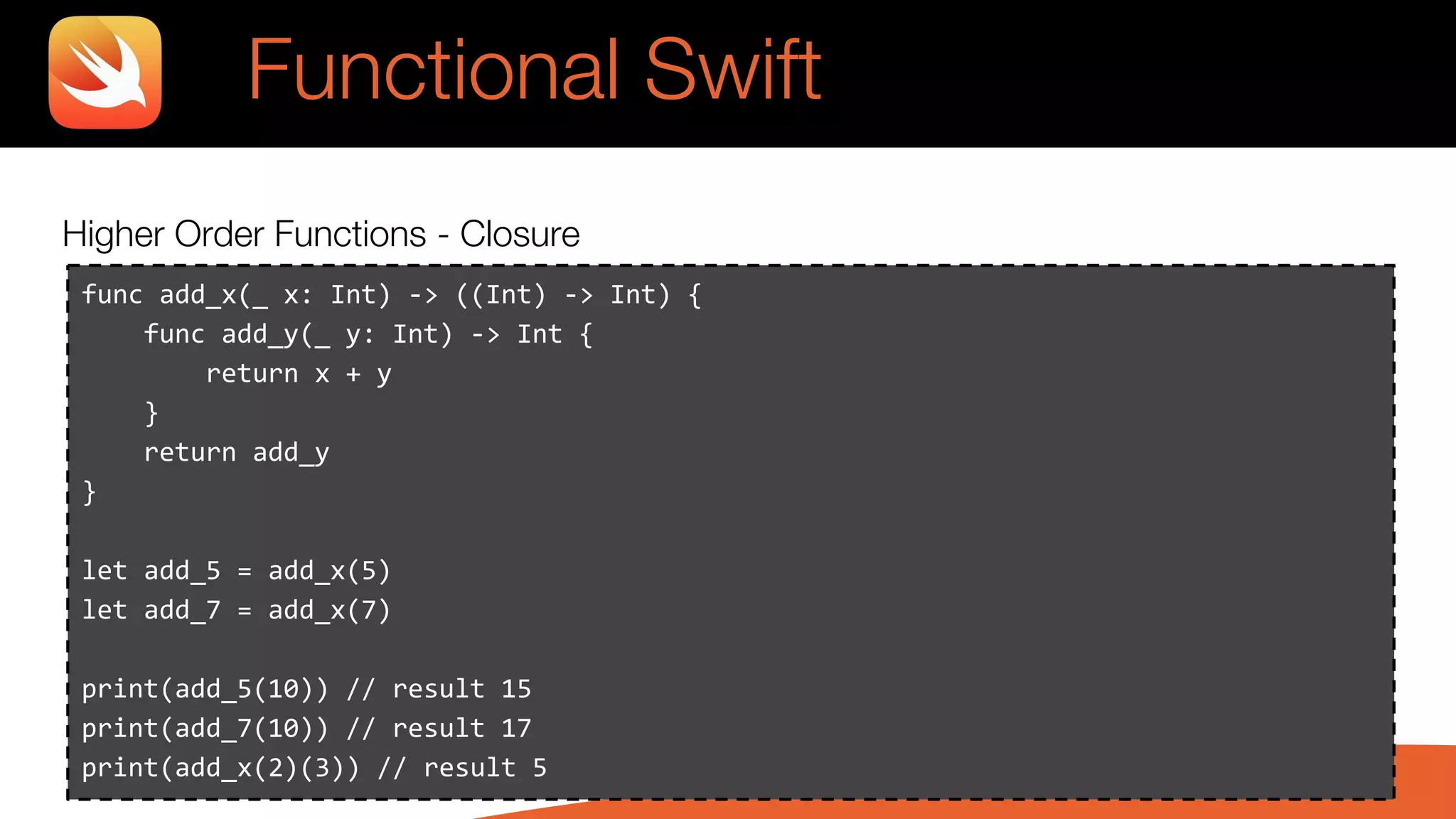
Higher Order Functions - Closure
Functional Swift
func add_x(_ x: Int) -> ((Int) -> Int) {
func add_y(_ y: Int) -> Int {
return x + y
}
return add_y
}
let add_5 = add_x(5)
let add_7 = add_x(7)
print(add_5(10)) // result 15
print(add_7(10)) // result 17
print(add_x(2)(3)) // result 5
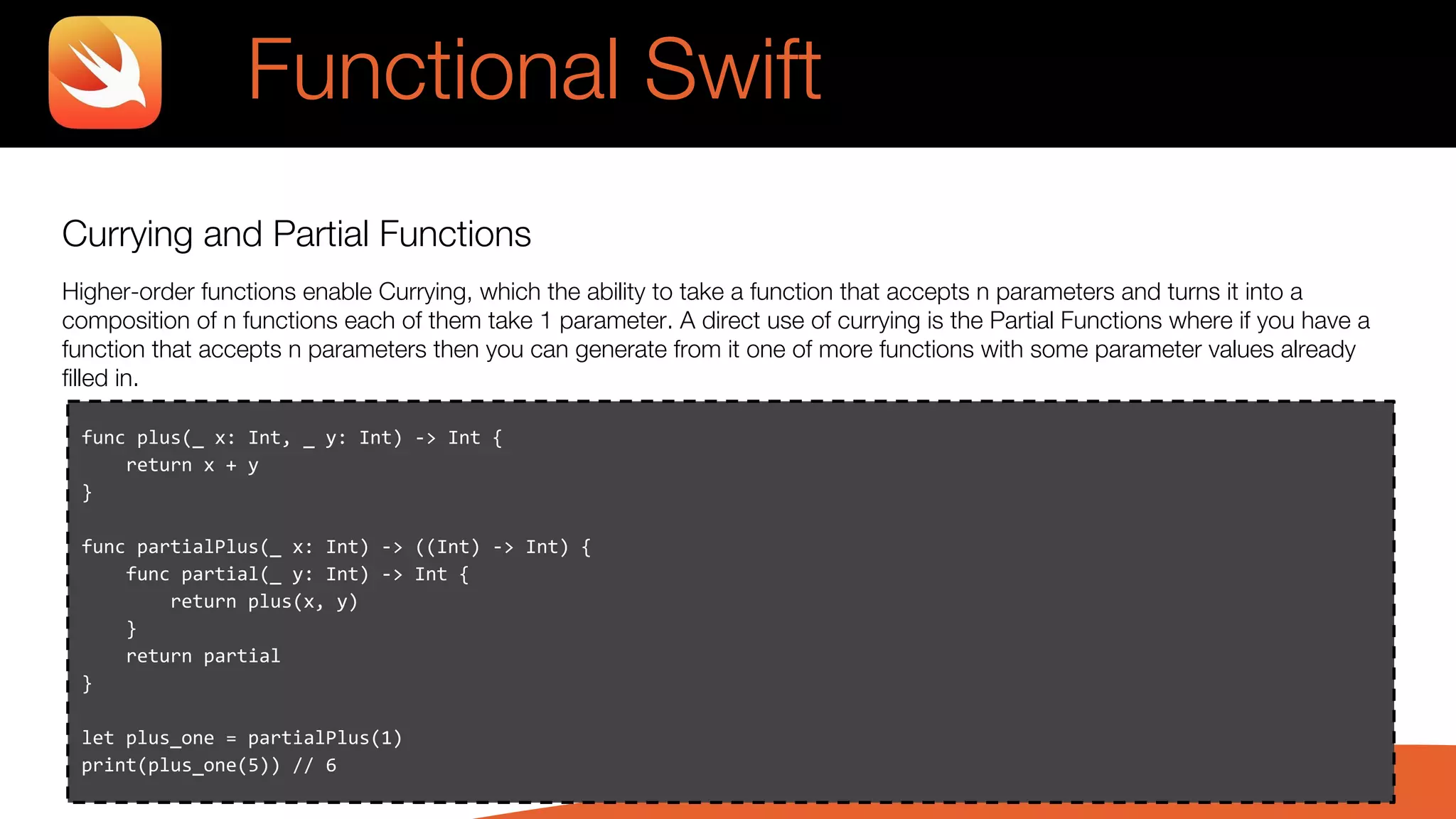
Currying and Partial Functions
Higher-order functions enable Currying, which the ability to take a function that accepts n parameters and turns it into a
composition of n functions each of them take 1 parameter. A direct use of currying is the Partial Functions where if you have a
function that accepts n parameters then you can generate from it one of more functions with some parameter values already
filled in.
Functional Swift
func plus(_ x: Int, _ y: Int) -> Int {
return x + y
}
func partialPlus(_ x: Int) -> ((Int) -> Int) {
func partial(_ y: Int) -> Int {
return plus(x, y)
}
return partial
}
let plus_one = partialPlus(1)
print(plus_one(5)) // 6
Eager vs Lazy Evaluation
Functional Swift
Eager vs Lazy Evaluation
● Eager evaluation: expressions are calculated at the moment that variables is assined, function called...
Functional Swift
Eager vs Lazy Evaluation
● Eager evaluation: expressions are calculated at the moment that variables is assined, function called...
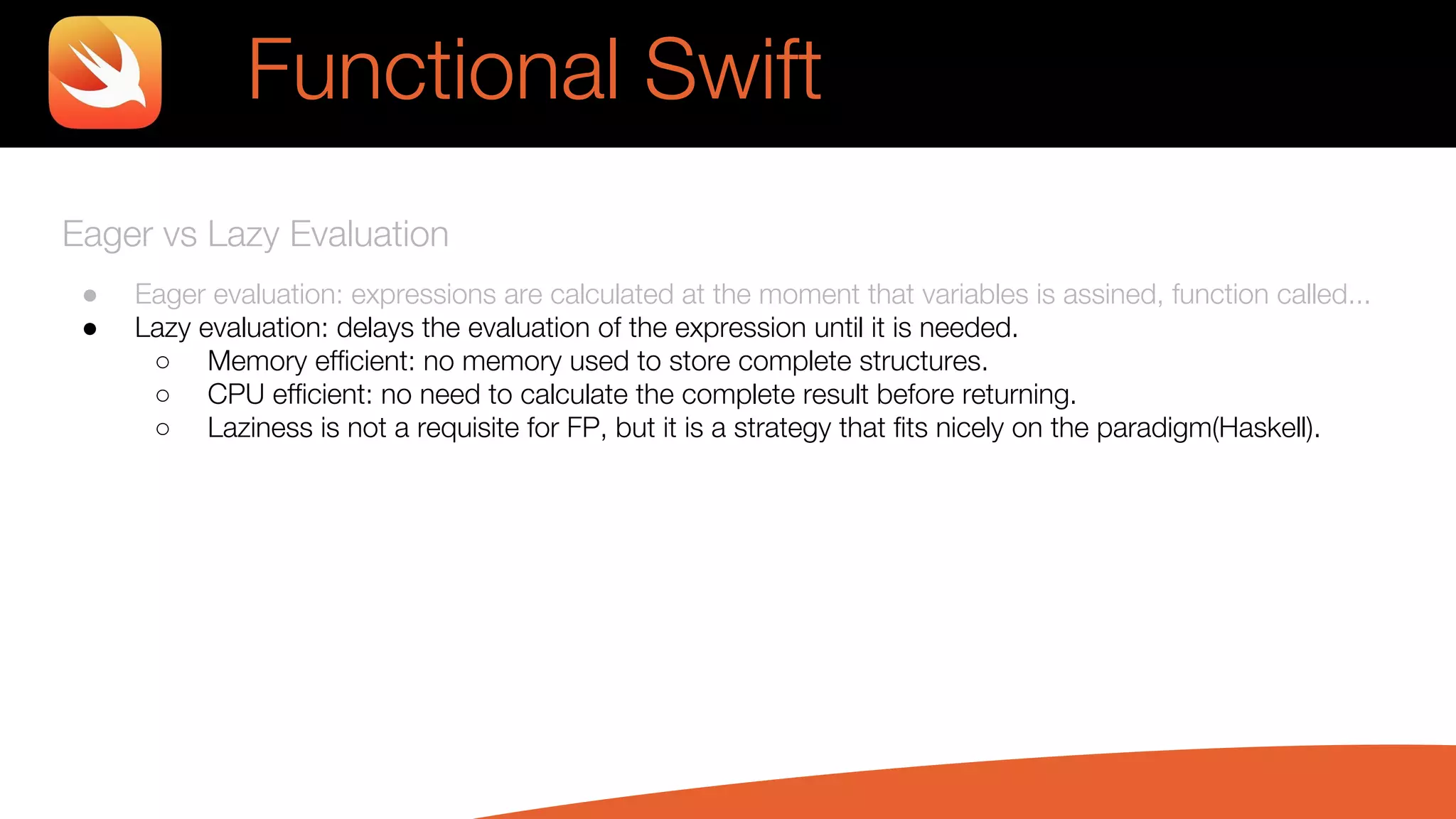
● Lazy evaluation: delays the evaluation of the expression until it is needed.
○ Memory efficient: no memory used to store complete structures.
○ CPU efficient: no need to calculate the complete result before returning.
○ Laziness is not a requisite for FP, but it is a strategy that fits nicely on the paradigm(Haskell).
Functional Swift
Eager vs Lazy Evaluation
● Eager evaluation: expressions are calculated at the moment that variables is assined, function called...
● Lazy evaluation: delays the evaluation of the expression until it is needed.
○ Memory efficient: no memory used to store complete structures.
○ CPU efficient: no need to calculate the complete result before returning.
○ Laziness is not a requisite for FP, but it is a strategy that fits nicely on the paradigm(Haskell).
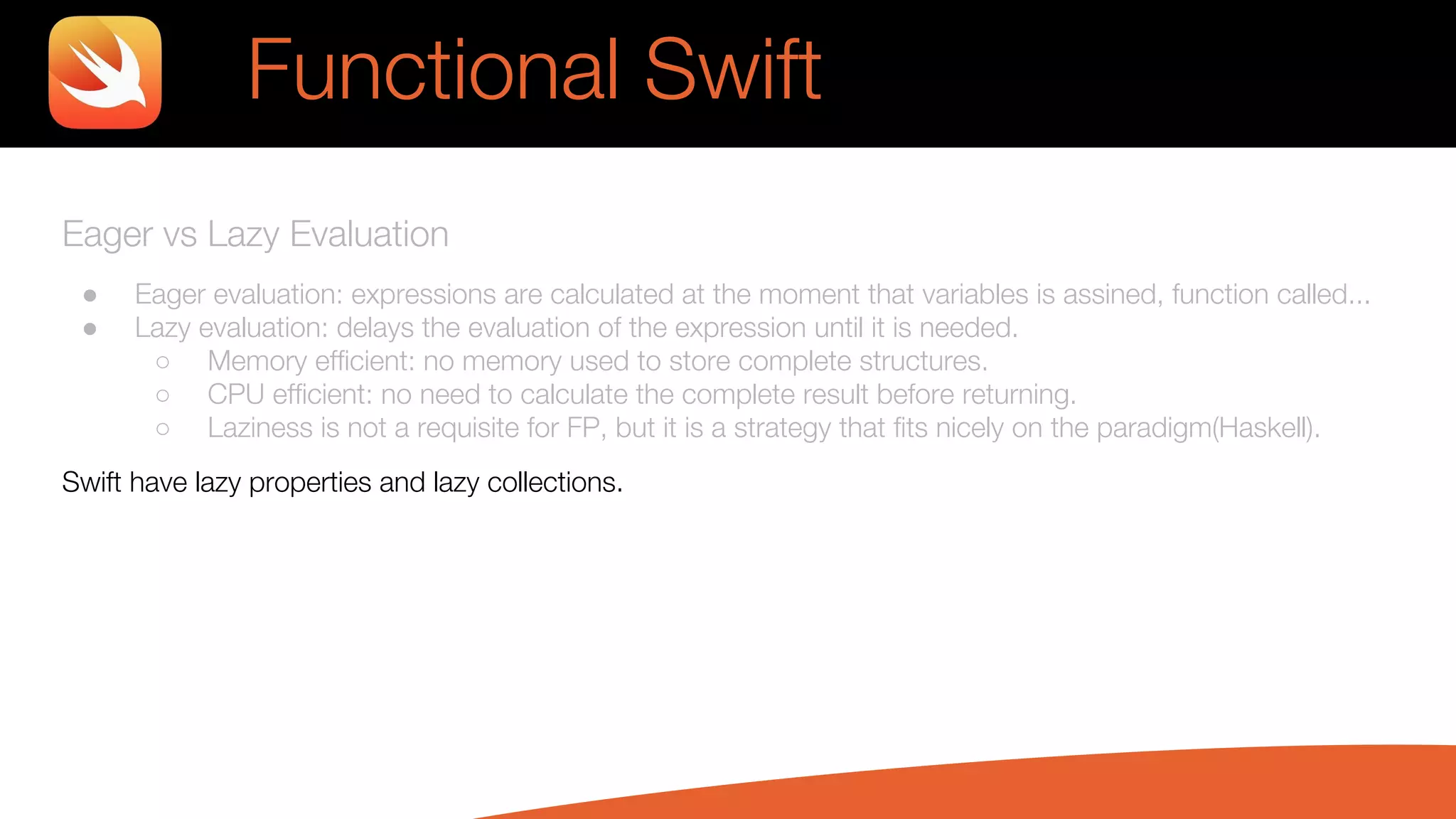
Swift have lazy properties and lazy collections.
Functional Swift
Recursion
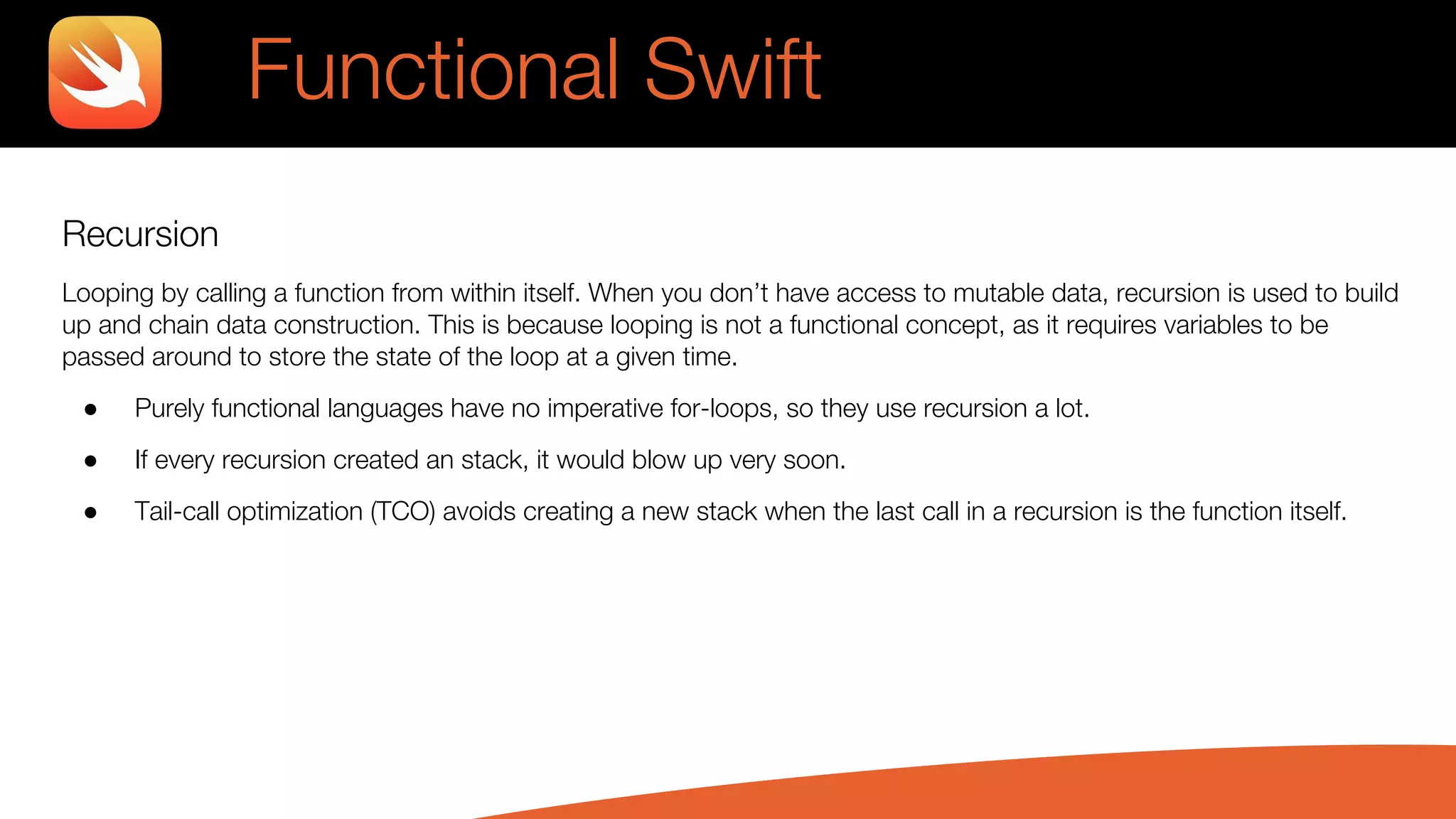
Looping by calling a function from within itself. When you don’t have access to mutable data, recursion is used to build
up and chain data construction. This is because looping is not a functional concept, as it requires variables to be
passed around to store the state of the loop at a given time.
● Purely functional languages have no imperative for-loops, so they use recursion a lot.
● If every recursion created an stack, it would blow up very soon.
● Tail-call optimization (TCO) avoids creating a new stack when the last call in a recursion is the function itself.
Functional Swift
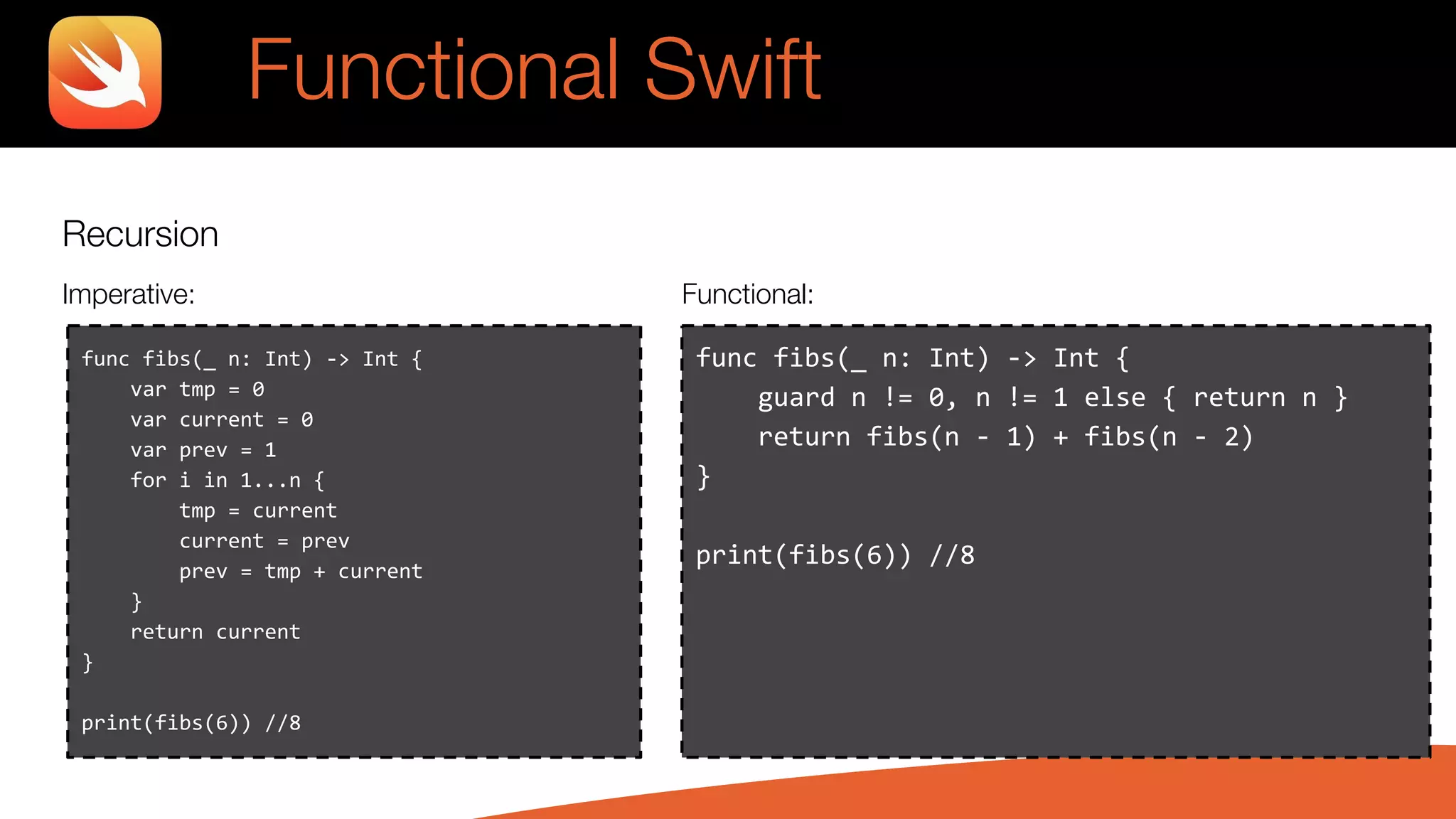
Recursion
Imperative: Functional:
Functional Swift
func fibs(_ n: Int) -> Int {
guard n != 0, n != 1 else { return n }
return fibs(n - 1) + fibs(n - 2)
}
print(fibs(6)) //8
func fibs(_ n: Int) -> Int {
var tmp = 0
var current = 0
var prev = 1
for i in 1...n {
tmp = current
current = prev
prev = tmp + current
}
return current
}
print(fibs(6)) //8
A Pratical Example
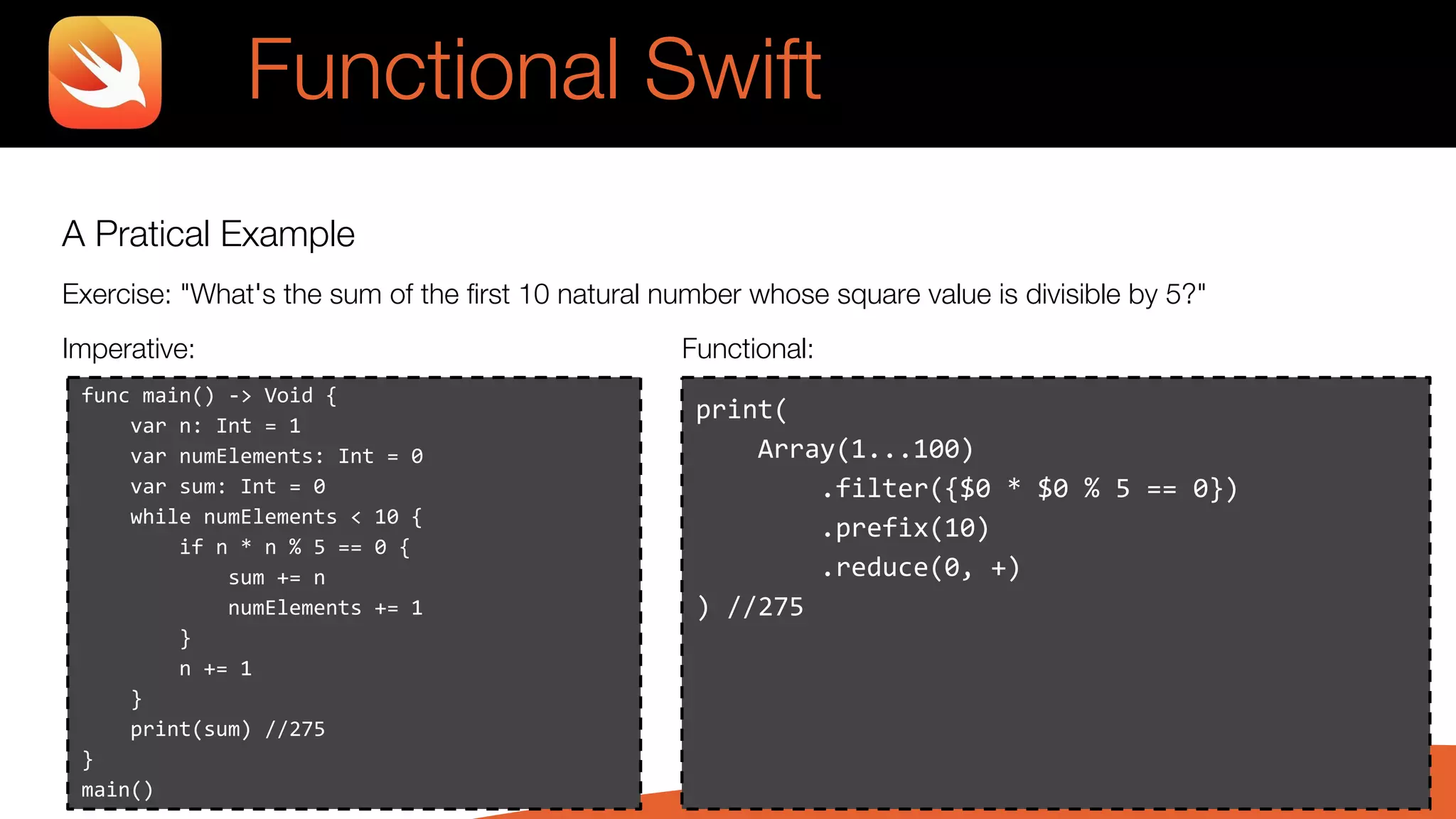
Exercise: "What's the sum of the first 10 natural number whose square value is divisible by 5?"
Imperative: Functional:
Functional Swift
print(
Array(1...100)
.filter({$0 * $0 % 5 == 0})
.prefix(10)
.reduce(0, +)
) //275
func main() -> Void {
var n: Int = 1
var numElements: Int = 0
var sum: Int = 0
while numElements < 10 {
if n * n % 5 == 0 {
sum += n
numElements += 1
}
n += 1
}
print(sum) //275
}
main()
Conclusion
Functional Swift
Conclusion
● As you can see, Swift helps you write in functional style but it doesn’t force you to it.
Functional Swift
Conclusion
● As you can see, Swift helps you write in functional style but it doesn’t force you to it.
● Writing in functional style enhances your code and makes it more self documented. Actually it will make
it more thread-safe also.
Functional Swift
Conclusion
● As you can see, Swift helps you write in functional style but it doesn’t force you to it.
● Writing in functional style enhances your code and makes it more self documented. Actually it will make
it more thread-safe also.
● The main support for FP in Swift comes from the use of closures, pattern matching, lazy evaluation and
generics.
Functional Swift
The last advice
Learn at least one functional language, it will open your mind to a new paradigm becoming you a better
programmer.
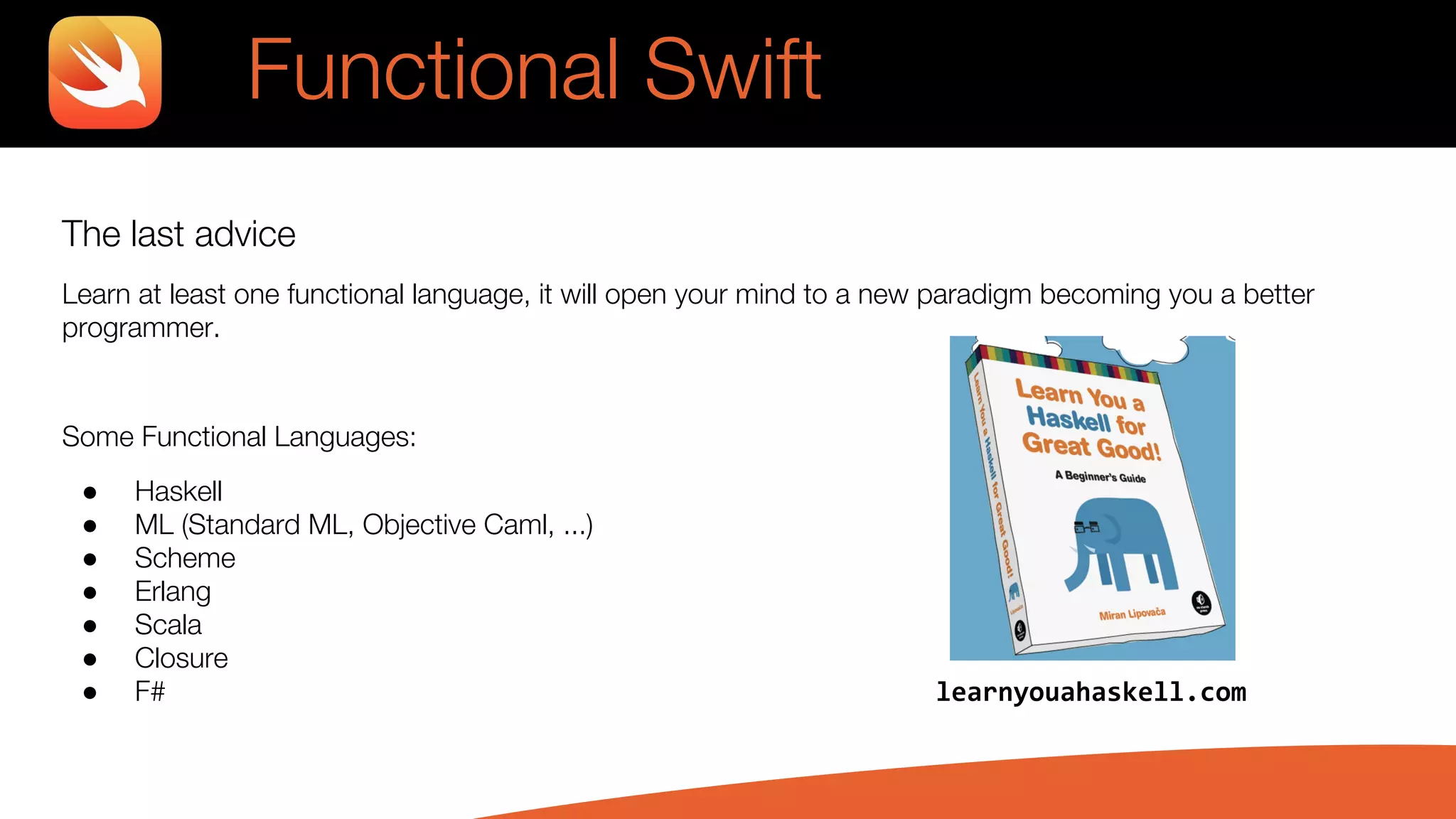
Some Functional Languages:
● Haskell
● ML (Standard ML, Objective Caml, ...)
● Scheme
● Erlang
● Scala
● Closure
● F# learnyouahaskell.com
Functional Swift
Functional Swift
OBRIGADO!
Email: geisonfgf@gmail.com
Skype: geisonfgf
Facebook: http://www.facebook.com/geisonfgf
Twitter: http://www.twitter.com/geisonfgf

Functional Swift

  • 1.
  • 2.
    Geison Goes ● SeniorConsultant na Thoughtworks ● Software Engineer for 12 years ● Husband ● Father ● Dog trainer ● Read more at about.me/geisonfgf
  • 3.
    Functional Swift Functional Programmingby Wikipidia: “Functional programming is a programming paradigm that treats computation as the evaluation of mathematical functions and avoids state and mutable data". In other words, functional programming promotes code with no side effects, no change of value in variables. It oposes to imperative programming, which emphasizes change of state”.
  • 4.
  • 5.
    What this means? ●No mutable data (no side effect). Functional Swift
  • 6.
    What this means? ●No mutable data (no side effect). ● No state (no implicit, hidden state). Once assigned (value binding), a variable (a symbol) does not change its value. Functional Swift
  • 7.
    What this means? ●No mutable data (no side effect). ● No state (no implicit, hidden state). Once assigned (value binding), a variable (a symbol) does not change its value. All state is bad? No, hidden, implicit state is bad. Functional Swift
  • 8.
    What this means? ●No mutable data (no side effect). ● No state (no implicit, hidden state). Once assigned (value binding), a variable (a symbol) does not change its value. All state is bad? No, hidden, implicit state is bad. Functional programming do not eliminate state, it just make it visible and explicit (at least when programmers want it to be). Functional Swift
  • 9.
    What this means? ●No mutable data (no side effect). ● No state (no implicit, hidden state). Once assigned (value binding), a variable (a symbol) does not change its value. All state is bad? No, hidden, implicit state is bad. Functional programming do not eliminate state, it just make it visible and explicit (at least when programmers want it to be). ● Functions are pure functions in the mathematical sense: their output depend only in their inputs, there is not “environment”. Functional Swift
  • 10.
    What this means? ●No mutable data (no side effect). ● No state (no implicit, hidden state). Once assigned (value binding), a variable (a symbol) does not change its value. All state is bad? No, hidden, implicit state is bad. Functional programming do not eliminate state, it just make it visible and explicit (at least when programmers want it to be). ● Functions are pure functions in the mathematical sense: their output depend only in their inputs, there is not “environment”. ● Same result returned by functions called with the same inputs. Functional Swift
  • 11.
    What are theadvantages? Functional Swift
  • 12.
    What are theadvantages? ● Cleaner code: "variables" are not modified once defined, so we don't have to follow the change of state to comprehend what a function, a, method, a class, a whole project works. Functional Swift
  • 13.
    What are theadvantages? ● Cleaner code: "variables" are not modified once defined, so we don't have to follow the change of state to comprehend what a function, a, method, a class, a whole project works. ● Referential transparency: Expressions can be replaced by its values. If we call a function with the same parameters, we know for sure the output will be the same (there is no state anywhere that would change it). Functional Swift
  • 14.
    What are theadvantages? ● Cleaner code: "variables" are not modified once defined, so we don't have to follow the change of state to comprehend what a function, a, method, a class, a whole project works. ● Referential transparency: Expressions can be replaced by its values. If we call a function with the same parameters, we know for sure the output will be the same (there is no state anywhere that would change it). There is a reason for which Einstein defined insanity as "doing the same thing over and over again and expecting different results". Functional Swift
  • 15.
    Advantages enabled byreferential transparency Functional Swift
  • 16.
    Advantages enabled byreferential transparency ● Memoization ○ Cache results for previous function calls. Functional Swift
  • 17.
    Advantages enabled byreferential transparency ● Memoization ○ Cache results for previous function calls. ● Idempotence ○ Same results regardless how many times you call a function. Functional Swift
  • 18.
    Advantages enabled byreferential transparency ● Memoization ○ Cache results for previous function calls. ● Idempotence ○ Same results regardless how many times you call a function. ● Modularization ○ We have no state that pervades the whole code, so we build our project with small, black boxes that we tie together, so it promotes bottom-up programming. Functional Swift
  • 19.
    Advantages enabled byreferential transparency ● Memoization ○ Cache results for previous function calls. ● Idempotence ○ Same results regardless how many times you call a function. ● Modularization ○ We have no state that pervades the whole code, so we build our project with small, black boxes that we tie together, so it promotes bottom-up programming. ● Ease of debugging ○ Functions are isolated, they only depend on their input and their output, so they are very easy to debug. Functional Swift
  • 20.
    Advantages enabled byreferential transparency ● Parallelization ○ Functions calls are independent. ○ We can parallelize in different process/CPUs/computers/… Functional Swift
  • 21.
    Advantages enabled byreferential transparency ● Parallelization ○ Functions calls are independent. ○ We can parallelize in different process/CPUs/computers/… We can execute func1 and func2 in parallel because a won’t be modified. let result = func1(a, b) + func2(a, c) Functional Swift
  • 22.
    Advantages enabled byreferential transparency ● Concurrence a. With no shared data, concurrence gets a lot simpler: i. No semaphores. ii. No monitors. iii. No locks. iv. No race-conditions. v. No dead-locks. Functional Swift
  • 23.
  • 24.
    Immutable Objects ● AnOO pattern that was originated in FP world. Functional Swift
  • 25.
    Immutable Objects ● AnOO pattern that was originated in FP world. ● When changing a data structure, don’t modify in place but create a new object. Functional Swift
  • 26.
    Immutable Objects ● AnOO pattern that was originated in FP world. ● When changing a data structure, don’t modify in place but create a new object. ● Name Mutating/nonmutating method pairs consistently. A mutating method will often have a nonmutating variant with similar semantics, but that returns a new value rather than updating an instance in-place. Functional Swift
  • 27.
    Immutable Objects ● AnOO pattern that was originated in FP world. ● When changing a data structure, don’t modify in place but create a new object. ● Name Mutating/nonmutating method pairs consistently. A mutating method will often have a nonmutating variant with similar semantics, but that returns a new value rather than updating an instance in-place. ○ When the operation is naturally described by a verb, use the verb’s imperative for the mutating method and apply the “ed” or “ing” suffix to name its nonmutating counterpart. Functional Swift
  • 28.
    Functional Swift Ok solet's play a little with functional programming?
  • 29.
    Don’t Update, Create- String var name = "Geison" var name = name + " Flores" Functional Swift
  • 30.
    Don’t Update, Create- String var name = "Geison" var name = name + " Flores" let firstname = "Geison" let lastname = "Flores" let name = firstname + " " + lastname Functional Swift
  • 31.
    Don’t Update, Create- Arrays var years: [Int] = [2001, 2002] years.append(2003) years.append(2004) print(years) // [2001, 2002, 2003, 2004] Functional Swift
  • 32.
    Don’t Update, Create- Arrays var years: [Int] = [2001, 2002] years.append(2003) years.append(2004) print(years) // [2001, 2002, 2003, 2004] let years: [Int] = [2001, 2001] let allYears = years + [2003] + [2004, 2005] print(allYears) // [2001, 2002, 2003, 2004, 2005] Functional Swift
  • 33.
    Don’t Update, Create- Dictionaries var ages = ["John": 30] ages["Mary"] = 28 print(ages) // ["Mary": 28, "John": 30] Functional Swift
  • 34.
    Don’t Update, Create- Dictionaries var ages = ["John": 30] ages["Mary"] = 28 print(ages) // ["Mary": 28, "John": 30] Functional Swift let johnAges = ["John": 30] let maryAges = ["Mary": 28] func +<Key, Value> (lhs: [Key: Value], rhs: [Key: Value]) -> [Key: Value] { var result = lhs rhs.forEach{ result[$0] = $1 } return result } let ages = johnAges + maryAges print(ages) // ["Mary": 28, "John": 30]
  • 35.
    Higher Order Functions Functionsand methods are first-class objects in Swift, so if you want to pass a function to another function, you can just treat it as any other object. typealias callerType = (String, String) -> String func caller(function: callerType) -> Void { let result = function("Hello", "David") print(result) } caller(function: { $0 + " " + $1 }) Functional Swift
  • 36.
    Higher Order Functions- Map let names = ["milu", "rantanplan"] let namesInUppercase = names.map { $0.uppercased() } print(namesInUppercase) //["MILU", "RANTANPLAN"] Functional Swift
  • 37.
    Higher Order Functions- Filter let numbers = [1, 2, 3, 4, 5, 6, 7, 8, 9, 10] let oddNumbers = numbers.filter { $0 % 2 != 0 } print(oddNumbers) //[1, 3, 5, 9] Functional Swift
  • 38.
    Higher Order Functions- Reduce let numbers = [1, 2, 3, 4, 5] let total = numbers.reduce(0, +) print(total) //15 Functional Swift
  • 39.
    Higher Order Functions- Closure Functional Swift func add_x(_ x: Int) -> ((Int) -> Int) { func add_y(_ y: Int) -> Int { return x + y } return add_y } let add_5 = add_x(5) let add_7 = add_x(7) print(add_5(10)) // result 15 print(add_7(10)) // result 17 print(add_x(2)(3)) // result 5
  • 40.
    Currying and PartialFunctions Higher-order functions enable Currying, which the ability to take a function that accepts n parameters and turns it into a composition of n functions each of them take 1 parameter. A direct use of currying is the Partial Functions where if you have a function that accepts n parameters then you can generate from it one of more functions with some parameter values already filled in. Functional Swift func plus(_ x: Int, _ y: Int) -> Int { return x + y } func partialPlus(_ x: Int) -> ((Int) -> Int) { func partial(_ y: Int) -> Int { return plus(x, y) } return partial } let plus_one = partialPlus(1) print(plus_one(5)) // 6
  • 41.
    Eager vs LazyEvaluation Functional Swift
  • 42.
    Eager vs LazyEvaluation ● Eager evaluation: expressions are calculated at the moment that variables is assined, function called... Functional Swift
  • 43.
    Eager vs LazyEvaluation ● Eager evaluation: expressions are calculated at the moment that variables is assined, function called... ● Lazy evaluation: delays the evaluation of the expression until it is needed. ○ Memory efficient: no memory used to store complete structures. ○ CPU efficient: no need to calculate the complete result before returning. ○ Laziness is not a requisite for FP, but it is a strategy that fits nicely on the paradigm(Haskell). Functional Swift
  • 44.
    Eager vs LazyEvaluation ● Eager evaluation: expressions are calculated at the moment that variables is assined, function called... ● Lazy evaluation: delays the evaluation of the expression until it is needed. ○ Memory efficient: no memory used to store complete structures. ○ CPU efficient: no need to calculate the complete result before returning. ○ Laziness is not a requisite for FP, but it is a strategy that fits nicely on the paradigm(Haskell). Swift have lazy properties and lazy collections. Functional Swift
  • 45.
    Recursion Looping by callinga function from within itself. When you don’t have access to mutable data, recursion is used to build up and chain data construction. This is because looping is not a functional concept, as it requires variables to be passed around to store the state of the loop at a given time. ● Purely functional languages have no imperative for-loops, so they use recursion a lot. ● If every recursion created an stack, it would blow up very soon. ● Tail-call optimization (TCO) avoids creating a new stack when the last call in a recursion is the function itself. Functional Swift
  • 46.
    Recursion Imperative: Functional: Functional Swift funcfibs(_ n: Int) -> Int { guard n != 0, n != 1 else { return n } return fibs(n - 1) + fibs(n - 2) } print(fibs(6)) //8 func fibs(_ n: Int) -> Int { var tmp = 0 var current = 0 var prev = 1 for i in 1...n { tmp = current current = prev prev = tmp + current } return current } print(fibs(6)) //8
  • 47.
    A Pratical Example Exercise:"What's the sum of the first 10 natural number whose square value is divisible by 5?" Imperative: Functional: Functional Swift print( Array(1...100) .filter({$0 * $0 % 5 == 0}) .prefix(10) .reduce(0, +) ) //275 func main() -> Void { var n: Int = 1 var numElements: Int = 0 var sum: Int = 0 while numElements < 10 { if n * n % 5 == 0 { sum += n numElements += 1 } n += 1 } print(sum) //275 } main()
  • 48.
  • 49.
    Conclusion ● As youcan see, Swift helps you write in functional style but it doesn’t force you to it. Functional Swift
  • 50.
    Conclusion ● As youcan see, Swift helps you write in functional style but it doesn’t force you to it. ● Writing in functional style enhances your code and makes it more self documented. Actually it will make it more thread-safe also. Functional Swift
  • 51.
    Conclusion ● As youcan see, Swift helps you write in functional style but it doesn’t force you to it. ● Writing in functional style enhances your code and makes it more self documented. Actually it will make it more thread-safe also. ● The main support for FP in Swift comes from the use of closures, pattern matching, lazy evaluation and generics. Functional Swift
  • 52.
    The last advice Learnat least one functional language, it will open your mind to a new paradigm becoming you a better programmer. Some Functional Languages: ● Haskell ● ML (Standard ML, Objective Caml, ...) ● Scheme ● Erlang ● Scala ● Closure ● F# learnyouahaskell.com Functional Swift
  • 53.
    Functional Swift OBRIGADO! Email: geisonfgf@gmail.com Skype:geisonfgf Facebook: http://www.facebook.com/geisonfgf Twitter: http://www.twitter.com/geisonfgf