Functional Programming
Idea 
• Restricted sense, a functional programming 
language is one which does not have mutable 
variables, assignments, or imperative control 
structures. 
• Wider sense, a functional programming 
language enables the construction of elegant 
programs that focus on functions. So it will be 
easier to be distributed
High-order funtion 
• Function 
– as paramters 
– as result 
=> Currying : f(x,y) => z = g(x)(y) => z
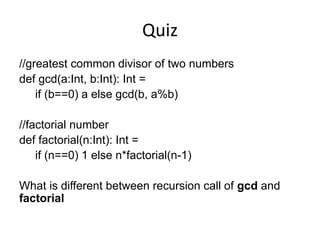
Quiz 
//greatest common divisor of two numbers 
def gcd(a:Int, b:Int): Int = 
if (b==0) a else gcd(b, a%b) 
//factorial number 
def factorial(n:Int): Int = 
if (n==0) 1 else n*factorial(n-1) 
What is different between recursion call of gcd and 
factorial
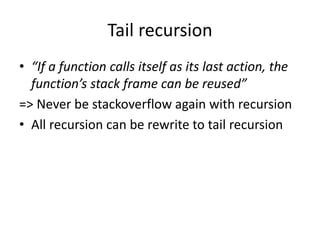
Tail recursion 
• “If a function calls itself as its last action, the 
function’s stack frame can be reused” 
=> Never be stackoverflow again with recursion 
• All recursion can be rewrite to tail recursion
Exercise 1 
• Rewrite factorial as tail-recursion
Think about loop in different way 
• Basically for loop = f(c) with c is a collection
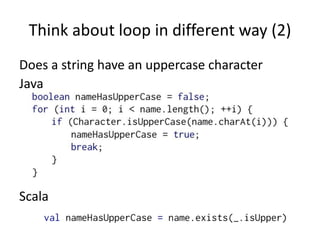
Think about loop in different way (2) 
Does a string have an uppercase character 
Java 
Scala
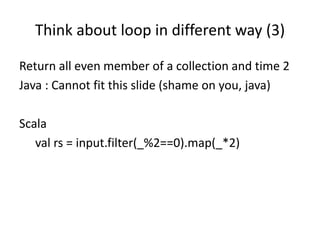
Think about loop in different way (3) 
Return all even member of a collection and time 2 
Java : Cannot fit this slide (shame on you, java) 
Scala 
val rs = input.filter(_%2==0).map(_*2)
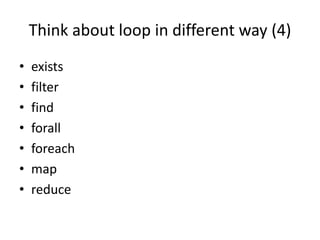
Think about loop in different way (4) 
• exists 
• filter 
• find 
• forall 
• foreach 
• map 
• reduce

Functional programming

  • 1.
  • 2.
    Idea • Restrictedsense, a functional programming language is one which does not have mutable variables, assignments, or imperative control structures. • Wider sense, a functional programming language enables the construction of elegant programs that focus on functions. So it will be easier to be distributed
  • 3.
    High-order funtion •Function – as paramters – as result => Currying : f(x,y) => z = g(x)(y) => z
  • 4.
    Quiz //greatest commondivisor of two numbers def gcd(a:Int, b:Int): Int = if (b==0) a else gcd(b, a%b) //factorial number def factorial(n:Int): Int = if (n==0) 1 else n*factorial(n-1) What is different between recursion call of gcd and factorial
  • 5.
    Tail recursion •“If a function calls itself as its last action, the function’s stack frame can be reused” => Never be stackoverflow again with recursion • All recursion can be rewrite to tail recursion
  • 6.
    Exercise 1 •Rewrite factorial as tail-recursion
  • 7.
    Think about loopin different way • Basically for loop = f(c) with c is a collection
  • 8.
    Think about loopin different way (2) Does a string have an uppercase character Java Scala
  • 9.
    Think about loopin different way (3) Return all even member of a collection and time 2 Java : Cannot fit this slide (shame on you, java) Scala val rs = input.filter(_%2==0).map(_*2)
  • 10.
    Think about loopin different way (4) • exists • filter • find • forall • foreach • map • reduce

Editor's Notes

  • #7 def factorial(n:Int): Int = { def loop(acc:Int, n:Int): Int = if (n == 0) acc else loop(acc * n, n – 1) loop(1, n) }