Download as PDF, PPTX

![What's Functional Programing?
In computer science, functional programming is a programming
paradigm that treats computation as the evaluation of mathematical
functions and avoids changing-state and mutable data. [1]
[1] Wikipedia - Functional Programining](https://image.slidesharecdn.com/sharingsection-afewfunctionalprogramingprinciples-170312003046/85/Functional-Programing-Principles-4-320.jpg)
![What's Functional Programing?
What's programing paradigm?
A style of building the structure and elements of computer programs.
Common paradiagm includes [1]:
Imperative
Declarative
Object-oriented
Functional
Note: Paradigm can overlap or can be used w/ each other.
[1] Definition of Programing Paradigms](https://image.slidesharecdn.com/sharingsection-afewfunctionalprogramingprinciples-170312003046/85/Functional-Programing-Principles-5-320.jpg)
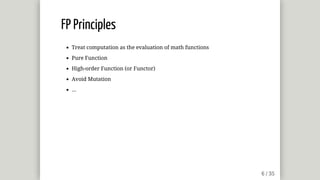
![FP Principles
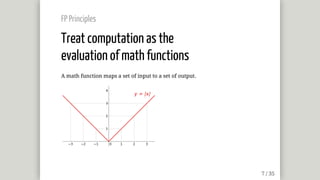
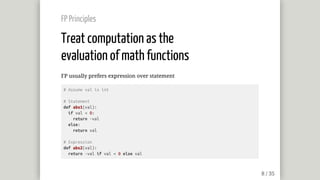
Treat computation as the
evaluation of math functions
FP usually prefers recursion over iteration
# Iteration - Procedural Style
def sum1(nums):
total = 0
for num in nums:
total += num
return total
# Recursion - Functional Style
def sum2(nums):
# Not very efficient in Python but you got the idea
return 0 if len(nums) == 0 else nums[0] + sum2(nums[1:])](https://image.slidesharecdn.com/sharingsection-afewfunctionalprogramingprinciples-170312003046/85/Functional-Programing-Principles-11-320.jpg)
![FP Principles
Treat computation as the
evaluation of math functions
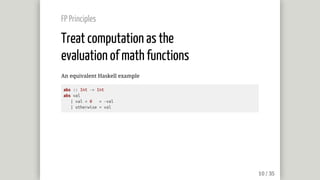
An equivalent Haskell example
sum :: [Int] -> Int
sum nums = case nums of
[] -> 0
x:xs -> x + sum2 xs](https://image.slidesharecdn.com/sharingsection-afewfunctionalprogramingprinciples-170312003046/85/Functional-Programing-Principles-12-320.jpg)
![FP Principles
Pure Function
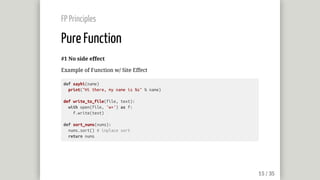
#1 No side effect
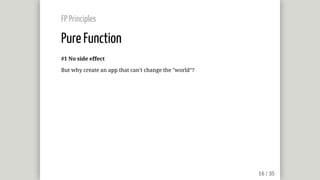
But why create an app that can't change the "world"?
In practice, applications need to have some side effects. Simon
Peyton-Jones, a major contributor to the functional programming
language Haskell, said the following: "In the end, any program must
manipulate state. A program that has no side effects whatsoever is a
kind of black box. All you can tell is that the box gets hotter." The key
is to limit side effects, clearly identify them, and avoid scattering
them throughout the code. [1]
[1] Why are side-effects considered evil in functional programming?](https://image.slidesharecdn.com/sharingsection-afewfunctionalprogramingprinciples-170312003046/85/Functional-Programing-Principles-17-320.jpg)
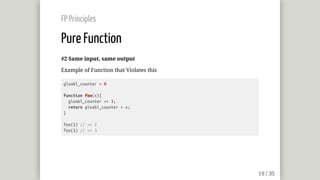
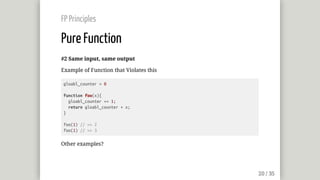
![FP Principles
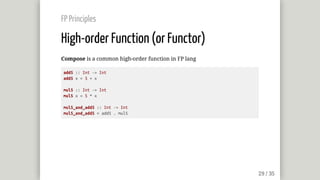
High-order Function (or Functor)
Example: A function that takes another function as input
nums = [1,2,3]
map(lambda x: x*2, nums)
# => [2,4,6]
filter(lambda x: x % 2 == 0, nums)
# => [2]
reduce(lambda total, num: total * num, nums)
# => 6](https://image.slidesharecdn.com/sharingsection-afewfunctionalprogramingprinciples-170312003046/85/Functional-Programing-Principles-22-320.jpg)
![FP Principles
High-order Function (or Functor)
Example: A function that returns a function as output
dirs = ['lib', 'bin', 'log']
# `functools` is a built-in Python module
# `functools.partial` return a partial-applied func
func = functools.partial(os.path.join, '/User/jason')
map(func, dirs)
# => ['/User/jason/lib', '/User/jason/bin', '/User/jason/log']](https://image.slidesharecdn.com/sharingsection-afewfunctionalprogramingprinciples-170312003046/85/Functional-Programing-Principles-23-320.jpg)
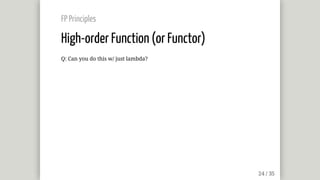
![FP Principles
High-order Function (or Functor)
Q: Can you do this w/ just lambda?
map(lambda dirname: os.path.join('/User/jason', dirname), dirs)
# => ['/User/jason/lib', '/User/jason/bin', '/User/jason/log']](https://image.slidesharecdn.com/sharingsection-afewfunctionalprogramingprinciples-170312003046/85/Functional-Programing-Principles-25-320.jpg)
![FP Principles
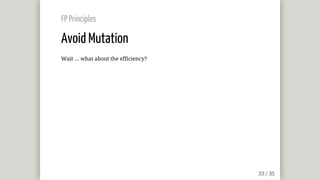
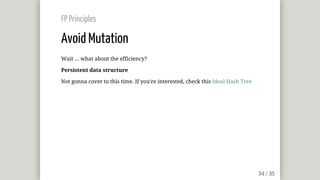
Avoid Mutation
[1,2,3] -> [1,2,42]](https://image.slidesharecdn.com/sharingsection-afewfunctionalprogramingprinciples-170312003046/85/Functional-Programing-Principles-30-320.jpg)
![FP Principles
Avoid Mutation
[1,2,3] -> [1,2,42]
Example: Mutation
def change(arr, idx, new_val):
arr[idx] = new_val
return arr](https://image.slidesharecdn.com/sharingsection-afewfunctionalprogramingprinciples-170312003046/85/Functional-Programing-Principles-31-320.jpg)
![FP Principles
Avoid Mutation
[1,2,3] -> [1,2,42]
Example: Mutation
def change(arr, idx, new_val):
arr[idx] = new_val
return arr
Example: No Mutation
def change(arr, idx, new_val):
return arr[:idx] + [new_val] + arr[idx+1:]
change([1,2,3], 2, 42)
# => [1,2,42]](https://image.slidesharecdn.com/sharingsection-afewfunctionalprogramingprinciples-170312003046/85/Functional-Programing-Principles-32-320.jpg)

The document discusses key principles of functional programming, emphasizing its paradigm that focuses on treating computation as mathematical function evaluation, using pure functions, higher-order functions, and avoiding mutable state. It contrasts functional programming with other paradigms and provides examples in Python and Haskell to illustrate concepts. Additional references and reading materials related to functional programming are also mentioned.


