Introduction to
Priority Queues
Priorityqueues are a fundamental data structure that allow efficient
insertion and retrieval of the highest (or lowest) priority element. They are
widely used in real-time applications where time-sensitive tasks must be
handled with utmost urgency.
by Abhimanyu Mahato
2.
Definition and KeyCharacteristics
Definition
A priority queue is an abstract data
type that stores elements and their
associated priorities. The highest
(or lowest) priority element is
always accessible and can be
efficiently removed.
Key Characteristics
Prioritized insertion, efficient
retrieval of highest/lowest priority,
and maintenance of priority order
are the core features of a priority
queue.
Applications
Priority queues are used in areas
like CPU task scheduling, event-
driven simulations, Dijkstra's
algorithm, and more.
3.
Real-Time Applications of
PriorityQueues
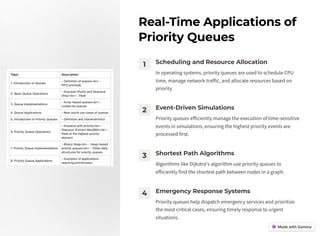
1 Scheduling and Resource Allocation
In operating systems, priority queues are used to schedule CPU
time, manage network traffic, and allocate resources based on
priority.
2 Event-Driven Simulations
Priority queues efficiently manage the execution of time-sensitive
events in simulations, ensuring the highest priority events are
processed first.
3 Shortest Path Algorithms
Algorithms like Dijkstra's algorithm use priority queues to
efficiently find the shortest path between nodes in a graph.
4 Emergency Response Systems
Priority queues help dispatch emergency services and prioritize
the most critical cases, ensuring timely response to urgent
situations.
4.
Implementing Priority Queues
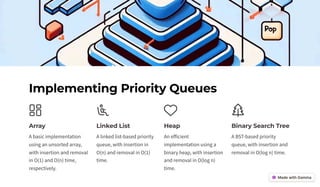
Array
Abasic implementation
using an unsorted array,
with insertion and removal
in O(1) and O(n) time,
respectively.
Linked List
A linked list-based priority
queue, with insertion in
O(n) and removal in O(1)
time.
Heap
An efficient
implementation using a
binary heap, with insertion
and removal in O(log n)
time.
Binary Search Tree
A BST-based priority
queue, with insertion and
removal in O(log n) time.
5.
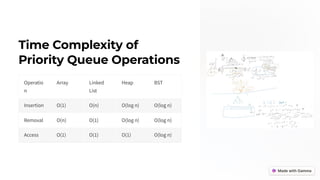
Time Complexity of
PriorityQueue Operations
Operatio
n
Array Linked
List
Heap BST
Insertion O(1) O(n) O(log n) O(log n)
Removal O(n) O(1) O(log n) O(log n)
Access O(1) O(1) O(1) O(log n)
6.
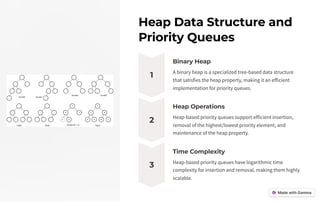
Heap Data Structureand
Priority Queues
1
Binary Heap
A binary heap is a specialized tree-based data structure
that satisfies the heap property, making it an efficient
implementation for priority queues.
2
Heap Operations
Heap-based priority queues support efficient insertion,
removal of the highest/lowest priority element, and
maintenance of the heap property.
3
Time Complexity
Heap-based priority queues have logarithmic time
complexity for insertion and removal, making them highly
scalable.
7.
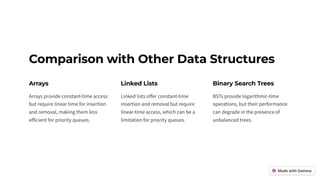
Comparison with OtherData Structures
Arrays
Arrays provide constant-time access
but require linear time for insertion
and removal, making them less
efficient for priority queues.
Linked Lists
Linked lists offer constant-time
insertion and removal but require
linear-time access, which can be a
limitation for priority queues.
Binary Search Trees
BSTs provide logarithmic-time
operations, but their performance
can degrade in the presence of
unbalanced trees.
8.
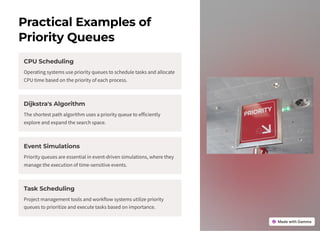
Practical Examples of
PriorityQueues
CPU Scheduling
Operating systems use priority queues to schedule tasks and allocate
CPU time based on the priority of each process.
Dijkstra's Algorithm
The shortest path algorithm uses a priority queue to efficiently
explore and expand the search space.
Event Simulations
Priority queues are essential in event-driven simulations, where they
manage the execution of time-sensitive events.
Task Scheduling
Project management tools and workflow systems utilize priority
queues to prioritize and execute tasks based on importance.
9.
Challenges and
Limitations
1 BalancingOverhead
Maintaining the priority queue structure can introduce overhead,
which must be balanced against the benefits of efficient access.
2 Memory Constraints
Depending on the implementation, priority queues may require
additional memory, which can be a limitation in resource-
constrained environments.
3 Handling Ties
When multiple elements have the same priority, priority queues
may need additional logic to handle tie-breaking or secondary
priority criteria.
10.
Conclusion and FutureTrends
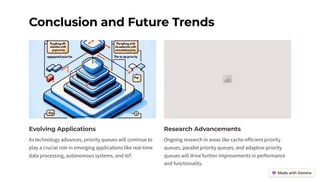
Evolving Applications
As technology advances, priority queues will continue to
play a crucial role in emerging applications like real-time
data processing, autonomous systems, and IoT.
Research Advancements
Ongoing research in areas like cache-efficient priority
queues, parallel priority queues, and adaptive priority
queues will drive further improvements in performance
and functionality.