Affiliate Summit East 2012

FTC Issues in an ERSP Advertising Challenge
William I. Rothbard, Law Offices of William I. Rothbard
Peter C. Marinello, Dir., Electronic Retailing Self-Regulation Program
THE ADVERTISING INDUSTRY’S
          SELF-REGULATORY SYSTEM
 1971 - The Self-Regulatory System formed as a response to
  consumer activists pushing for increased government
  regulation of the advertising industry
 Three major advertising trade associations and the Council of
  Better Business Bureaus created the system
TODAY…
• FTC points to ERSP as an example of successful
  industry self-regulation in America

• The Board has expanded to include:
ERSP GOALS & PROCEDURES
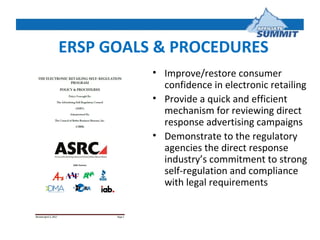
          • Improve/restore consumer
            confidence in electronic retailing
          • Provide a quick and efficient
            mechanism for reviewing direct
            response advertising campaigns
          • Demonstrate to the regulatory
            agencies the direct response
            industry’s commitment to strong
            self-regulation and compliance
            with legal requirements
ISSUES & CLAIMS REVIEWED BY ERSP
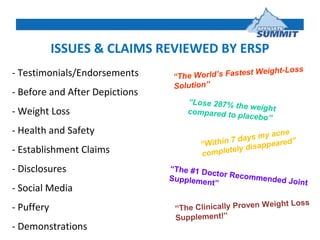
- Testimonials/Endorsements                         st W   eight-Loss
                                 “The World’s Faste
                                 Solution”
- Before and After Depictions
                                    “Lose 287% th
                                                  e weight
- Weight Loss                       compared to p
                                                  lacebo”
- Health and Safety                                         cne
                                                7 days my a d”
                                        “Within     disappe
                                                           are
- Establishment Claims                  complet
                                                ely

- Disclosures                   “The #1 Do
                                           ctor Recom
                                Supplemen            mended Jo
                                          t”                   int
- Social Media
                                                          eight Loss
- Puffery                        “The Clinically Proven W
                                 Supplement!”
- Demonstrations
ERSP PROCESS
• Advertising comes to the attention of ERSP through its monitoring
  of the marketplace and consumer and competitive challenges
• Process
   – Opening Letter
   – Marketer’s Reply
   – ERSP Reply
   – Marketer’s Response
   – Final Decision
   – Marketer’s Statement
   – Press Release
• ERSP final decisions and press releases are published in the ASRC
  Online Archive
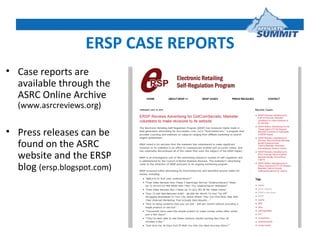
ERSP CASE REPORTS
• Case reports are
  available through the
  ASRC Online Archive
  (www.asrcreviews.org)


• Press releases can be
  found on the ASRC
  website and the ERSP
  blog (ersp.blogspot.com)
OVERVIEW OF TOPICS
• Ad Substantiation – Weight Loss Claims
• Clear & Conspicuous Disclosure -- Negative
  Option
• FTC Endorsement Guidelines
• FTC Business Opportunity Rule
• Affiliate Marketing Liability & FTC Orders
• Affiliate Marketing -- Compliance Tips
RED FLAG ISSUES
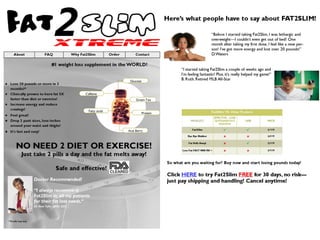
•   Cause weight loss of 2 pounds or more a week for a month or more without dieting or
    exercise
           • “Lose up to 35 pounds in 2 months without diet, without counting calories,
             without doing exercise.”
           • “Lose up to 30 pounds in 30 days”

•   Cause substantial weight loss no matter what or how much the consumer eats
          • “Eat the same way …. proven to reduce weight without special diet or
             exercise.”
          • “Lose Weight Without Cutting Your Favorite Foods”

•   Cause permanent weight loss (even when the consumer stops taking the product)
          • “Lose Weight Fast & Keep it Off”
          • “The inches have stayed off…”
          • “Everything you lose, you will never gain back, guaranteed.”
RED FLAG ISSUES
•   Block the absorption of fat or calories to enable consumer to lose substantial weight
           • “Blocks carbs. Eat the foods you want and still slim down”
           • “The ingredients increase the rate of fat metabolism, which reduces both
              surface and intestinal abdominal fat and helps inhibit future formation of
              these abdominal fats.”

•   Safely enable consumers to lose more than three pounds per week for four weeks
           • “Your patch has already helped my current weight loss of 15 pounds in one
              week.”
           • “In further case studies, participants lost up to 20 pounds of fat in only 14 to
              21 days!”

•   Cause substantial weight loss for all users
          • “With this product, there are no excuses for why this won’t work.”
          • “It works on everyone including you.”

•   Cause substantial weight loss by wearing it on the body or rubbing it on the skin
          • Amazing Diet Patch
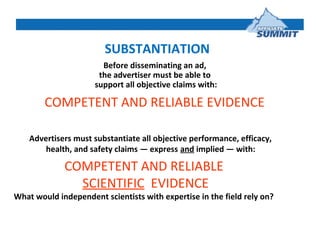
SUBSTANTIATION
                       Before disseminating an ad,
                      the advertiser must be able to
                     support all objective claims with:

        COMPETENT AND RELIABLE EVIDENCE

    Advertisers must substantiate all objective performance, efficacy,
        health, and safety claims — express and implied — with:

             COMPETENT AND RELIABLE
               SCIENTIFIC EVIDENCE
What would independent scientists with expertise in the field rely on?
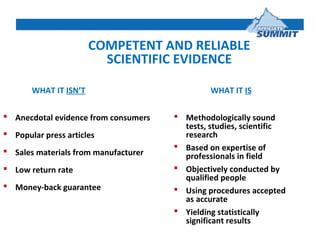
COMPETENT AND RELIABLE
                         SCIENTIFIC EVIDENCE

       WHAT IT ISN’T                           WHAT IT IS

 Anecdotal evidence from consumers    Methodologically sound
                                        tests, studies, scientific
 Popular press articles                research
                                       Based on expertise of
 Sales materials from manufacturer
                                        professionals in field
 Low return rate                      Objectively conducted by
                                        qualified people
 Money-back guarantee                 Using procedures accepted
                                        as accurate
                                       Yielding statistically
                                        significant results
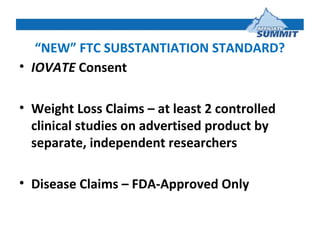
“NEW” FTC SUBSTANTIATION STANDARD?
• IOVATE Consent

• Weight Loss Claims – at least 2 controlled
  clinical studies on advertised product by
  separate, independent researchers

• Disease Claims – FDA-Approved Only
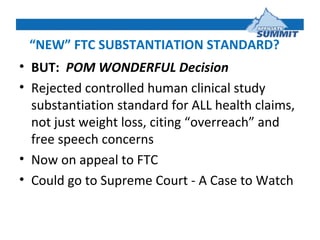
“NEW” FTC SUBSTANTIATION STANDARD?
• BUT: POM WONDERFUL Decision
• Rejected controlled human clinical study
  substantiation standard for ALL health claims,
  not just weight loss, citing “overreach” and
  free speech concerns
• Now on appeal to FTC
• Could go to Supreme Court - A Case to Watch
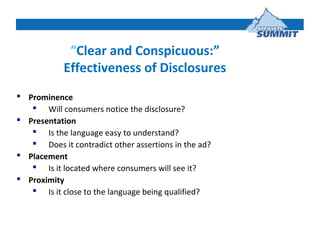
“Clear and Conspicuous:”
            Effectiveness of Disclosures
 Prominence
    Will consumers notice the disclosure?
 Presentation
    Is the language easy to understand?
    Does it contradict other assertions in the ad?
 Placement
    Is it located where consumers will see it?
 Proximity
    Is it close to the language being qualified?
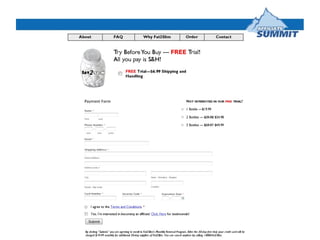
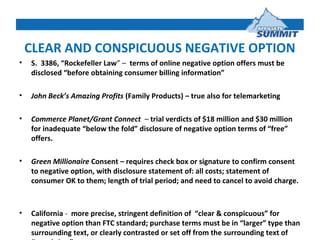
CLEAR AND CONSPICUOUS NEGATIVE OPTION
•   S. 3386, “Rockefeller Law” – terms of online negative option offers must be
    disclosed “before obtaining consumer billing information”

•   John Beck’s Amazing Profits (Family Products) – true also for telemarketing

•   Commerce Planet/Grant Connect – trial verdicts of $18 million and $30 million
    for inadequate “below the fold” disclosure of negative option terms of “free”
    offers.

•   Green Millionaire Consent – requires check box or signature to confirm consent
    to negative option, with disclosure statement of: all costs; statement of
    consumer OK to them; length of trial period; and need to cancel to avoid charge.


•   California - more precise, stringent definition of “clear & conspicuous” for
    negative option than FTC standard; purchase terms must be in “larger” type than
    surrounding text, or clearly contrasted or set off from the surrounding text of
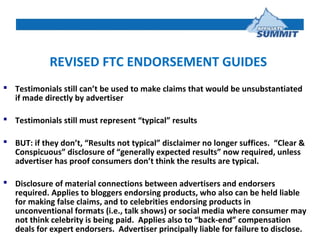
REVISED FTC ENDORSEMENT GUIDES
 Testimonials still can’t be used to make claims that would be unsubstantiated
  if made directly by advertiser

 Testimonials still must represent “typical” results

 BUT: if they don’t, “Results not typical” disclaimer no longer suffices. “Clear &
  Conspicuous” disclosure of “generally expected results” now required, unless
  advertiser has proof consumers don’t think the results are typical.

 Disclosure of material connections between advertisers and endorsers
  required. Applies to bloggers endorsing products, who also can be held liable
  for making false claims, and to celebrities endorsing products in
  unconventional formats (i.e., talk shows) or social media where consumer may
  not think celebrity is being paid. Applies also to “back-end” compensation
  deals for expert endorsers. Advertiser principally liable for failure to disclose.
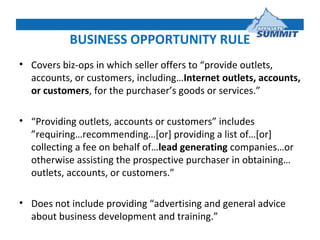
BUSINESS OPPORTUNITY RULE
• Covers biz-ops in which seller offers to “provide outlets,
  accounts, or customers, including…Internet outlets, accounts,
  or customers, for the purchaser’s goods or services.”

• “Providing outlets, accounts or customers” includes
  ”requiring…recommending…[or] providing a list of…[or]
  collecting a fee on behalf of…lead generating companies…or
  otherwise assisting the prospective purchaser in obtaining…
  outlets, accounts, or customers.”

• Does not include providing “advertising and general advice
  about business development and training.”
BUSINESS OPPORTUNITY RULE
• Are Biz-Op web stores “Internet outlets”?
• Is lead gen assistance to biz-op buyer providing
  “Internet customers”?
• Rule is a Biz-Op Killer if it applies
• Requires 7-Day Pre-Sale Written Disclosure of:
   –   Seller’s identity
   –   If it’s making earnings claims (and substantiation for same)
   –   Any prior legal actions
   –   Any cancellation/refund policy
   –   List of last 3 years’ purchasers
MERCHANT-ADVERTISER RESPONSIBILITY
•   Claim Substantiation
•   Compliance with FTC Endorsement Guidelines
•   Clear and Conspicuous Pre-Sale Disclosure of Material Terms &
    Conditions, including key billing terms on order page, not in hyperlinked
    T&Cs
•   Getting express, informed consumer billing consent - no prechecks
•   Responsive customer service, including fulfillment of stated
    cancellation/refund policies
•   Anti-Affiliate Fraud Policies and Procedures
•   Clear Privacy Policy Terms and Data Sharing Opt-Out Rights
AFFILIATE/NETWORK RESPONSIBILITY
•   CAN-SPAM Compliance

•   Endorsement Guidelines compliance, including disclosure of material
    financial connections to advertiser

•   Compliance with merchant-advertiser’s compliance guidelines and
    approved non-deceptive ad copy, avoidance of hyped, unapproved claims

•   Avoidance of fraudulent or confusing incentivized marketing schemes

•   Effective network monitoring of, and disciplinary action against, affiliate
    misconduct
OVERLAPPING ADVERTISER AND AFFILIATE
             NETWORK LIABILTY
•   Advertiser and Affiliates/Networks can have “cross liability” for the other’s acts.
    Liability isn’t automatic, depends on degree of participation, ratification, and
    negligent or willful ignorance or disregard
•   Affiliates/Networks could be liable not only for their deceptive claims and
    practices but advertiser’s claims as well if they were involved in creating the
    claims or had reason to believe they’re untrue or unsubstantiated; can’t
    necessarily rely on advertiser’s assurances
•   Advertiser is liable for deceptive claims it directs and pays its affiliates to make.
•   Advertiser also can be liable for deceptive claims and practices of affiliates it did
    not authorize but had reason to believe were occurring and ignored or didn’t take
    action to stop
•   Advertiser-Affiliate/Network contracts should contain reps and warranties of legal
    compliance, including with FTC laws and regs, CAN-SPAM, etc., and hold harmless
    indemnity clauses to protect against damage caused by the other party.
Top 5 Tips For Affiliates
•   Ensure that affiliate advertising of any merchant’s products or services is
    truthful, substantiated, and not deceptive or unfair;

•   Do not publish "flogs" (fake blogs) or other false content, false or
    unsubstantiated product claims, or offer incentives to consumers in return for
    their response to any ad, unless the terms and conditions of the offer are
    clearly and conspicuously disclosed;

•   Do not publish fake news articles or other fake media titles, without clearly
    and conspicuously disclosing that the content is an advertisement;

•   Do not publish false or unsubstantiated endorsements, and be sure to clearly
    and conspicuously disclose any material connections with the merchant
    and/or the network; and

•   Do not infringe on the personal rights, trademark, copyright, patent rights,
    service mark, or any other intellectual property right of any third party
    mentioned in published content.
Top 5 Tips For Merchants/Networks
•   Enter into written agreements with affiliate marketers, requiring that all
    affiliates abide by state and federal consumer protection laws and
    regulations including the FTC Act, the FTC’s Endorsement Guidelines, and the
    CAN-SPAM Act.
•   Agreements should require that affiliates not infringe on the personal rights,
    trademark, copyright, patent rights, service mark, or any other intellectual
    property right of any third party.
•   Agreements should require that affiliates clearly and conspicuously disclose
    the terms and conditions of any incentives, points, rewards, cash, or prizes
    promised to consumers in return for their response to any advertisement.
•   Agreements must provide that any affiliates who engage in non-compliant
    acts be terminated and forfeit commissions.
•   Monitor affiliate behavior and enforce contractual sanctions against
    misconduct
CONCLUSION: CAVEAT VENDOR!
•   Affiliates, networks and merchants should consider themselves on
    notice: everyone in the online advertising stream who engages in or
    assists with fraud might end up in the crosshairs of law enforcement.
•   Everyone involved in online marketing must be careful to publish
    truthful content that is not deceptive and contains the proper
    disclaimers and disclosures, and they must learn to adapt to this more
    aggressive regulatory landscape.
•    It is advisable to seek expert counsel who thoroughly understands the
    FTC’s and state AGs' thinking and likely enforcement strategies, so you
    have the benefit of sound advice concerning the best ways to avoid or
    fight off these regulatory challenges.
QUESTIONS?

•   William I. Rothbard     Peter C. Marinello
•   310-453-8713            212-705-0126
•   Rothbard@ftcadlaw.com   pmarinello@ersp.bbb.org
•   www.ftcadlaw.com        www.asrcreviews.org