







Training
           http://www.mongodb.org/
Hi,	
  I’m	
  Mike.
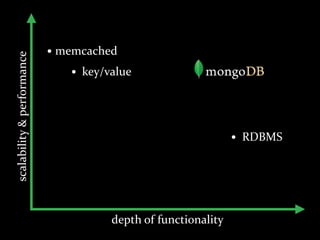
• memcached
scalability	
  &	
  performance


                                      • key/value


                                                                            •   RDBMS


                                             depth	
  of	
  functionality
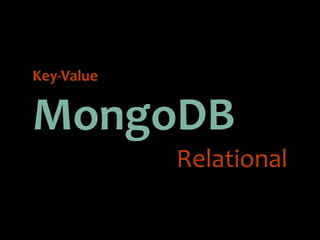
Key-­‐Value


MongoDB
              Relational
Goals for Today
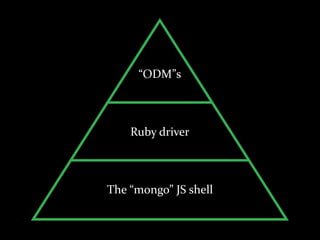
“ODM”s


      Ruby	
  driver


The	
  “mongo”	
  JS	
  shell
Installing	
  MongoDB
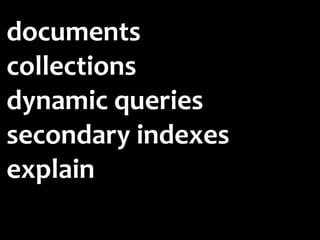
documents
collections
dynamic	
  queries
secondary	
  indexes	
  	
  
explain
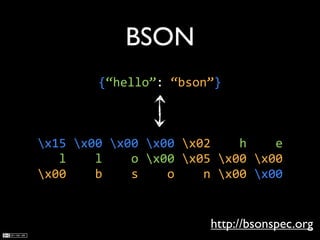
BSON
                     {“hello”:	
  “bson”}


x15	
  x00	
  x00	
  x00	
  x02	


  h	


  e


  l	


  l	


  o	
  x00	
  x05	
  x00	
  x00
x00	


  b	


  s	


  o	


  n	
  x00	
  x00


                                                              http://bsonspec.org
bsonspec.org
Messages


• TCP/IP Wire Protocol
• Separate messages for
  insert, update, query, get_more, delete, etc.


      http://www.mongodb.org/display/DOCS/Mongo+Wire+Protocol
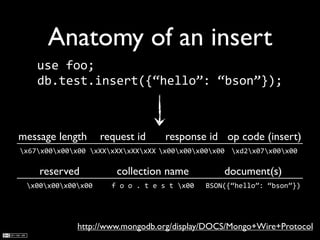
Anatomy of an insert
    use	
  foo;
    db.test.insert({“hello”:	
  “bson”});


message length      request id                    response id op code (insert)
x67x00x00x00 xXXxXXxXXxXX x00x00x00x00 xd2x07x00x00

    reserved            collection name                                   document(s)
 x00x00x00x00     f	
  o	
  o	
  .	
  t	
  e	
  s	
  t	
  x00   BSON({“hello”:	
  “bson”})


             http://www.mongodb.org/display/DOCS/Mongo+Wire+Protocol
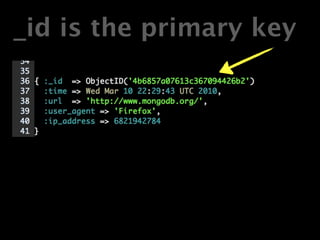
_id is the primary key
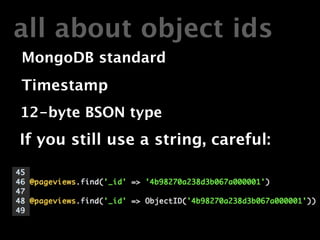
all about object ids
MongoDB standard
Timestamp
12-byte BSON type
If you still use a string, careful:
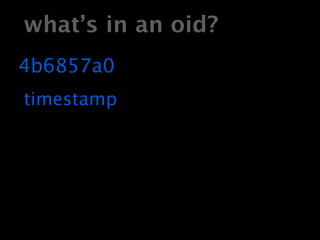
what’s in an oid?
what’s in an oid?
4b6857a0
timestamp
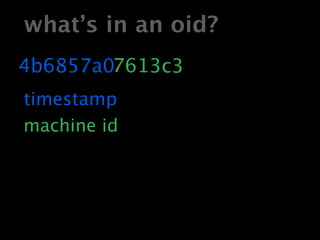
what’s in an oid?
4b6857a07613c3
timestamp
machine id
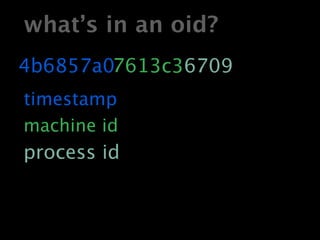
what’s in an oid?
4b6857a07613c36709
timestamp
machine id
process id
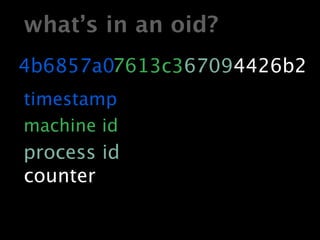
what’s in an oid?
4b6857a07613c367094426b2
timestamp
machine id
process id
counter
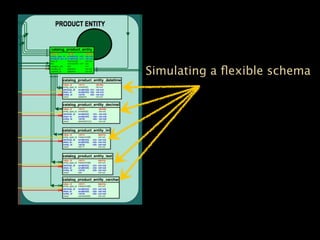
Simulating a flexible schema


What’s the   join like?
Simulating a flexible schema


What’s the   join like?
Can we   reason    about it?
{:sku => ‘637636’,
 :name => ‘Linen tailored pant’,
 :about => [{:title => ‘fabric & care’,
              :content => [‘Dry clean’,
                              ‘Imported’]},
             {:title => ‘overview’,
              :content => [‘Tailored fit’,
                              ‘Yarn dyed’]}
            ]
} *
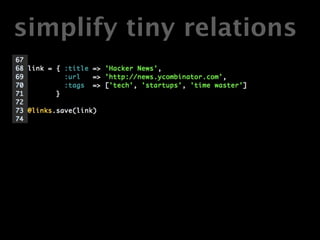
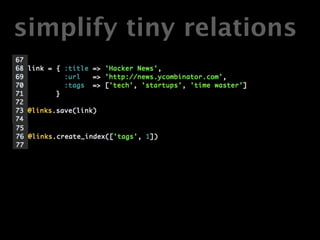
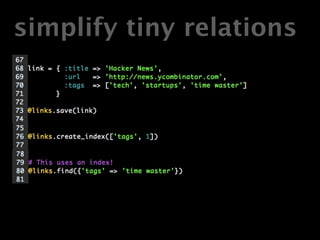
simplify tiny relations
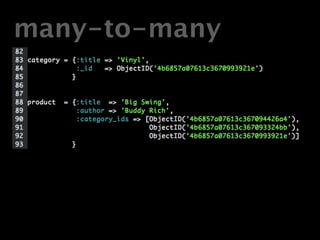
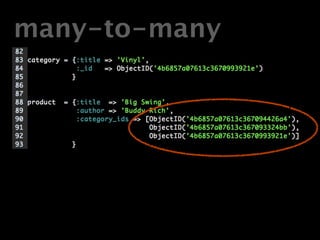
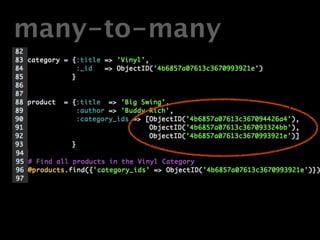
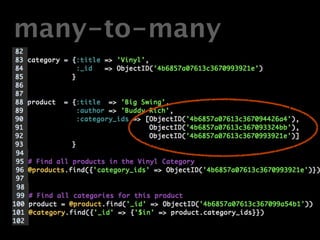
many-to-many
many-to-many
many-to-many
many-to-many
many-to-many
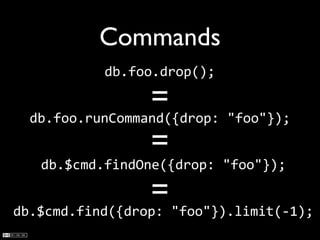
Commands
             db.foo.drop();

                 =
  db.foo.runCommand({drop:	
  "foo"});
                 =
   db.$cmd.findOne({drop:	
  "foo"});

                   =
db.$cmd.find({drop:	
  "foo"}).limit(-­‐1);
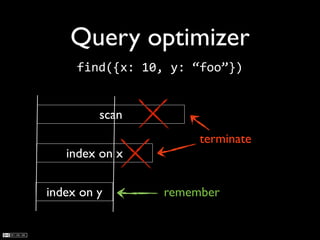
Query optimizer
     find({x:	
  10,	
  y:	
  “foo”})


         scan
                            terminate
   index on x

index on y           remember
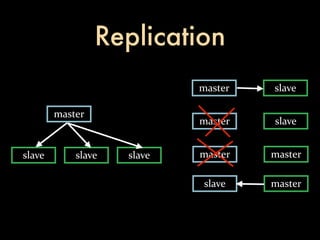
Replication
                            master   slave

        master
                            master   slave


slave       slave   slave   master   master

                             slave   master
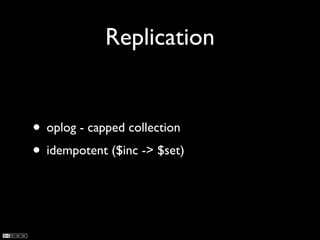
Replication


• oplog - capped collection
• idempotent ($inc -> $set)
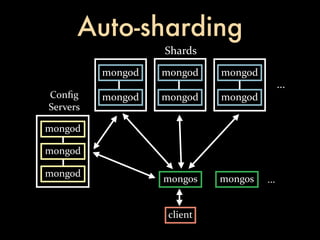
Auto-sharding
                   Shards
          mongod   mongod    mongod
                                            ...
Config     mongod   mongod    mongod
Servers

mongod

mongod

mongod
                   mongos    mongos   ...


                    client
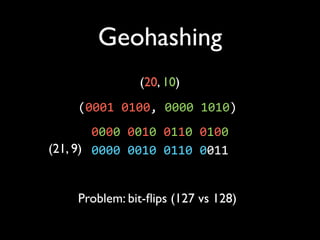
Geohashing
                  (20, 10)
     (0001	
  0100,	
  0000	
  1010)
        0000	
  0010	
  0110	
  0100
(21, 9) 0000	
  0010	
  0110	
  0011


     Problem: bit-flips (127 vs 128)

FrozenRails Training