JavaScript OOP
Maxis Kao @ Yahoo Search
Frontend 101
JavaScript
JavaScript
Java
OOP
Classical OOP
➔ Object-oriented programming
➔ C++, Java, Python
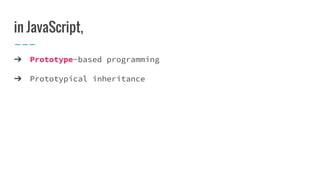
➔ Prototype-based programming
➔ Prototypical inheritance
in JavaScript,
before we start
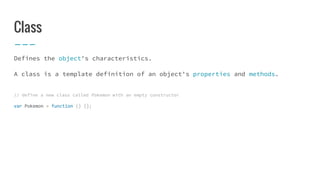
Class
// define a new class called Pokemon with an empty constructor
var Pokemon = function () {};
Defines the object's characteristics.
A class is a template definition of an object's properties and methods.
Object
// create two instances, mew and pikachu
var mew = new Pokemon();
var pikachu = new Pokemon();
An instance of a class.
Property
An object characteristic, such as name.
// define the name property for the Pokemon class
var Pokemon = function (pokemonName) {
this.name = pokemonName;
};
Method
An object capability, such as walk. It is a subroutine or function
associated with a class.
// define the method bark() for the Pokemon class
Pokemon.prototype.bark = function () {
console.log("Hey, I'm " + this.name);
};
Question 1.
Please use JavaScript object to describe a Pokemon which includes a property
“name” and a method “bark” to shout its name out.
1. Object function
var Pokemon = function (pokemonName) {
// this refers to Pokemon
this.name = pokemonName;
};
Pokemon.prototype.bark = function () {
// this refers to Pokemon
console.log("Hey, I'm " + this.name);
};
var pikachu = new Pokemon('Pikachu');
pikachu.bark();
pikachu.name = 'PikaPika';
pikachu.bark();
1. Object function
var Pokemon = function (pokemonName) {
// this refers to Pokemon
this.name = pokemonName;
};
Pokemon.prototype.bark = function () {
// this refers to Pokemon
console.log("Hey, I'm " + this.name);
};
var pikachu = new Pokemon('Pikachu');
pikachu.bark();
// "Hey, I'm Pikachu"
pikachu.name = 'PikaPika';
pikachu.bark();
// "Hey, I'm PikaPika"
2. Object function (without prototype)
var Pokemon = function(pokemonName) {
this.name = pokemonName;
this.bark = function() {
// this refers to Pokemon
console.log("Hey, I'm " + this.name);
};
};
var pikachu = new Pokemon('Pikachu');
pikachu.bark();
pikachu.name = 'PikaPika';
pikachu.bark();
2. Object function (without prototype)
var Pokemon = function(pokemonName) {
this.name = pokemonName;
this.bark = function() {
// this refers to Pokemon
console.log("Hey, I'm " + this.name);
};
};
var pikachu = new Pokemon('Pikachu');
pikachu.bark();
// "Hey, I'm Pikachu"
pikachu.name = 'PikaPika';
pikachu.bark();
// "Hey, I'm PikaPika"
3. Object Literal
var Pokemon = {
name: "Pikachu",
bark: function() {
console.log("Hey, I'm " + this.name);
}
};
Pokemon.name = 'Pikachu';
Pokemon.bark();
Pokemon.name = 'PikaPika';
Pokemon.bark();
3. Object Literal
var Pokemon = {
name: "Pikachu",
bark: function() {
console.log("Hey, I'm " + this.name);
}
};
Pokemon.name = 'Pikachu';
Pokemon.bark();
// "Hey, I'm Pikachu"
Pokemon.name = 'PikaPika';
Pokemon.bark();
// "Hey, I'm PikaPika"
Question 2.
Please make the public property “name” private in Question 1.
var Pokemon = function(pokemonName) {
this.name = pokemonName;
...
}
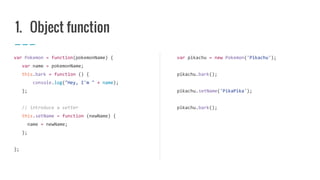
1. Object function
var Pokemon = function(pokemonName) {
var name = pokemonName;
this.bark = function () {
console.log("Hey, I'm " + name);
};
// introduce a setter
this.setName = function (newName) {
name = newName;
};
};
var pikachu = new Pokemon('Pikachu');
pikachu.bark();
pikachu.setName('PikaPika');
pikachu.bark();
1. Object function
var Pokemon = function(pokemonName) {
var name = pokemonName;
this.bark = function () {
console.log("Hey, I'm " + name);
};
// introduce a setter
this.setName = function (newName) {
name = newName;
};
};
var pikachu = new Pokemon('Pikachu');
pikachu.bark();
// "Hey, I'm Pikachu"
pikachu.setName('PikaPika');
pikachu.bark();
// "Hey, I'm PikaPika"
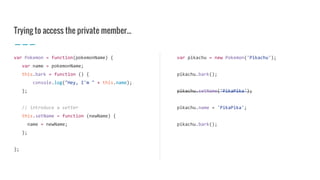
Trying to access the private member...
var Pokemon = function(pokemonName) {
var name = pokemonName;
this.bark = function () {
console.log("Hey, I'm " + name);
};
// introduce a setter
this.setName = function (newName) {
name = newName;
};
};
var pikachu = new Pokemon('Pikachu');
pikachu.bark();
pikachu.setName('PikaPika');
pikachu.name = 'PikaPika';
pikachu.bark();
Trying to access the private member...
var Pokemon = function(pokemonName) {
var name = pokemonName;
this.bark = function () {
console.log("Hey, I'm " + name);
};
// introduce a setter
this.setName = function (newName) {
name = newName;
};
};
var pikachu = new Pokemon('Pikachu');
pikachu.bark();
// "Hey, I'm Pikachu"
pikachu.setName('PikaPika');
pikachu.name = 'PikaPika';
pikachu.bark();
// "Hey, I'm Pikachu"
Pokemon.bark();
Pokemon.setName('Pikachu');
Pokemon.bark();
2. Immediately Invoked Function (IIF)
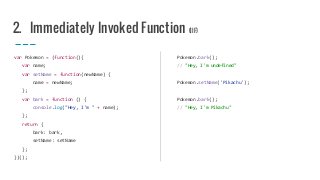
var Pokemon = (function(){
var name;
var setName = function(newName) {
name = newName;
};
var bark = function () {
console.log("Hey, I'm " + name);
};
return {
bark: bark,
setName: setName
};
})();
var Pokemon = (function(){
var name;
var setName = function(newName) {
name = newName;
};
var bark = function () {
console.log("Hey, I'm " + name);
};
return {
bark: bark,
setName: setName
};
})();
Pokemon.bark();
// "Hey, I'm undefined"
Pokemon.setName('Pikachu');
Pokemon.bark();
// "Hey, I'm Pikachu"
2. Immediately Invoked Function (IIF)
function MythPokemon(pokemonName, ability) {
// Call the parent constructor using .call()
Pokemon.call(this, pokemonName);
// Initialize the MythPokomon-specific properties
this.ability = ability;
}
MythPokemon.prototype = Object.create(Pokemon.prototype);
MythPokemon.prototype.bark = function(){
console.log("I'm mighty " + this.name + "! I can " + this.ability);
};
Inheritance
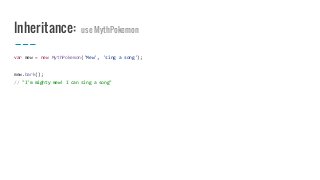
Inheritance: use MythPokemon
var mew = new MythPokemon('Mew', 'sing a song');
mew.bark();
Inheritance: use MythPokemon
var mew = new MythPokemon('Mew', 'sing a song');
mew.bark();
// "I'm mighty mew! I can sing a song"
Happy JavaScript OOP!

[Frontend 101] JavaScript OOP

  • 1.
    JavaScript OOP Maxis Kao@ Yahoo Search Frontend 101
  • 2.
  • 3.
  • 4.
  • 5.
  • 6.
    Classical OOP ➔ Object-orientedprogramming ➔ C++, Java, Python
  • 7.
    ➔ Prototype-based programming ➔Prototypical inheritance in JavaScript,
  • 8.
  • 9.
    Class // define anew class called Pokemon with an empty constructor var Pokemon = function () {}; Defines the object's characteristics. A class is a template definition of an object's properties and methods.
  • 10.
    Object // create twoinstances, mew and pikachu var mew = new Pokemon(); var pikachu = new Pokemon(); An instance of a class.
  • 11.
    Property An object characteristic,such as name. // define the name property for the Pokemon class var Pokemon = function (pokemonName) { this.name = pokemonName; };
  • 12.
    Method An object capability,such as walk. It is a subroutine or function associated with a class. // define the method bark() for the Pokemon class Pokemon.prototype.bark = function () { console.log("Hey, I'm " + this.name); };
  • 13.
    Question 1. Please useJavaScript object to describe a Pokemon which includes a property “name” and a method “bark” to shout its name out.
  • 14.
    1. Object function varPokemon = function (pokemonName) { // this refers to Pokemon this.name = pokemonName; }; Pokemon.prototype.bark = function () { // this refers to Pokemon console.log("Hey, I'm " + this.name); }; var pikachu = new Pokemon('Pikachu'); pikachu.bark(); pikachu.name = 'PikaPika'; pikachu.bark();
  • 15.
    1. Object function varPokemon = function (pokemonName) { // this refers to Pokemon this.name = pokemonName; }; Pokemon.prototype.bark = function () { // this refers to Pokemon console.log("Hey, I'm " + this.name); }; var pikachu = new Pokemon('Pikachu'); pikachu.bark(); // "Hey, I'm Pikachu" pikachu.name = 'PikaPika'; pikachu.bark(); // "Hey, I'm PikaPika"
  • 16.
    2. Object function(without prototype) var Pokemon = function(pokemonName) { this.name = pokemonName; this.bark = function() { // this refers to Pokemon console.log("Hey, I'm " + this.name); }; }; var pikachu = new Pokemon('Pikachu'); pikachu.bark(); pikachu.name = 'PikaPika'; pikachu.bark();
  • 17.
    2. Object function(without prototype) var Pokemon = function(pokemonName) { this.name = pokemonName; this.bark = function() { // this refers to Pokemon console.log("Hey, I'm " + this.name); }; }; var pikachu = new Pokemon('Pikachu'); pikachu.bark(); // "Hey, I'm Pikachu" pikachu.name = 'PikaPika'; pikachu.bark(); // "Hey, I'm PikaPika"
  • 18.
    3. Object Literal varPokemon = { name: "Pikachu", bark: function() { console.log("Hey, I'm " + this.name); } }; Pokemon.name = 'Pikachu'; Pokemon.bark(); Pokemon.name = 'PikaPika'; Pokemon.bark();
  • 19.
    3. Object Literal varPokemon = { name: "Pikachu", bark: function() { console.log("Hey, I'm " + this.name); } }; Pokemon.name = 'Pikachu'; Pokemon.bark(); // "Hey, I'm Pikachu" Pokemon.name = 'PikaPika'; Pokemon.bark(); // "Hey, I'm PikaPika"
  • 20.
    Question 2. Please makethe public property “name” private in Question 1. var Pokemon = function(pokemonName) { this.name = pokemonName; ... }
  • 21.
    1. Object function varPokemon = function(pokemonName) { var name = pokemonName; this.bark = function () { console.log("Hey, I'm " + name); }; // introduce a setter this.setName = function (newName) { name = newName; }; }; var pikachu = new Pokemon('Pikachu'); pikachu.bark(); pikachu.setName('PikaPika'); pikachu.bark();
  • 22.
    1. Object function varPokemon = function(pokemonName) { var name = pokemonName; this.bark = function () { console.log("Hey, I'm " + name); }; // introduce a setter this.setName = function (newName) { name = newName; }; }; var pikachu = new Pokemon('Pikachu'); pikachu.bark(); // "Hey, I'm Pikachu" pikachu.setName('PikaPika'); pikachu.bark(); // "Hey, I'm PikaPika"
  • 23.
    Trying to accessthe private member... var Pokemon = function(pokemonName) { var name = pokemonName; this.bark = function () { console.log("Hey, I'm " + name); }; // introduce a setter this.setName = function (newName) { name = newName; }; }; var pikachu = new Pokemon('Pikachu'); pikachu.bark(); pikachu.setName('PikaPika'); pikachu.name = 'PikaPika'; pikachu.bark();
  • 24.
    Trying to accessthe private member... var Pokemon = function(pokemonName) { var name = pokemonName; this.bark = function () { console.log("Hey, I'm " + name); }; // introduce a setter this.setName = function (newName) { name = newName; }; }; var pikachu = new Pokemon('Pikachu'); pikachu.bark(); // "Hey, I'm Pikachu" pikachu.setName('PikaPika'); pikachu.name = 'PikaPika'; pikachu.bark(); // "Hey, I'm Pikachu"
  • 25.
    Pokemon.bark(); Pokemon.setName('Pikachu'); Pokemon.bark(); 2. Immediately InvokedFunction (IIF) var Pokemon = (function(){ var name; var setName = function(newName) { name = newName; }; var bark = function () { console.log("Hey, I'm " + name); }; return { bark: bark, setName: setName }; })();
  • 26.
    var Pokemon =(function(){ var name; var setName = function(newName) { name = newName; }; var bark = function () { console.log("Hey, I'm " + name); }; return { bark: bark, setName: setName }; })(); Pokemon.bark(); // "Hey, I'm undefined" Pokemon.setName('Pikachu'); Pokemon.bark(); // "Hey, I'm Pikachu" 2. Immediately Invoked Function (IIF)
  • 27.
    function MythPokemon(pokemonName, ability){ // Call the parent constructor using .call() Pokemon.call(this, pokemonName); // Initialize the MythPokomon-specific properties this.ability = ability; } MythPokemon.prototype = Object.create(Pokemon.prototype); MythPokemon.prototype.bark = function(){ console.log("I'm mighty " + this.name + "! I can " + this.ability); }; Inheritance
  • 28.
    Inheritance: use MythPokemon varmew = new MythPokemon('Mew', 'sing a song'); mew.bark();
  • 29.
    Inheritance: use MythPokemon varmew = new MythPokemon('Mew', 'sing a song'); mew.bark(); // "I'm mighty mew! I can sing a song"
  • 30.