DRAFT
DRAFT
Retail Front End Optimization
2
©IBM Corporation
Contents
Problem Definition and IBM Offering Overview
Approach
Approach
Client Examples
Client Examples
The Path Forward
The Path Forward
3
©IBM Corporation
Today’s retail store environment is increasingly challenging due
to difficulties attracting and retaining staff, intensified
competition for customers and high operating costs
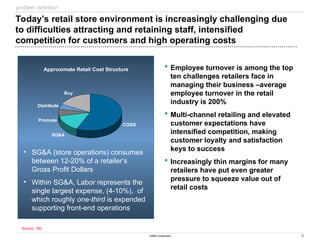
 Employee turnover is among the top
ten challenges retailers face in
managing their business –average
employee turnover in the retail
industry is 200%
 Multi-channel retailing and elevated
customer expectations have
intensified competition, making
customer loyalty and satisfaction
keys to success
 Increasingly thin margins for many
retailers have put even greater
pressure to squeeze value out of
retail costs
Approximate Retail Cost Structure
COGS
SG&A
Promote
Distribute
Buy
• SG&A (store operations) consumes
between 12-20% of a retailer’s
Gross Profit Dollars
• Within SG&A, Labor represents the
single largest expense, (4-10%), of
which roughly one-third is expended
supporting front-end operations
problem definition
Source: IDC
4
©IBM Corporation
Optimized front end operations can dramatically improve store
level staff productivity while increasing customer satisfaction
and throughput and reducing operating costs
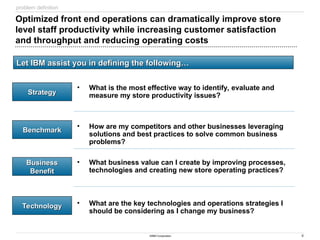
• What is the most effective way to identify, evaluate and
measure my store productivity issues?
• How are my competitors and other businesses leveraging
solutions and best practices to solve common business
problems?
• What business value can I create by improving processes,
technologies and creating new store operating practices?
• What are the key technologies and operations strategies I
should be considering as I change my business?
Strategy
Strategy
Benchmark
Benchmark
Business
Business
Benefit
Benefit
Technology
Technology
Let IBM assist you in defining the following…
problem definition
5
©IBM Corporation
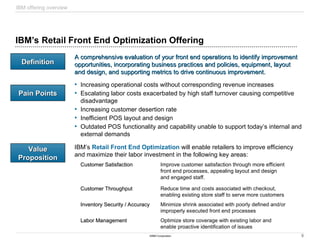
IBM’s Retail Front End Optimization Offering
Definition
Definition
Value
Value
Proposition
Proposition
Pain Points
Pain Points
• Increasing operational costs without corresponding revenue increases
• Escalating labor costs exacerbated by high staff turnover causing competitive
disadvantage
• Increasing customer desertion rate
• Inefficient POS layout and design
• Outdated POS functionality and capability unable to support today’s internal and
external demands
IBM’s Retail Front End Optimization will enable retailers to improve efficiency
and maximize their labor investment in the following key areas:
IBM offering overview
Improve customer satisfaction through more efficient
front end processes, appealing layout and design
and engaged staff.
Customer Satisfaction
Optimize store coverage with existing labor and
enable proactive identification of issues
Labor Management
Labor Management
Minimize shrink associated with poorly defined and/or
improperly executed front end processes
Inventory Security / Accuracy
Reduce time and costs associated with checkout,
enabling existing store staff to serve more customers
Customer Throughput
Customer Throughput
A comprehensive evaluation of your front end operations to identify improvement
opportunities, incorporating business practices and policies, equipment, layout
and design, and supporting metrics to drive continuous improvement.
6
©IBM Corporation
The ability to identify, address and measure retail front end
improvement opportunities can have a dramatic impact on retail
front end operations
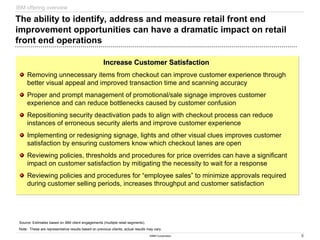
Increase Customer Satisfaction
Removing unnecessary items from checkout can improve customer experience through
better visual appeal and improved transaction time and scanning accuracy
Proper and prompt management of promotional/sale signage improves customer
experience and can reduce bottlenecks caused by customer confusion
Repositioning security deactivation pads to align with checkout process can reduce
instances of erroneous security alerts and improve customer experience
Implementing or redesigning signage, lights and other visual clues improves customer
satisfaction by ensuring customers know which checkout lanes are open
Reviewing policies, thresholds and procedures for price overrides can have a significant
impact on customer satisfaction by mitigating the necessity to wait for a response
Reviewing policies and procedures for “employee sales” to minimize approvals required
during customer selling periods, increases throughput and customer satisfaction
Source: Estimates based on IBM client engagements (multiple retail segments).
Note: These are representative results based on previous clients; actual results may vary.
IBM offering overview
7
©IBM Corporation
The ability to identify, address and measure retail front end
improvement opportunities can have a dramatic impact on retail
front end operations
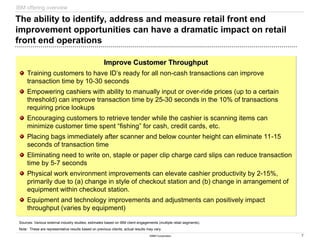
Improve Customer Throughput
Training customers to have ID’s ready for all non-cash transactions can improve
transaction time by 10-30 seconds
Empowering cashiers with ability to manually input or over-ride prices (up to a certain
threshold) can improve transaction time by 25-30 seconds in the 10% of transactions
requiring price lookups
Encouraging customers to retrieve tender while the cashier is scanning items can
minimize customer time spent “fishing” for cash, credit cards, etc.
Placing bags immediately after scanner and below counter height can eliminate 11-15
seconds of transaction time
Eliminating need to write on, staple or paper clip charge card slips can reduce transaction
time by 5-7 seconds
Physical work environment improvements can elevate cashier productivity by 2-15%,
primarily due to (a) change in style of checkout station and (b) change in arrangement of
equipment within checkout station.
Equipment and technology improvements and adjustments can positively impact
throughput (varies by equipment)
IBM offering overview
Sources: Various external industry studies; estimates based on IBM client engagements (multiple retail segments).
Note: These are representative results based on previous clients; actual results may vary.
8
©IBM Corporation
Downstream impacts of improving front end operations include
better ability to manage inventory and labor
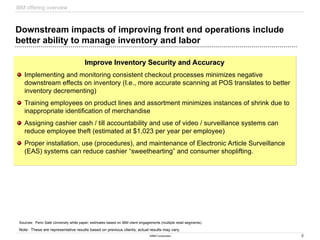
Improve Inventory Security and Accuracy
Implementing and monitoring consistent checkout processes minimizes negative
downstream effects on inventory (I.e., more accurate scanning at POS translates to better
inventory decrementing)
Training employees on product lines and assortment minimizes instances of shrink due to
inappropriate identification of merchandise
Assigning cashier cash / till accountability and use of video / surveillance systems can
reduce employee theft (estimated at $1,023 per year per employee)
Proper installation, use (procedures), and maintenance of Electronic Article Surveillance
(EAS) systems can reduce cashier “sweethearting” and consumer shoplifting.
IBM offering overview
Sources: Penn Sate University white paper; estimates based on IBM client engagements (multiple retail segments).
Note: These are representative results based on previous clients; actual results may vary.
9
©IBM Corporation
Downstream impacts of improving front end operations include
better ability to manage inventory and labor
Improve Labor Management
Better working environments can reduce staff and management turnover (estimated cost
per turnover occurrence is $2,500 per staff member and $25,000 per manager)
Revisions to labor management procedures, policies and new applications can identify
labor law violations and minimize chances of fines (estimated fine for labor law violations
is between $800 and $1,000 per occurrence)
IBM offering overview
Sources: Society of Human Resource Management; U.S. Department of Labor; Associated Press.
Note: These are representative results based on previous clients; actual results may vary.
10
©IBM Corporation
Contents
Problem Definition and IBM Offering Overview
Approach
Client Examples
Client Examples
The Path Forward
The Path Forward
11
©IBM Corporation
1b. Assess
1b. Assess
Opportunities &
Opportunities &
Best Practices
Best Practices
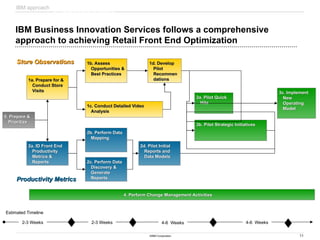
IBM Business Innovation Services follows a comprehensive
approach to achieving Retail Front End Optimization
0. Prepare &
0. Prepare &
Prioritize
Prioritize
APPROACH and SAMPLE RESULTS
2-3 Weeks 2-3 Weeks 4-6 Weeks 4-6 Weeks
IBM approach
1a. Prepare for &
1a. Prepare for &
Conduct Store
Conduct Store
Visits
Visits
1c. Conduct Detailed Video
Analysis
Analysis
1d. Develop
1d. Develop
Pilot
Pilot
Recommen
Recommen
dations
dations
3a. Pilot Quick
3a. Pilot Quick
Hits
Hits
3b. Pilot Strategic Initiatives
3c. Implement
3c. Implement
New
New
Operating
Operating
Model
Model
Store Observations
Store Observations
Estimated Timeline
4. Perform Change Management Activities
2c. Perform Data
2c. Perform Data
Discovery &
Discovery &
Generate
Generate
Reports
Reports
2b. Perform Data
2b. Perform Data
Mapping
Mapping
2a. ID Front End
2a. ID Front End
Productivity
Productivity
Metrics &
Metrics &
Reports
Reports
2d. Pilot Initial
2d. Pilot Initial
Reports and
Reports and
Data Models
Data Models
Productivity Metrics
12
©IBM Corporation
1b. Assess
1b. Assess
Opportunities &
Opportunities &
Best Practices
Best Practices
0. Prepare &
0. Prepare &
Prioritize
Prioritize
1a. Prepare for &
1a. Prepare for &
Conduct Store
Conduct Store
Visits
Visits
1c. Conduct Detailed Video
Analysis
Analysis
1d. Develop
1d. Develop
Pilot
Pilot
Recommen
Recommen
dations
dations
3a. Pilot Quick
3a. Pilot Quick
Hits
Hits
3b. Pilot Strategic Initiatives
3c. Implement
3c. Implement
New
New
Operating
Operating
Model
Model
Store Observations
Store Observations
4. Perform Change Management Activities
2c. Perform Data
2c. Perform Data
Discovery &
Discovery &
Generate
Generate
Reports
Reports
2b. Perform Data
2b. Perform Data
Mapping
Mapping
2a. ID Front End
2a. ID Front End
Productivity
Productivity
Metrics &
Metrics &
Reports
Reports
2d. Pilot Initial
2d. Pilot Initial
Reports and
Reports and
Data Models
Data Models
Productivity Metrics
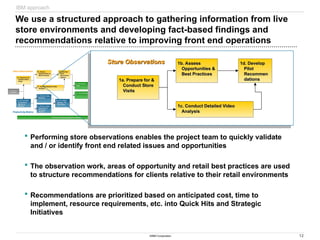
We use a structured approach to gathering information from live
store environments and developing fact-based findings and
recommendations relative to improving front end operations
 Performing store observations enables the project team to quickly validate
and / or identify front end related issues and opportunities
 The observation work, areas of opportunity and retail best practices are used
to structure recommendations for clients relative to their retail environments
 Recommendations are prioritized based on anticipated cost, time to
implement, resource requirements, etc. into Quick Hits and Strategic
Initiatives
1b. Assess
1b. Assess
Opportunities &
Opportunities &
Best Practices
Best Practices
1a. Prepare for &
1a. Prepare for &
Conduct Store
Conduct Store
Visits
Visits
1c. Conduct Detailed Video
Analysis
Analysis
1d. Develop
1d. Develop
Pilot
Pilot
Recommen
Recommen
dations
dations
Store Observations
Store Observations
IBM approach
13
©IBM Corporation
1b. Assess
1b. Assess
Opportunities &
Opportunities &
Best Practices
Best Practices
0. Prepare &
0. Prepare &
Prioritize
Prioritize
1a. Prepare for &
1a. Prepare for &
Conduct Store
Conduct Store
Visits
Visits
1c. Conduct Detailed Video
Analysis
Analysis
1d. Develop
1d. Develop
Pilot
Pilot
Recommen
Recommen
dations
dations
3a. Pilot Quick
3a. Pilot Quick
Hits
Hits
3b. Pilot Strategic Initiatives
3c. Implement
3c. Implement
New
New
Operating
Operating
Model
Model
Store Observations
Store Observations
4. Perform Change Management Activities
2c. Perform Data
2c. Perform Data
Discovery &
Discovery &
Generate
Generate
Reports
Reports
2b. Perform Data
2b. Perform Data
Mapping
Mapping
2a. ID Front End
2a. ID Front End
Productivity
Productivity
Metrics &
Metrics &
Reports
Reports
2d. Pilot Initial
2d. Pilot Initial
Reports and
Reports and
Data Models
Data Models
Productivity Metrics
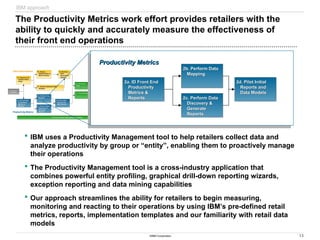
The Productivity Metrics work effort provides retailers with the
ability to quickly and accurately measure the effectiveness of
their front end operations
 IBM uses a Productivity Management tool to help retailers collect data and
analyze productivity by group or “entity”, enabling them to proactively manage
their operations
 The Productivity Management tool is a cross-industry application that
combines powerful entity profiling, graphical drill-down reporting wizards,
exception reporting and data mining capabilities
 Our approach streamlines the ability for retailers to begin measuring,
monitoring and reacting to their operations by using IBM’s pre-defined retail
metrics, reports, implementation templates and our familiarity with retail data
models
2c. Perform Data
2c. Perform Data
Discovery &
Discovery &
Generate
Generate
Reports
Reports
2b. Perform Data
2b. Perform Data
Mapping
Mapping
2a. ID Front End
2a. ID Front End
Productivity
Productivity
Metrics &
Metrics &
Reports
Reports
2d. Pilot Initial
2d. Pilot Initial
Reports and
Reports and
Data Models
Data Models
Productivity Metrics
IBM approach
14
©IBM Corporation
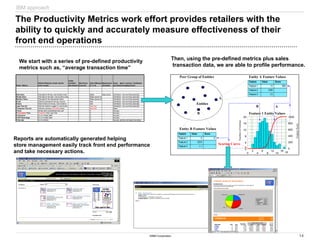
The Productivity Metrics work effort provides retailers with the
ability to quickly and accurately measure effectiveness of their
front end operations
Phase 1 Metrics
Definition/Notes (to include 'why the
metric is used)
Is Data
Available?
Data Quality?
Data Source
(e-journal)
Units of Measure
($ / % / #)
Measurement
Calculation
Group: speed / accuracy / Contribution
(non factored weighting factor)
Daily Sales Total sales for the day; must be able to total Dollars Sales across Contribution: how much they personally
Weekly Sales Total sales for the week; must be able to total Dollars (across all Contribution: how much they personally
Monthly $ Sales Total sales for the measurement period Dollars (across all Contribution: how much they personally
# Cust Total # of customers for the day; must be Units Contribution: how much they personally
# Items Total # of items for the day: must be able to Units Contribution: how much they personally
Login Time (hr) Total time Cashier is logged in; must be able Hours (two Contribution: how much they personally
Transaction Time (hr) Total time scanning and tendering items; Hours (two Speed
%Scan Number items scanned/total items sold % Accuracy
%Transaction Time Transaction Time/ Login Time % Accuracy
%Clearance As a % of Daily Sales % Accuracy
%UPC Book Usage As a % of Daily Sales % Accuracy
%Gun Use As a % of Items % Accuracy (primary) and Speed (secondary)
We start with a series of pre-defined productivity
metrics such as, “average transaction time”
Feature Value Score
Feature 1 13 850
Feature 2 1250
Feature 3 1.5
Feature Value Score
Feature 1 5 0
Feature 2 2375
Feature 3 1.1
Peer Group of Entities
Entities
Entity A Feature Values
Entity B Feature Values
A
B
Number
of
Entities
Feature
Score
20
16
12
8
4
0
2 6 12 16
4 8 14 18
0
1000
800
600
400
200
0
B A
Feature 1 Entity Values
Scoring Curve
Then, using the pre-defined metrics plus sales
transaction data, we are able to profile performance.
Reports are automatically generated helping
store management easily track front end performance
and take necessary actions.
IBM approach
15
©IBM Corporation
1b. Assess
1b. Assess
Opportunities &
Opportunities &
Best Practices
Best Practices
0. Prepare &
0. Prepare &
Prioritize
Prioritize
1a. Prepare for &
1a. Prepare for &
Conduct Store
Conduct Store
Visits
Visits
1c. Conduct Detailed Video
Analysis
Analysis
1d. Develop
1d. Develop
Pilot
Pilot
Recommen
Recommen
dations
dations
3a. Pilot Quick
3a. Pilot Quick
Hits
Hits
3b. Pilot Strategic Initiatives
3c. Implement
3c. Implement
New
New
Operating
Operating
Model
Model
Store Observations
Store Observations
4. Perform Change Management Activities
2c. Perform Data
2c. Perform Data
Discovery &
Discovery &
Generate
Generate
Reports
Reports
2b. Perform Data
2b. Perform Data
Mapping
Mapping
2a. ID Front End
2a. ID Front End
Productivity
Productivity
Metrics &
Metrics &
Reports
Reports
2d. Pilot Initial
2d. Pilot Initial
Reports and
Reports and
Data Models
Data Models
Productivity Metrics
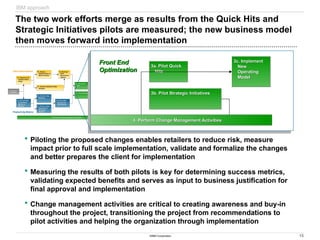
The two work efforts merge as results from the Quick Hits and
Strategic Initiatives pilots are measured; the new business model
then moves forward into implementation
3a. Pilot Quick
3a. Pilot Quick
Hits
Hits
3b. Pilot Strategic Initiatives
3c. Implement
3c. Implement
New
New
Operating
Operating
Model
Model
Front End
Front End
Optimization
Optimization
 Piloting the proposed changes enables retailers to reduce risk, measure
impact prior to full scale implementation, validate and formalize the changes
and better prepares the client for implementation
 Measuring the results of both pilots is key for determining success metrics,
validating expected benefits and serves as input to business justification for
final approval and implementation
 Change management activities are critical to creating awareness and buy-in
throughout the project, transitioning the project from recommendations to
pilot activities and helping the organization through implementation
4. Perform Change Management Activities
IBM approach
16
©IBM Corporation
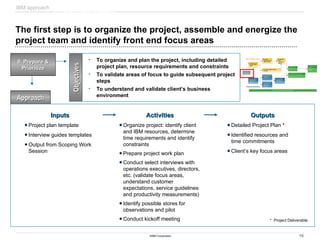
The first step is to organize the project, assemble and energize the
project team and identify front end focus areas
APPROACH and SAMPLE RESULTS
IBM approach
Objectives
Objectives
Approach
Approach
Outputs
Outputs
• To organize and plan the project, including detailed
project plan, resource requirements and constraints
• To validate areas of focus to guide subsequent project
steps
• To understand and validate client’s business
environment
Inputs
Inputs Activities
Activities
Organize project: identify client
and IBM resources, determine
time requirements and identify
constraints
Prepare project work plan
Conduct select interviews with
operations executives, directors,
etc. (validate focus areas,
understand customer
expectations, service guidelines
and productivity measurements)
Identify possible stores for
observations and pilot
Conduct kickoff meeting
Project plan template
Interview guides templates
Output from Scoping Work
Session
Detailed Project Plan *
Identified resources and
time commitments
Client’s key focus areas
* Project Deliverable
0. Prepare &
0. Prepare &
Prioritize
Prioritize
1b. Assess
1b. Assess
Opportunities &
Opportunities &
Best Practices
Best Practices
0. Prepare &
0. Prepare &
Prioritize
Prioritize
1a. Prepare for &
1a. Prepare for &
Conduct Store
Conduct Store
Visits
Visits
1c. Conduct Detailed Video
Analysis
Analysis
1d. Develop
1d. Develop
Pilot
Pilot
Recommen
Recommen
dations
dations
3a. Pilot Quick
3a. Pilot Quick
Hits
Hits
3b. Pilot Strategic Initiatives
3c. Implement
3c. Implement
New
New
Operating
Operating
Model
Model
Store Observations
Store Observations
4. Perform Change Management Activities
2c. Perform Data
2c. Perform Data
Discovery &
Discovery &
Generate
Generate
Reports
Reports
2b. Perform Data
2b. Perform Data
Mapping
Mapping
2a. ID Front End
2a. ID Front End
Productivity
Productivity
Metrics &
Metrics &
Reports
Reports
2d. Pilot Initial
2d. Pilot Initial
Reports and
Reports and
Data Models
Data Models
Productivity Metrics
17
©IBM Corporation
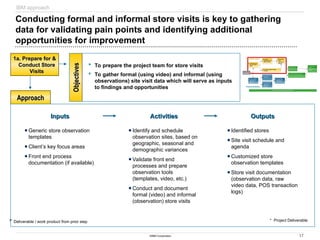
Conducting formal and informal store visits is key to gathering
data for validating pain points and identifying additional
opportunities for improvement
 To prepare the project team for store visits
 To gather formal (using video) and informal (using
observations) site visit data which will serve as inputs
to findings and opportunities
Objectives
Objectives
Approach
Approach
APPROACH and SAMPLE RESULTS
IBM approach
Outputs
Outputs
Inputs
Inputs Activities
Activities
Identify and schedule
observation sites, based on
geographic, seasonal and
demographic variances
Validate front end
processes and prepare
observation tools
(templates, video, etc.)
Conduct and document
formal (video) and informal
(observation) store visits
Generic store observation
templates
Client’s key focus areas
Front end process
documentation (if available)
Identified stores
Site visit schedule and
agenda
Customized store
observation templates
Store visit documentation
(observation data, raw
video data, POS transaction
logs)
1a. Prepare for &
1a. Prepare for &
Conduct Store
Conduct Store
Visits
Visits
* Project Deliverable
P
Deliverable / work product from prior step
1b. Assess
1b. Assess
Opportunities &
Opportunities &
Best Practices
Best Practices
0. Prepare &
0. Prepare &
Prioritize
Prioritize
1a. Prepare for &
1a. Prepare for &
Conduct Store
Conduct Store
Visits
Visits
1c. Conduct Detailed Video
Analysis
Analysis
1d. Develop
1d. Develop
Pilot
Pilot
Recommen
Recommen
dations
dations
3a. Pilot Quick
3a. Pilot Quick
Hits
Hits
3b. Pilot Strategic Initiatives
3c. Implement
3c. Implement
New
New
Operating
Operating
Model
Model
Store Observations
Store Observations
4. Perform Change Management Activities
2c. Perform Data
2c. Perform Data
Discovery &
Discovery &
Generate
Generate
Reports
Reports
2b. Perform Data
2b. Perform Data
Mapping
Mapping
2a. ID Front End
2a. ID Front End
Productivity
Productivity
Metrics &
Metrics &
Reports
Reports
2d. Pilot Initial
2d. Pilot Initial
Reports and
Reports and
Data Models
Data Models
Productivity Metrics
18
©IBM Corporation
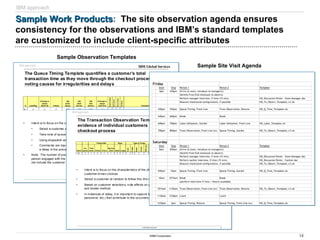
Sample Work Products
Sample Work Products: The site observation agenda ensures
consistency for the observations and IBM’s standard templates
are customized to include client-specific attributes
1
© 20 02 IBM Cor por ation
IBM Global Services
IBM Global Services
The Queue Timing Template quantifies a customer’s total
transaction time as they move through the checkout process,
noting causes for irregularities and delays
IBM approach
• Intent is to focus on the overall process duration, especially as affected by post-scan activities.
• Select a customer at random to follow thru the checkout process.
• Take note of queue length, both at the entry and exit
• Using stopwatch and personal observation make notations to the chart as appropriate.
• Comments are important for gathering other miscellaneous observations, such as reason for
a delay in the process.
• Note: The number of people in the queue should equal all those in line waiting for service plus the
person engaged with the cashier (in this case, two in line plus one). However, this figure should
not include the customer you are tracking.
# Lane/Reg
# People in
Queue
(Enter Q) # Items
TIME
Enter
Queue
TIME
Start
Service
TIME
End
Service
# People in
Queue
(End Svc)
Head
Cashier
UPC
Book
Price
Check
Till
Strip
Comments
Ex. 5 3 11 0:00 4:02 5:37 2
2
© 20 02 IBM Corpor ation
IBM Global Services
IBM Global Services
The Transaction Observation Template captures qualitative
evidence of individual customers progressing through the
checkout process
IBM approach
• Intent is to focus on the characteristics of the checkout process, particularly noting the effect of
customer-driven choices.
• Select a customer at random to follow thru the checkout process.
• Based on customer selections, note effects on product scanning method, handling by the cashier,
and tender method.
• In instances of delay, it is important to capture the situational aspects (process, product,
personnel, etc.) that contribute to the occurrence.
Obs #
# in
queue
Total
Items # Scan # Gun
Qty Key
Used Small Large
Cash
Credit
Debit
Check
Gift
card
Other Bag
Head
Cashier
UPC
Book
Price
Check
Till
Strip Comments
Ex. 2 7 5 1 1 4 3 X 2 l
Product Mix Type of Tender Use of following and #:
Sizes
Friday
Start Stop Person 1 Person 2 Template
4pm 430pm Arrive at store, introduce to manager(s)
Identify Front End checkouts to observe.
Perform manager interview, if time (15 min). HD_Discussion Points - Store Manager.doc
Measure checkstand configurations, if possible HD_Tx_Observ_Template_v3.xls
430pm 545pm Queue Timing, Front Line Trans Observation, Returns HD_Q_Time_Template.xls
545pm 600pm Break Break
600pm 700pm Labor Utilization, Garden Labor Utilization, Front Line HD_Labor_Template.xls
700pm 800pm Trans Observation, Front Line (ss) Queue Timing, Garden HD_Tx_Observ_Template_v3.xls
Saturday
Start Stop Person 1 Person 2 Template
8am 830am Arrive at store, introduce to manager(s)
Identify Front End checkouts to observe.
Perform manager interview, if time (15 min). HD_Discussion Points - Store Manager.doc
Perform cashier interview, if time (15 min). HD_Discussion Points - Cashier.doc
Measure checkstand configurations, if possible HD_Tx_Observ_Template_v3.xls
830am 10am Queue Timing, Front Line Queue Timing, Garden HD_Q_Time_Template.xls
10am 1015am Break Break
(perform interviews if time / they're available)
1015am 1130am Trans Observation, Front Line (ss) Trans Observation, Returns HD_Tx_Observ_Template_v3.xls
1130am 1230pm Lunch Lunch
1230pm 2pm Queue Timing, Returns Queue Timing, Front Line (ss) HD_Q_Time_Template.xls
Sample Site Visit Agenda
Sample Observation Templates
IBM approach
19
©IBM Corporation
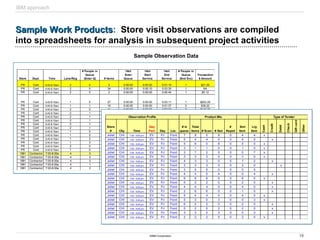
Sample Work Products
Sample Work Products: Store visit observations are compiled
into spreadsheets for analysis in subsequent project activities
Sample Observation Data
Store Dept. Time Lane/Reg
# People in
Queue
(Enter Q) # Items
TIME
Enter
Queue
TIME
Start
Service
TIME
End
Service
# People in
Queue
(End Svc)
Transaction
$ Amount
PR Cont 6:45-8:15am 2 0 3 0:00:00 0:00:00 0:01:10 1 $21.00
PR Cont 6:45-8:15am 2 0 34 0:00:00 0:00:10 0:03:30 1 NA
PR Cont 6:45-8:15am 2 0 2 0:00:00 0:00:00 0:00:44 1 $5.12
PR Cont 6:45-8:15am 1 0 27 0:00:00 0:00:00 0:03:11 1 $203.20
PR Cont 6:45-8:15am 1 1 10 0:00:00 0:00:50 0:01:37 0 $38.22
PR Cont 6:45-8:15am 2 0 6 0:00:00 0:00:05 0:02:30 0 $142.20
PR Cont 6:45-8:15am 2 1 4 0:00:00 0:00:36 0:01:21 2 $56.02
PR Cont 6:45-8:15am 2 1 1 0:00:00 0:00:24 0:00:50 0 $6.37
PR Cont 6:45-8:15am 2 1 4 0:00:00 0:01:01 0:02:59 0 $22.37
PR Cont 6:45-8:15am 2 1 6 0:00:00 0:00:25 0:01:14 1 $15.01
PR Cont 6:45-8:15am 2 1 51 0:00:00 0:01:03 0:03:40 0 $155.20
PR Cont 6:45-8:15am 1 0 1 0:00:00 0:00:15 0:00:37 1 $3.00
PR Cont 6:45-8:15am 1 0 12 0:00:00 0:00:00 0:00:48 3 $41.99
PR Cont 6:45-8:15am 1 2 34 0:00:00 0:00:52 0:02:19 3 $135.63
PR Cont 6:45-8:15am 1 3 3 0:00:00 0:01:35 0:02:38 1 $27.10
PR Cont 6:45-8:15am 2 0 1 0:00:00 0:00:00 0:00:54 0 $10.49
PR Cont 6:45-8:15am 1 0 7 0:00:00 0:00:00 0:01:20 1 $25.91
1961 Contractor 7:00-8:00a 4 0 10 10:01:00 10:16:00 11:34:00 0 $86.10
1961 Contractor 7:00-8:00a 4 0 11 11:48:00 11:48:00 13:11:00 0 $77.95
1961 Contractor 7:00-8:00a 4 0 1 17:48:00 17:49:00 23:06:00 1 $19.49
1961 Contractor 7:00-8:00a 4 1 16 22:12:00 23:10:00 25:00:00 0 $232.30
1961 Contractor 7:00-8:00a 4 0 1 26:51:00 26:51:00 27:26:00 0 $15.15
Store
# City Time
Day
Part Day Loc.
# in
queue
Total
Items # Scan # Gun
#
Keyed
Sml
Item
Lrg
Item
Cash
Credit
Debit
Check
Gift
card
Other
Joliet CHI 7:00 - 8:00 pm EV Fri Front 7 8 0 8 0 4 4 x
Joliet CHI 7:00 - 8:00 pm EV Fri Front 5 4 4 0 0 5 0 x
Joliet CHI 7:00 - 8:00 pm EV Fri Front 5 6 0 6 0 5 0 x
Joliet CHI 7:00 - 8:00 pm EV Fri Front 3 1 1 0 0 1 0 x
Joliet CHI 7:00 - 8:00 pm EV Fri Front 3 7 2 5 0 0 7 x
Joliet CHI 7:00 - 8:00 pm EV Fri Front 3 3 3 0 0 3 0 x
Joliet CHI 7:00 - 8:00 pm EV Fri Front 4 3 3 0 0 1 2 x
Joliet CHI 7:00 - 8:00 pm EV Fri Front 3 3 3 0 0 3 0 x
Joliet CHI 7:00 - 8:00 pm EV Fri Front 3 5 5 0 5 0 5
Joliet CHI 7:00 - 8:00 pm EV Fri Front 4 4 0 4 0 0 4 x
Joliet CHI 7:00 - 8:00 pm EV Fri Front 6 6 6 0 0 6 0 x
Joliet CHI 7:00 - 8:00 pm EV Fri Front 5 2 2 0 0 2 0 x
Joliet CHI 7:00 - 8:00 pm EV Fri Front 4 4 4 0 0 4 0 x
Joliet CHI 7:00 - 8:00 pm EV Fri Front 2 6 6 0 0 1 5 x
Joliet CHI 7:00 - 8:00 pm EV Fri Front 5 4 4 0 0 4 0 x
Joliet CHI 7:00 - 8:00 pm EV Fri Front 5 3 0 3 0 0 3 x
Joliet CHI 7:00 - 8:00 pm EV Fri Front 6 2 2 0 0 2 0 x
Joliet CHI 7:00 - 8:00 pm EV Fri Front 5 2 0 2 0 2 0 x
Joliet CHI 7:00 - 8:00 pm EV Fri Front 3 3 0 3 0 0 3 x
Joliet CHI 7:00 - 8:00 pm EV Fri Front 2 2 2 0 0 2 0 x
Observation Profile Product Mix Type of Tender
IBM approach
20
©IBM Corporation
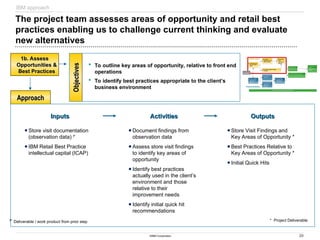
The project team assesses areas of opportunity and retail best
practices enabling us to challenge current thinking and evaluate
new alternatives
 To outline key areas of opportunity, relative to front end
operations
 To identify best practices appropriate to the client’s
business environment
APPROACH and SAMPLE RESULTS
IBM approach
1b. Assess
1b. Assess
Opportunities &
Opportunities &
Best Practices
Best Practices
Objectives
Objectives
Approach
Approach
Outputs
Outputs
Inputs
Inputs Activities
Activities
Document findings from
observation data
Assess store visit findings
to identify key areas of
opportunity
Identify best practices
actually used in the client’s
environment and those
relative to their
improvement needs
Identify initial quick hit
recommendations
Store visit documentation
(observation data) P
IBM Retail Best Practice
intellectual capital (ICAP)
Store Visit Findings and
Key Areas of Opportunity *
Best Practices Relative to
Key Areas of Opportunity *
Initial Quick Hits
* Project Deliverable
P
Deliverable / work product from prior step
1b. Assess
1b. Assess
Opportunities &
Opportunities &
Best Practices
Best Practices
0. Prepare &
0. Prepare &
Prioritize
Prioritize
1a. Prepare for &
1a. Prepare for &
Conduct Store
Conduct Store
Visits
Visits
1c. Conduct Detailed Video
Analysis
Analysis
1d. Develop
1d. Develop
Pilot
Pilot
Recommen
Recommen
dations
dations
3a. Pilot Quick
3a. Pilot Quick
Hits
Hits
3b. Pilot Strategic Initiatives
3c. Implement
3c. Implement
New
New
Operating
Operating
Model
Model
Store Observations
Store Observations
4. Perform Change Management Activities
2c. Perform Data
2c. Perform Data
Discovery &
Discovery &
Generate
Generate
Reports
Reports
2b. Perform Data
2b. Perform Data
Mapping
Mapping
2a. ID Front End
2a. ID Front End
Productivity
Productivity
Metrics &
Metrics &
Reports
Reports
2d. Pilot Initial
2d. Pilot Initial
Reports and
Reports and
Data Models
Data Models
Productivity Metrics
21
©IBM Corporation
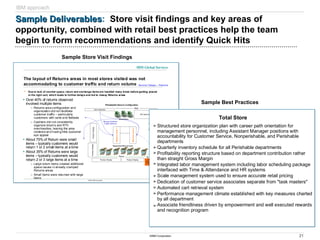
Sample Deliverables
Sample Deliverables: Store visit findings and key areas of
opportunity, combined with retail best practices help the team
begin to form recommendations and identify Quick Hits
Sample Store Visit Findings
14
© 20 01 IBM Cor por ation
IBM Global Services
IBM Global Services
The layout of Returns areas in most stores visited was not
accommodating to customer traffic and return volume
 Over 40% of returns observed
involved multiple items
– Returns area configuration and
organization did not facilitate
customer traffic – particularly
customers with carts and flatbeds
– Cashiers did not consistently
organize returns and RTV
merchandise, leaving the area
cluttered and having little customer
eye appeal
 About 75% of Return were small
items – typically customers would
return 1 or 2 small items at a time
 About 35% of Returns were large
items – typically customers would
return 2 or 3 large items at a time
– Large return items created additional
space issues in already cramped
Returns areas
– Small items were returned with large
items
RTV shelves
Returns
Lane
1
Returns
Lane
2
Returns
Lane
3
Store Entrance
Product
Display
Wall
Sp. Services
Desk
Product
Display
Product Display Product Display
Fence
Wall
Wheelchairs
Department Returns Carts
Sign:
Authorized
Personnel
Only
RTV Cart
Returns Customer
Traffic Patterns
Philadelphia Returns Configuration
RTV shelves
Returns
Lane
1
Returns
Lane
2
Returns
Lane
3
Store Entrance
Product
Display
Wall
Sp. Services
Desk
Product
Display
Product Display Product Display
Fence
Wall
Wall
Wheelchairs
Department Returns Carts
Sign:
Authorized
Personnel
Only
RTV Cart
Returns Customer
Traffic Patterns
Philadelphia Returns Configuration
Service Delays – Returns
• Due to lack of counter space, return and exchange items are handled many times before getting placed
in the right cart, which leads to further delays and led to messy Returns areas
Sample Best Practices
Total Store
Structured store organization plan with career path orientation for
management personnel, including Assistant Manager positions with
accountability for Customer Service, Nonperishable, and Perishable
departments
Quarterly inventory schedule for all Perishable departments
Profitability reporting structure based on department contribution rather
than straight Gross Margin
Integrated labor management system including labor scheduling package
interfaced with Time & Attendance and HR systems
Scale management system used to ensure accurate retail pricing
Dedication of customer service associates separate from "task masters"
Automated cart retrieval system
Performance management climate established with key measures charted
by all department
Associate friendliness driven by empowerment and well executed rewards
and recognition program
IBM approach
22
©IBM Corporation
Sample Deliverables
Sample Deliverables: Store visit findings and key areas of
opportunity, combined with retail best practices help the team
begin to form recommendations and identify Quick Hits
Sample Quick Hits
QUICK HITS
# Name Short Description Enablers
Expected Capabilities /
Benefits
Approx. Cost
Timeframe to
Implement
Impacted
Personnel
Impacted Areas Owner
1 Manage Sales
Signage
a. Remove signs promptly after a sale ends.
b. Sale signage should prominently display the ending
date for the sale.
c. Use a single color for all sale signage for a given
time period. The sale signs for the next period should
be a different color. Rotate through several (i.e., 6-8)
colors over time. The “color” of the weekly sale could
be touted in advertising materials. E.g., weekly sales
flyers could state the sales “color” signage to look for.
Communication of sale
start / end dates to store
staff
Discepancies will be
dealt with on the sales
floor rather than at
checkout.
Higher customer
satisfaction due to less
confusion and neater
store appearance
Minimal 1 month Cashiers, Floor
Associates
Entire Store S. Walton
2 Sales Floor Staff
Coverage
Maintain adequate sales floor staff to be available and
easily found or called by shoppers if they
want to ask a question before checkout.
Defined roles &
responsibilities
Staff deployment
[Labor scheduling
application]
Higher customer
satisfaction
Improved throughput due
to minimized delays
caused by customer
questions
Possible
additional labor
2 months Cashiers, Floor
Associates
Entire Store M. Field
3 Price Check
Review
Review all price checks for some period (e.g., a month)
to determine cause and typical amount under dispute.
For small disputed amounts, take the shopper’s word.
Over time, monitor the results of the dispute
resolutions to insure (a) that the practice is
implemented as desired and (b) that shoppers do not
take advantage of the store’s good faith.
Transaction Log data Improved customer
satisfaction due to
reduced delays caused
by price checks
Improved throughput
Additional
labor and/or
consultants (if
use external
resources)
1 month Cashiers Checkout B. Marcus
IBM approach
23
©IBM Corporation
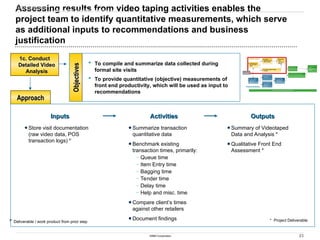
Assessing results from video taping activities enables the
project team to identify quantitative measurements, which serve
as additional inputs to recommendations and business
justification
 To compile and summarize data collected during
formal site visits
 To provide quantitative (objective) measurements of
front end productivity, which will be used as input to
recommendations
APPROACH and SAMPLE RESULTS
IBM approach
1c. Conduct
1c. Conduct
Detailed Video
Detailed Video
Analysis
Analysis
Approach
Approach
Outputs
Outputs
Inputs
Inputs Activities
Activities
Summarize transaction
quantitative data
Benchmark existing
transaction times, primarily:
– Queue time
– Item Entry time
– Bagging time
– Tender time
– Delay time
– Help and misc. time
Compare client’s times
against other retailers
Document findings
Store visit documentation
(raw video data, POS
transaction logs) P
Summary of Videotaped
Data and Analysis *
Qualitative Front End
Assessment *
* Project Deliverable
P
Deliverable / work product from prior step
Objectives
Objectives
1b. Assess
1b. Assess
Opportunities &
Opportunities &
Best Practices
Best Practices
0. Prepare &
0. Prepare &
Prioritize
Prioritize
1a. Prepare for &
1a. Prepare for &
Conduct Store
Conduct Store
Visits
Visits
1c. Conduct Detailed Video
Analysis
Analysis
1d. Develop
1d. Develop
Pilot
Pilot
Recommen
Recommen
dations
dations
3a. Pilot Quick
3a. Pilot Quick
Hits
Hits
3b. Pilot Strategic Initiatives
3c. Implement
3c. Implement
New
New
Operating
Operating
Model
Model
Store Observations
Store Observations
4. Perform Change Management Activities
2c. Perform Data
2c. Perform Data
Discovery &
Discovery &
Generate
Generate
Reports
Reports
2b. Perform Data
2b. Perform Data
Mapping
Mapping
2a. ID Front End
2a. ID Front End
Productivity
Productivity
Metrics &
Metrics &
Reports
Reports
2d. Pilot Initial
2d. Pilot Initial
Reports and
Reports and
Data Models
Data Models
Productivity Metrics
24
©IBM Corporation
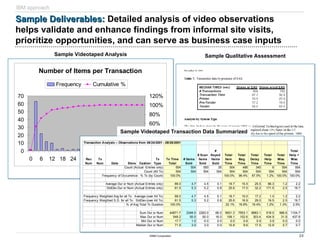
Sample Qualitative Assessment
Number of Items per Transaction
0
10
20
30
40
50
60
70
0 6 12 18 24 30 36 42 48 54 60
0%
20%
40%
60%
80%
100%
120%
Frequency Cumulative %
Sample Videotaped Analysis
Sample Deliverables:
Sample Deliverables: Detailed analysis of video observations
helps validate and enhance findings from informal site visits,
prioritize opportunities, and can serve as business case inputs
Sample Videotaped Transaction Data Summarized
Transaction Analysis -- Observations from 08/24/2001 - 08/26/2001
Rec
Num
Tx
Num Date Store Cashier
Tx
Type
Tx Time
Total
# Items
Sold
# Scan
Items
Sold
#
Keyed
Items
Sold
Total
Item
Time
Total
Bag
Time
Total
Delay
Time
Total
Help
Time
Total
Misc
Time
Total
Help +
Misc
Time
Count (Actual Entries only) 504 504 500 35 504 486 340 6 504 504
Count (All Tx) 504 504 504 504 504 504 504 504 504 504
Frequency of Occurrence: % Tx (by Count) 100.0% 100.0% 96.4% 67.5% 1.2% 100.0% 100.0%
Average Dur or Num (Actual Entries only) 89.0 4.7 4.5 0.1 19.7 15.5 25.5 86.3 1.2 2.2
StdDev Dur or Num (Actual Entries only) 61.5 5.3 5.2 0.8 25.6 17.0 32.2 171.5 2.5 19.7
Frequency Weighted Avg for all Tx: Average (over All Tx) 89.0 4.7 4.5 0.1 19.7 15.0 17.2 1.0 1.2 2.2
Frequency Weighted S.D. for all Tx: StdDev (over All Tx) 61.5 5.3 5.2 0.8 25.6 16.9 29.0 19.5 2.5 19.7
% of Avg Total Tx Duration 100.0% 22.1% 16.8% 19.4% 1.2% 1.3% 2.5%
Sum Dur or Num 44871.7 2349.0 2283.0 66.0 9931.3 7553.1 8683.1 518.0 586.6 1104.7
Max Dur or Num 549.2 50.0 50.0 16.0 199.1 152.6 303.4 434.9 31.9 437.8
Min Dur or Num 17.7 1.0 0.0 0.0 0.0 0.6 0.9 3.9 0.0 0.0
Median Dur or Num 71.9 3.0 3.0 0.0 10.8 9.6 17.5 12.8 0.7 0.7
IBM approach
25
©IBM Corporation
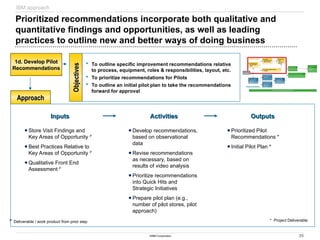
Prioritized recommendations incorporate both qualitative and
quantitative findings and opportunities, as well as leading
practices to outline new and better ways of doing business
 To outline specific improvement recommendations relative
to process, equipment, roles & responsibilities, layout, etc.
 To prioritize recommendations for Pilots
 To outline an initial pilot plan to take the recommendations
forward for approval
APPROACH and SAMPLE RESULTS
IBM approach
1d. Develop Pilot
1d. Develop Pilot
Recommendations
Recommendations
Approach
Approach
Outputs
Outputs
Inputs
Inputs Activities
Activities
Develop recommendations,
based on observational
data
Revise recommendations
as necessary, based on
results of video analysis
Prioritize recommendations
into Quick Hits and
Strategic Initiatives
Prepare pilot plan (e.g.,
number of pilot stores, pilot
approach)
Store Visit Findings and
Key Areas of Opportunity P
Best Practices Relative to
Key Areas of Opportunity P
Qualitative Front End
Assessment P
Prioritized Pilot
Recommendations *
Initial Pilot Plan *
* Project Deliverable
P
Deliverable / work product from prior step
Objectives
Objectives
1b. Assess
1b. Assess
Opportunities &
Opportunities &
Best Practices
Best Practices
0. Prepare &
0. Prepare &
Prioritize
Prioritize
1a. Prepare for &
1a. Prepare for &
Conduct Store
Conduct Store
Visits
Visits
1c. Conduct Detailed Video
Analysis
Analysis
1d. Develop
1d. Develop
Pilot
Pilot
Recommen
Recommen
dations
dations
3a. Pilot Quick
3a. Pilot Quick
Hits
Hits
3b. Pilot Strategic Initiatives
3c. Implement
3c. Implement
New
New
Operating
Operating
Model
Model
Store Observations
Store Observations
4. Perform Change Management Activities
2c. Perform Data
2c. Perform Data
Discovery &
Discovery &
Generate
Generate
Reports
Reports
2b. Perform Data
2b. Perform Data
Mapping
Mapping
2a. ID Front End
2a. ID Front End
Productivity
Productivity
Metrics &
Metrics &
Reports
Reports
2d. Pilot Initial
2d. Pilot Initial
Reports and
Reports and
Data Models
Data Models
Productivity Metrics
26
©IBM Corporation
Customer Service
Baseline Findings
Sample
Recommendations
Inconsistent greetings create
bottlenecks at the menu board and
front counter
- Construct a service manual which defines standard customer greeting
procedures
- Continually reinforce crew training
- Post signs by registers with standardized greetings and suggestive selling
Employee multi-tasking, training,
staffing, & deployment contributed
to delays at menu board, pay
window, PUW, front counter register
- Construct a service manual which defines daypart staffing and deployment
guidelines, staffing roles and responsibilities, and service standards
- Continually reinforce crew training
- Create "teams" within the restaurants at both the front counter and
drive-thru to create enthusiasm
Inconsistent execution of change
making procedures create
bottlenecks at the pay window &
front counter register
- Construct a service manual which defines standard change making
procedures
- Continually reinforce crew training
- Design and post a card/poster with "change recipes" to facilitate change
making process
POS functionality contributes to
bottlenecks at the menu board and
register
- Reduce the number of keys required & improve keyboard maneuvering
Menu complexity causes
bottlenecks at the menu board and
registers
- Make menu headings a different color form the menu items and
standardize
throughout the system
Product delays were due to product
build complexity and assembly
issues
- Continually reinforce crew training
- Eliminate delay in items appearing on VDU (kitchen monitors)
- Implement training to improve communications between sandwich maker
and grill person
- Pre-package condiments unique to each product group
Sample Deliverables
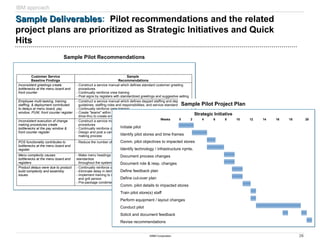
Sample Deliverables: Pilot recommendations and the related
project plans are prioritized as Strategic Initiatives and Quick
Hits
Sample Pilot Project Plan
Sample Pilot Recommendations
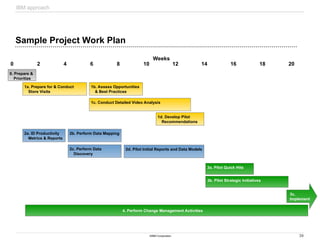
Initiate pilot
Identify pilot stores and time frames
Comm. pilot objectives to impacted stores
Identify technology / infrastructure rqmts.
Document process changes
Document role & resp. changes
Define feedback plan
Define cut-over plan
Comm. pilot details to impacted stores
Train pilot store(s) staff
Perform equipment / layout changes
Conduct pilot
Solicit and document feedback
Revise recommendations
0 2 4 6 8 10 12 14 16 18 20
Weeks
Strategic Initiative
IBM approach
27
©IBM Corporation
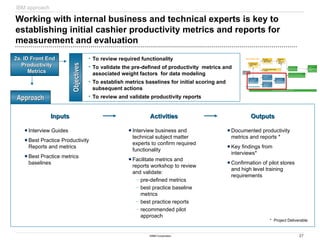
Working with internal business and technical experts is key to
establishing initial cashier productivity metrics and reports for
measurement and evaluation
APPROACH and SAMPLE RESULTS
IBM approach
Objectives
Objectives
Approach
Approach
Outputs
Outputs
• To review required functionality
• To validate the pre-defined of productivity metrics and
associated weight factors for data modeling
• To establish metrics baselines for initial scoring and
subsequent actions
• To review and validate productivity reports
Inputs
Inputs Activities
Activities
Interview business and
technical subject matter
experts to confirm required
functionality
Facilitate metrics and
reports workshop to review
and validate:
– pre-defined metrics
– best practice baseline
metrics
– best practice reports
– recommended pilot
approach
Interview Guides
Best Practice Productivity
Reports and metrics
Best Practice metrics
baselines
Documented productivity
metrics and reports *
Key findings from
interviews*
Confirmation of pilot stores
and high level training
requirements
* Project Deliverable
2a. ID Front End
2a. ID Front End
Productivity
Productivity
Metrics
Metrics
1b. Assess
1b. Assess
Opportunities &
Opportunities &
Best Practices
Best Practices
0. Prepare &
0. Prepare &
Prioritize
Prioritize
1a. Prepare for &
1a. Prepare for &
Conduct Store
Conduct Store
Visits
Visits
1c. Conduct Detailed Video
Analysis
Analysis
1d. Develop
1d. Develop
Pilot
Pilot
Recommen
Recommen
dations
dations
3a. Pilot Quick
3a. Pilot Quick
Hits
Hits
3b. Pilot Strategic Initiatives
3c. Implement
3c. Implement
New
New
Operating
Operating
Model
Model
Store Observations
Store Observations
4. Perform Change Management Activities
2c. Perform Data
2c. Perform Data
Discovery &
Discovery &
Generate
Generate
Reports
Reports
2b. Perform Data
2b. Perform Data
Mapping
Mapping
2a. ID Front End
2a. ID Front End
Productivity
Productivity
Metrics &
Metrics &
Reports
Reports
2d. Pilot Initial
2d. Pilot Initial
Reports and
Reports and
Data Models
Data Models
Productivity Metrics
28
©IBM Corporation
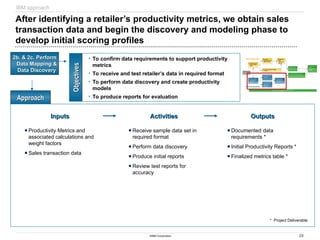
After identifying a retailer’s productivity metrics, we obtain sales
transaction data and begin the discovery and modeling phase to
develop initial scoring profiles
APPROACH and SAMPLE RESULTS
IBM approach
2b. & 2c. Perform
2b. & 2c. Perform
Data Mapping &
Data Mapping &
Data Discovery
Data Discovery
Objectives
Objectives
Approach
Approach
Outputs
Outputs
• To confirm data requirements to support productivity
metrics
• To receive and test retailer’s data in required format
• To perform data discovery and create productivity
models
• To produce reports for evaluation
Inputs
Inputs Activities
Activities
Receive sample data set in
required format
Perform data discovery
Produce initial reports
Review test reports for
accuracy
Productivity Metrics and
associated calculations and
weight factors
Sales transaction data
Documented data
requirements *
Initial Productivity Reports *
Finalized metrics table *
* Project Deliverable
1b. Assess
1b. Assess
Opportunities &
Opportunities &
Best Practices
Best Practices
0. Prepare &
0. Prepare &
Prioritize
Prioritize
1a. Prepare for &
1a. Prepare for &
Conduct Store
Conduct Store
Visits
Visits
1c. Conduct Detailed Video
Analysis
Analysis
1d. Develop
1d. Develop
Pilot
Pilot
Recommen
Recommen
dations
dations
3a. Pilot Quick
3a. Pilot Quick
Hits
Hits
3b. Pilot Strategic Initiatives
3c. Implement
3c. Implement
New
New
Operating
Operating
Model
Model
Store Observations
Store Observations
4. Perform Change Management Activities
2c. Perform Data
2c. Perform Data
Discovery &
Discovery &
Generate
Generate
Reports
Reports
2b. Perform Data
2b. Perform Data
Mapping
Mapping
2a. ID Front End
2a. ID Front End
Productivity
Productivity
Metrics &
Metrics &
Reports
Reports
2d. Pilot Initial
2d. Pilot Initial
Reports and
Reports and
Data Models
Data Models
Productivity Metrics
29
©IBM Corporation
Productivity Metrics Sample Reports:
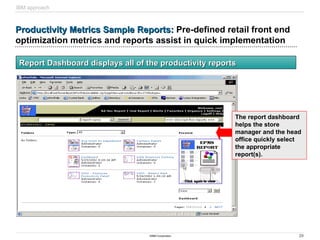
Productivity Metrics Sample Reports: Pre-defined retail front end
optimization metrics and reports assist in quick implementation
Report Dashboard displays all of the productivity reports
IBM approach
The report dashboard
helps the store
manager and the head
office quickly select
the appropriate
report(s).
30
©IBM Corporation
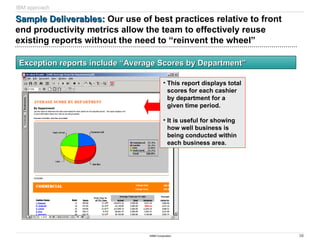
Sample Deliverables:
Sample Deliverables: Our use of best practices relative to front
end productivity metrics allow the team to effectively reuse
existing reports without the need to “reinvent the wheel”
Exception reports include “Average Scores by Department”
• This report displays total
scores for each cashier
by department for a
given time period.
• It is useful for showing
how well business is
being conducted within
each business area.
IBM approach
31
©IBM Corporation
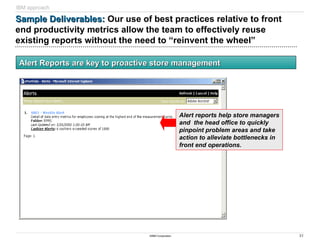
Sample Deliverables:
Sample Deliverables: Our use of best practices relative to front
end productivity metrics allow the team to effectively reuse
existing reports without the need to “reinvent the wheel”
Alert Reports are key to proactive store management
Alert reports help store managers
and the head office to quickly
pinpoint problem areas and take
action to alleviate bottlenecks in
front end operations.
IBM approach
32
©IBM Corporation
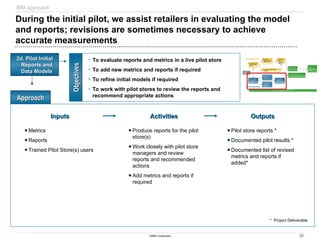
During the initial pilot, we assist retailers in evaluating the model
and reports; revisions are sometimes necessary to achieve
accurate measurements
APPROACH and SAMPLE RESULTS
IBM approach
Objectives
Objectives
Approach
Approach
Outputs
Outputs
• To evaluate reports and metrics in a live pilot store
• To add new metrics and reports if required
• To refine initial models if required
• To work with pilot stores to review the reports and
recommend appropriate actions
Inputs
Inputs Activities
Activities
Produce reports for the pilot
store(s)
Work closely with pilot store
managers and review
reports and recommended
actions
Add metrics and reports if
required
Metrics
Reports
Trained Pilot Store(s) users
Pilot store reports *
Documented pilot results *
Documented list of revised
metrics and reports if
added*
* Project Deliverable
2d. Pilot Initial
2d. Pilot Initial
Reports and
Reports and
Data Models
Data Models
1b. Assess
1b. Assess
Opportunities &
Opportunities &
Best Practices
Best Practices
0. Prepare &
0. Prepare &
Prioritize
Prioritize
1a. Prepare for &
1a. Prepare for &
Conduct Store
Conduct Store
Visits
Visits
1c. Conduct Detailed Video
Analysis
Analysis
1d. Develop
1d. Develop
Pilot
Pilot
Recommen
Recommen
dations
dations
3a. Pilot Quick
3a. Pilot Quick
Hits
Hits
3b. Pilot Strategic Initiatives
3c. Implement
3c. Implement
New
New
Operating
Operating
Model
Model
Store Observations
Store Observations
4. Perform Change Management Activities
2c. Perform Data
2c. Perform Data
Discovery &
Discovery &
Generate
Generate
Reports
Reports
2b. Perform Data
2b. Perform Data
Mapping
Mapping
2a. ID Front End
2a. ID Front End
Productivity
Productivity
Metrics &
Metrics &
Reports
Reports
2d. Pilot Initial
2d. Pilot Initial
Reports and
Reports and
Data Models
Data Models
Productivity Metrics
33
©IBM Corporation
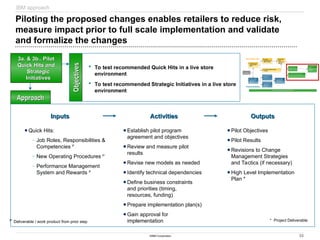
Piloting the proposed changes enables retailers to reduce risk,
measure impact prior to full scale implementation and validate
and formalize the changes
 To test recommended Quick Hits in a live store
environment
 To test recommended Strategic Initiatives in a live store
environment
APPROACH and SAMPLE RESULTS
IBM approach
3a. & 3b.. Pilot
3a. & 3b.. Pilot
Quick Hits and
Quick Hits and
Strategic
Strategic
Initiatives
Initiatives
Approach
Approach
Outputs
Outputs
Inputs
Inputs Activities
Activities
Establish pilot program
agreement and objectives
Review and measure pilot
results
Revise new models as needed
Identify technical dependencies
Define business constraints
and priorities (timing,
resources, funding)
Prepare implementation plan(s)
Gain approval for
implementation
Quick Hits:
– Job Roles, Responsibilities &
Competencies P
– New Operating Procedures P
– Performance Management
System and Rewards P
Pilot Objectives
Pilot Results
Revisions to Change
Management Strategies
and Tactics (if necessary)
High Level Implementation
Plan *
* Project Deliverable
P
Deliverable / work product from prior step
Objectives
Objectives
1b. Assess
1b. Assess
Opportunities &
Opportunities &
Best Practices
Best Practices
0. Prepare &
0. Prepare &
Prioritize
Prioritize
1a. Prepare for &
1a. Prepare for &
Conduct Store
Conduct Store
Visits
Visits
1c. Conduct Detailed Video
Analysis
Analysis
1d. Develop
1d. Develop
Pilot
Pilot
Recommen
Recommen
dations
dations
3a. Pilot Quick
3a. Pilot Quick
Hits
Hits
3b. Pilot Strategic Initiatives
3c. Implement
3c. Implement
New
New
Operating
Operating
Model
Model
Store Observations
Store Observations
4. Perform Change Management Activities
2c. Perform Data
2c. Perform Data
Discovery &
Discovery &
Generate
Generate
Reports
Reports
2b. Perform Data
2b. Perform Data
Mapping
Mapping
2a. ID Front End
2a. ID Front End
Productivity
Productivity
Metrics &
Metrics &
Reports
Reports
2d. Pilot Initial
2d. Pilot Initial
Reports and
Reports and
Data Models
Data Models
Productivity Metrics
34
©IBM Corporation
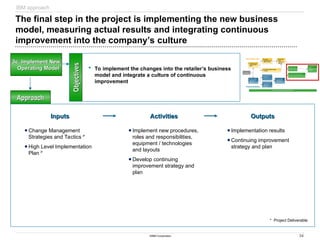
The final step in the project is implementing the new business
model, measuring actual results and integrating continuous
improvement into the company’s culture
 To implement the changes into the retailer’s business
model and integrate a culture of continuous
improvement
APPROACH and SAMPLE RESULTS
IBM approach
3c. Implement New
3c. Implement New
Operating Model
Operating Model
Approach
Approach
Outputs
Outputs
Inputs
Inputs Activities
Activities
* Project Deliverable
Implement new procedures,
roles and responsibilities,
equipment / technologies
and layouts
Develop continuing
improvement strategy and
plan
Change Management
Strategies and Tactics P
High Level Implementation
Plan P
Implementation results
Continuing improvement
strategy and plan
Objectives
Objectives
1b. Assess
1b. Assess
Opportunities &
Opportunities &
Best Practices
Best Practices
0. Prepare &
0. Prepare &
Prioritize
Prioritize
1a. Prepare for &
1a. Prepare for &
Conduct Store
Conduct Store
Visits
Visits
1c. Conduct Detailed Video
Analysis
Analysis
1d. Develop
1d. Develop
Pilot
Pilot
Recommen
Recommen
dations
dations
3a. Pilot Quick
3a. Pilot Quick
Hits
Hits
3b. Pilot Strategic Initiatives
3c. Implement
3c. Implement
New
New
Operating
Operating
Model
Model
Store Observations
Store Observations
4. Perform Change Management Activities
2c. Perform Data
2c. Perform Data
Discovery &
Discovery &
Generate
Generate
Reports
Reports
2b. Perform Data
2b. Perform Data
Mapping
Mapping
2a. ID Front End
2a. ID Front End
Productivity
Productivity
Metrics &
Metrics &
Reports
Reports
2d. Pilot Initial
2d. Pilot Initial
Reports and
Reports and
Data Models
Data Models
Productivity Metrics
35
©IBM Corporation
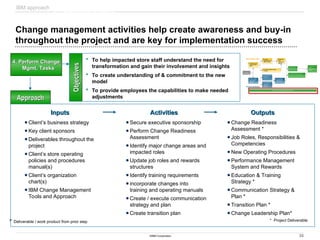
Change management activities help create awareness and buy-in
throughout the project and are key for implementation success
 To help impacted store staff understand the need for
transformation and gain their involvement and insights
 To create understanding of & commitment to the new
model
 To provide employees the capabilities to make needed
adjustments
APPROACH and SAMPLE RESULTS
IBM approach
4. Perform Change
4. Perform Change
Mgmt. Tasks
Mgmt. Tasks
Objectives
Objectives
Approach
Approach
Outputs
Outputs
Inputs
Inputs Activities
Activities
Secure executive sponsorship
Perform Change Readiness
Assessment
Identify major change areas and
impacted roles
Update job roles and rewards
structures
Identify training requirements
incorporate changes into
training and operating manuals
Create / execute communication
strategy and plan
Create transition plan
Client’s business strategy
Key client sponsors
Deliverables throughout the
project
Client’s store operating
policies and procedures
manual(s)
Client’s organization
chart(s)
IBM Change Management
Tools and Approach
Change Readiness
Assessment *
Job Roles, Responsibilities &
Competencies
New Operating Procedures
Performance Management
System and Rewards
Education & Training
Strategy *
Communication Strategy &
Plan *
Transition Plan *
Change Leadership Plan*
* Project Deliverable
P
Deliverable / work product from prior step
1b. Assess
1b. Assess
Opportunities &
Opportunities &
Best Practices
Best Practices
0. Prepare &
0. Prepare &
Prioritize
Prioritize
1a. Prepare for &
1a. Prepare for &
Conduct Store
Conduct Store
Visits
Visits
1c. Conduct Detailed Video
Analysis
Analysis
1d. Develop
1d. Develop
Pilot
Pilot
Recommen
Recommen
dations
dations
3a. Pilot Quick
3a. Pilot Quick
Hits
Hits
3b. Pilot Strategic Initiatives
3c. Implement
3c. Implement
New
New
Operating
Operating
Model
Model
Store Observations
Store Observations
4. Perform Change Management Activities
2c. Perform Data
2c. Perform Data
Discovery &
Discovery &
Generate
Generate
Reports
Reports
2b. Perform Data
2b. Perform Data
Mapping
Mapping
2a. ID Front End
2a. ID Front End
Productivity
Productivity
Metrics &
Metrics &
Reports
Reports
2d. Pilot Initial
2d. Pilot Initial
Reports and
Reports and
Data Models
Data Models
Productivity Metrics
36
©IBM Corporation
Sample Deliverables
Sample Deliverables: Since change management activities focus
on preparing and assisting the company throughout the change,
deliverables are traditionally assessment, strategy and planning
Sample Communications Plan
[TBD]
Go Live Date 9/1/2000
Communications Task Owner Vehicle Audience Message Ideal Timing Start Date
End/Pub
Date
5/5
HR trng. schedules/rosters DACG Email HR Directors Provide HR trng. schedules/rosters 6 weeks prior to go live 5/5/2000 7/21/2000
BPO mtg Ron Clark Meeting Randy Smith & Nita
Sanders
Bi-weekly project status Every 2 weeks or as
needed
5/5/2000 multiple XXXXX
XXXXX
XXXX
Trng. DACG Classroom HR team members End-users Pilot Project system task One month prior to go
live
5/5/2000 8/4/2000
Demo. Ops Manual Peggy Lane Meeting Randy Smith, Doug
Anderson
Review Ops Manual layout and
content
One month prior to go
live
5/5/2000 8/4/2000
Cutover procedures Change
Management
Email HR team members Communicate that nothing will
change during cutover. The process
will remain the same.
3 weeks prior to go live 5/5/2000 8/11/2000
Brown Bag meeting(s) Change
Management
Meeting HR team members Provide users with a basic
understanding of why Pilot Project,
what Pilot Project means to them, as
well as an opportunity to ask
questions
2 - 3 weeks prior to go
live
5/5/2000 8/11/2000
Overview conference call Ralph
Santosuosso
Conference Call Field HR team
members
Provide users with a basic
understanding of why Pilot Project,
what Pilot Project means to them, as
well as an opportunity to ask
questions
2 - 3 weeks prior to go
live
5/5/2000 8/11/2000
Sample Excerpt from Change Readiness Assessment
IBM approach
Q-Mart /IBM Confidential
13
Because of some functional overlap withParentCo and
resource limitations, the current organizational design could
impact availability of resources for a transformation project
Issues
1. Q-Mart is has organizational overlap withParentCo P
(i.e. shared resources and reporting structure)
2. Q-Mart lacks resource depth across most functional
units which may impact project staffing
3. Some employees will have to perform double duty
during the Front End Optimization project
4. Other projects in progress may stretch or limit project
resources in 2000
5. Key business leaders in Store Operations are not in
place
6. Current roles and responsibilities are not documented
and training is not consistentlyexecutied
7. Future outsourcing considerations of certain functional
responsibilities will alter the design of the organization
Issues
1. Q-Mart is has organizational overlap withParentCo P
(i.e. shared resources and reporting structure)
2. Q-Mart lacks resource depth across most functional
units which may impact project staffing
3. Some employees will have to perform double duty
during the Front End Optimization project
4. Other projects in progress may stretch or limit project
resources in 2000
5. Key business leaders in Store Operations are not in
place
6. Current roles and responsibilities are not documented
and training is not consistentlyexecutied
7. Future outsourcing considerations of certain functional
responsibilities will alter the design of the organization
Issue Resolution Recommendations
• Coordinate a company-wide kick-off meeting to explain
the reasons for change into Q-Mart
• Where possible, dedicate Q-Mart resources to the project
• Shift responsibilities or bring in temporary help where
necessary to supplement Q-Mart resource commitments
to the project
• Execute the system project with no outsourcing
decisions in mind (i.e. view Q-Mart as a stand-alone)
• Within the Organizational Change Management
component allow for new/changed positions to be
developed without ParentCo or current Q-Mart
requirements
Issue Resolution Recommendations
• Coordinate a company-wide kick-off meeting to explain
the reasons for change into Q-Mart
• Where possible, dedicate Q-Mart resources to the project
• Shift responsibilities or bring in temporary help where
necessary to supplement Q-Mart resource commitments
to the project
• Execute the system project with no outsourcing
decisions in mind (i.e. view Q-Mart as a stand-alone)
• Within the Organizational Change Management
component allow for new/changed positions to be
developed without ParentCo or current Q-Mart
requirements
Benefits
• Demonstrates Q-Mart management commitment to
business transformation
• Avoids message confusion on project purpose
• Develops permanent core team of Front End
Optimization system users
• Prepares the organization for significant change
• Assures the organization is in line to successfully
operate in the new environment
Benefits
• Demonstrates Q-Mart management commitment to
business transformation
• Avoids message confusion on project purpose
• Develops permanent core team of Front End
Optimization system users
• Prepares the organization for significant change
• Assures the organization is in line to successfully
operate in the new environment
37
©IBM Corporation
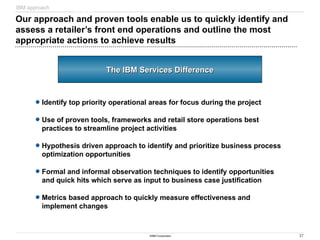
The IBM Services Difference
Identify top priority operational areas for focus during the project
Use of proven tools, frameworks and retail store operations best
practices to streamline project activities
Hypothesis driven approach to identify and prioritize business process
optimization opportunities
Formal and informal observation techniques to identify opportunities
and quick hits which serve as input to business case justification
Metrics based approach to quickly measure effectiveness and
implement changes
DEFINITION
Our approach and proven tools enable us to quickly identify and
assess a retailer’s front end operations and outline the most
appropriate actions to achieve results
IBM approach
38
©IBM Corporation
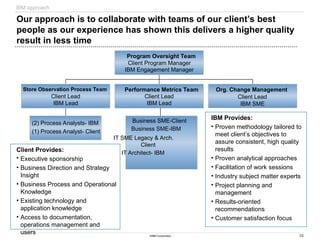
Performance Metrics Team
Client Lead
IBM Lead
Org. Change Management
Client Lead
Program Oversight Team
Client Program Manager
IBM Engagement Manager
Store Observation Process Team
Client Lead
IBM Lead
(2) Process Analysts- IBM
(1) Process Analyst- Client
Business SME-Client
IT SME Legacy & Arch.
Client
Business SME-IBM
IT Architect- IBM
IBM SME
Our approach is to collaborate with teams of our client’s best
people as our experience has shown this delivers a higher quality
result in less time
Client Provides:
 Executive sponsorship
• Business Direction and Strategy
Insight
• Business Process and Operational
Knowledge
• Existing technology and
application knowledge
• Access to documentation,
operations management and
users
IBM Provides:
• Proven methodology tailored to
meet client’s objectives to
assure consistent, high quality
results
• Proven analytical approaches
• Facilitation of work sessions
• Industry subject matter experts
• Project planning and
management
• Results-oriented
recommendations
• Customer satisfaction focus
IBM approach
39
©IBM Corporation
Sample Project Work Plan
0. Prepare &
Prioritize
1a. Prepare for & Conduct
Store Visits
2a. ID Productivity
Metrics & Reports
2c. Perform Data
Discovery
2b. Perform Data Mapping
1d. Develop Pilot
Recommendations
2d. Pilot Initial Reports and Data Models
1b. Assess Opportunities
& Best Practices
1c. Conduct Detailed Video Analysis
3a. Pilot Quick Hits
3b. Pilot Strategic Initiatives
3c.
Implement
0 2 4 6 8 10 12 14 16 18 20
Weeks
4. Perform Change Management Activities
IBM approach
40
©IBM Corporation
To perform a Retail Front End Optimization project, the cost for
consulting hours can range between $250,000 and $2 million
 Factors impacting project cost include:
– Client resource availability and expertise
– Client’s current use of a productivity metrics tool or similar application
– Current level of definition of client’s retail metrics and reports
– Client’s desire to perform both Productivity Metrics and Store Observation work
simultaneously (each can be performed independently)
– Level of detail deemed necessary (by client and IBM) for Store Observation work
– Other initiatives performed related to front end optimization
– Client timeframes (e.g., budgets, board meetings)
– Number of desired store observations
– Condition and readiness of client’s sales transaction data
 Cost estimate includes consulting hours for activities through pilots (steps 3a and
3b), not including implementation (3c)
Note: The above cost range is for budget and planning purposes only and does not represent a formal Proposal or Statement of Work.
Cost does not include travel and living expenses, which are traditionally estimated at 15-20% of consulting price.
IBM approach
41
©IBM Corporation
Contents
Problem Definition and IBM Offering Overview
Approach
Approach
Client Examples
The Path Forward
The Path Forward
42
©IBM Corporation
Our store operations experience encompasses many retail
industry segments
Specialty
Hardlines
Specialty
Softlines
Consumer
Electronics
Department
Stores
Drug
Stores
Discount
Stores
Eating and
Drinking
Grocery
Stores
Client Value
Client Value
client examples
43
©IBM Corporation
Challenge
Challenge
Reason
Reason
Vision
Vision
Project
Project
Result
Result
IBM analyzed Frank’s Nursery & Crafts front-end
configuration, recommending changes to existing and
future design plans
To Identify the best combination of process and technology solutions to optimize
front end efficiency and configuration
Frank’s Nursery & Crafts had older POS equipment and cash wrap concerns with their
current store layout, inhibiting both cashier motions and customer throughput at checkout.
They sought improvements to existing workstations and suggested configurations for
future stores.
To craft a front-end design and technology solution that incorporates proper ergonomic and
efficiency design, best suited for specialty nursery, hardware and crafts retailing.
The project team utilized in-store video and direct observation to document the current
status, focusing on these key areas:
Procedures
• Queuing
• Scanning
• Bagging
• Tender
• General
Equipment
• Printers
• Phones
• Scanners
Configuration
• Equipment and housing layout
The project team identified multiple areas for improvement and provided competitive
benchmarks in all areas. Combining cross-industry best practices with the limitations of the
space availability, IBM created a portfolio of design and technology solutions and a
cost/benefit analysis for each.
client examples
44
©IBM Corporation
Challenge
Challenge
Reason
Reason
Vision
Vision
Project
Project
Result
Result
Blockbuster commissioned IBM to help them improve their
check out process through video analysis and identification
of process bottlenecks
To optimize the checkout process using detailed video analysis and manual observations,
identifying process bottlenecks and offering improvement recommendations.
Blockbuster was seeking to improve customer throughput and minimize checkout
inefficiencies caused by a variety of transaction types, store layouts, tender methods, and
service-time activities
To improve the overall in-store experience for customers in the checkout process, addressing
aspects of queue time point-of-sale activities.
The project team visited nine Blockbuster stores during peak weekend hours, gathering
data on transaction activities, process and practice information, and customer queue
information via the following methods:
• Videotape of the checkout queue and front-end registers
• Direct observation and manual data recording
• Informal discussions/interviews with store personnel
• Exit surveys with customers to document perceptions
Detailed analysis of data was directed at recommending improvements to the front-end
register workstations and procedures that would result in cost savings or productivity gains.
From observations and analysis, the project team identified three main bottlenecks in the
Blockbuster checkout process: customer ID verification, credit, debit and gift card tender, and
miscellaneous delays. IBM outlined a detailed set of recommendations to address each of
the problem areas, designed to alleviate both real and perceived impediments to the
checkout process. IBM also worked with Blockbuster to incorporate feedback and comments
from customers and store personnel into the design of future business processes.
client examples
45
©IBM Corporation
Challenge
Challenge
Reason
Reason
Vision
Vision
Project
Project
Result
Result
Canadian Tire Corporation asked IBM to review its existing
checkstand designs and assess the productivity of its
front-end Point of Sale (POS) register workstations
To Identify best practices in checkout processes and store design to optimize
customer throughput and enhance overall front end appearance and functionality.
Canadian Tire was concerned about customer service desk procedures and front-end
transaction and queuing times versus other retailers. In addition, workstation configuration
was limiting both cashier efficiency and customer flow.
To design a new front end strategy, employing best practices from a broad array of retailers
in checkstand design, cashier behavior, customer education, and technology applications.
Using videotape analysis and direct observation, the project team documented the “As Is”
processes around existing checkout workstations and the service/returns desk, intending
to provide recommendations on the following:
• Customer Experience
• Cash Lane Footprint
• Transaction Processing
• Security
• Navigational Aids
Using detailed videotape analysis, the project team provided insight into the nature and type
of problems around checkstand design and POS productivity. Recommendations were
clustered around each problem area, incorporating new technology where appropriate to
quicken transactions, improve customer service and improve item pricing integrity.
• Hardware Layout and Configuration
• Peak Sales Management
• Process Delay Management
• Training Needs
• Technology
client examples
46
©IBM Corporation
Contents
Problem Definition and IBM Offering Overview
Approach
Approach
Client Examples
Client Examples
The Path Forward
47
©IBM Corporation
the path forward
The work session will include:
• Review of IBM’s project approach
• Review of required inputs and key outputs
• Review of existing documentation of your processes,
reports and metrics
• Documentation and validation as we conduct the session
Preparation will ensure value for all participants, thus we ask that you provide
responses to specific questions (next page) prior to the work session.
For Example:
For Example:
How do you currently measure front end productivity?
Do you use labor standards and/or a scheduling application for cashiers?
Do you use a standard method to roll new processes and policies to the stores?
To begin [CLIENT]’s Front End Optimization project, we recommend
conducting a collaborative work session to establish project
parameters, gather data and construct a high level project plan
Front end performance
Productivity
Customer Satisfaction
48
©IBM Corporation
It is important to include resources closest to and most knowledgeable
about [CLIENT’S] retail operations to achieve work session objectives
 Retail Operations, VP and Director Level
 Retail Field Management
 Retail Store Management (all levels)
 Retail Store Training Staff – Front End
 Customer Service
 Store Level IT Support Staff
the path forward
49
©IBM Corporation
During our work session, we will use your responses to the following
points to identify areas needing additional data and consideration, and
as input to begin project activities
 Retail chains and types to be included in the
project
 Total number of stores by chain
 Number and descriptions of different front end
prototypes included
 If applicable, average number of lanes per
store by chain
 Number of cashier areas within the store to be
studied (are there “satellite” areas to be
included?)
 Approximate number of cashiers per store (full
vs part time) by chain
 Front end payroll expense, by chain as a % of
sales (by function: cashier, customer service
desk, etc)
 Cashier turnover statistics (full vs. part time, by
chain;other important statistics if captured, i.e.
turnover by tenure)
 Cost of on-boarding a new cashier (hiring,
training, etc.)
 POS solution by chain: hardware, peripherals,
application(s) and version
 Use of transaction log (t-log) data, including
method to poll to central location and data
storage
 Use of Shrink Prevention solution(s) by chain
 Use of Labor Scheduling and Time &
Attendance applications (version, platform,
integration points, etc)
 Current labor standards for cashiers and how
derived (if used)
 Samples of cashier productivity reports,
exception reports and other performance
metrics provided to store management
 Peak sales hours and days of week
 Methods used to roll out new processes and
policies to the stores
 Other current / future initiatives related to this
effort
 Black-out dates applicable to project activity
the path forward

Front end optimization - simplified .ppt

  • 1.
    DRAFT DRAFT Retail Front EndOptimization Retail Front End Optimization
  • 2.
    2 ©IBM Corporation Contents Problem Definitionand IBM Offering Overview Problem Definition and IBM Offering Overview Approach Approach Client Examples Client Examples The Path Forward The Path Forward
  • 3.
    3 ©IBM Corporation Today’s retailstore environment is increasingly challenging due to difficulties attracting and retaining staff, intensified competition for customers and high operating costs  Employee turnover is among the top ten challenges retailers face in managing their business –average employee turnover in the retail industry is 200%  Multi-channel retailing and elevated customer expectations have intensified competition, making customer loyalty and satisfaction keys to success  Increasingly thin margins for many retailers have put even greater pressure to squeeze value out of retail costs Approximate Retail Cost Structure COGS SG&A Promote Distribute Buy • SG&A (store operations) consumes between 12-20% of a retailer’s Gross Profit Dollars • Within SG&A, Labor represents the single largest expense, (4-10%), of which roughly one-third is expended supporting front-end operations problem definition Source: IDC
  • 4.
    4 ©IBM Corporation Optimized frontend operations can dramatically improve store level staff productivity while increasing customer satisfaction and throughput and reducing operating costs • What is the most effective way to identify, evaluate and measure my store productivity issues? • How are my competitors and other businesses leveraging solutions and best practices to solve common business problems? • What business value can I create by improving processes, technologies and creating new store operating practices? • What are the key technologies and operations strategies I should be considering as I change my business? Strategy Strategy Benchmark Benchmark Business Business Benefit Benefit Technology Technology Let IBM assist you in defining the following… Let IBM assist you in defining the following… problem definition
  • 5.
    5 ©IBM Corporation IBM’s RetailFront End Optimization Offering Definition Definition Value Value Proposition Proposition Pain Points Pain Points • Increasing operational costs without corresponding revenue increases • Escalating labor costs exacerbated by high staff turnover causing competitive disadvantage • Increasing customer desertion rate • Inefficient POS layout and design • Outdated POS functionality and capability unable to support today’s internal and external demands IBM’s Retail Front End Optimization will enable retailers to improve efficiency and maximize their labor investment in the following key areas: IBM offering overview Improve customer satisfaction through more efficient front end processes, appealing layout and design and engaged staff. Customer Satisfaction Customer Satisfaction Optimize store coverage with existing labor and enable proactive identification of issues Labor Management Labor Management Minimize shrink associated with poorly defined and/or improperly executed front end processes Inventory Security / Accuracy Inventory Security / Accuracy Reduce time and costs associated with checkout, enabling existing store staff to serve more customers Customer Throughput Customer Throughput A comprehensive evaluation of your front end operations to identify improvement A comprehensive evaluation of your front end operations to identify improvement opportunities, incorporating business practices and policies, equipment, layout opportunities, incorporating business practices and policies, equipment, layout and design, and supporting metrics to drive continuous improvement. and design, and supporting metrics to drive continuous improvement.
  • 6.
    6 ©IBM Corporation The abilityto identify, address and measure retail front end improvement opportunities can have a dramatic impact on retail front end operations Increase Customer Satisfaction Increase Customer Satisfaction Removing unnecessary items from checkout can improve customer experience through better visual appeal and improved transaction time and scanning accuracy Proper and prompt management of promotional/sale signage improves customer experience and can reduce bottlenecks caused by customer confusion Repositioning security deactivation pads to align with checkout process can reduce instances of erroneous security alerts and improve customer experience Implementing or redesigning signage, lights and other visual clues improves customer satisfaction by ensuring customers know which checkout lanes are open Reviewing policies, thresholds and procedures for price overrides can have a significant impact on customer satisfaction by mitigating the necessity to wait for a response Reviewing policies and procedures for “employee sales” to minimize approvals required during customer selling periods, increases throughput and customer satisfaction Source: Estimates based on IBM client engagements (multiple retail segments). Note: These are representative results based on previous clients; actual results may vary. IBM offering overview
  • 7.
    7 ©IBM Corporation The abilityto identify, address and measure retail front end improvement opportunities can have a dramatic impact on retail front end operations Improve Customer Throughput Improve Customer Throughput Training customers to have ID’s ready for all non-cash transactions can improve transaction time by 10-30 seconds Empowering cashiers with ability to manually input or over-ride prices (up to a certain threshold) can improve transaction time by 25-30 seconds in the 10% of transactions requiring price lookups Encouraging customers to retrieve tender while the cashier is scanning items can minimize customer time spent “fishing” for cash, credit cards, etc. Placing bags immediately after scanner and below counter height can eliminate 11-15 seconds of transaction time Eliminating need to write on, staple or paper clip charge card slips can reduce transaction time by 5-7 seconds Physical work environment improvements can elevate cashier productivity by 2-15%, primarily due to (a) change in style of checkout station and (b) change in arrangement of equipment within checkout station. Equipment and technology improvements and adjustments can positively impact throughput (varies by equipment) IBM offering overview Sources: Various external industry studies; estimates based on IBM client engagements (multiple retail segments). Note: These are representative results based on previous clients; actual results may vary.
  • 8.
    8 ©IBM Corporation Downstream impactsof improving front end operations include better ability to manage inventory and labor Improve Inventory Security and Accuracy Improve Inventory Security and Accuracy Implementing and monitoring consistent checkout processes minimizes negative downstream effects on inventory (I.e., more accurate scanning at POS translates to better inventory decrementing) Training employees on product lines and assortment minimizes instances of shrink due to inappropriate identification of merchandise Assigning cashier cash / till accountability and use of video / surveillance systems can reduce employee theft (estimated at $1,023 per year per employee) Proper installation, use (procedures), and maintenance of Electronic Article Surveillance (EAS) systems can reduce cashier “sweethearting” and consumer shoplifting. IBM offering overview Sources: Penn Sate University white paper; estimates based on IBM client engagements (multiple retail segments). Note: These are representative results based on previous clients; actual results may vary.
  • 9.
    9 ©IBM Corporation Downstream impactsof improving front end operations include better ability to manage inventory and labor Improve Labor Management Improve Labor Management Better working environments can reduce staff and management turnover (estimated cost per turnover occurrence is $2,500 per staff member and $25,000 per manager) Revisions to labor management procedures, policies and new applications can identify labor law violations and minimize chances of fines (estimated fine for labor law violations is between $800 and $1,000 per occurrence) IBM offering overview Sources: Society of Human Resource Management; U.S. Department of Labor; Associated Press. Note: These are representative results based on previous clients; actual results may vary.
  • 10.
    10 ©IBM Corporation Contents Problem Definitionand IBM Offering Overview Problem Definition and IBM Offering Overview Approach Client Examples Client Examples The Path Forward The Path Forward
  • 11.
    11 ©IBM Corporation 1b. Assess 1b.Assess Opportunities & Opportunities & Best Practices Best Practices IBM Business Innovation Services follows a comprehensive approach to achieving Retail Front End Optimization 0. Prepare & 0. Prepare & Prioritize Prioritize APPROACH and SAMPLE RESULTS 2-3 Weeks 2-3 Weeks 4-6 Weeks 4-6 Weeks IBM approach 1a. Prepare for & 1a. Prepare for & Conduct Store Conduct Store Visits Visits 1c. Conduct Detailed Video 1c. Conduct Detailed Video Analysis Analysis 1d. Develop 1d. Develop Pilot Pilot Recommen Recommen dations dations 3a. Pilot Quick 3a. Pilot Quick Hits Hits 3b. Pilot Strategic Initiatives 3b. Pilot Strategic Initiatives 3c. Implement 3c. Implement New New Operating Operating Model Model Store Observations Store Observations Estimated Timeline 4. Perform Change Management Activities 4. Perform Change Management Activities 2c. Perform Data 2c. Perform Data Discovery & Discovery & Generate Generate Reports Reports 2b. Perform Data 2b. Perform Data Mapping Mapping 2a. ID Front End 2a. ID Front End Productivity Productivity Metrics & Metrics & Reports Reports 2d. Pilot Initial 2d. Pilot Initial Reports and Reports and Data Models Data Models Productivity Metrics Productivity Metrics
  • 12.
    12 ©IBM Corporation 1b. Assess 1b.Assess Opportunities & Opportunities & Best Practices Best Practices 0. Prepare & 0. Prepare & Prioritize Prioritize 1a. Prepare for & 1a. Prepare for & Conduct Store Conduct Store Visits Visits 1c. Conduct Detailed Video 1c. Conduct Detailed Video Analysis Analysis 1d. Develop 1d. Develop Pilot Pilot Recommen Recommen dations dations 3a. Pilot Quick 3a. Pilot Quick Hits Hits 3b. Pilot Strategic Initiatives 3b. Pilot Strategic Initiatives 3c. Implement 3c. Implement New New Operating Operating Model Model Store Observations Store Observations 4. Perform Change Management Activities 4. Perform Change Management Activities 2c. Perform Data 2c. Perform Data Discovery & Discovery & Generate Generate Reports Reports 2b. Perform Data 2b. Perform Data Mapping Mapping 2a. ID Front End 2a. ID Front End Productivity Productivity Metrics & Metrics & Reports Reports 2d. Pilot Initial 2d. Pilot Initial Reports and Reports and Data Models Data Models Productivity Metrics Productivity Metrics We use a structured approach to gathering information from live store environments and developing fact-based findings and recommendations relative to improving front end operations  Performing store observations enables the project team to quickly validate and / or identify front end related issues and opportunities  The observation work, areas of opportunity and retail best practices are used to structure recommendations for clients relative to their retail environments  Recommendations are prioritized based on anticipated cost, time to implement, resource requirements, etc. into Quick Hits and Strategic Initiatives 1b. Assess 1b. Assess Opportunities & Opportunities & Best Practices Best Practices 1a. Prepare for & 1a. Prepare for & Conduct Store Conduct Store Visits Visits 1c. Conduct Detailed Video 1c. Conduct Detailed Video Analysis Analysis 1d. Develop 1d. Develop Pilot Pilot Recommen Recommen dations dations Store Observations Store Observations IBM approach
  • 13.
    13 ©IBM Corporation 1b. Assess 1b.Assess Opportunities & Opportunities & Best Practices Best Practices 0. Prepare & 0. Prepare & Prioritize Prioritize 1a. Prepare for & 1a. Prepare for & Conduct Store Conduct Store Visits Visits 1c. Conduct Detailed Video 1c. Conduct Detailed Video Analysis Analysis 1d. Develop 1d. Develop Pilot Pilot Recommen Recommen dations dations 3a. Pilot Quick 3a. Pilot Quick Hits Hits 3b. Pilot Strategic Initiatives 3b. Pilot Strategic Initiatives 3c. Implement 3c. Implement New New Operating Operating Model Model Store Observations Store Observations 4. Perform Change Management Activities 4. Perform Change Management Activities 2c. Perform Data 2c. Perform Data Discovery & Discovery & Generate Generate Reports Reports 2b. Perform Data 2b. Perform Data Mapping Mapping 2a. ID Front End 2a. ID Front End Productivity Productivity Metrics & Metrics & Reports Reports 2d. Pilot Initial 2d. Pilot Initial Reports and Reports and Data Models Data Models Productivity Metrics Productivity Metrics The Productivity Metrics work effort provides retailers with the ability to quickly and accurately measure the effectiveness of their front end operations  IBM uses a Productivity Management tool to help retailers collect data and analyze productivity by group or “entity”, enabling them to proactively manage their operations  The Productivity Management tool is a cross-industry application that combines powerful entity profiling, graphical drill-down reporting wizards, exception reporting and data mining capabilities  Our approach streamlines the ability for retailers to begin measuring, monitoring and reacting to their operations by using IBM’s pre-defined retail metrics, reports, implementation templates and our familiarity with retail data models 2c. Perform Data 2c. Perform Data Discovery & Discovery & Generate Generate Reports Reports 2b. Perform Data 2b. Perform Data Mapping Mapping 2a. ID Front End 2a. ID Front End Productivity Productivity Metrics & Metrics & Reports Reports 2d. Pilot Initial 2d. Pilot Initial Reports and Reports and Data Models Data Models Productivity Metrics Productivity Metrics IBM approach
  • 14.
    14 ©IBM Corporation The ProductivityMetrics work effort provides retailers with the ability to quickly and accurately measure effectiveness of their front end operations Phase 1 Metrics Definition/Notes (to include 'why the metric is used) Is Data Available? Data Quality? Data Source (e-journal) Units of Measure ($ / % / #) Measurement Calculation Group: speed / accuracy / Contribution (non factored weighting factor) Daily Sales Total sales for the day; must be able to total Dollars Sales across Contribution: how much they personally Weekly Sales Total sales for the week; must be able to total Dollars (across all Contribution: how much they personally Monthly $ Sales Total sales for the measurement period Dollars (across all Contribution: how much they personally # Cust Total # of customers for the day; must be Units Contribution: how much they personally # Items Total # of items for the day: must be able to Units Contribution: how much they personally Login Time (hr) Total time Cashier is logged in; must be able Hours (two Contribution: how much they personally Transaction Time (hr) Total time scanning and tendering items; Hours (two Speed %Scan Number items scanned/total items sold % Accuracy %Transaction Time Transaction Time/ Login Time % Accuracy %Clearance As a % of Daily Sales % Accuracy %UPC Book Usage As a % of Daily Sales % Accuracy %Gun Use As a % of Items % Accuracy (primary) and Speed (secondary) We start with a series of pre-defined productivity metrics such as, “average transaction time” Feature Value Score Feature 1 13 850 Feature 2 1250 Feature 3 1.5 Feature Value Score Feature 1 5 0 Feature 2 2375 Feature 3 1.1 Peer Group of Entities Entities Entity A Feature Values Entity B Feature Values A B Number of Entities Feature Score 20 16 12 8 4 0 2 6 12 16 4 8 14 18 0 1000 800 600 400 200 0 B A Feature 1 Entity Values Scoring Curve Then, using the pre-defined metrics plus sales transaction data, we are able to profile performance. Reports are automatically generated helping store management easily track front end performance and take necessary actions. IBM approach
  • 15.
    15 ©IBM Corporation 1b. Assess 1b.Assess Opportunities & Opportunities & Best Practices Best Practices 0. Prepare & 0. Prepare & Prioritize Prioritize 1a. Prepare for & 1a. Prepare for & Conduct Store Conduct Store Visits Visits 1c. Conduct Detailed Video 1c. Conduct Detailed Video Analysis Analysis 1d. Develop 1d. Develop Pilot Pilot Recommen Recommen dations dations 3a. Pilot Quick 3a. Pilot Quick Hits Hits 3b. Pilot Strategic Initiatives 3b. Pilot Strategic Initiatives 3c. Implement 3c. Implement New New Operating Operating Model Model Store Observations Store Observations 4. Perform Change Management Activities 4. Perform Change Management Activities 2c. Perform Data 2c. Perform Data Discovery & Discovery & Generate Generate Reports Reports 2b. Perform Data 2b. Perform Data Mapping Mapping 2a. ID Front End 2a. ID Front End Productivity Productivity Metrics & Metrics & Reports Reports 2d. Pilot Initial 2d. Pilot Initial Reports and Reports and Data Models Data Models Productivity Metrics Productivity Metrics The two work efforts merge as results from the Quick Hits and Strategic Initiatives pilots are measured; the new business model then moves forward into implementation 3a. Pilot Quick 3a. Pilot Quick Hits Hits 3b. Pilot Strategic Initiatives 3b. Pilot Strategic Initiatives 3c. Implement 3c. Implement New New Operating Operating Model Model Front End Front End Optimization Optimization  Piloting the proposed changes enables retailers to reduce risk, measure impact prior to full scale implementation, validate and formalize the changes and better prepares the client for implementation  Measuring the results of both pilots is key for determining success metrics, validating expected benefits and serves as input to business justification for final approval and implementation  Change management activities are critical to creating awareness and buy-in throughout the project, transitioning the project from recommendations to pilot activities and helping the organization through implementation 4. Perform Change Management Activities 4. Perform Change Management Activities IBM approach
  • 16.
    16 ©IBM Corporation The firststep is to organize the project, assemble and energize the project team and identify front end focus areas APPROACH and SAMPLE RESULTS IBM approach Objectives Objectives Approach Approach Outputs Outputs • To organize and plan the project, including detailed project plan, resource requirements and constraints • To validate areas of focus to guide subsequent project steps • To understand and validate client’s business environment Inputs Inputs Activities Activities Organize project: identify client and IBM resources, determine time requirements and identify constraints Prepare project work plan Conduct select interviews with operations executives, directors, etc. (validate focus areas, understand customer expectations, service guidelines and productivity measurements) Identify possible stores for observations and pilot Conduct kickoff meeting Project plan template Interview guides templates Output from Scoping Work Session Detailed Project Plan * Identified resources and time commitments Client’s key focus areas * Project Deliverable 0. Prepare & 0. Prepare & Prioritize Prioritize 1b. Assess 1b. Assess Opportunities & Opportunities & Best Practices Best Practices 0. Prepare & 0. Prepare & Prioritize Prioritize 1a. Prepare for & 1a. Prepare for & Conduct Store Conduct Store Visits Visits 1c. Conduct Detailed Video 1c. Conduct Detailed Video Analysis Analysis 1d. Develop 1d. Develop Pilot Pilot Recommen Recommen dations dations 3a. Pilot Quick 3a. Pilot Quick Hits Hits 3b. Pilot Strategic Initiatives 3b. Pilot Strategic Initiatives 3c. Implement 3c. Implement New New Operating Operating Model Model Store Observations Store Observations 4. Perform Change Management Activities 4. Perform Change Management Activities 2c. Perform Data 2c. Perform Data Discovery & Discovery & Generate Generate Reports Reports 2b. Perform Data 2b. Perform Data Mapping Mapping 2a. ID Front End 2a. ID Front End Productivity Productivity Metrics & Metrics & Reports Reports 2d. Pilot Initial 2d. Pilot Initial Reports and Reports and Data Models Data Models Productivity Metrics Productivity Metrics
  • 17.
    17 ©IBM Corporation Conducting formaland informal store visits is key to gathering data for validating pain points and identifying additional opportunities for improvement  To prepare the project team for store visits  To gather formal (using video) and informal (using observations) site visit data which will serve as inputs to findings and opportunities Objectives Objectives Approach Approach APPROACH and SAMPLE RESULTS IBM approach Outputs Outputs Inputs Inputs Activities Activities Identify and schedule observation sites, based on geographic, seasonal and demographic variances Validate front end processes and prepare observation tools (templates, video, etc.) Conduct and document formal (video) and informal (observation) store visits Generic store observation templates Client’s key focus areas Front end process documentation (if available) Identified stores Site visit schedule and agenda Customized store observation templates Store visit documentation (observation data, raw video data, POS transaction logs) 1a. Prepare for & 1a. Prepare for & Conduct Store Conduct Store Visits Visits * Project Deliverable P Deliverable / work product from prior step 1b. Assess 1b. Assess Opportunities & Opportunities & Best Practices Best Practices 0. Prepare & 0. Prepare & Prioritize Prioritize 1a. Prepare for & 1a. Prepare for & Conduct Store Conduct Store Visits Visits 1c. Conduct Detailed Video 1c. Conduct Detailed Video Analysis Analysis 1d. Develop 1d. Develop Pilot Pilot Recommen Recommen dations dations 3a. Pilot Quick 3a. Pilot Quick Hits Hits 3b. Pilot Strategic Initiatives 3b. Pilot Strategic Initiatives 3c. Implement 3c. Implement New New Operating Operating Model Model Store Observations Store Observations 4. Perform Change Management Activities 4. Perform Change Management Activities 2c. Perform Data 2c. Perform Data Discovery & Discovery & Generate Generate Reports Reports 2b. Perform Data 2b. Perform Data Mapping Mapping 2a. ID Front End 2a. ID Front End Productivity Productivity Metrics & Metrics & Reports Reports 2d. Pilot Initial 2d. Pilot Initial Reports and Reports and Data Models Data Models Productivity Metrics Productivity Metrics
  • 18.
    18 ©IBM Corporation Sample WorkProducts Sample Work Products: The site observation agenda ensures consistency for the observations and IBM’s standard templates are customized to include client-specific attributes 1 © 20 02 IBM Cor por ation IBM Global Services IBM Global Services The Queue Timing Template quantifies a customer’s total transaction time as they move through the checkout process, noting causes for irregularities and delays IBM approach • Intent is to focus on the overall process duration, especially as affected by post-scan activities. • Select a customer at random to follow thru the checkout process. • Take note of queue length, both at the entry and exit • Using stopwatch and personal observation make notations to the chart as appropriate. • Comments are important for gathering other miscellaneous observations, such as reason for a delay in the process. • Note: The number of people in the queue should equal all those in line waiting for service plus the person engaged with the cashier (in this case, two in line plus one). However, this figure should not include the customer you are tracking. # Lane/Reg # People in Queue (Enter Q) # Items TIME Enter Queue TIME Start Service TIME End Service # People in Queue (End Svc) Head Cashier UPC Book Price Check Till Strip Comments Ex. 5 3 11 0:00 4:02 5:37 2 2 © 20 02 IBM Corpor ation IBM Global Services IBM Global Services The Transaction Observation Template captures qualitative evidence of individual customers progressing through the checkout process IBM approach • Intent is to focus on the characteristics of the checkout process, particularly noting the effect of customer-driven choices. • Select a customer at random to follow thru the checkout process. • Based on customer selections, note effects on product scanning method, handling by the cashier, and tender method. • In instances of delay, it is important to capture the situational aspects (process, product, personnel, etc.) that contribute to the occurrence. Obs # # in queue Total Items # Scan # Gun Qty Key Used Small Large Cash Credit Debit Check Gift card Other Bag Head Cashier UPC Book Price Check Till Strip Comments Ex. 2 7 5 1 1 4 3 X 2 l Product Mix Type of Tender Use of following and #: Sizes Friday Start Stop Person 1 Person 2 Template 4pm 430pm Arrive at store, introduce to manager(s) Identify Front End checkouts to observe. Perform manager interview, if time (15 min). HD_Discussion Points - Store Manager.doc Measure checkstand configurations, if possible HD_Tx_Observ_Template_v3.xls 430pm 545pm Queue Timing, Front Line Trans Observation, Returns HD_Q_Time_Template.xls 545pm 600pm Break Break 600pm 700pm Labor Utilization, Garden Labor Utilization, Front Line HD_Labor_Template.xls 700pm 800pm Trans Observation, Front Line (ss) Queue Timing, Garden HD_Tx_Observ_Template_v3.xls Saturday Start Stop Person 1 Person 2 Template 8am 830am Arrive at store, introduce to manager(s) Identify Front End checkouts to observe. Perform manager interview, if time (15 min). HD_Discussion Points - Store Manager.doc Perform cashier interview, if time (15 min). HD_Discussion Points - Cashier.doc Measure checkstand configurations, if possible HD_Tx_Observ_Template_v3.xls 830am 10am Queue Timing, Front Line Queue Timing, Garden HD_Q_Time_Template.xls 10am 1015am Break Break (perform interviews if time / they're available) 1015am 1130am Trans Observation, Front Line (ss) Trans Observation, Returns HD_Tx_Observ_Template_v3.xls 1130am 1230pm Lunch Lunch 1230pm 2pm Queue Timing, Returns Queue Timing, Front Line (ss) HD_Q_Time_Template.xls Sample Site Visit Agenda Sample Observation Templates IBM approach
  • 19.
    19 ©IBM Corporation Sample WorkProducts Sample Work Products: Store visit observations are compiled into spreadsheets for analysis in subsequent project activities Sample Observation Data Store Dept. Time Lane/Reg # People in Queue (Enter Q) # Items TIME Enter Queue TIME Start Service TIME End Service # People in Queue (End Svc) Transaction $ Amount PR Cont 6:45-8:15am 2 0 3 0:00:00 0:00:00 0:01:10 1 $21.00 PR Cont 6:45-8:15am 2 0 34 0:00:00 0:00:10 0:03:30 1 NA PR Cont 6:45-8:15am 2 0 2 0:00:00 0:00:00 0:00:44 1 $5.12 PR Cont 6:45-8:15am 1 0 27 0:00:00 0:00:00 0:03:11 1 $203.20 PR Cont 6:45-8:15am 1 1 10 0:00:00 0:00:50 0:01:37 0 $38.22 PR Cont 6:45-8:15am 2 0 6 0:00:00 0:00:05 0:02:30 0 $142.20 PR Cont 6:45-8:15am 2 1 4 0:00:00 0:00:36 0:01:21 2 $56.02 PR Cont 6:45-8:15am 2 1 1 0:00:00 0:00:24 0:00:50 0 $6.37 PR Cont 6:45-8:15am 2 1 4 0:00:00 0:01:01 0:02:59 0 $22.37 PR Cont 6:45-8:15am 2 1 6 0:00:00 0:00:25 0:01:14 1 $15.01 PR Cont 6:45-8:15am 2 1 51 0:00:00 0:01:03 0:03:40 0 $155.20 PR Cont 6:45-8:15am 1 0 1 0:00:00 0:00:15 0:00:37 1 $3.00 PR Cont 6:45-8:15am 1 0 12 0:00:00 0:00:00 0:00:48 3 $41.99 PR Cont 6:45-8:15am 1 2 34 0:00:00 0:00:52 0:02:19 3 $135.63 PR Cont 6:45-8:15am 1 3 3 0:00:00 0:01:35 0:02:38 1 $27.10 PR Cont 6:45-8:15am 2 0 1 0:00:00 0:00:00 0:00:54 0 $10.49 PR Cont 6:45-8:15am 1 0 7 0:00:00 0:00:00 0:01:20 1 $25.91 1961 Contractor 7:00-8:00a 4 0 10 10:01:00 10:16:00 11:34:00 0 $86.10 1961 Contractor 7:00-8:00a 4 0 11 11:48:00 11:48:00 13:11:00 0 $77.95 1961 Contractor 7:00-8:00a 4 0 1 17:48:00 17:49:00 23:06:00 1 $19.49 1961 Contractor 7:00-8:00a 4 1 16 22:12:00 23:10:00 25:00:00 0 $232.30 1961 Contractor 7:00-8:00a 4 0 1 26:51:00 26:51:00 27:26:00 0 $15.15 Store # City Time Day Part Day Loc. # in queue Total Items # Scan # Gun # Keyed Sml Item Lrg Item Cash Credit Debit Check Gift card Other Joliet CHI 7:00 - 8:00 pm EV Fri Front 7 8 0 8 0 4 4 x Joliet CHI 7:00 - 8:00 pm EV Fri Front 5 4 4 0 0 5 0 x Joliet CHI 7:00 - 8:00 pm EV Fri Front 5 6 0 6 0 5 0 x Joliet CHI 7:00 - 8:00 pm EV Fri Front 3 1 1 0 0 1 0 x Joliet CHI 7:00 - 8:00 pm EV Fri Front 3 7 2 5 0 0 7 x Joliet CHI 7:00 - 8:00 pm EV Fri Front 3 3 3 0 0 3 0 x Joliet CHI 7:00 - 8:00 pm EV Fri Front 4 3 3 0 0 1 2 x Joliet CHI 7:00 - 8:00 pm EV Fri Front 3 3 3 0 0 3 0 x Joliet CHI 7:00 - 8:00 pm EV Fri Front 3 5 5 0 5 0 5 Joliet CHI 7:00 - 8:00 pm EV Fri Front 4 4 0 4 0 0 4 x Joliet CHI 7:00 - 8:00 pm EV Fri Front 6 6 6 0 0 6 0 x Joliet CHI 7:00 - 8:00 pm EV Fri Front 5 2 2 0 0 2 0 x Joliet CHI 7:00 - 8:00 pm EV Fri Front 4 4 4 0 0 4 0 x Joliet CHI 7:00 - 8:00 pm EV Fri Front 2 6 6 0 0 1 5 x Joliet CHI 7:00 - 8:00 pm EV Fri Front 5 4 4 0 0 4 0 x Joliet CHI 7:00 - 8:00 pm EV Fri Front 5 3 0 3 0 0 3 x Joliet CHI 7:00 - 8:00 pm EV Fri Front 6 2 2 0 0 2 0 x Joliet CHI 7:00 - 8:00 pm EV Fri Front 5 2 0 2 0 2 0 x Joliet CHI 7:00 - 8:00 pm EV Fri Front 3 3 0 3 0 0 3 x Joliet CHI 7:00 - 8:00 pm EV Fri Front 2 2 2 0 0 2 0 x Observation Profile Product Mix Type of Tender IBM approach
  • 20.
    20 ©IBM Corporation The projectteam assesses areas of opportunity and retail best practices enabling us to challenge current thinking and evaluate new alternatives  To outline key areas of opportunity, relative to front end operations  To identify best practices appropriate to the client’s business environment APPROACH and SAMPLE RESULTS IBM approach 1b. Assess 1b. Assess Opportunities & Opportunities & Best Practices Best Practices Objectives Objectives Approach Approach Outputs Outputs Inputs Inputs Activities Activities Document findings from observation data Assess store visit findings to identify key areas of opportunity Identify best practices actually used in the client’s environment and those relative to their improvement needs Identify initial quick hit recommendations Store visit documentation (observation data) P IBM Retail Best Practice intellectual capital (ICAP) Store Visit Findings and Key Areas of Opportunity * Best Practices Relative to Key Areas of Opportunity * Initial Quick Hits * Project Deliverable P Deliverable / work product from prior step 1b. Assess 1b. Assess Opportunities & Opportunities & Best Practices Best Practices 0. Prepare & 0. Prepare & Prioritize Prioritize 1a. Prepare for & 1a. Prepare for & Conduct Store Conduct Store Visits Visits 1c. Conduct Detailed Video 1c. Conduct Detailed Video Analysis Analysis 1d. Develop 1d. Develop Pilot Pilot Recommen Recommen dations dations 3a. Pilot Quick 3a. Pilot Quick Hits Hits 3b. Pilot Strategic Initiatives 3b. Pilot Strategic Initiatives 3c. Implement 3c. Implement New New Operating Operating Model Model Store Observations Store Observations 4. Perform Change Management Activities 4. Perform Change Management Activities 2c. Perform Data 2c. Perform Data Discovery & Discovery & Generate Generate Reports Reports 2b. Perform Data 2b. Perform Data Mapping Mapping 2a. ID Front End 2a. ID Front End Productivity Productivity Metrics & Metrics & Reports Reports 2d. Pilot Initial 2d. Pilot Initial Reports and Reports and Data Models Data Models Productivity Metrics Productivity Metrics
  • 21.
    21 ©IBM Corporation Sample Deliverables SampleDeliverables: Store visit findings and key areas of opportunity, combined with retail best practices help the team begin to form recommendations and identify Quick Hits Sample Store Visit Findings 14 © 20 01 IBM Cor por ation IBM Global Services IBM Global Services The layout of Returns areas in most stores visited was not accommodating to customer traffic and return volume  Over 40% of returns observed involved multiple items – Returns area configuration and organization did not facilitate customer traffic – particularly customers with carts and flatbeds – Cashiers did not consistently organize returns and RTV merchandise, leaving the area cluttered and having little customer eye appeal  About 75% of Return were small items – typically customers would return 1 or 2 small items at a time  About 35% of Returns were large items – typically customers would return 2 or 3 large items at a time – Large return items created additional space issues in already cramped Returns areas – Small items were returned with large items RTV shelves Returns Lane 1 Returns Lane 2 Returns Lane 3 Store Entrance Product Display Wall Sp. Services Desk Product Display Product Display Product Display Fence Wall Wheelchairs Department Returns Carts Sign: Authorized Personnel Only RTV Cart Returns Customer Traffic Patterns Philadelphia Returns Configuration Philadelphia Returns Configuration RTV shelves Returns Lane 1 Returns Lane 2 Returns Lane 3 Store Entrance Product Display Wall Sp. Services Desk Product Display Product Display Product Display Fence Wall Wall Wheelchairs Department Returns Carts Sign: Authorized Personnel Only RTV Cart Returns Customer Traffic Patterns Philadelphia Returns Configuration Philadelphia Returns Configuration Service Delays – Returns Service Delays – Returns • Due to lack of counter space, return and exchange items are handled many times before getting placed in the right cart, which leads to further delays and led to messy Returns areas Sample Best Practices Total Store Structured store organization plan with career path orientation for management personnel, including Assistant Manager positions with accountability for Customer Service, Nonperishable, and Perishable departments Quarterly inventory schedule for all Perishable departments Profitability reporting structure based on department contribution rather than straight Gross Margin Integrated labor management system including labor scheduling package interfaced with Time & Attendance and HR systems Scale management system used to ensure accurate retail pricing Dedication of customer service associates separate from "task masters" Automated cart retrieval system Performance management climate established with key measures charted by all department Associate friendliness driven by empowerment and well executed rewards and recognition program IBM approach
  • 22.
    22 ©IBM Corporation Sample Deliverables SampleDeliverables: Store visit findings and key areas of opportunity, combined with retail best practices help the team begin to form recommendations and identify Quick Hits Sample Quick Hits QUICK HITS # Name Short Description Enablers Expected Capabilities / Benefits Approx. Cost Timeframe to Implement Impacted Personnel Impacted Areas Owner 1 Manage Sales Signage a. Remove signs promptly after a sale ends. b. Sale signage should prominently display the ending date for the sale. c. Use a single color for all sale signage for a given time period. The sale signs for the next period should be a different color. Rotate through several (i.e., 6-8) colors over time. The “color” of the weekly sale could be touted in advertising materials. E.g., weekly sales flyers could state the sales “color” signage to look for. Communication of sale start / end dates to store staff Discepancies will be dealt with on the sales floor rather than at checkout. Higher customer satisfaction due to less confusion and neater store appearance Minimal 1 month Cashiers, Floor Associates Entire Store S. Walton 2 Sales Floor Staff Coverage Maintain adequate sales floor staff to be available and easily found or called by shoppers if they want to ask a question before checkout. Defined roles & responsibilities Staff deployment [Labor scheduling application] Higher customer satisfaction Improved throughput due to minimized delays caused by customer questions Possible additional labor 2 months Cashiers, Floor Associates Entire Store M. Field 3 Price Check Review Review all price checks for some period (e.g., a month) to determine cause and typical amount under dispute. For small disputed amounts, take the shopper’s word. Over time, monitor the results of the dispute resolutions to insure (a) that the practice is implemented as desired and (b) that shoppers do not take advantage of the store’s good faith. Transaction Log data Improved customer satisfaction due to reduced delays caused by price checks Improved throughput Additional labor and/or consultants (if use external resources) 1 month Cashiers Checkout B. Marcus IBM approach
  • 23.
    23 ©IBM Corporation Assessing resultsfrom video taping activities enables the project team to identify quantitative measurements, which serve as additional inputs to recommendations and business justification  To compile and summarize data collected during formal site visits  To provide quantitative (objective) measurements of front end productivity, which will be used as input to recommendations APPROACH and SAMPLE RESULTS IBM approach 1c. Conduct 1c. Conduct Detailed Video Detailed Video Analysis Analysis Approach Approach Outputs Outputs Inputs Inputs Activities Activities Summarize transaction quantitative data Benchmark existing transaction times, primarily: – Queue time – Item Entry time – Bagging time – Tender time – Delay time – Help and misc. time Compare client’s times against other retailers Document findings Store visit documentation (raw video data, POS transaction logs) P Summary of Videotaped Data and Analysis * Qualitative Front End Assessment * * Project Deliverable P Deliverable / work product from prior step Objectives Objectives 1b. Assess 1b. Assess Opportunities & Opportunities & Best Practices Best Practices 0. Prepare & 0. Prepare & Prioritize Prioritize 1a. Prepare for & 1a. Prepare for & Conduct Store Conduct Store Visits Visits 1c. Conduct Detailed Video 1c. Conduct Detailed Video Analysis Analysis 1d. Develop 1d. Develop Pilot Pilot Recommen Recommen dations dations 3a. Pilot Quick 3a. Pilot Quick Hits Hits 3b. Pilot Strategic Initiatives 3b. Pilot Strategic Initiatives 3c. Implement 3c. Implement New New Operating Operating Model Model Store Observations Store Observations 4. Perform Change Management Activities 4. Perform Change Management Activities 2c. Perform Data 2c. Perform Data Discovery & Discovery & Generate Generate Reports Reports 2b. Perform Data 2b. Perform Data Mapping Mapping 2a. ID Front End 2a. ID Front End Productivity Productivity Metrics & Metrics & Reports Reports 2d. Pilot Initial 2d. Pilot Initial Reports and Reports and Data Models Data Models Productivity Metrics Productivity Metrics
  • 24.
    24 ©IBM Corporation Sample QualitativeAssessment Number of Items per Transaction 0 10 20 30 40 50 60 70 0 6 12 18 24 30 36 42 48 54 60 0% 20% 40% 60% 80% 100% 120% Frequency Cumulative % Sample Videotaped Analysis Sample Deliverables: Sample Deliverables: Detailed analysis of video observations helps validate and enhance findings from informal site visits, prioritize opportunities, and can serve as business case inputs Sample Videotaped Transaction Data Summarized Transaction Analysis -- Observations from 08/24/2001 - 08/26/2001 Rec Num Tx Num Date Store Cashier Tx Type Tx Time Total # Items Sold # Scan Items Sold # Keyed Items Sold Total Item Time Total Bag Time Total Delay Time Total Help Time Total Misc Time Total Help + Misc Time Count (Actual Entries only) 504 504 500 35 504 486 340 6 504 504 Count (All Tx) 504 504 504 504 504 504 504 504 504 504 Frequency of Occurrence: % Tx (by Count) 100.0% 100.0% 96.4% 67.5% 1.2% 100.0% 100.0% Average Dur or Num (Actual Entries only) 89.0 4.7 4.5 0.1 19.7 15.5 25.5 86.3 1.2 2.2 StdDev Dur or Num (Actual Entries only) 61.5 5.3 5.2 0.8 25.6 17.0 32.2 171.5 2.5 19.7 Frequency Weighted Avg for all Tx: Average (over All Tx) 89.0 4.7 4.5 0.1 19.7 15.0 17.2 1.0 1.2 2.2 Frequency Weighted S.D. for all Tx: StdDev (over All Tx) 61.5 5.3 5.2 0.8 25.6 16.9 29.0 19.5 2.5 19.7 % of Avg Total Tx Duration 100.0% 22.1% 16.8% 19.4% 1.2% 1.3% 2.5% Sum Dur or Num 44871.7 2349.0 2283.0 66.0 9931.3 7553.1 8683.1 518.0 586.6 1104.7 Max Dur or Num 549.2 50.0 50.0 16.0 199.1 152.6 303.4 434.9 31.9 437.8 Min Dur or Num 17.7 1.0 0.0 0.0 0.0 0.6 0.9 3.9 0.0 0.0 Median Dur or Num 71.9 3.0 3.0 0.0 10.8 9.6 17.5 12.8 0.7 0.7 IBM approach
  • 25.
    25 ©IBM Corporation Prioritized recommendationsincorporate both qualitative and quantitative findings and opportunities, as well as leading practices to outline new and better ways of doing business  To outline specific improvement recommendations relative to process, equipment, roles & responsibilities, layout, etc.  To prioritize recommendations for Pilots  To outline an initial pilot plan to take the recommendations forward for approval APPROACH and SAMPLE RESULTS IBM approach 1d. Develop Pilot 1d. Develop Pilot Recommendations Recommendations Approach Approach Outputs Outputs Inputs Inputs Activities Activities Develop recommendations, based on observational data Revise recommendations as necessary, based on results of video analysis Prioritize recommendations into Quick Hits and Strategic Initiatives Prepare pilot plan (e.g., number of pilot stores, pilot approach) Store Visit Findings and Key Areas of Opportunity P Best Practices Relative to Key Areas of Opportunity P Qualitative Front End Assessment P Prioritized Pilot Recommendations * Initial Pilot Plan * * Project Deliverable P Deliverable / work product from prior step Objectives Objectives 1b. Assess 1b. Assess Opportunities & Opportunities & Best Practices Best Practices 0. Prepare & 0. Prepare & Prioritize Prioritize 1a. Prepare for & 1a. Prepare for & Conduct Store Conduct Store Visits Visits 1c. Conduct Detailed Video 1c. Conduct Detailed Video Analysis Analysis 1d. Develop 1d. Develop Pilot Pilot Recommen Recommen dations dations 3a. Pilot Quick 3a. Pilot Quick Hits Hits 3b. Pilot Strategic Initiatives 3b. Pilot Strategic Initiatives 3c. Implement 3c. Implement New New Operating Operating Model Model Store Observations Store Observations 4. Perform Change Management Activities 4. Perform Change Management Activities 2c. Perform Data 2c. Perform Data Discovery & Discovery & Generate Generate Reports Reports 2b. Perform Data 2b. Perform Data Mapping Mapping 2a. ID Front End 2a. ID Front End Productivity Productivity Metrics & Metrics & Reports Reports 2d. Pilot Initial 2d. Pilot Initial Reports and Reports and Data Models Data Models Productivity Metrics Productivity Metrics
  • 26.
    26 ©IBM Corporation Customer Service BaselineFindings Sample Recommendations Inconsistent greetings create bottlenecks at the menu board and front counter - Construct a service manual which defines standard customer greeting procedures - Continually reinforce crew training - Post signs by registers with standardized greetings and suggestive selling Employee multi-tasking, training, staffing, & deployment contributed to delays at menu board, pay window, PUW, front counter register - Construct a service manual which defines daypart staffing and deployment guidelines, staffing roles and responsibilities, and service standards - Continually reinforce crew training - Create "teams" within the restaurants at both the front counter and drive-thru to create enthusiasm Inconsistent execution of change making procedures create bottlenecks at the pay window & front counter register - Construct a service manual which defines standard change making procedures - Continually reinforce crew training - Design and post a card/poster with "change recipes" to facilitate change making process POS functionality contributes to bottlenecks at the menu board and register - Reduce the number of keys required & improve keyboard maneuvering Menu complexity causes bottlenecks at the menu board and registers - Make menu headings a different color form the menu items and standardize throughout the system Product delays were due to product build complexity and assembly issues - Continually reinforce crew training - Eliminate delay in items appearing on VDU (kitchen monitors) - Implement training to improve communications between sandwich maker and grill person - Pre-package condiments unique to each product group Sample Deliverables Sample Deliverables: Pilot recommendations and the related project plans are prioritized as Strategic Initiatives and Quick Hits Sample Pilot Project Plan Sample Pilot Recommendations Initiate pilot Identify pilot stores and time frames Comm. pilot objectives to impacted stores Identify technology / infrastructure rqmts. Document process changes Document role & resp. changes Define feedback plan Define cut-over plan Comm. pilot details to impacted stores Train pilot store(s) staff Perform equipment / layout changes Conduct pilot Solicit and document feedback Revise recommendations 0 2 4 6 8 10 12 14 16 18 20 Weeks Strategic Initiative IBM approach
  • 27.
    27 ©IBM Corporation Working withinternal business and technical experts is key to establishing initial cashier productivity metrics and reports for measurement and evaluation APPROACH and SAMPLE RESULTS IBM approach Objectives Objectives Approach Approach Outputs Outputs • To review required functionality • To validate the pre-defined of productivity metrics and associated weight factors for data modeling • To establish metrics baselines for initial scoring and subsequent actions • To review and validate productivity reports Inputs Inputs Activities Activities Interview business and technical subject matter experts to confirm required functionality Facilitate metrics and reports workshop to review and validate: – pre-defined metrics – best practice baseline metrics – best practice reports – recommended pilot approach Interview Guides Best Practice Productivity Reports and metrics Best Practice metrics baselines Documented productivity metrics and reports * Key findings from interviews* Confirmation of pilot stores and high level training requirements * Project Deliverable 2a. ID Front End 2a. ID Front End Productivity Productivity Metrics Metrics 1b. Assess 1b. Assess Opportunities & Opportunities & Best Practices Best Practices 0. Prepare & 0. Prepare & Prioritize Prioritize 1a. Prepare for & 1a. Prepare for & Conduct Store Conduct Store Visits Visits 1c. Conduct Detailed Video 1c. Conduct Detailed Video Analysis Analysis 1d. Develop 1d. Develop Pilot Pilot Recommen Recommen dations dations 3a. Pilot Quick 3a. Pilot Quick Hits Hits 3b. Pilot Strategic Initiatives 3b. Pilot Strategic Initiatives 3c. Implement 3c. Implement New New Operating Operating Model Model Store Observations Store Observations 4. Perform Change Management Activities 4. Perform Change Management Activities 2c. Perform Data 2c. Perform Data Discovery & Discovery & Generate Generate Reports Reports 2b. Perform Data 2b. Perform Data Mapping Mapping 2a. ID Front End 2a. ID Front End Productivity Productivity Metrics & Metrics & Reports Reports 2d. Pilot Initial 2d. Pilot Initial Reports and Reports and Data Models Data Models Productivity Metrics Productivity Metrics
  • 28.
    28 ©IBM Corporation After identifyinga retailer’s productivity metrics, we obtain sales transaction data and begin the discovery and modeling phase to develop initial scoring profiles APPROACH and SAMPLE RESULTS IBM approach 2b. & 2c. Perform 2b. & 2c. Perform Data Mapping & Data Mapping & Data Discovery Data Discovery Objectives Objectives Approach Approach Outputs Outputs • To confirm data requirements to support productivity metrics • To receive and test retailer’s data in required format • To perform data discovery and create productivity models • To produce reports for evaluation Inputs Inputs Activities Activities Receive sample data set in required format Perform data discovery Produce initial reports Review test reports for accuracy Productivity Metrics and associated calculations and weight factors Sales transaction data Documented data requirements * Initial Productivity Reports * Finalized metrics table * * Project Deliverable 1b. Assess 1b. Assess Opportunities & Opportunities & Best Practices Best Practices 0. Prepare & 0. Prepare & Prioritize Prioritize 1a. Prepare for & 1a. Prepare for & Conduct Store Conduct Store Visits Visits 1c. Conduct Detailed Video 1c. Conduct Detailed Video Analysis Analysis 1d. Develop 1d. Develop Pilot Pilot Recommen Recommen dations dations 3a. Pilot Quick 3a. Pilot Quick Hits Hits 3b. Pilot Strategic Initiatives 3b. Pilot Strategic Initiatives 3c. Implement 3c. Implement New New Operating Operating Model Model Store Observations Store Observations 4. Perform Change Management Activities 4. Perform Change Management Activities 2c. Perform Data 2c. Perform Data Discovery & Discovery & Generate Generate Reports Reports 2b. Perform Data 2b. Perform Data Mapping Mapping 2a. ID Front End 2a. ID Front End Productivity Productivity Metrics & Metrics & Reports Reports 2d. Pilot Initial 2d. Pilot Initial Reports and Reports and Data Models Data Models Productivity Metrics Productivity Metrics
  • 29.
    29 ©IBM Corporation Productivity MetricsSample Reports: Productivity Metrics Sample Reports: Pre-defined retail front end optimization metrics and reports assist in quick implementation Report Dashboard displays all of the productivity reports Report Dashboard displays all of the productivity reports IBM approach The report dashboard helps the store manager and the head office quickly select the appropriate report(s).
  • 30.
    30 ©IBM Corporation Sample Deliverables: SampleDeliverables: Our use of best practices relative to front end productivity metrics allow the team to effectively reuse existing reports without the need to “reinvent the wheel” Exception reports include “Average Scores by Department” Exception reports include “Average Scores by Department” • This report displays total scores for each cashier by department for a given time period. • It is useful for showing how well business is being conducted within each business area. IBM approach
  • 31.
    31 ©IBM Corporation Sample Deliverables: SampleDeliverables: Our use of best practices relative to front end productivity metrics allow the team to effectively reuse existing reports without the need to “reinvent the wheel” Alert Reports are key to proactive store management Alert Reports are key to proactive store management Alert reports help store managers and the head office to quickly pinpoint problem areas and take action to alleviate bottlenecks in front end operations. IBM approach
  • 32.
    32 ©IBM Corporation During theinitial pilot, we assist retailers in evaluating the model and reports; revisions are sometimes necessary to achieve accurate measurements APPROACH and SAMPLE RESULTS IBM approach Objectives Objectives Approach Approach Outputs Outputs • To evaluate reports and metrics in a live pilot store • To add new metrics and reports if required • To refine initial models if required • To work with pilot stores to review the reports and recommend appropriate actions Inputs Inputs Activities Activities Produce reports for the pilot store(s) Work closely with pilot store managers and review reports and recommended actions Add metrics and reports if required Metrics Reports Trained Pilot Store(s) users Pilot store reports * Documented pilot results * Documented list of revised metrics and reports if added* * Project Deliverable 2d. Pilot Initial 2d. Pilot Initial Reports and Reports and Data Models Data Models 1b. Assess 1b. Assess Opportunities & Opportunities & Best Practices Best Practices 0. Prepare & 0. Prepare & Prioritize Prioritize 1a. Prepare for & 1a. Prepare for & Conduct Store Conduct Store Visits Visits 1c. Conduct Detailed Video 1c. Conduct Detailed Video Analysis Analysis 1d. Develop 1d. Develop Pilot Pilot Recommen Recommen dations dations 3a. Pilot Quick 3a. Pilot Quick Hits Hits 3b. Pilot Strategic Initiatives 3b. Pilot Strategic Initiatives 3c. Implement 3c. Implement New New Operating Operating Model Model Store Observations Store Observations 4. Perform Change Management Activities 4. Perform Change Management Activities 2c. Perform Data 2c. Perform Data Discovery & Discovery & Generate Generate Reports Reports 2b. Perform Data 2b. Perform Data Mapping Mapping 2a. ID Front End 2a. ID Front End Productivity Productivity Metrics & Metrics & Reports Reports 2d. Pilot Initial 2d. Pilot Initial Reports and Reports and Data Models Data Models Productivity Metrics Productivity Metrics
  • 33.
    33 ©IBM Corporation Piloting theproposed changes enables retailers to reduce risk, measure impact prior to full scale implementation and validate and formalize the changes  To test recommended Quick Hits in a live store environment  To test recommended Strategic Initiatives in a live store environment APPROACH and SAMPLE RESULTS IBM approach 3a. & 3b.. Pilot 3a. & 3b.. Pilot Quick Hits and Quick Hits and Strategic Strategic Initiatives Initiatives Approach Approach Outputs Outputs Inputs Inputs Activities Activities Establish pilot program agreement and objectives Review and measure pilot results Revise new models as needed Identify technical dependencies Define business constraints and priorities (timing, resources, funding) Prepare implementation plan(s) Gain approval for implementation Quick Hits: – Job Roles, Responsibilities & Competencies P – New Operating Procedures P – Performance Management System and Rewards P Pilot Objectives Pilot Results Revisions to Change Management Strategies and Tactics (if necessary) High Level Implementation Plan * * Project Deliverable P Deliverable / work product from prior step Objectives Objectives 1b. Assess 1b. Assess Opportunities & Opportunities & Best Practices Best Practices 0. Prepare & 0. Prepare & Prioritize Prioritize 1a. Prepare for & 1a. Prepare for & Conduct Store Conduct Store Visits Visits 1c. Conduct Detailed Video 1c. Conduct Detailed Video Analysis Analysis 1d. Develop 1d. Develop Pilot Pilot Recommen Recommen dations dations 3a. Pilot Quick 3a. Pilot Quick Hits Hits 3b. Pilot Strategic Initiatives 3b. Pilot Strategic Initiatives 3c. Implement 3c. Implement New New Operating Operating Model Model Store Observations Store Observations 4. Perform Change Management Activities 4. Perform Change Management Activities 2c. Perform Data 2c. Perform Data Discovery & Discovery & Generate Generate Reports Reports 2b. Perform Data 2b. Perform Data Mapping Mapping 2a. ID Front End 2a. ID Front End Productivity Productivity Metrics & Metrics & Reports Reports 2d. Pilot Initial 2d. Pilot Initial Reports and Reports and Data Models Data Models Productivity Metrics Productivity Metrics
  • 34.
    34 ©IBM Corporation The finalstep in the project is implementing the new business model, measuring actual results and integrating continuous improvement into the company’s culture  To implement the changes into the retailer’s business model and integrate a culture of continuous improvement APPROACH and SAMPLE RESULTS IBM approach 3c. Implement New 3c. Implement New Operating Model Operating Model Approach Approach Outputs Outputs Inputs Inputs Activities Activities * Project Deliverable Implement new procedures, roles and responsibilities, equipment / technologies and layouts Develop continuing improvement strategy and plan Change Management Strategies and Tactics P High Level Implementation Plan P Implementation results Continuing improvement strategy and plan Objectives Objectives 1b. Assess 1b. Assess Opportunities & Opportunities & Best Practices Best Practices 0. Prepare & 0. Prepare & Prioritize Prioritize 1a. Prepare for & 1a. Prepare for & Conduct Store Conduct Store Visits Visits 1c. Conduct Detailed Video 1c. Conduct Detailed Video Analysis Analysis 1d. Develop 1d. Develop Pilot Pilot Recommen Recommen dations dations 3a. Pilot Quick 3a. Pilot Quick Hits Hits 3b. Pilot Strategic Initiatives 3b. Pilot Strategic Initiatives 3c. Implement 3c. Implement New New Operating Operating Model Model Store Observations Store Observations 4. Perform Change Management Activities 4. Perform Change Management Activities 2c. Perform Data 2c. Perform Data Discovery & Discovery & Generate Generate Reports Reports 2b. Perform Data 2b. Perform Data Mapping Mapping 2a. ID Front End 2a. ID Front End Productivity Productivity Metrics & Metrics & Reports Reports 2d. Pilot Initial 2d. Pilot Initial Reports and Reports and Data Models Data Models Productivity Metrics Productivity Metrics
  • 35.
    35 ©IBM Corporation Change managementactivities help create awareness and buy-in throughout the project and are key for implementation success  To help impacted store staff understand the need for transformation and gain their involvement and insights  To create understanding of & commitment to the new model  To provide employees the capabilities to make needed adjustments APPROACH and SAMPLE RESULTS IBM approach 4. Perform Change 4. Perform Change Mgmt. Tasks Mgmt. Tasks Objectives Objectives Approach Approach Outputs Outputs Inputs Inputs Activities Activities Secure executive sponsorship Perform Change Readiness Assessment Identify major change areas and impacted roles Update job roles and rewards structures Identify training requirements incorporate changes into training and operating manuals Create / execute communication strategy and plan Create transition plan Client’s business strategy Key client sponsors Deliverables throughout the project Client’s store operating policies and procedures manual(s) Client’s organization chart(s) IBM Change Management Tools and Approach Change Readiness Assessment * Job Roles, Responsibilities & Competencies New Operating Procedures Performance Management System and Rewards Education & Training Strategy * Communication Strategy & Plan * Transition Plan * Change Leadership Plan* * Project Deliverable P Deliverable / work product from prior step 1b. Assess 1b. Assess Opportunities & Opportunities & Best Practices Best Practices 0. Prepare & 0. Prepare & Prioritize Prioritize 1a. Prepare for & 1a. Prepare for & Conduct Store Conduct Store Visits Visits 1c. Conduct Detailed Video 1c. Conduct Detailed Video Analysis Analysis 1d. Develop 1d. Develop Pilot Pilot Recommen Recommen dations dations 3a. Pilot Quick 3a. Pilot Quick Hits Hits 3b. Pilot Strategic Initiatives 3b. Pilot Strategic Initiatives 3c. Implement 3c. Implement New New Operating Operating Model Model Store Observations Store Observations 4. Perform Change Management Activities 4. Perform Change Management Activities 2c. Perform Data 2c. Perform Data Discovery & Discovery & Generate Generate Reports Reports 2b. Perform Data 2b. Perform Data Mapping Mapping 2a. ID Front End 2a. ID Front End Productivity Productivity Metrics & Metrics & Reports Reports 2d. Pilot Initial 2d. Pilot Initial Reports and Reports and Data Models Data Models Productivity Metrics Productivity Metrics
  • 36.
    36 ©IBM Corporation Sample Deliverables SampleDeliverables: Since change management activities focus on preparing and assisting the company throughout the change, deliverables are traditionally assessment, strategy and planning Sample Communications Plan [TBD] Go Live Date 9/1/2000 Communications Task Owner Vehicle Audience Message Ideal Timing Start Date End/Pub Date 5/5 HR trng. schedules/rosters DACG Email HR Directors Provide HR trng. schedules/rosters 6 weeks prior to go live 5/5/2000 7/21/2000 BPO mtg Ron Clark Meeting Randy Smith & Nita Sanders Bi-weekly project status Every 2 weeks or as needed 5/5/2000 multiple XXXXX XXXXX XXXX Trng. DACG Classroom HR team members End-users Pilot Project system task One month prior to go live 5/5/2000 8/4/2000 Demo. Ops Manual Peggy Lane Meeting Randy Smith, Doug Anderson Review Ops Manual layout and content One month prior to go live 5/5/2000 8/4/2000 Cutover procedures Change Management Email HR team members Communicate that nothing will change during cutover. The process will remain the same. 3 weeks prior to go live 5/5/2000 8/11/2000 Brown Bag meeting(s) Change Management Meeting HR team members Provide users with a basic understanding of why Pilot Project, what Pilot Project means to them, as well as an opportunity to ask questions 2 - 3 weeks prior to go live 5/5/2000 8/11/2000 Overview conference call Ralph Santosuosso Conference Call Field HR team members Provide users with a basic understanding of why Pilot Project, what Pilot Project means to them, as well as an opportunity to ask questions 2 - 3 weeks prior to go live 5/5/2000 8/11/2000 Sample Excerpt from Change Readiness Assessment IBM approach Q-Mart /IBM Confidential 13 Because of some functional overlap withParentCo and resource limitations, the current organizational design could impact availability of resources for a transformation project Issues 1. Q-Mart is has organizational overlap withParentCo P (i.e. shared resources and reporting structure) 2. Q-Mart lacks resource depth across most functional units which may impact project staffing 3. Some employees will have to perform double duty during the Front End Optimization project 4. Other projects in progress may stretch or limit project resources in 2000 5. Key business leaders in Store Operations are not in place 6. Current roles and responsibilities are not documented and training is not consistentlyexecutied 7. Future outsourcing considerations of certain functional responsibilities will alter the design of the organization Issues 1. Q-Mart is has organizational overlap withParentCo P (i.e. shared resources and reporting structure) 2. Q-Mart lacks resource depth across most functional units which may impact project staffing 3. Some employees will have to perform double duty during the Front End Optimization project 4. Other projects in progress may stretch or limit project resources in 2000 5. Key business leaders in Store Operations are not in place 6. Current roles and responsibilities are not documented and training is not consistentlyexecutied 7. Future outsourcing considerations of certain functional responsibilities will alter the design of the organization Issue Resolution Recommendations • Coordinate a company-wide kick-off meeting to explain the reasons for change into Q-Mart • Where possible, dedicate Q-Mart resources to the project • Shift responsibilities or bring in temporary help where necessary to supplement Q-Mart resource commitments to the project • Execute the system project with no outsourcing decisions in mind (i.e. view Q-Mart as a stand-alone) • Within the Organizational Change Management component allow for new/changed positions to be developed without ParentCo or current Q-Mart requirements Issue Resolution Recommendations • Coordinate a company-wide kick-off meeting to explain the reasons for change into Q-Mart • Where possible, dedicate Q-Mart resources to the project • Shift responsibilities or bring in temporary help where necessary to supplement Q-Mart resource commitments to the project • Execute the system project with no outsourcing decisions in mind (i.e. view Q-Mart as a stand-alone) • Within the Organizational Change Management component allow for new/changed positions to be developed without ParentCo or current Q-Mart requirements Benefits • Demonstrates Q-Mart management commitment to business transformation • Avoids message confusion on project purpose • Develops permanent core team of Front End Optimization system users • Prepares the organization for significant change • Assures the organization is in line to successfully operate in the new environment Benefits • Demonstrates Q-Mart management commitment to business transformation • Avoids message confusion on project purpose • Develops permanent core team of Front End Optimization system users • Prepares the organization for significant change • Assures the organization is in line to successfully operate in the new environment
  • 37.
    37 ©IBM Corporation The IBMServices Difference The IBM Services Difference Identify top priority operational areas for focus during the project Use of proven tools, frameworks and retail store operations best practices to streamline project activities Hypothesis driven approach to identify and prioritize business process optimization opportunities Formal and informal observation techniques to identify opportunities and quick hits which serve as input to business case justification Metrics based approach to quickly measure effectiveness and implement changes DEFINITION Our approach and proven tools enable us to quickly identify and assess a retailer’s front end operations and outline the most appropriate actions to achieve results IBM approach
  • 38.
    38 ©IBM Corporation Performance MetricsTeam Client Lead IBM Lead Org. Change Management Client Lead Program Oversight Team Client Program Manager IBM Engagement Manager Store Observation Process Team Client Lead IBM Lead (2) Process Analysts- IBM (1) Process Analyst- Client Business SME-Client IT SME Legacy & Arch. Client Business SME-IBM IT Architect- IBM IBM SME Our approach is to collaborate with teams of our client’s best people as our experience has shown this delivers a higher quality result in less time Client Provides:  Executive sponsorship • Business Direction and Strategy Insight • Business Process and Operational Knowledge • Existing technology and application knowledge • Access to documentation, operations management and users IBM Provides: • Proven methodology tailored to meet client’s objectives to assure consistent, high quality results • Proven analytical approaches • Facilitation of work sessions • Industry subject matter experts • Project planning and management • Results-oriented recommendations • Customer satisfaction focus IBM approach
  • 39.
    39 ©IBM Corporation Sample ProjectWork Plan 0. Prepare & Prioritize 1a. Prepare for & Conduct Store Visits 2a. ID Productivity Metrics & Reports 2c. Perform Data Discovery 2b. Perform Data Mapping 1d. Develop Pilot Recommendations 2d. Pilot Initial Reports and Data Models 1b. Assess Opportunities & Best Practices 1c. Conduct Detailed Video Analysis 3a. Pilot Quick Hits 3b. Pilot Strategic Initiatives 3c. Implement 0 2 4 6 8 10 12 14 16 18 20 Weeks 4. Perform Change Management Activities IBM approach
  • 40.
    40 ©IBM Corporation To performa Retail Front End Optimization project, the cost for consulting hours can range between $250,000 and $2 million  Factors impacting project cost include: – Client resource availability and expertise – Client’s current use of a productivity metrics tool or similar application – Current level of definition of client’s retail metrics and reports – Client’s desire to perform both Productivity Metrics and Store Observation work simultaneously (each can be performed independently) – Level of detail deemed necessary (by client and IBM) for Store Observation work – Other initiatives performed related to front end optimization – Client timeframes (e.g., budgets, board meetings) – Number of desired store observations – Condition and readiness of client’s sales transaction data  Cost estimate includes consulting hours for activities through pilots (steps 3a and 3b), not including implementation (3c) Note: The above cost range is for budget and planning purposes only and does not represent a formal Proposal or Statement of Work. Cost does not include travel and living expenses, which are traditionally estimated at 15-20% of consulting price. IBM approach
  • 41.
    41 ©IBM Corporation Contents Problem Definitionand IBM Offering Overview Problem Definition and IBM Offering Overview Approach Approach Client Examples The Path Forward The Path Forward
  • 42.
    42 ©IBM Corporation Our storeoperations experience encompasses many retail industry segments Specialty Hardlines Specialty Softlines Consumer Electronics Department Stores Drug Stores Discount Stores Eating and Drinking Grocery Stores Client Value Client Value client examples
  • 43.
    43 ©IBM Corporation Challenge Challenge Reason Reason Vision Vision Project Project Result Result IBM analyzedFrank’s Nursery & Crafts front-end configuration, recommending changes to existing and future design plans To Identify the best combination of process and technology solutions to optimize front end efficiency and configuration Frank’s Nursery & Crafts had older POS equipment and cash wrap concerns with their current store layout, inhibiting both cashier motions and customer throughput at checkout. They sought improvements to existing workstations and suggested configurations for future stores. To craft a front-end design and technology solution that incorporates proper ergonomic and efficiency design, best suited for specialty nursery, hardware and crafts retailing. The project team utilized in-store video and direct observation to document the current status, focusing on these key areas: Procedures • Queuing • Scanning • Bagging • Tender • General Equipment • Printers • Phones • Scanners Configuration • Equipment and housing layout The project team identified multiple areas for improvement and provided competitive benchmarks in all areas. Combining cross-industry best practices with the limitations of the space availability, IBM created a portfolio of design and technology solutions and a cost/benefit analysis for each. client examples
  • 44.
    44 ©IBM Corporation Challenge Challenge Reason Reason Vision Vision Project Project Result Result Blockbuster commissionedIBM to help them improve their check out process through video analysis and identification of process bottlenecks To optimize the checkout process using detailed video analysis and manual observations, identifying process bottlenecks and offering improvement recommendations. Blockbuster was seeking to improve customer throughput and minimize checkout inefficiencies caused by a variety of transaction types, store layouts, tender methods, and service-time activities To improve the overall in-store experience for customers in the checkout process, addressing aspects of queue time point-of-sale activities. The project team visited nine Blockbuster stores during peak weekend hours, gathering data on transaction activities, process and practice information, and customer queue information via the following methods: • Videotape of the checkout queue and front-end registers • Direct observation and manual data recording • Informal discussions/interviews with store personnel • Exit surveys with customers to document perceptions Detailed analysis of data was directed at recommending improvements to the front-end register workstations and procedures that would result in cost savings or productivity gains. From observations and analysis, the project team identified three main bottlenecks in the Blockbuster checkout process: customer ID verification, credit, debit and gift card tender, and miscellaneous delays. IBM outlined a detailed set of recommendations to address each of the problem areas, designed to alleviate both real and perceived impediments to the checkout process. IBM also worked with Blockbuster to incorporate feedback and comments from customers and store personnel into the design of future business processes. client examples
  • 45.
    45 ©IBM Corporation Challenge Challenge Reason Reason Vision Vision Project Project Result Result Canadian TireCorporation asked IBM to review its existing checkstand designs and assess the productivity of its front-end Point of Sale (POS) register workstations To Identify best practices in checkout processes and store design to optimize customer throughput and enhance overall front end appearance and functionality. Canadian Tire was concerned about customer service desk procedures and front-end transaction and queuing times versus other retailers. In addition, workstation configuration was limiting both cashier efficiency and customer flow. To design a new front end strategy, employing best practices from a broad array of retailers in checkstand design, cashier behavior, customer education, and technology applications. Using videotape analysis and direct observation, the project team documented the “As Is” processes around existing checkout workstations and the service/returns desk, intending to provide recommendations on the following: • Customer Experience • Cash Lane Footprint • Transaction Processing • Security • Navigational Aids Using detailed videotape analysis, the project team provided insight into the nature and type of problems around checkstand design and POS productivity. Recommendations were clustered around each problem area, incorporating new technology where appropriate to quicken transactions, improve customer service and improve item pricing integrity. • Hardware Layout and Configuration • Peak Sales Management • Process Delay Management • Training Needs • Technology client examples
  • 46.
    46 ©IBM Corporation Contents Problem Definitionand IBM Offering Overview Problem Definition and IBM Offering Overview Approach Approach Client Examples Client Examples The Path Forward
  • 47.
    47 ©IBM Corporation the pathforward The work session will include: • Review of IBM’s project approach • Review of required inputs and key outputs • Review of existing documentation of your processes, reports and metrics • Documentation and validation as we conduct the session Preparation will ensure value for all participants, thus we ask that you provide responses to specific questions (next page) prior to the work session. For Example: For Example: How do you currently measure front end productivity? How do you currently measure front end productivity? Do you use labor standards and/or a scheduling application for cashiers? Do you use labor standards and/or a scheduling application for cashiers? Do you use a standard method to roll new processes and policies to the stores? Do you use a standard method to roll new processes and policies to the stores? To begin [CLIENT]’s Front End Optimization project, we recommend conducting a collaborative work session to establish project parameters, gather data and construct a high level project plan Front end performance Productivity Customer Satisfaction
  • 48.
    48 ©IBM Corporation It isimportant to include resources closest to and most knowledgeable about [CLIENT’S] retail operations to achieve work session objectives  Retail Operations, VP and Director Level  Retail Field Management  Retail Store Management (all levels)  Retail Store Training Staff – Front End  Customer Service  Store Level IT Support Staff the path forward
  • 49.
    49 ©IBM Corporation During ourwork session, we will use your responses to the following points to identify areas needing additional data and consideration, and as input to begin project activities  Retail chains and types to be included in the project  Total number of stores by chain  Number and descriptions of different front end prototypes included  If applicable, average number of lanes per store by chain  Number of cashier areas within the store to be studied (are there “satellite” areas to be included?)  Approximate number of cashiers per store (full vs part time) by chain  Front end payroll expense, by chain as a % of sales (by function: cashier, customer service desk, etc)  Cashier turnover statistics (full vs. part time, by chain;other important statistics if captured, i.e. turnover by tenure)  Cost of on-boarding a new cashier (hiring, training, etc.)  POS solution by chain: hardware, peripherals, application(s) and version  Use of transaction log (t-log) data, including method to poll to central location and data storage  Use of Shrink Prevention solution(s) by chain  Use of Labor Scheduling and Time & Attendance applications (version, platform, integration points, etc)  Current labor standards for cashiers and how derived (if used)  Samples of cashier productivity reports, exception reports and other performance metrics provided to store management  Peak sales hours and days of week  Methods used to roll out new processes and policies to the stores  Other current / future initiatives related to this effort  Black-out dates applicable to project activity the path forward

Editor's Notes

  • #3 Speaker Notes: Client Questions: Statistics gathered both internally and externally Data reflects the retail industry as a whole. ( Food Service, Grocery, Mass, etc) Detailed Information:
  • #5 Speaker Notes: Client Questions: Detailed Information: Pain points: Inefficient POS layout and design Causes delays throughout the check-out process ( repetitive unproductive motion, outdated equipment that increases transaction time, etc. Fractions of seconds of time saved over hundreds of thousands of transactions across the company can mean huge dollar savings AND happier customers.) Outdated POS functionality and capability unable to support today’s internal and external demands Internal Example: A buyer wants to use multi-tier pricing to advertise an item for 5.00 each, or buy 3/13.00. The POS application must support it, or the cashier is expected to execute the “exception” to accomplish what the retailer’s technology cannot. External example: Manufacturers may require a link between a UPC and a specific coupon within a transaction for redemption to ensure retailer integrity in the process (retailer fraud prevention).
  • #6 Detailed Background Information Changes resulting from relocation of POS components within a specific checkstand are of smaller impact and more common (new checkstands can run $2k-$5k depending on construction material, belts, etc. - new checkstands are a luxury On several occasions, a $2 item will register an incorrect price. The resulting price check - i.e., wait for department personnel or phone calls - can hold up a queue of 2-4 shoppers for up to 10-12 minutes. Stores should establish quick resolution procedures for such events rather than risk the frustration of the queued-up shoppers and the potential loss of return business. In a related manner, stores should establish clear, reasonable guidelines on the priority of communications within stores by cashiers and department (or managerial) personnel. Initial recommendations are: 1. Cashiers actively checking out a shopper should NOT answer a phone call from outside the store. 2. Cashiers actively checking out a shopper should answer internal calls only if awaiting a price or other information pertinent to the active transaction. 3. Price check calls from Cashiers to Dept personnel or Managers should have priority over other calls and even over shoppers talking with Dept personnel on the sales floor. i.e., Shoppers holding money get priority over others simply seeking information. 4. Shoppers inside the store, usually in Depts on the sales floor, get priority over phone call from outside the store. Sources: Estimates based on IBM client engagements (multiple retail segments). Note: These are representative results based on previous clients; actual results may vary.
  • #7 Detailed Background Information: Substantially larger improvement is possible in laned environments (i.e., supermarkets or discount stores) if changing from older cashier-unload, scan-and-pass checkstands to newer belted, scan-and-bag checkouts. Specific improvement opportunities require before-and-after comparison of reasonably identical stores with the different arrangements. (1) Years ago, the Food Marketing Institute shared data supplied by NCR & other consultants that showed the possibility of 5-15% improvements among grocers who simply moved to a more productive (belted, scan-and-bag) checkstand style from older scan-and-pass styles. (2) In 1992-93, a study of 2 checkout arrangements at CVS Drugs showed an 11.6% improvement by altering the sales counter shape and arrangement. (3) From Zellers (2001), comparisons within similar scan-and-bag checkstands revealed an apparent improvement in base transaction time of about 14% if the keyboard was moved from an integrated, upstream register to a location above the scan & bag-well area. Moving the printer to the end of the checkstand added another 1-2% transaction time improvement. (Base transaction time is Item Entry + Bagging + Tender.) (4) The Wal*Mart sales teams claims to have data supporting a 3-7% transaction time improvement if the cash drawer is moved from the integrated, upstream register to a location inline with the flow of merchandise near (above) the scanner and bag-well area. Not all POS equipment is of equal importance. Cashier productivity is affected by certain devices more than others. (1) Printers are often a source of wait time during a transaction because the cashier may have finished all other overlapping tasks (like bagging). Across 7 home improvement stores (1999), impact printer delays added about 8 seconds to each 112-second transaction, about 7%. Thermal printers should eliminate the delay almost entirely. (2) At dept. store and specialty retailers observed in 2001, rescans added about 0.33% to the transaction time. The rescans may be the result of outdated scanners, scanners that are poorly maintained or cashier technique. (3) Newer does not necessarily mean better. At a home improvement chain (1999), Unlimited Technology registers with simpler interfaces (i.e., key sequences and operating procedures) were about 6-25% faster than IBM registers. Cashiers preferred the non-IBM registers which were actually older than their sister IBM machines in the same stores. (4) Scanner maintenance is important. In some observations, we saw many instances where cashiers could not scan items with the in-counter scanner and resorted to the hand-held scanner. Further, there were instances where the hand-held scanner would not scan a bar code unless the cashier completed substantial manipulation of the gun or the item. Estimate: The productivity impact may be as much as 2-5%. (5) EAS equipment: Time is spent by some cashiers recording the occurrance of EAS alarms - some retailers request that stores keep a log of EAS alarms. Typically, one cashier at each door has the logging responsibility, but this is not consistently performed. Usually, the alarms momentarily halt checkout activity of several cashiers near the doors. Estimate: The productivity impact could be 1-5%, depending on store location. There is also the related loss prevention / shrink issue. Source: Various external industry studies; estimates based on IBM client engagements (multiple retail segments). Note: These are representative results based on previous clients; actual results may vary.
  • #8 Speaker Notes: Often we find that cashiers are unknowingly and unintentionally knocking inventory management out of wack by not understanding the impacts of inconsistent checkout procedures. Additionally, cashier education on the store’s merchandise - particularly high shrink items and items with similar characteristics - can have a significant impact on improving inventory control. From a security perspective, if employees know they are being monitored and they are also held accountable for store operations (e.g., cash, scan %s), incidences of employee theft can be reduced. Studies have shown that employees prone to stealing will seek out companies that do not have strong controls over cash and inventory and avoid companies who employ these types of measures. Sources: Penn Sate University white paper; estimates based on IBM client engagements (multiple retail segments). Note: These are representative results based on previous clients; actual results may vary.
  • #9 Speaker Notes: Staff turnover is such a big issue in today’s retail environment, that anything that can make an employees job more satisfying and less frustrating can have a huge impact on staff retention. This translates to a significant savings by reducing required recruiting, hiring, on-boarding, training and other personnel costs. Labor laws can not only cost the company money in fines, but also create bad publicity, which is probably more important, since the fines are often reduced. But bad publicity around labor in a highly labor-competitive environment is clearly not welcome. Sources: Society of Human Resource Management; U.S. Department of Labor; Associated Press. Note: These are representative results based on previous clients; actual results may vary.
  • #11 Speaker Notes: During the initial few weeks of this type of project, there are two mini work efforts happening simultaneously. We’ll go into each of these in more detail, but at a high level, the Store Observations work effort focuses on identifying improvement opportunities within a live store environment, while the Productivity Metrics effort centers on metrics and information relative to cashier productivity. The two efforts merge as recommendations from the Store Observation work are piloted and the pilot(s) are measured using the newly created metrics. The final step is implementation, where the proposed changes become a permanent way of operating. Throughout the entire effort is strong Change Management, which keeps the project in the limelight, helps minimize resistance and creates buy-in and acceptance. Detailed Background Information: The typical 20-30 hours of video tape from 4-5 store-days of observation will take at least 6-8 weeks to breakdown (code), interpret, and draw recommendations from. In contrast, the (less detailed) data captured manually in the stores can be assembled and analyzed in 2-3 weeks.
  • #16 Speaker Notes: This step really initiates the project, gets the team assembled, educated and energized, and kicks off the project activities. We use existing IBM templates to develop the project plan as well as provide a guide for interviews. The detailed project work plan takes into consideration resource constraints, client’s requirements / desires (e.g., if the client only wants to do a limited # of store visits) and calendars (e.g., holidays). Interviews help the team focus on areas within the store that are top of mind with executives and directors. Stores identified for observations typically consist of a good variety of the client’s environment: seasonality, demographics, store layout, store volume, etc. Pilot stores must be chosen carefully and are often those stores where retailers perform tests.
  • #17 Speaker Notes: We use IBM’s generic observation templates and “tweak” them for each client’s environment - e.g., if a retailer does NOT use counter / flat scanners, this would be removed from a template Key focus areas are areas that will be observed in the store; e.g., a retailer may not be concerned about their Customer Service Desk, but want all other checkout areas observed OR they may want to focus in on only ONE area Front end process documentation is important to give the consultants a good overview of what store staff are trained on prior to doing the store visits. Typically, store visits are conducted back-to-back within each respective geography or location and results are documented immediately.
  • #19 Speaker Notes: All site observation data is compiled into spreadsheets for analysis. This helps the team summarize findings relative to different checkout lanes, different geographies, dayparts, etc. Provides a good amount of detail with supporting comments captured during the observations - often, these comments are key to identifying service issues.
  • #20 Speaker Notes: Through our extensive experience in a variety of retail environments, IBM has compiled and developed intellectual capital relative to leading practices. This ICAP is used in conjunction with findings from the site observations to identify opportunities and begin formulating recommendations, based on how leading retailers operate Key areas of opportunity are those areas that are identified as having significant service issues and require the most improvement. Background info: This is sometimes referred to "process benchmarking," which is generally higher-level and less numbers-intensive than metrics (Human Factors). These studies demonstrate how top performing companies accomplish the specific process in question. Such studies can take the form of research, surveys/interviews, and site visits. By identifying how others perform the same functional task or objective, clients gain insight and ideas they may not otherwise achieve. Such information affirms and supports quality decision making by executives. This insight is one key benefit and value-added feature of benchmarking, The benefits of process benchmarking are realized when clients employ recommendations and embark on a change process – making marked improvements in the productivity, costs, and revenues of the company
  • #21 Speaker Notes: Store visit findings are typically documented at a medium level of detail and relate to the areas observed. Findings can relate to layout, equipment issues, customer satisfaction, tender issues, signage, customer queue length, product issues, and other bottlenecks and service issues
  • #23 Client Question 1: If a client asks “Why would we need both video and observation done?” Answer 1: Observation based analysis cannot begin to break down and time components of transactions for time and motion studies – that is better suited for video tape analysis. Observations can capture the characteristics of transactions and the frequency with which each occurs. It can also analyze queue problems, observe training issues, observe checkout stand layout problems, etc. The industry knowledge of the consultants doing the visual observations also enables us to identify and monitor things not captured on video, for example, customer reactions. Observations are best suited to help produce the opportunity analysis and to identify Quick Hit process and training changes. These are relatively low cost and should not require the detailed justification that can be produced from the time and motion based Human Factors analysis – this should be used to support check stand ergonomic changes, equipment changes, etc.
  • #25 Speaker Notes: It may be necessary to revise recommendations initially developed from the observation work based on results of video analysis, to include more specific elements, such as check stand ergonomic changes, equipment changes, etc. Quick Hits are relatively low cost and have short implementation timeframes with quick results / benefits, whereas Strategic Initiatives will most likely require funding approval and perhaps additional investigation (e.g., selecting a labor scheduling package) In preparing the pilot plan (e.g., number of pilot stores, pilot approach) - this can be laid out to include all or a subset of the Quick Hits and Strategic Initiatives recommendations and will help the client think through and understand project dependencies and other impacts
  • #27 Speaker Notes: The first step in implementing Productivity Metrics Reporting is to work with internal business and technical experts to validate best practice front end metrics and reports. IBM will provide a pre-defined set of metrics and reports which can then be modified, if needed, for the retailer. We review the metrics and reports via facilitated workshops. In addition, we will also provide a recommended pilot approach for the initial implementation of the productivity reports. There are many factors to consider during pilot implementation - which stores should be piloted first, what is the rollout plan after the initial pilot, who will be trained and when, what will we learn from the pilot, and how will we make changes or revisions to our metrics and reports base after the pilot. Again, a facilitated workshop will be held to determine the pilot requirements for the retailer. Each of the decisions made regarding metrics / reports and the pilot will be documented.
  • #28 Speaker Notes: Once we have an agreed to metrics table and weighting factors, we will ask for sales transaction data (T-Log data) to begin the discovery and modeling phase to develop the initial scoring profiles. Productivity Metrics toolset will use [the client’s] T-Log data to begin the data discovery and data mining steps which will pinpoint outliers. During this phase we will produce an initial set of reports that will be reviewed for format and accuracy. The reports will also help dictate the training modules that will need to be created prior to pilot rollout. The next three slides provide examples of some of the reports we will produce and review.
  • #29 Speaker Notes: The first example displays the “Report Dashboard”. The dashboard is most useful for both home office and stores when determining which reports will be most useful for analysis. All of the available reports are displayed for review and selection to help the user easily select which report to review.
  • #30 Speaker Notes: The second report example displays an exception report. Most retailers find this type of report most useful as it helps to hone in on the exception based issues and problems that require action. This report displays total scores for each cashier by department for a given time period. It’s especially useful for displaying how well business being conducted within a given business area.
  • #31 Speaker Notes: The final report example is an ‘alert report’. This type of report will help store managers and head office users to quickly pinpoint problem areas and take action to alleviate front end problems.
  • #32 Speaker Notes: During the initial pilot phase, we assist retailers in evaluating the models and reports. We typically spend 2-4 weeks in the pilot phase to help store managers and the head office analyze the reports, choose the most effective reports to use and assist in the follow up actions for store associates, such as retraining, replacement, etc. We will also add metrics if required by the retailer. The pilot phase should be considered a 'learning' phase. During the pilot phase, we will also document our findings. Typical findings include: adding metrics, training issues, optimum report usage, cashier and front end operator reaction to the reports, etc.
  • #35 Speaker Notes: At a basic level, the focus of this type of project is really business transformation - or changing the way you do business. Therefore, change management MUST play a key role in achieving positive change while minimizing any loss in store staff productivity. Change management activities,when performed correctly, can help impacted staff understand, provide input to and embrace changes to their environment, which will help the organization achieve a much easier, painless and quicker return on investment and effort. It is our observation that most clients do not perform change management very well - if at all - when attempting to do it internally. This is primarily because many cultural and political elements create barriers to effectively leading change efforts.
  • #42 Detailed Background Info: The Home Depot: - Cashier Productivity Study; A&P - Business Transformation / Change Management; Fred Meyer, Inc. - Store Systems Business Validation and Package Selection; The Bay - Store Level Productivity Initiation Study (Canada); Canadian Tire - Front End Productivity Study, POS System Analysis; Ikea - In-store Process Design; Eckerd’s - Change Leadership Analysis & Management Strategy; Taco Bell - Store Operations Assessment & Plan; Wendy’s: -Labor Process Study & Simulation, Store Systems Strategy & Plan; AFC - Store level business transformation; Dunkin’ Donuts: Store Systems Strategy & Plan and operational / store improvement; Comp USA - Change Management, Organizational Design; Staples - Front-end review of checkout design, with productivity assessment and technology recommendations; West Lumber - Front-end checkout productivity and checkstand design study; Lowe's Home Improvement - Front-end checkout productivity study; Kmart - Front-end video study of productivity and shopper efficiency comparing old and new payment systems; Frank's Nursery and Crafts - Front-end checkstand design review, with productivity assessment and technology recommendations; Blockbuster Video - Checkout process video analysis; Input to simulation queuing model; CVS Drug Stores - Checkout layout and technology review; Boscov's Department Stores - Store checkout process and technology review; Duane Reade Drug Stores - Checkout layout and technology review; Linens n' Things - Front-end checkstand design review, with productivity assessment and technology recommendations; Zellers (Hudson's Bay Company) - Checkout process video analysis and technology review; Service desk process review; Canadian Tire Corporation - Checkout process video analysis and technology review; Service desk process review
  • #47 Speaker notes: The types of information we look for relate to your current environment. This helps us tailor the session to your specific needs.
  • #48 Detailed Information: Gathering this data prior to the worksession will help scope the project and provide the basis for the SOW development. It will also provide us with better information to size of the potential savings.
  • #49 Detailed Information: Gathering this data prior to the worksession will help scope the project and provide the basis for the SOW development. It will also provide us with better information to size of the potential savings.