From Vulnerability to
Strength: The Role of CISO
Services in Cyber
Resilience
There was a time when no one really needed a CISO. Today, an
organization would be dangerously insane not to have one. And
that CISO had better be top-notch. The role of the Chief
Information Security Officer (CISO) has evolved significantly from
being solely a technology-focused professional to becoming a
strategic business leader
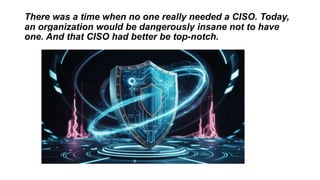
There was a time when no one really needed a CISO. Today,
an organization would be dangerously insane not to have
one. And that CISO had better be top-notch.
The Strategic Imperative of Cyber
Resilience
The attack surface for cyber threats has expanded exponentially
in this evolving age of digital transformation. The sophistication of
cyber-attacks—ranging from zero-day exploits to advanced
persistent threats (APTs)—demands a proactive and strategic
approach to cybersecurity. CEOs must recognize that cyber
resilience is not just about defense, it is also about ensuring the
robustness and recovery capability of business operations in
case of attacks.
The Expanded CISO Mandate
Modern CISO’s role transcends traditional IT security, including
strategic risk management, policy formulation, and cross-
functional collaboration within and outside the organization.
CISOs are tasked with identifying, assessing, and mitigating risks
across the entire digital ecosystem beyond mere technical
controls and passwords securities. This involves deploying
advanced threat intelligence systems and leveraging big data
analytics, automation capabilities to anticipate and neutralize
potential threats before they occur.
Adopting a Cybersecurity Mesh Architecture (CSMA) approach
allows for scalable and flexible security solutions. It provides a
centralized policy enforcement and decentralized execution
system to organizations. This strengthens the resilience of an
organization’s security posture by adding disparate security tools
and data sources. Over two-thirds (68%) of respondents in a
Gartner survey understand how CSMA works but only 5%
consider themselves to be experts on it. Most people consider it
likely that CSMA will eventually be a standard component of
security operations
The combination of Artificial Intelligence (AI) and Blockchain
technologies is a novel approach to strengthen cybersecurity
measures in particularly organizations that deal with sensitive
information such as regulated industries – government, finance,
healthcare etc. The fusion of adaptive intelligence through AI
systems and blockchain’s decentralized ledger is a new
approach for safeguarding digital assets.
The integration of AI algorithms with blockchain’s immutable and
distributed ledger system is a promising cybersecurity practice. AI
and automation, with an ability to analyze deep patterns
intelligently, detect errors, and adapt in real-time, allows
predictive capabilities that are necessary to detect and mitigate
emerging cyber threats proactively.
Modern-day senior CISOs use advanced neural network
architectures and sophisticated algorithms to ingest and analyze
diverse data sources in real-time, identifying anomalies indicative
of malicious activity. They believe that while manual processes
can maintain compliance, they cannot ensure security. A
combination of supervised and unsupervised learning techniques
with automation detects both known threats and novel attack
vectors with unparalleled accuracy.
CISO Services: Transformative Pillars
Investing in robust CISO services is important for building your
organization’s cyber resilience. These are some advanced areas
where CISO services can drive transformation.
Advanced Threat Detection and Response: Utilizing AI-driven
Security Information and Event Management (SIEM) systems
and Extended Detection and Response (XDR) platforms enables
real-time threat detection and automated response mechanisms.
This reduces the mean time to detect (MTTD) and mean time to
respond (MTTR) to incidents.
Adaptive Security Frameworks: Implementing adaptive security
measures that evolve with the threat landscape. This includes
dynamic threat modeling, behavioral analytics, and machine
learning algorithms that continuously refine defense
mechanisms.
Digital Forensics and Incident Response (DFIR): Advanced
DFIR capabilities are essential for investigating and mitigating
cyber incidents. Your CISO should oversee the development of
comprehensive incident response plans that include forensics
analysis, containment strategies, and post-incident reviews to
prevent future occurrences.
Cyber Risk Quantification: Employing quantitative risk
assessment models, such as FAIR (Factor Analysis of
Information Risk), allows for a more precise evaluation of cyber
risks in financial terms. This aids in prioritizing investments in
cybersecurity and justifying budget allocations.
Third-Party Risk Management (TPRM): Third-party risk is a
significant concern due to the interconnectivity of modern
business ecosystems. Your CISO must be capable of
implementing rigorous TPRM programs that include continuous
monitoring, rigorous vendor assessments, and compliance
audits.
CEO’s Role in Empowering the CISO
CEOs must provide strategic support by allocating strategic
investments for the CISO to maximize efficacy in delivering
security services. The CISO must have access to the latest
technologies and sufficient resources to implement advanced
security measures. He / She should drive a security-first culture.
Championing cybersecurity initiatives at the executive level helps
in embedding a security-first mindset across the organization.
Key takeaways
In a world where cyber threats are a persistent and evolving
challenge, the role of a CISO is indispensable. CEOs must invest
in advanced CISO services and integrate cybersecurity into the
strategic fabric of the organization to transform vulnerabilities into
strengths. This proactive approach not only safeguards the
enterprise but also improves its agility and competitive advantage
in the complex digital age.

From Vulnerability to Strength: The Role

  • 1.
    From Vulnerability to Strength:The Role of CISO Services in Cyber Resilience
  • 2.
    There was atime when no one really needed a CISO. Today, an organization would be dangerously insane not to have one. And that CISO had better be top-notch. The role of the Chief Information Security Officer (CISO) has evolved significantly from being solely a technology-focused professional to becoming a strategic business leader
  • 3.
    There was atime when no one really needed a CISO. Today, an organization would be dangerously insane not to have one. And that CISO had better be top-notch.
  • 4.
    The Strategic Imperativeof Cyber Resilience The attack surface for cyber threats has expanded exponentially in this evolving age of digital transformation. The sophistication of cyber-attacks—ranging from zero-day exploits to advanced persistent threats (APTs)—demands a proactive and strategic approach to cybersecurity. CEOs must recognize that cyber resilience is not just about defense, it is also about ensuring the robustness and recovery capability of business operations in case of attacks.
  • 5.
    The Expanded CISOMandate Modern CISO’s role transcends traditional IT security, including strategic risk management, policy formulation, and cross- functional collaboration within and outside the organization. CISOs are tasked with identifying, assessing, and mitigating risks across the entire digital ecosystem beyond mere technical controls and passwords securities. This involves deploying advanced threat intelligence systems and leveraging big data analytics, automation capabilities to anticipate and neutralize potential threats before they occur.
  • 6.
    Adopting a CybersecurityMesh Architecture (CSMA) approach allows for scalable and flexible security solutions. It provides a centralized policy enforcement and decentralized execution system to organizations. This strengthens the resilience of an organization’s security posture by adding disparate security tools and data sources. Over two-thirds (68%) of respondents in a Gartner survey understand how CSMA works but only 5% consider themselves to be experts on it. Most people consider it likely that CSMA will eventually be a standard component of security operations
  • 7.
    The combination ofArtificial Intelligence (AI) and Blockchain technologies is a novel approach to strengthen cybersecurity measures in particularly organizations that deal with sensitive information such as regulated industries – government, finance, healthcare etc. The fusion of adaptive intelligence through AI systems and blockchain’s decentralized ledger is a new approach for safeguarding digital assets. The integration of AI algorithms with blockchain’s immutable and distributed ledger system is a promising cybersecurity practice. AI and automation, with an ability to analyze deep patterns intelligently, detect errors, and adapt in real-time, allows predictive capabilities that are necessary to detect and mitigate emerging cyber threats proactively.
  • 8.
    Modern-day senior CISOsuse advanced neural network architectures and sophisticated algorithms to ingest and analyze diverse data sources in real-time, identifying anomalies indicative of malicious activity. They believe that while manual processes can maintain compliance, they cannot ensure security. A combination of supervised and unsupervised learning techniques with automation detects both known threats and novel attack vectors with unparalleled accuracy.
  • 9.
    CISO Services: TransformativePillars Investing in robust CISO services is important for building your organization’s cyber resilience. These are some advanced areas where CISO services can drive transformation. Advanced Threat Detection and Response: Utilizing AI-driven Security Information and Event Management (SIEM) systems and Extended Detection and Response (XDR) platforms enables real-time threat detection and automated response mechanisms. This reduces the mean time to detect (MTTD) and mean time to respond (MTTR) to incidents.
  • 10.
    Adaptive Security Frameworks:Implementing adaptive security measures that evolve with the threat landscape. This includes dynamic threat modeling, behavioral analytics, and machine learning algorithms that continuously refine defense mechanisms. Digital Forensics and Incident Response (DFIR): Advanced DFIR capabilities are essential for investigating and mitigating cyber incidents. Your CISO should oversee the development of comprehensive incident response plans that include forensics analysis, containment strategies, and post-incident reviews to prevent future occurrences.
  • 11.
    Cyber Risk Quantification:Employing quantitative risk assessment models, such as FAIR (Factor Analysis of Information Risk), allows for a more precise evaluation of cyber risks in financial terms. This aids in prioritizing investments in cybersecurity and justifying budget allocations. Third-Party Risk Management (TPRM): Third-party risk is a significant concern due to the interconnectivity of modern business ecosystems. Your CISO must be capable of implementing rigorous TPRM programs that include continuous monitoring, rigorous vendor assessments, and compliance audits.
  • 12.
    CEO’s Role inEmpowering the CISO CEOs must provide strategic support by allocating strategic investments for the CISO to maximize efficacy in delivering security services. The CISO must have access to the latest technologies and sufficient resources to implement advanced security measures. He / She should drive a security-first culture. Championing cybersecurity initiatives at the executive level helps in embedding a security-first mindset across the organization.
  • 13.
    Key takeaways In aworld where cyber threats are a persistent and evolving challenge, the role of a CISO is indispensable. CEOs must invest in advanced CISO services and integrate cybersecurity into the strategic fabric of the organization to transform vulnerabilities into strengths. This proactive approach not only safeguards the enterprise but also improves its agility and competitive advantage in the complex digital age.