SHARED
MANUFACTURING
Presented by Nuha Nazy – Co-Founder & President
Emilia Rogowska – Co-Founder & Vice President
• Space
• Financing For Equipment
• Access to Technology
• Training
• Staffing
• Technical Skills:
Engineering, CAD/CAM
Designers, Prototyping
BARRIERS TO ENTRY
Z-axis is a place where inventors, designers, artisans, craftspeople,
and engineers can share equipment, technology, and ideas to
launch their next creation.
Z-axis offers a range of memberships levels geared toward artists,
makers and small businesses. The 30,000 s.f. space with $500K in
equipment and 9 production staff, providing resources for Members
who want to scale beyond a start-up shop or “DIY” home-based
location.
Fundamentally, Z-axis fosters a community for creative stimulation,
collaboration, education, and entrepreneurship.
SHARED MANUFACTURING
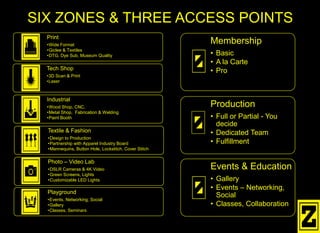
SIX ZONES & THREE ACCESS POINTS
Print
•Wide Format
•Giclee & Textiles
•DTG, Dye Sub, Museum Quality
Tech Shop
•3D Scan & Print
•Laser
Industrial
•Wood Shop, CNC,
•Metal Shop, Fabrication & Welding
•Paint Booth
Textile & Fashion
•Design to Production
•Partnership with Apparel Industry Board
•Mannequins, Button Hole, Lockstitch, Cover Stitch
Photo – Video Lab
•DSLR Cameras & 4K Video
•Green Screens, Lights
•Customizable LED Lights
Playground
•Events, Networking, Social
•Gallery
•Classes, Seminars
Membership
• Basic
• A la Carte
• Pro
Production
• Full or Partial - You
decide
• Dedicated Team
• Fulfillment
Events & Education
• Gallery
• Events – Networking,
Social
• Classes, Collaboration
FROM PROTOTYPE
TO PRODUCTION
Presented by Nuha Nazy – Co-Founder & President
Emilia Rogowska – Co-Founder & Vice President
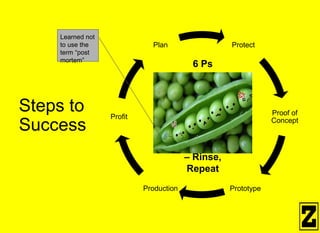
Steps to
Success
Protect
Proof of
Concept
PrototypeProduction
Profit
Plan
6 Ps
– Rinse,
Repeat
Learned not
to use the
term “post
mortem”
Plan – ORC
• Objective
• Resources
• Time
• Money
• Staff
• Technology
• Space
• Constraints
• Time
• Money
• Staff
• Technology
• Space
Plan – Before you Produce
• Elevator Pitch – 30 seconds
• Your Story – 1 to 2 short paragraphs
• Executive Summary 2 pages max.
The summary should discuss:
• the company and team;
• the market opportunity, value proposition, and customers;
• the technology/innovation;
• key technology risks to be addressed by this effort;
• and the competition.
Business Plan
• SBA.gov and SCORE have easy to use templates –
start with those and edit as needed.
• Key pieces: P&L, Income Statement, Balance
Sheet.
• Separate out your Capital Expenditures and your
Operating Expenditures
• Keep it basic – you don’t know enough to project out
for 10 years or even 5 –
• Do market research to substantiate your numbers –
write down your references.
• Update Regularly – keep the old versions
Protect
• Copyright – easy, inexpensive, fairly long-term, fairly
easy to defend
• Branding & Trademark – moderately easy,
reasonably priced, lasts indefinitely with renewal,
easy to defend
• Patent – very difficult, very expensive, limited life,
difficult to protect – but it matters
• NDAs – mutual and unilateral – keeps honest
people honest, establishes intent to protect
• Each of these protections is only as successful as
your willingness to sue – and pay lawyers.
Proof of Concept
• Don’t spend more on the initial prototype than the
minimum, until you have done your proof of concept
evaluation.
• If the numbers don’t justify it, either pivot or get out.
Excel is your friend.
• Find someone who will tell you your baby is ugly.
• Ask the value users would place on your product.
Would they pay?
Prototype - Iterate
• Keep it local
• Control
• Time
• Quality
• IP Protection
• It doesn’t have to be pretty, just enough to test
• Get willing participants
• Limit variables from iteration to iteration
• Test and document – process, testing methods, results,
keep a journal, take pictures
• Adjust your business plan (including market research)
and IP documentation accordingly.
Prototype - Options
• DIY
• Do you have the skills?
• Do you have all the ideas you will need?
• Track your time and investment.
• Job Shop
• Experience
• Visit the shop
• Be specific, drawings aren’t enough
• Get an expert to do your GD&T evaluation before you spend $
• Design House
• Expensive
• But thorough
• This is where pretty starts becoming important
• Limit variables from iteration to iteration and pick a stop point
• Get to a point where you can start selling a decent product – and measure
success (or failure)
• Test and document – process, testing methods, results, keep a journal, take
pictures
Production - Initial
• Keep it local
• Time is the only commodity you can’t replace
• Money – may be higher, but see above
• Assume a loss
• Intellectual Property – ask Apple
• Avoid long-term investment in equipment and space
– run lean
Profit - Revenue & Funding
• Focus on funding initially
• Crowdsourcing
• Kickstarter
• Indiegogo, etc.
• SEC investor changes
• Republic
• NextSeed, etc.
• Sales – get paying customers
• Measure against plan
Rinse, Repeat
• Evaluate results against plan
• Lessons learned?
• Do the numbers still make sense?
• Pivot as needed
• The customer isn’t always right, but you should
listen anyway
• Options to scale
• Domestic
• NAFTA & EU
• Asia

From Prototype to Production

  • 1.
    SHARED MANUFACTURING Presented by NuhaNazy – Co-Founder & President Emilia Rogowska – Co-Founder & Vice President
  • 2.
    • Space • FinancingFor Equipment • Access to Technology • Training • Staffing • Technical Skills: Engineering, CAD/CAM Designers, Prototyping BARRIERS TO ENTRY
  • 3.
    Z-axis is aplace where inventors, designers, artisans, craftspeople, and engineers can share equipment, technology, and ideas to launch their next creation. Z-axis offers a range of memberships levels geared toward artists, makers and small businesses. The 30,000 s.f. space with $500K in equipment and 9 production staff, providing resources for Members who want to scale beyond a start-up shop or “DIY” home-based location. Fundamentally, Z-axis fosters a community for creative stimulation, collaboration, education, and entrepreneurship. SHARED MANUFACTURING
  • 4.
    SIX ZONES &THREE ACCESS POINTS Print •Wide Format •Giclee & Textiles •DTG, Dye Sub, Museum Quality Tech Shop •3D Scan & Print •Laser Industrial •Wood Shop, CNC, •Metal Shop, Fabrication & Welding •Paint Booth Textile & Fashion •Design to Production •Partnership with Apparel Industry Board •Mannequins, Button Hole, Lockstitch, Cover Stitch Photo – Video Lab •DSLR Cameras & 4K Video •Green Screens, Lights •Customizable LED Lights Playground •Events, Networking, Social •Gallery •Classes, Seminars Membership • Basic • A la Carte • Pro Production • Full or Partial - You decide • Dedicated Team • Fulfillment Events & Education • Gallery • Events – Networking, Social • Classes, Collaboration
  • 5.
    FROM PROTOTYPE TO PRODUCTION Presentedby Nuha Nazy – Co-Founder & President Emilia Rogowska – Co-Founder & Vice President
  • 6.
    Steps to Success Protect Proof of Concept PrototypeProduction Profit Plan 6Ps – Rinse, Repeat Learned not to use the term “post mortem”
  • 7.
    Plan – ORC •Objective • Resources • Time • Money • Staff • Technology • Space • Constraints • Time • Money • Staff • Technology • Space
  • 8.
    Plan – Beforeyou Produce • Elevator Pitch – 30 seconds • Your Story – 1 to 2 short paragraphs • Executive Summary 2 pages max. The summary should discuss: • the company and team; • the market opportunity, value proposition, and customers; • the technology/innovation; • key technology risks to be addressed by this effort; • and the competition.
  • 9.
    Business Plan • SBA.govand SCORE have easy to use templates – start with those and edit as needed. • Key pieces: P&L, Income Statement, Balance Sheet. • Separate out your Capital Expenditures and your Operating Expenditures • Keep it basic – you don’t know enough to project out for 10 years or even 5 – • Do market research to substantiate your numbers – write down your references. • Update Regularly – keep the old versions
  • 10.
    Protect • Copyright –easy, inexpensive, fairly long-term, fairly easy to defend • Branding & Trademark – moderately easy, reasonably priced, lasts indefinitely with renewal, easy to defend • Patent – very difficult, very expensive, limited life, difficult to protect – but it matters • NDAs – mutual and unilateral – keeps honest people honest, establishes intent to protect • Each of these protections is only as successful as your willingness to sue – and pay lawyers.
  • 11.
    Proof of Concept •Don’t spend more on the initial prototype than the minimum, until you have done your proof of concept evaluation. • If the numbers don’t justify it, either pivot or get out. Excel is your friend. • Find someone who will tell you your baby is ugly. • Ask the value users would place on your product. Would they pay?
  • 12.
    Prototype - Iterate •Keep it local • Control • Time • Quality • IP Protection • It doesn’t have to be pretty, just enough to test • Get willing participants • Limit variables from iteration to iteration • Test and document – process, testing methods, results, keep a journal, take pictures • Adjust your business plan (including market research) and IP documentation accordingly.
  • 13.
    Prototype - Options •DIY • Do you have the skills? • Do you have all the ideas you will need? • Track your time and investment. • Job Shop • Experience • Visit the shop • Be specific, drawings aren’t enough • Get an expert to do your GD&T evaluation before you spend $ • Design House • Expensive • But thorough • This is where pretty starts becoming important • Limit variables from iteration to iteration and pick a stop point • Get to a point where you can start selling a decent product – and measure success (or failure) • Test and document – process, testing methods, results, keep a journal, take pictures
  • 14.
    Production - Initial •Keep it local • Time is the only commodity you can’t replace • Money – may be higher, but see above • Assume a loss • Intellectual Property – ask Apple • Avoid long-term investment in equipment and space – run lean
  • 15.
    Profit - Revenue& Funding • Focus on funding initially • Crowdsourcing • Kickstarter • Indiegogo, etc. • SEC investor changes • Republic • NextSeed, etc. • Sales – get paying customers • Measure against plan
  • 16.
    Rinse, Repeat • Evaluateresults against plan • Lessons learned? • Do the numbers still make sense? • Pivot as needed • The customer isn’t always right, but you should listen anyway • Options to scale • Domestic • NAFTA & EU • Asia

Editor's Notes

  • #2 Elevator Pitch: 30,000 s.f. Shared manufacturing in the Pilsen neighborhood of Chicago Lacuna Lofts Building – When you are ready to generate revenue with your product, we are where you go for your professional manufacturing. We are NOT a maker space. We are NOT a co-working space. making small business revenue generation a reality. Think it there – Make it here My Story: Emigrated School Graduated Still Nothing … All jobs 10 Years Corporate Z-axis regular route vs. love of art and making throughout my life. Mom was an artist – art as a way of connecting to people Art as communication The only constant interest was that I liked to make things Started a company with my childhood friend making custom hair decorations – at the age of 9. They really should teach finance earlier. Emigrated to the US 1992 High school, college – changed major six times Freshman year I got a degree in both forensic science AND theater – I am perfectly suited to commit a crime and get away with it. Got a series of jobs – makeup, fashion, print and format engineering – a marriage of math and art – but TEN LONG YEARS. Then I attended this talk on 3d printing in medicine, where I met Nuha. Z-axis Factory was created to allow people like me to learn, experiment and continue to adapt my art to what is possible.
  • #3 Massive investment in time, money and focus Limits ability to pivot when needed
  • #4 30,000 s.f. – 15,000 industrial production space $500K in equipment investment 9 production staff
  • #5 And of course conference rooms, break room/kitchen, office printer, etc.
  • #6 Introduce Nuha Nuha personal story - cabinet maker & seamstress 5th business 2 concurrent Operations analysis 3d print in medicine Tech and operations focus
  • #10 be honest and don’t waste time making numbers up that you can’t justify.
  • #11 For patent – do a search first. Identify key words, do the flowchart, Provisional vs. non-provisional Timing The search
  • #12 PJ vs. Kevin
  • #13 GD&T - Geometric Dimensioning and Tolerancing (GD&T)
  • #14 DIY – your time is valuable – don’t lose your day job - yet Job Shop - GD&T - Geometric Dimensioning and Tolerancing (GD&T) Design house – quit your day job, license, pay a lot – your choice Iterate - Don’t let the perfect become the enemy of the good.
  • #16 2012 – no longer a $200k and $1M minimum The JOBS Act was enacted to provide less costly alternatives for businesses to sell securities through the internet. Section 4(a)(6), in particular, allows businesses to sell securities to anyone, not just investors with a certain level of income and net worth.