From Code to
Commerce
A Backend Java
Developer’s Galactic
Journey into E-Commerce
2
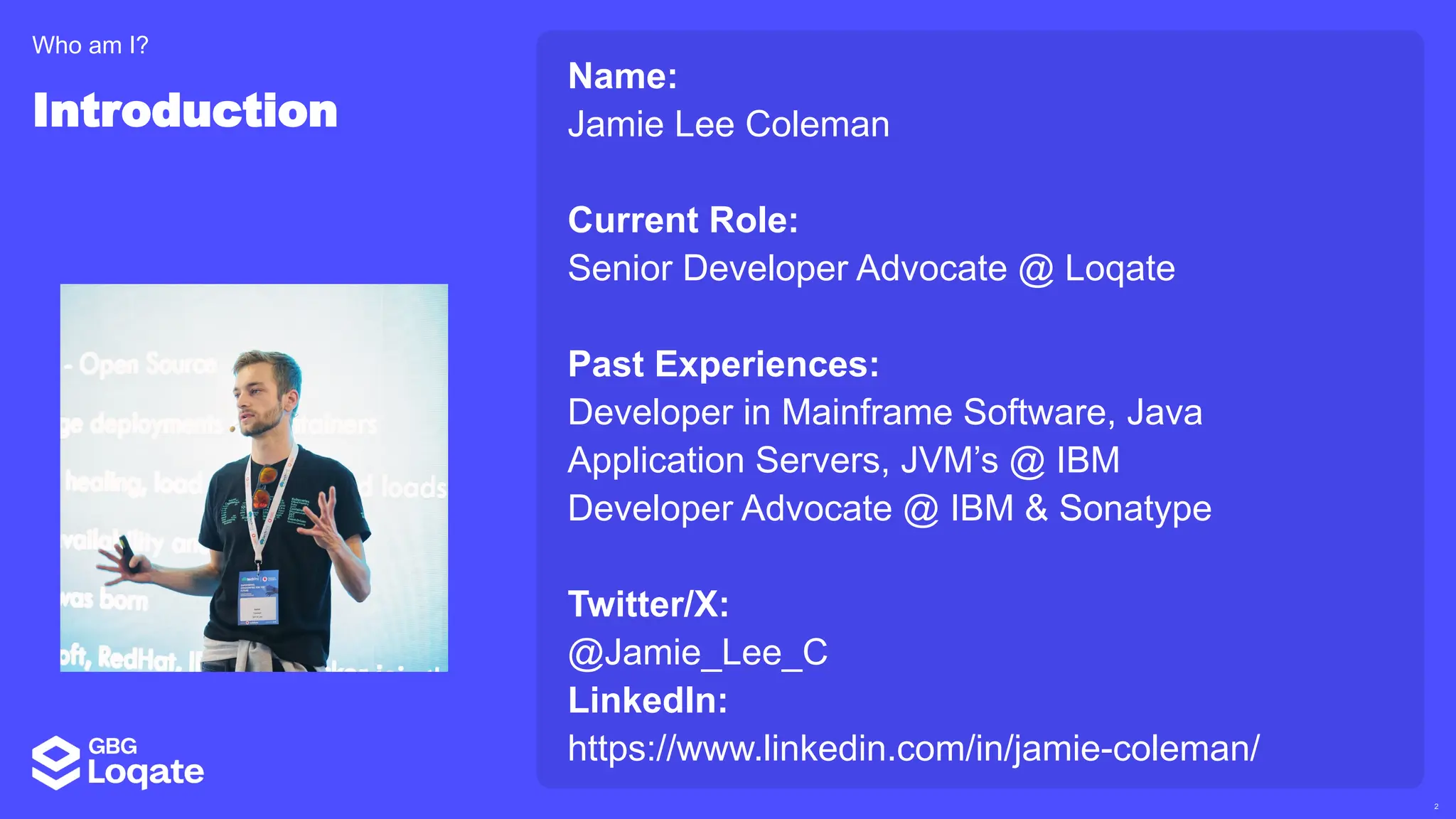
Name:
Jamie Lee Coleman
Current Role:
Senior Developer Advocate @ Loqate
Past Experiences:
Developer in Mainframe Software, Java
Application Servers, JVM’s @ IBM
Developer Advocate @ IBM & Sonatype
Twitter/X:
@Jamie_Lee_C
LinkedIn:
https://www.linkedin.com/in/jamie-coleman/
Introduction
Who am I?
3
01
02
03
04
05
06
07
08
09
10
11
My Journey into E-commerce
My Mainframe Days
My WebSphere Days
My Cloud/MicroProfile Days
My Energy Efficiency Days
My DevSecOps Days
My AI Days
E-commerce & UX
E-commerce & AI
E-commerce & Open Source
Overview
Todays Agenda
Contents
4
4
01 My journey into
e-commerce
5
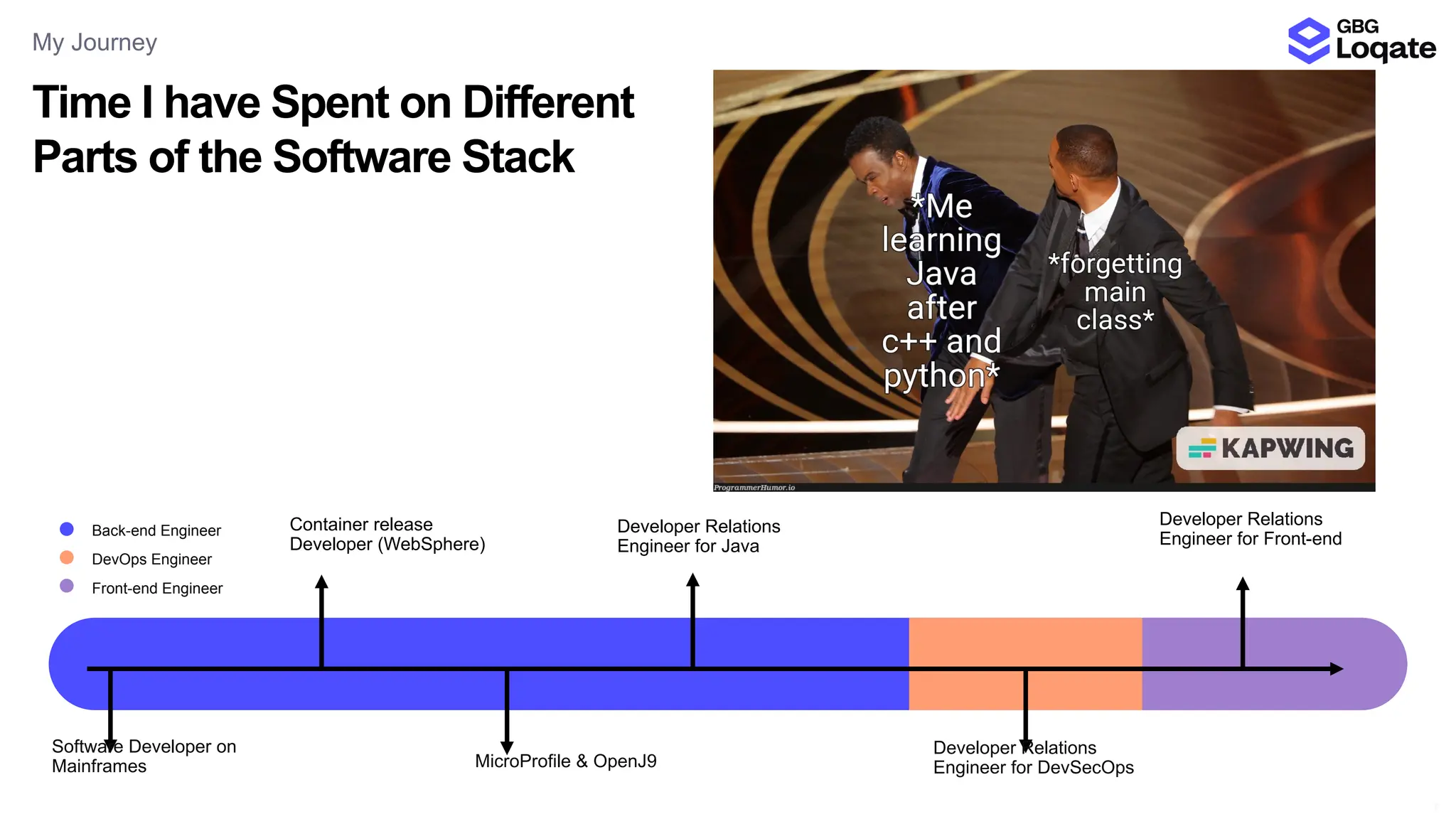
Back-end Engineer
DevOps Engineer
Front-end Engineer
Time I have Spent on Different
Parts of the Software Stack
My Journey
Software Developer on
Mainframes
Container release
Developer (WebSphere)
MicroProfile & OpenJ9
Developer Relations
Engineer for Java
Developer Relations
Engineer for DevSecOps
Developer Relations
Engineer for Front-end
6
7
7
02 The Mainframe
Days
8
8
9
9
03 The WebSphere
Days
10
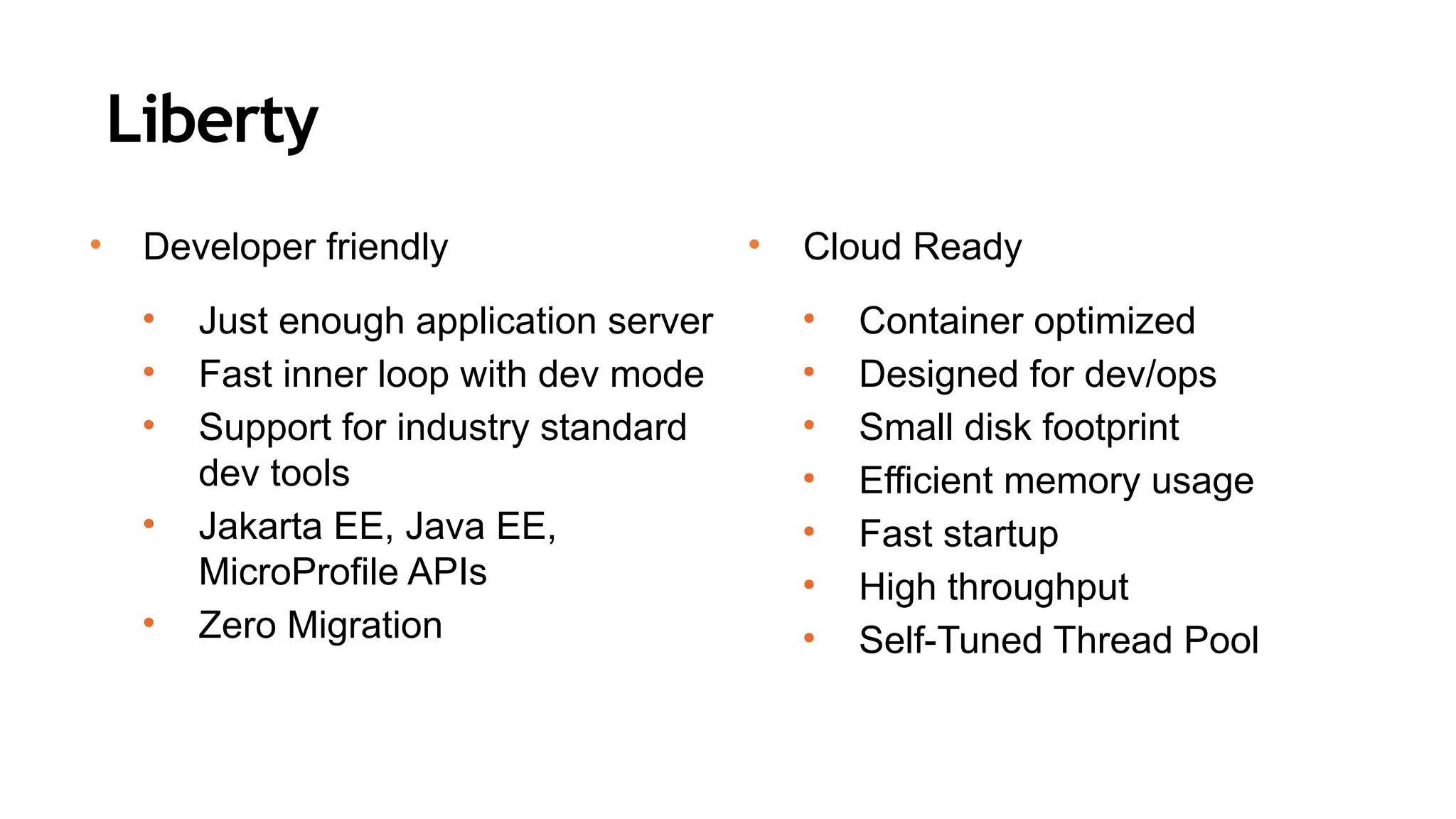
Liberty
• Developer friendly
• Just enough application server
• Fast inner loop with dev mode
• Support for industry standard
dev tools
• Jakarta EE, Java EE,
MicroProfile APIs
• Zero Migration
• Cloud Ready
• Container optimized
• Designed for dev/ops
• Small disk footprint
• Efficient memory usage
• Fast startup
• High throughput
• Self-Tuned Thread Pool
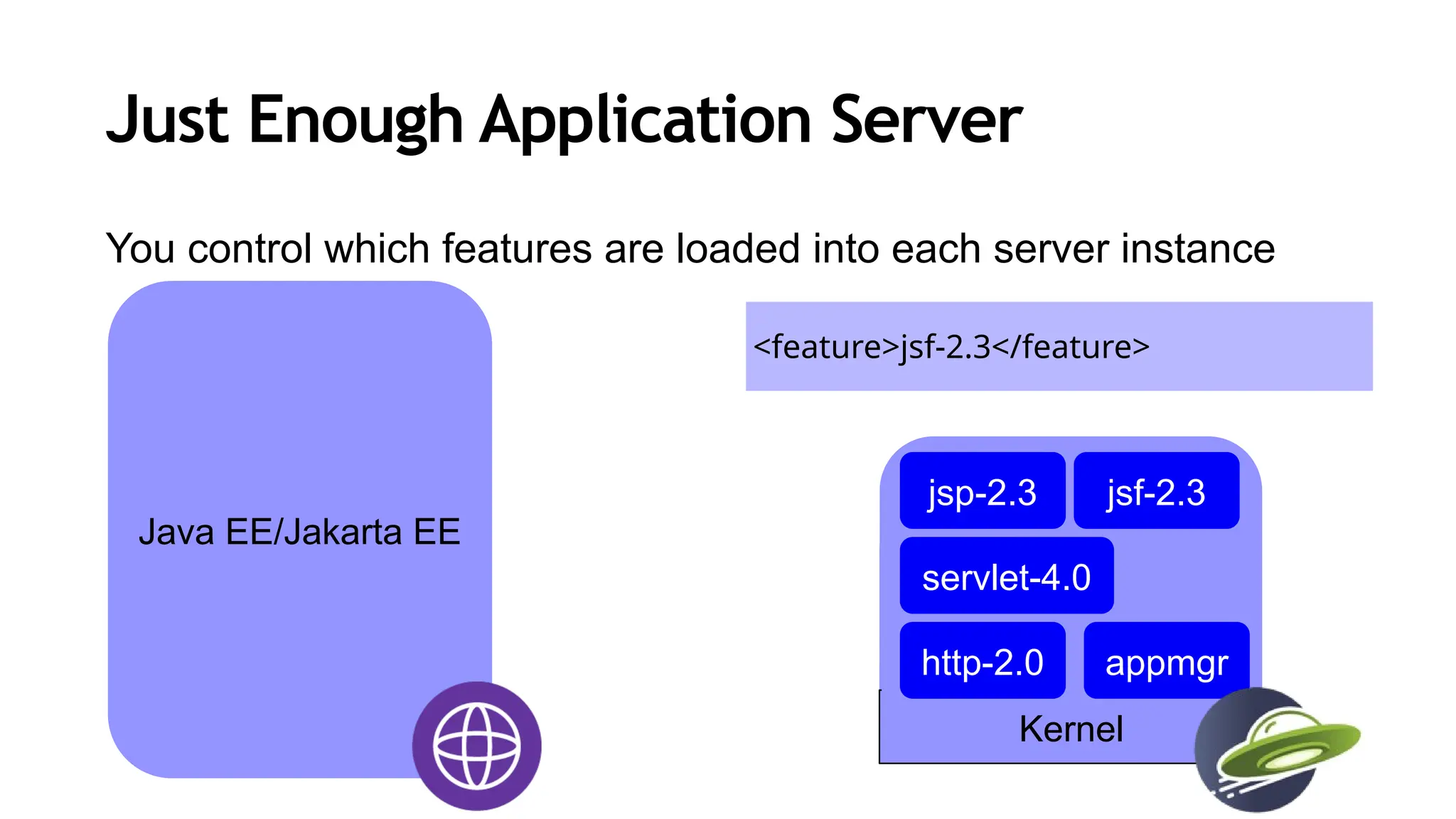
<feature>servlet-4.0</feature>
<feature>jsf-2.3</feature>
Just Enough Application Server
You control which features are loaded into each server instance
Kernel
servlet-4.0
http-2.0 appmgr
jsp-2.3 jsf-2.3
Java EE/Jakarta EE
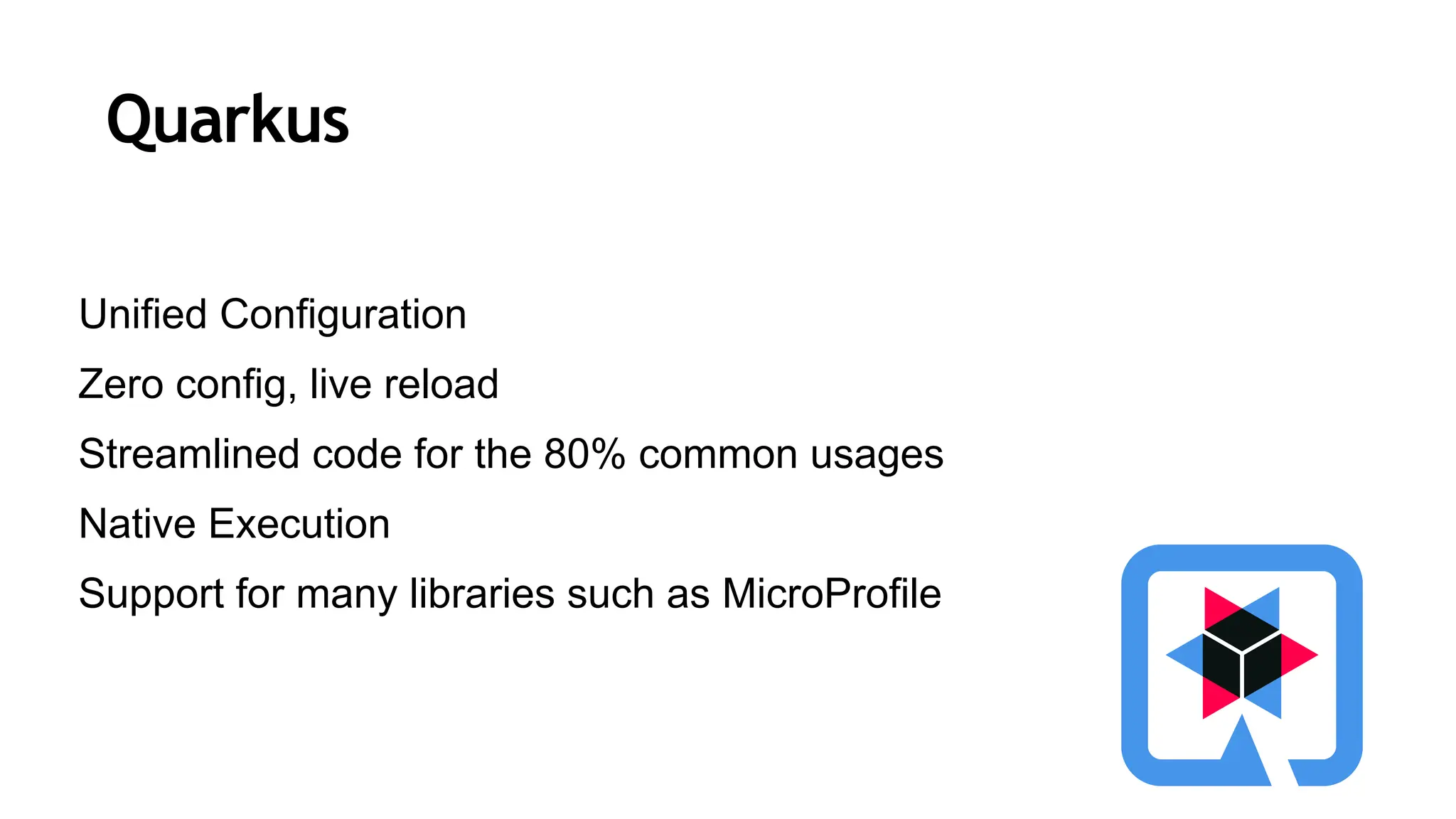
Quarkus
Unified Configuration
Zero config, live reload
Streamlined code for the 80% common usages
Native Execution
Support for many libraries such as MicroProfile
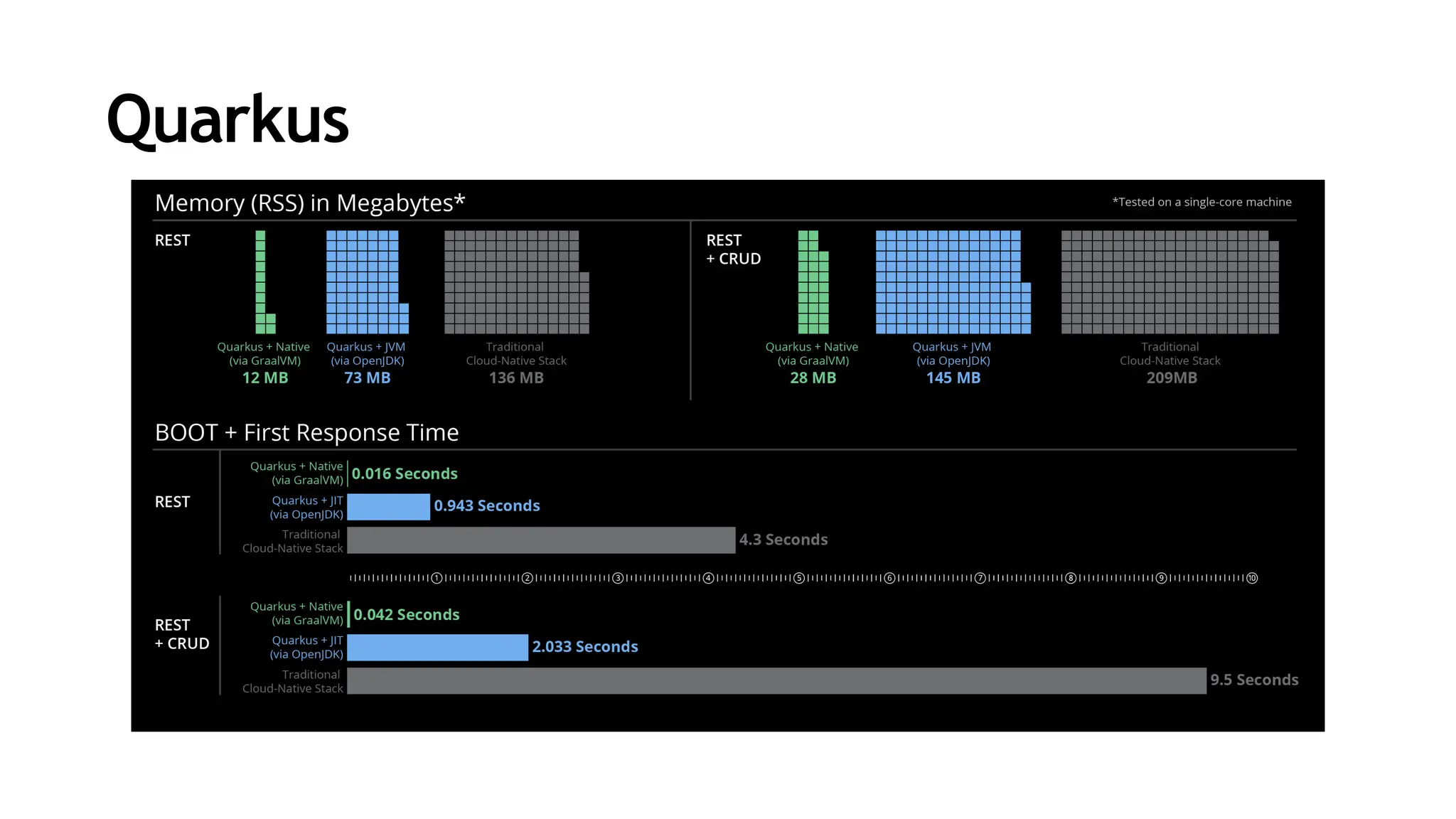
Quarkus
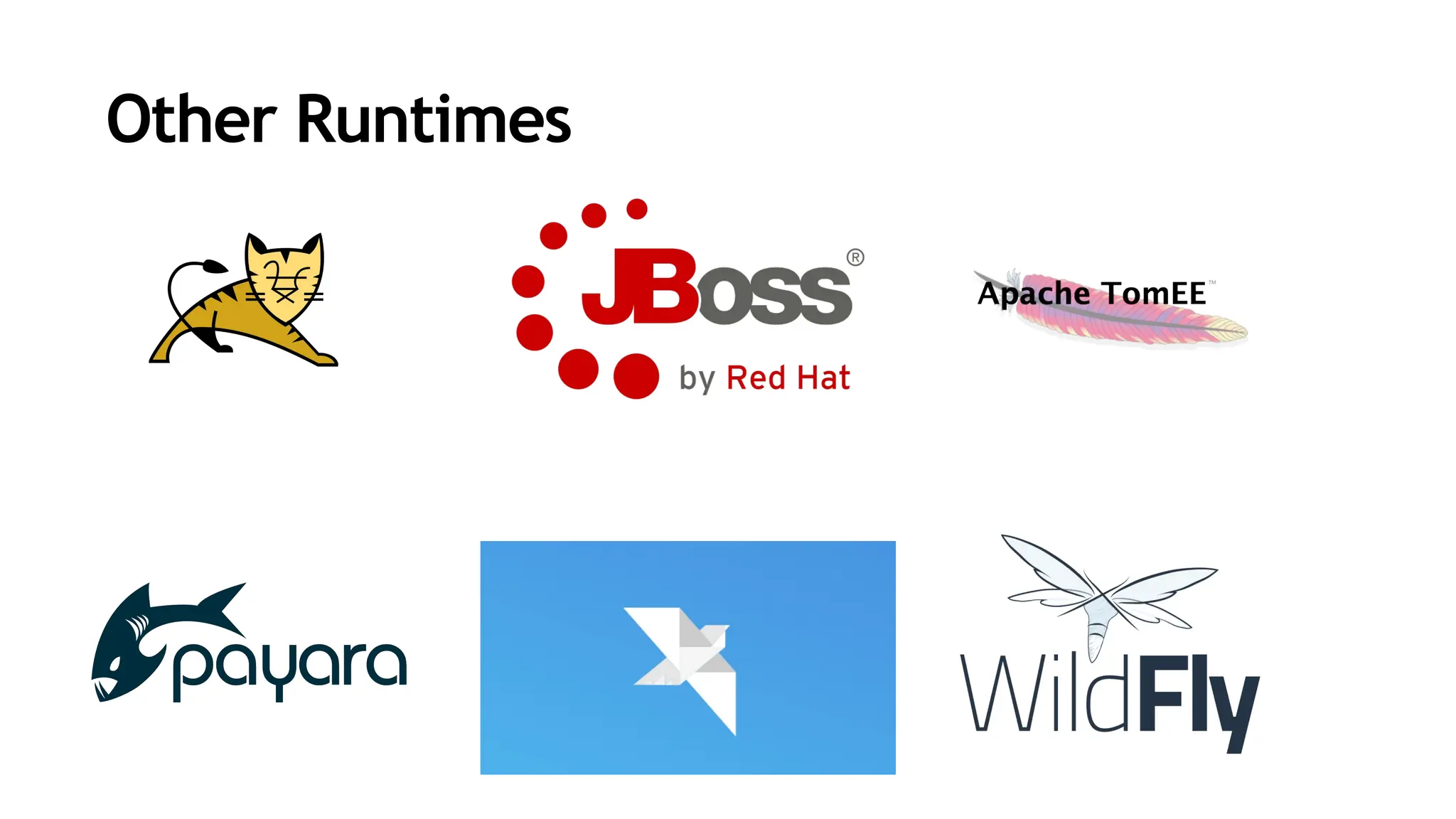
Other Runtimes
17
17
04 The
Cloud/MicroProfle
Days
How the cloud has changed the
JVM
$ $ $ $ $
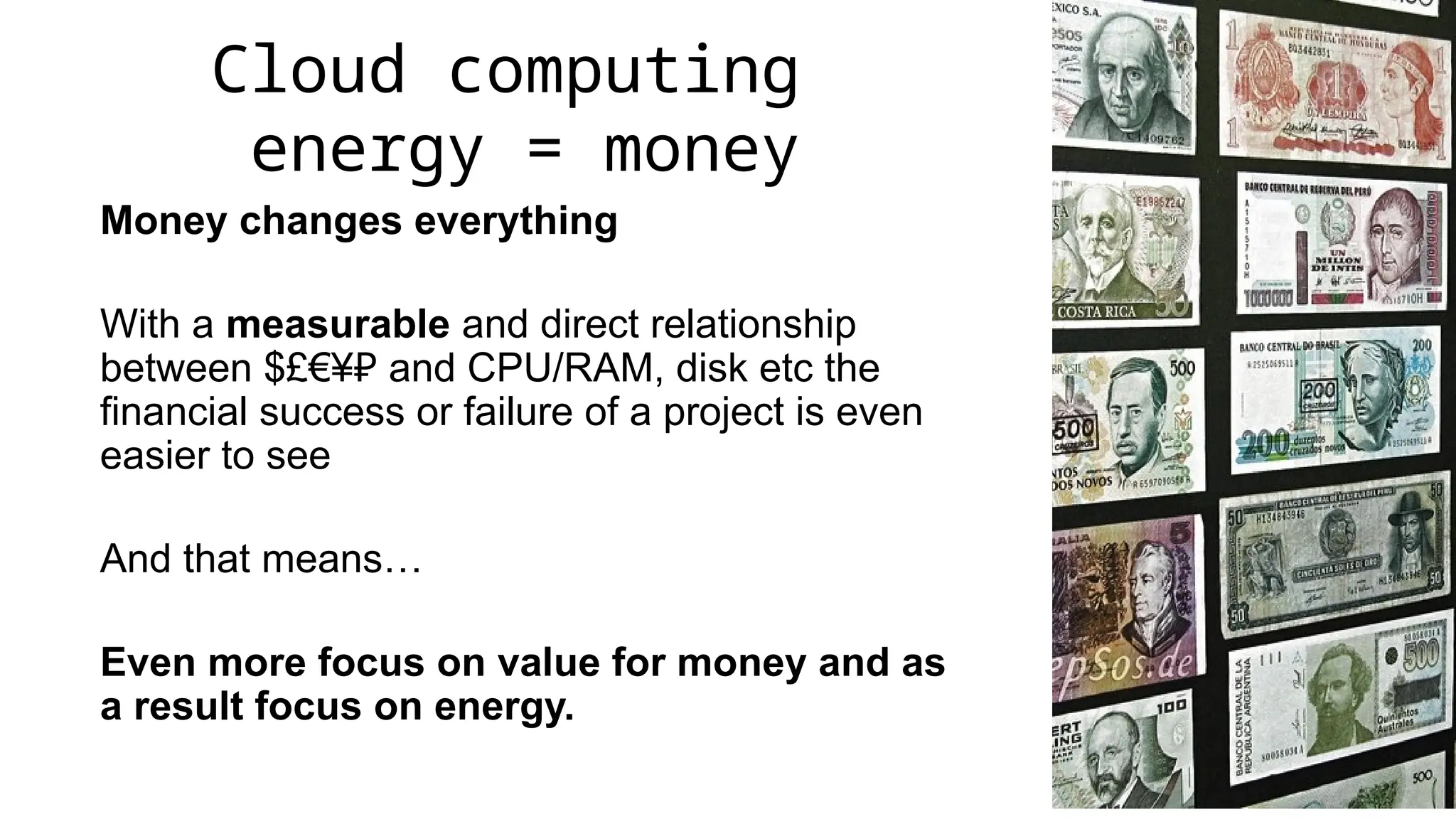
Cloud computing
energy = money
Money changes everything
With a measurable and direct relationship
between $£€¥₽ and CPU/RAM, disk etc the
financial success or failure of a project is even
easier to see
And that means…
Even more focus on value for money and as
a result focus on energy.
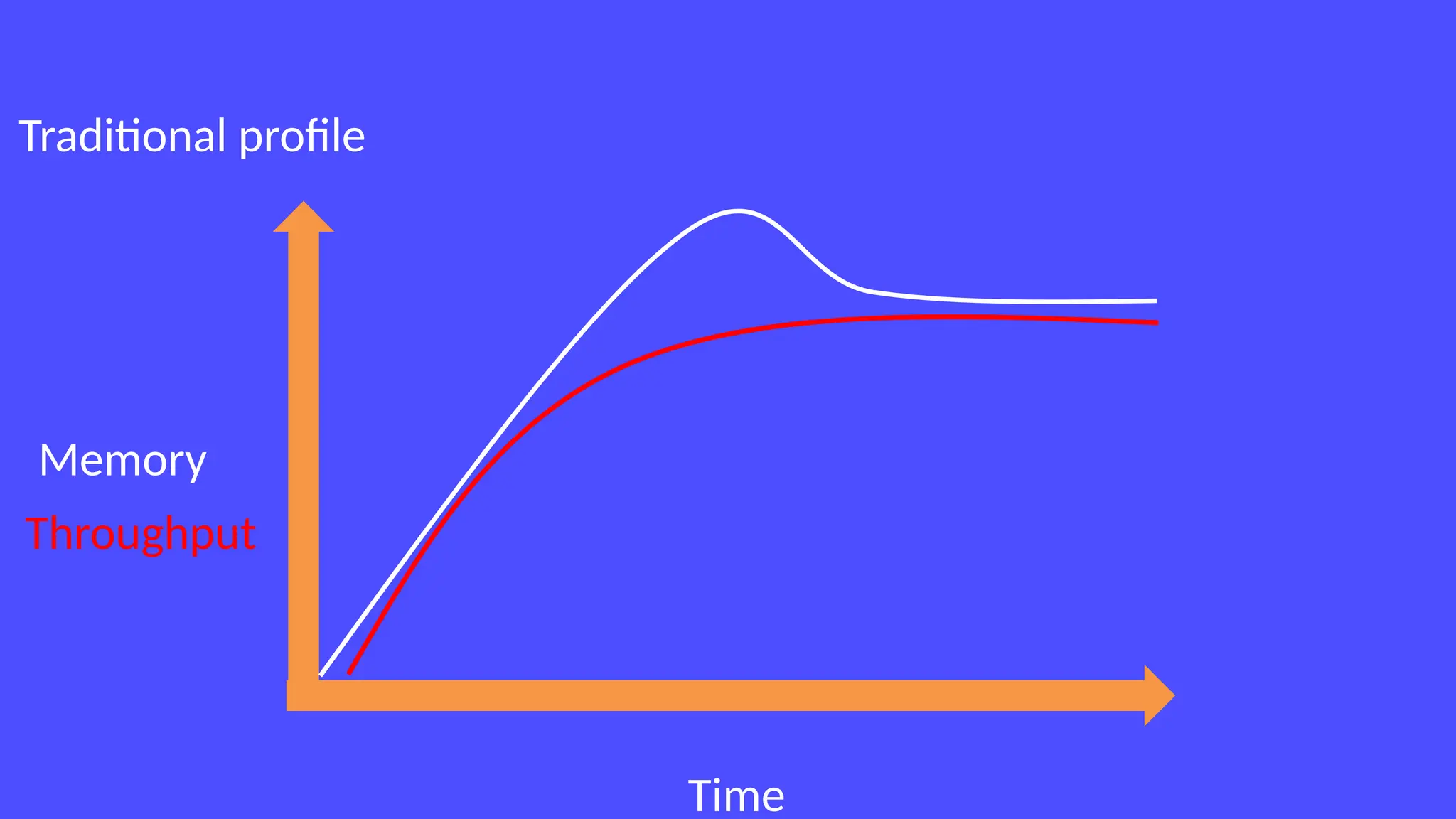
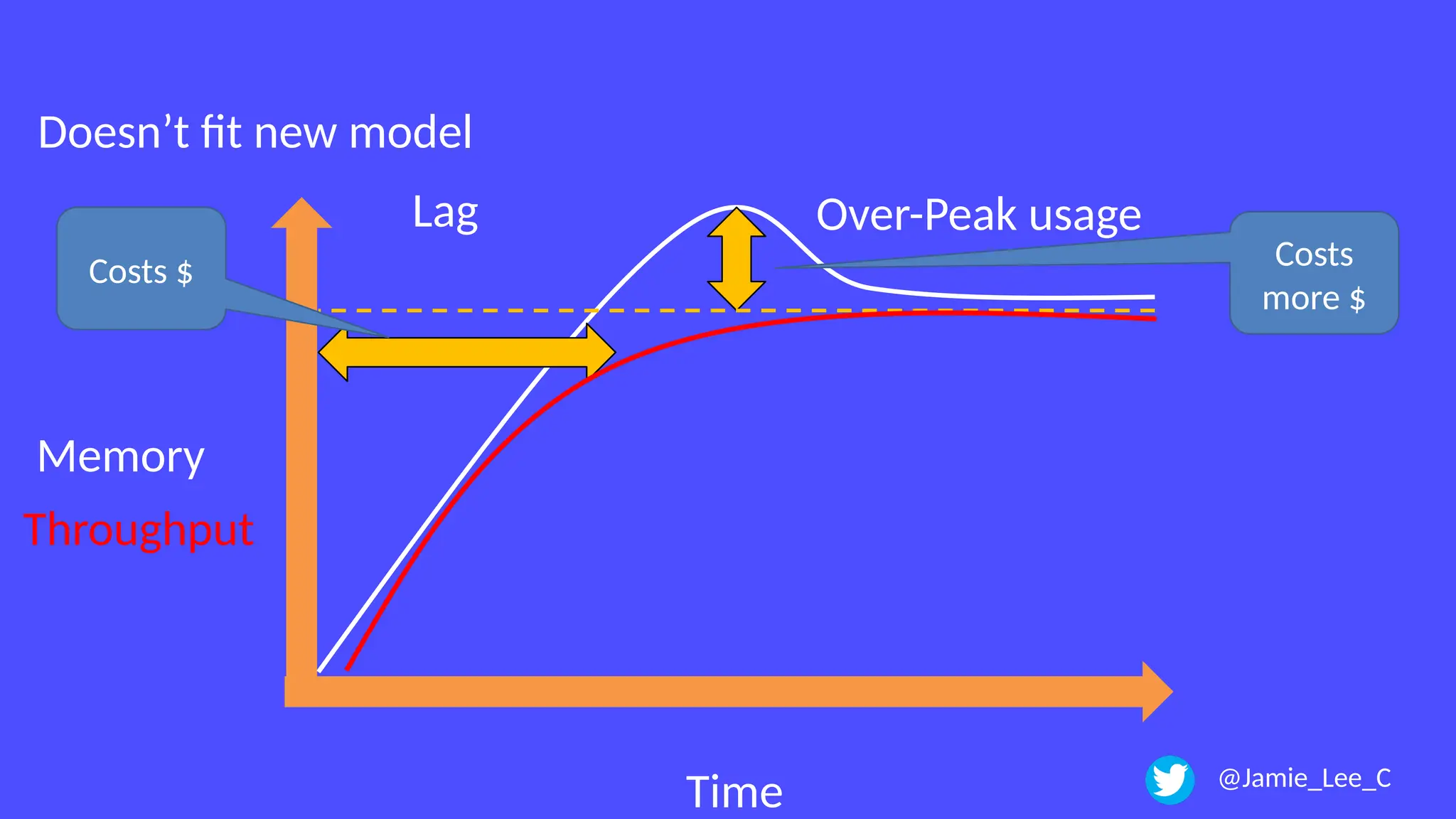
Time
Memory
Traditional profile
Throughput
Time
Lag Over-Peak usage
Doesn’t fit new model
Costs $ Costs
more $
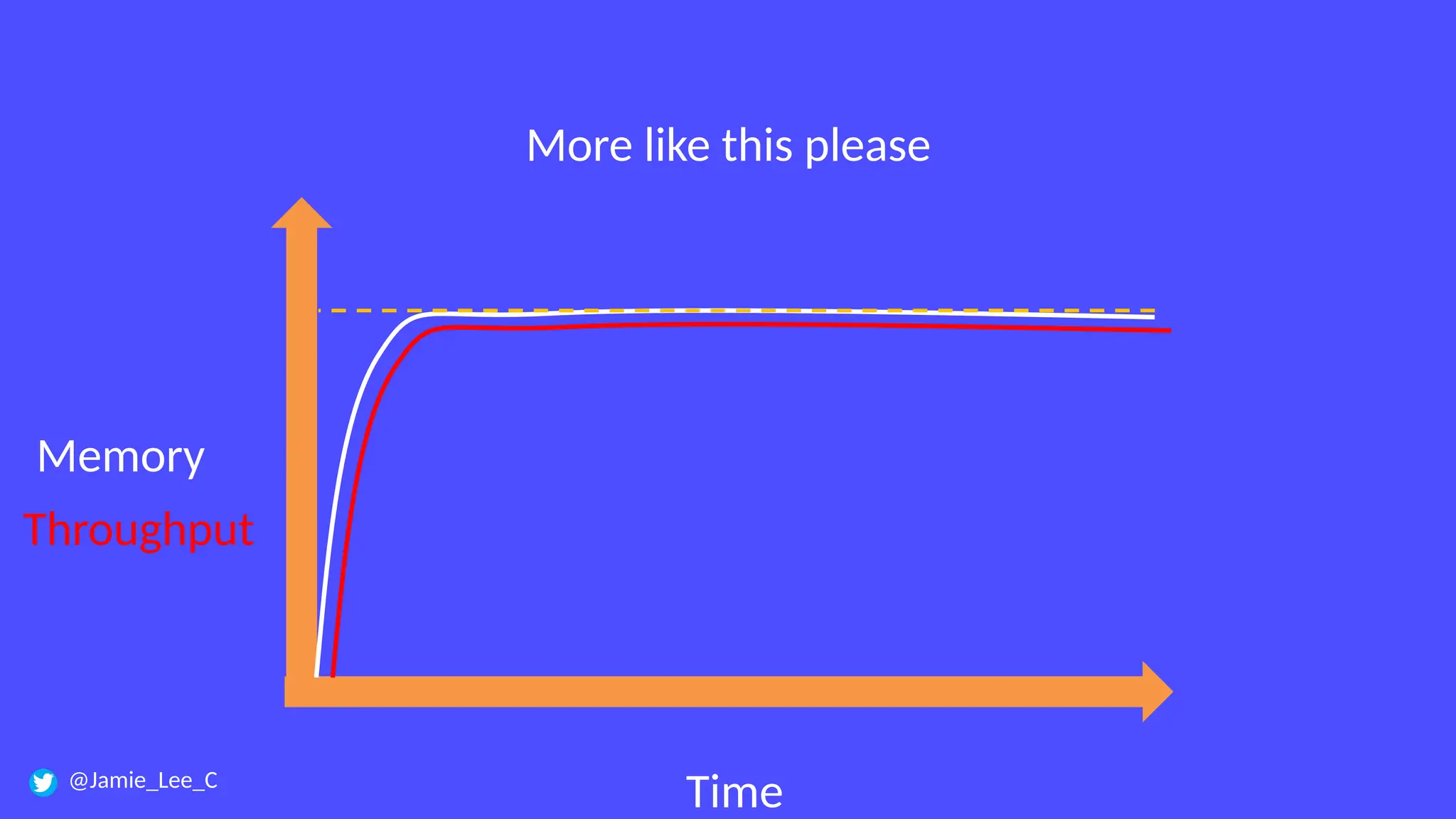
Memory
Throughput
@Jamie_Lee_C
Time
More like this please
Memory
Throughput
@Jamie_Lee_C
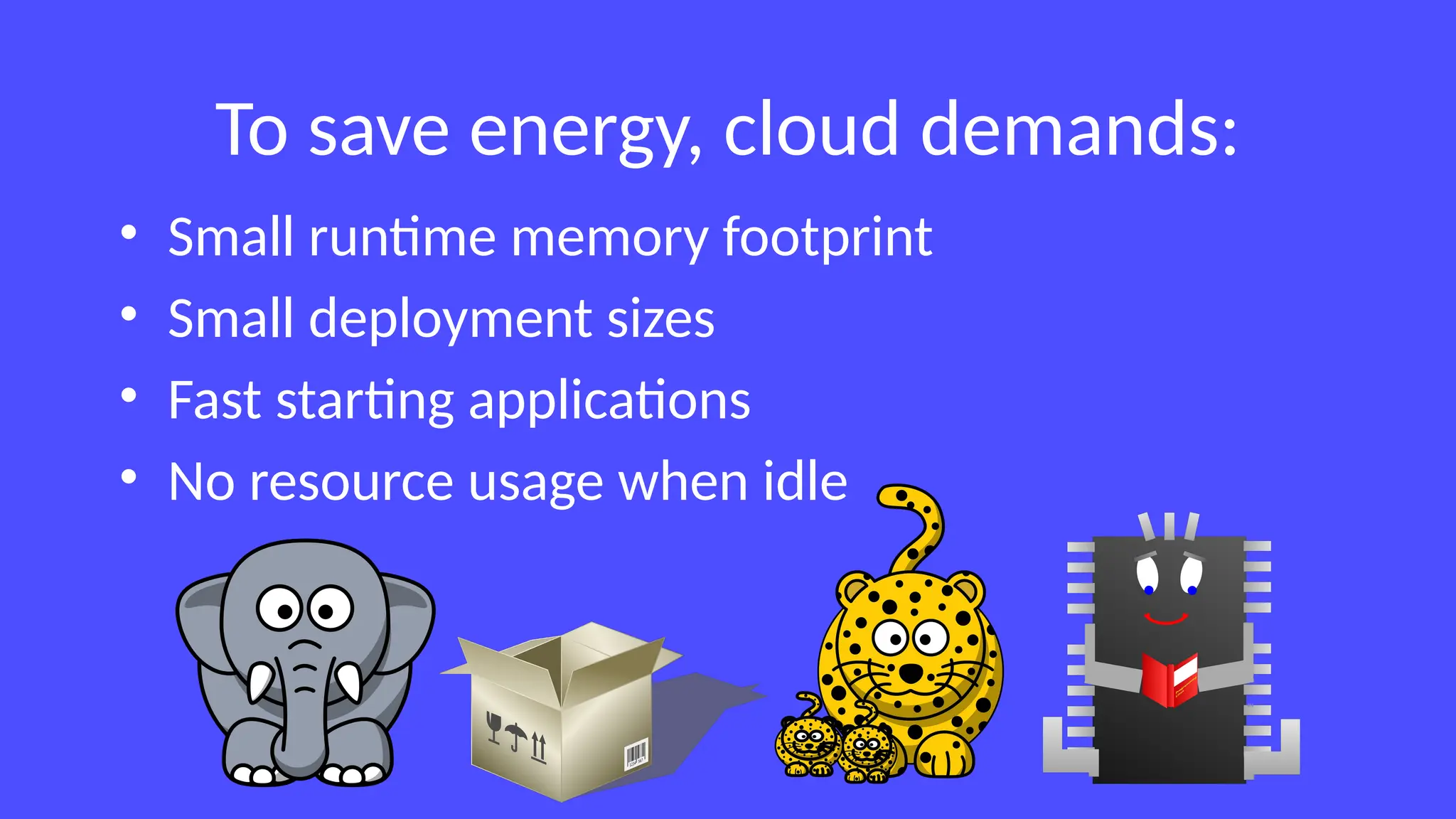
To save energy, cloud demands:
• Small runtime memory footprint
• Small deployment sizes
• Fast starting applications
• No resource usage when idle
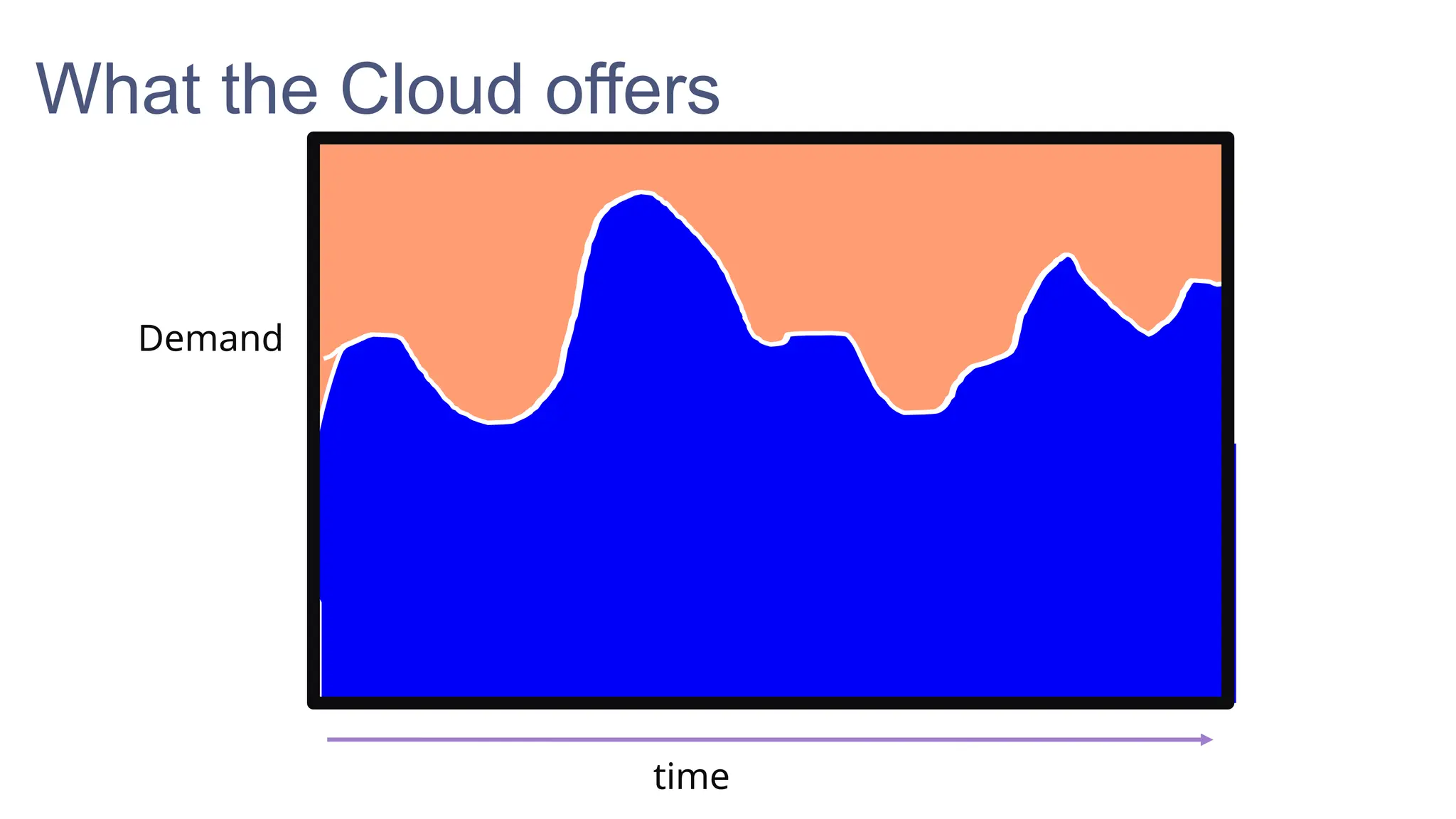
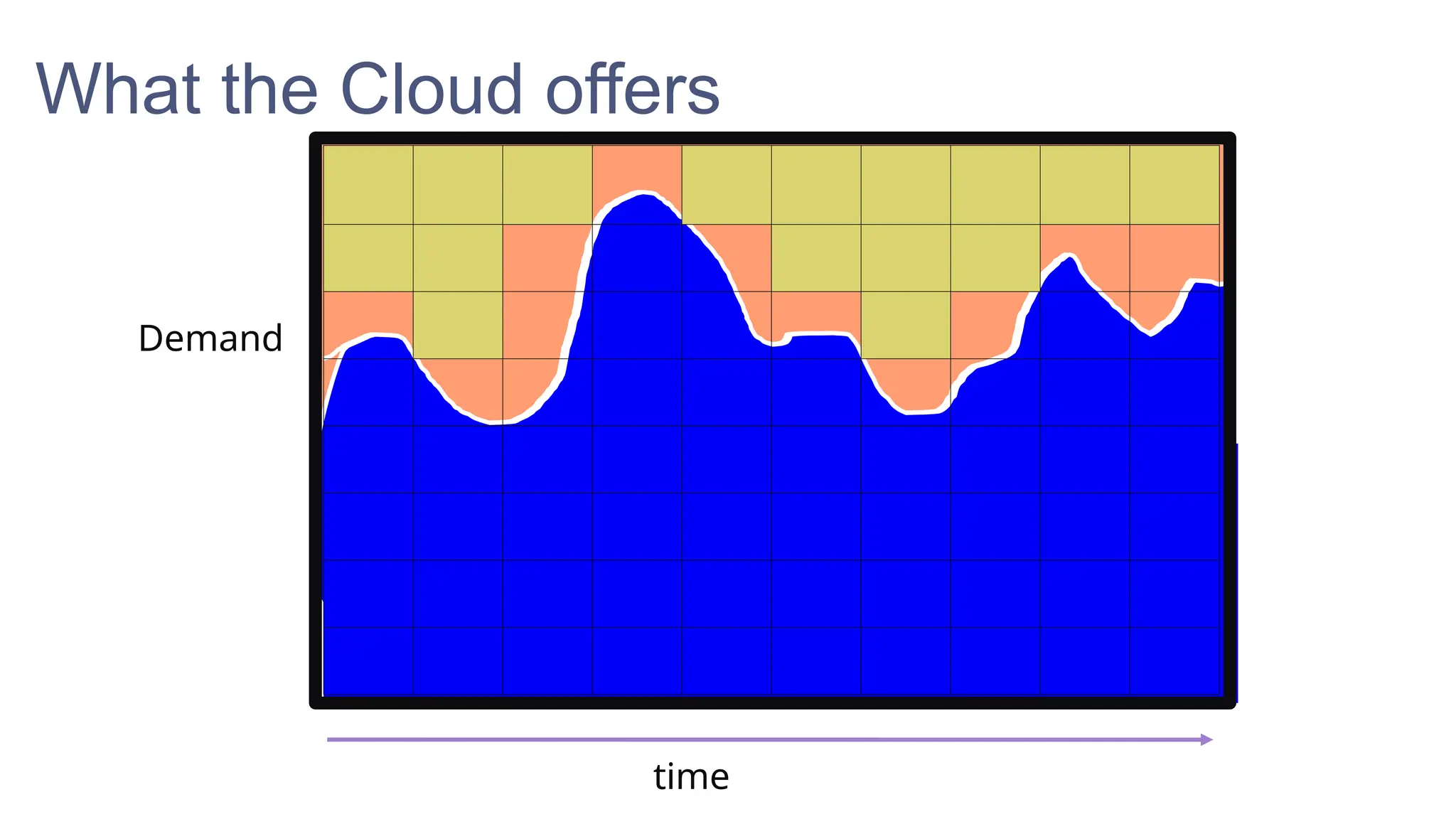
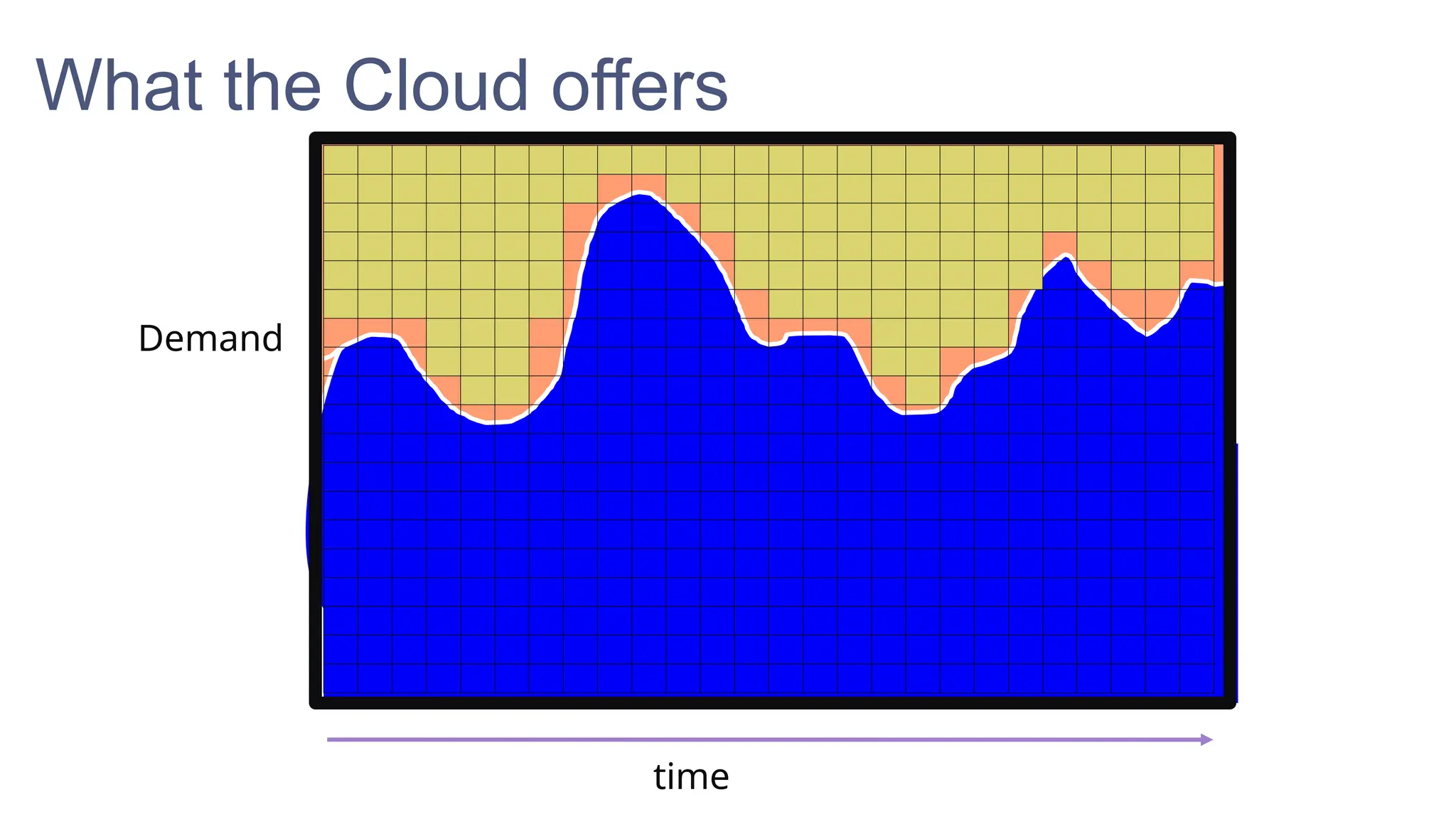
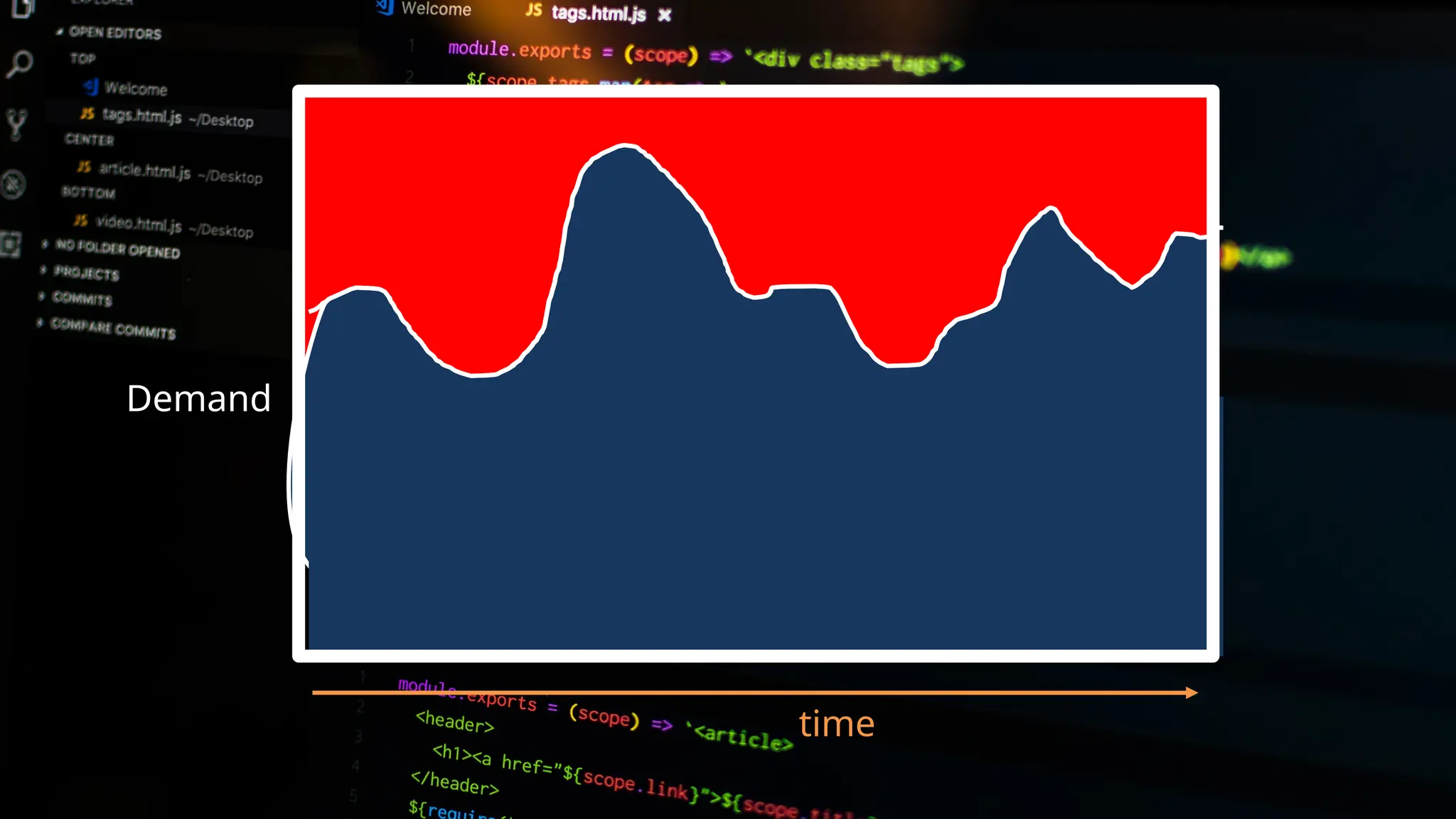
Demand
One big server running all the time?
time
What the Cloud offers
Demand
One big server running all the time?
time
What the Cloud offers
Demand
time
One big server running all the time?
What the Cloud offers
Microservices and the JVM
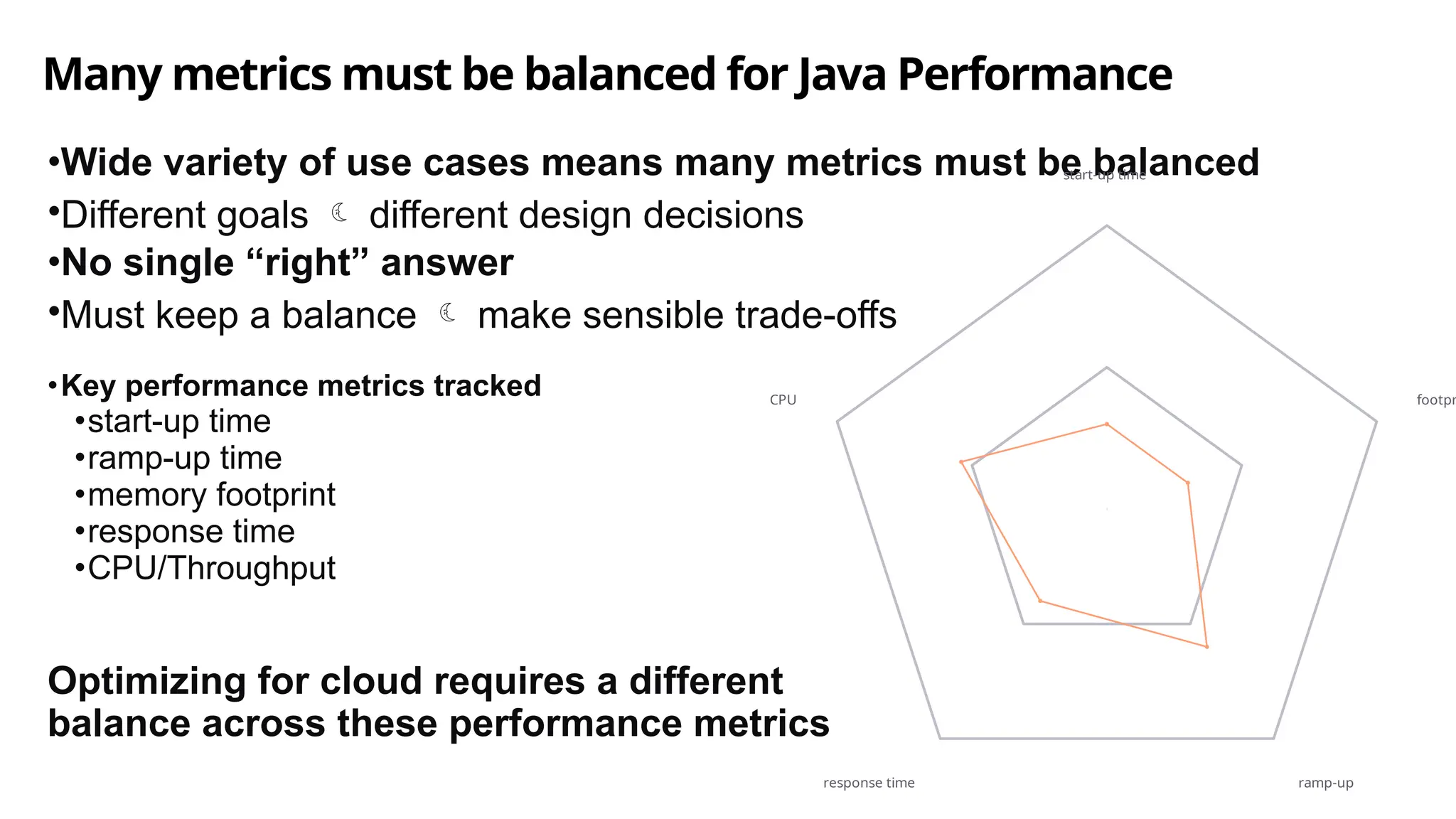
Many metrics must be balanced for Java Performance
•Wide variety of use cases means many metrics must be balanced
•Different goals  different design decisions
•No single “right” answer
•Must keep a balance  make sensible trade-offs
•Key performance metrics tracked
•start-up time
•ramp-up time
•memory footprint
•response time
•CPU/Throughput
Optimizing for cloud requires a different
balance across these performance metrics
start-up time
footpr
ramp-up
response time
CPU
Java ME Inside!
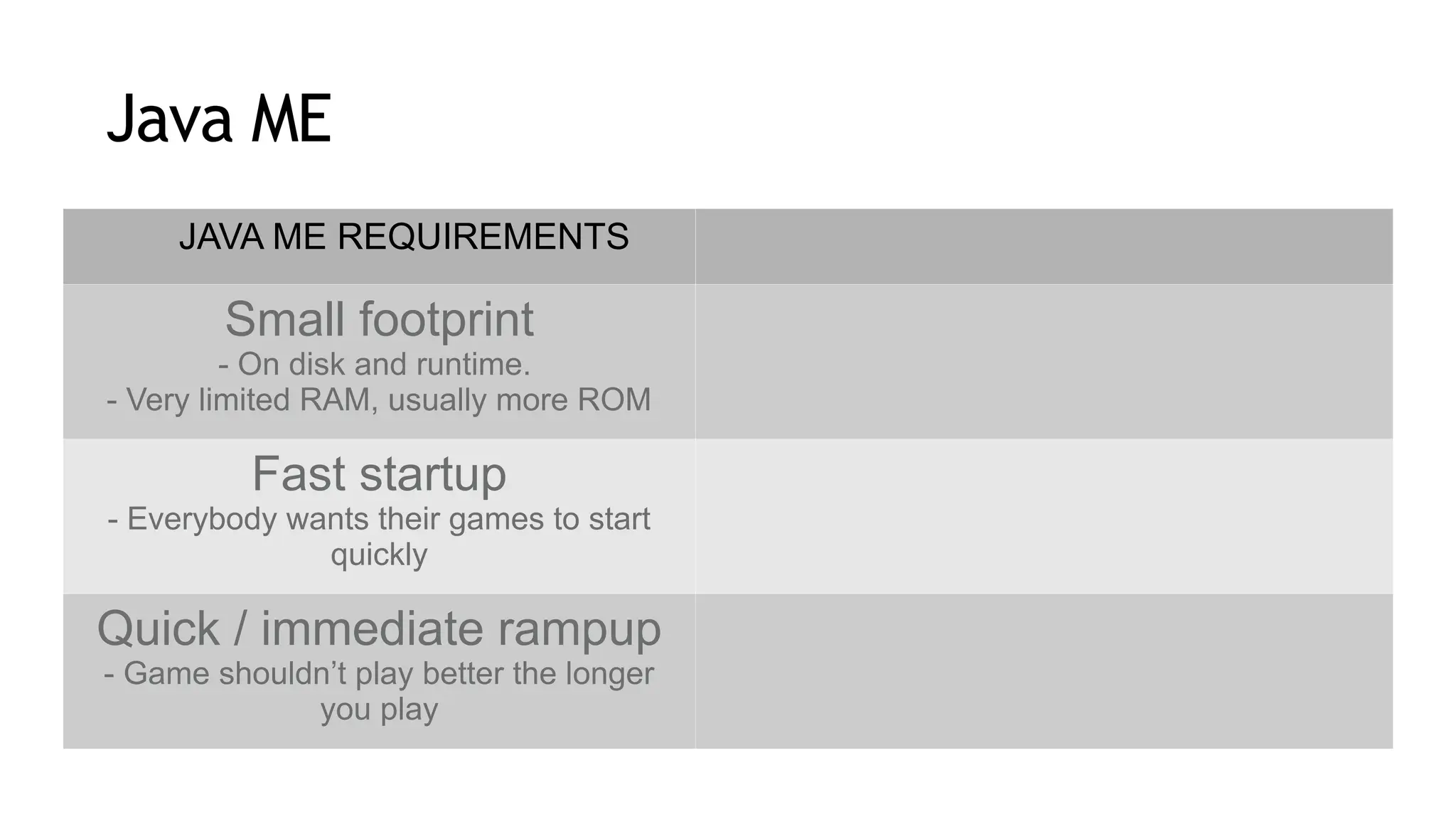
JAVA ME REQUIREMENTS
Small footprint
- On disk and runtime.
- Very limited RAM, usually more ROM
Fast startup
- Everybody wants their games to start
quickly
Quick / immediate rampup
- Game shouldn’t play better the longer
you play
Java ME
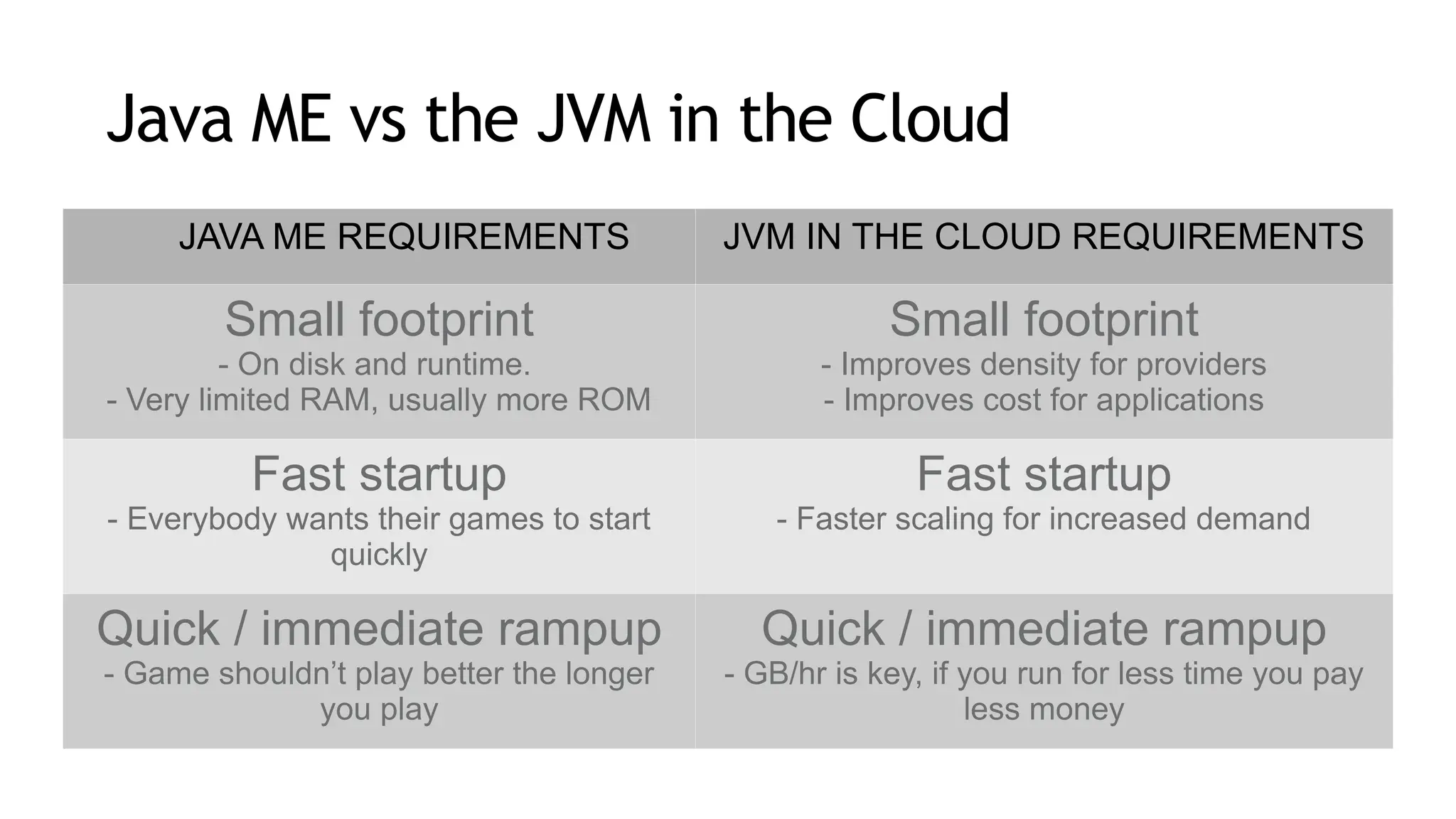
JAVA ME REQUIREMENTS JVM IN THE CLOUD REQUIREMENTS
Small footprint
- On disk and runtime.
- Very limited RAM, usually more ROM
Small footprint
- Improves density for providers
- Improves cost for applications
Fast startup
- Everybody wants their games to start
quickly
Fast startup
- Faster scaling for increased demand
Quick / immediate rampup
- Game shouldn’t play better the longer
you play
Quick / immediate rampup
- GB/hr is key, if you run for less time you pay
less money
Java ME vs the JVM in the Cloud
Eclipse
MicroProfile
3
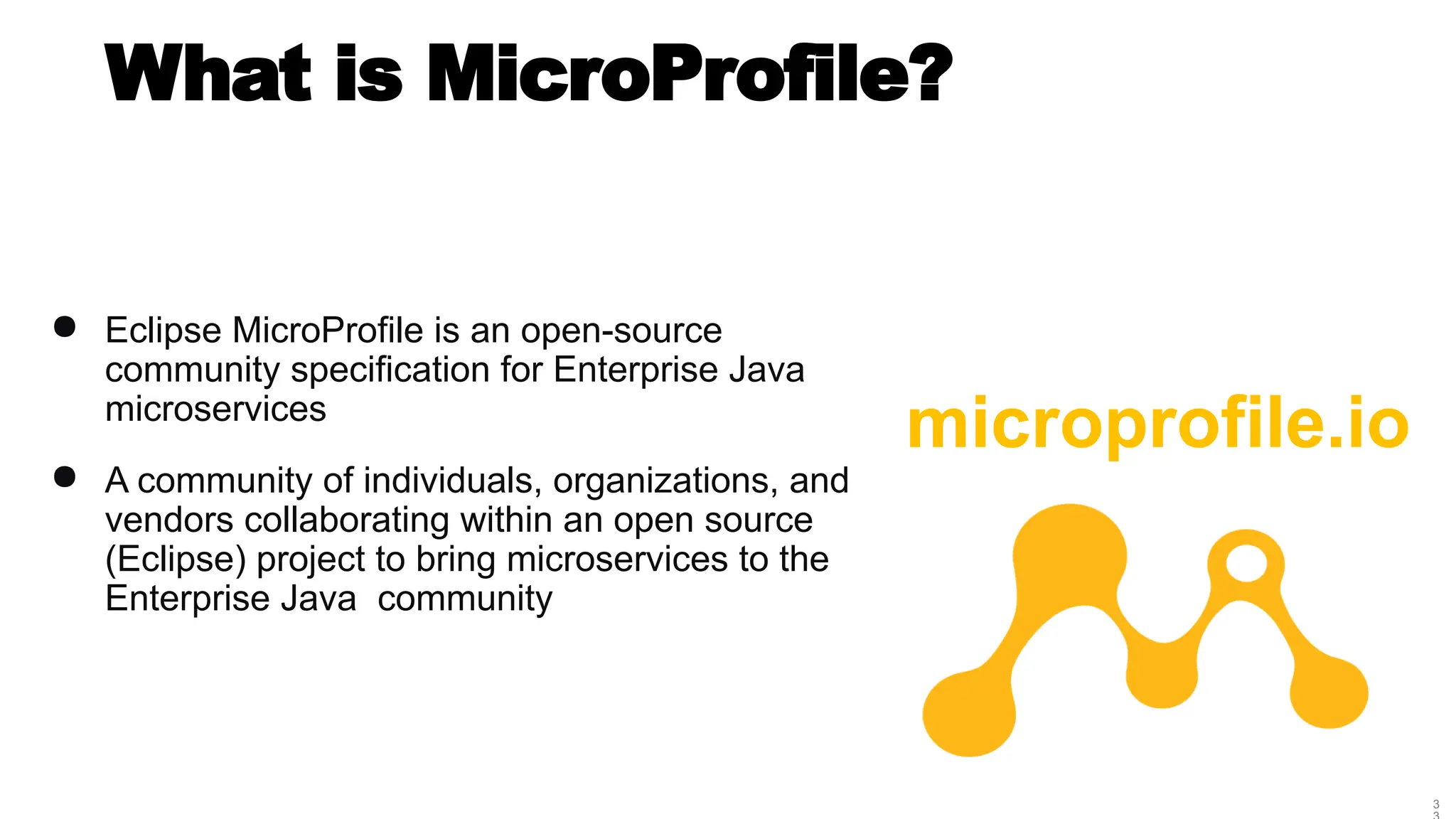
What is MicroProfile?
● Eclipse MicroProfile is an open-source
community specification for Enterprise Java
microservices
● A community of individuals, organizations, and
vendors collaborating within an open source
(Eclipse) project to bring microservices to the
Enterprise Java community
microprofile.io
34
MicroProfile
Contributors
3
MicroProfile Community
Video Hang
outs
Bi-Weekly &
Quarterly
General com
munity
Meetings
MicroProfile
Projects
Google Gr
oups
YouTube C
hannel
36
MicroProfile
Vendors/Implementations
MicroProfile
Technologies
38
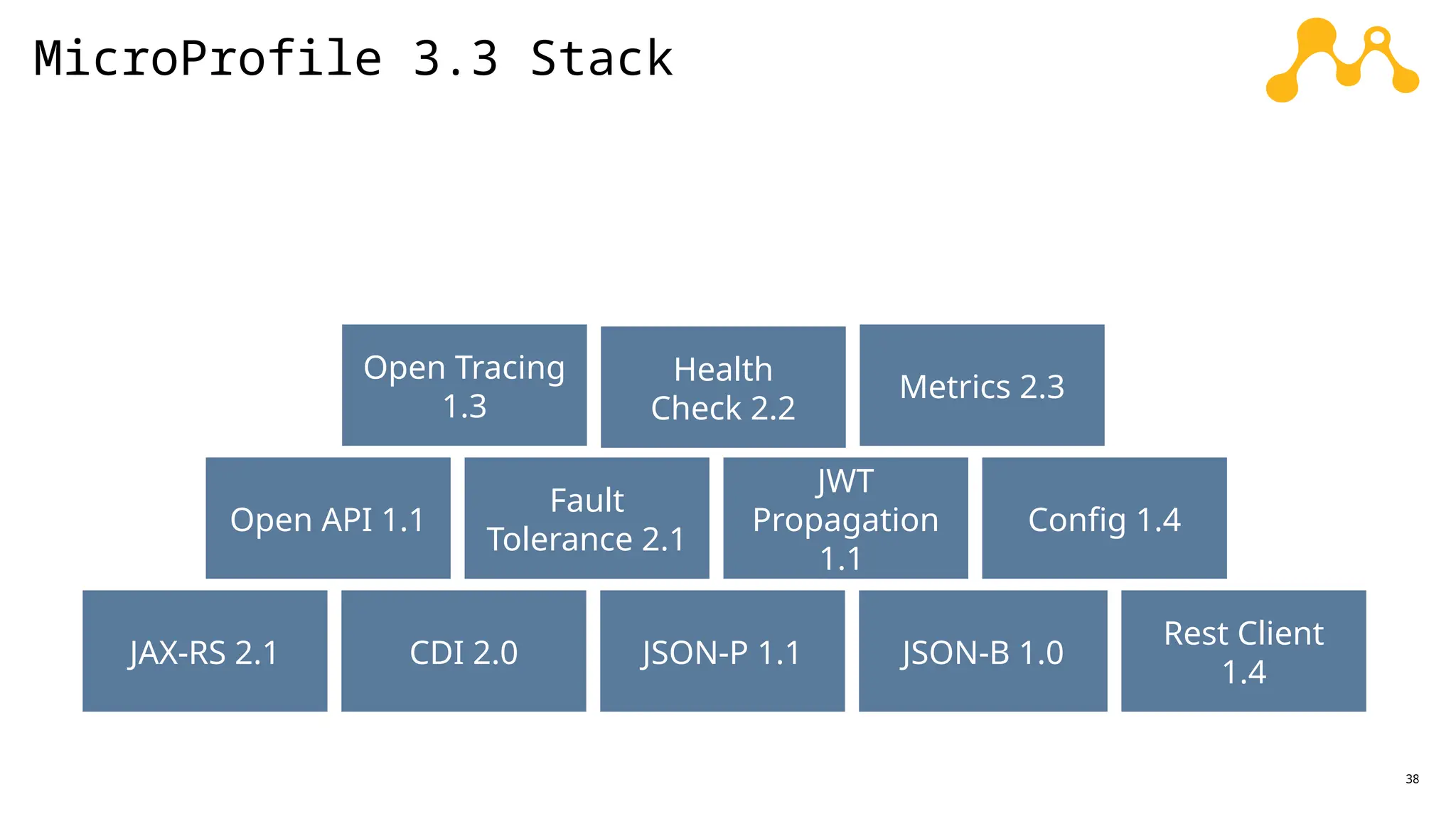
MicroProfile 3.3 Stack
JSON-B 1.0
JSON-P 1.1
CDI 2.0
Config 1.4
Fault
Tolerance 2.1
JWT
Propagation
1.1
Health
Check 2.2
Metrics 2.3
Open Tracing
1.3
Open API 1.1
JAX-RS 2.1
Rest Client
1.4
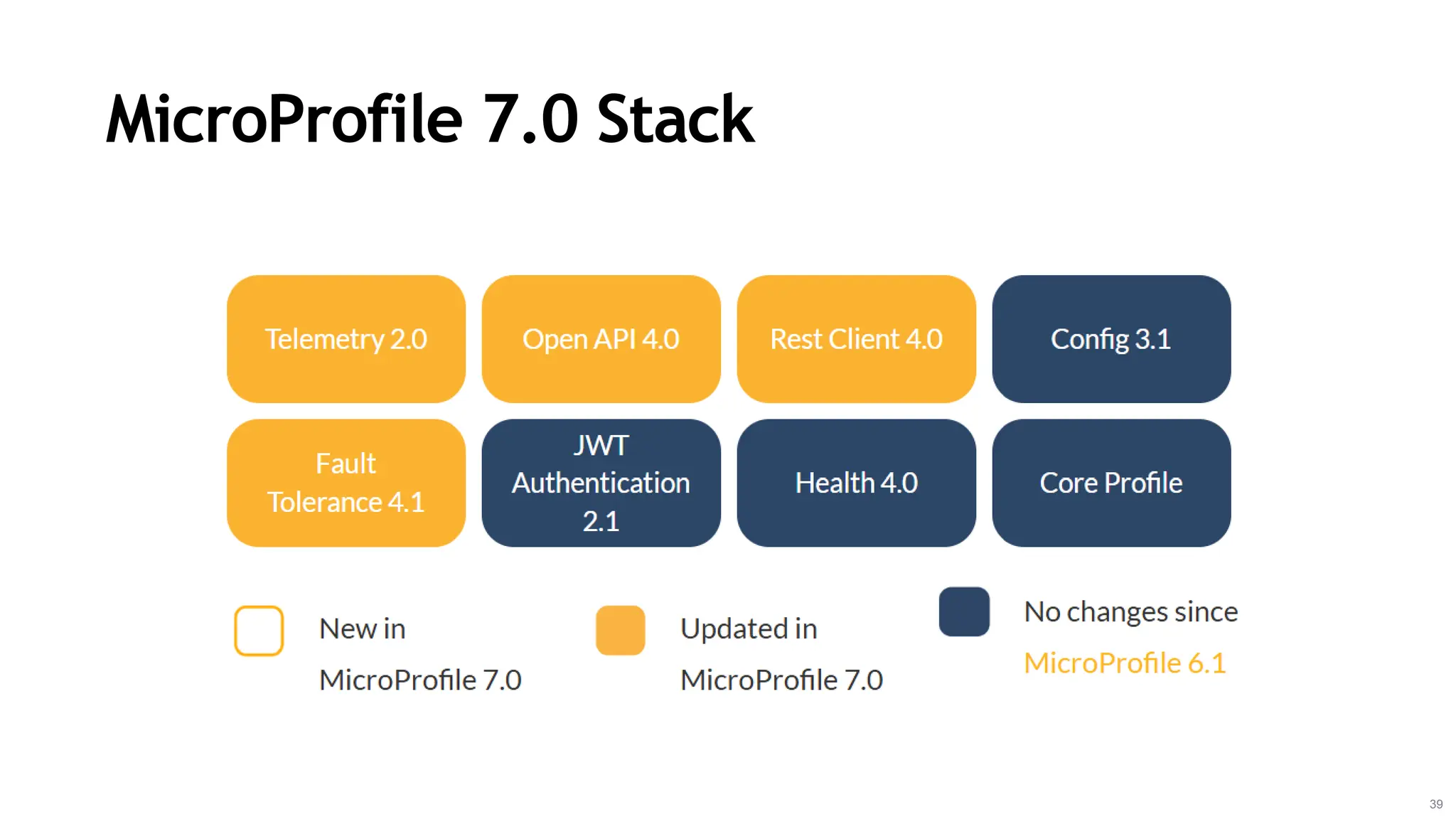
MicroProfile 7.0 Stack
39
40
40
05 The Saving
Energy Days
41
41
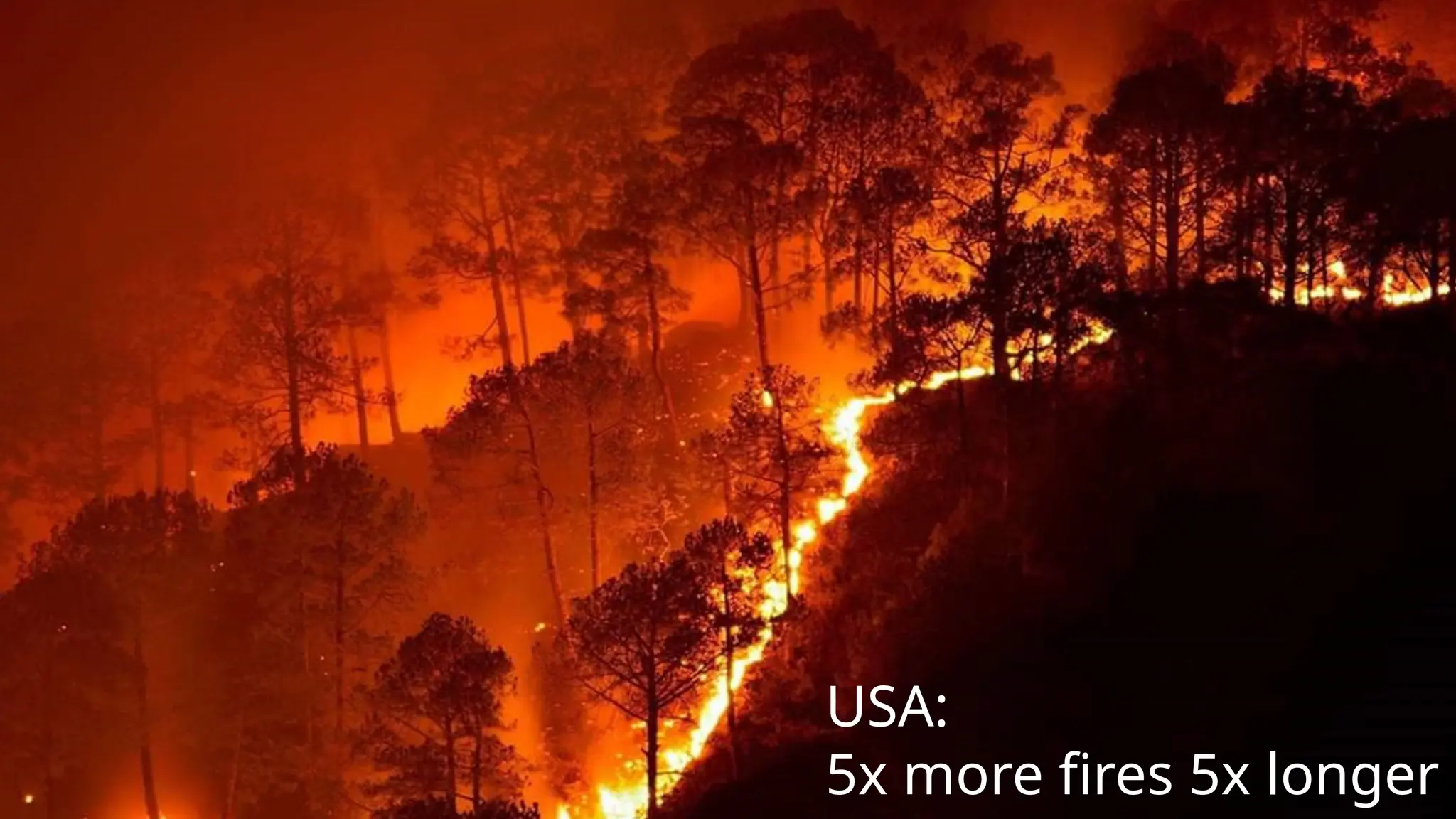
USA:
5x more fires 5x longer
42
42

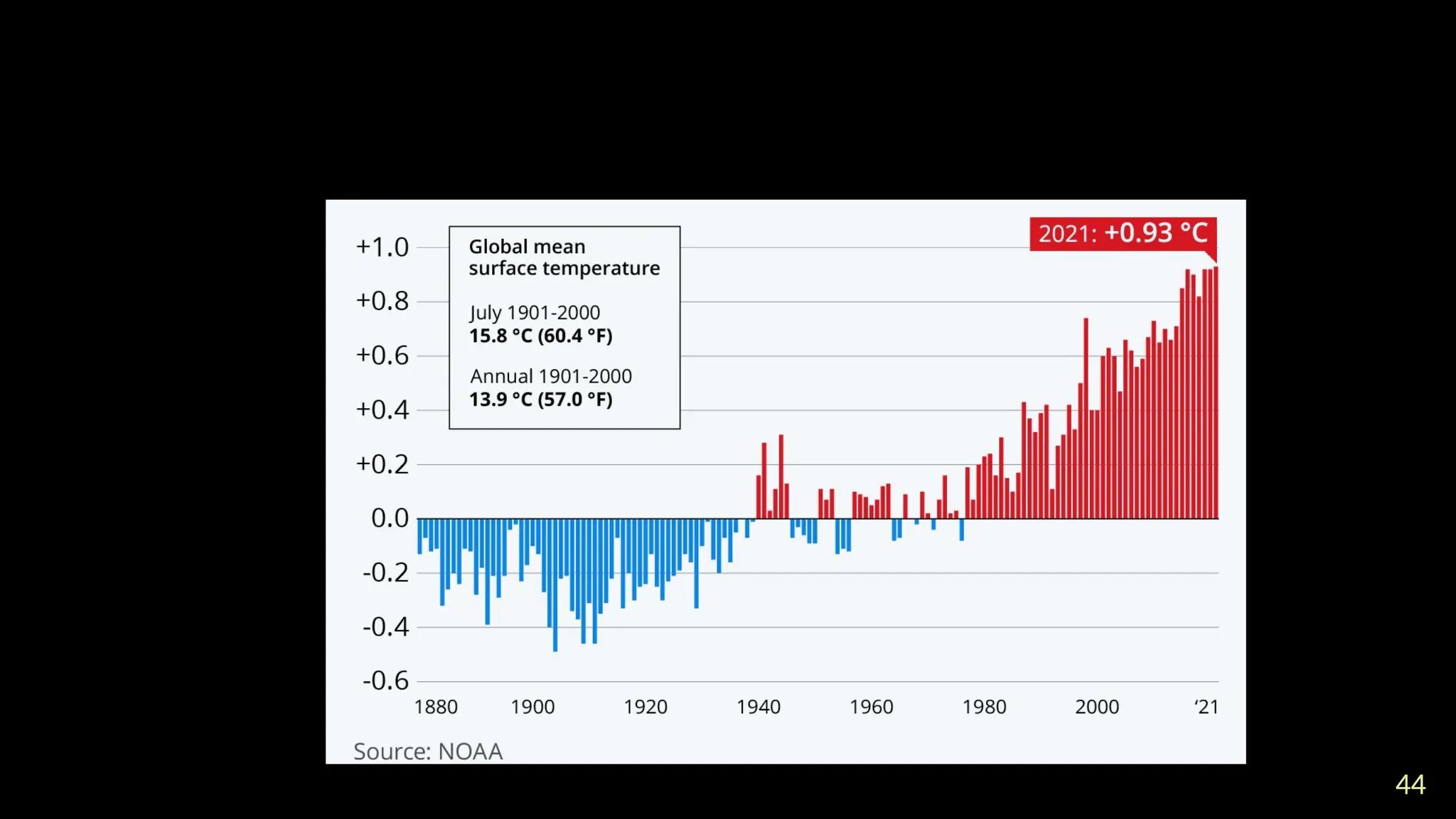
July 2019 was the warmest month

EVER

worldwide
43
43

Now July 2021 is the warmest month

EVER

worldwide
@Jamie_Lee_C
44
44
45
45
46
46
47
47
No more doom and gloom
please!
49
Some Random Facts About Data
Centers
50
50
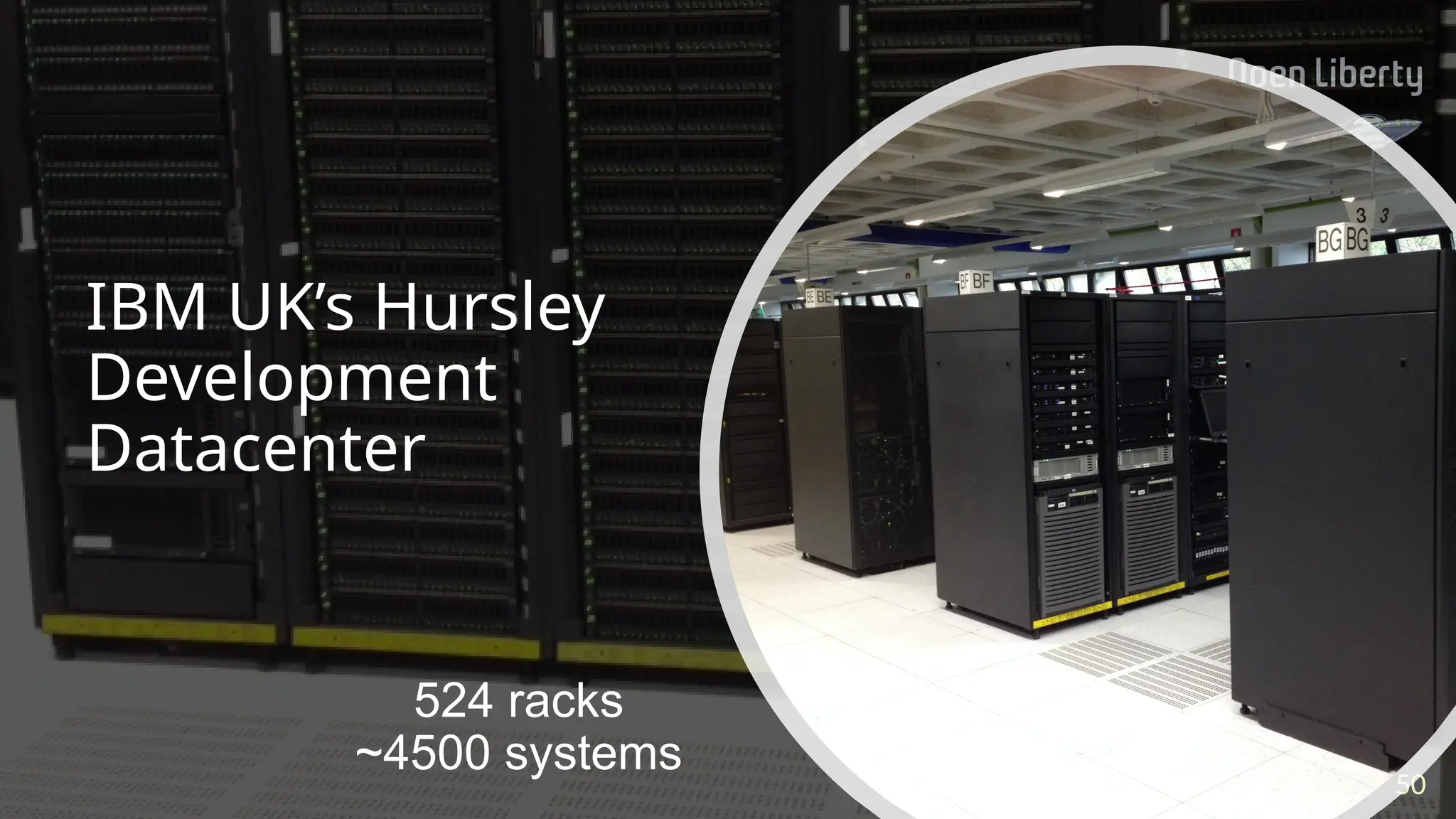
IBM UK’s Hursley
Development
Datacenter
524 racks
~4500 systems
There are over 7,500 major data centers worldwide, with over 2,600
in the top 20 global cities alone.
With just over 300 locations, London England has the largest
concentration of data centers in any given city across the globe.
The Natural Resources Defense Council (NRDC) estimates that
data centers consume up to 3% of all global electricity production.
52
52
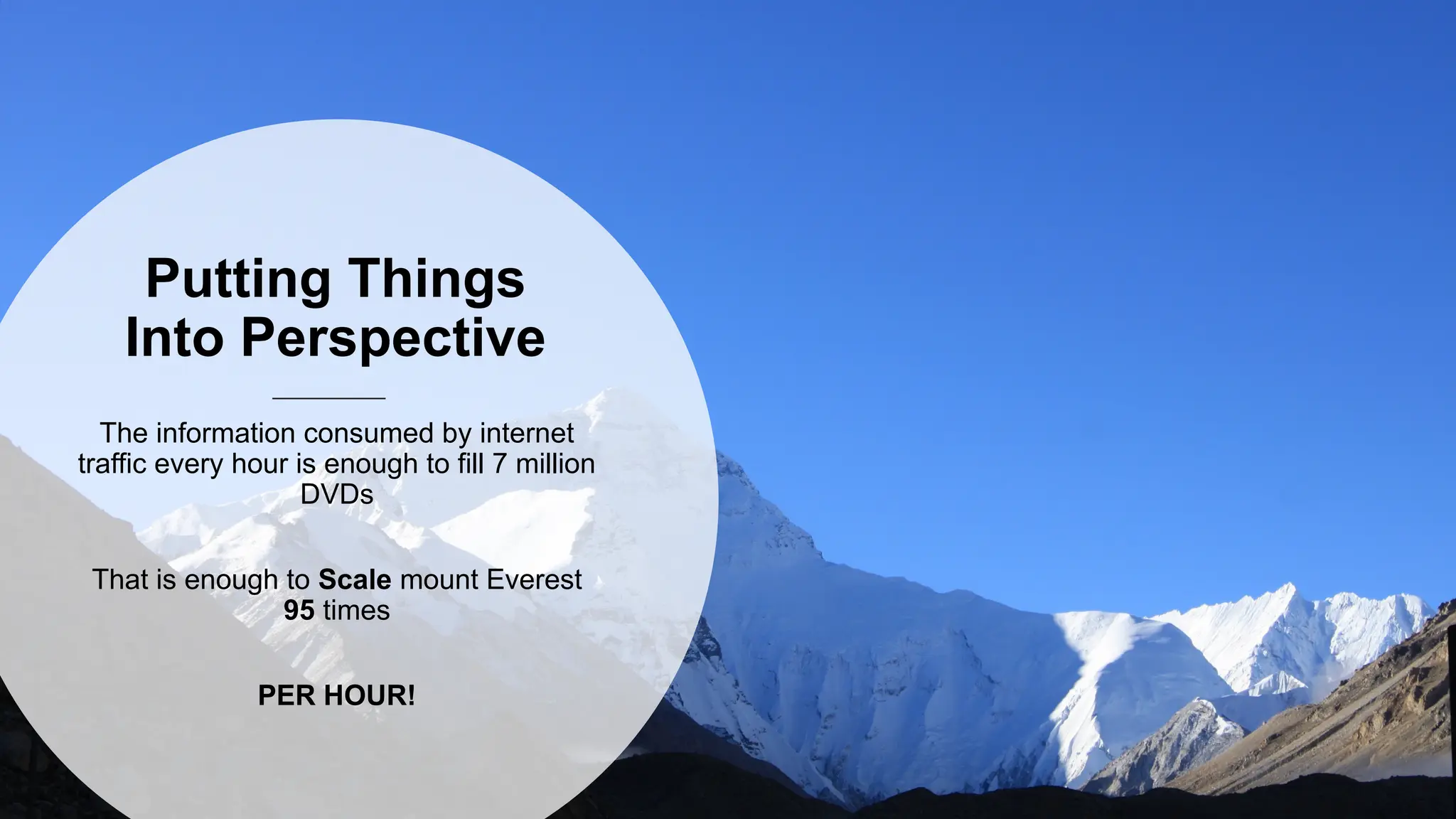
Putting Things
Into Perspective
The information consumed by internet
traffic every hour is enough to fill 7 million
DVDs
That is enough to Scale mount Everest
95 times
PER HOUR!
53
53
There is over
500,000 data
centers worldwide

The area of land they consume
is around the same as 6,000
football pitches
54
54
Environmental Impacts of Data
Centers
1/3 of all data passes through the cloud!
Currently we produce 1.2 trillion GB’s of data per year
Over the next decade, datacenters could use 1/5 of the whole
world's energy supply!
That is a lot of Energy!
56
56
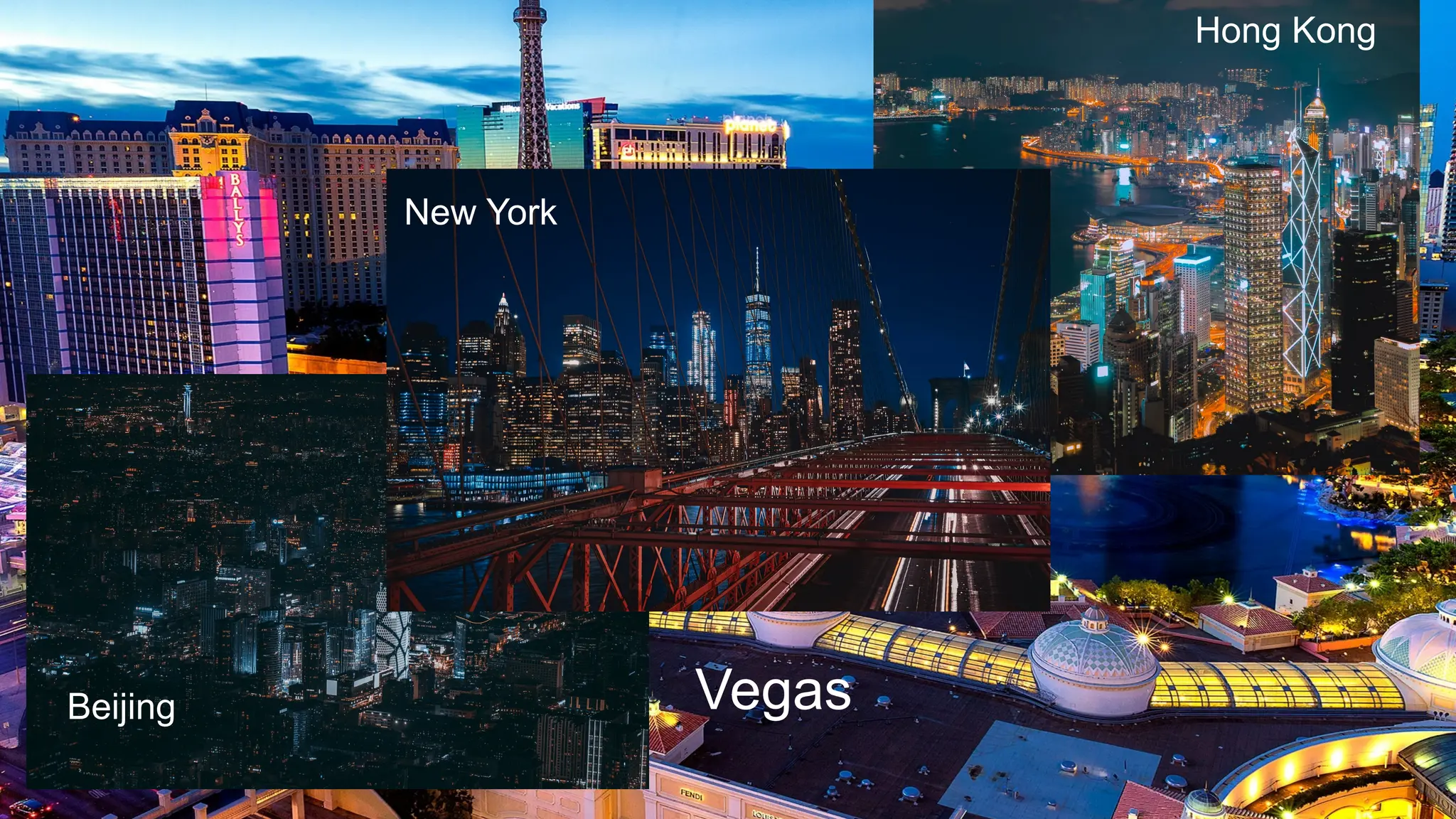
Beijing
New York
Hong Kong
Vegas
57
57
58
58

Bitcoin == carbon footprint of
Denmark
59
59

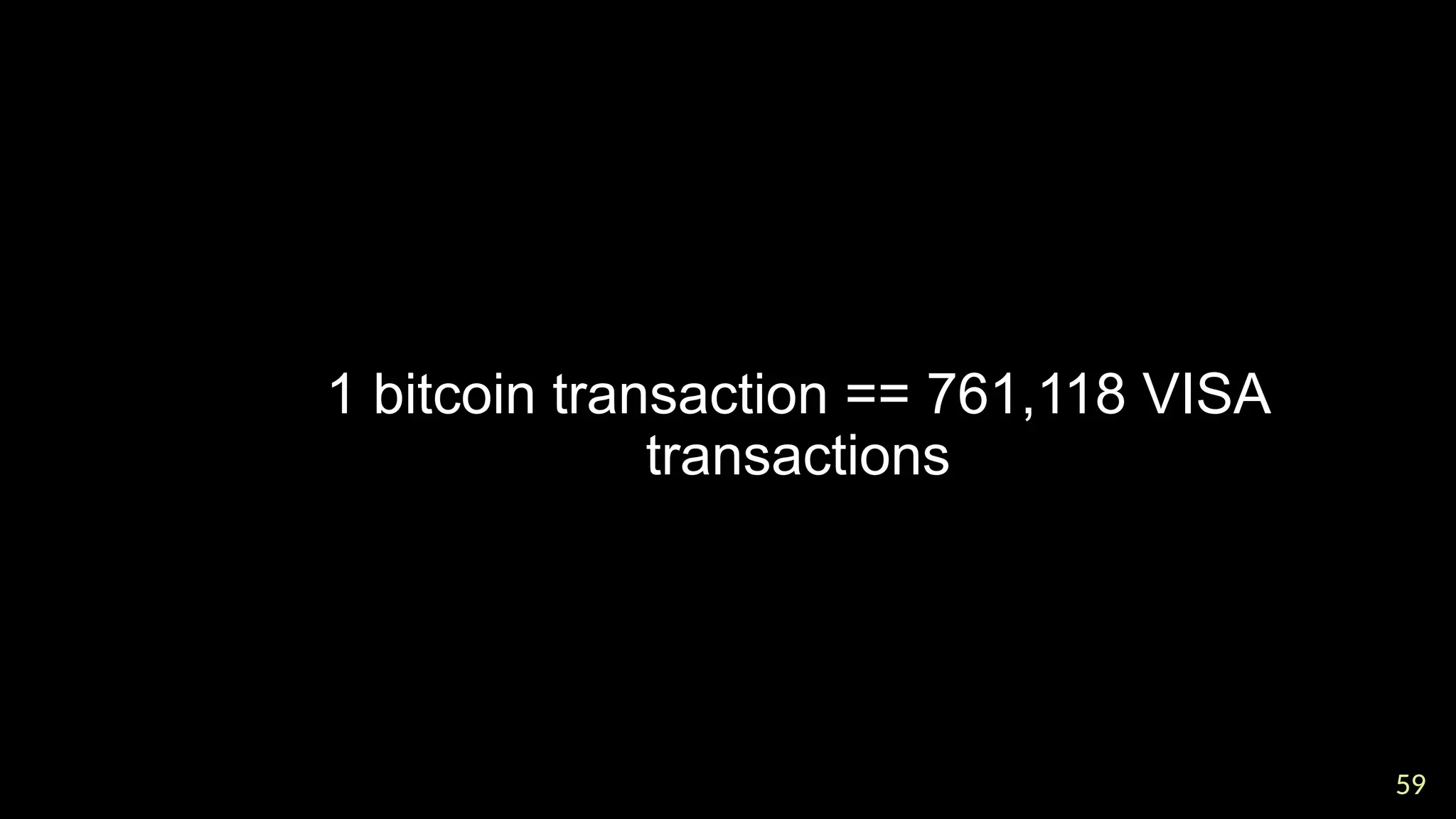
1 bitcoin transaction == 761,118 VISA
transactions
60
60

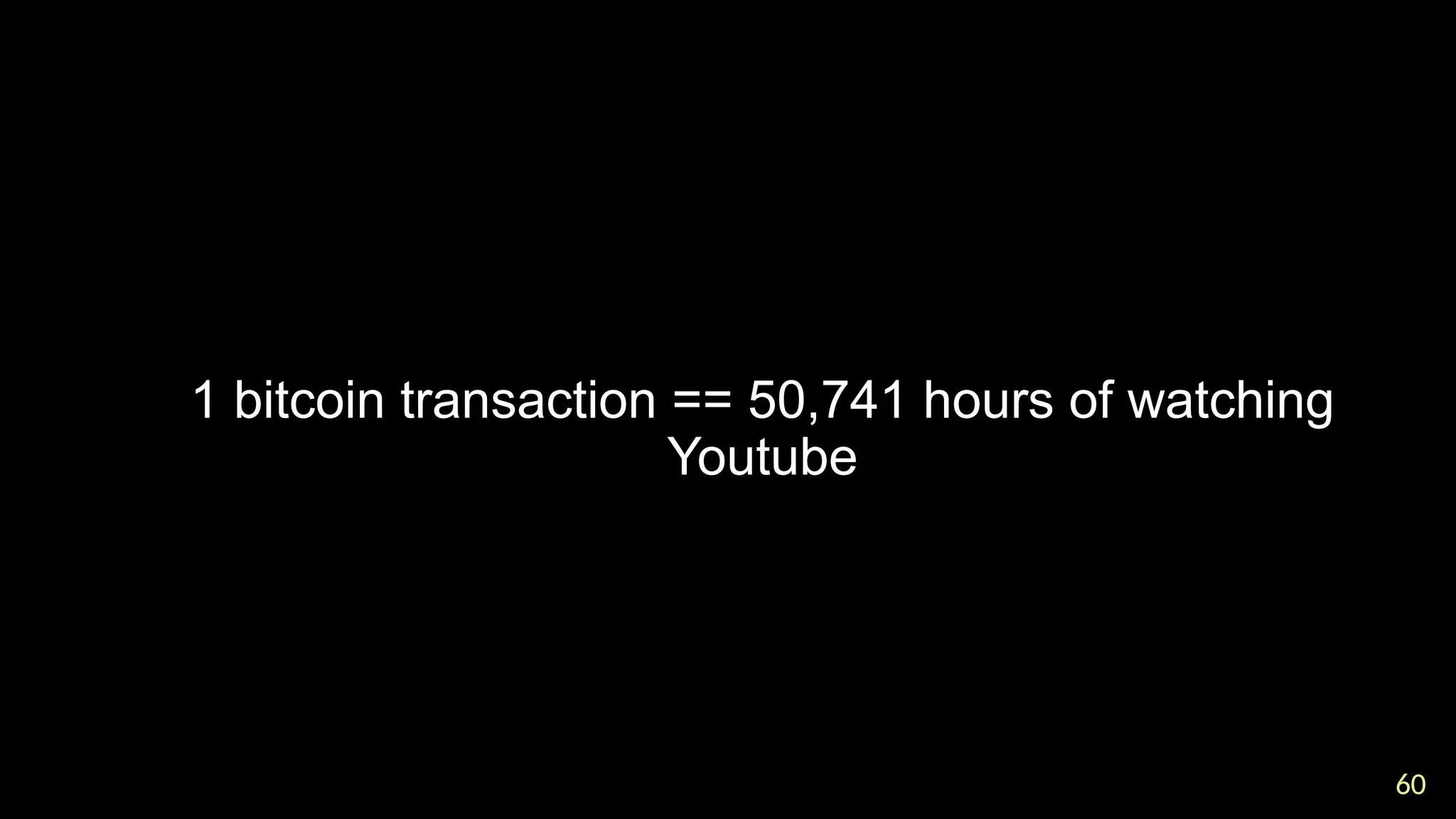
1 bitcoin transaction == 50,741 hours of watching
Youtube
61
61
62
62

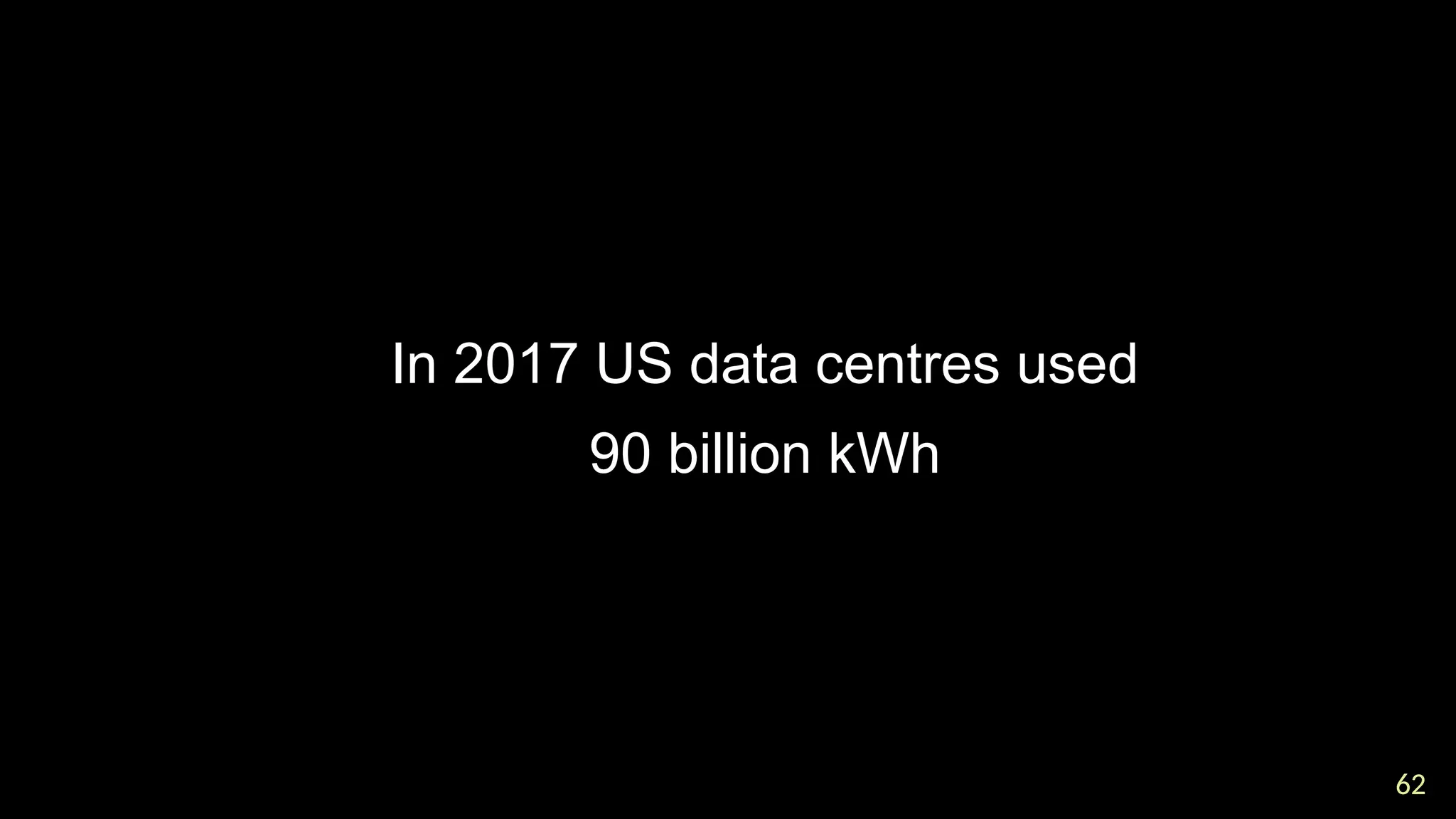
In 2017 US data centres used

90 billion kWh
63
63

45,000,000,000 x 1 smart phone x 1 year
64
64

UK energy consumption x 1.5 == global data
centre energy consumption.
65
65
66
66
What are Data Center/Cloud
owners doing to reduce their
carbon footprint?
67
67
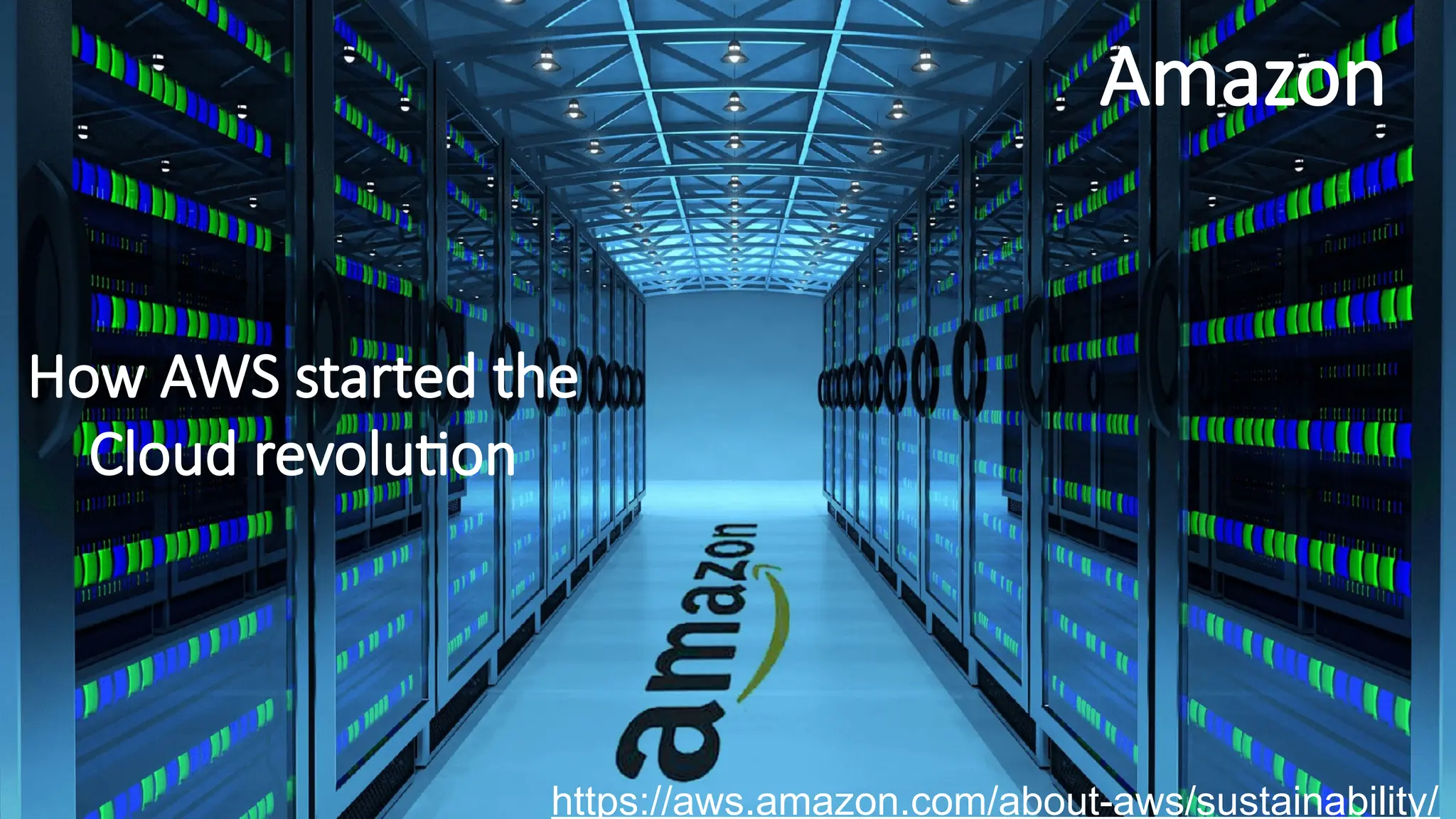
Amazon
How AWS started the
Cloud revolution
https://aws.amazon.com/about-aws/sustainability/
68
68
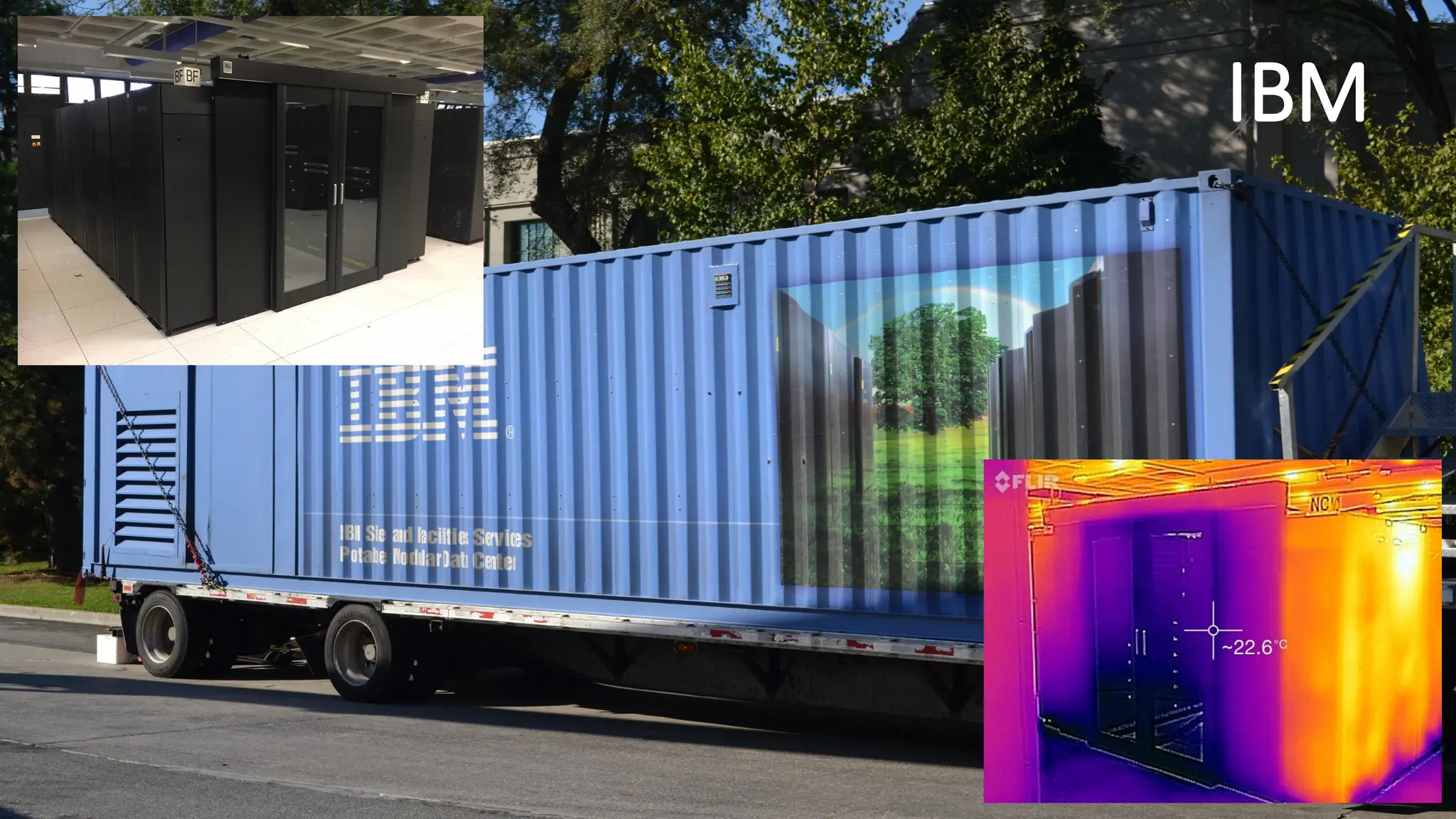
IBM
69
69
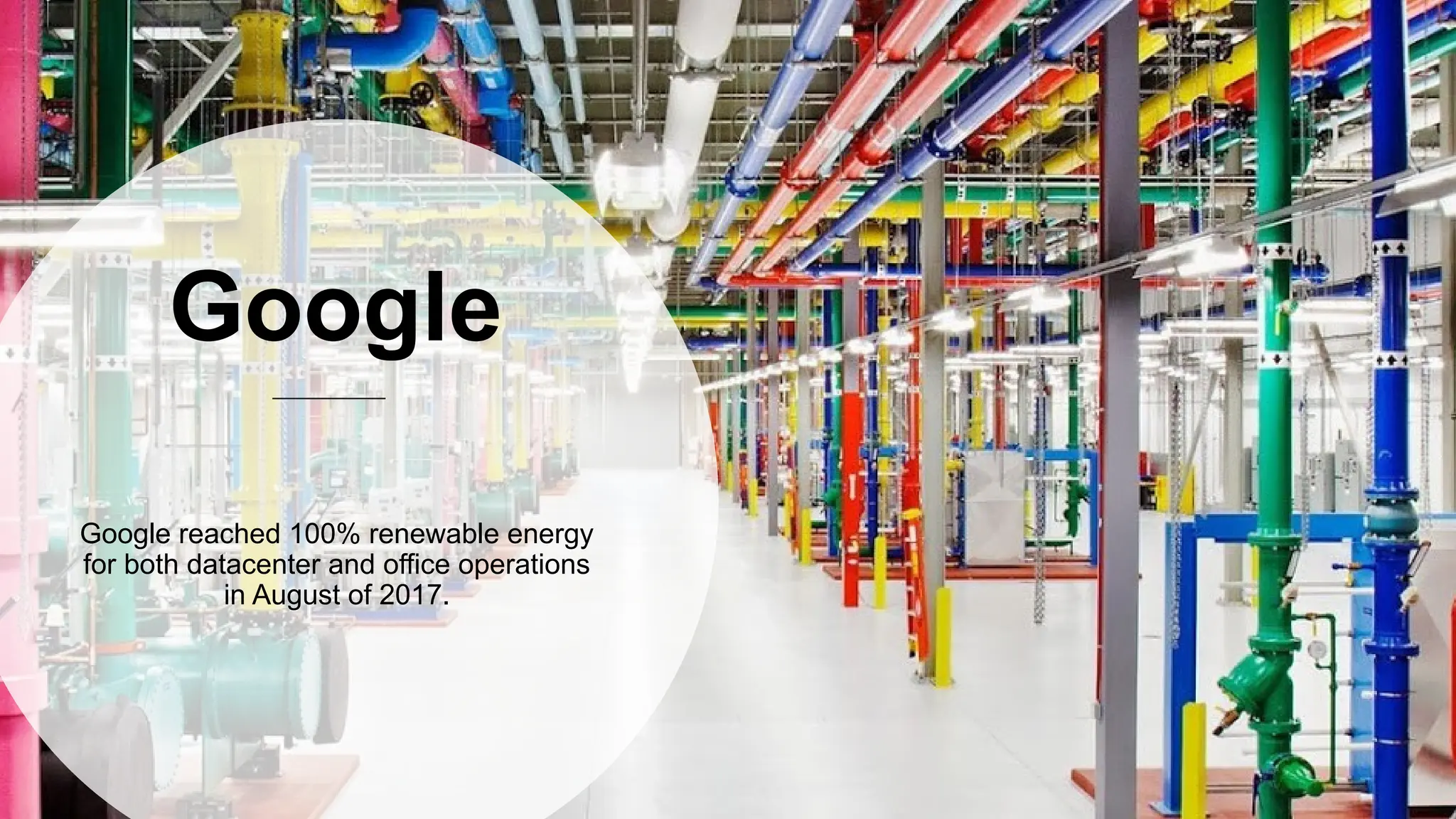
Google
Google reached 100% renewable energy
for both datacenter and office operations
in August of 2017.
70
70
Microsoft
71
71
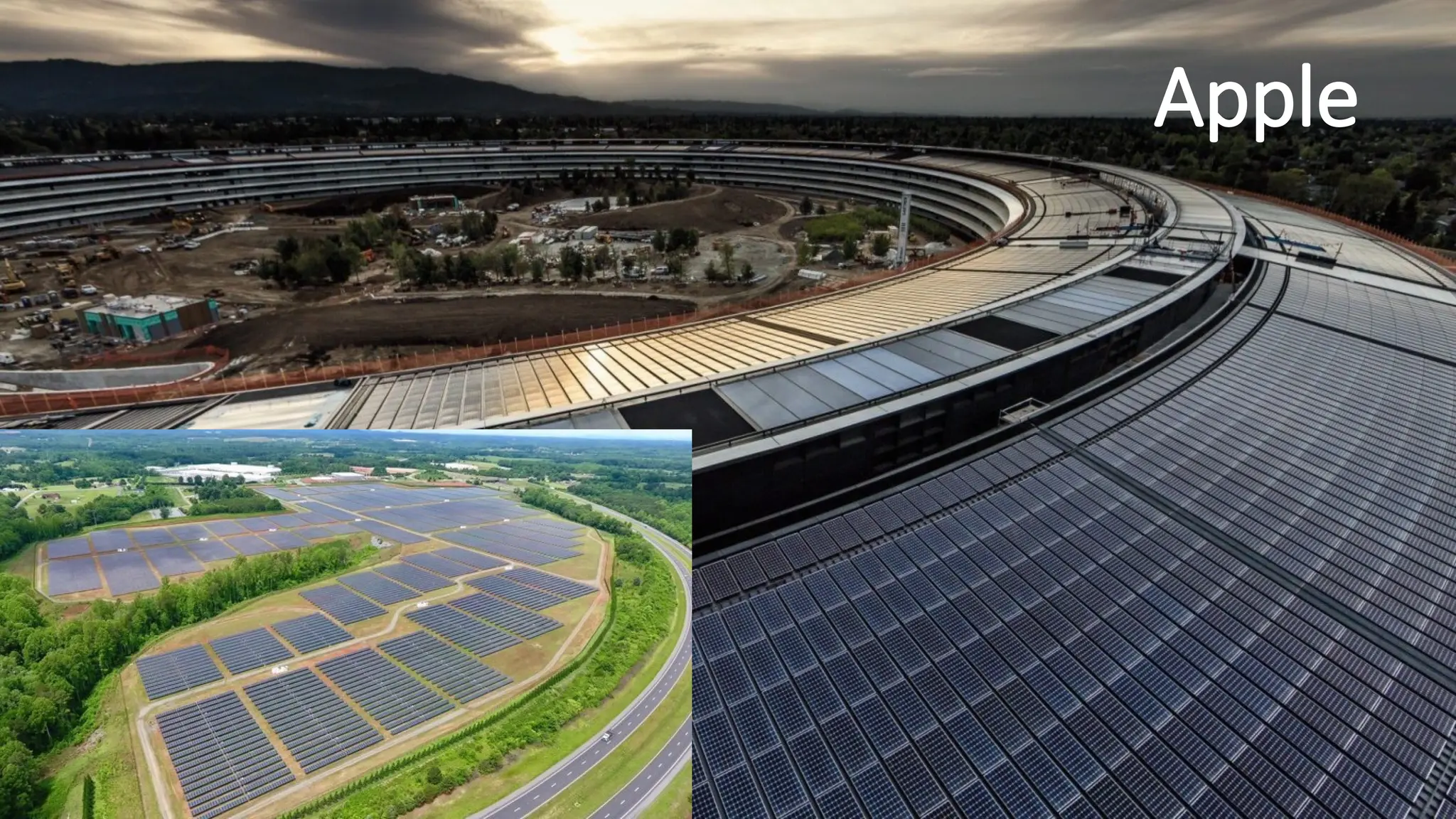
Apple
72
72
Past, Current and Future tech to the
rescue?
73
73
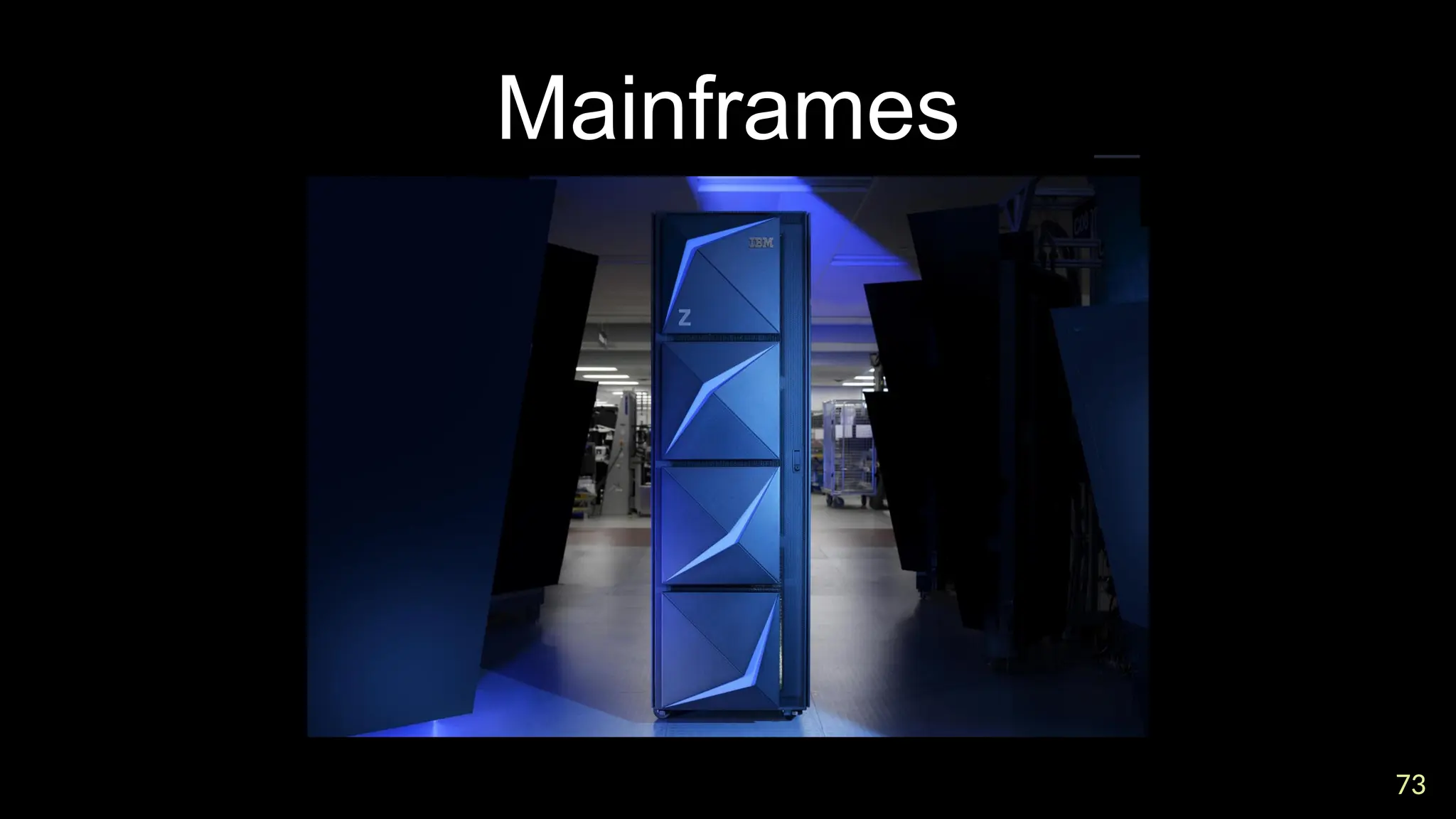
Mainframes
74
74
75
75
IBM zSeries

50%

Power consumption of x86

(30% more performance)
76
76
What Can You Do As a
Software Developer?
77
77
Serverless?
78
78
Microservices
79
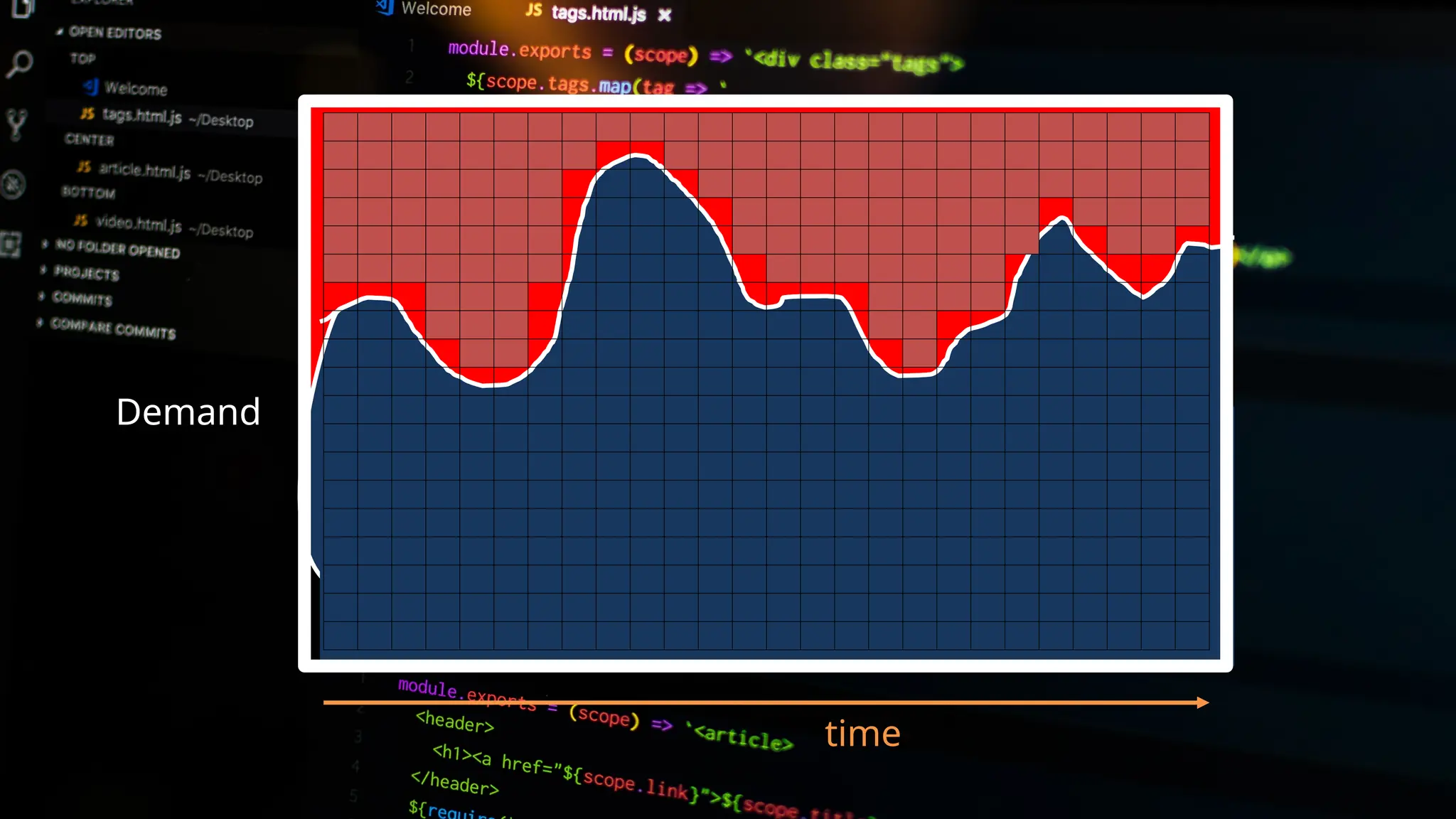
time
One big server running all the time?
Demand
80
Demand
time
One big server running all the time?
81
Reactive
Architecture
82
82
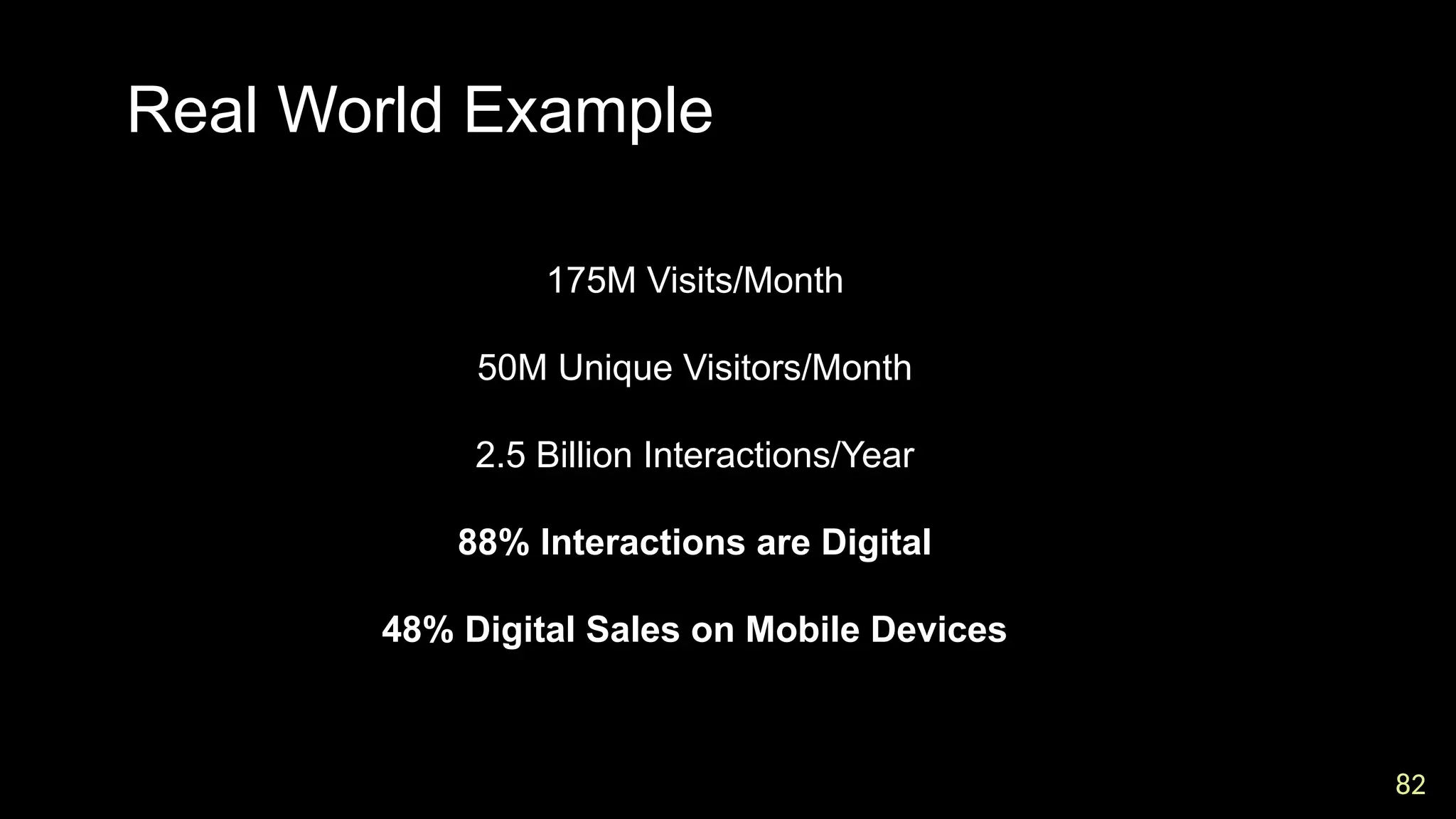
Real World Example
175M Visits/Month
50M Unique Visitors/Month
2.5 Billion Interactions/Year
88% Interactions are Digital
48% Digital Sales on Mobile Devices
83
83
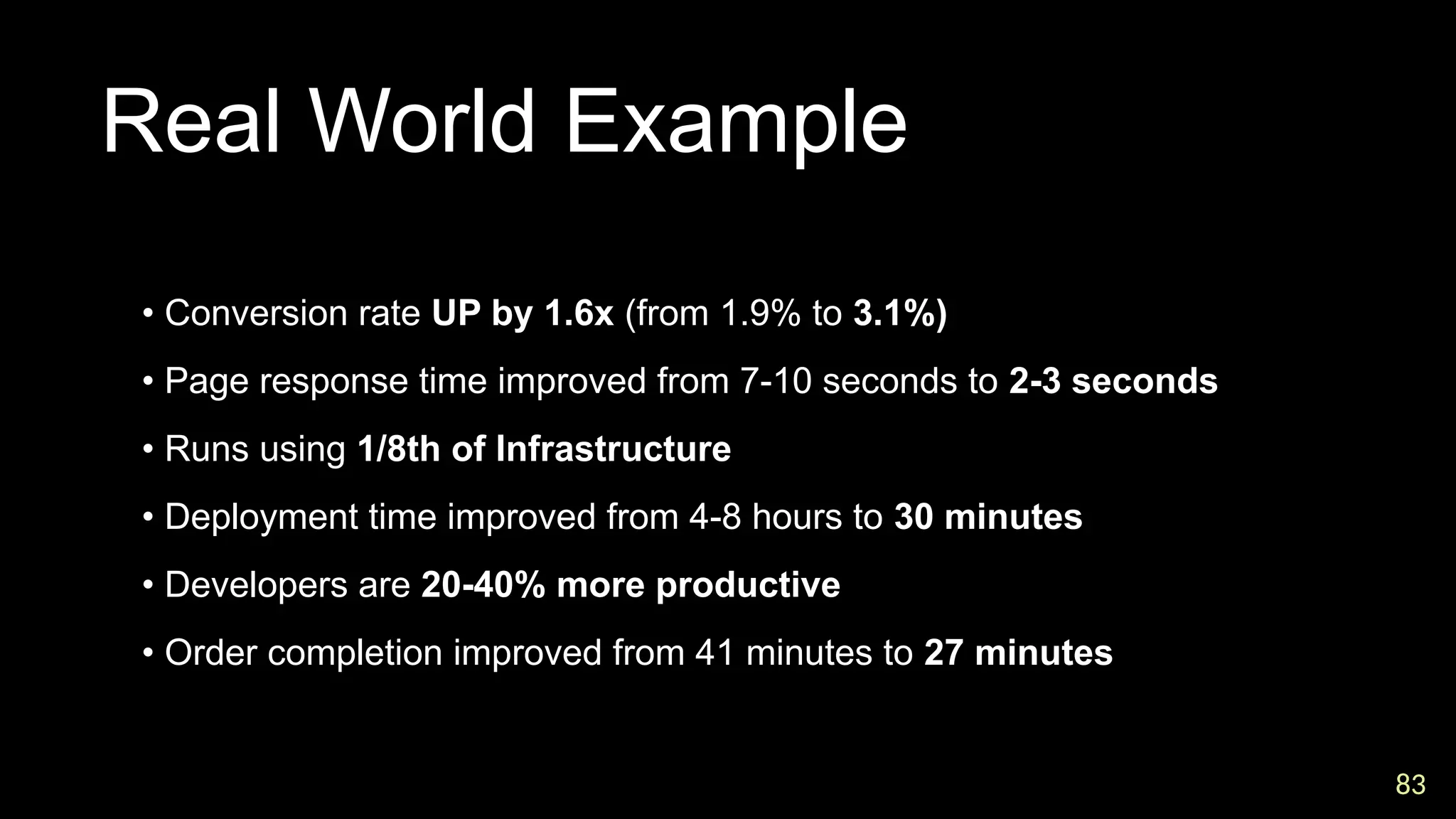
Real World Example

• Conversion rate UP by 1.6x (from 1.9% to 3.1%)

• Page response time improved from 7-10 seconds to 2-3 seconds

• Runs using 1/8th of Infrastructure

• Deployment time improved from 4-8 hours to 30 minutes

• Developers are 20-40% more productive

• Order completion improved from 41 minutes to 27 minutes
84
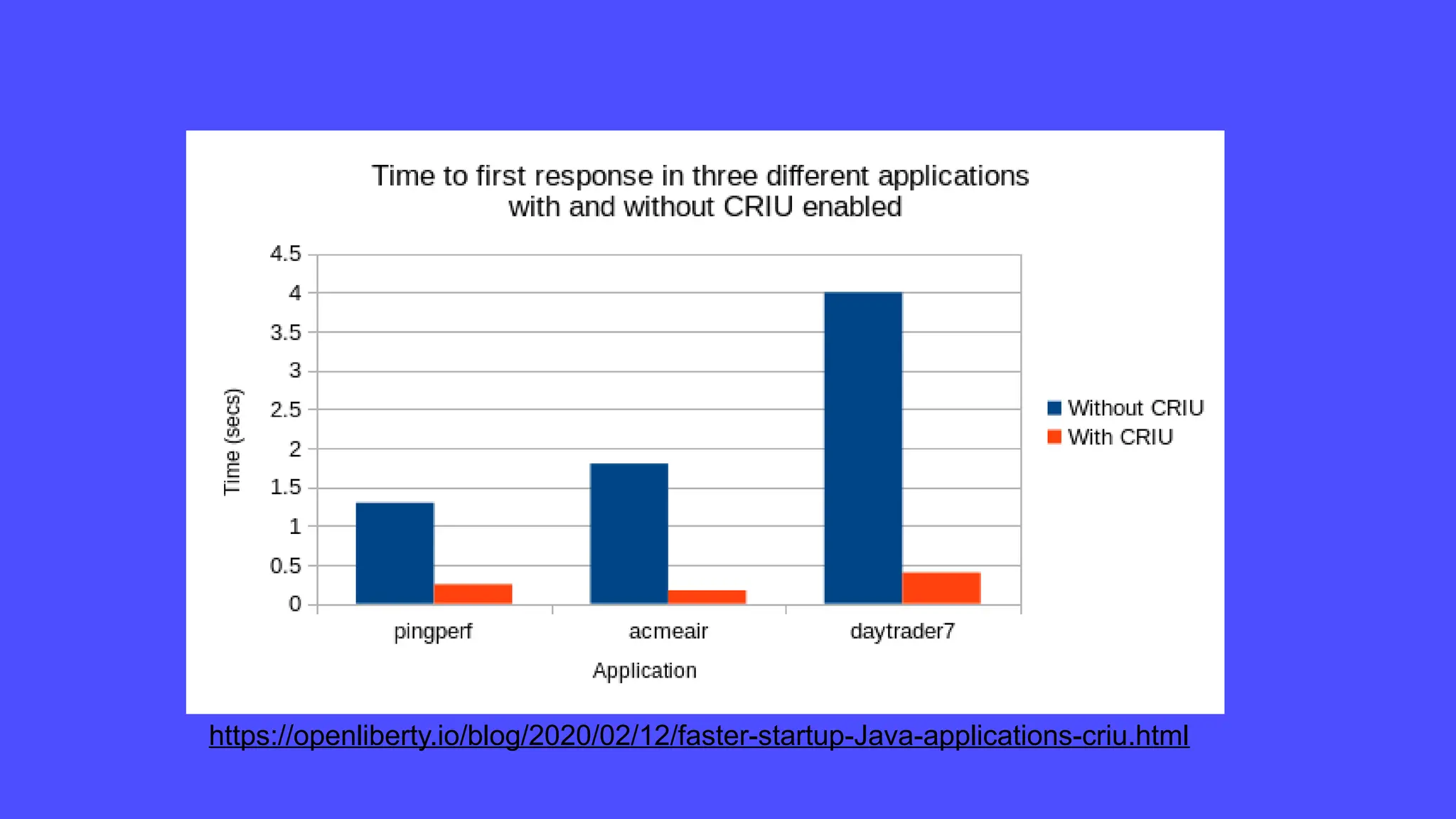
CRIU
Checkpoint/Restore in Userspace
https://openliberty.io/blog/2020/02/12/faster-startup-Java-applications-criu.html
86
Optimizing your code
(Java Examples)
87
87
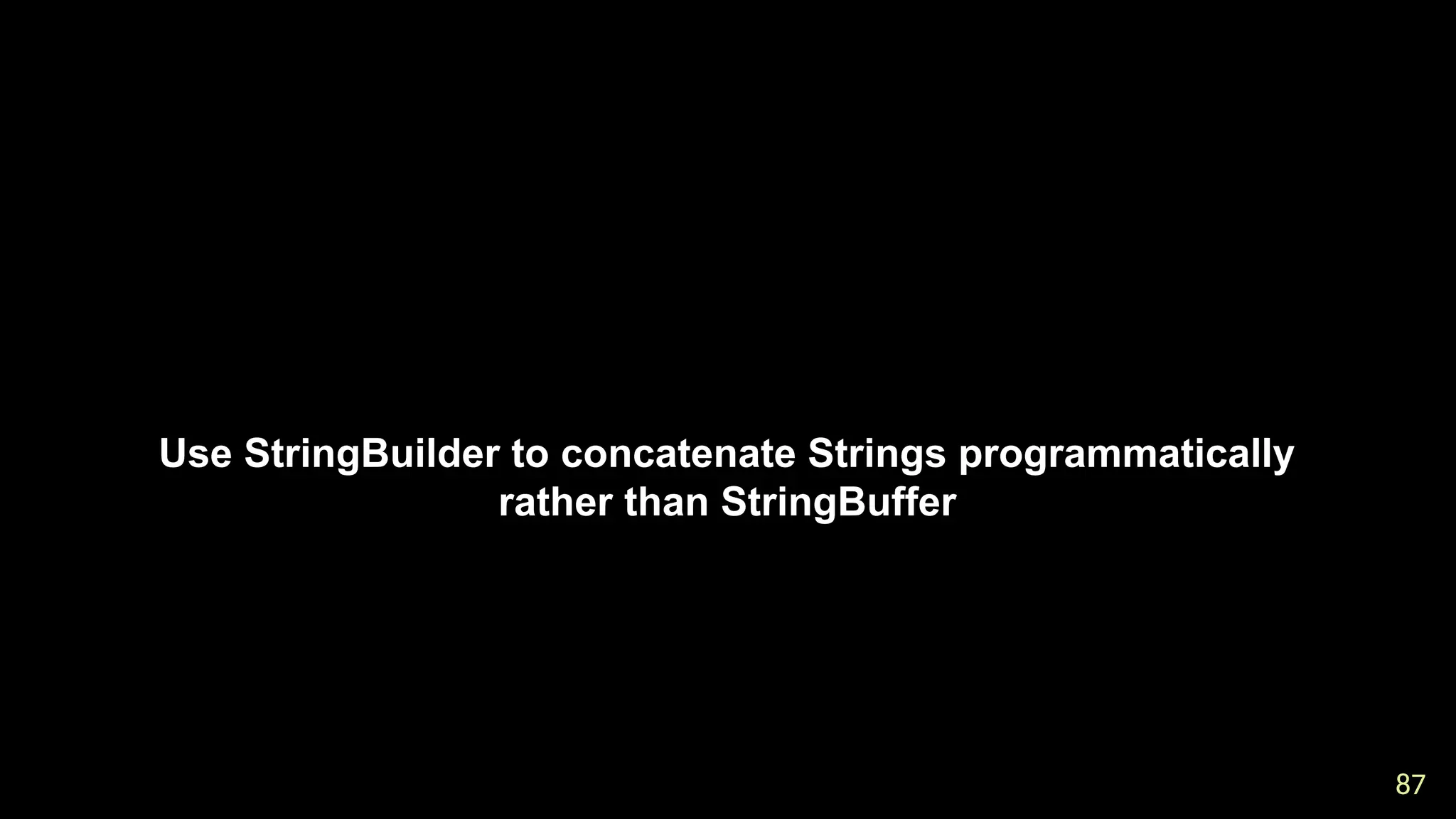
Use StringBuilder to concatenate Strings programmatically
rather than StringBuffer
88
88
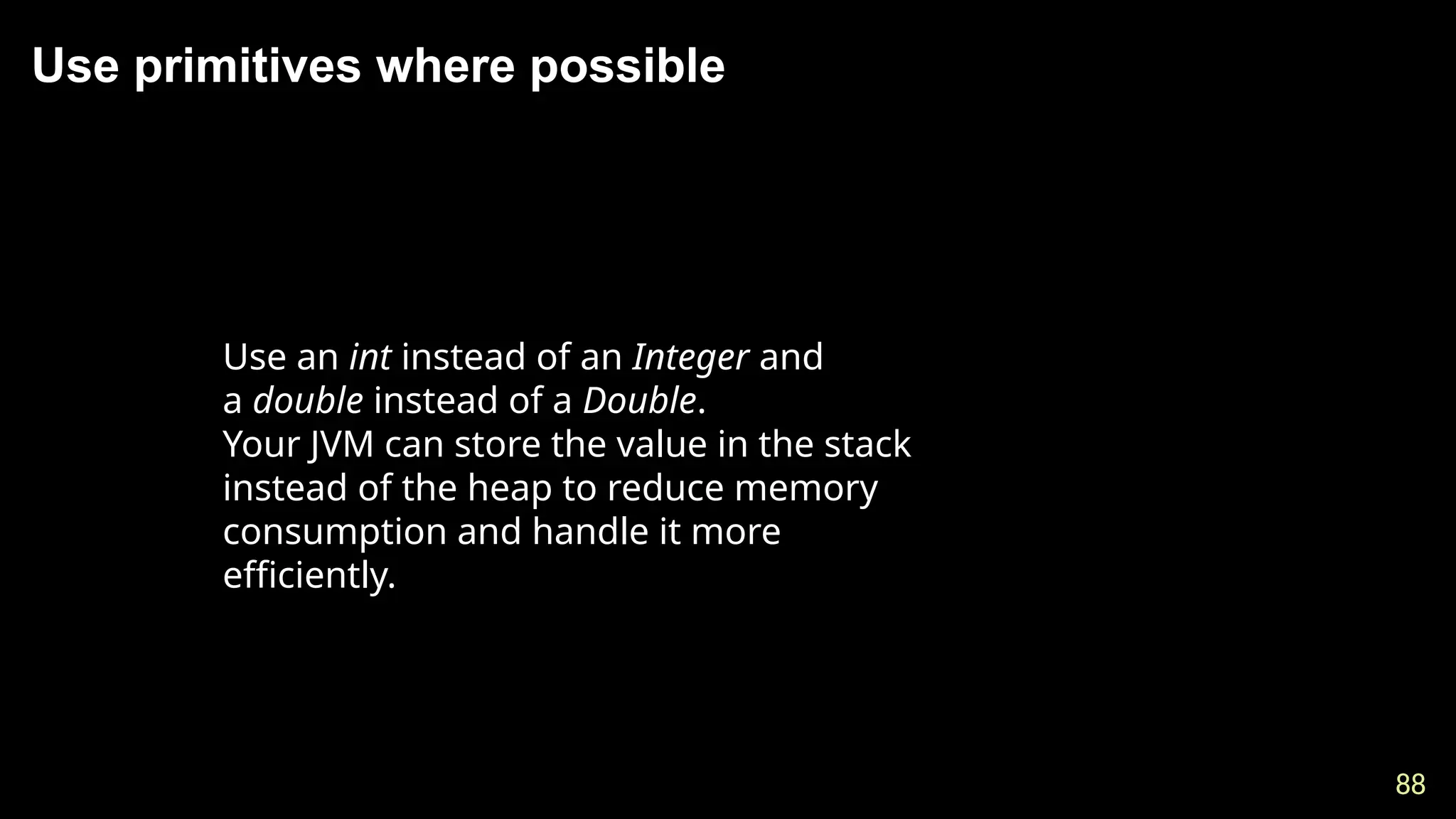
Use primitives where possible
Use an int instead of an Integer and
a double instead of a Double.
Your JVM can store the value in the stack
instead of the heap to reduce memory
consumption and handle it more
efficiently.
89
89
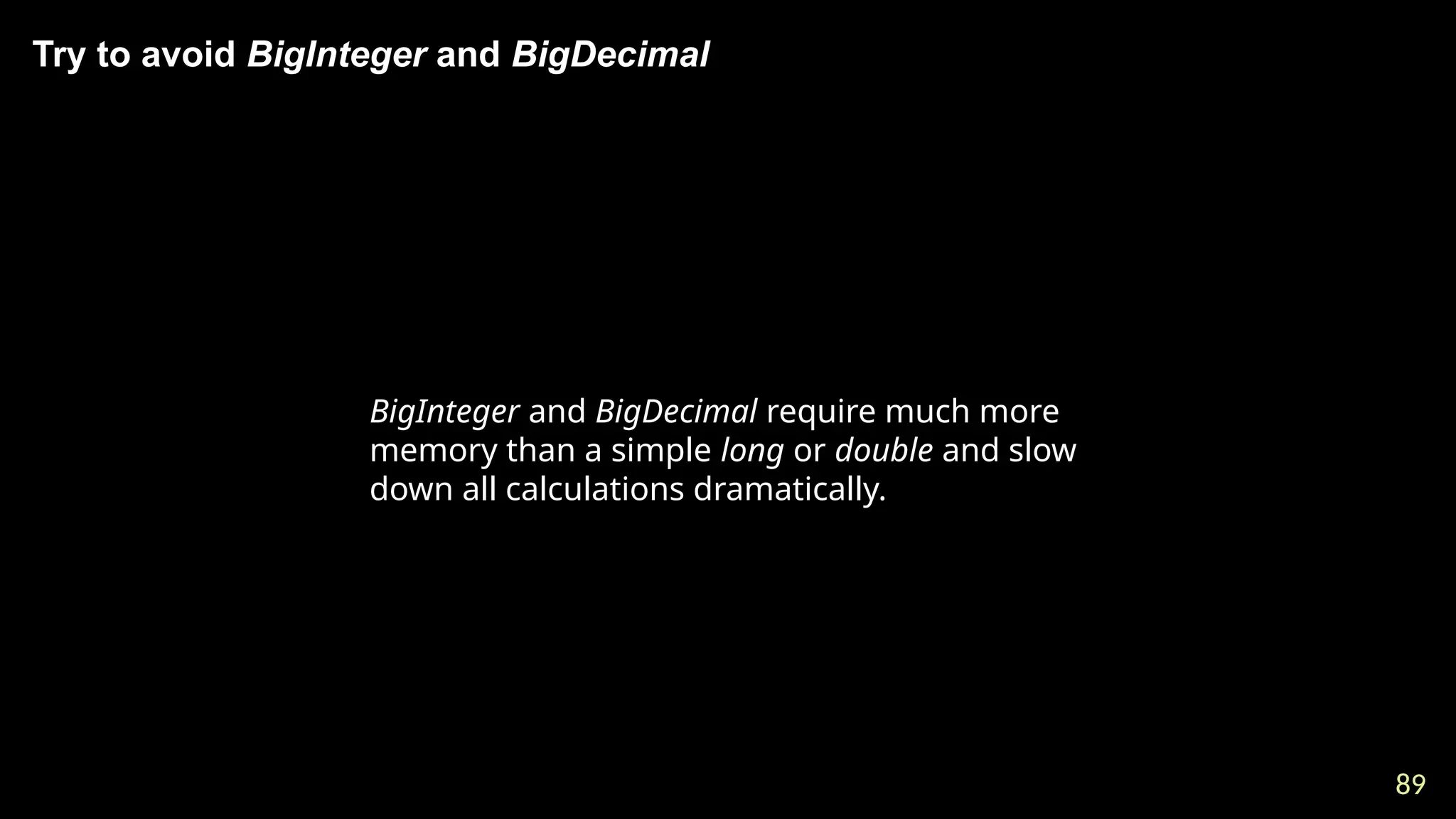
Try to avoid BigInteger and BigDecimal
BigInteger and BigDecimal require much more
memory than a simple long or double and slow
down all calculations dramatically.
90
90
I created a
Kubernetes
Cluster
I forgot
about it for
a week
That cost
$500 
91
91
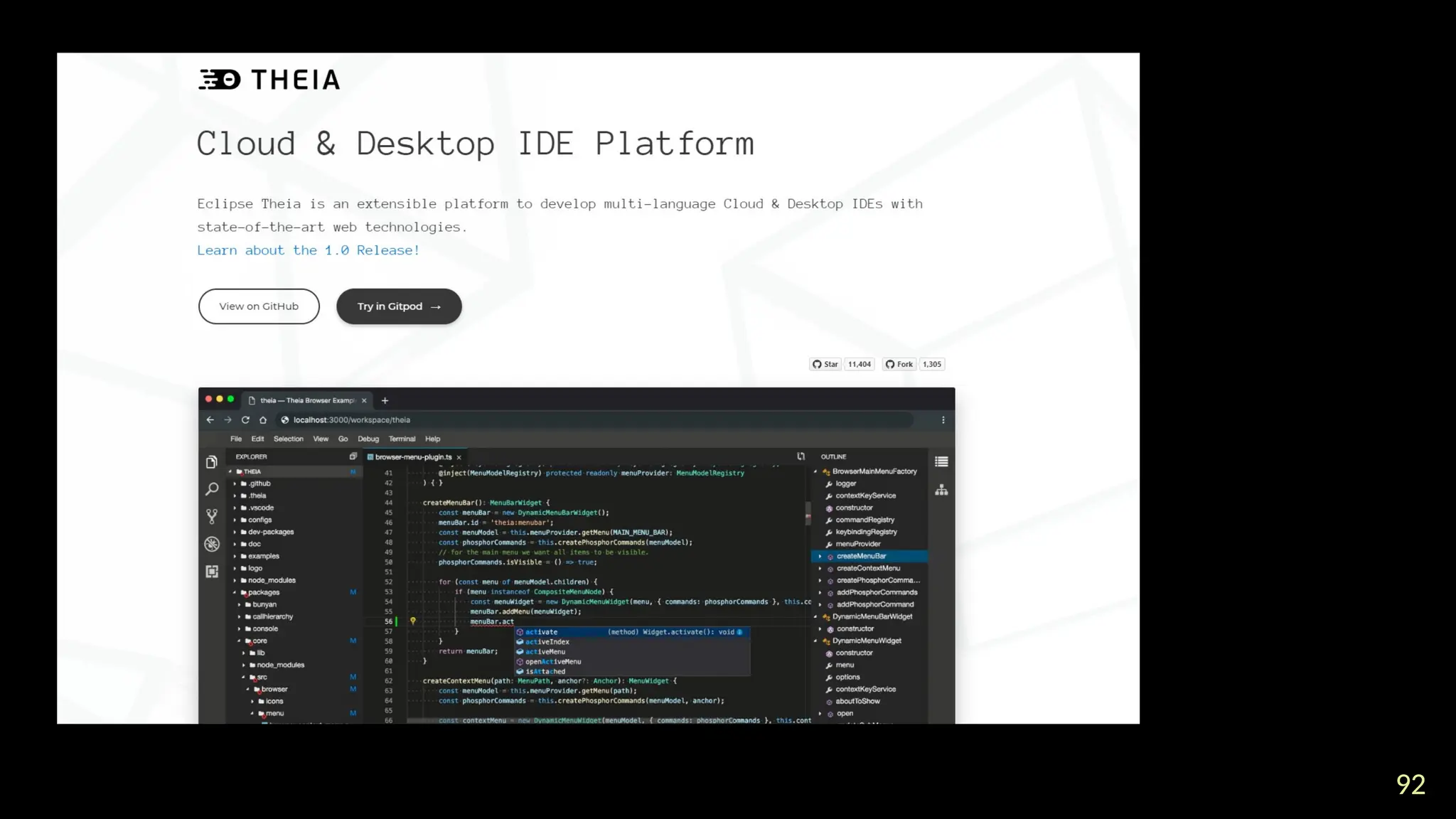
Online Development
Environment's
92
92
93
93
06 The DevSecOps
Days
94
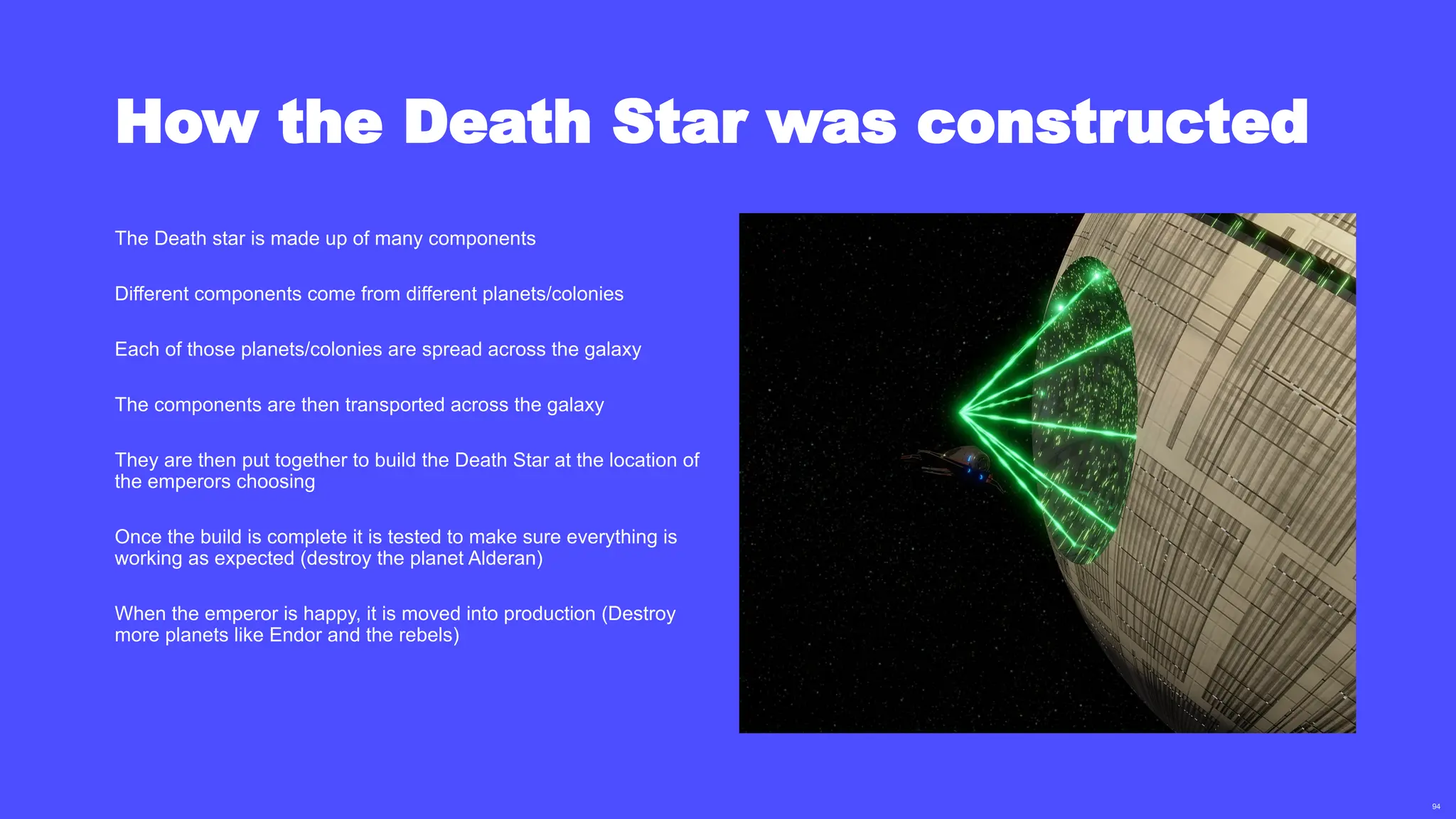
How the Death Star was constructed
The Death star is made up of many components
Different components come from different planets/colonies
Each of those planets/colonies are spread across the galaxy
The components are then transported across the galaxy
They are then put together to build the Death Star at the location of
the emperors choosing
Once the build is complete it is tested to make sure everything is
working as expected (destroy the planet Alderan)
When the emperor is happy, it is moved into production (Destroy
more planets like Endor and the rebels)
95
How our applications are constructed
Our applications are made up of many different
dependencies
Different open source dependencies come from
different people/orgs
Each of those dependencies are created across
the world
The dependencies are then transported across the
internet to your dev environment
They are then put together via Maven or Gradle etc
to build your application at a location of your
choosing (usually locally on your dev machine)
96
How our applications are constructed
Once the build is complete, it is
tested to make sure your
application is functioning as
expected
When you team lead/release
manager is happy, it is then
deployed into production
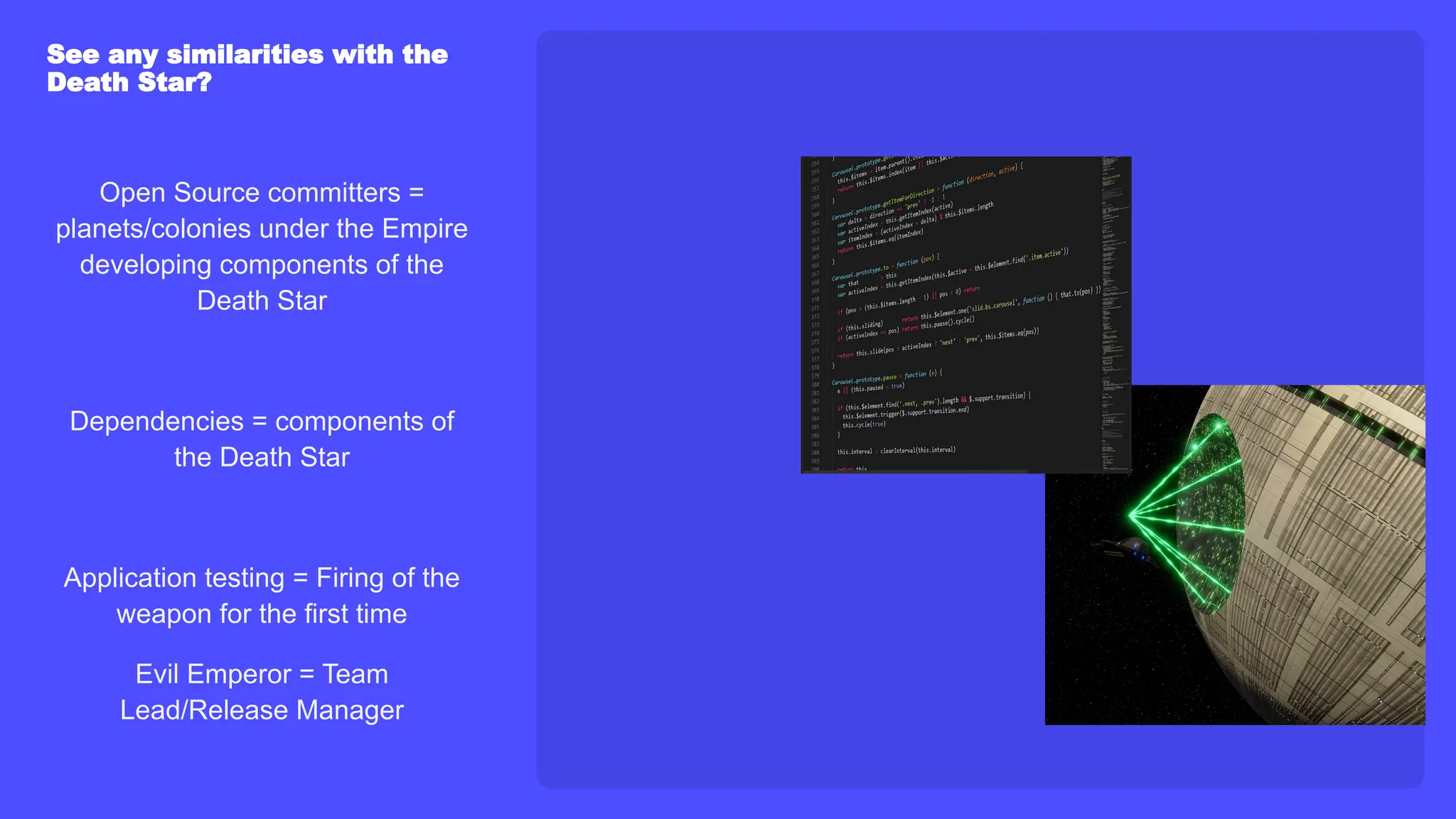
See any similarities with the
Death Star?
Open Source committers =
planets/colonies under the Empire
developing components of the
Death Star
Dependencies = components of
the Death Star
Application testing = Firing of the
weapon for the first time
Evil Emperor = Team
Lead/Release Manager
But what is missing?
Have a think while we see why open source is great
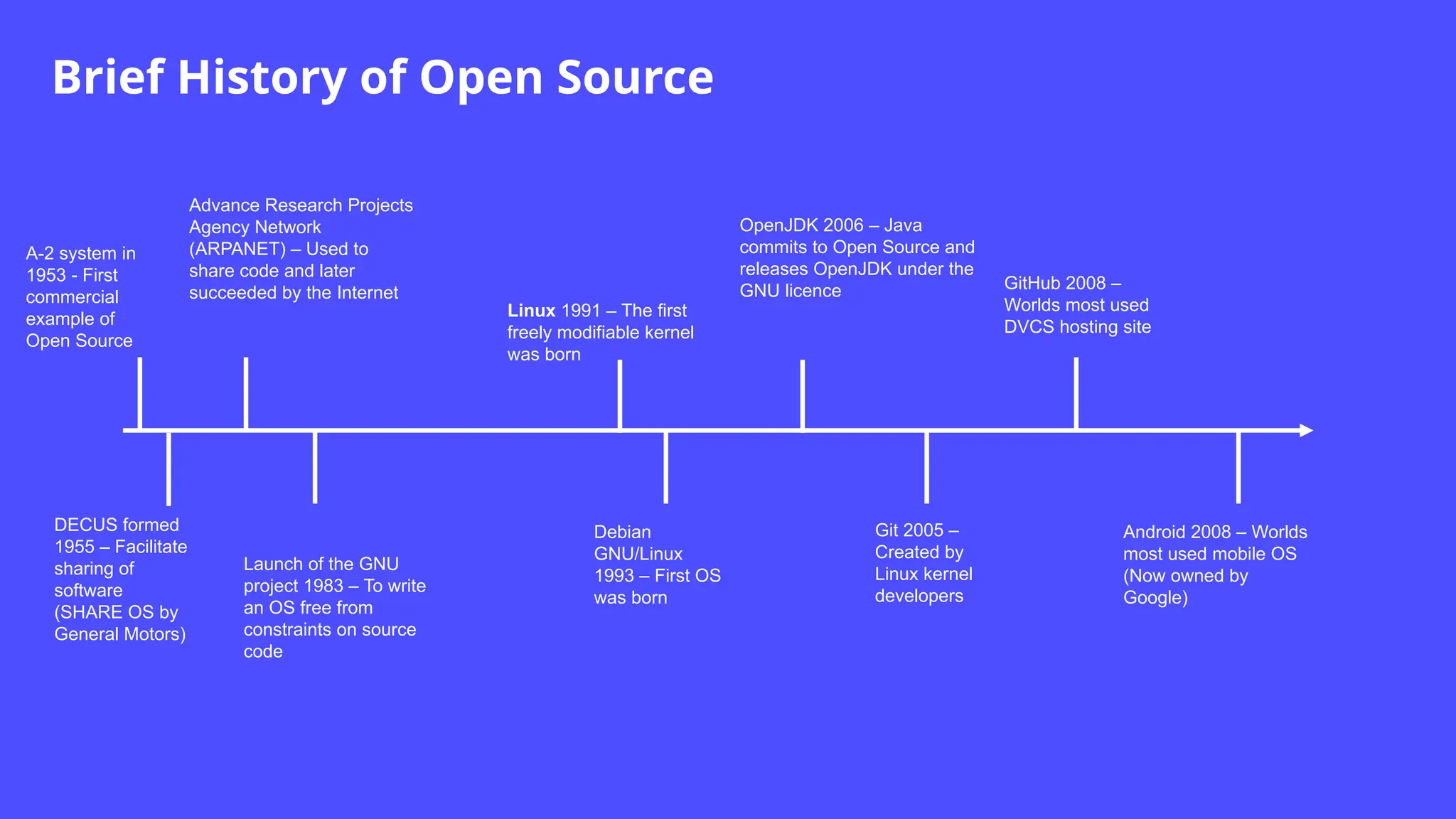
Brief History of Open Source
A-2 system in
1953 - First
commercial
example of
Open Source
DECUS formed
1955 – Facilitate
sharing of
software
(SHARE OS by
General Motors)
Advance Research Projects
Agency Network
(ARPANET) – Used to
share code and later
succeeded by the Internet
Launch of the GNU
project 1983 – To write
an OS free from
constraints on source
code
Linux 1991 – The first
freely modifiable kernel
was born
Debian
GNU/Linux
1993 – First OS
was born
OpenJDK 2006 – Java
commits to Open Source and
releases OpenJDK under the
GNU licence
Git 2005 –
Created by
Linux kernel
developers
GitHub 2008 –
Worlds most used
DVCS hosting site
Android 2008 – Worlds
most used mobile OS
(Now owned by
Google)
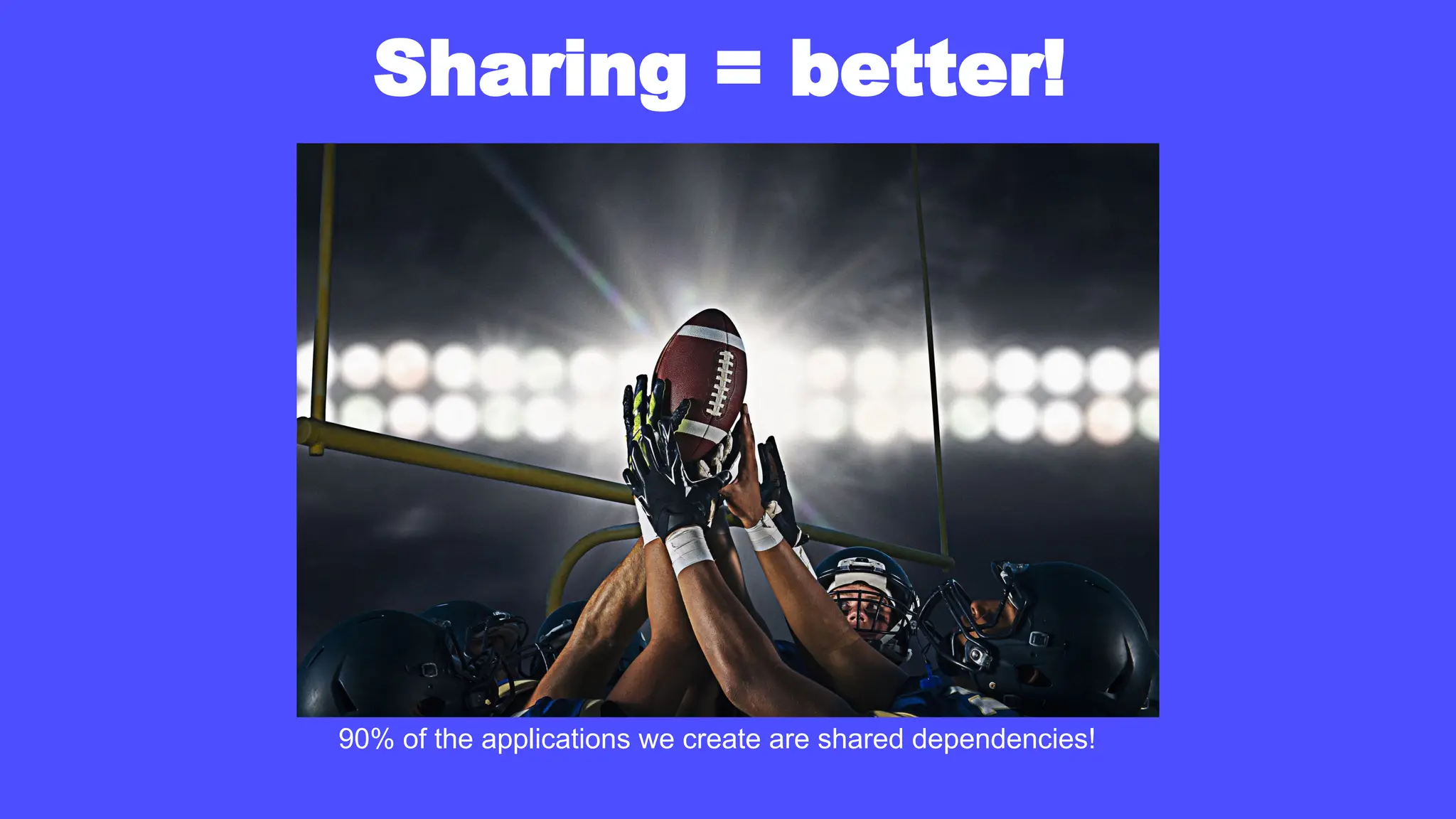
Sharing = better!
90% of the applications we create are shared dependencies!
Dependency Managment
150 Dependencies (avg Java project)
10 Releases Per Year (avg per dependency)
1500 Updates To Consider 😱
x
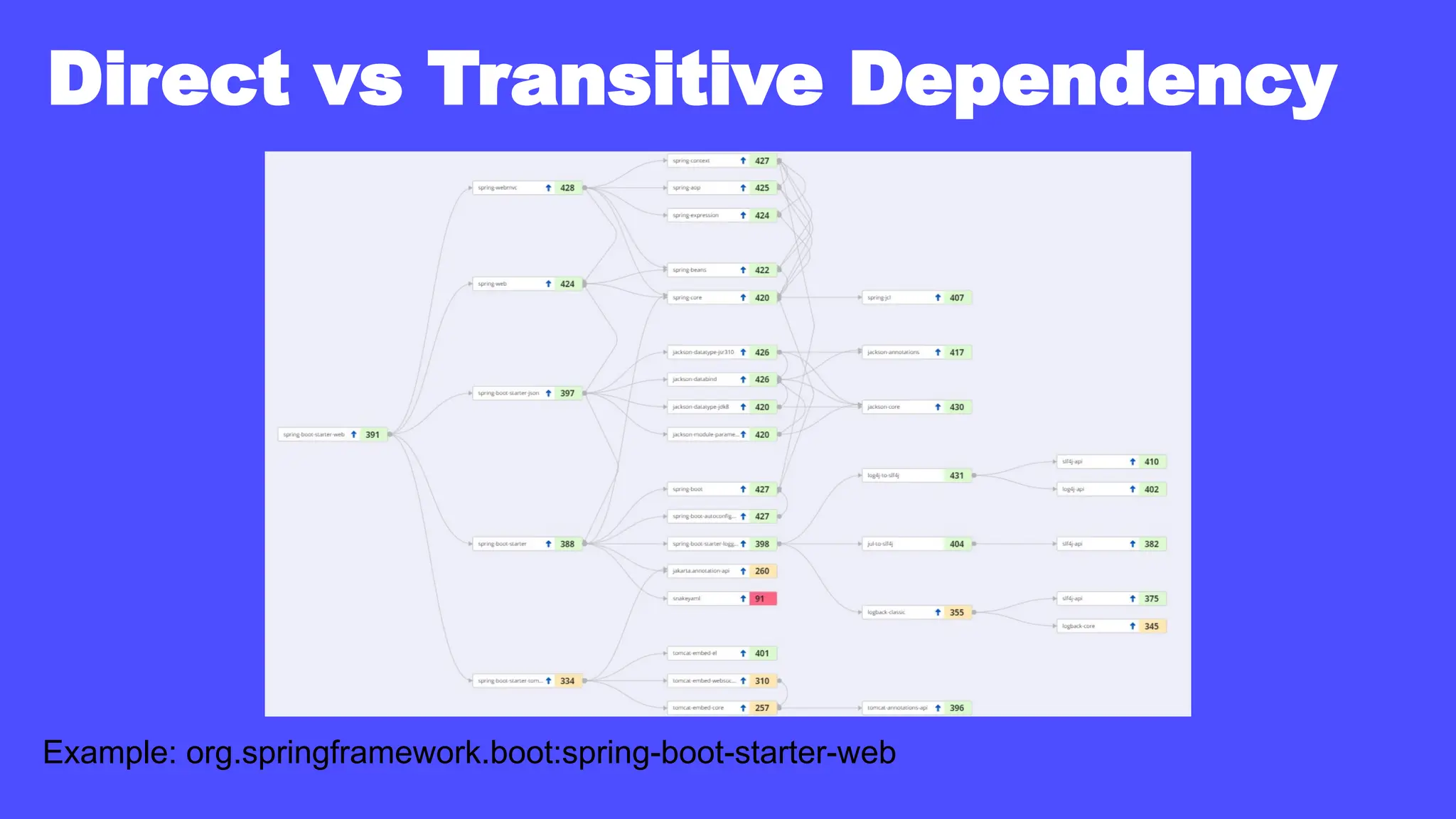
Direct vs Transitive Dependency
Example: org.springframework.boot:spring-boot-starter-web
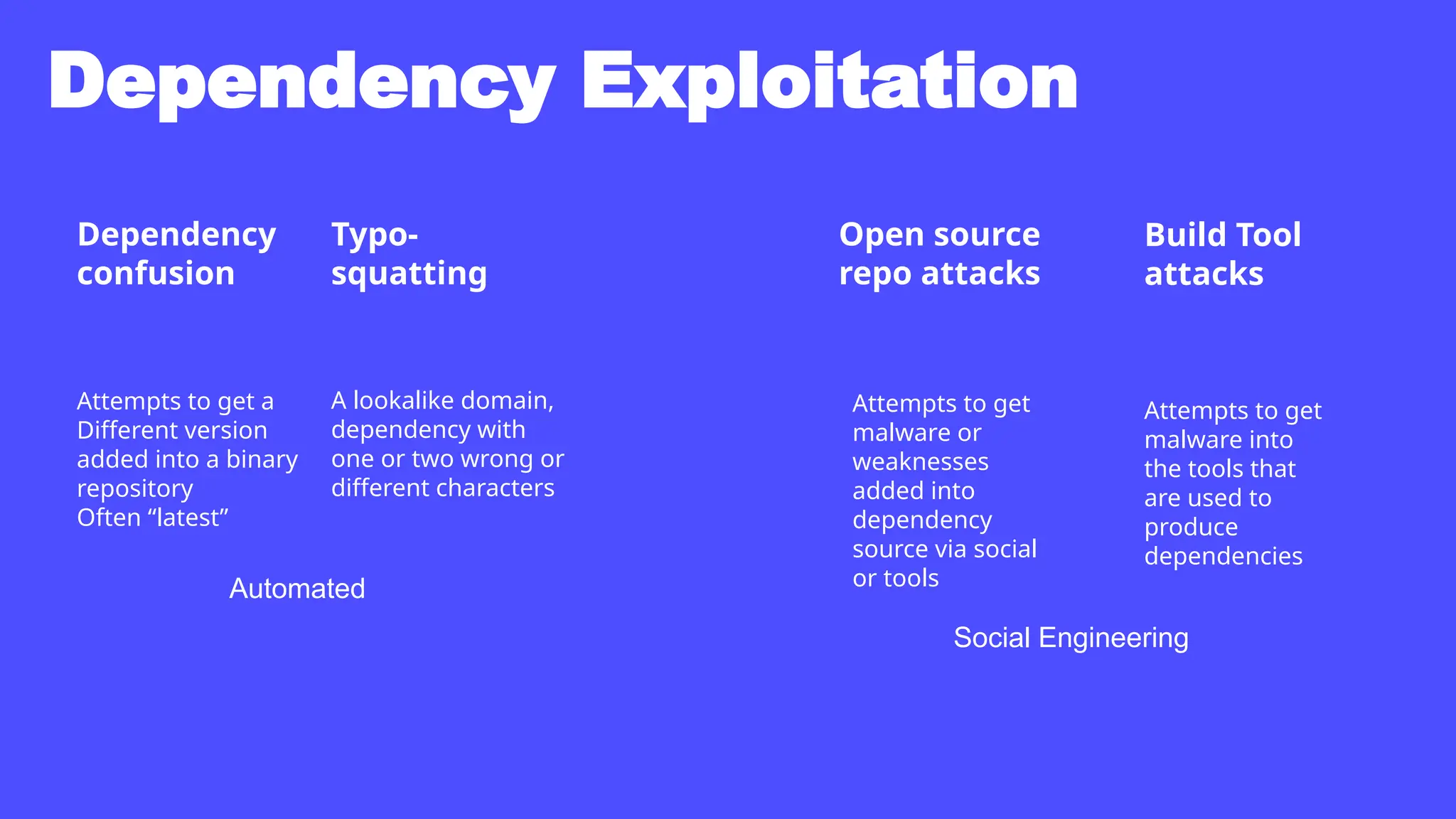
Dependency Exploitation
Dependency
confusion
Attempts to get a
Different version
added into a binary
repository
Often “latest”
Typo-
squatting
A lookalike domain,
dependency with
one or two wrong or
different characters
Open source
repo attacks
Attempts to get
malware or
weaknesses
added into
dependency
source via social
or tools
Build Tool
attacks
Attempts to get
malware into
the tools that
are used to
produce
dependencies
Automated
Social Engineering
Similar
problems
that faced
the Death
Star
Problems facing the Death Star
• Many components are built in remote locations
• Keeping track of how they are built, and the quality is difficult for the Empire
• The Death Star is very complex and vulnerability testing is an afterthought as
the empire is overconfident that they have no vulnerabilites
• When the rebels started to attack, this is when the empire realised, they had a
major vulnerability
• By this point it was too late and the rebels took full advantage to destroy all the
hard work the empire had done to create such a magnificent piece of
engineering
Why does
this
matter?
Cyber Crime Facts
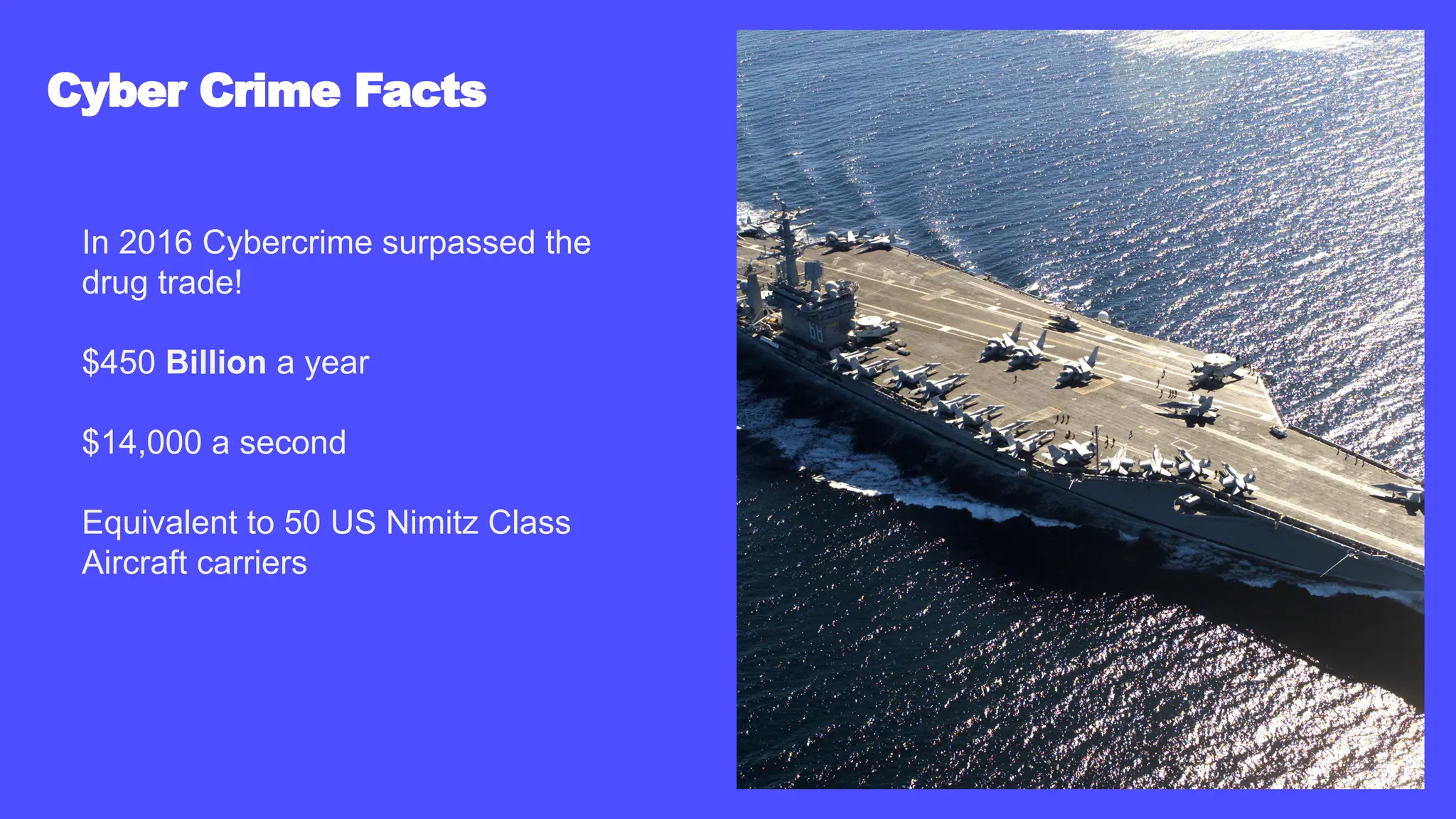
In 2016 Cybercrime surpassed the
drug trade!
$450 Billion a year
$14,000 a second
Equivalent to 50 US Nimitz Class
Aircraft carriers
What about 2022?
Cyber Crime Facts
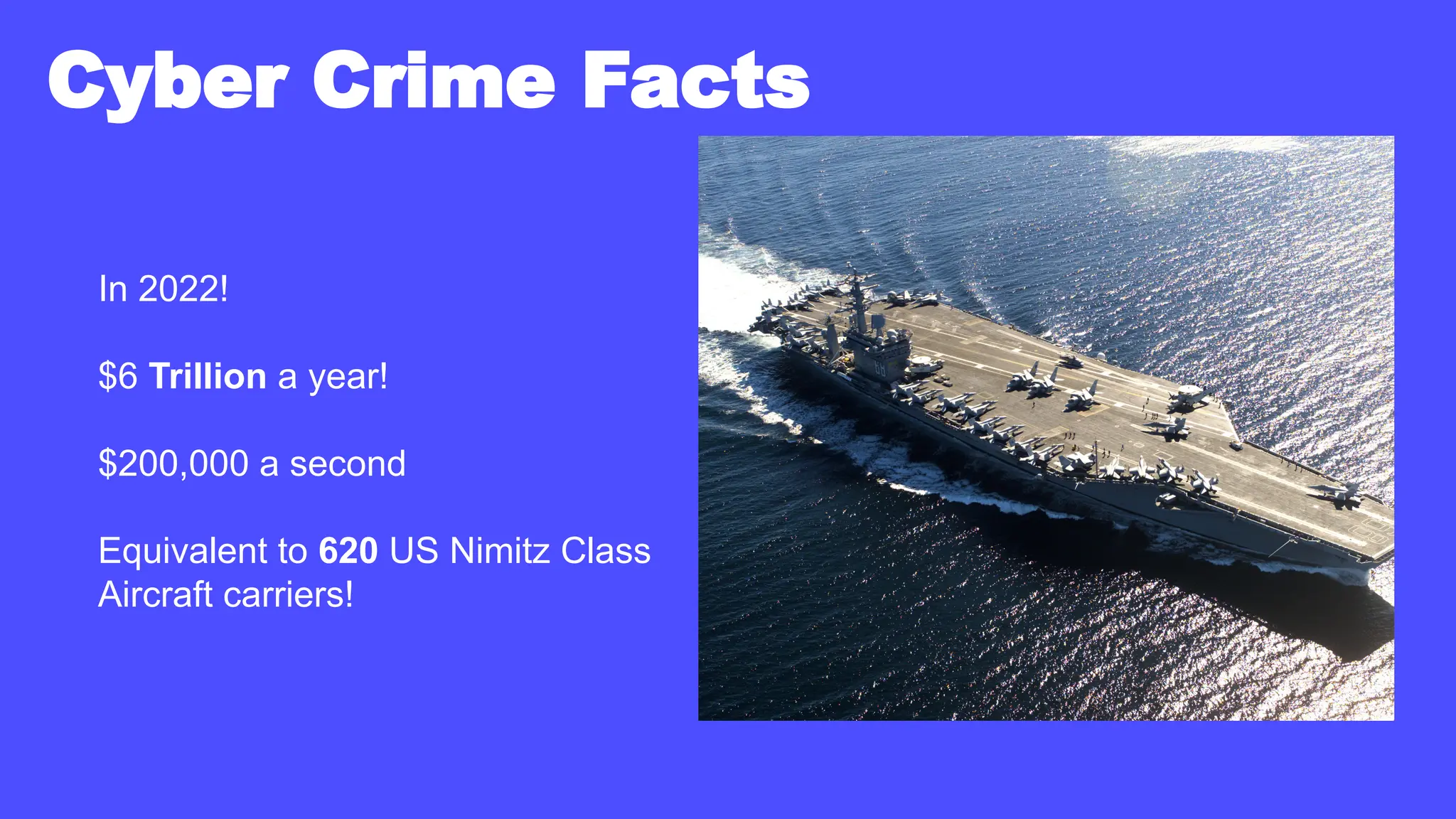
In 2022!
$6 Trillion a year!
$200,000 a second
Equivalent to 620 US Nimitz Class
Aircraft carriers!
If Cybercrime was a country by
GDP in 2022
United States: $20.89 trillion
China: $14.72 trillion
Cyber Crime: $6 trillion
Japan: $5.06 trillion
Germany: $3.85 trillion
India: $2.65 trillion
United Kingdom: $2.63 trillion
France: $2.58 trillion
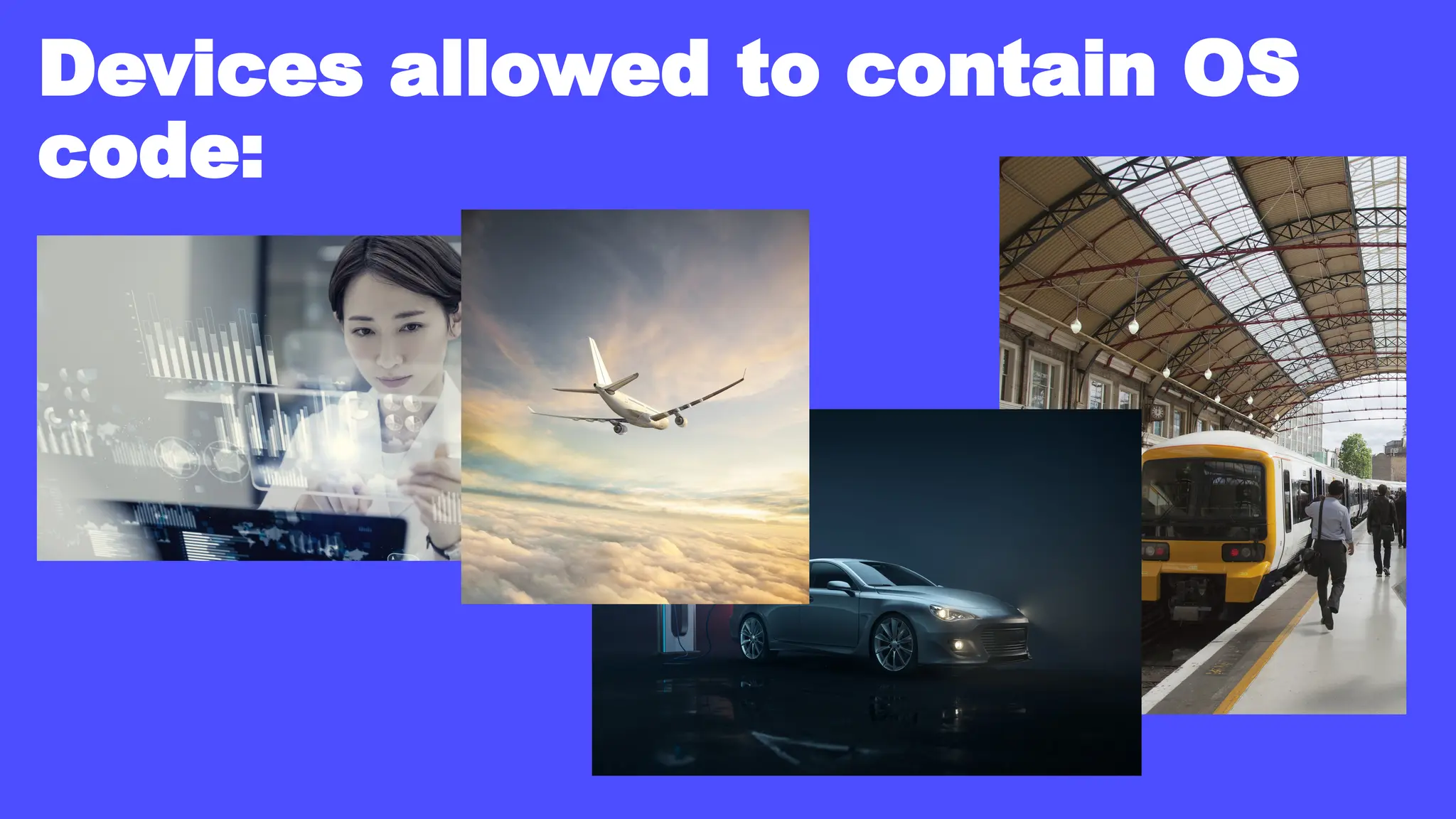
Devices allowed to contain OS
code:
IEC 62304
Be Proactive rather than Reactive
“If no other manufacturing industry is permitted to
ship known vulnerable or defective parts in their
products, why should software manufacturers be any
different?” – Brian Fox CTO/Founder of Sonatype
US - National Cyber Secuirty
Stratagy
In another historic move, the US
government is calling for
generational investments to:
• Renew infrastructure.
• Secure software and semiconductor supply chains.
• Modernize cryptographic technologies.
In a nutshell the themes for this new strategy are as
follows:
• Software providers and data owners held
responsible under cybersecurity liability
• Realigned long-term investment in cybersecurity will
have a focus on the future
• A drive to invest in security resilience starts with
every digital ecosystem
• Coordinated vulnerability disclosures and SBOMs
are still a best practice. Get your SBOM below.
EU - Cyber Resilience Act
Main points of this legislation:
• Essential cybersecurity requirements
• Requirement for any digital products on the market and includes things
such as good practices for example: “products must protect the
availability of essential functions, including the resilience against and
mitigation of denial of service attacks”
• Vulnerability handling requirements
• Requirement for how to handle vulnerabilities with the use of policies for
example: “once a security update has been made available,
manufacturers must publically disclose information about fixed
vulnerabilities and have a policy in place on coordinated vulnerability
disclosure”
• Extra requirements for Critical products
• There are two classes of critical products. Class 1 includes stuff like
password management, traffic and identity systems. Class 2 includes
operating systems for servers, desktops and mobile devices.
• Conformity of products and information and
instructions to users
• Requirement of software to conform to certain requirements
such as Technical documentation that is available before
release and is updated throughout the software lifecycle that
includes stuff such as a security risk assessment and reports
of tests related to vulnerabilities. It also needs to be clear
and understandable to the user and includes stuff like a
point of contact for reporting vulnerabilities etc.
• Reporting obligations
• The requirement here is to notify the ENISA within 24h of
becoming aware of a actively exploited vulnerability
contained in the product. Users should also be notified
without undue delay and if possible you should provide them
with information about fixes to said vulnerabilities.
• Obligations on the rest of the supply chain
• Requirements for importers of software that what they have
imported has abided by the obligations in the CRA.
UK – PSTI
The Product Security and Telecommunications
Infrastructure (PSTI) Bill:
• Require manufacturers, importers and distributors to
ensure that minimum security requirements are met in
relation to consumer connectable products that are
available to consumers.
• Provide a robust regulatory framework that can adapt
and remain effective in the face of rapid technological
advancement, the evolving techniques employed by
malicious actors, and the broader international
regulatory landscape.
Main points of this bill
Ban default passwords.
•Products that come with default passwords are an easy
target for cyber criminals.
Require products to have a vulnerability
disclosure policy.
•Security researchers regularly identify security flaws in
products, but need a way to give notice to manufacturers of
the risk they have identified, so that they can enable the
manufacturer to act before criminals can take advantage.
The Bill will provide measures to help ensure any
vulnerabilities in a product are identified and flagged.
Require transparency about the length of
time for which the product will receive
important security updates.
•Consumers should know if their product will be
supported with security updates, and if so, what the
minimum length of time is that they can expect that support
to continue.
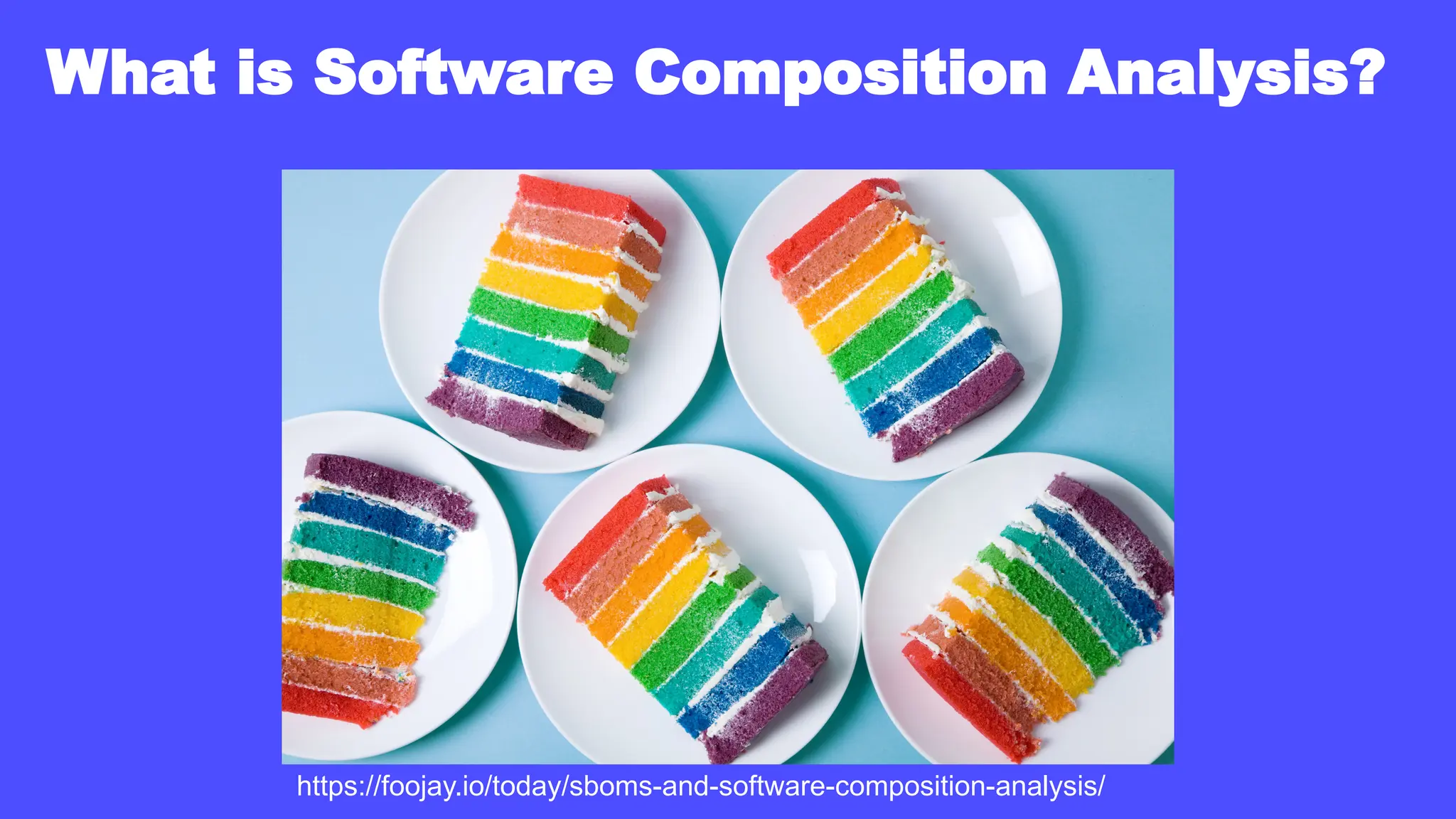
What is Software Composition Analysis?
https://foojay.io/today/sboms-and-software-composition-analysis/
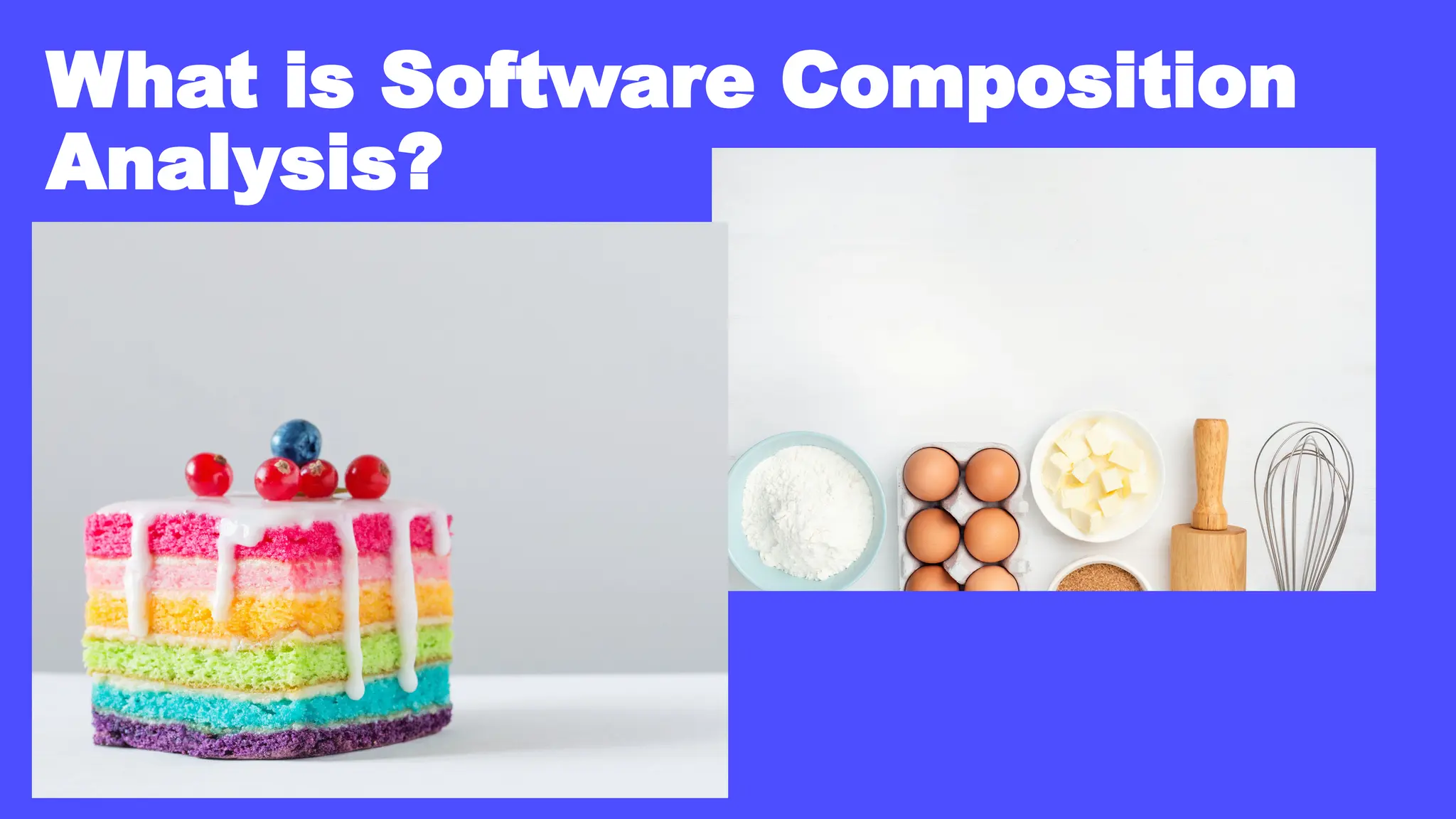
What is Software Composition
Analysis?
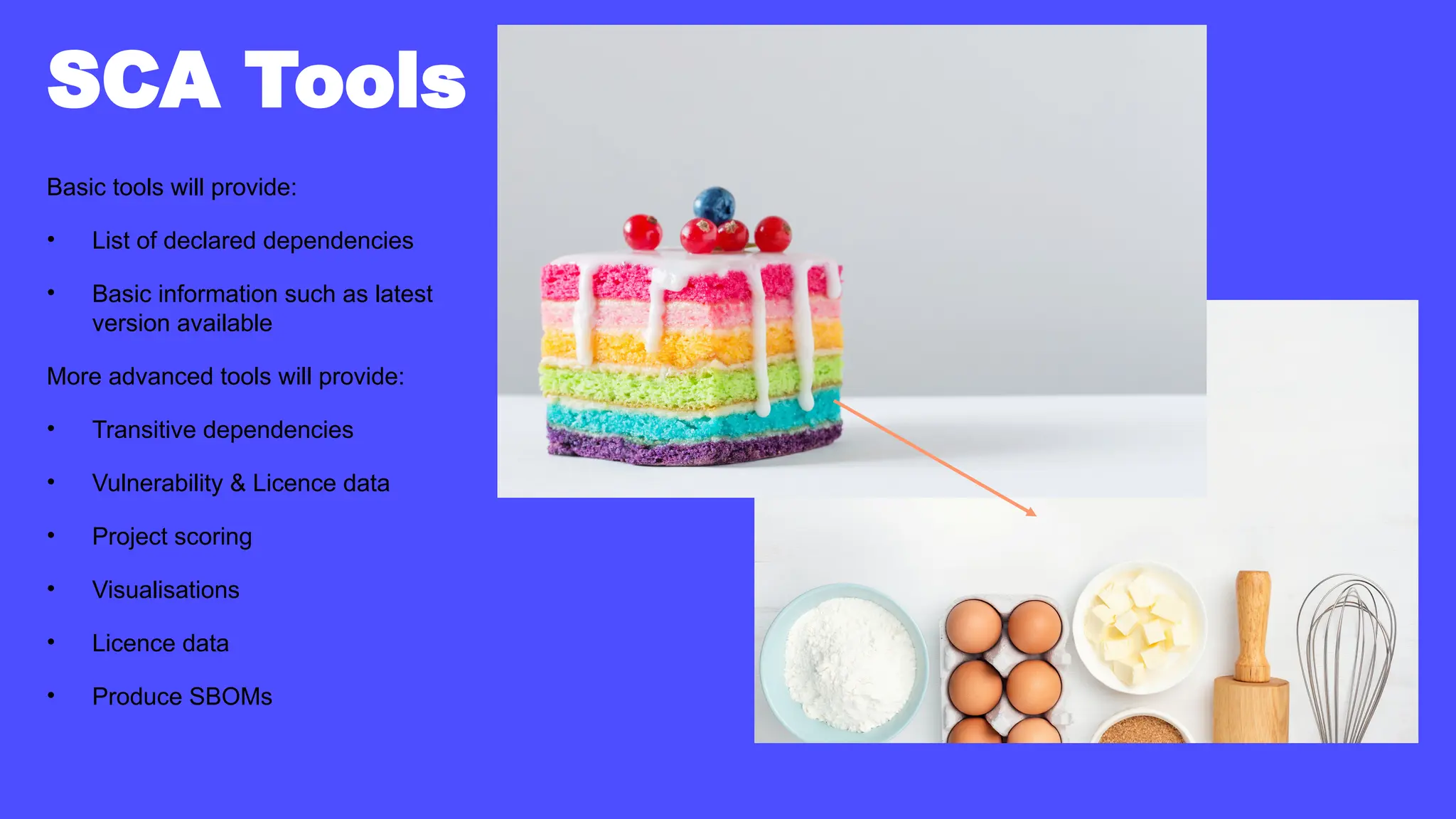
SCA Tools
Basic tools will provide:
• List of declared dependencies
• Basic information such as latest
version available
More advanced tools will provide:
• Transitive dependencies
• Vulnerability & Licence data
• Project scoring
• Visualisations
• Licence data
• Produce SBOMs
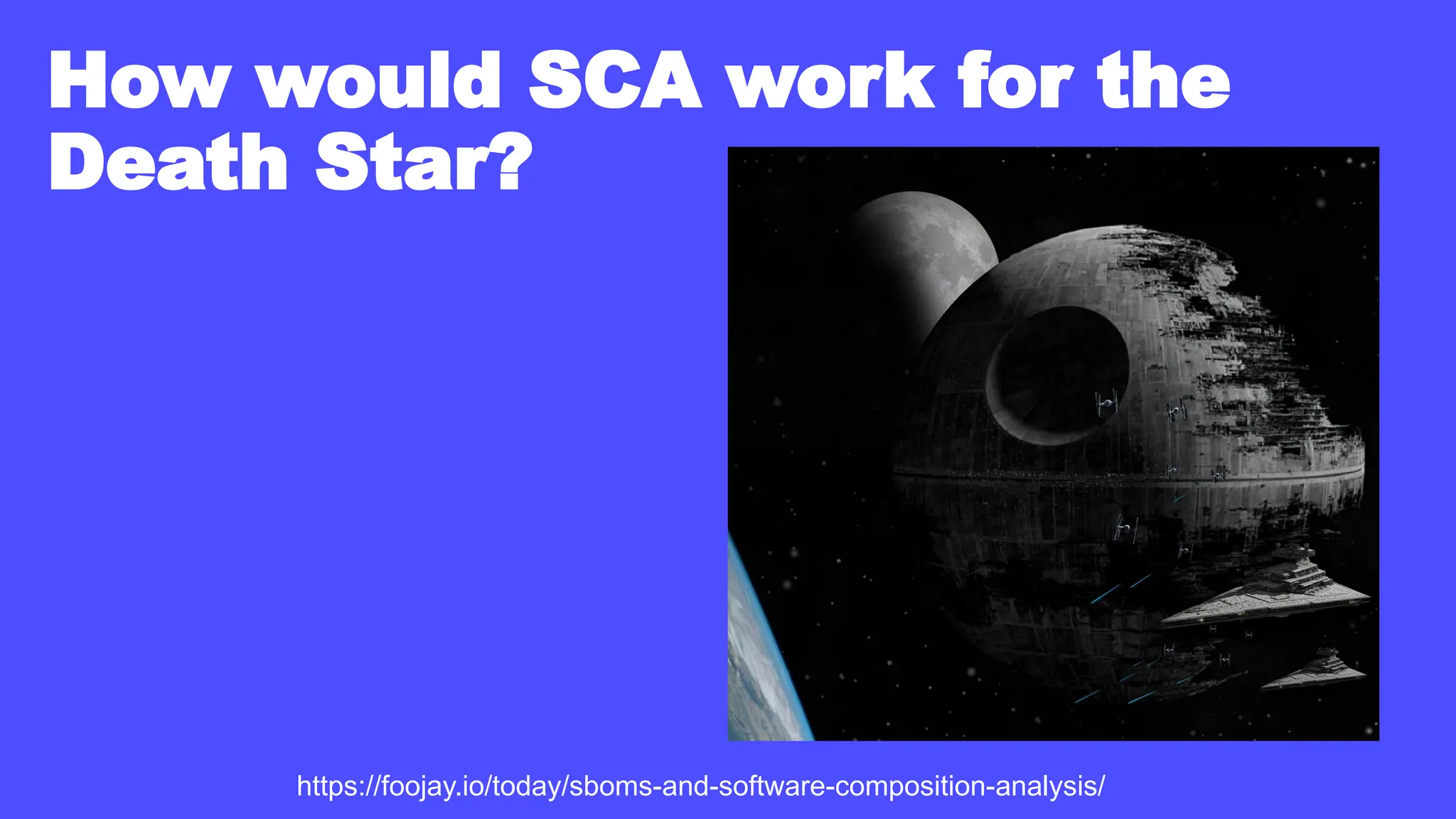
How would SCA work for the
Death Star?
https://foojay.io/today/sboms-and-software-composition-analysis/
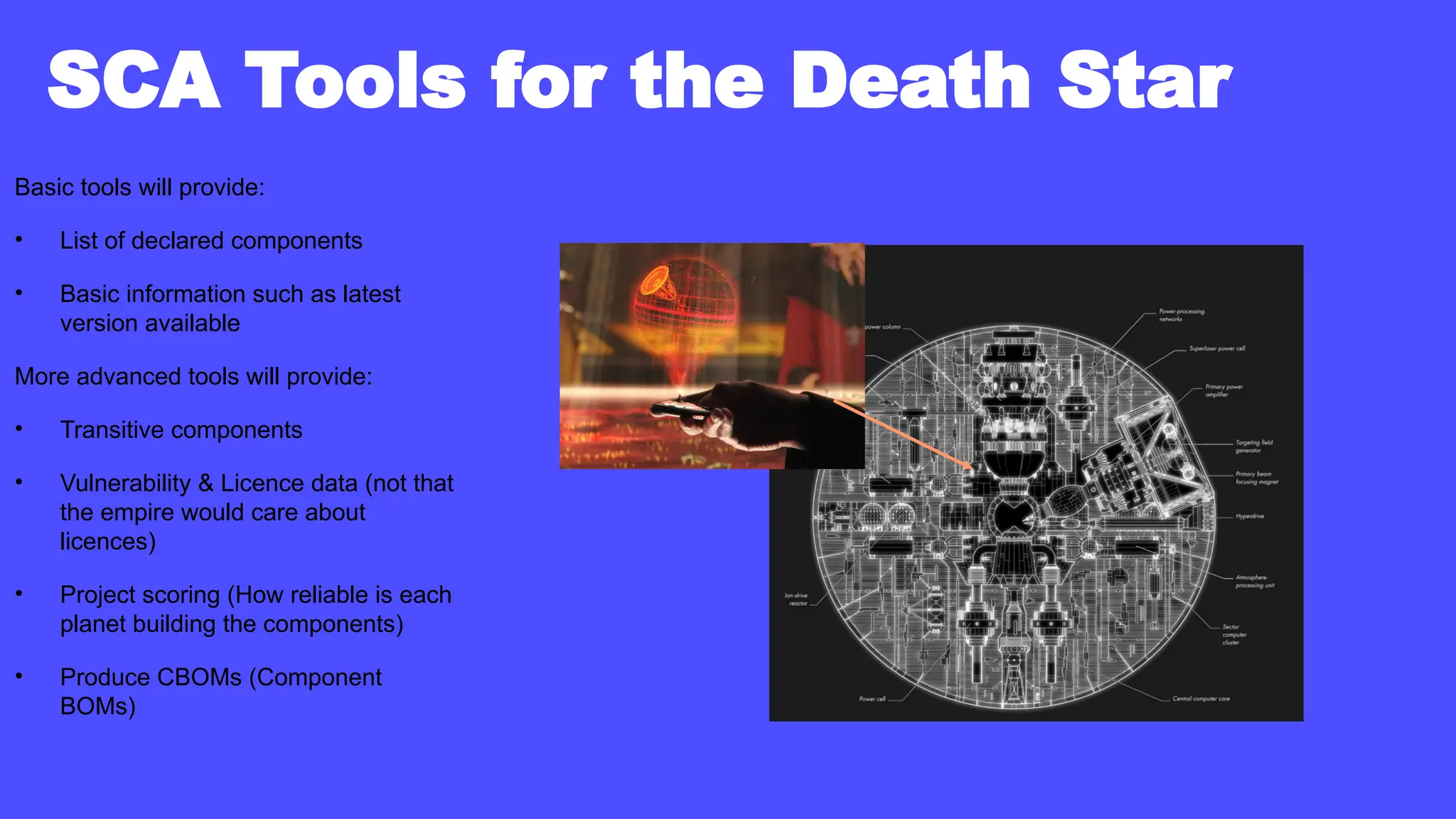
SCA Tools for the Death Star
Basic tools will provide:
• List of declared components
• Basic information such as latest
version available
More advanced tools will provide:
• Transitive components
• Vulnerability & Licence data (not that
the empire would care about
licences)
• Project scoring (How reliable is each
planet building the components)
• Produce CBOMs (Component
BOMs)
SBOM To The Rescue?
Easy ways to generate an SBOM
1.CycloneDX Maven Plugin
2.Kubernetes bom
3.Microsoft’s SBOM Tool
4.SPDX SBOM Generator
5.Syft
6.Sonatype Lifecycle
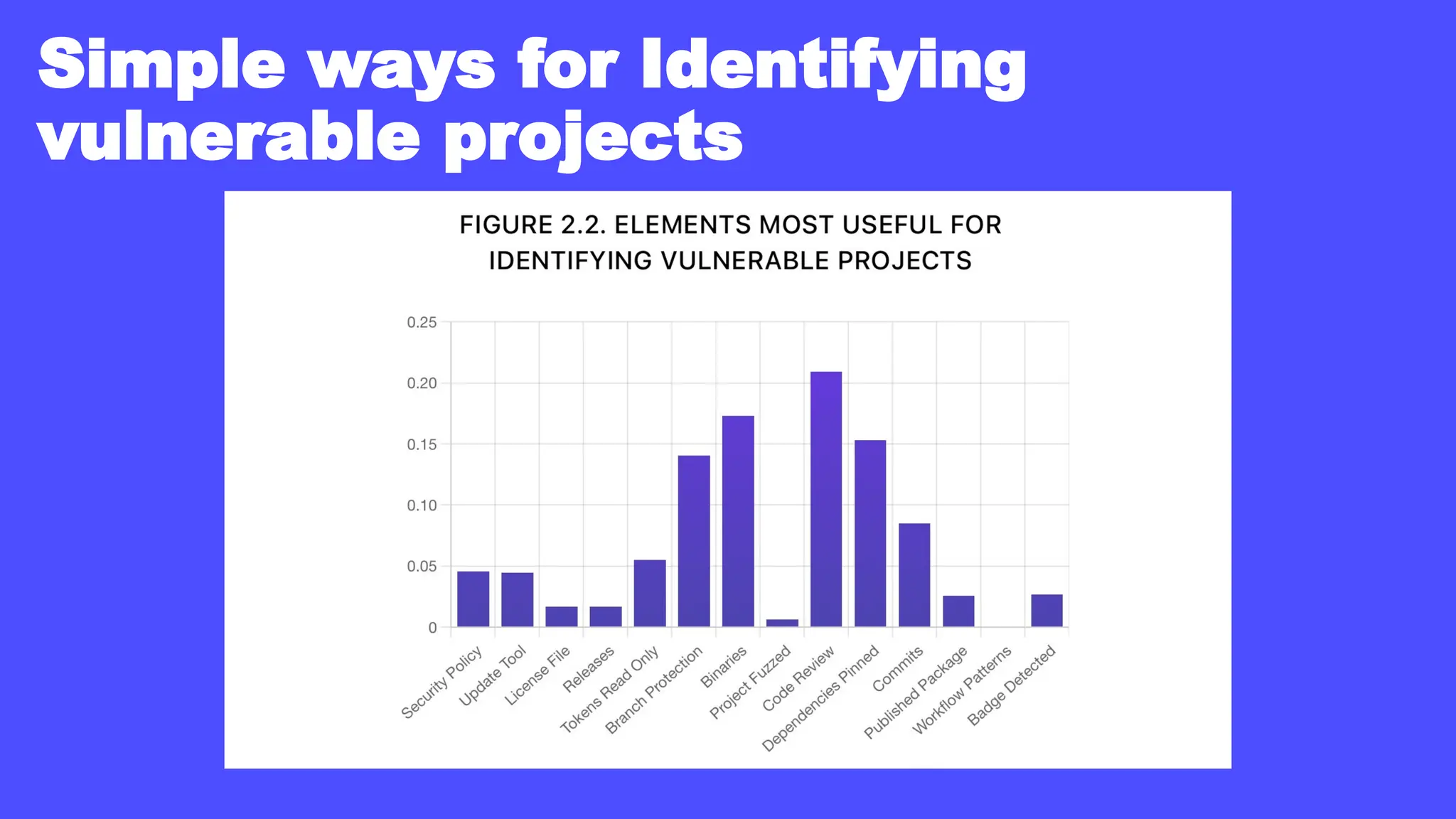
Simple ways for Identifying
vulnerable projects
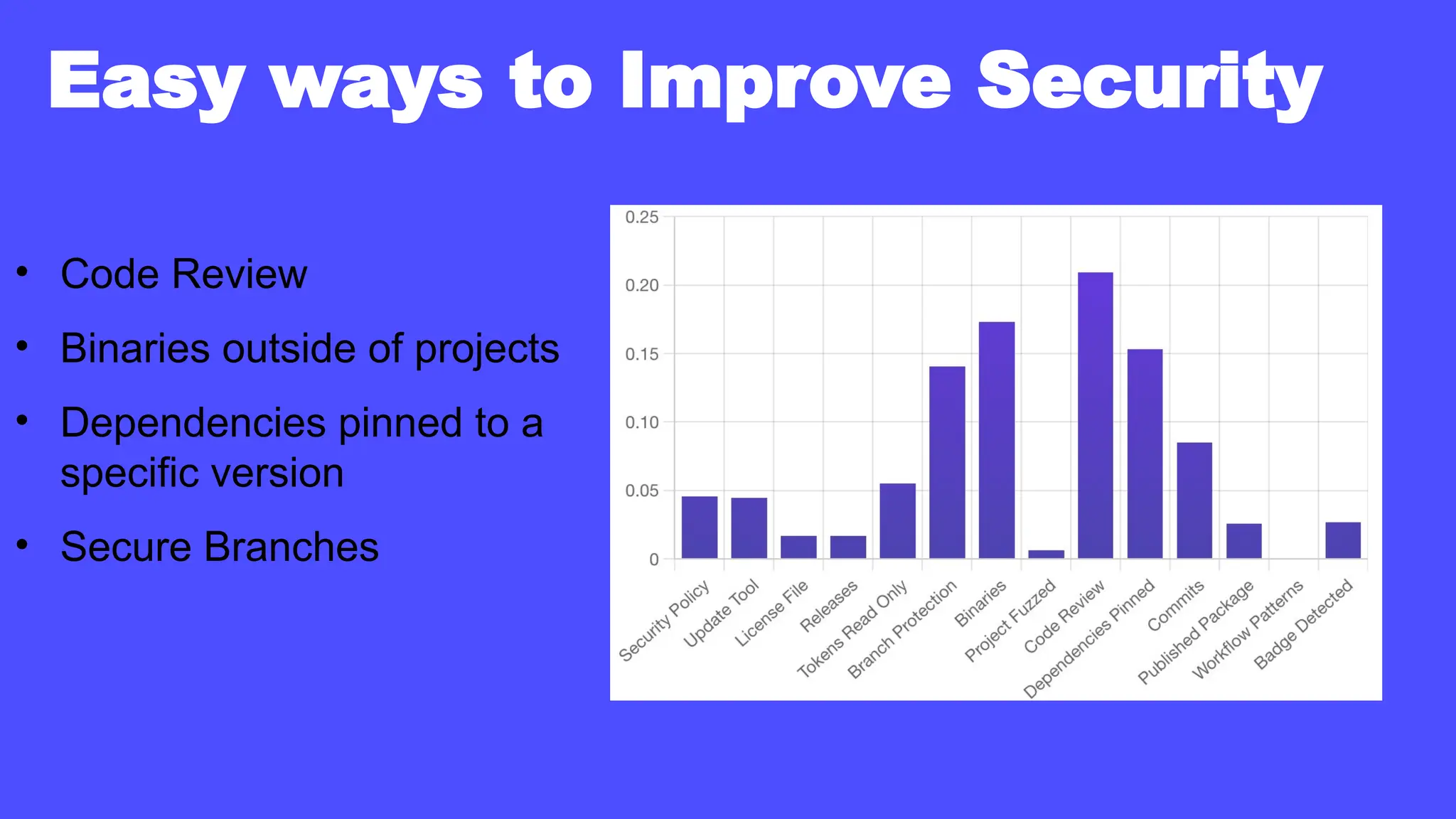
Easy ways to Improve Security
• Code Review
• Binaries outside of projects
• Dependencies pinned to a
specific version
• Secure Branches
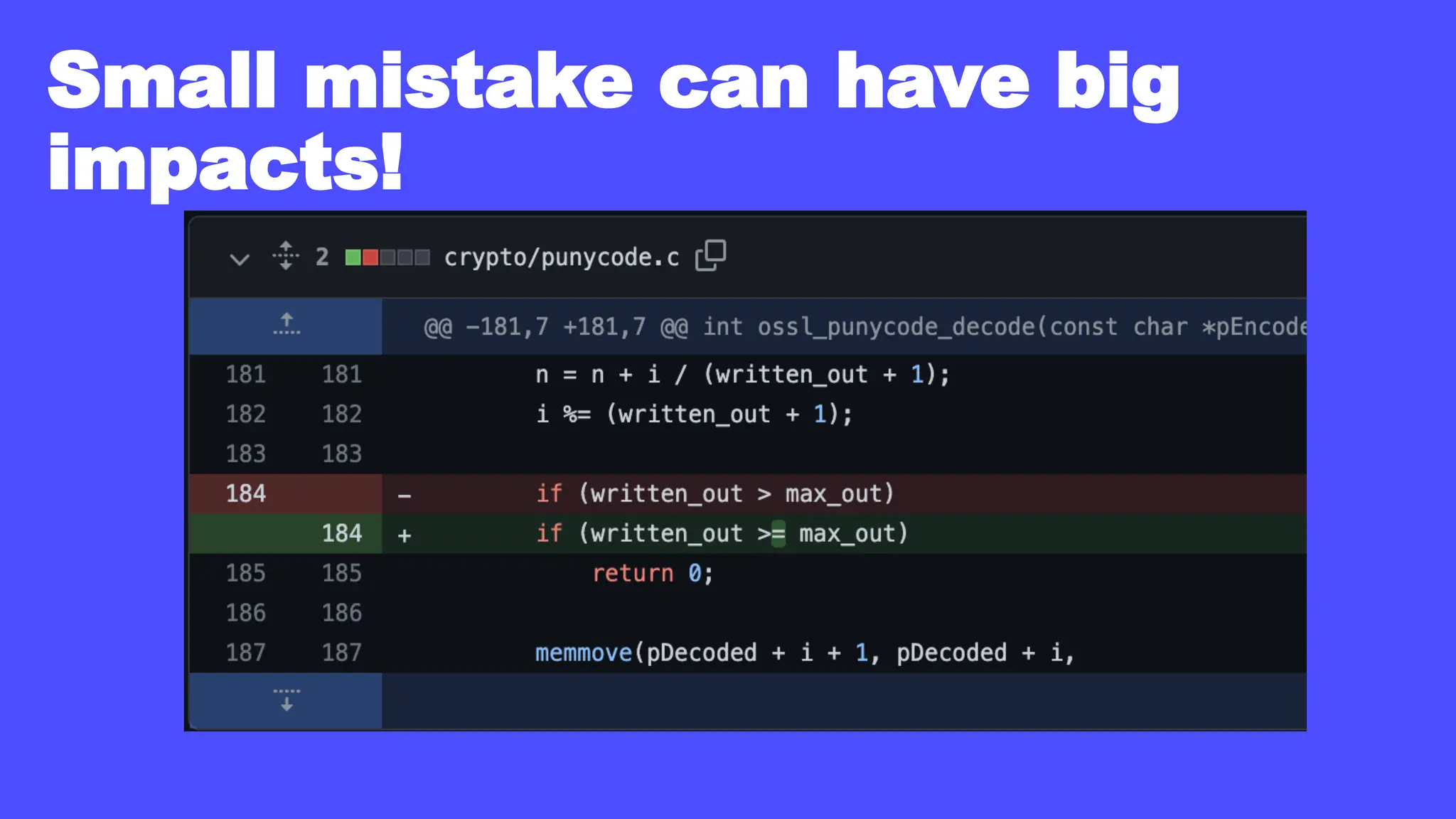
Small mistake can have big
impacts!
12
7
127
06 The AI Days
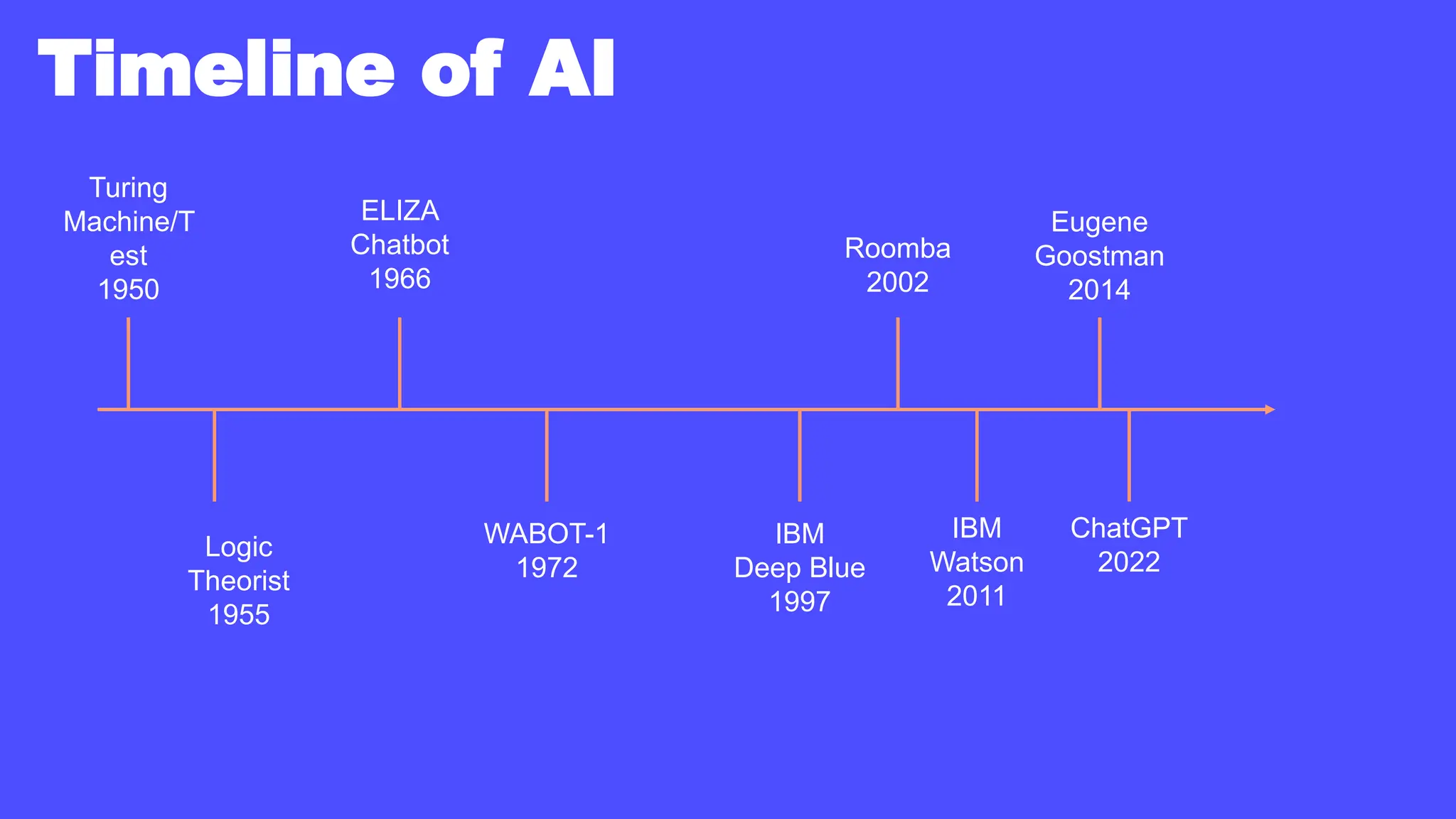
Timeline of AI
Turing
Machine/T
est
1950
ELIZA
Chatbot
1966
Logic
Theorist
1955
Eugene
Goostman
2014
IBM
Deep Blue
1997
WABOT-1
1972
Roomba
2002
IBM
Watson
2011
ChatGPT
2022
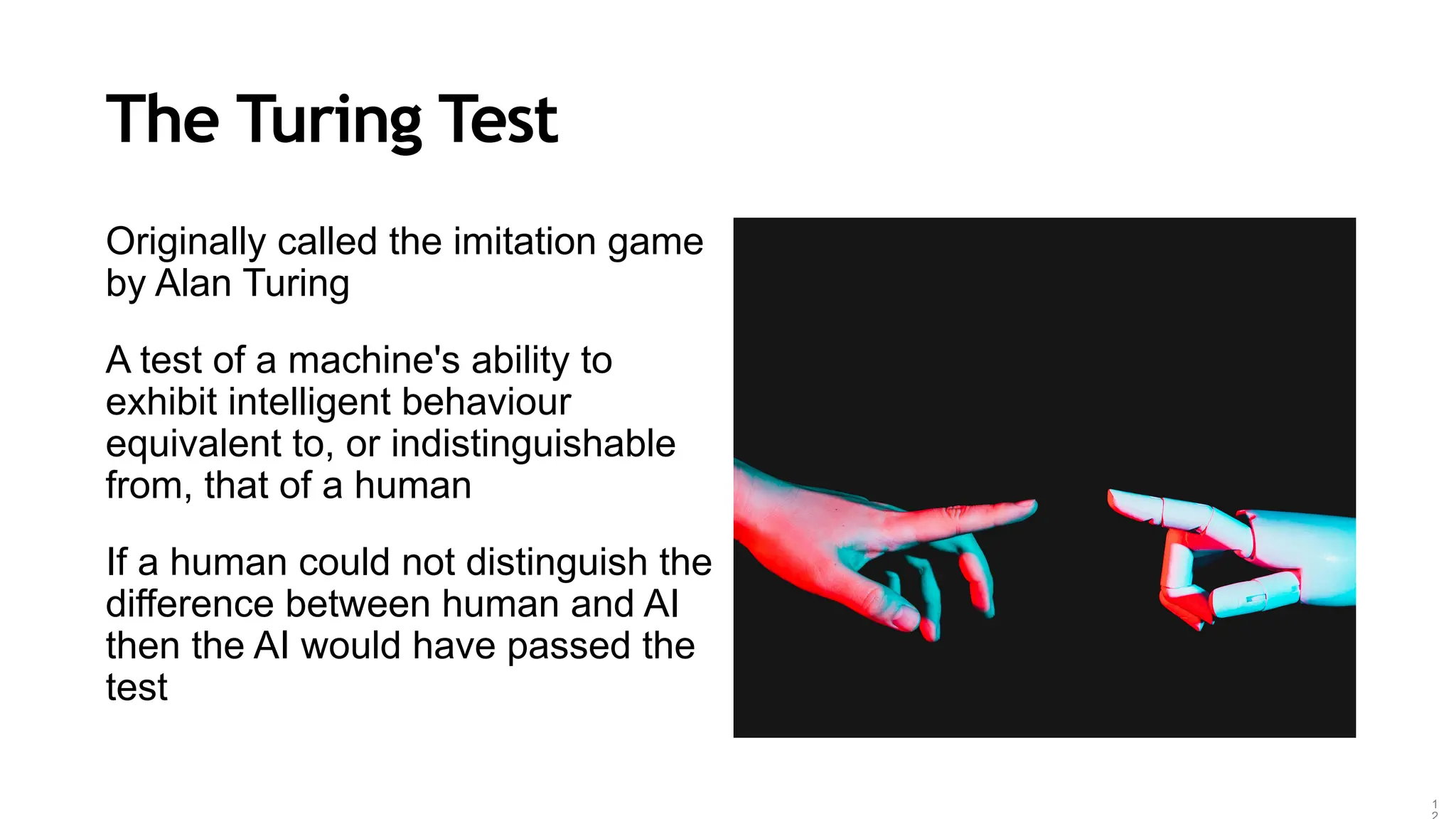
The Turing Test
Originally called the imitation game
by Alan Turing
A test of a machine's ability to
exhibit intelligent behaviour
equivalent to, or indistinguishable
from, that of a human
If a human could not distinguish the
difference between human and AI
then the AI would have passed the
test
1
13
0
IBM Deep Blue
Development started in 1985
It lost its first attempt at beating Garry Kasparov with
2 to IBM and 4 to Garry
It was upgraded in 1997 to once again challenge
Garry
It then beat the world chess champion Garry
Kasparov
6 Matches over several days
2 to IBM, 1 to the champion and 3 draws
IBM Watson
A question answering machine of natural
language
The computer system was initially developed
to answer questions on the quiz show
Jeopardy. In 2011 it played against champions
Brad Rutter and Ken Jennings, winning the
first-place prize of 1 million USD.
In 2013 it has been used in healthcare to
diagnose patients among other things.
Eugene Goostman
Possibly the most advanced chatbot of its time
Developed in Saint Petersburg in 2001 by a group of three
programmers, Vladimir Veselov, Eugene Demchenko, and Sergey
Ulasen.
Goostman is portrayed as a 13-year-old Ukrainian boy—characteristics
that are intended to induce forgiveness in those with whom it interacts
for its grammatical errors and lack of general knowledge.
In 2005 & 2008 it finished 2nd
in Turing test competitions
In 2014 on the 60th
anniversary of Turin death it convinced 33% of the
judges it was human. Some declare this as passing the Turing test.
ChatGPT
Released on November 2022 by OpenAI
In January 2023, it became the fastest growing consumer application in
history
Many other ChatBot systems are based of this technology such as Googles
BARD
It has a tendency to confidently provide inaccurate information.
The dark side of ChatGPT
In order to train it against stuff like (sexual above, violence, racism, sexism
etc) OpenAI outsources this training to Kenyan workers for less than $2 an
hour.
The outsourced laborers were exposed to such toxic and dangerous
content that they described the experience as "torture".
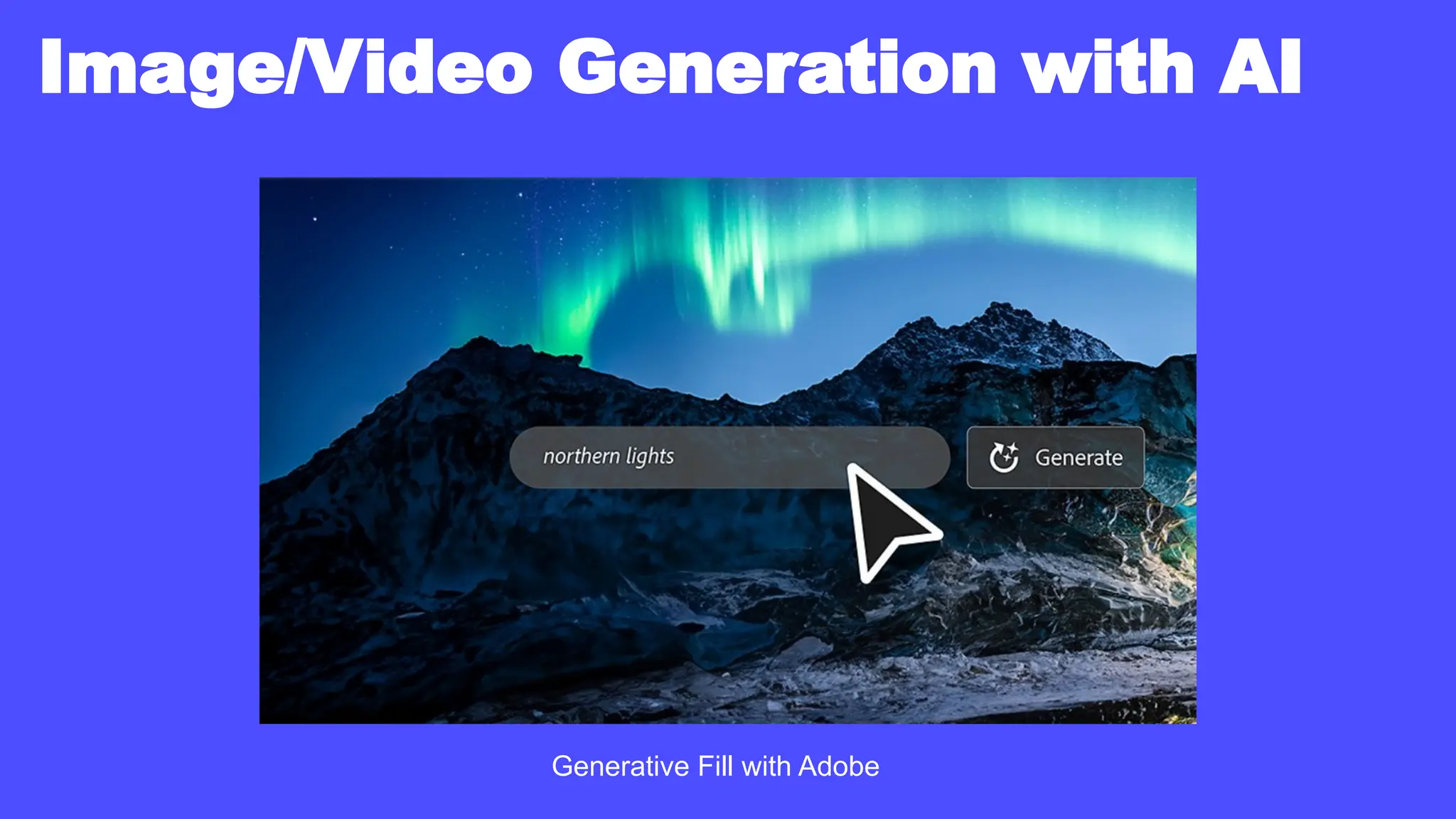
Image/Video Generation with AI
Generative Fill with Adobe
Uses for AI and
Developers
Developer Productivity
Codesnippets
Works with Java, Python, C++…
Creates error-prone and performance-optimized codes
GitHub Copilot
Offers intelligent coding suggestions for code snippets, functions, and
methods while coding
Integrates seamlessly with renowned code editors, including VS Code,
JetBrains, and more.
Developer Productivity
AutoRegex
Optimizes regular expression to enhance the performance of the
application
Converts English language to RegEx using Natural Language Processing
(NLP)
Mintlify
Understanding complicated functions and generating documentation.
Quickly generating comments to understand what someone else’s function
is doing.
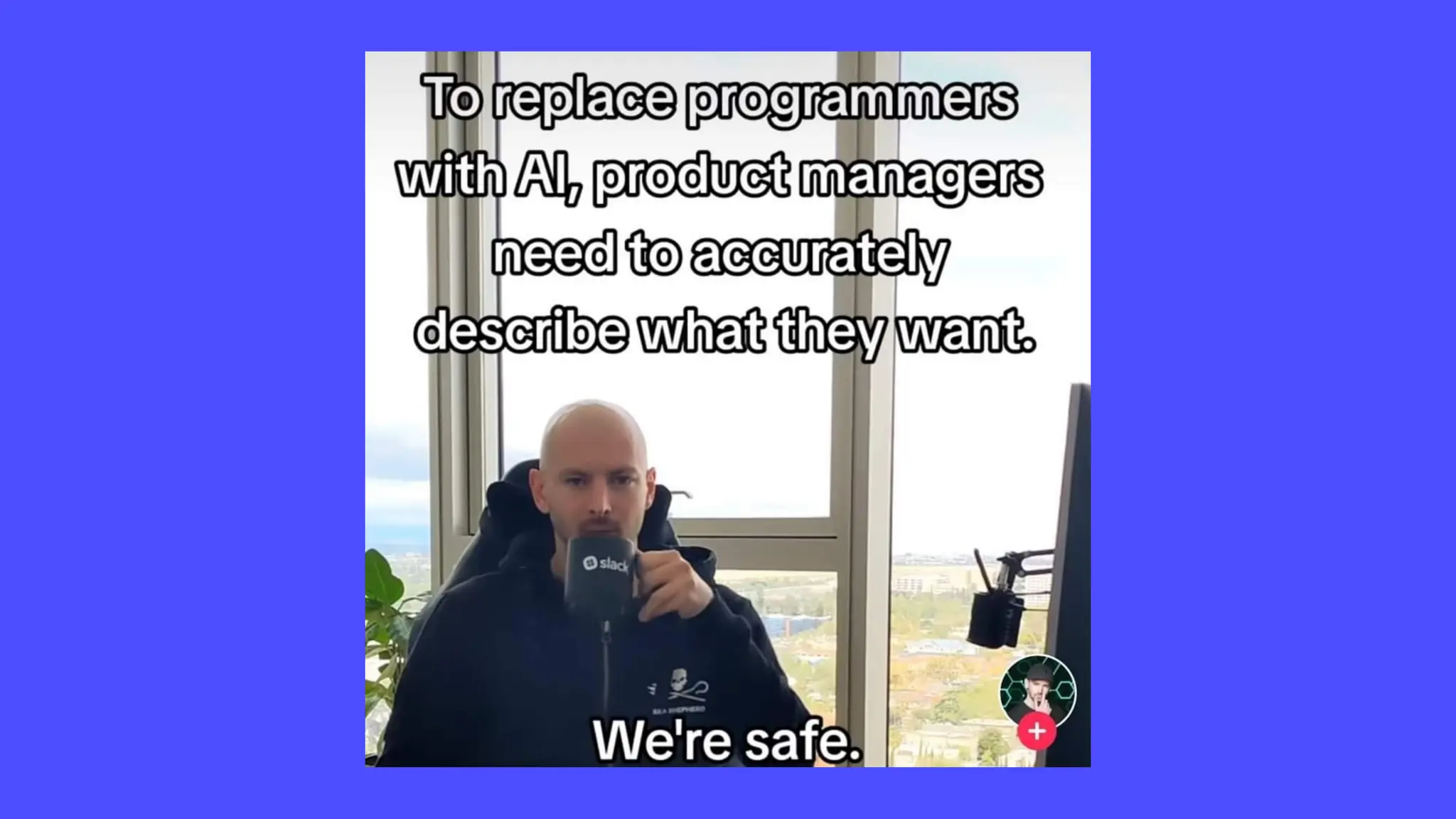
Should you be
worried?
Yes & No
14
1
141
06 The E-commerce
Days
14
2
142
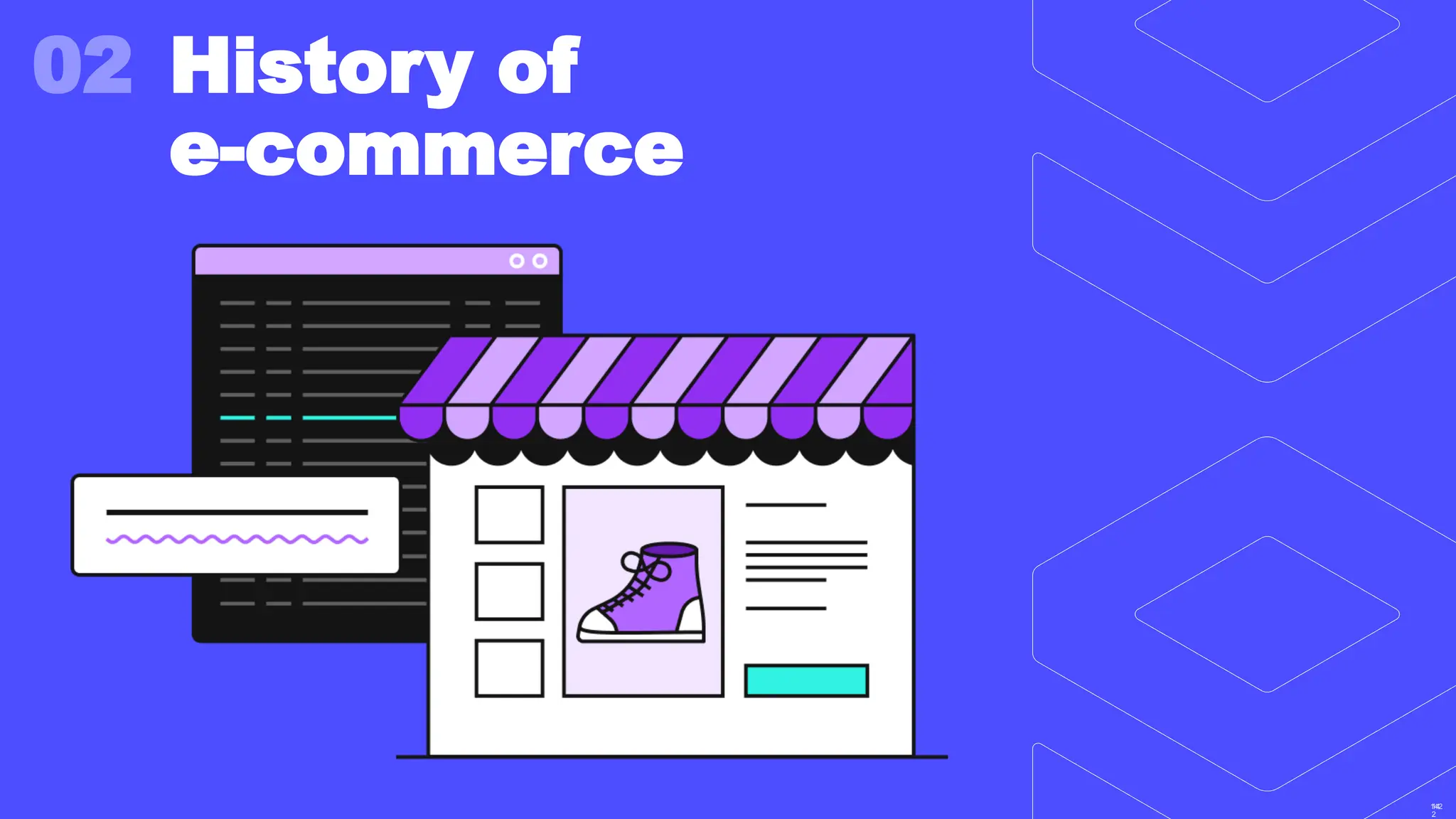
02 History of
e-commerce
What is E-Commerce?
E-Commerce
14
3
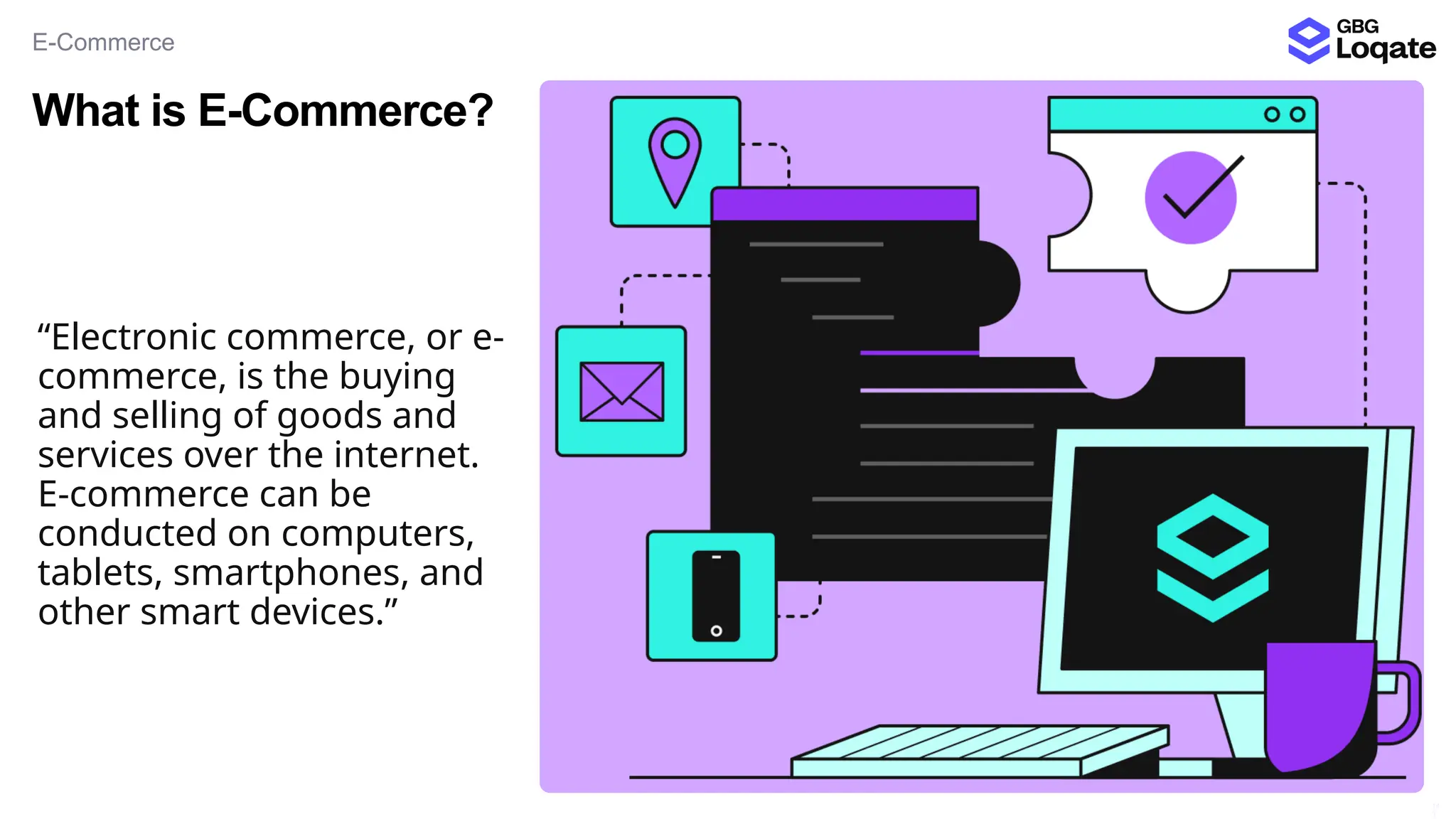
“Electronic commerce, or e-
commerce, is the buying
and selling of goods and
services over the internet.
E-commerce can be
conducted on computers,
tablets, smartphones, and
other smart devices.”
Can you guess what
the 1st
ever example
of e-commerce was?
E-Commerce
14
4
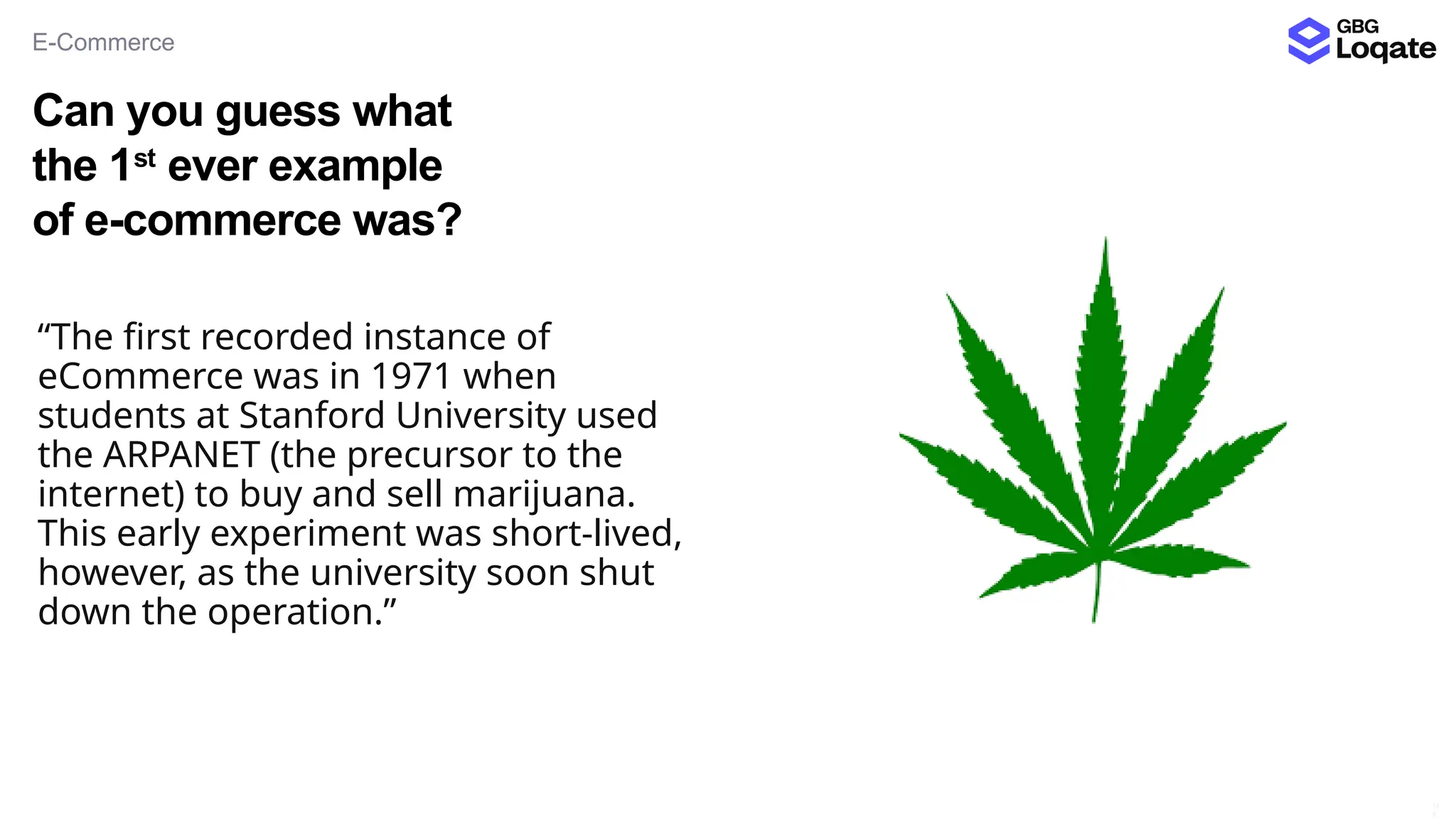
“The first recorded instance of
eCommerce was in 1971 when
students at Stanford University used
the ARPANET (the precursor to the
internet) to buy and sell marijuana.
This early experiment was short-lived,
however, as the university soon shut
down the operation.”
Can we guess what
the 1st
ever example
of e-commerce was?
E-Commerce
14
5
“The first recorded instance
of eCommerce was in 1971
when students at Stanford
University used the
ARPANET (the precursor to
the internet) to buy and sell
marijuana. This early
experiment was short-
lived, however, as the
university soon shut down
the operation.”
14
6
Early e-commerce
The e-commerce
revolution
Future of e-commerce
The History of E-Commerce
History of e-commerce
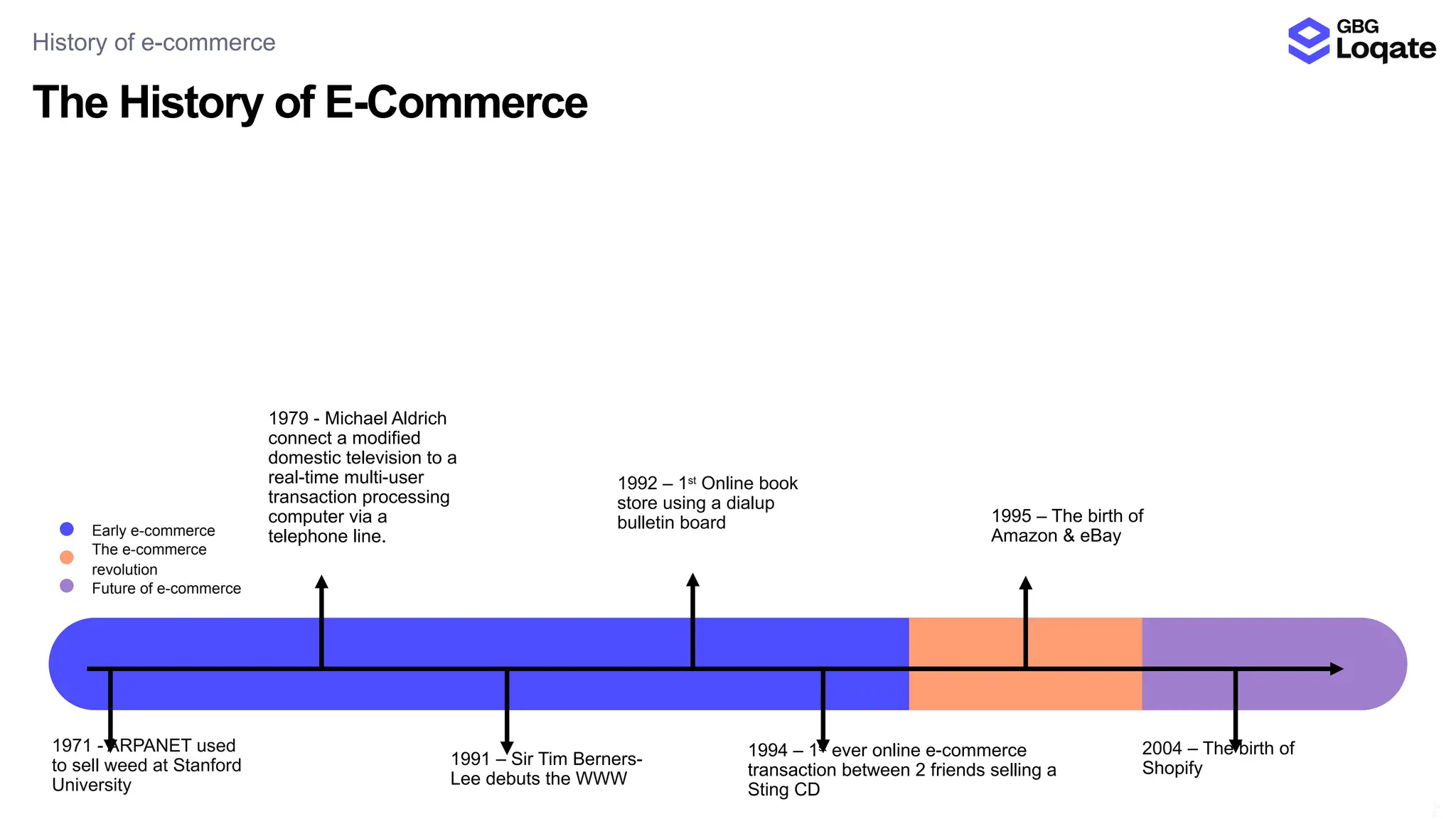
1971 - ARPANET used
to sell weed at Stanford
University
1979 - Michael Aldrich
connect a modified
domestic television to a
real-time multi-user
transaction processing
computer via a
telephone line.
1991 – Sir Tim Berners-
Lee debuts the WWW
1992 – 1st
Online book
store using a dialup
bulletin board
1994 – 1st
ever online e-commerce
transaction between 2 friends selling a
Sting CD
1995 – The birth of
Amazon & eBay
2004 – The birth of
Shopify
14
7
147
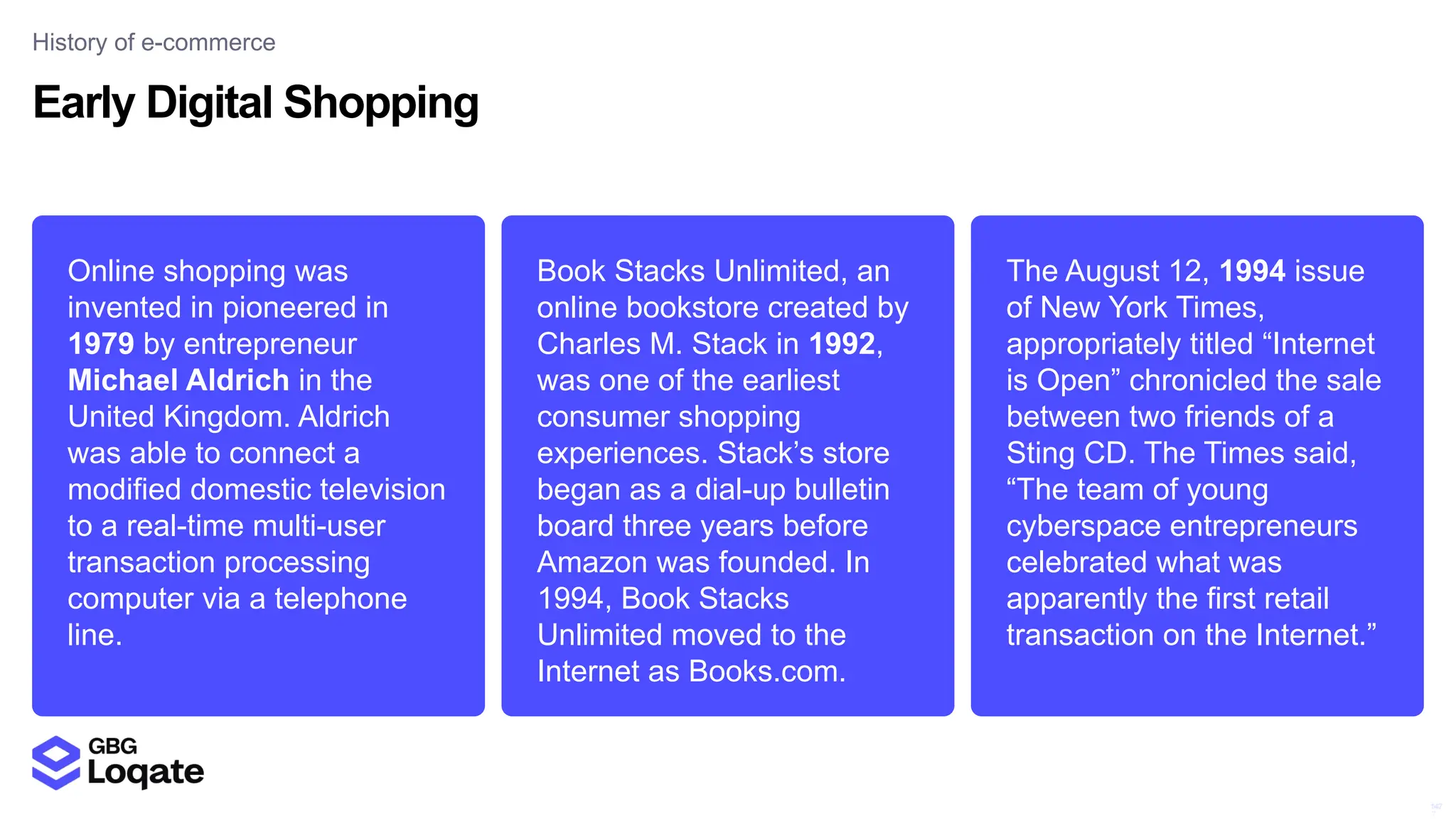
Online shopping was
invented in pioneered in
1979 by entrepreneur
Michael Aldrich in the
United Kingdom. Aldrich
was able to connect a
modified domestic television
to a real-time multi-user
transaction processing
computer via a telephone
line.
The August 12, 1994 issue
of New York Times,
appropriately titled “Internet
is Open” chronicled the sale
between two friends of a
Sting CD. The Times said,
“The team of young
cyberspace entrepreneurs
celebrated what was
apparently the first retail
transaction on the Internet.”
Book Stacks Unlimited, an
online bookstore created by
Charles M. Stack in 1992,
was one of the earliest
consumer shopping
experiences. Stack’s store
began as a dial-up bulletin
board three years before
Amazon was founded. In
1994, Book Stacks
Unlimited moved to the
Internet as Books.com.
Early Digital Shopping
History of e-commerce
14
8
148
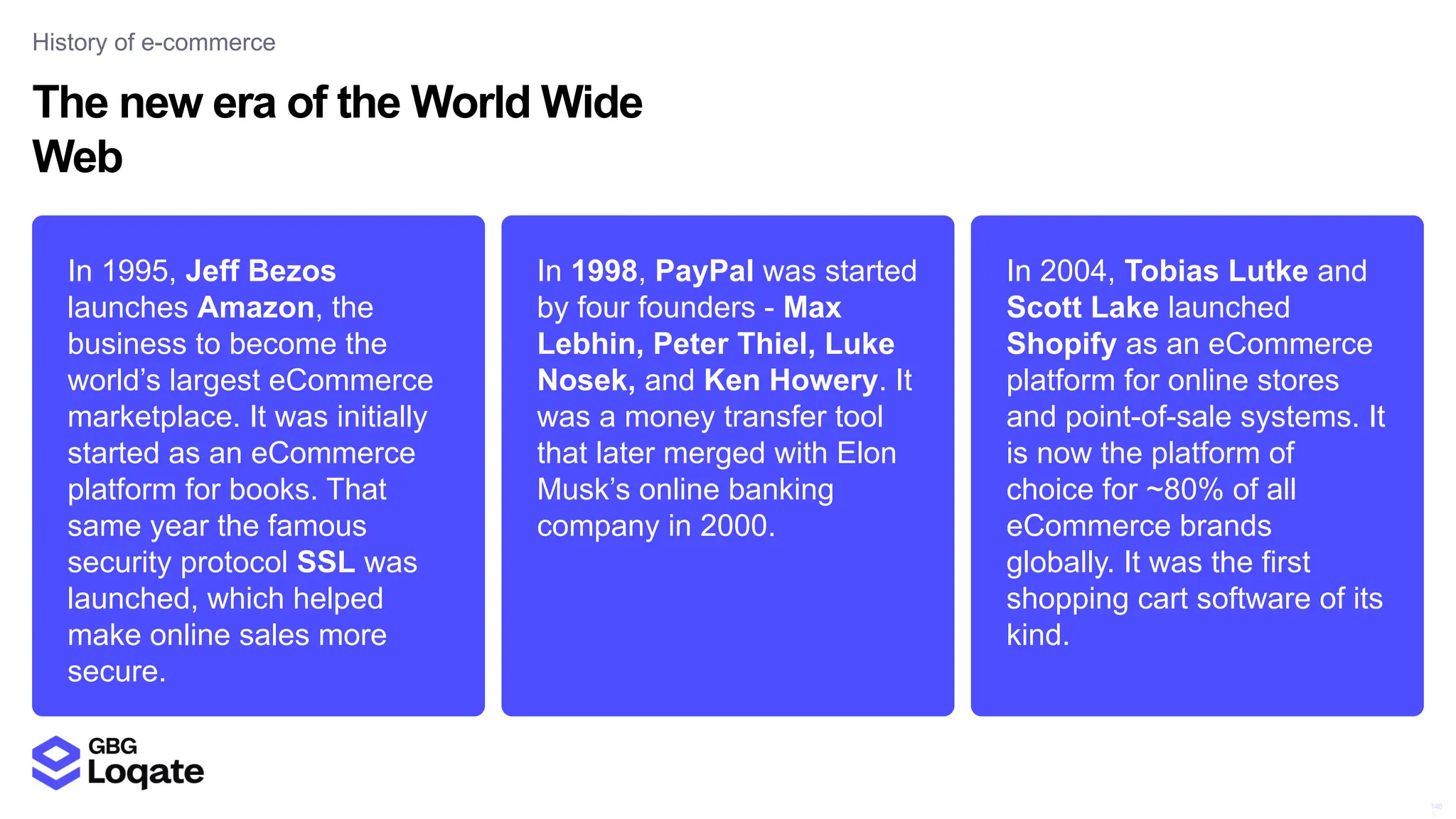
In 1995, Jeff Bezos
launches Amazon, the
business to become the
world’s largest eCommerce
marketplace. It was initially
started as an eCommerce
platform for books. That
same year the famous
security protocol SSL was
launched, which helped
make online sales more
secure.
In 2004, Tobias Lutke and
Scott Lake launched
Shopify as an eCommerce
platform for online stores
and point-of-sale systems. It
is now the platform of
choice for ~80% of all
eCommerce brands
globally. It was the first
shopping cart software of its
kind.
In 1998, PayPal was started
by four founders - Max
Lebhin, Peter Thiel, Luke
Nosek, and Ken Howery. It
was a money transfer tool
that later merged with Elon
Musk’s online banking
company in 2000.
The new era of the World Wide
Web
History of e-commerce
14
9
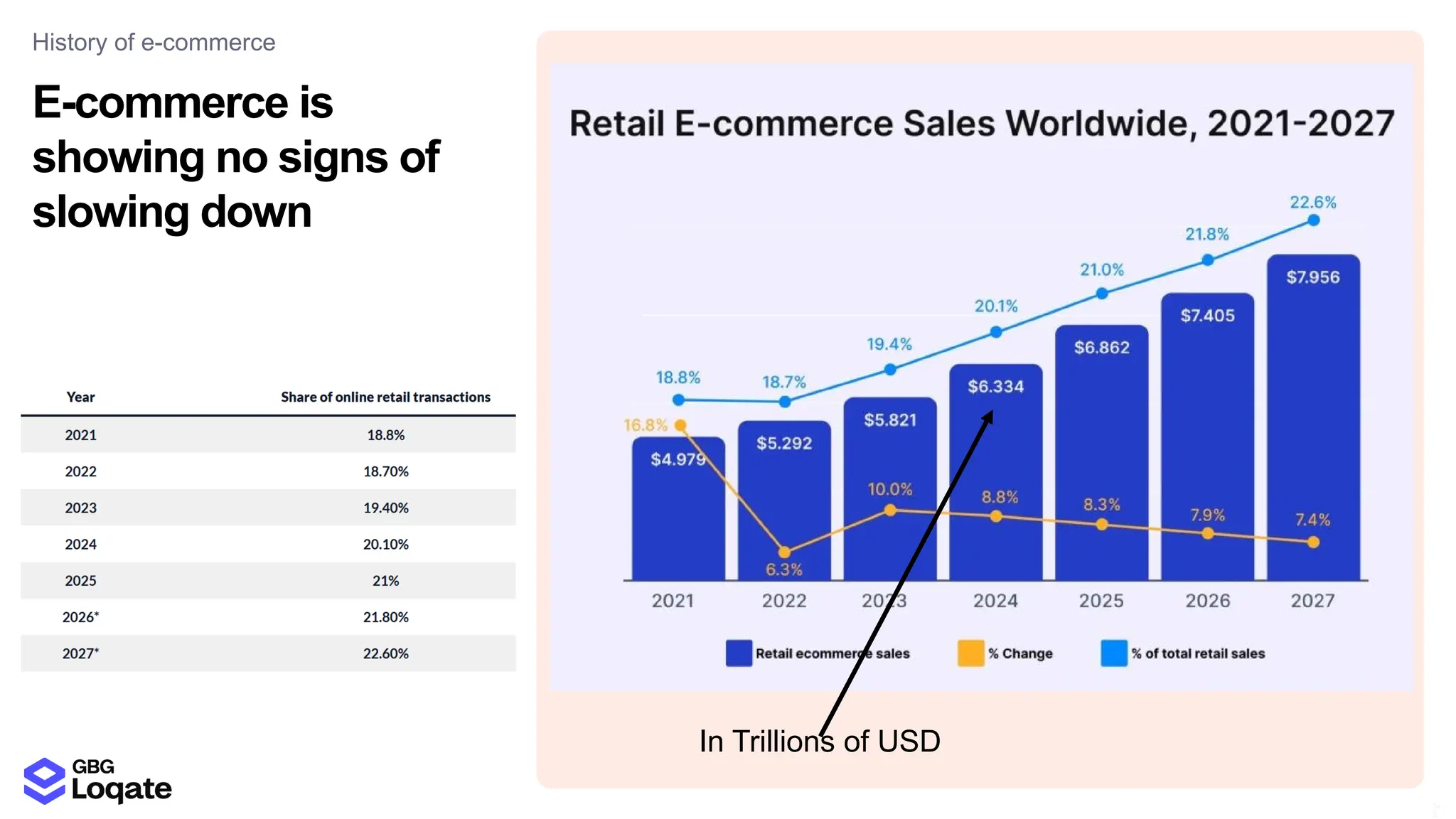
E-commerce is
showing no signs of
slowing down
History of e-commerce
In Trillions of USD
15
0
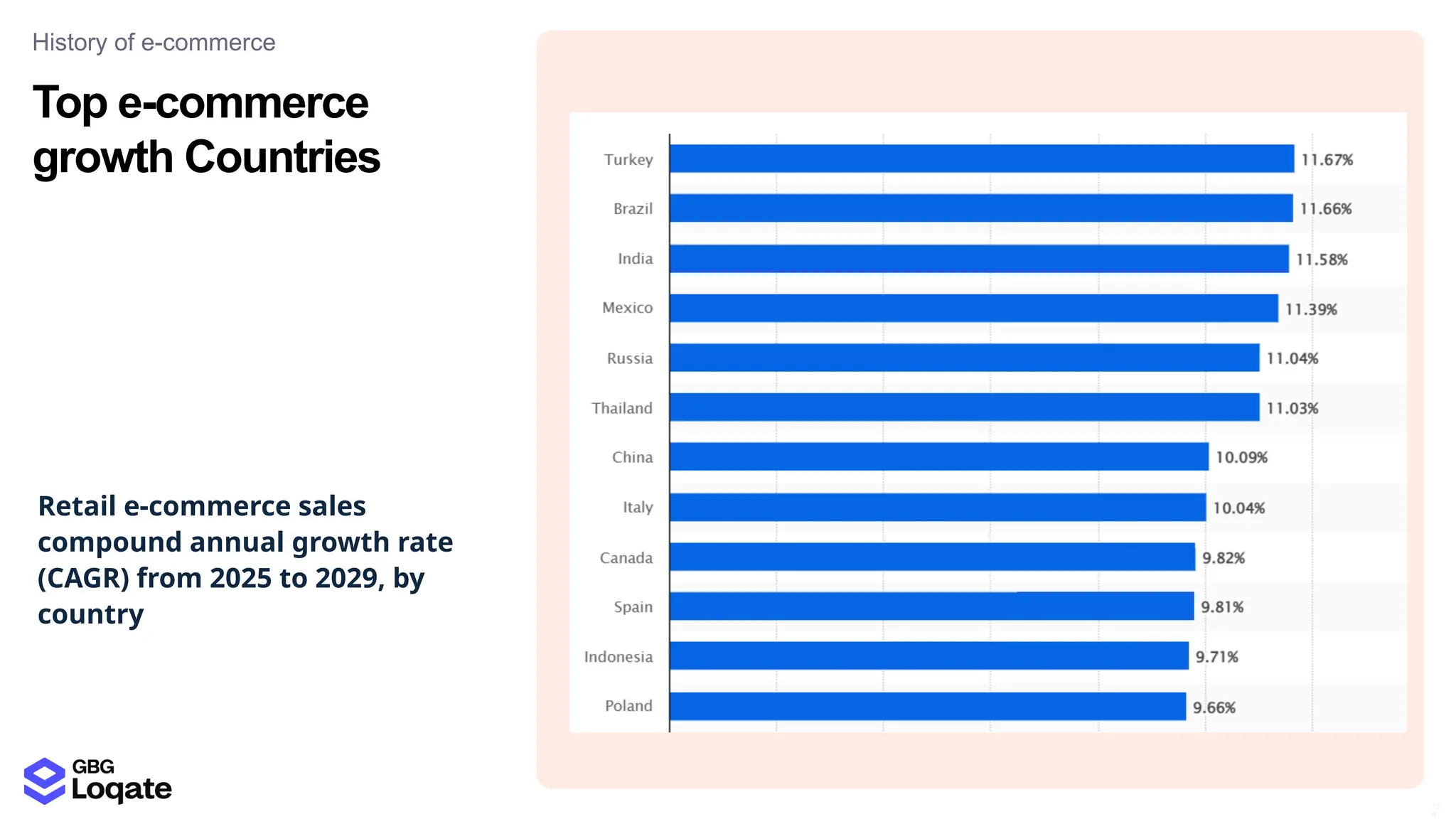
Top e-commerce
growth Countries
History of e-commerce
Retail e-commerce sales
compound annual growth rate
(CAGR) from 2025 to 2029, by
country
15
1
151
03 Evolution of UX
15
2
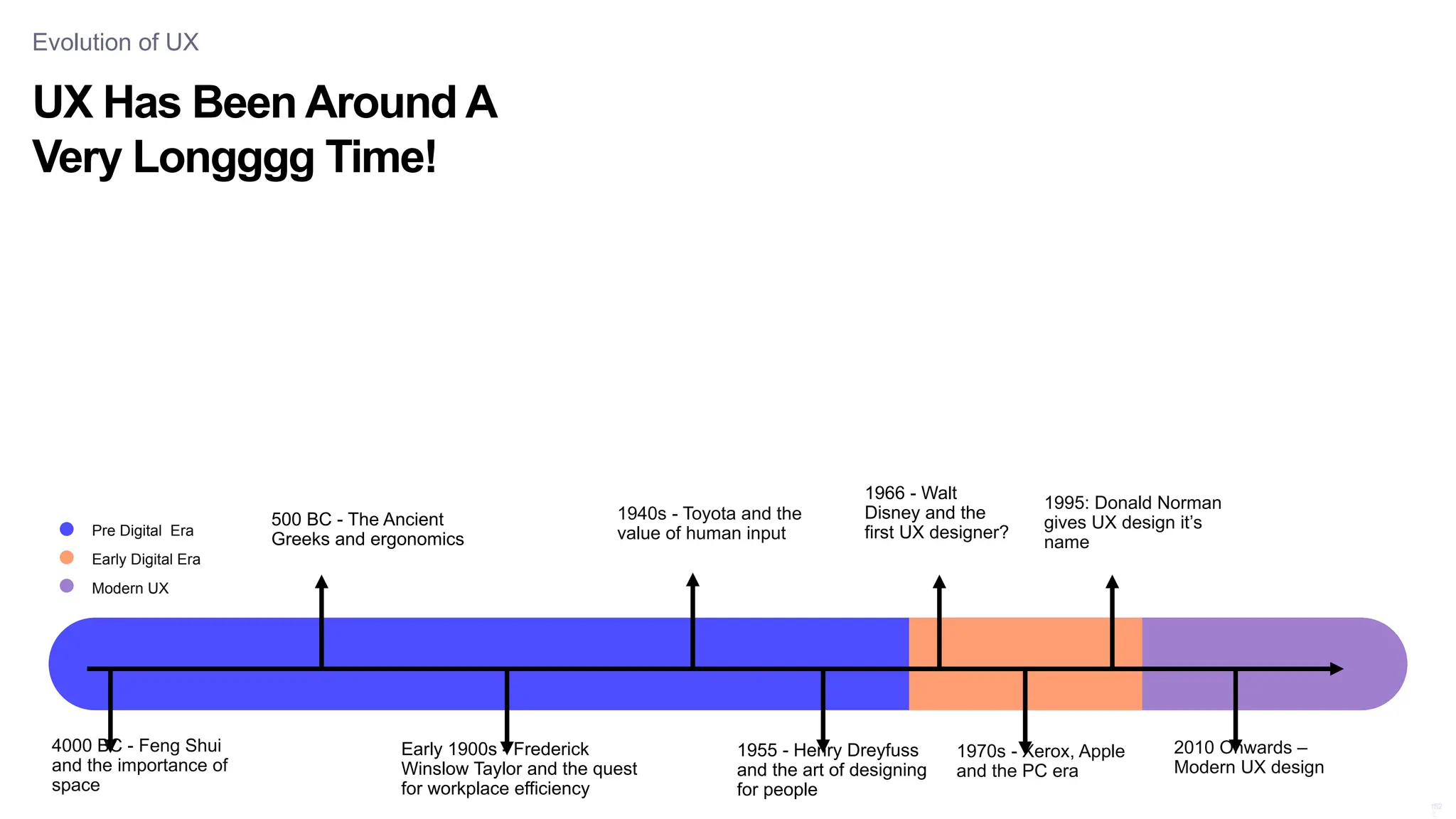
Pre Digital Era
Early Digital Era
Modern UX
UX Has Been Around A
Very Longggg Time!
Evolution of UX
152
4000 BC - Feng Shui
and the importance of
space
500 BC - The Ancient
Greeks and ergonomics
Early 1900s - Frederick
Winslow Taylor and the quest
for workplace efficiency
1940s - Toyota and the
value of human input
1955 - Henry Dreyfuss
and the art of designing
for people
1966 - Walt
Disney and the
first UX designer?
1970s - Xerox, Apple
and the PC era
1995: Donald Norman
gives UX design it’s
name
2010 Onwards –
Modern UX design
Importance of UX in e-commerce
UX in e-commerce
15
3
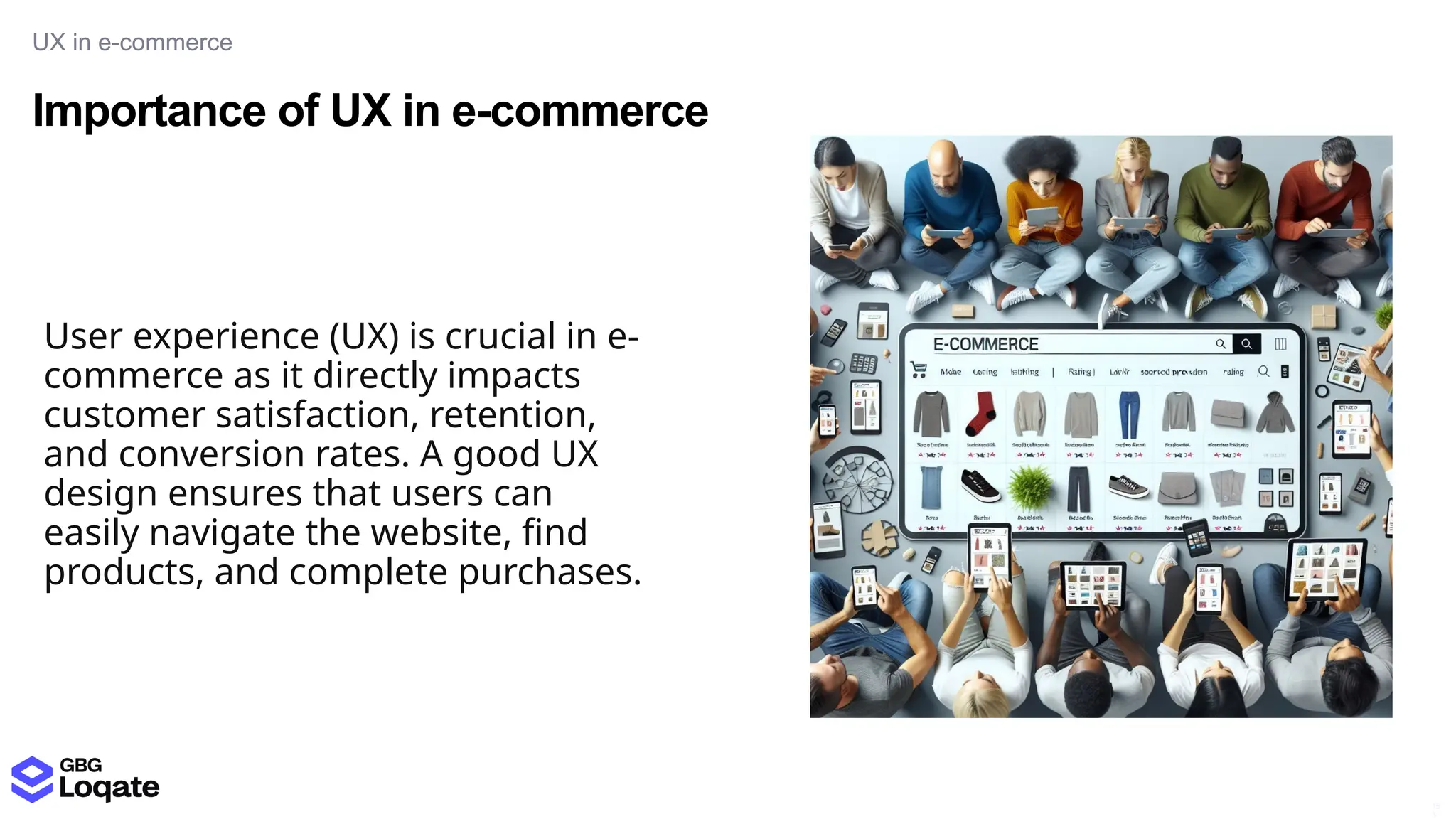
User experience (UX) is crucial in e-
commerce as it directly impacts
customer satisfaction, retention,
and conversion rates. A good UX
design ensures that users can
easily navigate the website, find
products, and complete purchases.
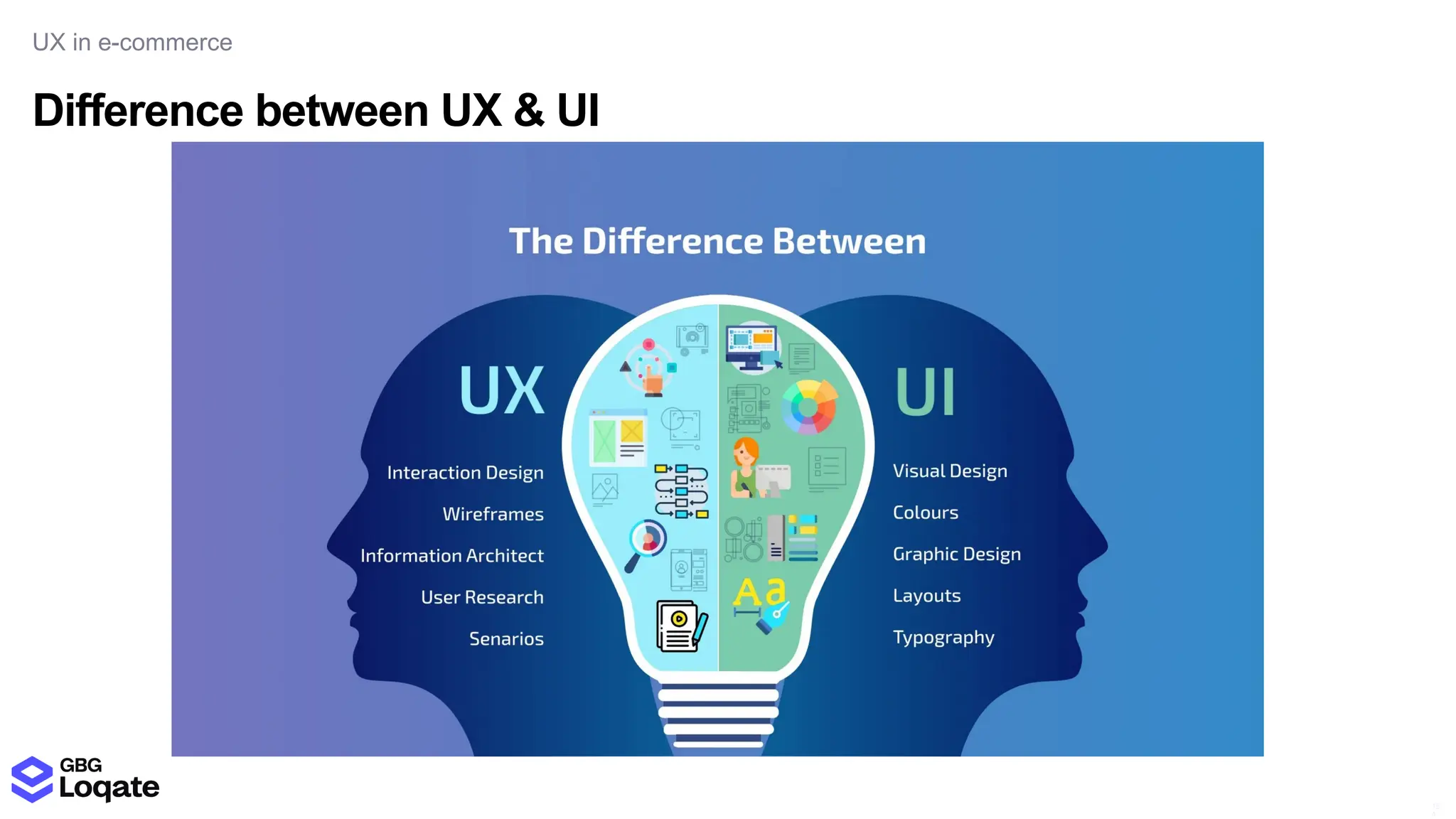
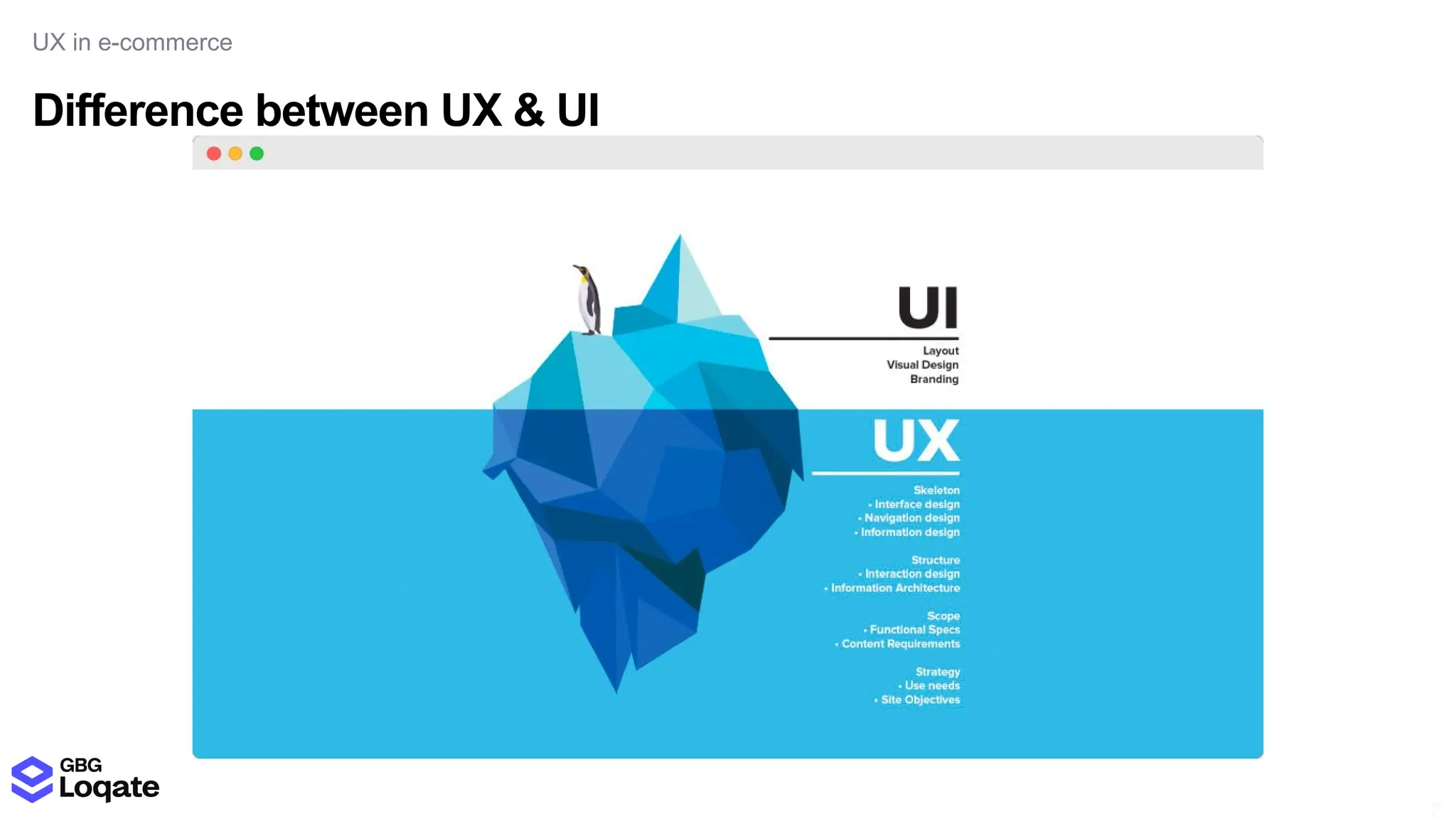
Difference between UX & UI
UX in e-commerce
15
4
Difference between UX & UI
UX in e-commerce
15
5
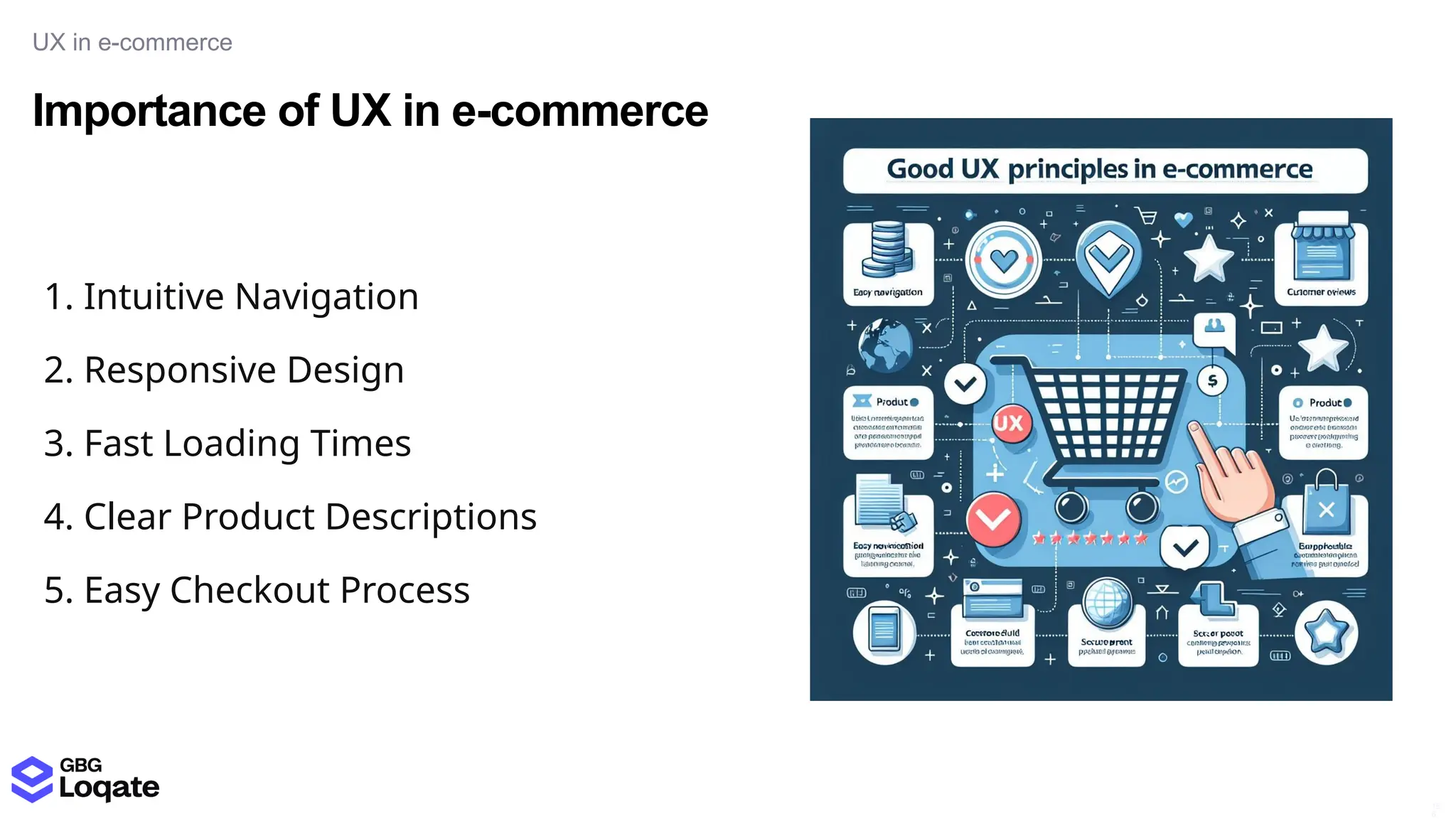
Importance of UX in e-commerce
UX in e-commerce
15
6
1. Intuitive Navigation
2. Responsive Design
3. Fast Loading Times
4. Clear Product Descriptions
5. Easy Checkout Process
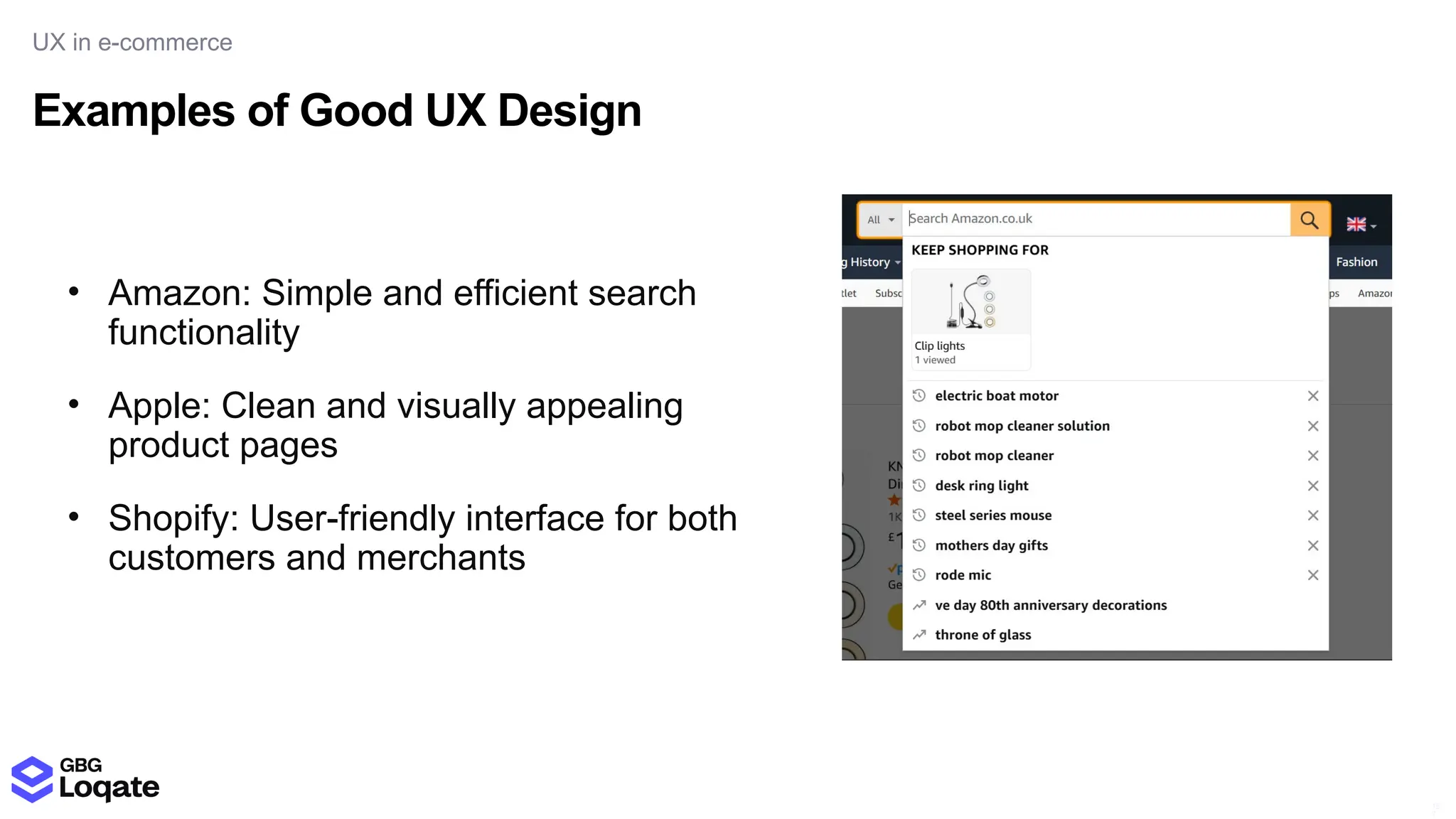
Examples of Good UX Design
UX in e-commerce
15
7
• Amazon: Simple and efficient search
functionality
• Apple: Clean and visually appealing
product pages
• Shopify: User-friendly interface for both
customers and merchants
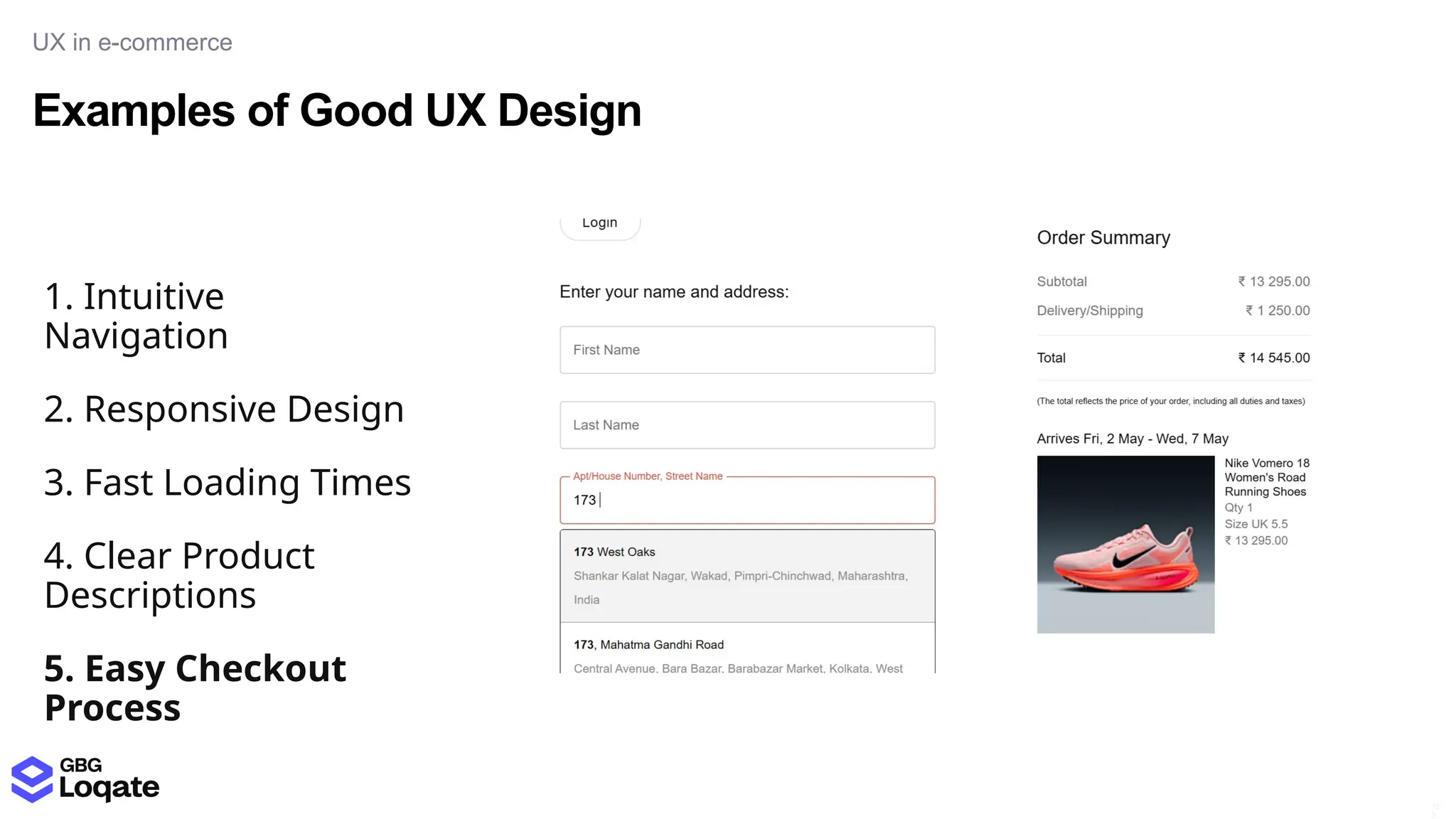
Examples of Good UX Design
UX in e-commerce
15
8
1. Intuitive
Navigation
2. Responsive Design
3. Fast Loading Times
4. Clear Product
Descriptions
5. Easy Checkout
Process
Examples of Bad UX Design
UX in e-commerce
15
9
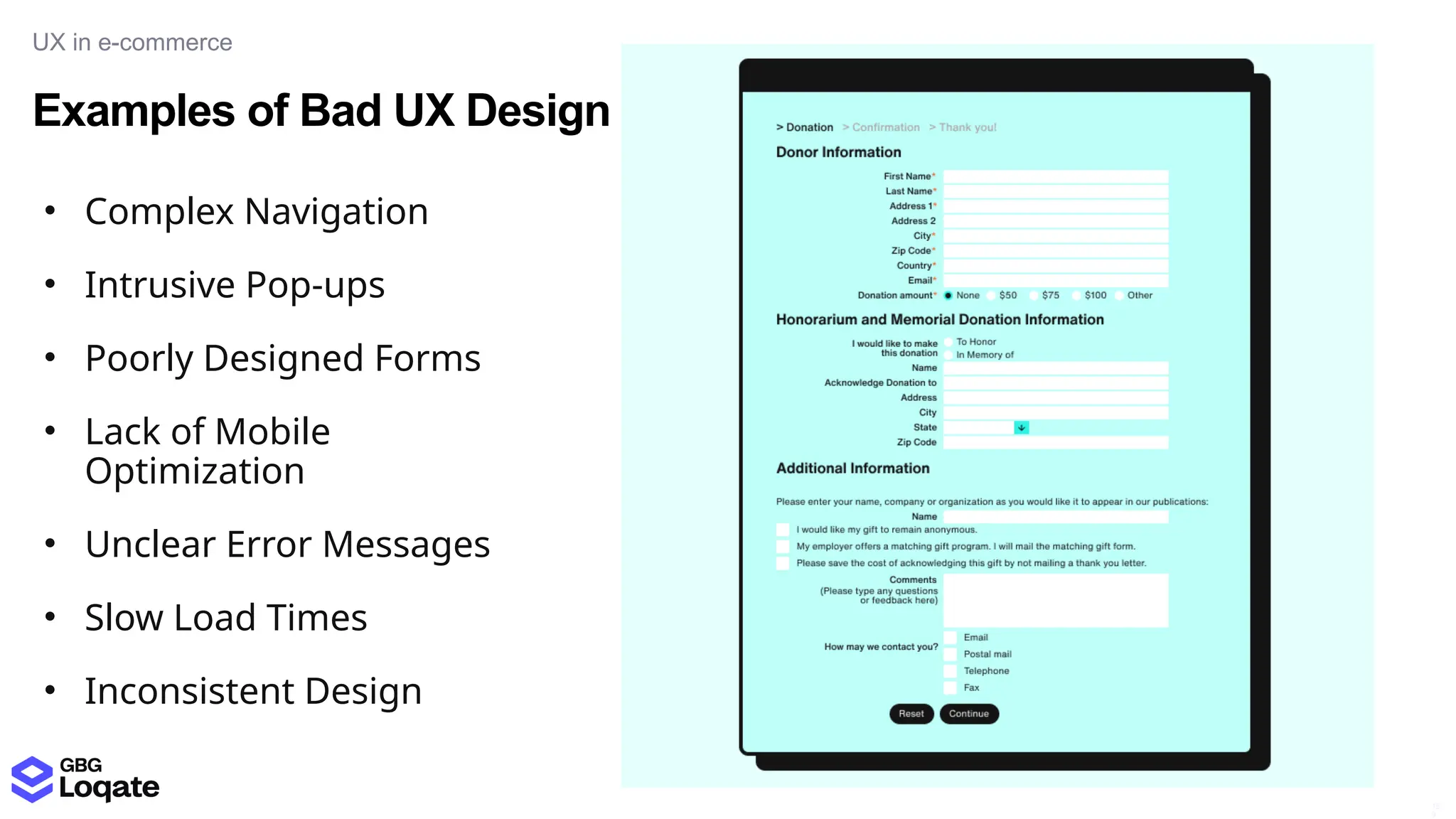
• Complex Navigation
• Intrusive Pop-ups
• Poorly Designed Forms
• Lack of Mobile
Optimization
• Unclear Error Messages
• Slow Load Times
• Inconsistent Design
What Good UX can Achive
UX in e-commerce
16
0
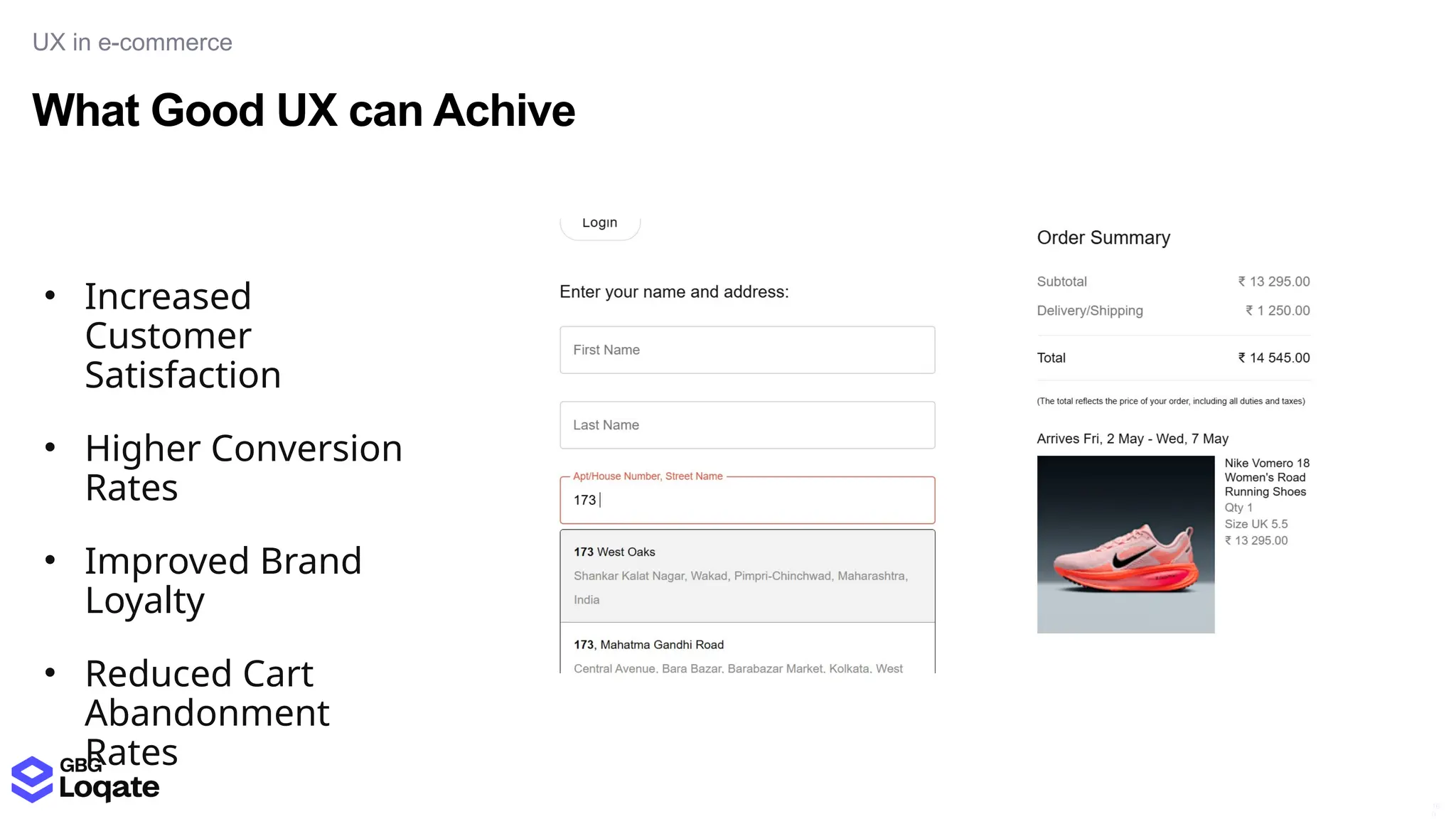
• Increased
Customer
Satisfaction
• Higher Conversion
Rates
• Improved Brand
Loyalty
• Reduced Cart
Abandonment
Rates
16
1
161
06 AI in e-commerce
How can AI help?
AI in e-commerce
16
2
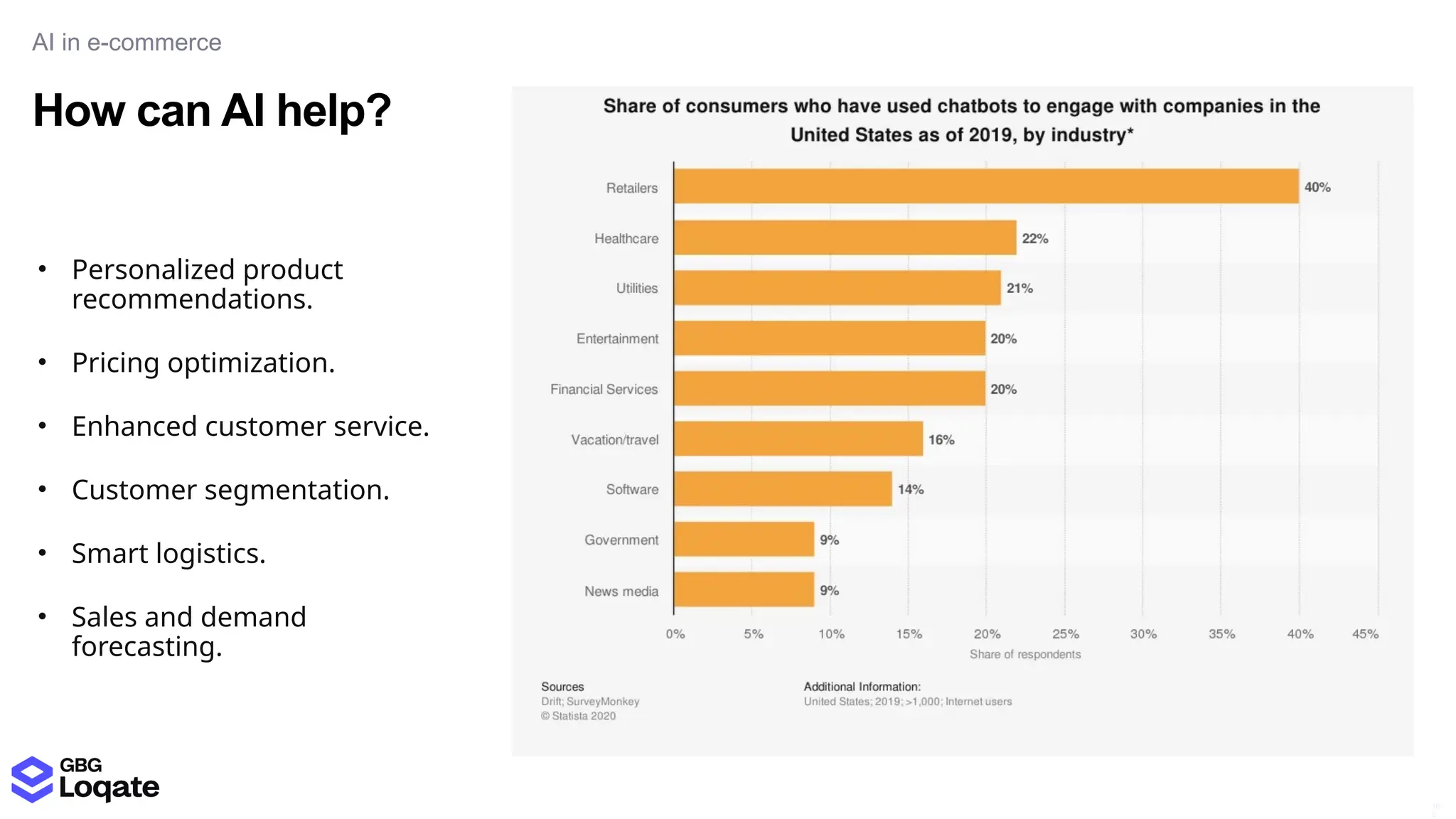
• Personalized product
recommendations.
• Pricing optimization.
• Enhanced customer service.
• Customer segmentation.
• Smart logistics.
• Sales and demand
forecasting.
Personalized Product Recommendations
AI in e-commerce
16
3
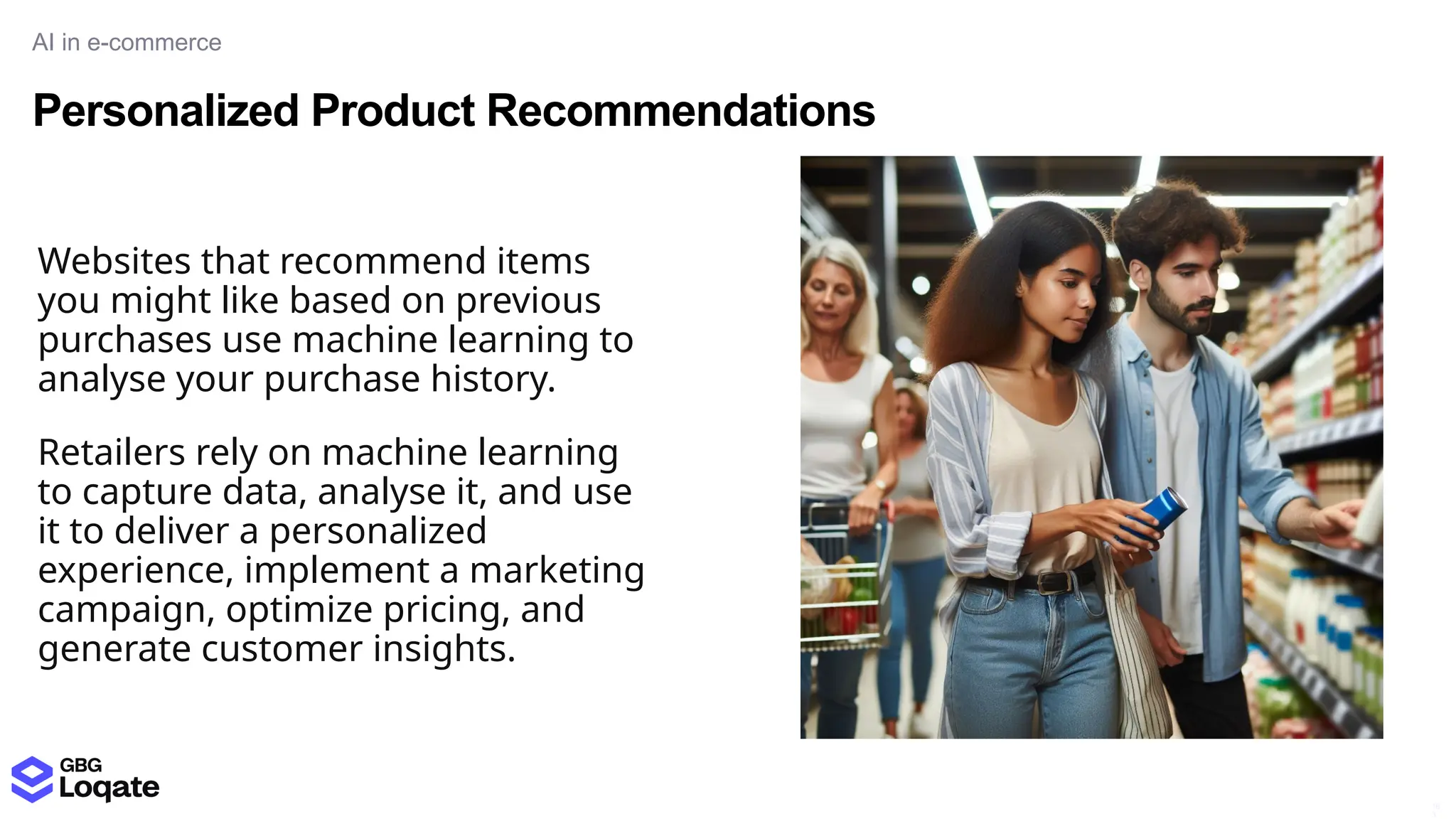
Websites that recommend items
you might like based on previous
purchases use machine learning to
analyse your purchase history.
Retailers rely on machine learning
to capture data, analyse it, and use
it to deliver a personalized
experience, implement a marketing
campaign, optimize pricing, and
generate customer insights.
Pricing Optimization
AI in e-commerce
16
4
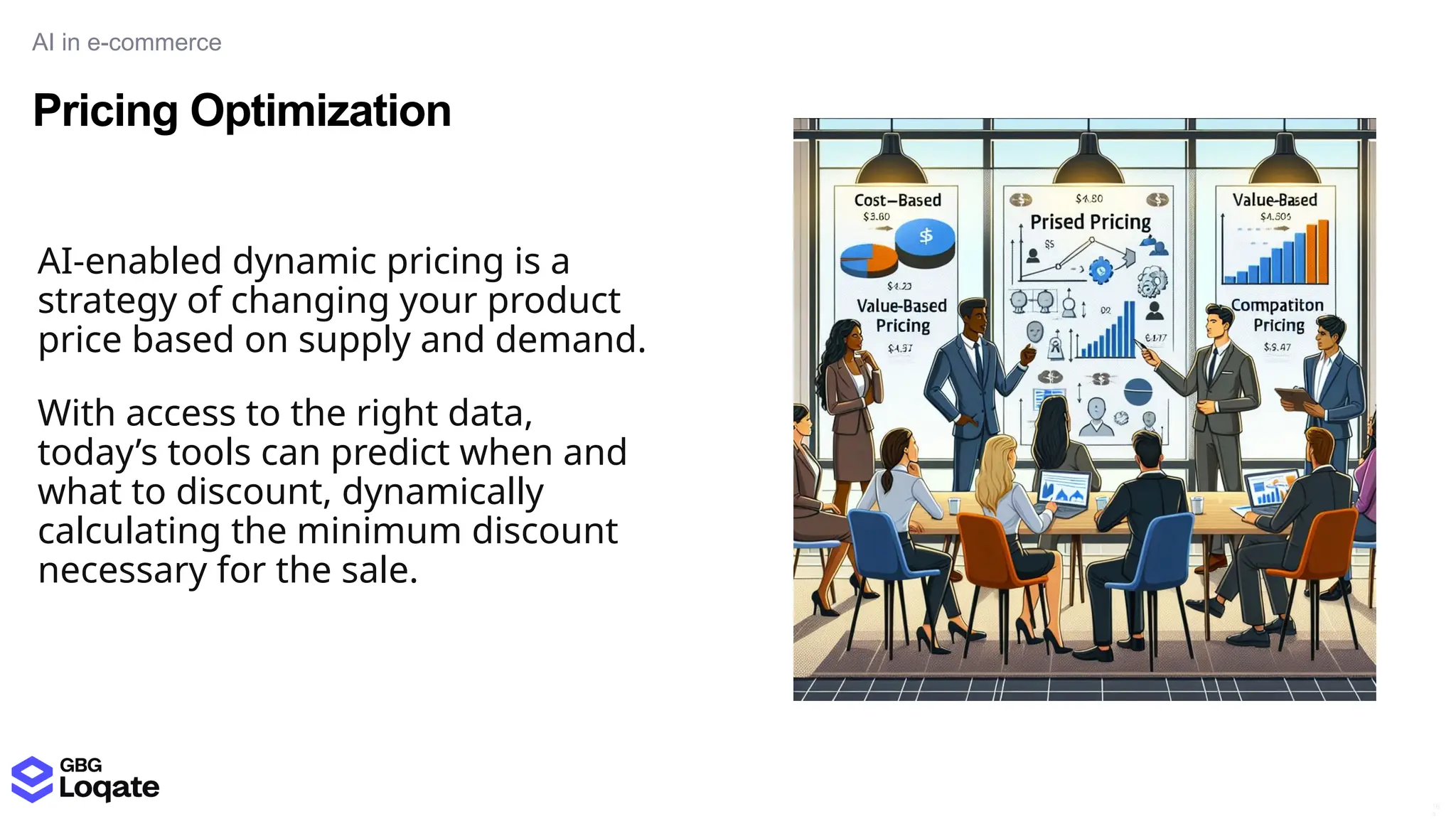
AI-enabled dynamic pricing is a
strategy of changing your product
price based on supply and demand.
With access to the right data,
today’s tools can predict when and
what to discount, dynamically
calculating the minimum discount
necessary for the sale.
Enhanced Customer Service
AI in e-commerce
16
5
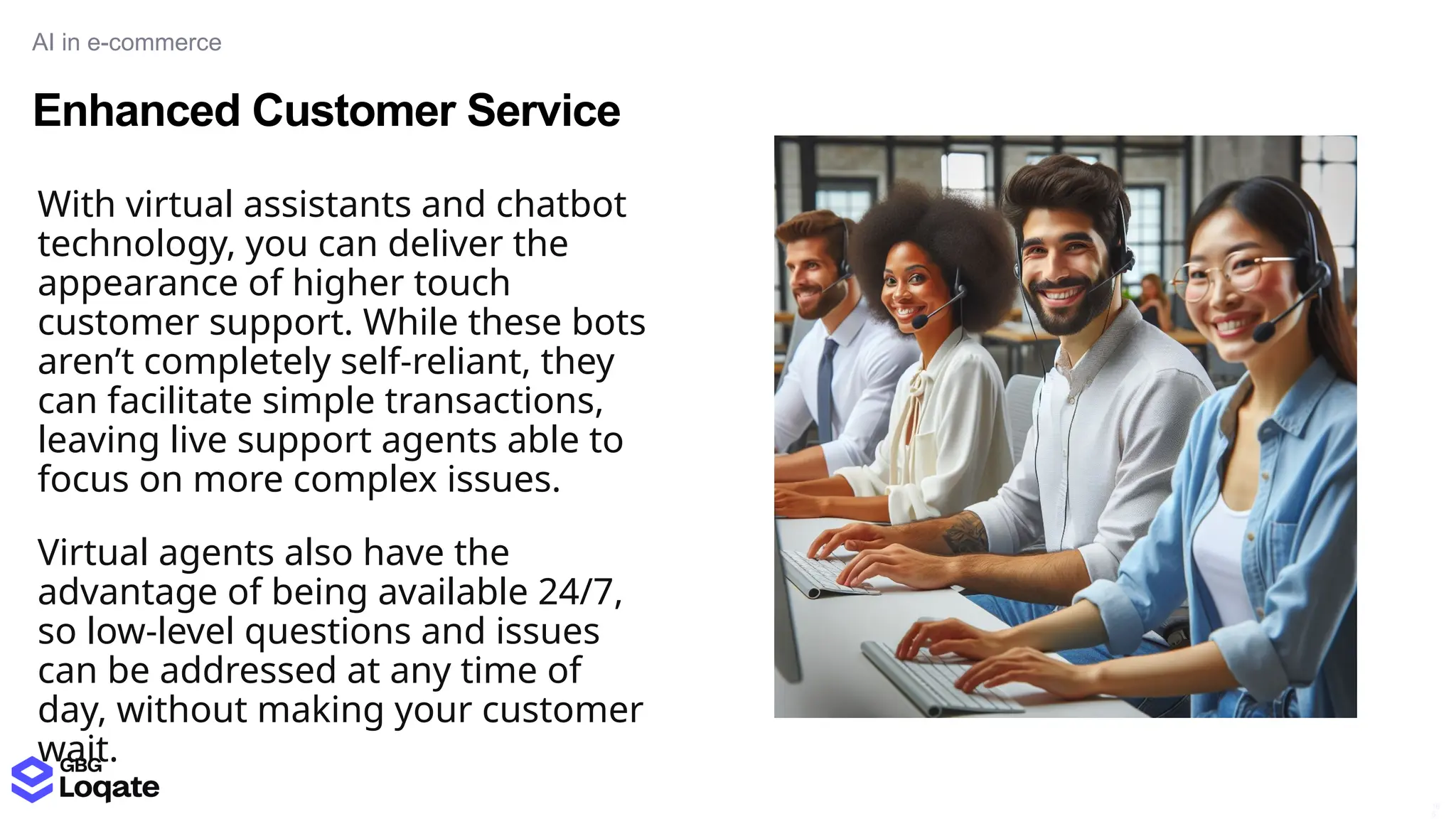
With virtual assistants and chatbot
technology, you can deliver the
appearance of higher touch
customer support. While these bots
aren’t completely self-reliant, they
can facilitate simple transactions,
leaving live support agents able to
focus on more complex issues.
Virtual agents also have the
advantage of being available 24/7,
so low-level questions and issues
can be addressed at any time of
day, without making your customer
wait.
Customer Segmentation
AI in e-commerce
16
6
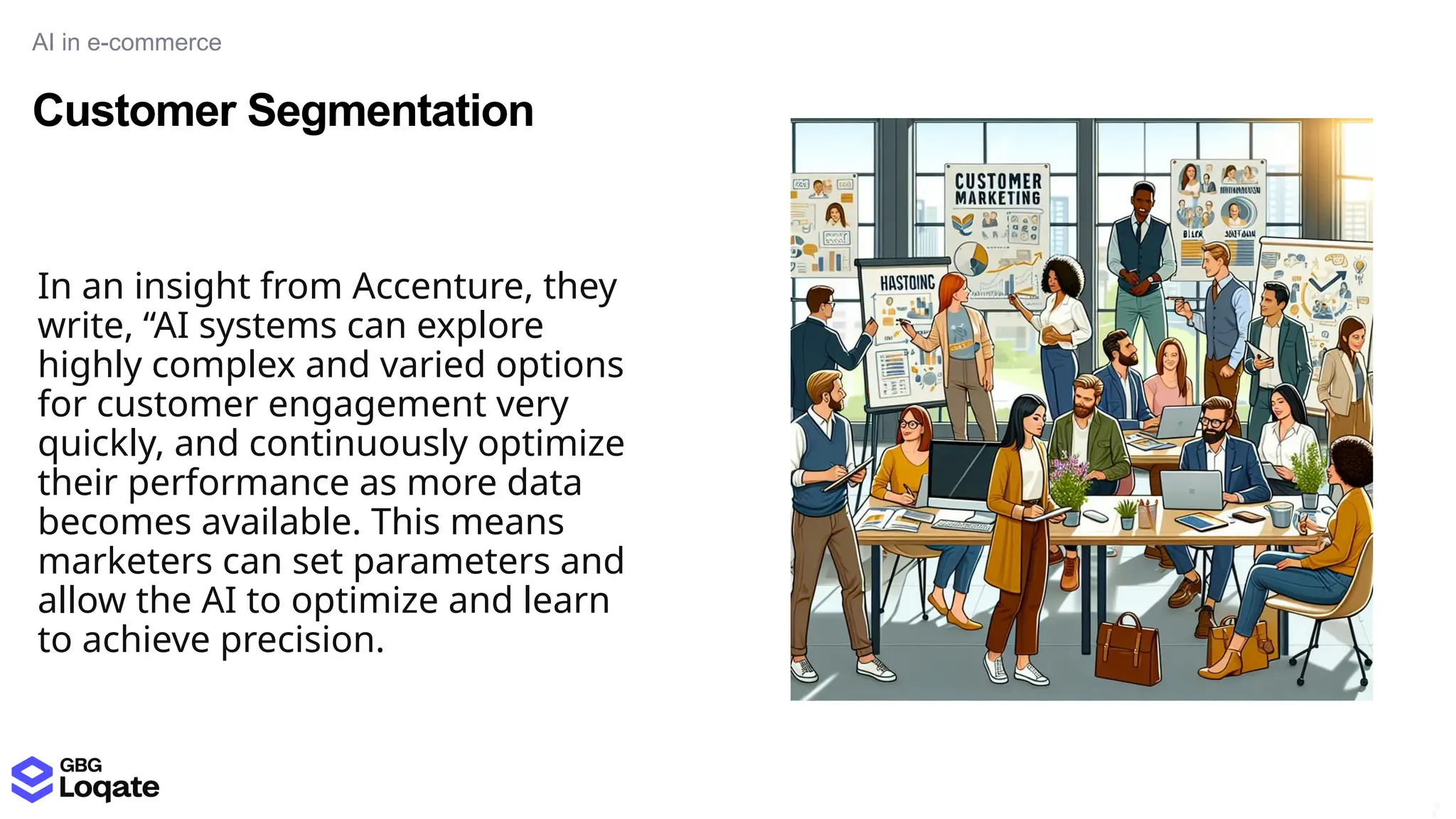
In an insight from Accenture, they
write, “AI systems can explore
highly complex and varied options
for customer engagement very
quickly, and continuously optimize
their performance as more data
becomes available. This means
marketers can set parameters and
allow the AI to optimize and learn
to achieve precision.
Smart Logistics
AI in e-commerce
16
7
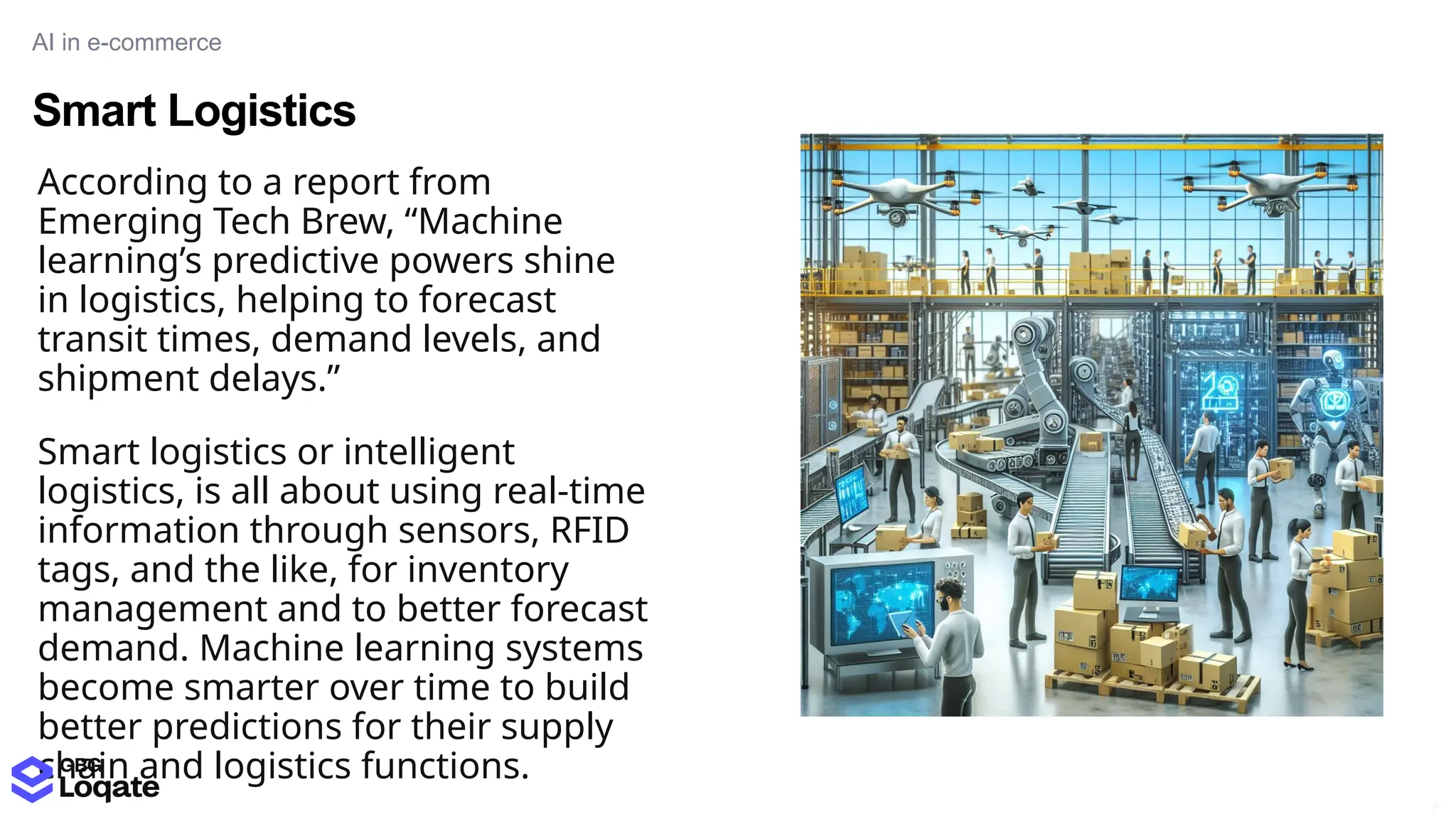
According to a report from
Emerging Tech Brew, “Machine
learning’s predictive powers shine
in logistics, helping to forecast
transit times, demand levels, and
shipment delays.”
Smart logistics or intelligent
logistics, is all about using real-time
information through sensors, RFID
tags, and the like, for inventory
management and to better forecast
demand. Machine learning systems
become smarter over time to build
better predictions for their supply
chain and logistics functions.
Sales and Demand Forecasting
AI in e-commerce
16
8
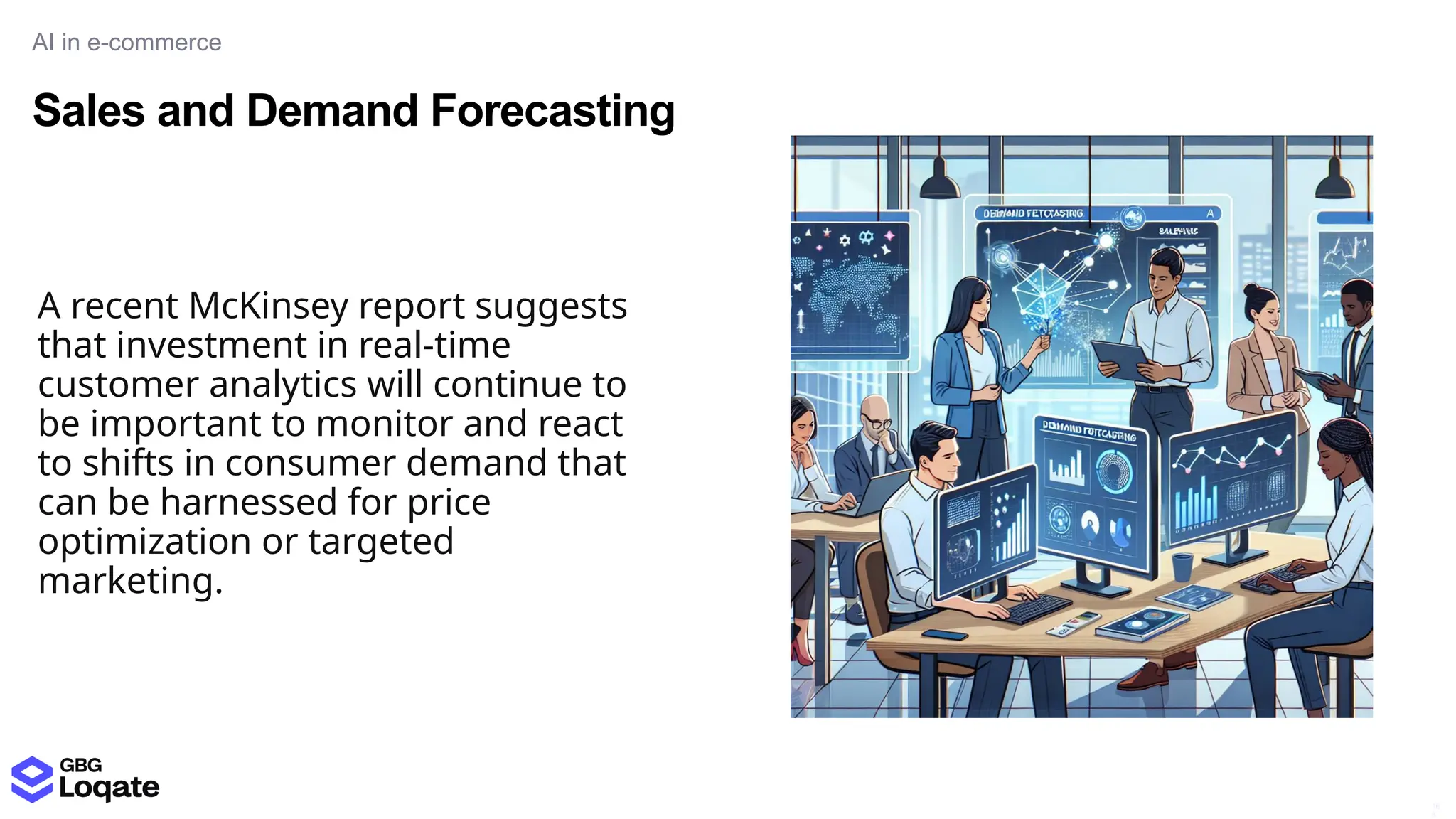
A recent McKinsey report suggests
that investment in real-time
customer analytics will continue to
be important to monitor and react
to shifts in consumer demand that
can be harnessed for price
optimization or targeted
marketing.
Don’t Let AI go Rogue!
AI in e-commerce
16
9
17
0
170
08 Open-source &
E-commerce
Introduction to Open-Source E-Commerce
Solutions
Open-source & E-commerce
17
1
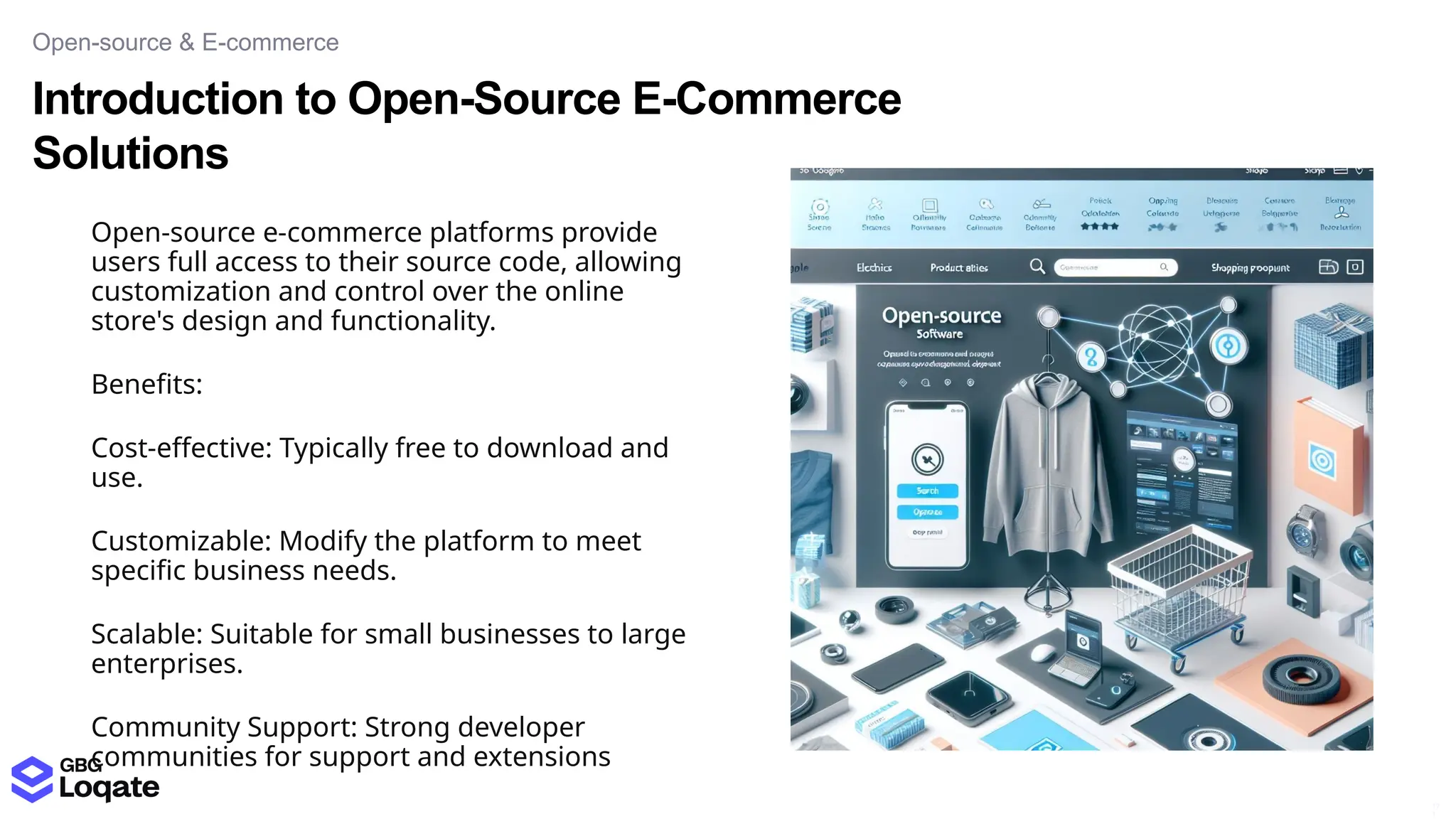
Open-source e-commerce platforms provide
users full access to their source code, allowing
customization and control over the online
store's design and functionality.
Benefits:
Cost-effective: Typically free to download and
use.
Customizable: Modify the platform to meet
specific business needs.
Scalable: Suitable for small businesses to large
enterprises.
Community Support: Strong developer
communities for support and extensions
Popular Open-Source E-Commerce Platforms
Open-source & E-commerce
17
2
WooCommerce:
Built for WordPress.
Powers over 37% of online stores.
Extensive plugin ecosystem.
Magento:
Highly customizable.
Suitable for large-scale businesses.
Popular Open-Source E-Commerce Platforms
Open-source & E-commerce
17
3
OpenCart:
User-friendly interface.
Supports multiple languages and currencies.
PrestaShop:
Feature-rich.
Strong community support.
Zen Cart:
Easy to set up.
Good for small to medium-sized businesses.
Java-Based E-Commerce Solutions
Open-source & E-commerce
17
4
Elastic Path:
Features:
API-first approach.
Utilizes Java and Spring Framework.
Offers robust security and modular architecture.
Advantages:
High performance and scalability.
Reliable and agile.
Shopizer:
Features:
Headless commerce.
REST API for e-commerce operations.
Advantages:
Easy integration with other systems.
Active community and regular updates.
Choosing the Right Platform
Open-source & E-commerce
17
5
Considerations:
Technical Expertise: Level of customization and development skills required.
Business Size: Scalability and feature set.
Community and Support: Availability of plugins, extensions, and developer
support.
Recommendations:
Small Businesses: WooCommerce, OpenCart.
Medium to Large Businesses: Magento, Elastic Path.
Tech-Savvy Teams: Shopizer.
17
6
176
09 Overview
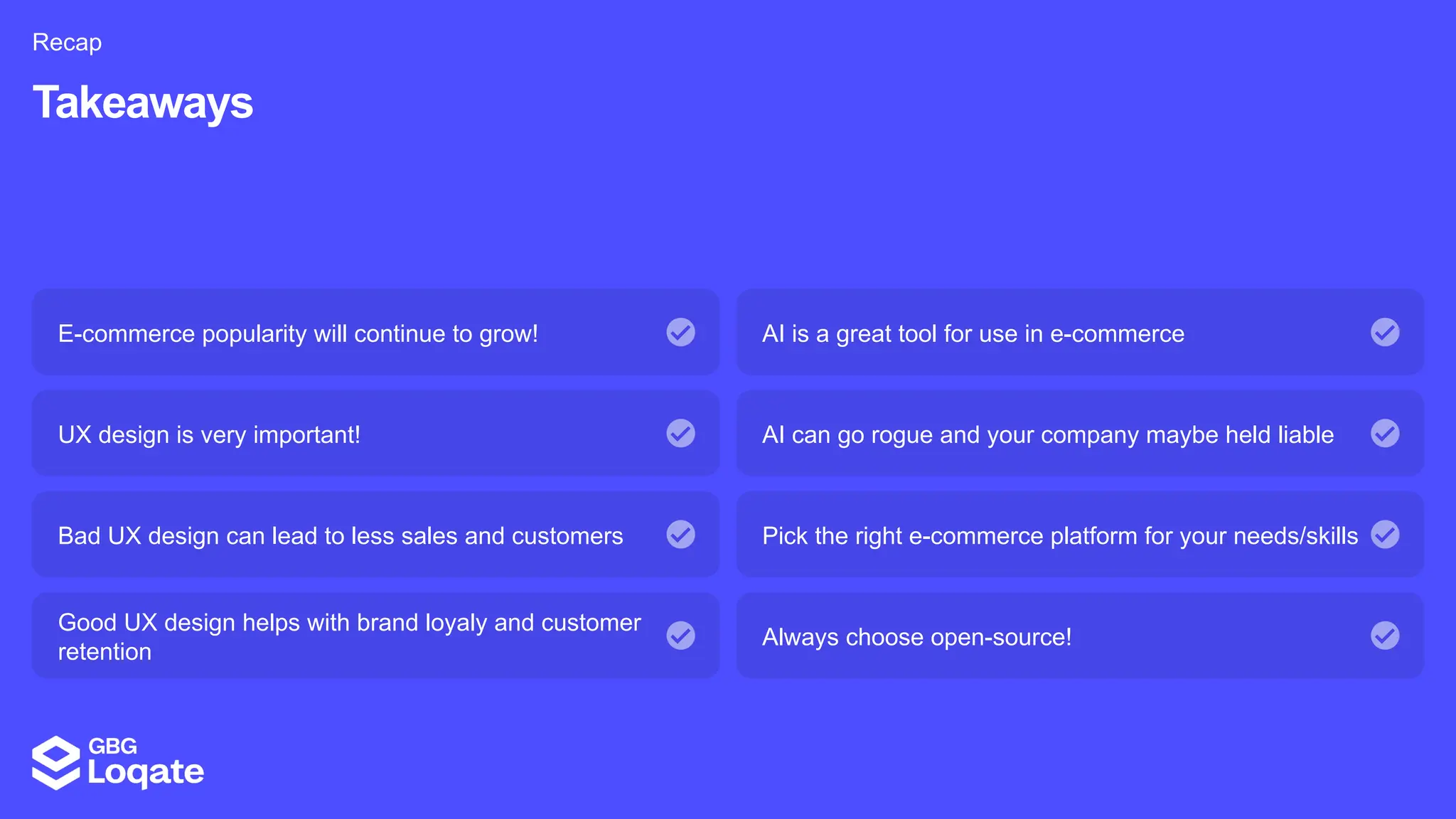
E-commerce popularity will continue to grow!
Takeaways
Recap
AI is a great tool for use in e-commerce
UX design is very important! AI can go rogue and your company maybe held liable
Bad UX design can lead to less sales and customers Pick the right e-commerce platform for your needs/skills
Good UX design helps with brand loyaly and customer
retention
Always choose open-source!
17
8
178
10 Questions
Links to information in this
presentation
Links
17
9
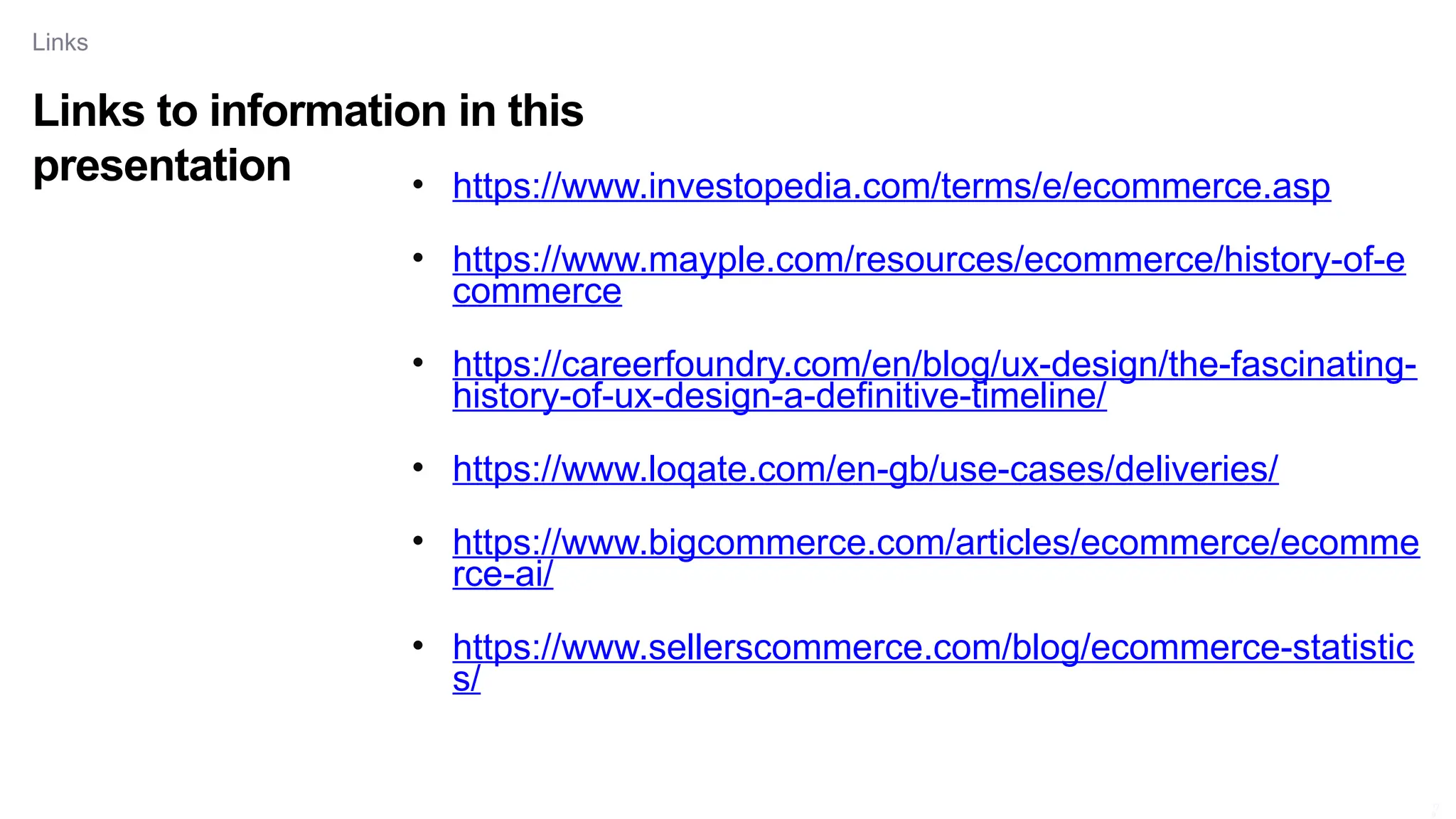
• https://www.investopedia.com/terms/e/ecommerce.asp
• https://www.mayple.com/resources/ecommerce/history-of-e
commerce
• https://careerfoundry.com/en/blog/ux-design/the-fascinating-
history-of-ux-design-a-definitive-timeline/
• https://www.loqate.com/en-gb/use-cases/deliveries/
• https://www.bigcommerce.com/articles/ecommerce/ecomme
rce-ai/
• https://www.sellerscommerce.com/blog/ecommerce-statistic
s/
18
0
180
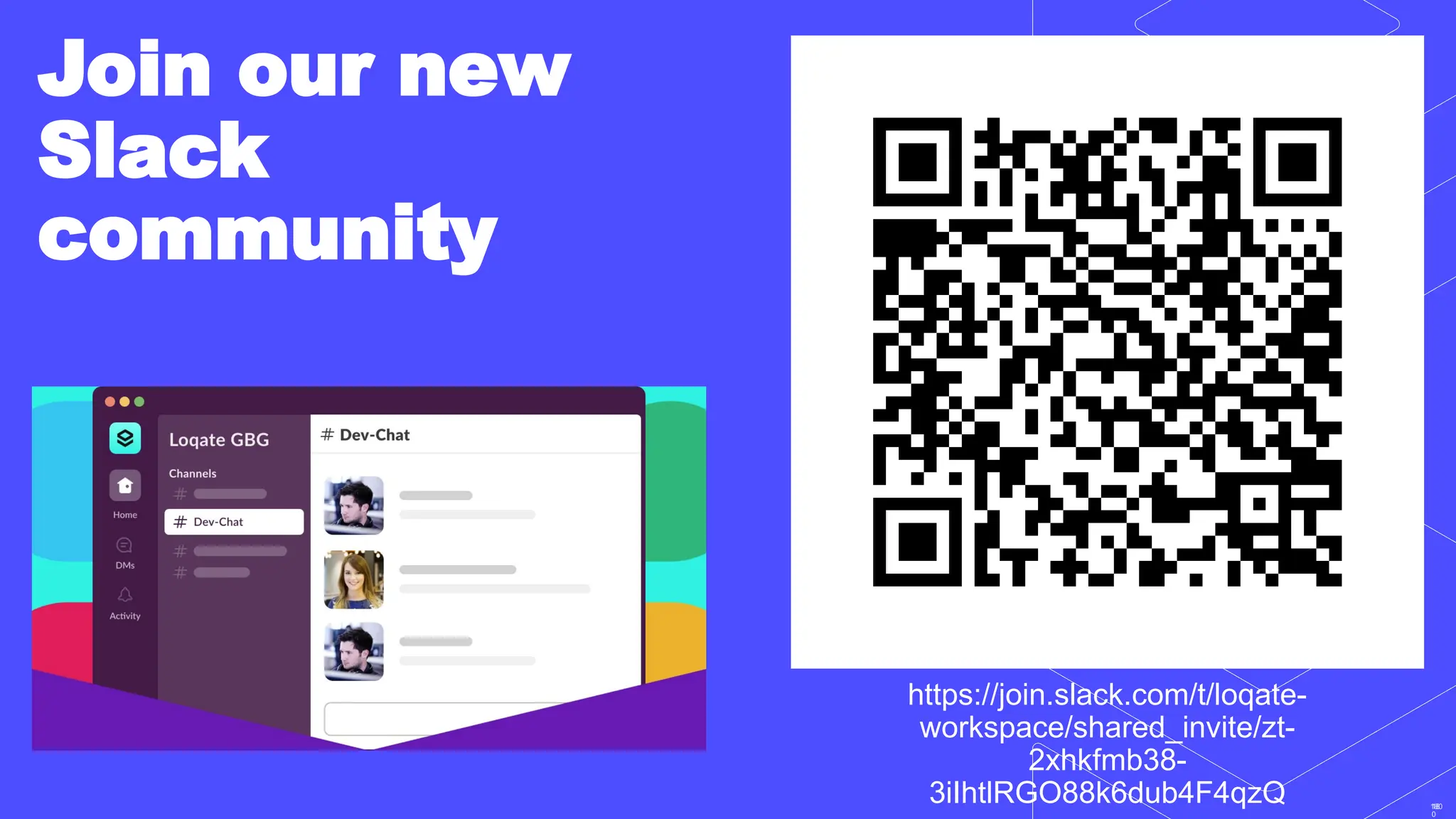
Join our new
Slack
community
https://join.slack.com/t/loqate-
workspace/shared_invite/zt-
2xhkfmb38-
3iIhtlRGO88k6dub4F4qzQ
18
1
Thank you Mainz
Twitter/X: @Jamie_Lee_C
LinkedIn: https://www.linkedin.com/in/jamie-coleman/
Get in Touch
It is great to be back!

From Code to Commerce, a Backend Java Developer's Galactic Journey into Ecommerce.pptx

  • 1.
    From Code to Commerce ABackend Java Developer’s Galactic Journey into E-Commerce
  • 2.
    2 Name: Jamie Lee Coleman CurrentRole: Senior Developer Advocate @ Loqate Past Experiences: Developer in Mainframe Software, Java Application Servers, JVM’s @ IBM Developer Advocate @ IBM & Sonatype Twitter/X: @Jamie_Lee_C LinkedIn: https://www.linkedin.com/in/jamie-coleman/ Introduction Who am I?
  • 3.
    3 01 02 03 04 05 06 07 08 09 10 11 My Journey intoE-commerce My Mainframe Days My WebSphere Days My Cloud/MicroProfile Days My Energy Efficiency Days My DevSecOps Days My AI Days E-commerce & UX E-commerce & AI E-commerce & Open Source Overview Todays Agenda Contents
  • 4.
    4 4 01 My journeyinto e-commerce
  • 5.
    5 Back-end Engineer DevOps Engineer Front-endEngineer Time I have Spent on Different Parts of the Software Stack My Journey Software Developer on Mainframes Container release Developer (WebSphere) MicroProfile & OpenJ9 Developer Relations Engineer for Java Developer Relations Engineer for DevSecOps Developer Relations Engineer for Front-end
  • 6.
  • 7.
  • 8.
  • 9.
  • 10.
  • 11.
    Liberty • Developer friendly •Just enough application server • Fast inner loop with dev mode • Support for industry standard dev tools • Jakarta EE, Java EE, MicroProfile APIs • Zero Migration • Cloud Ready • Container optimized • Designed for dev/ops • Small disk footprint • Efficient memory usage • Fast startup • High throughput • Self-Tuned Thread Pool
  • 12.
    <feature>servlet-4.0</feature> <feature>jsf-2.3</feature> Just Enough ApplicationServer You control which features are loaded into each server instance Kernel servlet-4.0 http-2.0 appmgr jsp-2.3 jsf-2.3 Java EE/Jakarta EE
  • 14.
    Quarkus Unified Configuration Zero config,live reload Streamlined code for the 80% common usages Native Execution Support for many libraries such as MicroProfile
  • 15.
  • 16.
  • 17.
  • 18.
    How the cloudhas changed the JVM $ $ $ $ $
  • 19.
    Cloud computing energy =money Money changes everything With a measurable and direct relationship between $£€¥₽ and CPU/RAM, disk etc the financial success or failure of a project is even easier to see And that means… Even more focus on value for money and as a result focus on energy.
  • 20.
  • 21.
    Time Lag Over-Peak usage Doesn’tfit new model Costs $ Costs more $ Memory Throughput @Jamie_Lee_C
  • 22.
    Time More like thisplease Memory Throughput @Jamie_Lee_C
  • 23.
    To save energy,cloud demands: • Small runtime memory footprint • Small deployment sizes • Fast starting applications • No resource usage when idle
  • 24.
    Demand One big serverrunning all the time? time What the Cloud offers
  • 25.
    Demand One big serverrunning all the time? time What the Cloud offers
  • 26.
    Demand time One big serverrunning all the time? What the Cloud offers
  • 27.
  • 28.
    Many metrics mustbe balanced for Java Performance •Wide variety of use cases means many metrics must be balanced •Different goals  different design decisions •No single “right” answer •Must keep a balance  make sensible trade-offs •Key performance metrics tracked •start-up time •ramp-up time •memory footprint •response time •CPU/Throughput Optimizing for cloud requires a different balance across these performance metrics start-up time footpr ramp-up response time CPU
  • 29.
  • 30.
    JAVA ME REQUIREMENTS Smallfootprint - On disk and runtime. - Very limited RAM, usually more ROM Fast startup - Everybody wants their games to start quickly Quick / immediate rampup - Game shouldn’t play better the longer you play Java ME
  • 31.
    JAVA ME REQUIREMENTSJVM IN THE CLOUD REQUIREMENTS Small footprint - On disk and runtime. - Very limited RAM, usually more ROM Small footprint - Improves density for providers - Improves cost for applications Fast startup - Everybody wants their games to start quickly Fast startup - Faster scaling for increased demand Quick / immediate rampup - Game shouldn’t play better the longer you play Quick / immediate rampup - GB/hr is key, if you run for less time you pay less money Java ME vs the JVM in the Cloud
  • 32.
  • 33.
    3 What is MicroProfile? ●Eclipse MicroProfile is an open-source community specification for Enterprise Java microservices ● A community of individuals, organizations, and vendors collaborating within an open source (Eclipse) project to bring microservices to the Enterprise Java community microprofile.io
  • 34.
  • 35.
    3 MicroProfile Community Video Hang outs Bi-Weekly& Quarterly General com munity Meetings MicroProfile Projects Google Gr oups YouTube C hannel
  • 36.
  • 37.
  • 38.
    38 MicroProfile 3.3 Stack JSON-B1.0 JSON-P 1.1 CDI 2.0 Config 1.4 Fault Tolerance 2.1 JWT Propagation 1.1 Health Check 2.2 Metrics 2.3 Open Tracing 1.3 Open API 1.1 JAX-RS 2.1 Rest Client 1.4
  • 39.
  • 40.
  • 41.
  • 42.
    42 42  July 2019 wasthe warmest month  EVER  worldwide
  • 43.
    43 43  Now July 2021is the warmest month  EVER  worldwide @Jamie_Lee_C
  • 44.
  • 45.
  • 46.
  • 47.
  • 48.
    No more doomand gloom please!
  • 49.
    49 Some Random FactsAbout Data Centers
  • 50.
  • 51.
    There are over7,500 major data centers worldwide, with over 2,600 in the top 20 global cities alone. With just over 300 locations, London England has the largest concentration of data centers in any given city across the globe. The Natural Resources Defense Council (NRDC) estimates that data centers consume up to 3% of all global electricity production.
  • 52.
    52 52 Putting Things Into Perspective Theinformation consumed by internet traffic every hour is enough to fill 7 million DVDs That is enough to Scale mount Everest 95 times PER HOUR!
  • 53.
    53 53 There is over 500,000data centers worldwide  The area of land they consume is around the same as 6,000 football pitches
  • 54.
  • 55.
    1/3 of alldata passes through the cloud! Currently we produce 1.2 trillion GB’s of data per year Over the next decade, datacenters could use 1/5 of the whole world's energy supply! That is a lot of Energy!
  • 56.
  • 57.
  • 58.
    58 58  Bitcoin == carbonfootprint of Denmark
  • 59.
    59 59  1 bitcoin transaction== 761,118 VISA transactions
  • 60.
    60 60  1 bitcoin transaction== 50,741 hours of watching Youtube
  • 61.
  • 62.
    62 62  In 2017 USdata centres used  90 billion kWh
  • 63.
    63 63  45,000,000,000 x 1smart phone x 1 year
  • 64.
    64 64  UK energy consumptionx 1.5 == global data centre energy consumption.
  • 65.
  • 66.
    66 66 What are DataCenter/Cloud owners doing to reduce their carbon footprint?
  • 67.
    67 67 Amazon How AWS startedthe Cloud revolution https://aws.amazon.com/about-aws/sustainability/
  • 68.
  • 69.
    69 69 Google Google reached 100%renewable energy for both datacenter and office operations in August of 2017.
  • 70.
  • 71.
  • 72.
    72 72 Past, Current andFuture tech to the rescue?
  • 73.
  • 74.
  • 75.
    75 75 IBM zSeries  50%  Power consumptionof x86  (30% more performance)
  • 76.
    76 76 What Can YouDo As a Software Developer?
  • 77.
  • 78.
  • 79.
    79 time One big serverrunning all the time? Demand
  • 80.
    80 Demand time One big serverrunning all the time?
  • 81.
  • 82.
    82 82 Real World Example 175MVisits/Month 50M Unique Visitors/Month 2.5 Billion Interactions/Year 88% Interactions are Digital 48% Digital Sales on Mobile Devices
  • 83.
    83 83 Real World Example  •Conversion rate UP by 1.6x (from 1.9% to 3.1%)  • Page response time improved from 7-10 seconds to 2-3 seconds  • Runs using 1/8th of Infrastructure  • Deployment time improved from 4-8 hours to 30 minutes  • Developers are 20-40% more productive  • Order completion improved from 41 minutes to 27 minutes
  • 84.
  • 85.
  • 86.
  • 87.
    87 87 Use StringBuilder toconcatenate Strings programmatically rather than StringBuffer
  • 88.
    88 88 Use primitives wherepossible Use an int instead of an Integer and a double instead of a Double. Your JVM can store the value in the stack instead of the heap to reduce memory consumption and handle it more efficiently.
  • 89.
    89 89 Try to avoidBigInteger and BigDecimal BigInteger and BigDecimal require much more memory than a simple long or double and slow down all calculations dramatically.
  • 90.
    90 90 I created a Kubernetes Cluster Iforgot about it for a week That cost $500 
  • 91.
  • 92.
  • 93.
  • 94.
    94 How the DeathStar was constructed The Death star is made up of many components Different components come from different planets/colonies Each of those planets/colonies are spread across the galaxy The components are then transported across the galaxy They are then put together to build the Death Star at the location of the emperors choosing Once the build is complete it is tested to make sure everything is working as expected (destroy the planet Alderan) When the emperor is happy, it is moved into production (Destroy more planets like Endor and the rebels)
  • 95.
    95 How our applicationsare constructed Our applications are made up of many different dependencies Different open source dependencies come from different people/orgs Each of those dependencies are created across the world The dependencies are then transported across the internet to your dev environment They are then put together via Maven or Gradle etc to build your application at a location of your choosing (usually locally on your dev machine)
  • 96.
    96 How our applicationsare constructed Once the build is complete, it is tested to make sure your application is functioning as expected When you team lead/release manager is happy, it is then deployed into production
  • 97.
    See any similaritieswith the Death Star? Open Source committers = planets/colonies under the Empire developing components of the Death Star Dependencies = components of the Death Star Application testing = Firing of the weapon for the first time Evil Emperor = Team Lead/Release Manager
  • 98.
    But what ismissing? Have a think while we see why open source is great
  • 99.
    Brief History ofOpen Source A-2 system in 1953 - First commercial example of Open Source DECUS formed 1955 – Facilitate sharing of software (SHARE OS by General Motors) Advance Research Projects Agency Network (ARPANET) – Used to share code and later succeeded by the Internet Launch of the GNU project 1983 – To write an OS free from constraints on source code Linux 1991 – The first freely modifiable kernel was born Debian GNU/Linux 1993 – First OS was born OpenJDK 2006 – Java commits to Open Source and releases OpenJDK under the GNU licence Git 2005 – Created by Linux kernel developers GitHub 2008 – Worlds most used DVCS hosting site Android 2008 – Worlds most used mobile OS (Now owned by Google)
  • 100.
    Sharing = better! 90%of the applications we create are shared dependencies!
  • 101.
    Dependency Managment 150 Dependencies(avg Java project) 10 Releases Per Year (avg per dependency) 1500 Updates To Consider 😱 x
  • 102.
    Direct vs TransitiveDependency Example: org.springframework.boot:spring-boot-starter-web
  • 103.
    Dependency Exploitation Dependency confusion Attempts toget a Different version added into a binary repository Often “latest” Typo- squatting A lookalike domain, dependency with one or two wrong or different characters Open source repo attacks Attempts to get malware or weaknesses added into dependency source via social or tools Build Tool attacks Attempts to get malware into the tools that are used to produce dependencies Automated Social Engineering
  • 104.
  • 105.
    Problems facing theDeath Star • Many components are built in remote locations • Keeping track of how they are built, and the quality is difficult for the Empire • The Death Star is very complex and vulnerability testing is an afterthought as the empire is overconfident that they have no vulnerabilites • When the rebels started to attack, this is when the empire realised, they had a major vulnerability • By this point it was too late and the rebels took full advantage to destroy all the hard work the empire had done to create such a magnificent piece of engineering
  • 106.
  • 107.
    Cyber Crime Facts In2016 Cybercrime surpassed the drug trade! $450 Billion a year $14,000 a second Equivalent to 50 US Nimitz Class Aircraft carriers
  • 108.
  • 109.
    Cyber Crime Facts In2022! $6 Trillion a year! $200,000 a second Equivalent to 620 US Nimitz Class Aircraft carriers!
  • 110.
    If Cybercrime wasa country by GDP in 2022 United States: $20.89 trillion China: $14.72 trillion Cyber Crime: $6 trillion Japan: $5.06 trillion Germany: $3.85 trillion India: $2.65 trillion United Kingdom: $2.63 trillion France: $2.58 trillion
  • 112.
    Devices allowed tocontain OS code: IEC 62304
  • 113.
    Be Proactive ratherthan Reactive “If no other manufacturing industry is permitted to ship known vulnerable or defective parts in their products, why should software manufacturers be any different?” – Brian Fox CTO/Founder of Sonatype
  • 114.
    US - NationalCyber Secuirty Stratagy In another historic move, the US government is calling for generational investments to: • Renew infrastructure. • Secure software and semiconductor supply chains. • Modernize cryptographic technologies. In a nutshell the themes for this new strategy are as follows: • Software providers and data owners held responsible under cybersecurity liability • Realigned long-term investment in cybersecurity will have a focus on the future • A drive to invest in security resilience starts with every digital ecosystem • Coordinated vulnerability disclosures and SBOMs are still a best practice. Get your SBOM below.
  • 115.
    EU - CyberResilience Act Main points of this legislation: • Essential cybersecurity requirements • Requirement for any digital products on the market and includes things such as good practices for example: “products must protect the availability of essential functions, including the resilience against and mitigation of denial of service attacks” • Vulnerability handling requirements • Requirement for how to handle vulnerabilities with the use of policies for example: “once a security update has been made available, manufacturers must publically disclose information about fixed vulnerabilities and have a policy in place on coordinated vulnerability disclosure” • Extra requirements for Critical products • There are two classes of critical products. Class 1 includes stuff like password management, traffic and identity systems. Class 2 includes operating systems for servers, desktops and mobile devices. • Conformity of products and information and instructions to users • Requirement of software to conform to certain requirements such as Technical documentation that is available before release and is updated throughout the software lifecycle that includes stuff such as a security risk assessment and reports of tests related to vulnerabilities. It also needs to be clear and understandable to the user and includes stuff like a point of contact for reporting vulnerabilities etc. • Reporting obligations • The requirement here is to notify the ENISA within 24h of becoming aware of a actively exploited vulnerability contained in the product. Users should also be notified without undue delay and if possible you should provide them with information about fixes to said vulnerabilities. • Obligations on the rest of the supply chain • Requirements for importers of software that what they have imported has abided by the obligations in the CRA.
  • 116.
    UK – PSTI TheProduct Security and Telecommunications Infrastructure (PSTI) Bill: • Require manufacturers, importers and distributors to ensure that minimum security requirements are met in relation to consumer connectable products that are available to consumers. • Provide a robust regulatory framework that can adapt and remain effective in the face of rapid technological advancement, the evolving techniques employed by malicious actors, and the broader international regulatory landscape. Main points of this bill Ban default passwords. •Products that come with default passwords are an easy target for cyber criminals. Require products to have a vulnerability disclosure policy. •Security researchers regularly identify security flaws in products, but need a way to give notice to manufacturers of the risk they have identified, so that they can enable the manufacturer to act before criminals can take advantage. The Bill will provide measures to help ensure any vulnerabilities in a product are identified and flagged. Require transparency about the length of time for which the product will receive important security updates. •Consumers should know if their product will be supported with security updates, and if so, what the minimum length of time is that they can expect that support to continue.
  • 117.
    What is SoftwareComposition Analysis? https://foojay.io/today/sboms-and-software-composition-analysis/
  • 118.
    What is SoftwareComposition Analysis?
  • 119.
    SCA Tools Basic toolswill provide: • List of declared dependencies • Basic information such as latest version available More advanced tools will provide: • Transitive dependencies • Vulnerability & Licence data • Project scoring • Visualisations • Licence data • Produce SBOMs
  • 120.
    How would SCAwork for the Death Star? https://foojay.io/today/sboms-and-software-composition-analysis/
  • 121.
    SCA Tools forthe Death Star Basic tools will provide: • List of declared components • Basic information such as latest version available More advanced tools will provide: • Transitive components • Vulnerability & Licence data (not that the empire would care about licences) • Project scoring (How reliable is each planet building the components) • Produce CBOMs (Component BOMs)
  • 122.
    SBOM To TheRescue?
  • 123.
    Easy ways togenerate an SBOM 1.CycloneDX Maven Plugin 2.Kubernetes bom 3.Microsoft’s SBOM Tool 4.SPDX SBOM Generator 5.Syft 6.Sonatype Lifecycle
  • 124.
    Simple ways forIdentifying vulnerable projects
  • 125.
    Easy ways toImprove Security • Code Review • Binaries outside of projects • Dependencies pinned to a specific version • Secure Branches
  • 126.
    Small mistake canhave big impacts!
  • 127.
  • 128.
  • 129.
    The Turing Test Originallycalled the imitation game by Alan Turing A test of a machine's ability to exhibit intelligent behaviour equivalent to, or indistinguishable from, that of a human If a human could not distinguish the difference between human and AI then the AI would have passed the test 1
  • 130.
    13 0 IBM Deep Blue Developmentstarted in 1985 It lost its first attempt at beating Garry Kasparov with 2 to IBM and 4 to Garry It was upgraded in 1997 to once again challenge Garry It then beat the world chess champion Garry Kasparov 6 Matches over several days 2 to IBM, 1 to the champion and 3 draws
  • 131.
    IBM Watson A questionanswering machine of natural language The computer system was initially developed to answer questions on the quiz show Jeopardy. In 2011 it played against champions Brad Rutter and Ken Jennings, winning the first-place prize of 1 million USD. In 2013 it has been used in healthcare to diagnose patients among other things.
  • 132.
    Eugene Goostman Possibly themost advanced chatbot of its time Developed in Saint Petersburg in 2001 by a group of three programmers, Vladimir Veselov, Eugene Demchenko, and Sergey Ulasen. Goostman is portrayed as a 13-year-old Ukrainian boy—characteristics that are intended to induce forgiveness in those with whom it interacts for its grammatical errors and lack of general knowledge. In 2005 & 2008 it finished 2nd in Turing test competitions In 2014 on the 60th anniversary of Turin death it convinced 33% of the judges it was human. Some declare this as passing the Turing test.
  • 133.
    ChatGPT Released on November2022 by OpenAI In January 2023, it became the fastest growing consumer application in history Many other ChatBot systems are based of this technology such as Googles BARD It has a tendency to confidently provide inaccurate information. The dark side of ChatGPT In order to train it against stuff like (sexual above, violence, racism, sexism etc) OpenAI outsources this training to Kenyan workers for less than $2 an hour. The outsourced laborers were exposed to such toxic and dangerous content that they described the experience as "torture".
  • 134.
    Image/Video Generation withAI Generative Fill with Adobe
  • 135.
    Uses for AIand Developers
  • 136.
    Developer Productivity Codesnippets Works withJava, Python, C++… Creates error-prone and performance-optimized codes GitHub Copilot Offers intelligent coding suggestions for code snippets, functions, and methods while coding Integrates seamlessly with renowned code editors, including VS Code, JetBrains, and more.
  • 137.
    Developer Productivity AutoRegex Optimizes regularexpression to enhance the performance of the application Converts English language to RegEx using Natural Language Processing (NLP) Mintlify Understanding complicated functions and generating documentation. Quickly generating comments to understand what someone else’s function is doing.
  • 138.
  • 139.
  • 141.
  • 142.
  • 143.
    What is E-Commerce? E-Commerce 14 3 “Electroniccommerce, or e- commerce, is the buying and selling of goods and services over the internet. E-commerce can be conducted on computers, tablets, smartphones, and other smart devices.”
  • 144.
    Can you guesswhat the 1st ever example of e-commerce was? E-Commerce 14 4 “The first recorded instance of eCommerce was in 1971 when students at Stanford University used the ARPANET (the precursor to the internet) to buy and sell marijuana. This early experiment was short-lived, however, as the university soon shut down the operation.”
  • 145.
    Can we guesswhat the 1st ever example of e-commerce was? E-Commerce 14 5 “The first recorded instance of eCommerce was in 1971 when students at Stanford University used the ARPANET (the precursor to the internet) to buy and sell marijuana. This early experiment was short- lived, however, as the university soon shut down the operation.”
  • 146.
    14 6 Early e-commerce The e-commerce revolution Futureof e-commerce The History of E-Commerce History of e-commerce 1971 - ARPANET used to sell weed at Stanford University 1979 - Michael Aldrich connect a modified domestic television to a real-time multi-user transaction processing computer via a telephone line. 1991 – Sir Tim Berners- Lee debuts the WWW 1992 – 1st Online book store using a dialup bulletin board 1994 – 1st ever online e-commerce transaction between 2 friends selling a Sting CD 1995 – The birth of Amazon & eBay 2004 – The birth of Shopify
  • 147.
    14 7 147 Online shopping was inventedin pioneered in 1979 by entrepreneur Michael Aldrich in the United Kingdom. Aldrich was able to connect a modified domestic television to a real-time multi-user transaction processing computer via a telephone line. The August 12, 1994 issue of New York Times, appropriately titled “Internet is Open” chronicled the sale between two friends of a Sting CD. The Times said, “The team of young cyberspace entrepreneurs celebrated what was apparently the first retail transaction on the Internet.” Book Stacks Unlimited, an online bookstore created by Charles M. Stack in 1992, was one of the earliest consumer shopping experiences. Stack’s store began as a dial-up bulletin board three years before Amazon was founded. In 1994, Book Stacks Unlimited moved to the Internet as Books.com. Early Digital Shopping History of e-commerce
  • 148.
    14 8 148 In 1995, JeffBezos launches Amazon, the business to become the world’s largest eCommerce marketplace. It was initially started as an eCommerce platform for books. That same year the famous security protocol SSL was launched, which helped make online sales more secure. In 2004, Tobias Lutke and Scott Lake launched Shopify as an eCommerce platform for online stores and point-of-sale systems. It is now the platform of choice for ~80% of all eCommerce brands globally. It was the first shopping cart software of its kind. In 1998, PayPal was started by four founders - Max Lebhin, Peter Thiel, Luke Nosek, and Ken Howery. It was a money transfer tool that later merged with Elon Musk’s online banking company in 2000. The new era of the World Wide Web History of e-commerce
  • 149.
    14 9 E-commerce is showing nosigns of slowing down History of e-commerce In Trillions of USD
  • 150.
    15 0 Top e-commerce growth Countries Historyof e-commerce Retail e-commerce sales compound annual growth rate (CAGR) from 2025 to 2029, by country
  • 151.
  • 152.
    15 2 Pre Digital Era EarlyDigital Era Modern UX UX Has Been Around A Very Longggg Time! Evolution of UX 152 4000 BC - Feng Shui and the importance of space 500 BC - The Ancient Greeks and ergonomics Early 1900s - Frederick Winslow Taylor and the quest for workplace efficiency 1940s - Toyota and the value of human input 1955 - Henry Dreyfuss and the art of designing for people 1966 - Walt Disney and the first UX designer? 1970s - Xerox, Apple and the PC era 1995: Donald Norman gives UX design it’s name 2010 Onwards – Modern UX design
  • 153.
    Importance of UXin e-commerce UX in e-commerce 15 3 User experience (UX) is crucial in e- commerce as it directly impacts customer satisfaction, retention, and conversion rates. A good UX design ensures that users can easily navigate the website, find products, and complete purchases.
  • 154.
    Difference between UX& UI UX in e-commerce 15 4
  • 155.
    Difference between UX& UI UX in e-commerce 15 5
  • 156.
    Importance of UXin e-commerce UX in e-commerce 15 6 1. Intuitive Navigation 2. Responsive Design 3. Fast Loading Times 4. Clear Product Descriptions 5. Easy Checkout Process
  • 157.
    Examples of GoodUX Design UX in e-commerce 15 7 • Amazon: Simple and efficient search functionality • Apple: Clean and visually appealing product pages • Shopify: User-friendly interface for both customers and merchants
  • 158.
    Examples of GoodUX Design UX in e-commerce 15 8 1. Intuitive Navigation 2. Responsive Design 3. Fast Loading Times 4. Clear Product Descriptions 5. Easy Checkout Process
  • 159.
    Examples of BadUX Design UX in e-commerce 15 9 • Complex Navigation • Intrusive Pop-ups • Poorly Designed Forms • Lack of Mobile Optimization • Unclear Error Messages • Slow Load Times • Inconsistent Design
  • 160.
    What Good UXcan Achive UX in e-commerce 16 0 • Increased Customer Satisfaction • Higher Conversion Rates • Improved Brand Loyalty • Reduced Cart Abandonment Rates
  • 161.
  • 162.
    How can AIhelp? AI in e-commerce 16 2 • Personalized product recommendations. • Pricing optimization. • Enhanced customer service. • Customer segmentation. • Smart logistics. • Sales and demand forecasting.
  • 163.
    Personalized Product Recommendations AIin e-commerce 16 3 Websites that recommend items you might like based on previous purchases use machine learning to analyse your purchase history. Retailers rely on machine learning to capture data, analyse it, and use it to deliver a personalized experience, implement a marketing campaign, optimize pricing, and generate customer insights.
  • 164.
    Pricing Optimization AI ine-commerce 16 4 AI-enabled dynamic pricing is a strategy of changing your product price based on supply and demand. With access to the right data, today’s tools can predict when and what to discount, dynamically calculating the minimum discount necessary for the sale.
  • 165.
    Enhanced Customer Service AIin e-commerce 16 5 With virtual assistants and chatbot technology, you can deliver the appearance of higher touch customer support. While these bots aren’t completely self-reliant, they can facilitate simple transactions, leaving live support agents able to focus on more complex issues. Virtual agents also have the advantage of being available 24/7, so low-level questions and issues can be addressed at any time of day, without making your customer wait.
  • 166.
    Customer Segmentation AI ine-commerce 16 6 In an insight from Accenture, they write, “AI systems can explore highly complex and varied options for customer engagement very quickly, and continuously optimize their performance as more data becomes available. This means marketers can set parameters and allow the AI to optimize and learn to achieve precision.
  • 167.
    Smart Logistics AI ine-commerce 16 7 According to a report from Emerging Tech Brew, “Machine learning’s predictive powers shine in logistics, helping to forecast transit times, demand levels, and shipment delays.” Smart logistics or intelligent logistics, is all about using real-time information through sensors, RFID tags, and the like, for inventory management and to better forecast demand. Machine learning systems become smarter over time to build better predictions for their supply chain and logistics functions.
  • 168.
    Sales and DemandForecasting AI in e-commerce 16 8 A recent McKinsey report suggests that investment in real-time customer analytics will continue to be important to monitor and react to shifts in consumer demand that can be harnessed for price optimization or targeted marketing.
  • 169.
    Don’t Let AIgo Rogue! AI in e-commerce 16 9
  • 170.
  • 171.
    Introduction to Open-SourceE-Commerce Solutions Open-source & E-commerce 17 1 Open-source e-commerce platforms provide users full access to their source code, allowing customization and control over the online store's design and functionality. Benefits: Cost-effective: Typically free to download and use. Customizable: Modify the platform to meet specific business needs. Scalable: Suitable for small businesses to large enterprises. Community Support: Strong developer communities for support and extensions
  • 172.
    Popular Open-Source E-CommercePlatforms Open-source & E-commerce 17 2 WooCommerce: Built for WordPress. Powers over 37% of online stores. Extensive plugin ecosystem. Magento: Highly customizable. Suitable for large-scale businesses.
  • 173.
    Popular Open-Source E-CommercePlatforms Open-source & E-commerce 17 3 OpenCart: User-friendly interface. Supports multiple languages and currencies. PrestaShop: Feature-rich. Strong community support. Zen Cart: Easy to set up. Good for small to medium-sized businesses.
  • 174.
    Java-Based E-Commerce Solutions Open-source& E-commerce 17 4 Elastic Path: Features: API-first approach. Utilizes Java and Spring Framework. Offers robust security and modular architecture. Advantages: High performance and scalability. Reliable and agile. Shopizer: Features: Headless commerce. REST API for e-commerce operations. Advantages: Easy integration with other systems. Active community and regular updates.
  • 175.
    Choosing the RightPlatform Open-source & E-commerce 17 5 Considerations: Technical Expertise: Level of customization and development skills required. Business Size: Scalability and feature set. Community and Support: Availability of plugins, extensions, and developer support. Recommendations: Small Businesses: WooCommerce, OpenCart. Medium to Large Businesses: Magento, Elastic Path. Tech-Savvy Teams: Shopizer.
  • 176.
  • 177.
    E-commerce popularity willcontinue to grow! Takeaways Recap AI is a great tool for use in e-commerce UX design is very important! AI can go rogue and your company maybe held liable Bad UX design can lead to less sales and customers Pick the right e-commerce platform for your needs/skills Good UX design helps with brand loyaly and customer retention Always choose open-source!
  • 178.
  • 179.
    Links to informationin this presentation Links 17 9 • https://www.investopedia.com/terms/e/ecommerce.asp • https://www.mayple.com/resources/ecommerce/history-of-e commerce • https://careerfoundry.com/en/blog/ux-design/the-fascinating- history-of-ux-design-a-definitive-timeline/ • https://www.loqate.com/en-gb/use-cases/deliveries/ • https://www.bigcommerce.com/articles/ecommerce/ecomme rce-ai/ • https://www.sellerscommerce.com/blog/ecommerce-statistic s/
  • 180.
  • 181.
    18 1 Thank you Mainz Twitter/X:@Jamie_Lee_C LinkedIn: https://www.linkedin.com/in/jamie-coleman/ Get in Touch It is great to be back!

Editor's Notes

  • #12 The server configuration allows you to control which features are loaded into a given server instance at a very fine-grained level, so you get exactly the function you want and no more.
  • #19 - Accountants → connection between size and cost more visible
  • #20 JIT profiling – takes time to “warm up” Memory also peaks towards end of warm up
  • #27 So many JVM’s
  • #29 Anyone remember J2ME?
  • #45 UK = 38.7 degrees
  • #67 AWS exceeded 50% renewable energy usage for 2018. 14 new Solar and wind projects 100% renewable by 2025 Largest corporate buyer of renewable energy in the US and the world
  • #68 Talk about data centre fungshway IBM had previously pledged 55% renewable by 2025. In 2020 this had already been reached so the pledge has been upgraded to 75% by 2025 which on past trends should also be exceeded.
  • #70 Carbon Neutral and remove carbon from atmosphere The European Marine Energy Centre is a test site for experimental tidal turbines and wave energy converters that generate electricity from the movement of seawater. Tidal currents there travel up to nine miles per hour at peak intensity and the sea surface regularly roils with 10-foot waves that whip up to more than 60 feet in stormy conditions. Onshore, wind turbines sprout from farmers’ rolling fields and solar panels adorn roofs of centuries-old homes, generating more than enough electricity to supply the islands’ 10,000 residents with 100 percent renewable energy. A cable from the Orkney Island grid sends electricity to the datacenter, which requires just under a quarter of a megawatt of power when operating at full capacity. Better reliability than on land using special atmosphere Not sure about all datacentres in the ocean…. Would this not warm up the ocean?
  • #71 Carbon Neutral across all businesses (Inc manufacturing) by 2030 Apple is constructing one of the largest battery projects in the country inCalifornia Flats Capable of storing enough to power over 7,000 homes for one day.
  • #73 Mention been around for a while and programs work at low level languages such as assembler. CICS efficient for this reason
  • #77 Talk about scaling quickly
  • #87 When you are programmatically adding new stuff to your String, for example in a for-loop, you should use the StringBuilder. StringBuilder provides better performance than StringBuffer but it is not thread-safe and might not be a good fit for all use cases.
  • #116 The Product Security and Telecommunications Infrastructure (PSTI) Bill 
  • #126 What is the difference between these two lines of code? *pause* One is a vulnerability and one is not. These aren’t big changes, anyone can make this type of mistake CVE-2022-3602 An off by one error in the punycode decoder allowed for a single unsigned int overwrite of a buffer which could cause a crash and possible code execution. vulnerability might be described as CRITICAL if “remote code execution is considered likely in common situations”. This was not the case for this CVE as it was unlikely in common system configurations. Secondly, many modern platforms implement stack overflow protections which would mitigate against the risk of remote code execution and usually lead to a crash instead. Examples of protection from following best practices. Source: https://www.openssl.org/blog/blog/2022/11/01/email-address-overflows/ https://github.com/openssl/openssl/commit/3b421ebc64c7b52f1b9feb3812bdc7781c784332
  • #128 Year 1955: An Allen Newell and Herbert A. Simon created the "first artificial intelligence program"Which was named as "Logic Theorist". This program had proved 38 of 52 Mathematics theorems, and find new and more elegant proofs for some theorems. Year 1966: The researchers emphasized developing algorithms which can solve mathematical problems. Joseph Weizenbaum created the first chatbot in 1966, which was named as ELIZA. Year 1972: The first intelligent humanoid robot was built in Japan which was named as WABOT-1. Year 2014: In the year 2014, Chatbot "Eugene Goostman" won a competition in the infamous "Turing test."
  • #136 Code smartly and quickly using the GPT-4 engine  Natural Language Processing (NLP) used for coding Store and fetch codes securely whenever you need it  Creates error-prone and performance-optimized codes Provides Intelligent coding suggestions for the developers Integrates with other developer-friendly tools and platforms Share code with the entire team and collaborate in development with your code-base  Ensures high-quality code by preventing syntax errors, code style violations, and other issues.  Code snippets tailored for specific languages and frameworks (codinPython, Java, C++, and more) Can self-learn from previous code snippets used by developers and suggest personalized codes.