LEARNING ACTION CELL
FRIENDLY JOY D. ETE
STUDENT
DepEd Order No. 35
S. 2016
The Learning Action Cell as a K-12
Education Program School-based
Continuing Professional Development
Strategy for the improvement of Teaching
and Learning.
2
Rationale
As an institution of learning, the Department of Education
(DepEd) works to protect and promote the right of Filipinos to
quality basic education that is equitable, culture-based, and
complete, and allows them to realize their potential and
contribute meaningfully to building the nation. The investment
of the DepEd in the development of human potential is a
commitment it makes not only to its learners but also its
teachers.
3
Towards this end, the DepEd fully supports the
continuing professional development of its teaching personnel
based on the principle of lifelong learning and the view of the
teaching profession as one that “requires teachers expert
knowledge and specialized skills, acquired and maintained
through rigorous and continuing study” (UNESCO 1966).
4
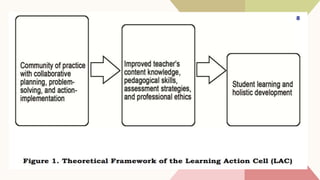
In the DepEd, a Learning Action Cell is a group of
teachers who engage in collaborative learning sessions
to solve shared challenges encountered in the school
facilitated by the school head or a designated LAC
Leader. LACs will become the school-based
communities of practice that are positive, caring, and
safe spaces.
5
Key aspects of the process
 Key aspects of the process are ongoing collaborative
learning or problem solving within a shared domain of
professional interest, self-directed learning, reflective
practice leading to action and self evaluation, and
collective competence. The following are the objectives of
this policy:
6
 to nurture successful teachers;
 to enable teachers to support each other to continuously
improve their content and pedagogical knowledge, practice,
skills, and attitudes; and
 to foster a professional collaborative spirit among school
heads, teachers, and the community as a whole.
7
8
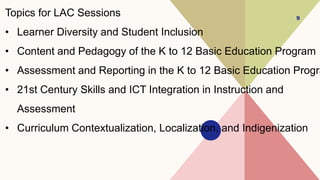
Topics for LAC Sessions
• Learner Diversity and Student Inclusion
• Content and Pedagogy of the K to 12 Basic Education Program
• Assessment and Reporting in the K to 12 Basic Education Progra
• 21st Century Skills and ICT Integration in Instruction and
Assessment
• Curriculum Contextualization, Localization, and Indigenization
9
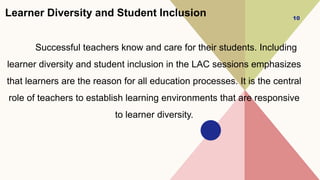
Learner Diversity and Student Inclusion
Successful teachers know and care for their students. Including
learner diversity and student inclusion in the LAC sessions emphasizes
that learners are the reason for all education processes. It is the central
role of teachers to establish learning environments that are responsive
to learner diversity.
10
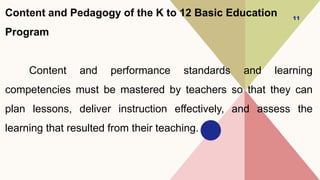
Content and Pedagogy of the K to 12 Basic Education
Program
Content and performance standards and learning
competencies must be mastered by teachers so that they can
plan lessons, deliver instruction effectively, and assess the
learning that resulted from their teaching.
11
Assessment and Reporting in the K to 12 Basic Education Program
Discussions about lessons should necessarily include ways
in assessing the learning of students and how data from
formative assessment can improve subsequent lessons.
12
21st Century Skills and ICT Integration in Instruction and
Assessment.
Teachers must enrich lessons with simple integration strategies
utilizing Information and Communications Technology (ICT) that are
developmentally appropriate. Instruction and assessment processes
can be made more collaborative with ICT, which teachers can
implement with the tools and equipment available in their schools.
13
Curriculum Contextualization, Localization, and Indigenization
Curriculum contextualization is the process of matching the
curriculum content and instructional strategies relevant to
learners. Student diversity requires that teachers always
consider individual differences in lesson planning and
implementation.
14
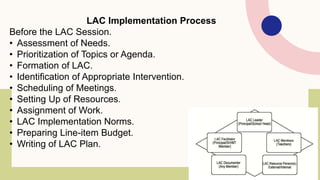
LAC Implementation Process
Before the LAC Session.
• Assessment of Needs.
• Prioritization of Topics or Agenda.
• Formation of LAC.
• Identification of Appropriate Intervention.
• Scheduling of Meetings.
• Setting Up of Resources.
• Assignment of Work.
• LAC Implementation Norms.
• Preparing Line-item Budget.
• Writing of LAC Plan.
During the LAC Session.
The priorities set out in the LAC Plan are implemented
through a variety of activities, which can include stimulus
(e.g. lectures, practicum, orientation, coaching, workshops,
development and utilization of instructional materials, etc.)
followed by collaborative discussion of possible ways
forward. The final activity of the session will involve
individual and group action planning in order to implement
agreed activities in the classroom.
After the LAC Session.
LAC members are expected to implement the proposed
strategies or activities in their classroom or school or
community as appropriate and evaluate their success. LAC
members should be prepared to report back on the
success of these activities in future LAC sessions. LAC
facilitators and LAC leaders should monitor these activities
and evaluate how far they are contributing to improved
outcomes for learners at school.
ROLES AND RESPONSIBILITIES OF
VARIOUS DEPED OFFICES
 School Level
 Schools Division Level
 Regional Level
 Central Office
18
SCHOOL LEVEL
The School Head should also take the lead in
monitoring school LAC activities and in evaluating
their impact on the total school improvement.
Likewise, active participation of teachers and
involvement in various LAC activities should be
captured as an objective in the Individual
Performance and Commitment Review Form
(IPCRF).
19
SCHOOLS DIVISION LEVEL
Through and with the District Supervisor,
the Schools Division Office (SDO) Curriculum
Implementation Division (CID) should support
the schools in establishing, maintaining, and
sustaining their LAC practice.
20
REGIONAL LEVEL
The Regional Offices (ROs) through the
Curriculum and Learning Management Division
(CLMD) should provide more explicit guidance
to SDOs and schools regarding the conduct of
LACs.
21
CENTRAL OFFICE
The Central Office (CO) shall review the
policy and its implementation in light of the
feedback gathered from the field. The CO through
the Office of the Undersecretary for Curriculum
and Instruction shall coordinate efforts at the
central and field offices to ensure that the support
systems and mechanism to sustain LAC practice
are established and responsive such as putting in
place a rewards system and allocating funds for
the program.
22
CONDUCT OF THE LAC SESSION.
LIMITATION/PROHIBITIONS.
23
Since LACs and LAC sessions are aimed
at the continuous professional development of
teachers, the conduct of LAC sessions shall be
limited to the purposes stated in this policy. The
holding of LAC sessions for purposes other than
those provided herein is prohibited. Prohibited
purposes may include but shall not be limited to
the following: sale of goods and other
merchandise; lending transactions; political and
religious meetings and other purposes which are
not included in this policy.
THANK
YOU

FRIENDLY JOY ETE Learning action cell.pptx

  • 1.
  • 2.
    DepEd Order No.35 S. 2016 The Learning Action Cell as a K-12 Education Program School-based Continuing Professional Development Strategy for the improvement of Teaching and Learning. 2
  • 3.
    Rationale As an institutionof learning, the Department of Education (DepEd) works to protect and promote the right of Filipinos to quality basic education that is equitable, culture-based, and complete, and allows them to realize their potential and contribute meaningfully to building the nation. The investment of the DepEd in the development of human potential is a commitment it makes not only to its learners but also its teachers. 3
  • 4.
    Towards this end,the DepEd fully supports the continuing professional development of its teaching personnel based on the principle of lifelong learning and the view of the teaching profession as one that “requires teachers expert knowledge and specialized skills, acquired and maintained through rigorous and continuing study” (UNESCO 1966). 4
  • 5.
    In the DepEd,a Learning Action Cell is a group of teachers who engage in collaborative learning sessions to solve shared challenges encountered in the school facilitated by the school head or a designated LAC Leader. LACs will become the school-based communities of practice that are positive, caring, and safe spaces. 5
  • 6.
    Key aspects ofthe process  Key aspects of the process are ongoing collaborative learning or problem solving within a shared domain of professional interest, self-directed learning, reflective practice leading to action and self evaluation, and collective competence. The following are the objectives of this policy: 6
  • 7.
     to nurturesuccessful teachers;  to enable teachers to support each other to continuously improve their content and pedagogical knowledge, practice, skills, and attitudes; and  to foster a professional collaborative spirit among school heads, teachers, and the community as a whole. 7
  • 8.
  • 9.
    Topics for LACSessions • Learner Diversity and Student Inclusion • Content and Pedagogy of the K to 12 Basic Education Program • Assessment and Reporting in the K to 12 Basic Education Progra • 21st Century Skills and ICT Integration in Instruction and Assessment • Curriculum Contextualization, Localization, and Indigenization 9
  • 10.
    Learner Diversity andStudent Inclusion Successful teachers know and care for their students. Including learner diversity and student inclusion in the LAC sessions emphasizes that learners are the reason for all education processes. It is the central role of teachers to establish learning environments that are responsive to learner diversity. 10
  • 11.
    Content and Pedagogyof the K to 12 Basic Education Program Content and performance standards and learning competencies must be mastered by teachers so that they can plan lessons, deliver instruction effectively, and assess the learning that resulted from their teaching. 11
  • 12.
    Assessment and Reportingin the K to 12 Basic Education Program Discussions about lessons should necessarily include ways in assessing the learning of students and how data from formative assessment can improve subsequent lessons. 12
  • 13.
    21st Century Skillsand ICT Integration in Instruction and Assessment. Teachers must enrich lessons with simple integration strategies utilizing Information and Communications Technology (ICT) that are developmentally appropriate. Instruction and assessment processes can be made more collaborative with ICT, which teachers can implement with the tools and equipment available in their schools. 13
  • 14.
    Curriculum Contextualization, Localization,and Indigenization Curriculum contextualization is the process of matching the curriculum content and instructional strategies relevant to learners. Student diversity requires that teachers always consider individual differences in lesson planning and implementation. 14
  • 15.
    LAC Implementation Process Beforethe LAC Session. • Assessment of Needs. • Prioritization of Topics or Agenda. • Formation of LAC. • Identification of Appropriate Intervention. • Scheduling of Meetings. • Setting Up of Resources. • Assignment of Work. • LAC Implementation Norms. • Preparing Line-item Budget. • Writing of LAC Plan.
  • 16.
    During the LACSession. The priorities set out in the LAC Plan are implemented through a variety of activities, which can include stimulus (e.g. lectures, practicum, orientation, coaching, workshops, development and utilization of instructional materials, etc.) followed by collaborative discussion of possible ways forward. The final activity of the session will involve individual and group action planning in order to implement agreed activities in the classroom.
  • 17.
    After the LACSession. LAC members are expected to implement the proposed strategies or activities in their classroom or school or community as appropriate and evaluate their success. LAC members should be prepared to report back on the success of these activities in future LAC sessions. LAC facilitators and LAC leaders should monitor these activities and evaluate how far they are contributing to improved outcomes for learners at school.
  • 18.
    ROLES AND RESPONSIBILITIESOF VARIOUS DEPED OFFICES  School Level  Schools Division Level  Regional Level  Central Office 18
  • 19.
    SCHOOL LEVEL The SchoolHead should also take the lead in monitoring school LAC activities and in evaluating their impact on the total school improvement. Likewise, active participation of teachers and involvement in various LAC activities should be captured as an objective in the Individual Performance and Commitment Review Form (IPCRF). 19
  • 20.
    SCHOOLS DIVISION LEVEL Throughand with the District Supervisor, the Schools Division Office (SDO) Curriculum Implementation Division (CID) should support the schools in establishing, maintaining, and sustaining their LAC practice. 20
  • 21.
    REGIONAL LEVEL The RegionalOffices (ROs) through the Curriculum and Learning Management Division (CLMD) should provide more explicit guidance to SDOs and schools regarding the conduct of LACs. 21
  • 22.
    CENTRAL OFFICE The CentralOffice (CO) shall review the policy and its implementation in light of the feedback gathered from the field. The CO through the Office of the Undersecretary for Curriculum and Instruction shall coordinate efforts at the central and field offices to ensure that the support systems and mechanism to sustain LAC practice are established and responsive such as putting in place a rewards system and allocating funds for the program. 22
  • 23.
    CONDUCT OF THELAC SESSION. LIMITATION/PROHIBITIONS. 23 Since LACs and LAC sessions are aimed at the continuous professional development of teachers, the conduct of LAC sessions shall be limited to the purposes stated in this policy. The holding of LAC sessions for purposes other than those provided herein is prohibited. Prohibited purposes may include but shall not be limited to the following: sale of goods and other merchandise; lending transactions; political and religious meetings and other purposes which are not included in this policy.
  • 25.