A Guide to its Customs and Culture
Location! Location!
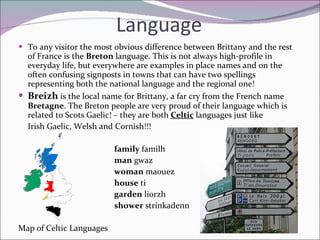
Language To any visitor the most obvious difference between Brittany and the rest of France is the  Breton  language. This is not always high-profile in everyday life, but everywhere are examples in place names and on the often confusing signposts in towns that can have two spellings representing both the national language and the regional one! Breizh  is the local name for Brittany, a far cry from the French name  Bretagne . The Breton people are very proud of their language which is related to Scots Gaelic! – they are both   Celtic   languages just like Irish Gaelic, Welsh and Cornish!!!     family  familh man  gwaz woman  maouez house  ti garden  liorzh   shower  strinkadenn Map of Celtic Languages
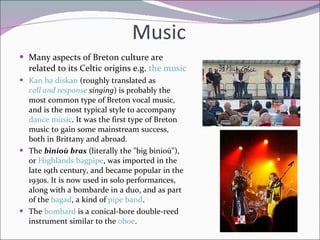
Music Many aspects of Breton culture are related to its Celtic origins e.g.  the music Kan ha diskan  (roughly translated as  call and response  singing ) is probably the most common type of Breton vocal music, and is the most typical style to accompany  dance music . It was the first type of Breton music to gain some mainstream success, both in Brittany and abroad. The  binioù bras  (literally the "big binioù"), or  Highlands bagpipe , was imported in the late 19th century, and became popular in the 1930s. It is now used in solo performances, along with a bombarde in a duo, and as part of the  bagad , a kind of  pipe band . The  bombard  is a conical-bore double-reed instrument similar to the  oboe .
History Living originally as hunter gatherers, the population of the Breton area became settled in the Neolithic period (around 4500 BC).  This was the civilisation that created the tradition of  standing stones . Most of the megaliths were constructed between 4500 and 200 BC.  Some of the stones, such as the great  menhir  of Locmariaquer, weigh 350 tonnes; the average stones exceed 50 tonnes. They had to be extracted from the ground and transported several kilometres to be raised at the desired site. They were moved using simple systems of logs, ropes, levers and inclined surfaces. With almost  3000 standing stones  spread over several sites,  Carnac  displays some of the greatest remains of megalithic art.
Flag The first known flag of Brittany was the Kroaz Du (or Groaz du), the Black Cross, virtually the reverse of the old Cornish flag. This was effectively the national flag of Brittany until 1532.  Within Breton history is also the ermine banner or Ar Banniel Erminigaouet which was a part of the arms of the Dukes of Brittany and dates back to 1316 The present flag 'Gwenn Ha Du' means simple  'white and black'  and was designed as late as the 1920's and incorporates 11 ermines to represent traditional Brittany with black and white bars to represent the Breton and Gallaise speaking regions
Food and Drink Brittany is one of the two main regions where cider apple trees are grown and cider produced. The French word  'cidre'  has appeared in tales since the 6th Century. Today this region accounts for 40% of the total national French production. Furthermore, the combination of  cider and crêpes  is deeply rooted in Breton traditional cuisine. Sabl é s , also known as a French Butter Cookie or Breton Biscuit, is a classic French cookie . The name 'Sabl é s' is French for " sand ", which refers to the sandy texture of this delicate and crumbly  shortbread-like  cookie. 
Kenavo!! (goodbye)

La Bretagne­

  • 1.
    A Guide toits Customs and Culture
  • 2.
  • 3.
    Language To anyvisitor the most obvious difference between Brittany and the rest of France is the Breton language. This is not always high-profile in everyday life, but everywhere are examples in place names and on the often confusing signposts in towns that can have two spellings representing both the national language and the regional one! Breizh is the local name for Brittany, a far cry from the French name Bretagne . The Breton people are very proud of their language which is related to Scots Gaelic! – they are both Celtic languages just like Irish Gaelic, Welsh and Cornish!!! family familh man gwaz woman maouez house ti garden liorzh shower strinkadenn Map of Celtic Languages
  • 4.
    Music Many aspectsof Breton culture are related to its Celtic origins e.g. the music Kan ha diskan (roughly translated as call and response singing ) is probably the most common type of Breton vocal music, and is the most typical style to accompany dance music . It was the first type of Breton music to gain some mainstream success, both in Brittany and abroad. The binioù bras (literally the "big binioù"), or Highlands bagpipe , was imported in the late 19th century, and became popular in the 1930s. It is now used in solo performances, along with a bombarde in a duo, and as part of the bagad , a kind of pipe band . The bombard is a conical-bore double-reed instrument similar to the oboe .
  • 5.
    History Living originallyas hunter gatherers, the population of the Breton area became settled in the Neolithic period (around 4500 BC). This was the civilisation that created the tradition of standing stones . Most of the megaliths were constructed between 4500 and 200 BC. Some of the stones, such as the great menhir of Locmariaquer, weigh 350 tonnes; the average stones exceed 50 tonnes. They had to be extracted from the ground and transported several kilometres to be raised at the desired site. They were moved using simple systems of logs, ropes, levers and inclined surfaces. With almost 3000 standing stones spread over several sites, Carnac displays some of the greatest remains of megalithic art.
  • 6.
    Flag The firstknown flag of Brittany was the Kroaz Du (or Groaz du), the Black Cross, virtually the reverse of the old Cornish flag. This was effectively the national flag of Brittany until 1532. Within Breton history is also the ermine banner or Ar Banniel Erminigaouet which was a part of the arms of the Dukes of Brittany and dates back to 1316 The present flag 'Gwenn Ha Du' means simple 'white and black' and was designed as late as the 1920's and incorporates 11 ermines to represent traditional Brittany with black and white bars to represent the Breton and Gallaise speaking regions
  • 7.
    Food and DrinkBrittany is one of the two main regions where cider apple trees are grown and cider produced. The French word 'cidre' has appeared in tales since the 6th Century. Today this region accounts for 40% of the total national French production. Furthermore, the combination of cider and crêpes is deeply rooted in Breton traditional cuisine. Sabl é s , also known as a French Butter Cookie or Breton Biscuit, is a classic French cookie . The name 'Sabl é s' is French for " sand ", which refers to the sandy texture of this delicate and crumbly shortbread-like cookie. 
  • 8.