La monetizzazione delle API
Francesco Arcieri
CODEMOTION MILAN - SPECIAL EDITION
11 NOVEMBER 2017
2
API Economy
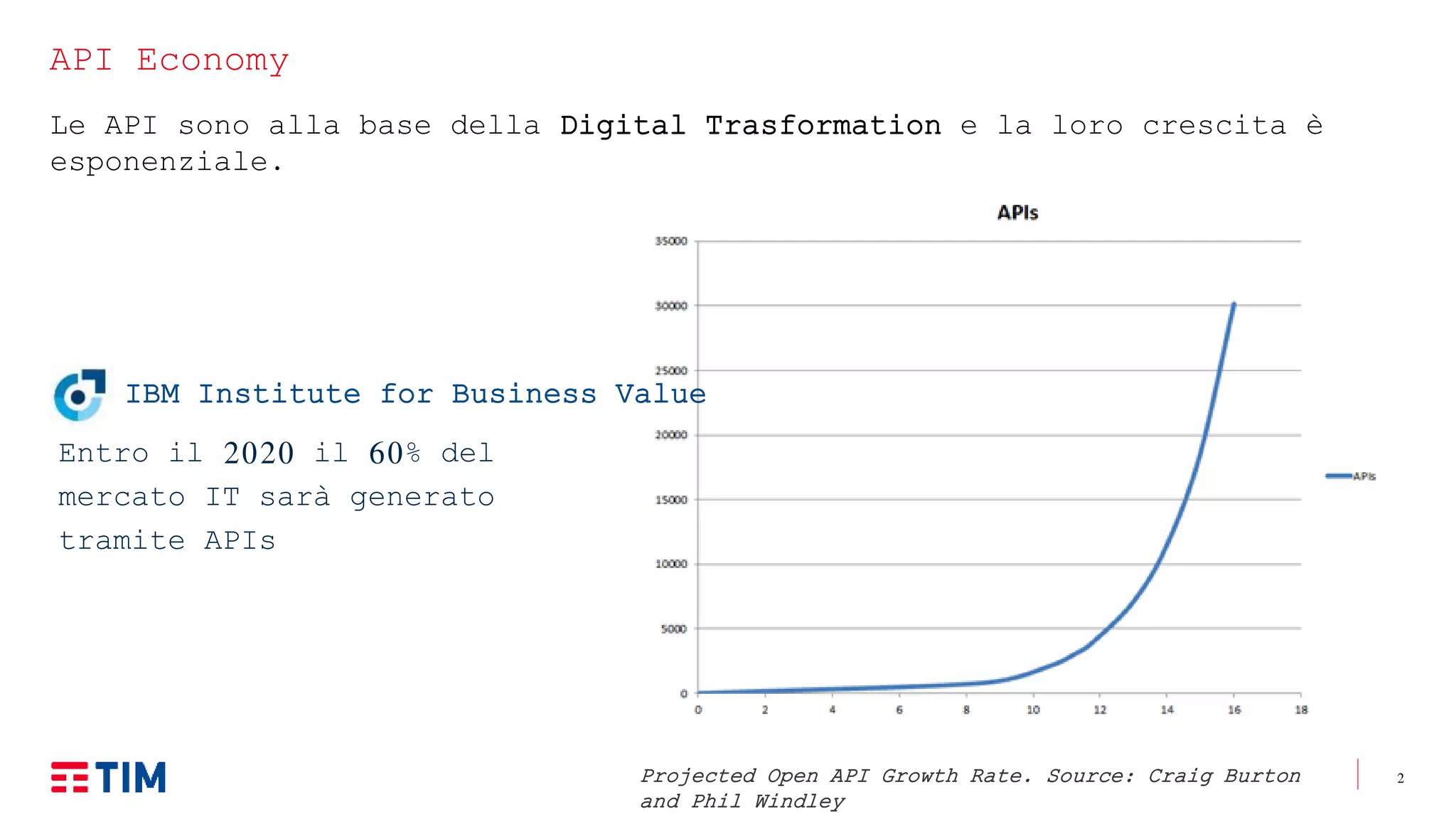
Le API sono alla base della Digital Trasformation e la loro crescita è
esponenziale.
Projected Open API Growth Rate. Source: Craig Burton
and Phil Windley
Entro il 2020 il 60% del
mercato IT sarà generato
tramite APIs
IBM Institute for Business Value
3
API Business Models
Esporre delle API non è sufficiente ad abilitare un Business model.
Nell'API Economy diventa fondamentale sviluppare una corretta
strategia di commercializzazione delle API ed un'architettura in grado
di abilitare transazioni commerciali.
4
API Business Models
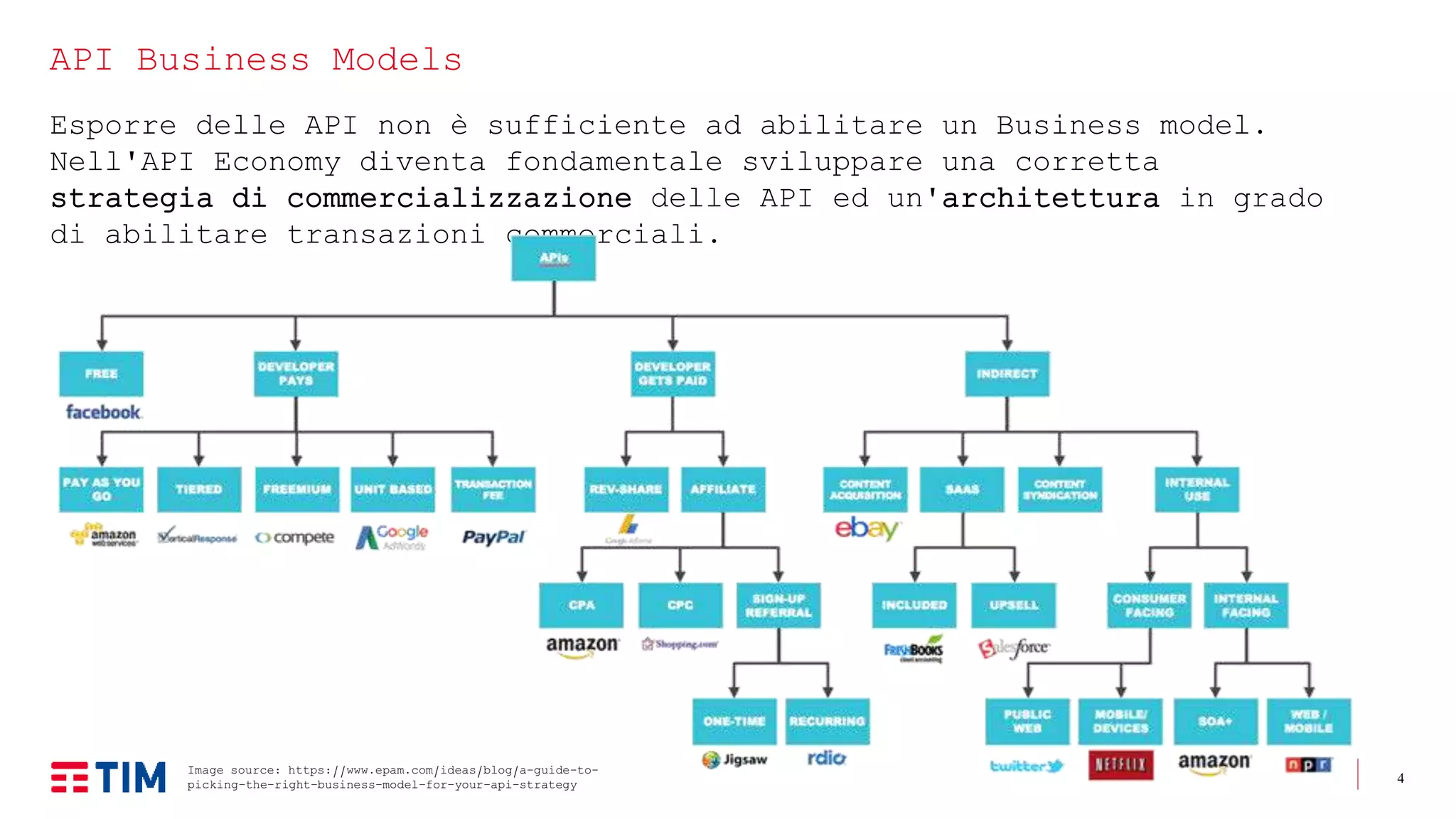
Esporre delle API non è sufficiente ad abilitare un Business model.
Nell'API Economy diventa fondamentale sviluppare una corretta
strategia di commercializzazione delle API ed un'architettura in grado
di abilitare transazioni commerciali.
Image source: https://www.epam.com/ideas/blog/a-guide-to-
picking-the-right-business-model-for-your-api-strategy
5
Ciclo di vita della Commercializzazione di un’API
Back-end
APIs
Mediated API
(ex: REST-to-SOAP, XML-
to-JSON, HTTP-to-JMS, …)
Security Enforced API (opz)
(Throttling, schema validation, content filtering, …)
Mash-up API
(internal+internal, internal+external, … )
Virtualized
API
API
Gateway
Exposed API
Published API
(Technical documentation, …)
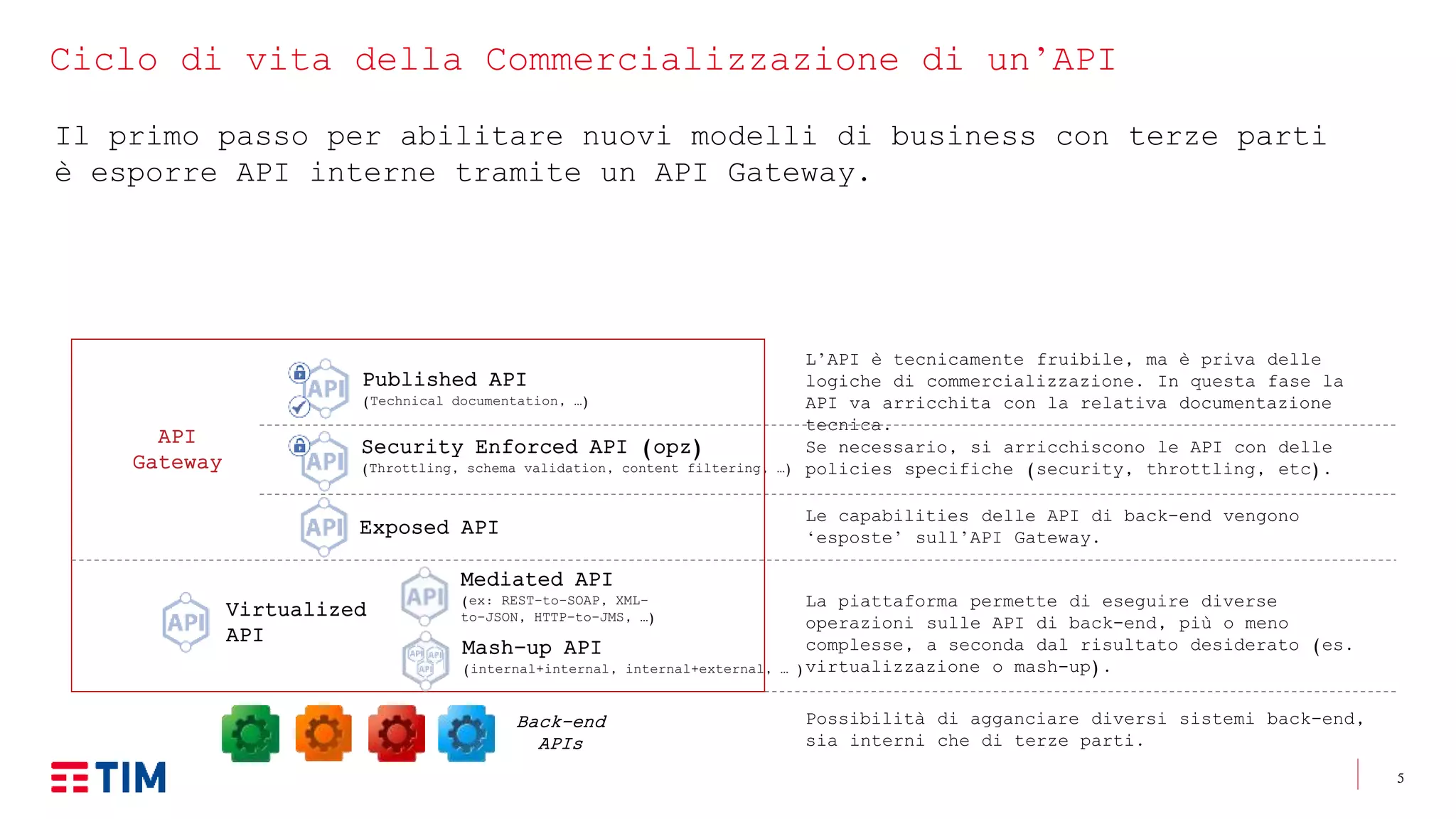
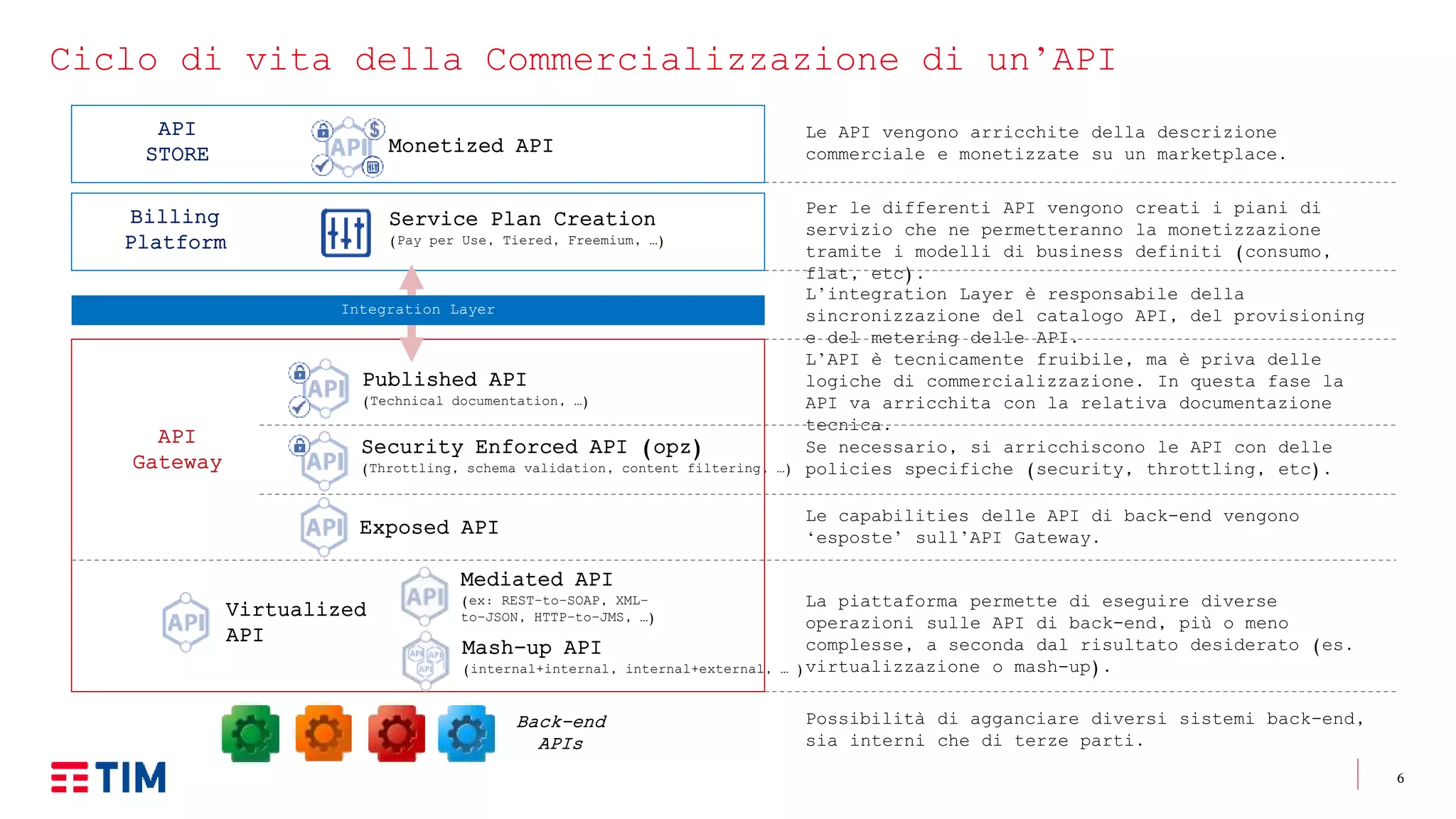
Possibilità di agganciare diversi sistemi back-end,
sia interni che di terze parti.
La piattaforma permette di eseguire diverse
operazioni sulle API di back-end, più o meno
complesse, a seconda dal risultato desiderato (es.
virtualizzazione o mash-up).
L’API è tecnicamente fruibile, ma è priva delle
logiche di commercializzazione. In questa fase la
API va arricchita con la relativa documentazione
tecnica.
Se necessario, si arricchiscono le API con delle
policies specifiche (security, throttling, etc).
Le capabilities delle API di back-end vengono
‘esposte’ sull’API Gateway.
Il primo passo per abilitare nuovi modelli di business con terze parti
è esporre API interne tramite un API Gateway.
6
Ciclo di vita della Commercializzazione di un’API
Back-end
APIs
Mediated API
(ex: REST-to-SOAP, XML-
to-JSON, HTTP-to-JMS, …)
Security Enforced API (opz)
(Throttling, schema validation, content filtering, …)
Mash-up API
(internal+internal, internal+external, … )
Virtualized
API
Service Plan Creation
(Pay per Use, Tiered, Freemium, …)
API
Gateway
Exposed API
Published API
(Technical documentation, …)
Monetized API
Possibilità di agganciare diversi sistemi back-end,
sia interni che di terze parti.
La piattaforma permette di eseguire diverse
operazioni sulle API di back-end, più o meno
complesse, a seconda dal risultato desiderato (es.
virtualizzazione o mash-up).
L’API è tecnicamente fruibile, ma è priva delle
logiche di commercializzazione. In questa fase la
API va arricchita con la relativa documentazione
tecnica.
Se necessario, si arricchiscono le API con delle
policies specifiche (security, throttling, etc).
Le capabilities delle API di back-end vengono
‘esposte’ sull’API Gateway.
L’integration Layer è responsabile della
sincronizzazione del catalogo API, del provisioning
e del metering delle API.
Per le differenti API vengono creati i piani di
servizio che ne permetteranno la monetizzazione
tramite i modelli di business definiti (consumo,
flat, etc).
Le API vengono arricchite della descrizione
commerciale e monetizzate su un marketplace.
Integration Layer
Billing
Platform
API
STORE
7
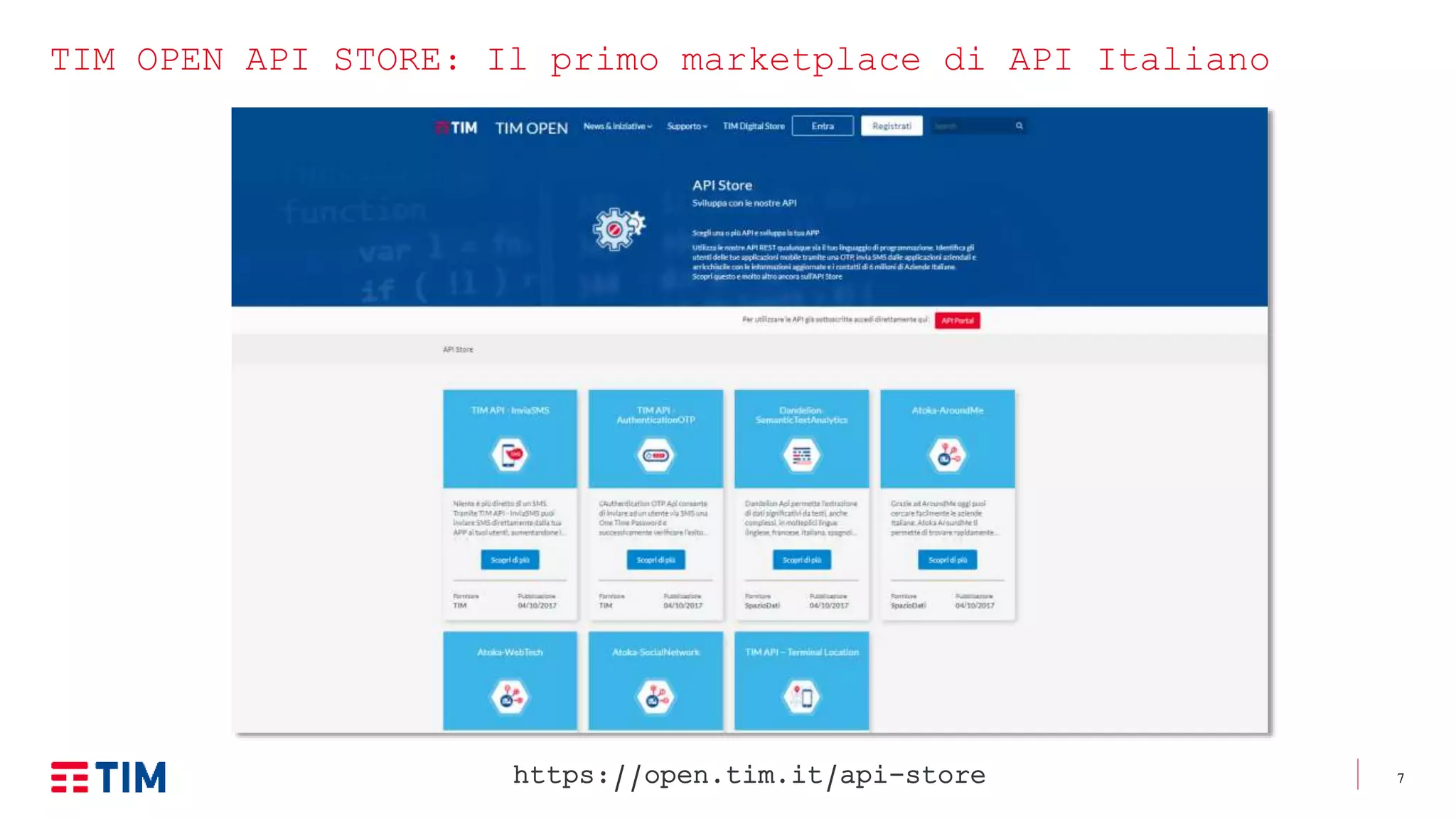
TIM OPEN API STORE: Il primo marketplace di API Italiano
https://open.tim.it/api-store
8
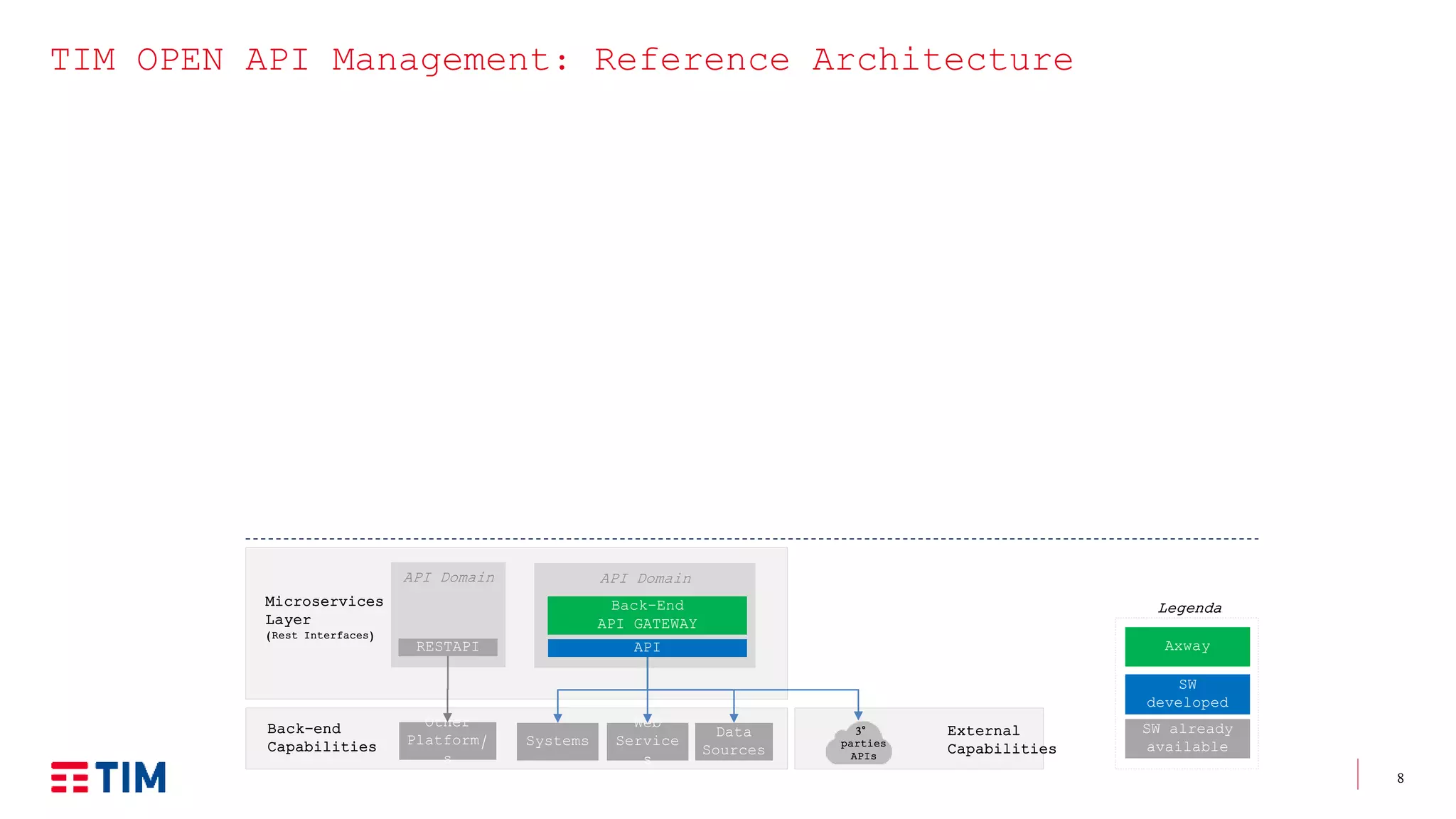
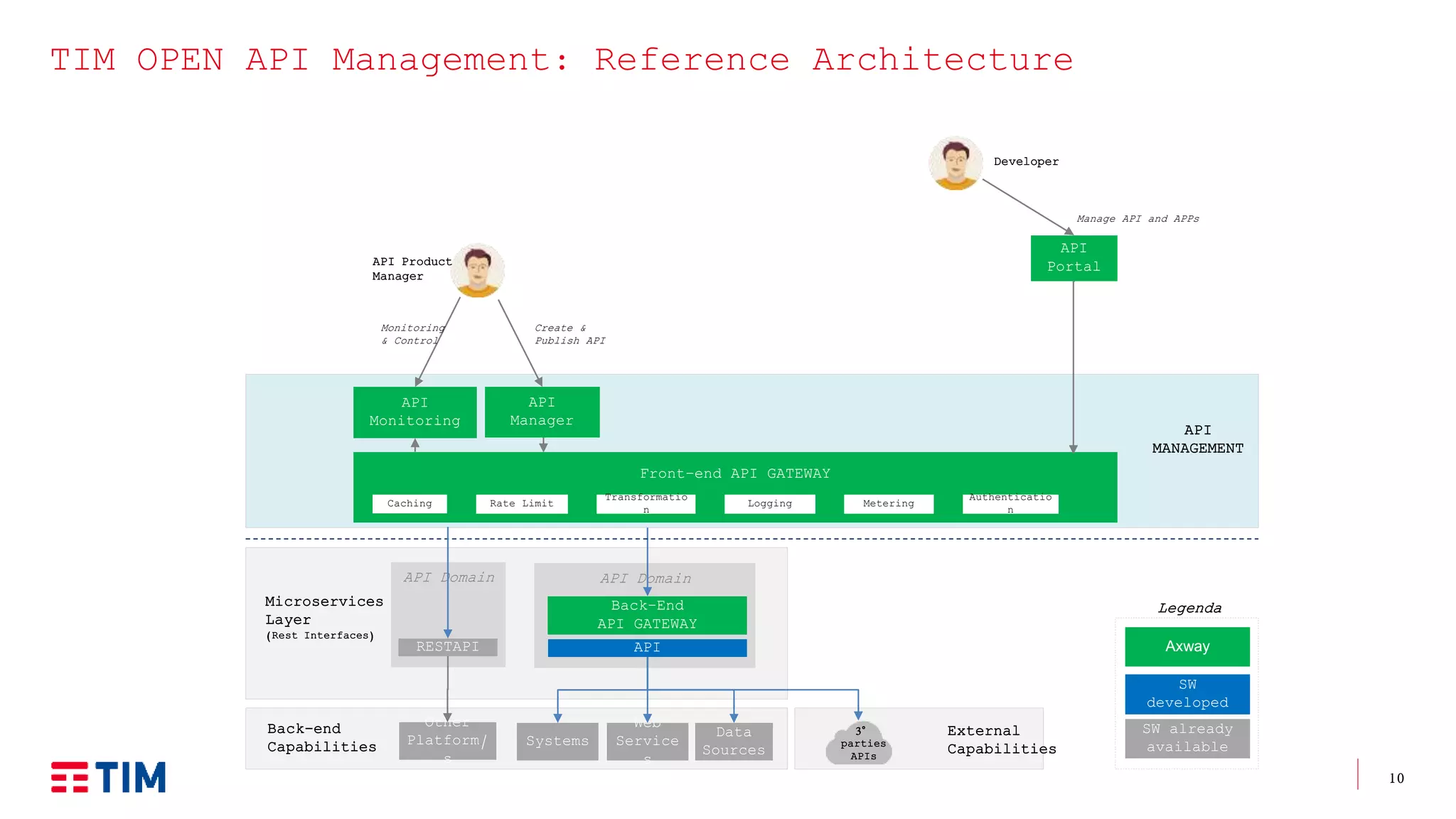
TIM OPEN API Management: Reference Architecture
External
Capabilities
Microservices
Layer
(Rest Interfaces)
Back-end
Capabilities
3°
parties
APIs
API Domain
Back-End
API GATEWAY
Web
Service
s
Data
Sources
Axway
SW
developed
SW already
availableSystems
Legenda
API
API Domain
RESTAPI
Other
Platform/
s
9
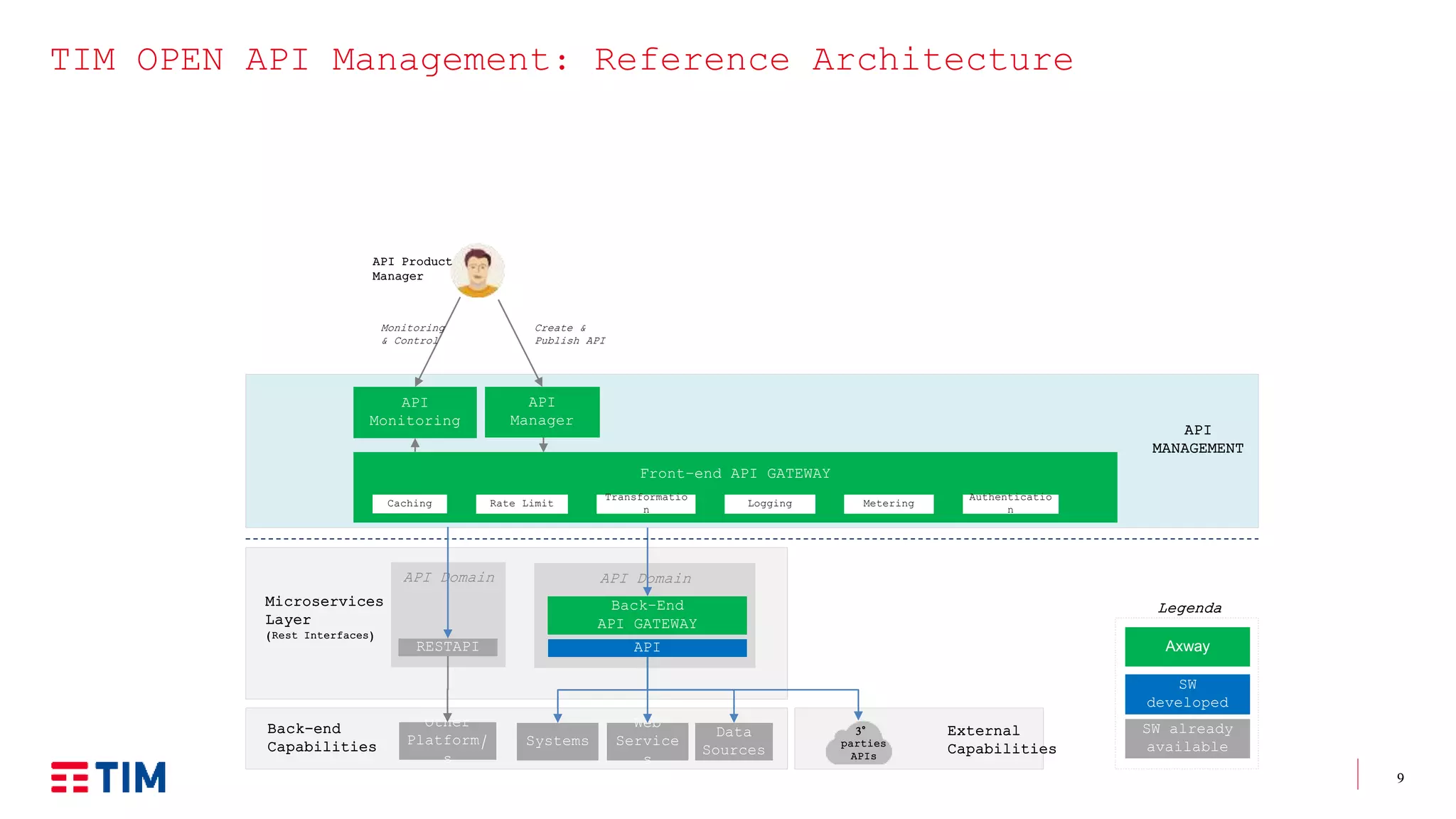
TIM OPEN API Management: Reference Architecture
External
Capabilities
Microservices
Layer
(Rest Interfaces)
API Product
Manager
Create &
Publish API
Front-end API GATEWAY
Rate Limit
Authenticatio
n
Transformatio
n
Logging Metering
API
Monitoring
Back-end
Capabilities
3°
parties
APIs
API Domain
Back-End
API GATEWAY
Caching
Web
Service
s
Data
Sources
API
MANAGEMENT
Monitoring
& Control
Axway
SW
developed
SW already
availableSystems
Legenda
API
API
Manager
API Domain
RESTAPI
Other
Platform/
s
10
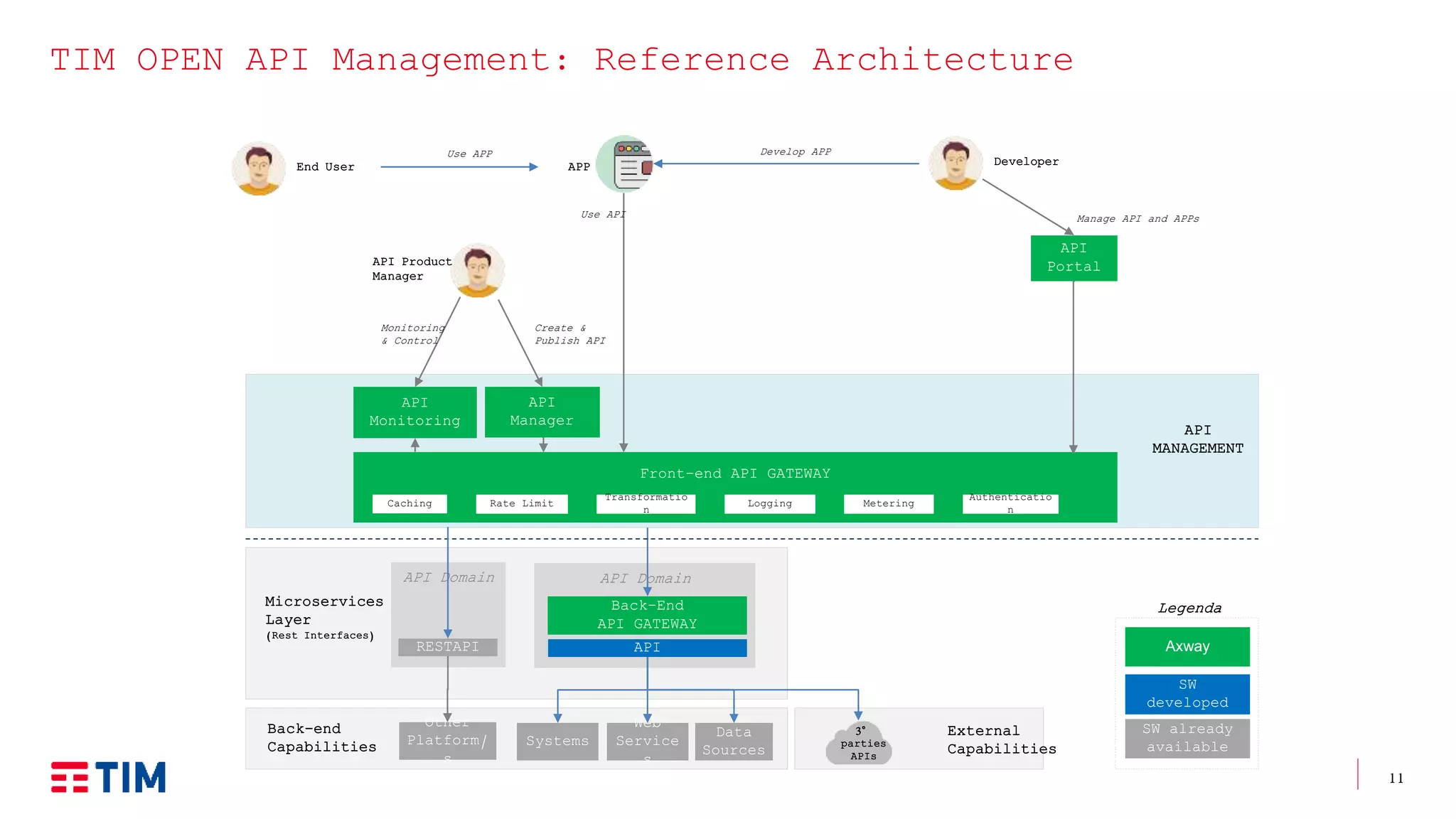
TIM OPEN API Management: Reference Architecture
External
Capabilities
Manage API and APPs
Microservices
Layer
(Rest Interfaces)
Developer
API Product
Manager
Create &
Publish API
Front-end API GATEWAY
Rate Limit
Authenticatio
n
Transformatio
n
Logging Metering
API
Monitoring
Back-end
Capabilities
3°
parties
APIs
API Domain
Back-End
API GATEWAY
Caching
API
Portal
Web
Service
s
Data
Sources
API
MANAGEMENT
Monitoring
& Control
Axway
SW
developed
SW already
availableSystems
Legenda
API
API
Manager
API Domain
RESTAPI
Other
Platform/
s
11
TIM OPEN API Management: Reference Architecture
External
Capabilities
Manage API and APPs
Microservices
Layer
(Rest Interfaces)
Developer
API Product
Manager
Create &
Publish API
Front-end API GATEWAY
Rate Limit
Authenticatio
n
Transformatio
n
Logging Metering
API
Monitoring
Back-end
Capabilities
3°
parties
APIs
API Domain
Back-End
API GATEWAY
Caching
API
Portal
Web
Service
s
Data
Sources
API
MANAGEMENT
Monitoring
& Control
Axway
SW
developed
SW already
availableSystems
Legenda
API
API
Manager
API Domain
RESTAPI
Other
Platform/
s
Develop APP
Use API
APPEnd User
Use APP
12
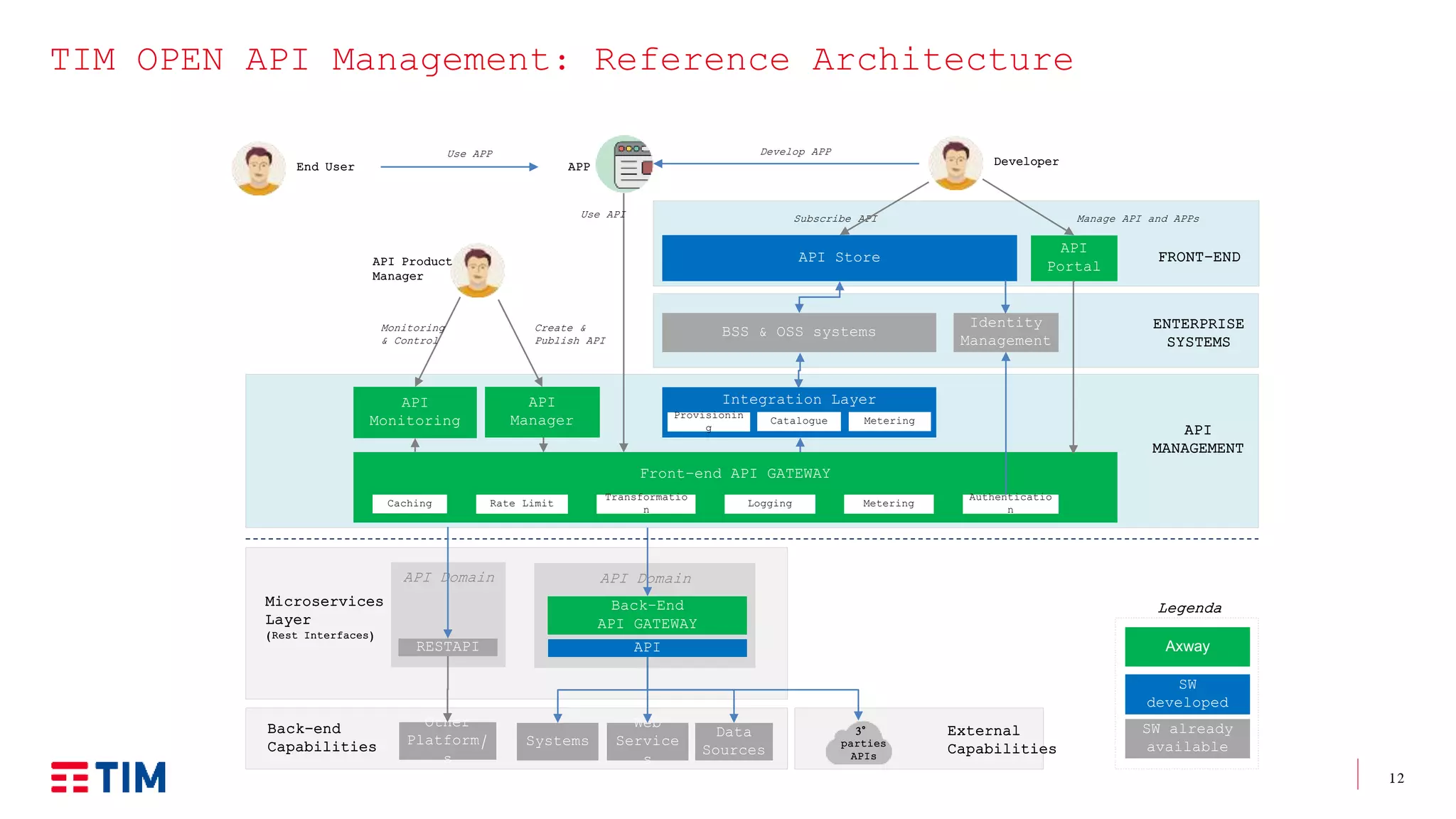
TIM OPEN API Management: Reference Architecture
External
Capabilities
Subscribe API
FRONT-END
Manage API and APPs
Microservices
Layer
(Rest Interfaces)
API Store
Developer
Develop APP
API Product
Manager
Create &
Publish API
Identity
Management
Front-end API GATEWAY
Rate Limit
Authenticatio
n
Transformatio
n
Logging Metering
API
Monitoring
Use API
Back-end
Capabilities
3°
parties
APIs
ENTERPRISE
SYSTEMS
API Domain
Back-End
API GATEWAY
APP
Caching
API
Portal
BSS & OSS systems
Integration Layer
Web
Service
s
Data
Sources
API
MANAGEMENT
Monitoring
& Control
Axway
SW
developed
SW already
availableSystems
Legenda
API
API
Manager Provisionin
g
Catalogue Metering
API Domain
RESTAPI
Other
Platform/
s
End User
Use APP
13
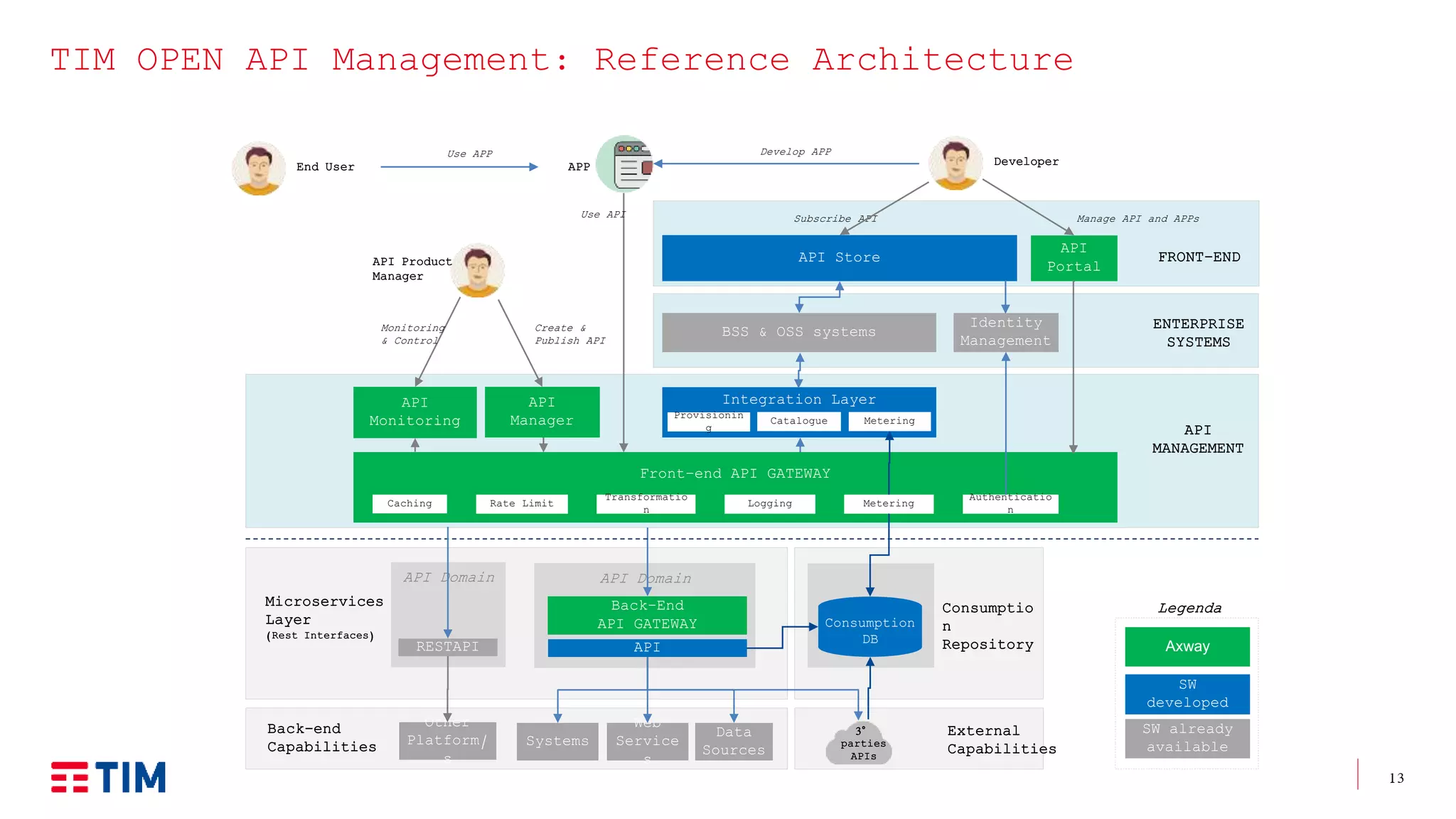
TIM OPEN API Management: Reference Architecture
External
Capabilities
Subscribe API
FRONT-END
Manage API and APPs
Microservices
Layer
(Rest Interfaces)
API Store
Developer
Develop APP
API Product
Manager
Create &
Publish API
Identity
Management
Front-end API GATEWAY
Rate Limit
Authenticatio
n
Transformatio
n
Logging Metering
API
Monitoring
Use API
Back-end
Capabilities
3°
parties
APIs
ENTERPRISE
SYSTEMS
API Domain
Back-End
API GATEWAY
APP
Caching
API
Portal
BSS & OSS systems
Integration Layer
Web
Service
s
Data
Sources
API
MANAGEMENT
Monitoring
& Control
Axway
SW
developed
SW already
availableSystems
Legenda
API
API
Manager
End User
Use APP
Provisionin
g
Catalogue Metering
Consumptio
n
Repository
Consumption
DB
API Domain
RESTAPI
Other
Platform/
s
14
ENTERPRISE
SYSTEMS
TIM OPEN API Management: Reference Architecture
TIM API
MANAGEMENT
LAYER
API GATEWAY
Rate
Limit
Authent
.
Trans
f.
Cachin
g
Loggin
g
Meter
Connector
Provision
ing API
(3)
Catalogu
e
API (2)
Metering
API (4)
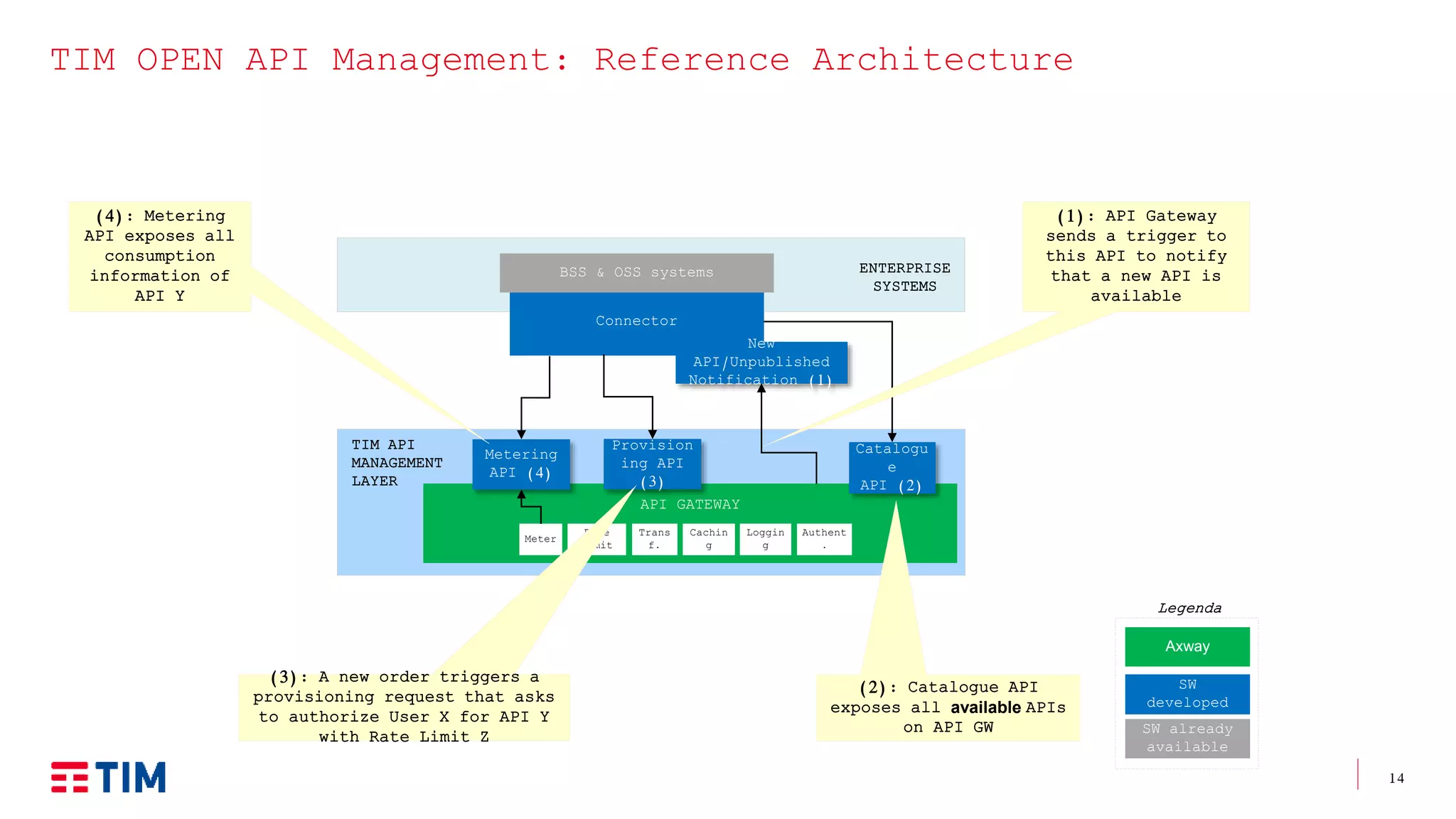
(2): Catalogue API
exposes all available APIs
on API GW
(3): A new order triggers a
provisioning request that asks
to authorize User X for API Y
with Rate Limit Z
(4): Metering
API exposes all
consumption
information of
API Y
New
API/Unpublished
Notification (1)
(1): API Gateway
sends a trigger to
this API to notify
that a new API is
available
BSS & OSS systems
Axway
SW
developed
SW already
available
Legenda
15
ENTERPRISE
SYSTEMS
BSS & OSS systems
Metering by Calls
Axway
SW
developed
SW already
available
Legenda
API GATEWAY
API Domain
Microservice
metered by Call
(es: SMS)
Meter
Connector
Metering APIs
Native Metering DB
Consumptions API (ByDev,
ByAPI)
Calls
Calls
TIM API –
InviaSMS
Cal
ls
API
MANAGEMENT
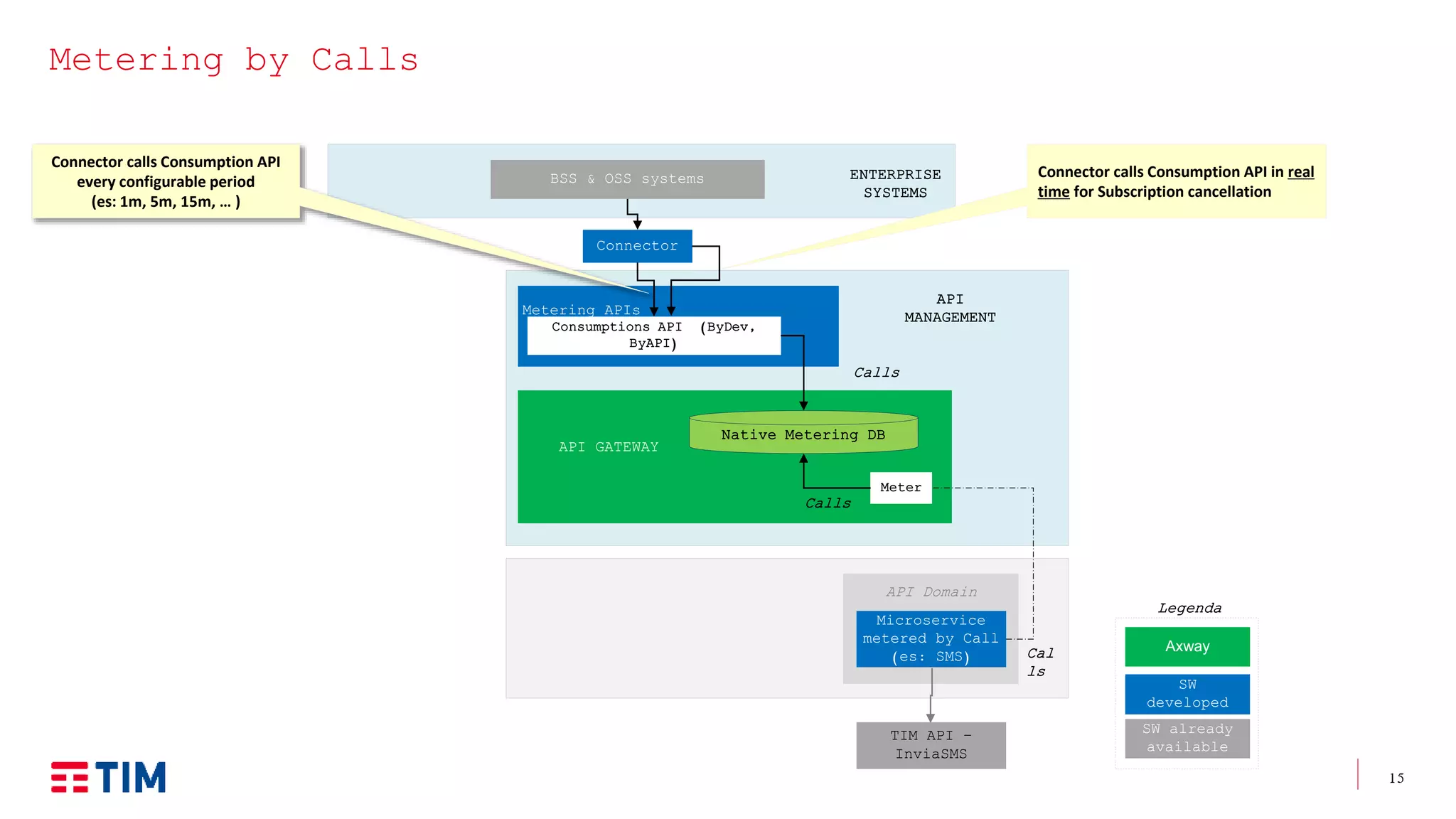
Connector calls Consumption API
every configurable period
(es: 1m, 5m, 15m, … )
Connector calls Consumption API in real
time for Subscription cancellation
16
ENTERPRISE
SYSTEMS
BSS & OSS systems
Metering by Credits
Axway
SW
developed
SW already
available
Legenda
API GATEWAY
API Domain
Microservice
metered by Call
(es: SMS)
Meter
CONSUMPTION
REPOSITORY
Connector
Metering APIs
Native Metering DB
Consumptions API (ByDev,
ByAPI)
Calls
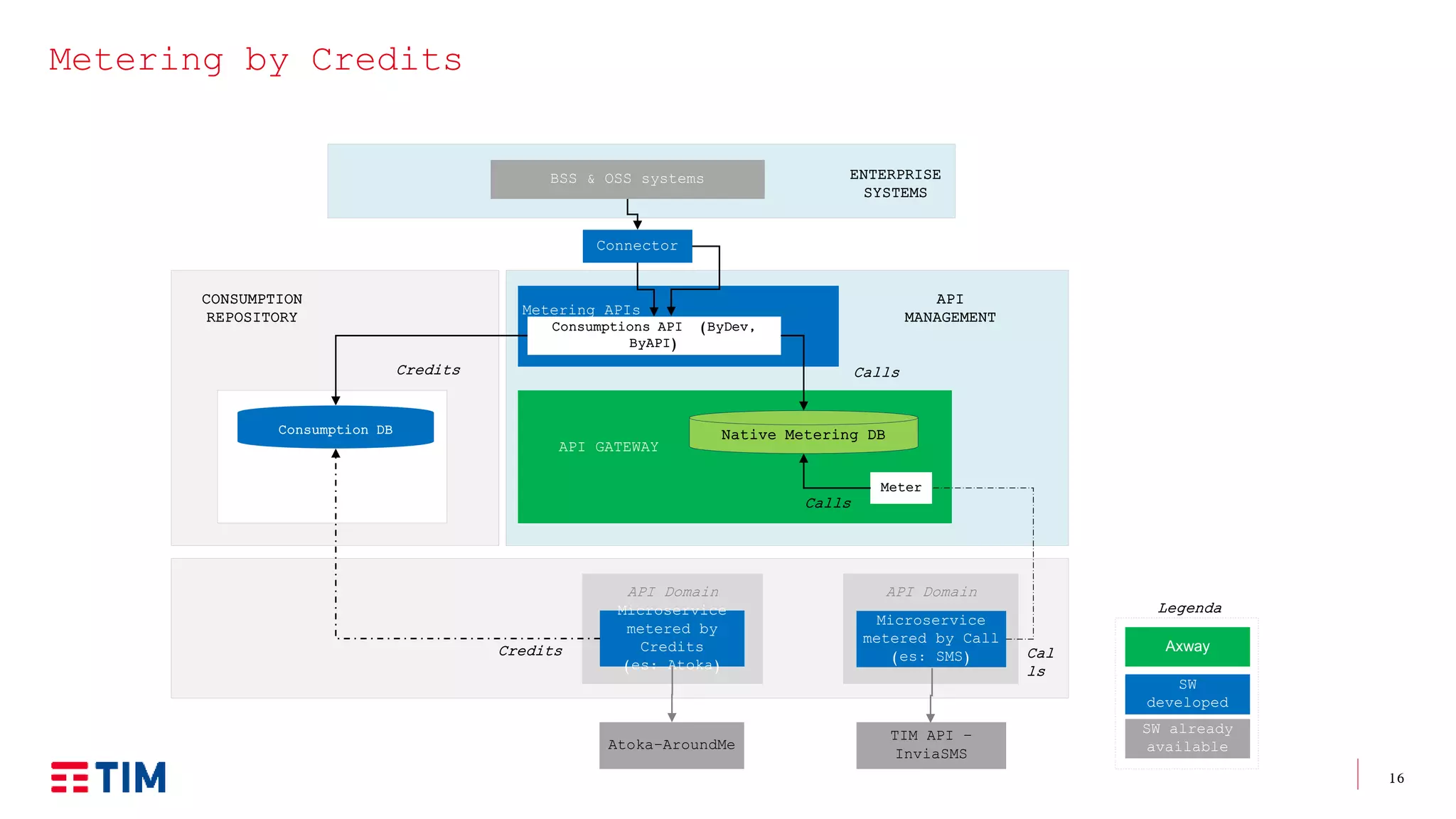
Credits
CallsCredits
Consumption DB
API Domain
Microservice
metered by
Credits
(es: Atoka)
Atoka-AroundMe
TIM API –
InviaSMS
Cal
ls
API
MANAGEMENT
17
ENTERPRISE
SYSTEMS
BSS & OSS systems
Metering by other measures
Axway
SW
developed
SW already
available
Legenda
API GATEWAY
API Domain
Microservice
metered by Call
(es: SMS)
Meter
CONSUMPTION
REPOSITORY
Consumption DB
Write API
Connector
API Domain
Microservice
metered by
other units
Metering APIs
Native Metering DB
Consumptions API (ByDev,
ByAPI)
GB
Calls
Credits
Calls
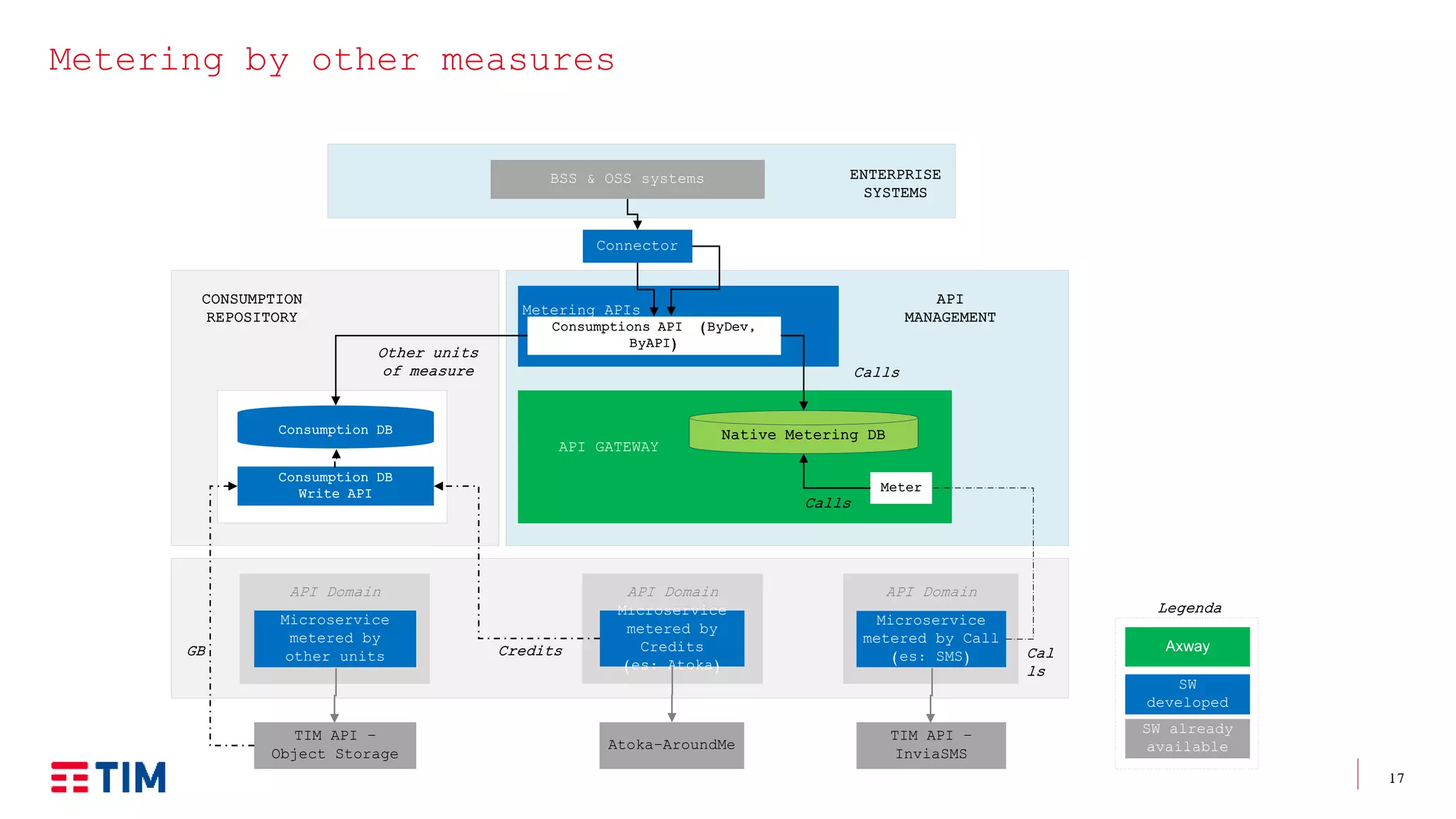
Other units
of measure
Consumption DB
API Domain
Microservice
metered by
Credits
(es: Atoka)
Atoka-AroundMe
TIM API –
Object Storage
TIM API –
InviaSMS
Cal
ls
API
MANAGEMENT
18
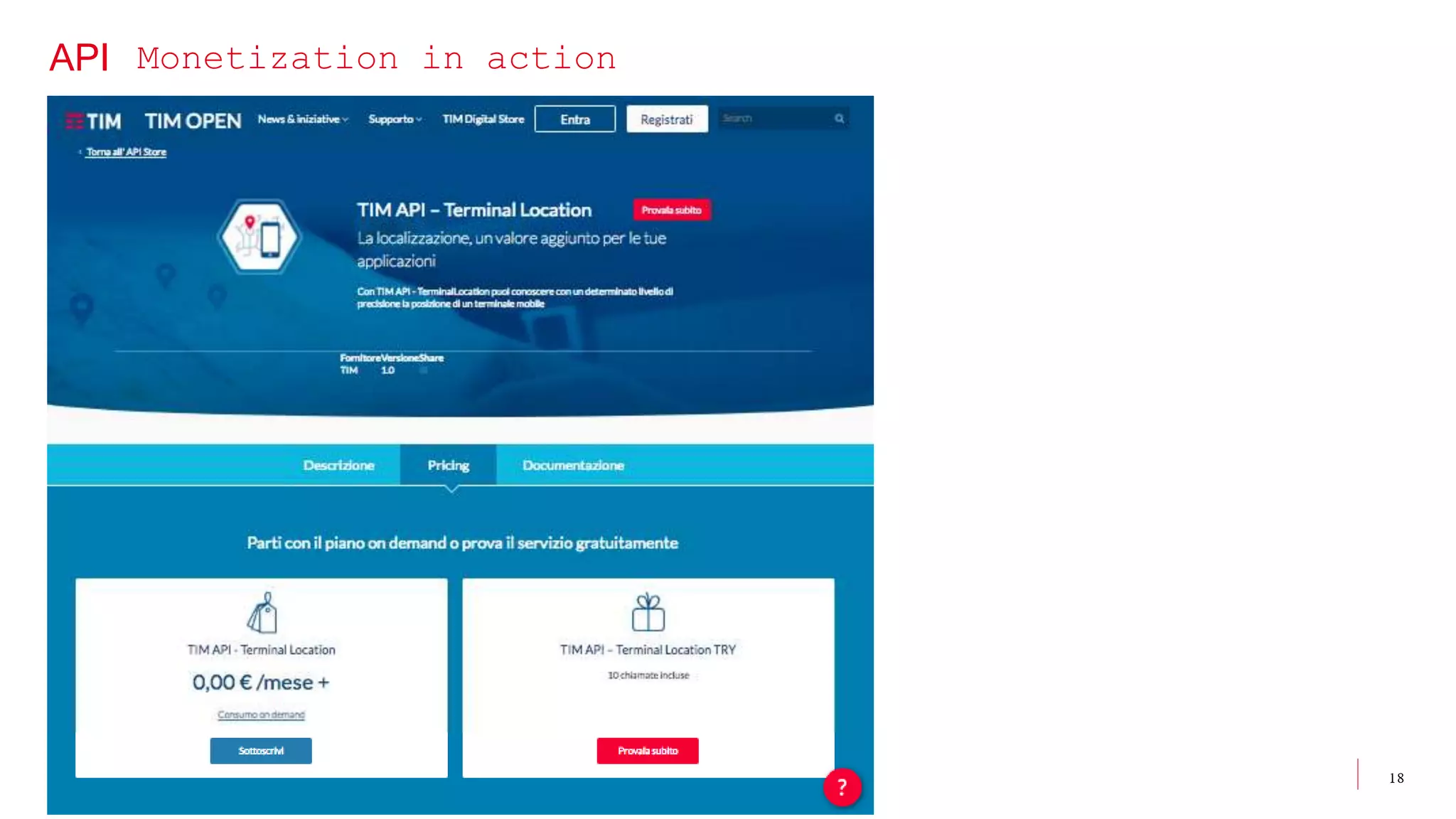
API Monetization in action
19
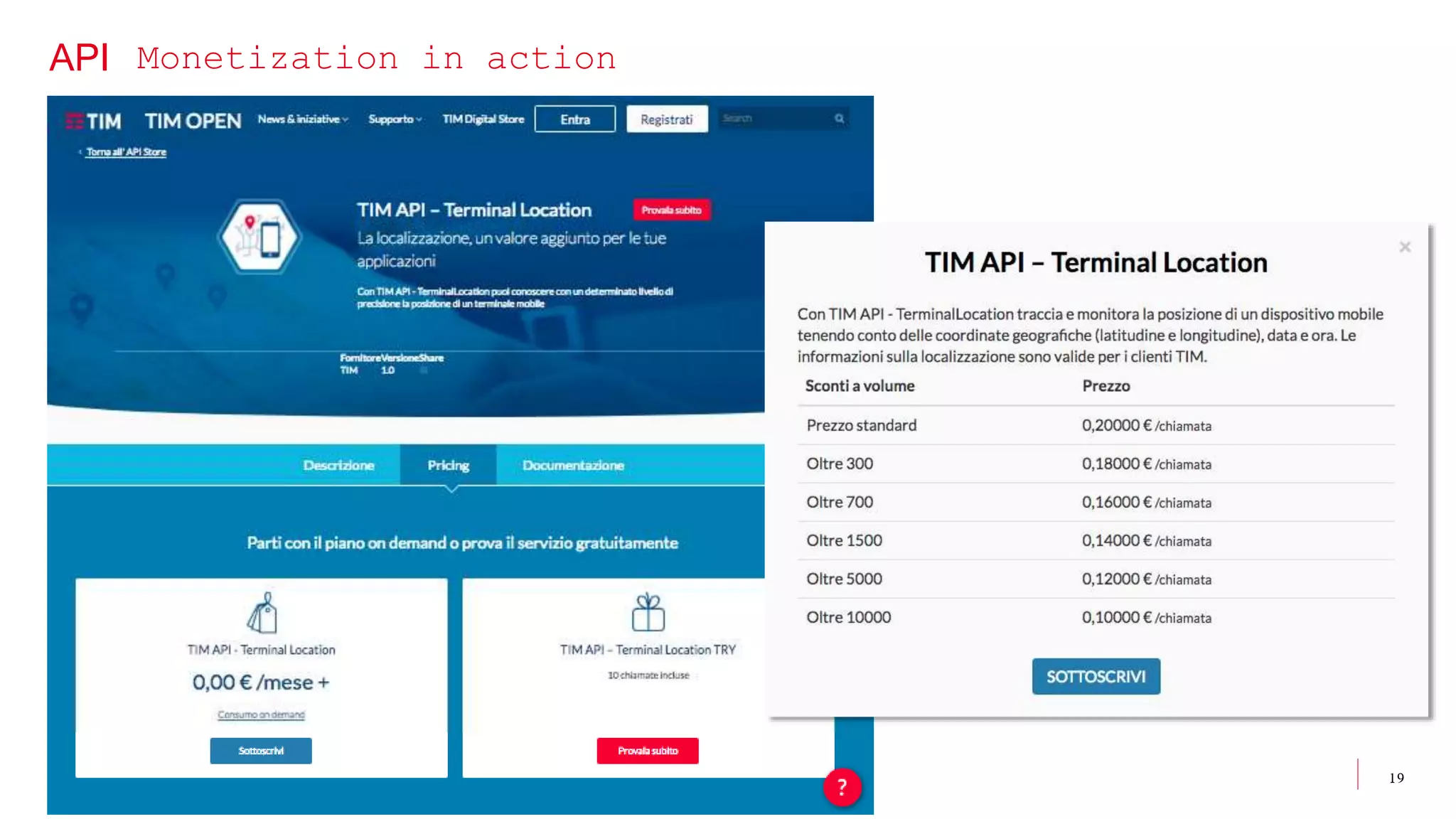
API Monetization in action
20
Francesco Arcieri
Francesco.Arcieri@Olivetti.com
https://www.linkedin.com/in/francescoarcieri/

Francesco Arcieri - La monetizzazione delle API - Codemotion Milan 2017

  • 1.
    La monetizzazione delleAPI Francesco Arcieri CODEMOTION MILAN - SPECIAL EDITION 11 NOVEMBER 2017
  • 2.
    2 API Economy Le APIsono alla base della Digital Trasformation e la loro crescita è esponenziale. Projected Open API Growth Rate. Source: Craig Burton and Phil Windley Entro il 2020 il 60% del mercato IT sarà generato tramite APIs IBM Institute for Business Value
  • 3.
    3 API Business Models Esporredelle API non è sufficiente ad abilitare un Business model. Nell'API Economy diventa fondamentale sviluppare una corretta strategia di commercializzazione delle API ed un'architettura in grado di abilitare transazioni commerciali.
  • 4.
    4 API Business Models Esporredelle API non è sufficiente ad abilitare un Business model. Nell'API Economy diventa fondamentale sviluppare una corretta strategia di commercializzazione delle API ed un'architettura in grado di abilitare transazioni commerciali. Image source: https://www.epam.com/ideas/blog/a-guide-to- picking-the-right-business-model-for-your-api-strategy
  • 5.
    5 Ciclo di vitadella Commercializzazione di un’API Back-end APIs Mediated API (ex: REST-to-SOAP, XML- to-JSON, HTTP-to-JMS, …) Security Enforced API (opz) (Throttling, schema validation, content filtering, …) Mash-up API (internal+internal, internal+external, … ) Virtualized API API Gateway Exposed API Published API (Technical documentation, …) Possibilità di agganciare diversi sistemi back-end, sia interni che di terze parti. La piattaforma permette di eseguire diverse operazioni sulle API di back-end, più o meno complesse, a seconda dal risultato desiderato (es. virtualizzazione o mash-up). L’API è tecnicamente fruibile, ma è priva delle logiche di commercializzazione. In questa fase la API va arricchita con la relativa documentazione tecnica. Se necessario, si arricchiscono le API con delle policies specifiche (security, throttling, etc). Le capabilities delle API di back-end vengono ‘esposte’ sull’API Gateway. Il primo passo per abilitare nuovi modelli di business con terze parti è esporre API interne tramite un API Gateway.
  • 6.
    6 Ciclo di vitadella Commercializzazione di un’API Back-end APIs Mediated API (ex: REST-to-SOAP, XML- to-JSON, HTTP-to-JMS, …) Security Enforced API (opz) (Throttling, schema validation, content filtering, …) Mash-up API (internal+internal, internal+external, … ) Virtualized API Service Plan Creation (Pay per Use, Tiered, Freemium, …) API Gateway Exposed API Published API (Technical documentation, …) Monetized API Possibilità di agganciare diversi sistemi back-end, sia interni che di terze parti. La piattaforma permette di eseguire diverse operazioni sulle API di back-end, più o meno complesse, a seconda dal risultato desiderato (es. virtualizzazione o mash-up). L’API è tecnicamente fruibile, ma è priva delle logiche di commercializzazione. In questa fase la API va arricchita con la relativa documentazione tecnica. Se necessario, si arricchiscono le API con delle policies specifiche (security, throttling, etc). Le capabilities delle API di back-end vengono ‘esposte’ sull’API Gateway. L’integration Layer è responsabile della sincronizzazione del catalogo API, del provisioning e del metering delle API. Per le differenti API vengono creati i piani di servizio che ne permetteranno la monetizzazione tramite i modelli di business definiti (consumo, flat, etc). Le API vengono arricchite della descrizione commerciale e monetizzate su un marketplace. Integration Layer Billing Platform API STORE
  • 7.
    7 TIM OPEN APISTORE: Il primo marketplace di API Italiano https://open.tim.it/api-store
  • 8.
    8 TIM OPEN APIManagement: Reference Architecture External Capabilities Microservices Layer (Rest Interfaces) Back-end Capabilities 3° parties APIs API Domain Back-End API GATEWAY Web Service s Data Sources Axway SW developed SW already availableSystems Legenda API API Domain RESTAPI Other Platform/ s
  • 9.
    9 TIM OPEN APIManagement: Reference Architecture External Capabilities Microservices Layer (Rest Interfaces) API Product Manager Create & Publish API Front-end API GATEWAY Rate Limit Authenticatio n Transformatio n Logging Metering API Monitoring Back-end Capabilities 3° parties APIs API Domain Back-End API GATEWAY Caching Web Service s Data Sources API MANAGEMENT Monitoring & Control Axway SW developed SW already availableSystems Legenda API API Manager API Domain RESTAPI Other Platform/ s
  • 10.
    10 TIM OPEN APIManagement: Reference Architecture External Capabilities Manage API and APPs Microservices Layer (Rest Interfaces) Developer API Product Manager Create & Publish API Front-end API GATEWAY Rate Limit Authenticatio n Transformatio n Logging Metering API Monitoring Back-end Capabilities 3° parties APIs API Domain Back-End API GATEWAY Caching API Portal Web Service s Data Sources API MANAGEMENT Monitoring & Control Axway SW developed SW already availableSystems Legenda API API Manager API Domain RESTAPI Other Platform/ s
  • 11.
    11 TIM OPEN APIManagement: Reference Architecture External Capabilities Manage API and APPs Microservices Layer (Rest Interfaces) Developer API Product Manager Create & Publish API Front-end API GATEWAY Rate Limit Authenticatio n Transformatio n Logging Metering API Monitoring Back-end Capabilities 3° parties APIs API Domain Back-End API GATEWAY Caching API Portal Web Service s Data Sources API MANAGEMENT Monitoring & Control Axway SW developed SW already availableSystems Legenda API API Manager API Domain RESTAPI Other Platform/ s Develop APP Use API APPEnd User Use APP
  • 12.
    12 TIM OPEN APIManagement: Reference Architecture External Capabilities Subscribe API FRONT-END Manage API and APPs Microservices Layer (Rest Interfaces) API Store Developer Develop APP API Product Manager Create & Publish API Identity Management Front-end API GATEWAY Rate Limit Authenticatio n Transformatio n Logging Metering API Monitoring Use API Back-end Capabilities 3° parties APIs ENTERPRISE SYSTEMS API Domain Back-End API GATEWAY APP Caching API Portal BSS & OSS systems Integration Layer Web Service s Data Sources API MANAGEMENT Monitoring & Control Axway SW developed SW already availableSystems Legenda API API Manager Provisionin g Catalogue Metering API Domain RESTAPI Other Platform/ s End User Use APP
  • 13.
    13 TIM OPEN APIManagement: Reference Architecture External Capabilities Subscribe API FRONT-END Manage API and APPs Microservices Layer (Rest Interfaces) API Store Developer Develop APP API Product Manager Create & Publish API Identity Management Front-end API GATEWAY Rate Limit Authenticatio n Transformatio n Logging Metering API Monitoring Use API Back-end Capabilities 3° parties APIs ENTERPRISE SYSTEMS API Domain Back-End API GATEWAY APP Caching API Portal BSS & OSS systems Integration Layer Web Service s Data Sources API MANAGEMENT Monitoring & Control Axway SW developed SW already availableSystems Legenda API API Manager End User Use APP Provisionin g Catalogue Metering Consumptio n Repository Consumption DB API Domain RESTAPI Other Platform/ s
  • 14.
    14 ENTERPRISE SYSTEMS TIM OPEN APIManagement: Reference Architecture TIM API MANAGEMENT LAYER API GATEWAY Rate Limit Authent . Trans f. Cachin g Loggin g Meter Connector Provision ing API (3) Catalogu e API (2) Metering API (4) (2): Catalogue API exposes all available APIs on API GW (3): A new order triggers a provisioning request that asks to authorize User X for API Y with Rate Limit Z (4): Metering API exposes all consumption information of API Y New API/Unpublished Notification (1) (1): API Gateway sends a trigger to this API to notify that a new API is available BSS & OSS systems Axway SW developed SW already available Legenda
  • 15.
    15 ENTERPRISE SYSTEMS BSS & OSSsystems Metering by Calls Axway SW developed SW already available Legenda API GATEWAY API Domain Microservice metered by Call (es: SMS) Meter Connector Metering APIs Native Metering DB Consumptions API (ByDev, ByAPI) Calls Calls TIM API – InviaSMS Cal ls API MANAGEMENT Connector calls Consumption API every configurable period (es: 1m, 5m, 15m, … ) Connector calls Consumption API in real time for Subscription cancellation
  • 16.
    16 ENTERPRISE SYSTEMS BSS & OSSsystems Metering by Credits Axway SW developed SW already available Legenda API GATEWAY API Domain Microservice metered by Call (es: SMS) Meter CONSUMPTION REPOSITORY Connector Metering APIs Native Metering DB Consumptions API (ByDev, ByAPI) Calls Credits CallsCredits Consumption DB API Domain Microservice metered by Credits (es: Atoka) Atoka-AroundMe TIM API – InviaSMS Cal ls API MANAGEMENT
  • 17.
    17 ENTERPRISE SYSTEMS BSS & OSSsystems Metering by other measures Axway SW developed SW already available Legenda API GATEWAY API Domain Microservice metered by Call (es: SMS) Meter CONSUMPTION REPOSITORY Consumption DB Write API Connector API Domain Microservice metered by other units Metering APIs Native Metering DB Consumptions API (ByDev, ByAPI) GB Calls Credits Calls Other units of measure Consumption DB API Domain Microservice metered by Credits (es: Atoka) Atoka-AroundMe TIM API – Object Storage TIM API – InviaSMS Cal ls API MANAGEMENT
  • 18.
  • 19.
  • 20.

Editor's Notes

  • #22 l’API Economy ha permesso ad aziende e startup di fornire i propri servizi attraverso nuovi canali accelerando e disaccoppiando l'integrazione dei sistemi. La nascita di ecosistemi digitali interaziendali ha spinto ulteriormente molte aziende ad inserire nel loro piano di Digital Transformation programmi di sviluppo ed esposizione di API interne ed esterne per aumentare l'integrazione aziendale e abilitare nuovi modelli di business con terze parti.