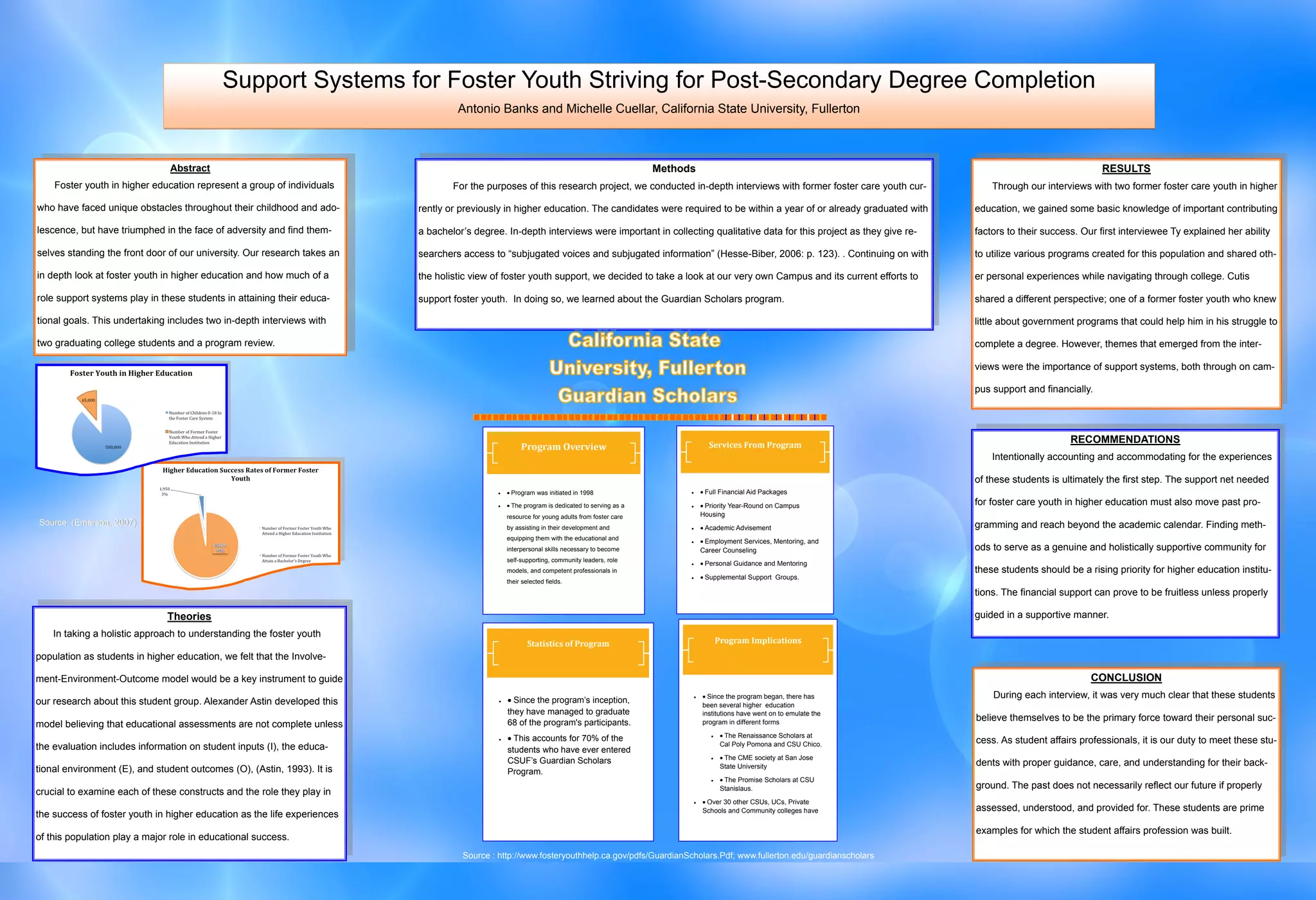
Support Systems for Foster Youth Striving for Post-Secondary Degree Completion
                                                                                   Antonio Banks and Michelle Cuellar, California State University, Fullerton


                               Abstract                                                                                                       Methods                                                                               RESULTS
    Foster youth in higher education represent a group of individuals             For the purposes of this research project, we conducted in-depth interviews with former foster care youth cur-         Through our interviews with two former foster care youth in higher

who have faced unique obstacles throughout their childhood and ado-       rently or previously in higher education. The candidates were required to be within a year of or already graduated with    education, we gained some basic knowledge of important contributing

lescence, but have triumphed in the face of adversity and find them-      a bachelor’s degree. In-depth interviews were important in collecting qualitative data for this project as they give re-   factors to their success. Our first interviewee Ty explained her ability

selves standing the front door of our university. Our research takes an   searchers access to “subjugated voices and subjugated information” (Hesse-Biber, 2006: p. 123). . Continuing on with       to utilize various programs created for this population and shared oth-

in depth look at foster youth in higher education and how much of a       the holistic view of foster youth support, we decided to take a look at our very own Campus and its current efforts to     er personal experiences while navigating through college. Cutis

role support systems play in these students in attaining their educa-     support foster youth. In doing so, we learned about the Guardian Scholars program.                                         shared a different perspective; one of a former foster youth who knew

tional goals. This undertaking includes two in-depth interviews with                                                                                                                                 little about government programs that could help him in his struggle to

two graduating college students and a program review.                                                                                                                                                complete a degree. However, themes that emerged from the inter-

                                                                                                                                                                                                     views were the importance of support systems, both through on cam-

                                                                                                                                                                                                     pus support and financially.


                                                                                                                                                          Services From Program
                                                                                                                                                                                                                            RECOMMENDATIONS
                                                                                                      Program Overview
                                                                                                                                                                                                         Intentionally accounting and accommodating for the experiences

                                                                                                                                                                                                     of these students is ultimately the first step. The support net needed
                                                                                                 Program was initiated in 1998                        Full Financial Aid Packages
                                                                                                 The program is dedicated to serving as a             Priority Year-Round on Campus              for foster care youth in higher education must also move past pro-
                                                                                                 resource for young adults from foster care             Housing
Source: (Emerson, 2007)                                                                                                                                                                              gramming and reach beyond the academic calendar. Finding meth-
                                                                                                 by assisting in their development and                  Academic Advisement
                                                                                                 equipping them with the educational and
                                                                                                                                                        Employment Services, Mentoring, and
                                                                                                 interpersonal skills necessary to become               Career Counseling                            ods to serve as a genuine and holistically supportive community for
                                                                                                 self-supporting, community leaders, role
                                                                                                                                                        Personal Guidance and Mentoring
                                                                                                 models, and competent professionals in                                                              these students should be a rising priority for higher education institu-
                                                                                                                                                        Supplemental Support Groups.
                                                                                                 their selected fields.
                                                                                                                                                                                                     tions. The financial support can prove to be fruitless unless properly

                               Theories                                                                                                                                                              guided in a supportive manner.
    In taking a holistic approach to understanding the foster youth
                                                                                                         Statistics of Program                                 Program Implications
population as students in higher education, we felt that the Involve-

ment-Environment-Outcome model would be a key instrument to guide                                                                                                                                                                CONCLUSION

                                                                                                  Since the program’s inception,
                                                                                                                                                        Since the program began, there has             During each interview, it was very much clear that these students
our research about this student group. Alexander Astin developed this                        
                                                                                                                                                        been several higher education
                                                                                                 they have managed to graduate                          institutions have went on to emulate the
                                                                                                 68 of the program's participants.
                                                                                                                                                                                                     believe themselves to be the primary force toward their personal suc-
model believing that educational assessments are not complete unless                                                                                    program in different forms
                                                                                                                                                                 The Renaissance Scholars at
                                                                                                 This accounts for 70% of the                            
                                                                                                                                                                                                     cess. As student affairs professionals, it is our duty to meet these stu-
the evaluation includes information on student inputs (I), the educa-                                                                                           Cal Poly Pomona and CSU Chico.
                                                                                                 students who have ever entered
                                                                                                                                                                The CME society at San Jose
                                                                                                 CSUF’s Guardian Scholars                                                                            dents with proper guidance, care, and understanding for their back-
                                                                                                                                                                State University
tional environment (E), and student outcomes (O), (Astin, 1993). It is                           Program.
                                                                                                                                                                The Promise Scholars at CSU
                                                                                                                                                                Stanislaus.                          ground. The past does not necessarily reflect our future if properly
crucial to examine each of these constructs and the role they play in
                                                                                                                                                        Over 30 other CSUs, UCs, Private
                                                                                                                                                        Schools and Community colleges have          assessed, understood, and provided for. These students are prime
the success of foster youth in higher education as the life experiences
                                                                                                                                                                                                     examples for which the student affairs profession was built.
of this population play a major role in educational success.
                                                                                    Source : http://www.fosteryouthhelp.ca.gov/pdfs/GuardianScholars.Pdf; www.fullerton.edu/guardianscholars

Foster youth degree completion poster board ss

  • 1.
    Support Systems forFoster Youth Striving for Post-Secondary Degree Completion Antonio Banks and Michelle Cuellar, California State University, Fullerton Abstract Methods RESULTS Foster youth in higher education represent a group of individuals For the purposes of this research project, we conducted in-depth interviews with former foster care youth cur- Through our interviews with two former foster care youth in higher who have faced unique obstacles throughout their childhood and ado- rently or previously in higher education. The candidates were required to be within a year of or already graduated with education, we gained some basic knowledge of important contributing lescence, but have triumphed in the face of adversity and find them- a bachelor’s degree. In-depth interviews were important in collecting qualitative data for this project as they give re- factors to their success. Our first interviewee Ty explained her ability selves standing the front door of our university. Our research takes an searchers access to “subjugated voices and subjugated information” (Hesse-Biber, 2006: p. 123). . Continuing on with to utilize various programs created for this population and shared oth- in depth look at foster youth in higher education and how much of a the holistic view of foster youth support, we decided to take a look at our very own Campus and its current efforts to er personal experiences while navigating through college. Cutis role support systems play in these students in attaining their educa- support foster youth. In doing so, we learned about the Guardian Scholars program. shared a different perspective; one of a former foster youth who knew tional goals. This undertaking includes two in-depth interviews with little about government programs that could help him in his struggle to two graduating college students and a program review. complete a degree. However, themes that emerged from the inter- views were the importance of support systems, both through on cam- pus support and financially. Services From Program RECOMMENDATIONS Program Overview Intentionally accounting and accommodating for the experiences of these students is ultimately the first step. The support net needed   Program was initiated in 1998   Full Financial Aid Packages   The program is dedicated to serving as a   Priority Year-Round on Campus for foster care youth in higher education must also move past pro- resource for young adults from foster care Housing Source: (Emerson, 2007) gramming and reach beyond the academic calendar. Finding meth- by assisting in their development and   Academic Advisement equipping them with the educational and   Employment Services, Mentoring, and interpersonal skills necessary to become Career Counseling ods to serve as a genuine and holistically supportive community for self-supporting, community leaders, role   Personal Guidance and Mentoring models, and competent professionals in these students should be a rising priority for higher education institu-   Supplemental Support Groups. their selected fields. tions. The financial support can prove to be fruitless unless properly Theories guided in a supportive manner. In taking a holistic approach to understanding the foster youth Statistics of Program Program Implications population as students in higher education, we felt that the Involve- ment-Environment-Outcome model would be a key instrument to guide CONCLUSION  Since the program’s inception,   Since the program began, there has During each interview, it was very much clear that these students our research about this student group. Alexander Astin developed this  been several higher education they have managed to graduate institutions have went on to emulate the 68 of the program's participants. believe themselves to be the primary force toward their personal suc- model believing that educational assessments are not complete unless program in different forms  The Renaissance Scholars at   This accounts for 70% of the  cess. As student affairs professionals, it is our duty to meet these stu- the evaluation includes information on student inputs (I), the educa- Cal Poly Pomona and CSU Chico. students who have ever entered   The CME society at San Jose CSUF’s Guardian Scholars dents with proper guidance, care, and understanding for their back- State University tional environment (E), and student outcomes (O), (Astin, 1993). It is Program.   The Promise Scholars at CSU Stanislaus. ground. The past does not necessarily reflect our future if properly crucial to examine each of these constructs and the role they play in   Over 30 other CSUs, UCs, Private Schools and Community colleges have assessed, understood, and provided for. These students are prime the success of foster youth in higher education as the life experiences examples for which the student affairs profession was built. of this population play a major role in educational success. Source : http://www.fosteryouthhelp.ca.gov/pdfs/GuardianScholars.Pdf; www.fullerton.edu/guardianscholars