SIGIT PRIHATMOKO
Foster Financial
Inclusion
1
Agenda
Which consumer segments are still unbanked, and why?
Banking for every island: how can banks overcome the challenge of poor infrastructure?
From innovation to design: what can be done to foster public accessibility to credit from banks?
Looking ahead: exploring the potential of a cashless society
2
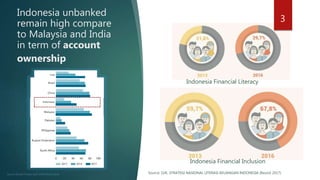
Indonesia unbanked
remain high compare
to Malaysia and India
in term of account
ownership
Indonesia Financial Literacy
Indonesia Financial Inclusion
Source: OJK, STRATEGI NASIONAL LITERASI KEUANGAN INDONESIA (Revisit 2017)Source Global Findex April 2018 World Bank
3
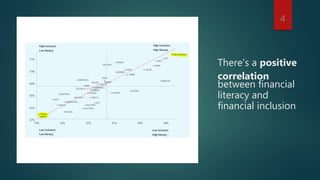
There’s a positive
correlation
between financial
literacy and
financial inclusion
4
Benefit of Financial
Inclusion Program
 Accumulated financial transactions will contribute
to a country's economic growth
 Financial Inclusion can help community
development (poverty reduction, social, and
economic)
5
Account ownership in
Indonesia
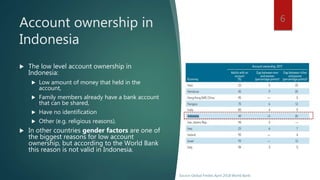
 The low level account ownership in
Indonesia:
 Low amount of money that held in the
account,
 Family members already have a bank account
that can be shared,
 Have no identification
 Other (e.g. religious reasons).
 In other countries gender factors are one of
the biggest reasons for low account
ownership, but according to the World Bank
this reason is not valid in Indonesia.
Source Global Findex April 2018 World Bank
6
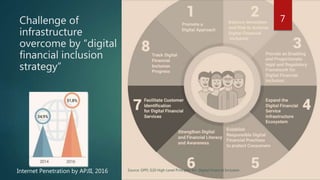
Challenge of
infrastructure
overcome by “digital
financial inclusion
strategy”
Source: GPFI, G20 High-Level Principles for Digital Financial InclusionInternet Penetration by APJII, 2016
7
Digital
Financial
Inclusion
 Digitalization plays a critical role to support “access
to and use of financial services” to support
inclusive and sustainable development
 Digitization offers an extraordinary opportunity
to address eligibility and affordability barriers to
formal financial inclusion faced by informal
individuals and firms. Rule of digitization
 Facilitate identity verification,
 Promote digital payments
 Improve the information environment.
 Support attention to financial consumer protection
and financial literacy
8
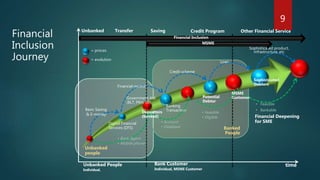
• Feasible
• Eligible
• Bank Agent
• Mobile phone
Credit scheme
Financial record
• Feasible
• Bankable
Banking
Transaction
• Account
• Database
Potential
Debtor
Depositors
(banked)
Digital Financial
Services (DFS)
= proces
= evolution
Unbanked
people
Sophisticated
Debtors
Unbanked Saving Other Financial Service
Loan
Sophisticated product,
infrastructure, etc
time
Financial Deepening
for SME
MSME
Financial Inclusion
Unbanked People
Individual,
Bank Customer
Individual, MSME Customer
MSME
CustomerGovernment Aid
(BLT, PKH, dll)
Banked
People
Credit ProgramTransfer
Basic Saving
& E-money
Financial
Inclusion
Journey
9
Financial Access
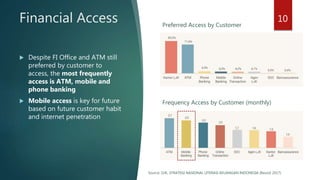
 Despite FI Office and ATM still
preferred by customer to
access, the most frequently
access is ATM, mobile and
phone banking
 Mobile access is key for future
based on future customer habit
and internet penetration
Preferred Access by Customer
Frequency Access by Customer (monthly)
Source: OJK, STRATEGI NASIONAL LITERASI KEUANGAN INDONESIA (Revisit 2017)
10
Foster public
accessibility for loan
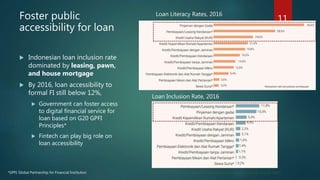
 Indonesian loan inclusion rate
dominated by leasing, pawn,
and house mortgage
 By 2016, loan accessibility to
formal FI still below 12%,
 Government can foster access
to digital financial service for
loan based on G20 GPFI
Principles*
 Fintech can play big role on
loan accessibility
Loan Literacy Rates, 2016
Loan Inclusion Rate, 2016
Source: OJK, STRATEGI NASIONAL LITERASI KEUANGAN INDONESIA (Revisit 2017)*GPFI: Global Partnership for Financial Institution
11
Use of
alternative
data for credit
reporting
 Improve availability and accuracy of information
from alternate information:
 Structured data: e.g. payment, transaction, invoice,
account payable shipment, pensions, remittance,
pensions
 Unstructured data: e.g. use of internet, social media,
emails, GPS data, mobile usage, psychographic,
 Expand credit information sharing
 Enable responsible cross-border data exchanges
 Balance market integrity, innovation and
competition
12
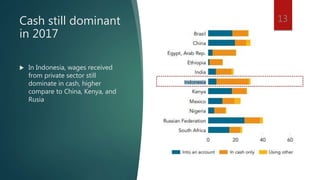
Cash still dominant
in 2017
 In Indonesia, wages received
from private sector still
dominate in cash, higher
compare to China, Kenya, and
Rusia
13
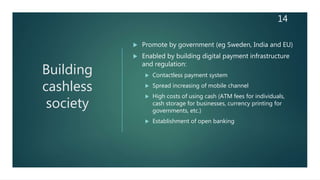
Building
cashless
society
 Promote by government (eg Sweden, India and EU)
 Enabled by building digital payment infrastructure
and regulation:
 Contactless payment system
 Spread increasing of mobile channel
 High costs of using cash (ATM fees for individuals,
cash storage for businesses, currency printing for
governments, etc.)
 Establishment of open banking
14
Pro cons of cashless economy
 Cashless economy pros:
 increased scope for monetary
policy,
 reduced tax evasion,
 less crime and corruption,
 savings on costs of cash, and
 accelerated modernization of
citizens.
 Cashless economy cons:
 potential violation of privacy,
 increased risk of large scale
personal and national security
breaches, and
 technology-dependent
financial inclusion.
15
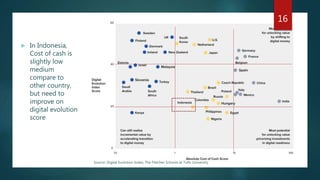
Source: Digital Evolution Index, The Fletcher Schools at Tufts University
 In Indonesia,
Cost of cash is
slightly low
medium
compare to
other country,
but need to
improve on
digital evolution
score
16
Thank You
17
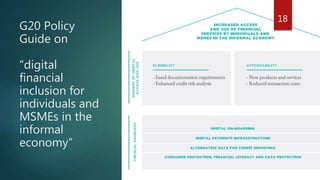
G20 Policy
Guide on
“digital
financial
inclusion for
individuals and
MSMEs in the
informal
economy”
18
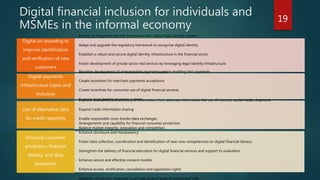
Digital financial inclusion for individuals and
MSMEs in the informal economy
Ensure an integrated identity framework with digital legal identity system
Adapt and upgrade the regulatory framework to recognize digital identity
Establish a robust and secure digital identity infrastructure in the financial sector
Foster development of private sector-led services by leveraging legal identity infrastructure
Monitor new developments and approaches to identity
Digital on-boarding to
improve identification
and verification of new
customers
Priorities development of interoperable payment systems enabling fast payments
Create incentives for merchant payments acceptance
Create incentives for consumer use of digital financial services
Support cross-border payment systems
Digital payments
infrastructure (open and
inclusive)
Improve availability and accuracy of information from alternate information like use of internet, social media, shipment,
Expand credit information sharing
Enable responsible cross-border data exchanges
Balance market integrity, innovation and competition
Use of alternative data
for credit reporting
Arrangements and capability for financial consumer protection
Enhance disclosure and transparency
Foster data collection, coordination and identification of new core competencies on digital financial literacy.
Strengthen the delivery of financial education for digital financial services and support its evaluation
Enhance secure and effective consent models
Enhance access, rectification, cancellation and opposition rights
Adoption of security measures could help protect against operational risks
Financial consumer
protection, financial
literacy, and data
protection
19

Foster Financial inclusion

  • 1.
  • 2.
    Agenda Which consumer segmentsare still unbanked, and why? Banking for every island: how can banks overcome the challenge of poor infrastructure? From innovation to design: what can be done to foster public accessibility to credit from banks? Looking ahead: exploring the potential of a cashless society 2
  • 3.
    Indonesia unbanked remain highcompare to Malaysia and India in term of account ownership Indonesia Financial Literacy Indonesia Financial Inclusion Source: OJK, STRATEGI NASIONAL LITERASI KEUANGAN INDONESIA (Revisit 2017)Source Global Findex April 2018 World Bank 3
  • 4.
    There’s a positive correlation betweenfinancial literacy and financial inclusion 4
  • 5.
    Benefit of Financial InclusionProgram  Accumulated financial transactions will contribute to a country's economic growth  Financial Inclusion can help community development (poverty reduction, social, and economic) 5
  • 6.
    Account ownership in Indonesia The low level account ownership in Indonesia:  Low amount of money that held in the account,  Family members already have a bank account that can be shared,  Have no identification  Other (e.g. religious reasons).  In other countries gender factors are one of the biggest reasons for low account ownership, but according to the World Bank this reason is not valid in Indonesia. Source Global Findex April 2018 World Bank 6
  • 7.
    Challenge of infrastructure overcome by“digital financial inclusion strategy” Source: GPFI, G20 High-Level Principles for Digital Financial InclusionInternet Penetration by APJII, 2016 7
  • 8.
    Digital Financial Inclusion  Digitalization playsa critical role to support “access to and use of financial services” to support inclusive and sustainable development  Digitization offers an extraordinary opportunity to address eligibility and affordability barriers to formal financial inclusion faced by informal individuals and firms. Rule of digitization  Facilitate identity verification,  Promote digital payments  Improve the information environment.  Support attention to financial consumer protection and financial literacy 8
  • 9.
    • Feasible • Eligible •Bank Agent • Mobile phone Credit scheme Financial record • Feasible • Bankable Banking Transaction • Account • Database Potential Debtor Depositors (banked) Digital Financial Services (DFS) = proces = evolution Unbanked people Sophisticated Debtors Unbanked Saving Other Financial Service Loan Sophisticated product, infrastructure, etc time Financial Deepening for SME MSME Financial Inclusion Unbanked People Individual, Bank Customer Individual, MSME Customer MSME CustomerGovernment Aid (BLT, PKH, dll) Banked People Credit ProgramTransfer Basic Saving & E-money Financial Inclusion Journey 9
  • 10.
    Financial Access  DespiteFI Office and ATM still preferred by customer to access, the most frequently access is ATM, mobile and phone banking  Mobile access is key for future based on future customer habit and internet penetration Preferred Access by Customer Frequency Access by Customer (monthly) Source: OJK, STRATEGI NASIONAL LITERASI KEUANGAN INDONESIA (Revisit 2017) 10
  • 11.
    Foster public accessibility forloan  Indonesian loan inclusion rate dominated by leasing, pawn, and house mortgage  By 2016, loan accessibility to formal FI still below 12%,  Government can foster access to digital financial service for loan based on G20 GPFI Principles*  Fintech can play big role on loan accessibility Loan Literacy Rates, 2016 Loan Inclusion Rate, 2016 Source: OJK, STRATEGI NASIONAL LITERASI KEUANGAN INDONESIA (Revisit 2017)*GPFI: Global Partnership for Financial Institution 11
  • 12.
    Use of alternative data forcredit reporting  Improve availability and accuracy of information from alternate information:  Structured data: e.g. payment, transaction, invoice, account payable shipment, pensions, remittance, pensions  Unstructured data: e.g. use of internet, social media, emails, GPS data, mobile usage, psychographic,  Expand credit information sharing  Enable responsible cross-border data exchanges  Balance market integrity, innovation and competition 12
  • 13.
    Cash still dominant in2017  In Indonesia, wages received from private sector still dominate in cash, higher compare to China, Kenya, and Rusia 13
  • 14.
    Building cashless society  Promote bygovernment (eg Sweden, India and EU)  Enabled by building digital payment infrastructure and regulation:  Contactless payment system  Spread increasing of mobile channel  High costs of using cash (ATM fees for individuals, cash storage for businesses, currency printing for governments, etc.)  Establishment of open banking 14
  • 15.
    Pro cons ofcashless economy  Cashless economy pros:  increased scope for monetary policy,  reduced tax evasion,  less crime and corruption,  savings on costs of cash, and  accelerated modernization of citizens.  Cashless economy cons:  potential violation of privacy,  increased risk of large scale personal and national security breaches, and  technology-dependent financial inclusion. 15
  • 16.
    Source: Digital EvolutionIndex, The Fletcher Schools at Tufts University  In Indonesia, Cost of cash is slightly low medium compare to other country, but need to improve on digital evolution score 16
  • 17.
  • 18.
    G20 Policy Guide on “digital financial inclusionfor individuals and MSMEs in the informal economy” 18
  • 19.
    Digital financial inclusionfor individuals and MSMEs in the informal economy Ensure an integrated identity framework with digital legal identity system Adapt and upgrade the regulatory framework to recognize digital identity Establish a robust and secure digital identity infrastructure in the financial sector Foster development of private sector-led services by leveraging legal identity infrastructure Monitor new developments and approaches to identity Digital on-boarding to improve identification and verification of new customers Priorities development of interoperable payment systems enabling fast payments Create incentives for merchant payments acceptance Create incentives for consumer use of digital financial services Support cross-border payment systems Digital payments infrastructure (open and inclusive) Improve availability and accuracy of information from alternate information like use of internet, social media, shipment, Expand credit information sharing Enable responsible cross-border data exchanges Balance market integrity, innovation and competition Use of alternative data for credit reporting Arrangements and capability for financial consumer protection Enhance disclosure and transparency Foster data collection, coordination and identification of new core competencies on digital financial literacy. Strengthen the delivery of financial education for digital financial services and support its evaluation Enhance secure and effective consent models Enhance access, rectification, cancellation and opposition rights Adoption of security measures could help protect against operational risks Financial consumer protection, financial literacy, and data protection 19