
Open J9
The Next Free Java VM
Charlie Gracie, Eclipse OMR Co-Project Lead
IBM Advisory Software Developer
1
Important Disclaimers
• THE INFORMATION CONTAINED IN THIS PRESENTATION IS PROVIDED FOR INFORMATIONAL PURPOSES ONLY.
• WHILST EFFORTS WERE MADE TO VERIFY THE COMPLETENESS AND ACCURACY OF THE INFORMATION
CONTAINED IN THIS PRESENTATION, IT IS PROVIDED “AS IS”, WITHOUT WARRANTY OF ANY KIND,
EXPRESS OR IMPLIED.
• ALL PERFORMANCE DATA INCLUDED IN THIS PRESENTATION HAVE BEEN GATHERED IN A CONTROLLED
ENVIRONMENT. YOUR OWN TEST RESULTS MAY VARY BASED ON HARDWARE, SOFTWARE OR
INFRASTRUCTURE DIFFERENCES.
• ALL DATA INCLUDED IN THIS PRESENTATION ARE MEANT TO BE USED ONLY AS A GUIDE.
• IN ADDITION, THE INFORMATION CONTAINED IN THIS PRESENTATION IS BASED ON IBM’S CURRENT
PRODUCT PLANS AND STRATEGY, WHICH ARE SUBJECT TO CHANGE BY IBM, WITHOUT NOTICE.
• IBM AND ITS AFFILIATED COMPANIES SHALL NOT BE RESPONSIBLE FOR ANY DAMAGES ARISING OUT
OF THE USE OF, OR OTHERWISE RELATED TO, THIS PRESENTATION OR ANY OTHER DOCUMENTATION.
• NOTHING CONTAINED IN THIS PRESENTATION IS INTENDED TO, OR SHALL HAVE THE EFFECT OF:
• CREATING ANY WARRANT OR REPRESENTATION FROM IBM, ITS AFFILIATED COMPANIES OR ITS
OR THEIR SUPPLIERS AND/OR LICENSORS
2
This Talk
1. J9 Overview
2. Eclipse OMR
3. Open J9
4. Questions
3
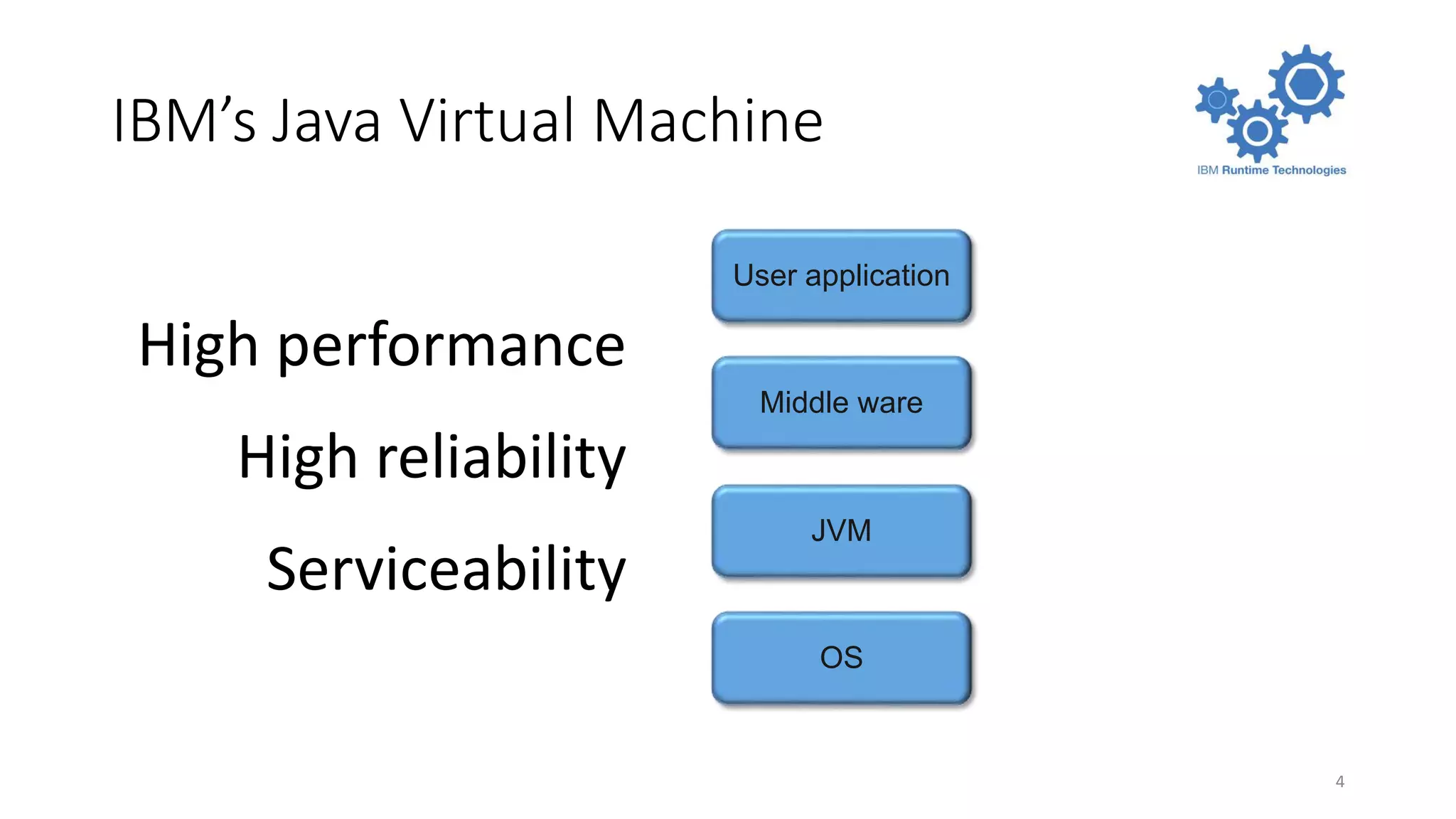
IBM’s Java Virtual Machine
High performance
High reliability
Serviceability
4
OS
JVM
Middle ware
User application
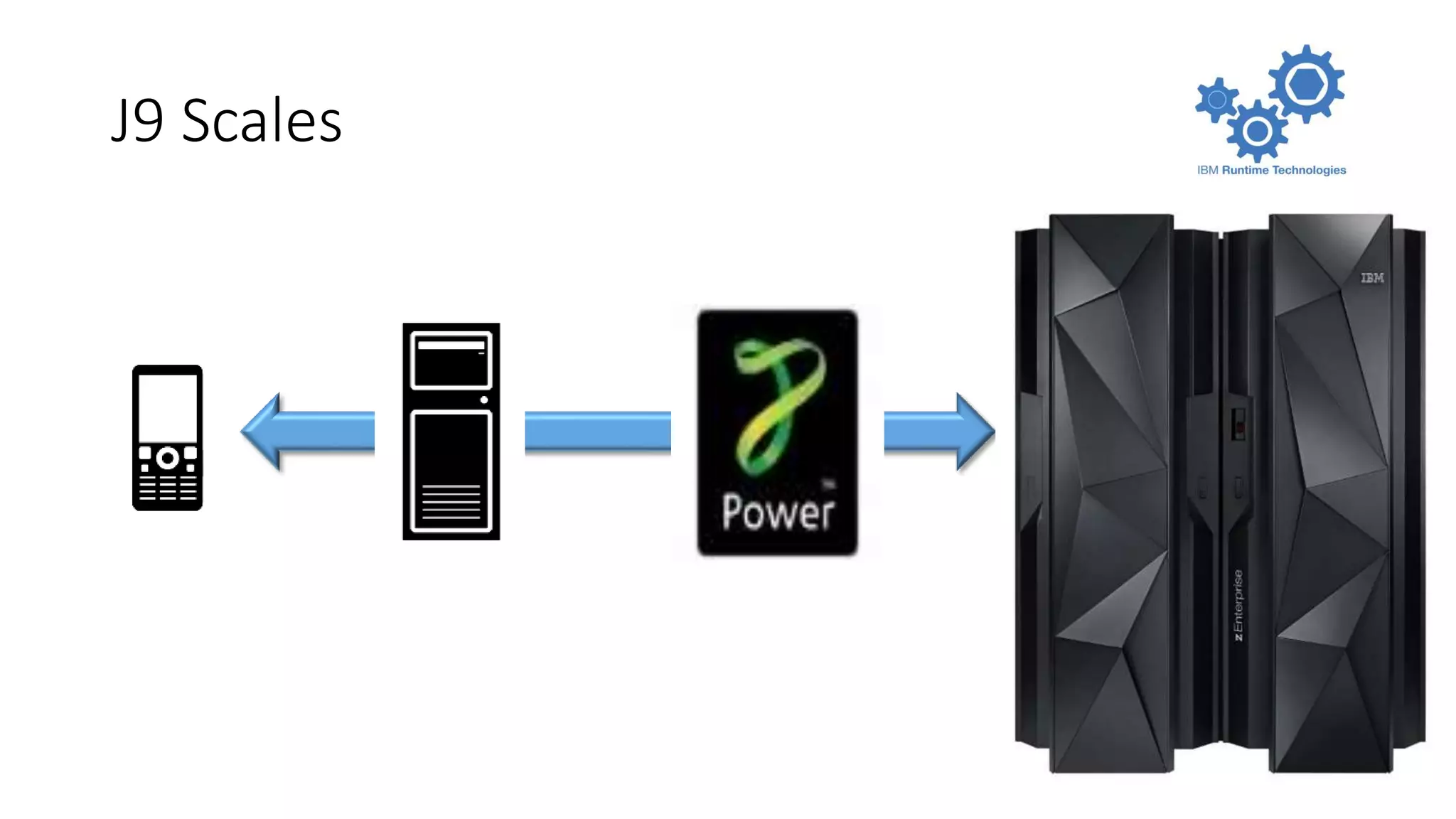
J9 Scales
5
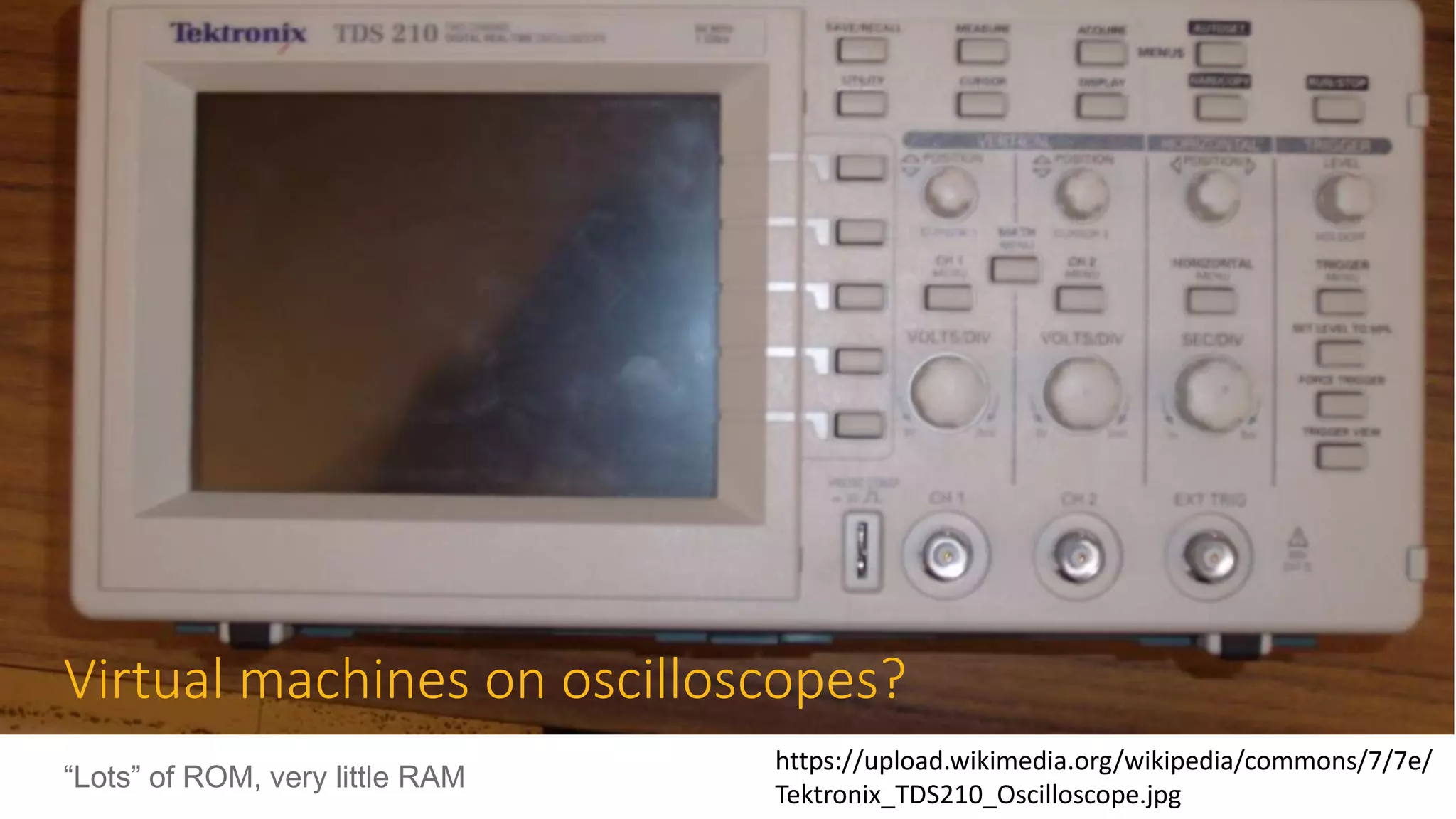
Virtual machines on oscilloscopes?
“Lots” of ROM, very little RAM
https://upload.wikimedia.org/wikipedia/commons/7/7e/
Tektronix_TDS210_Oscilloscope.jpg
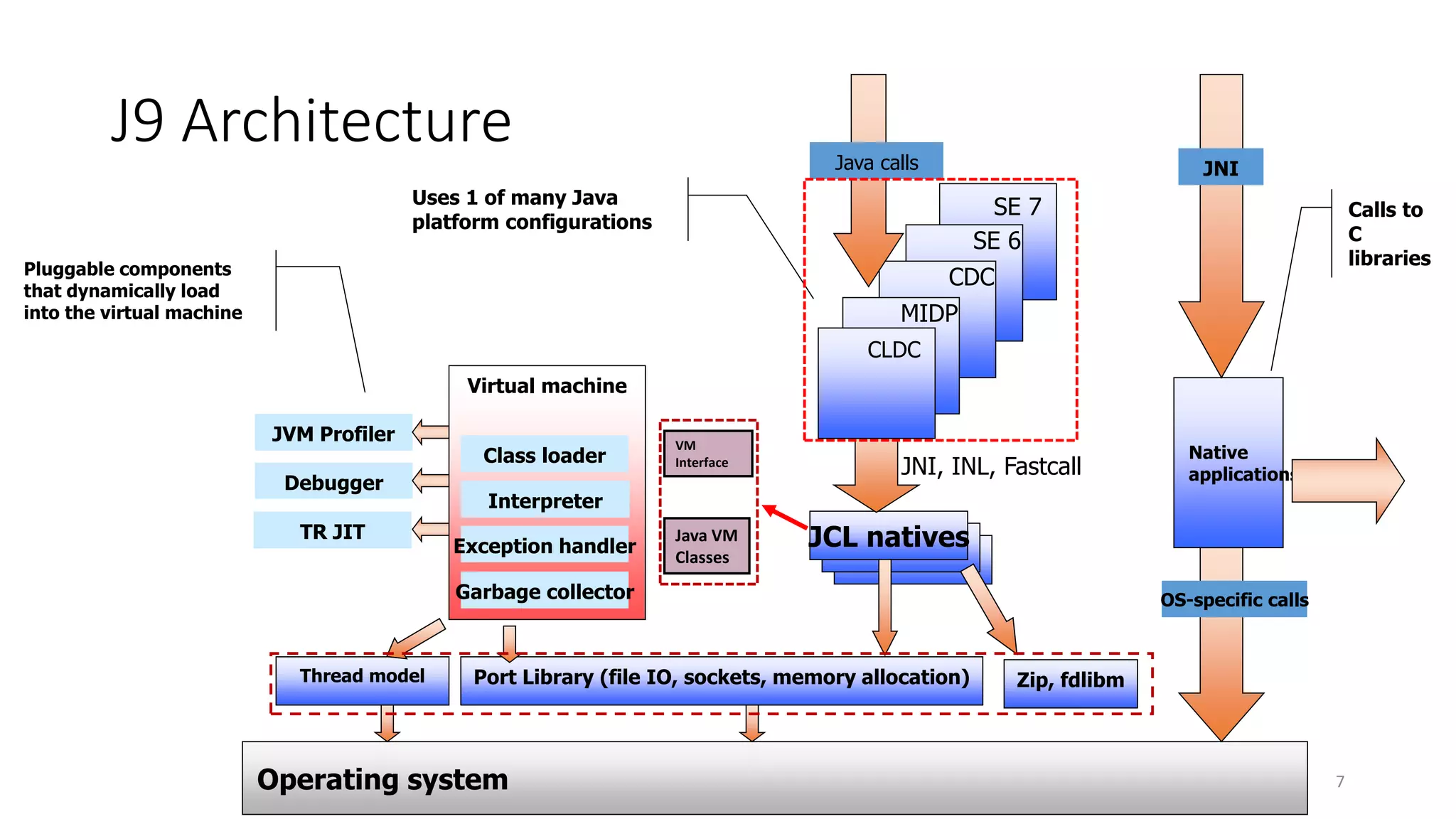
J9 Architecture
7
SE 7
Operating system
Native
applications
OS-specific calls
Virtual machine
SE 6
Garbage collector
Interpreter
Exception handler
Class loader
Pluggable components
that dynamically load
into the virtual machine
Thread model
JVM Profiler
Debugger
Port Library (file IO, sockets, memory allocation)
Uses 1 of many Java
platform configurations
JCL natives
JNI
Calls to
C
libraries
CDC
MIDP
Java calls
JNI, INL, Fastcall
TR JIT
CLDC
VM
Interface
Zip, fdlibm
Java VM
Classes
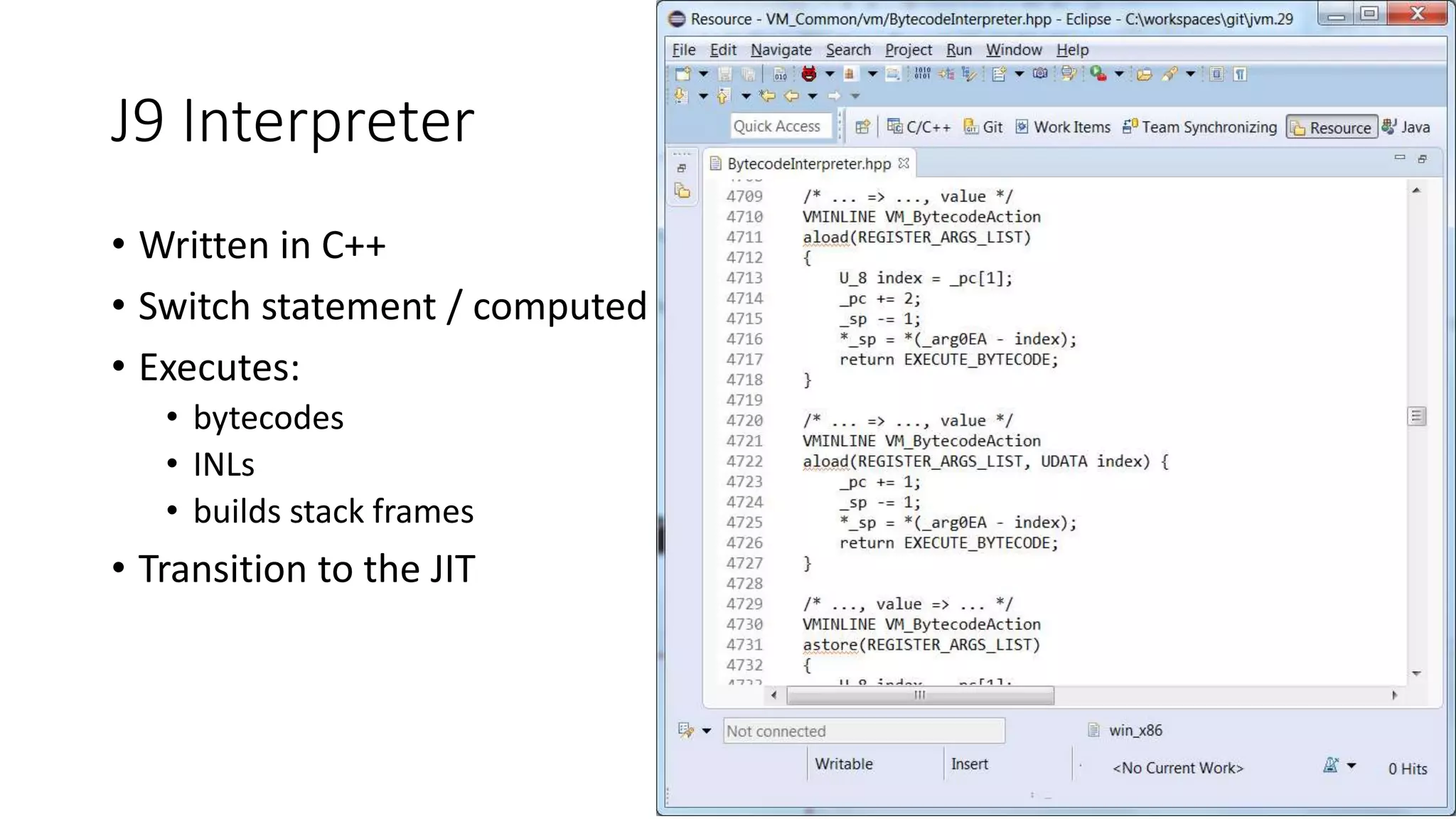
J9 Interpreter
• Written in C++
• Switch statement / computed goto
• Executes:
• bytecodes
• INLs
• builds stack frames
• Transition to the JIT
8
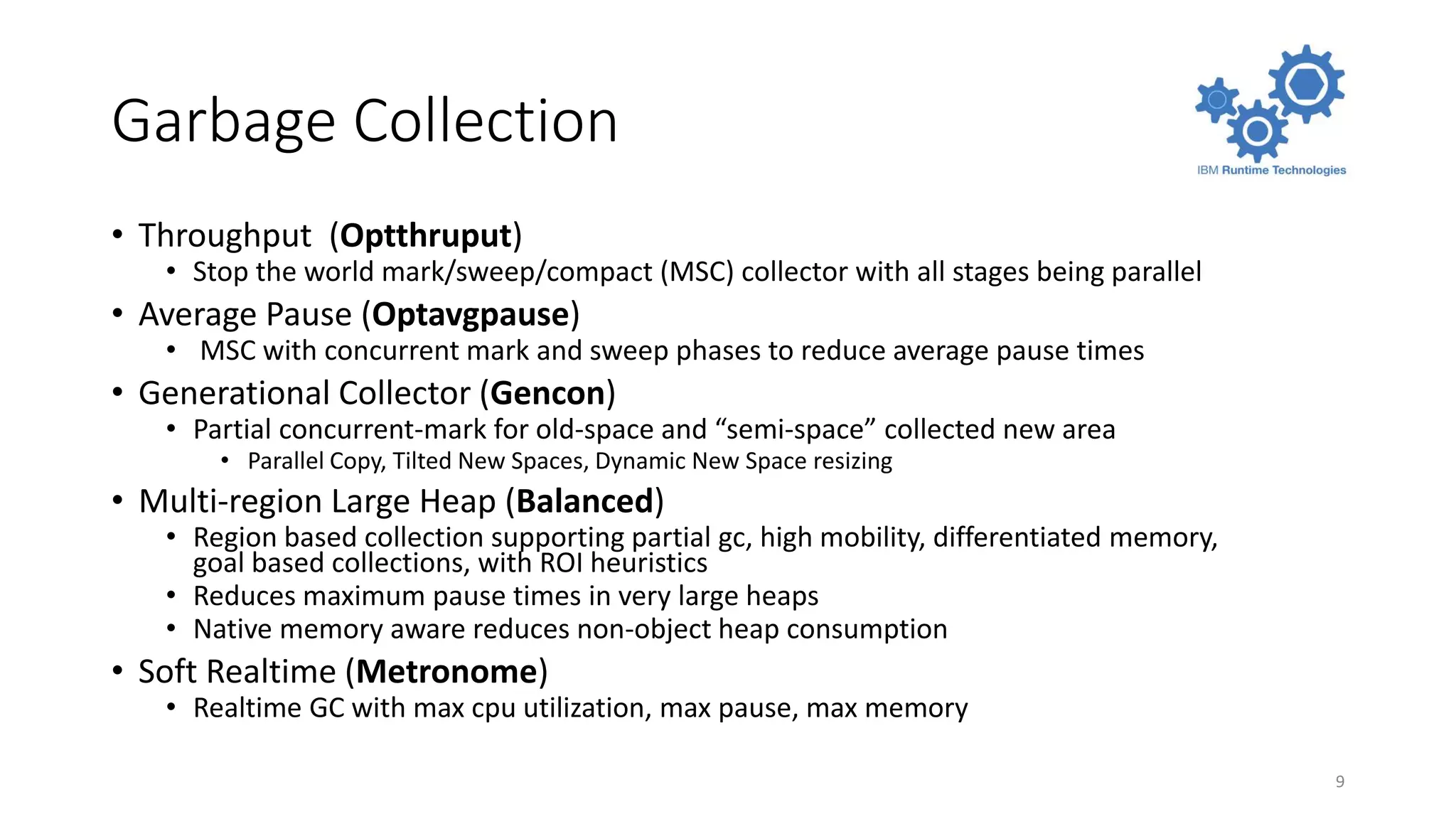
Garbage Collection
• Throughput (Optthruput)
• Stop the world mark/sweep/compact (MSC) collector with all stages being parallel
• Average Pause (Optavgpause)
• MSC with concurrent mark and sweep phases to reduce average pause times
• Generational Collector (Gencon)
• Partial concurrent-mark for old-space and “semi-space” collected new area
• Parallel Copy, Tilted New Spaces, Dynamic New Space resizing
• Multi-region Large Heap (Balanced)
• Region based collection supporting partial gc, high mobility, differentiated memory,
goal based collections, with ROI heuristics
• Reduces maximum pause times in very large heaps
• Native memory aware reduces non-object heap consumption
• Soft Realtime (Metronome)
• Realtime GC with max cpu utilization, max pause, max memory
9
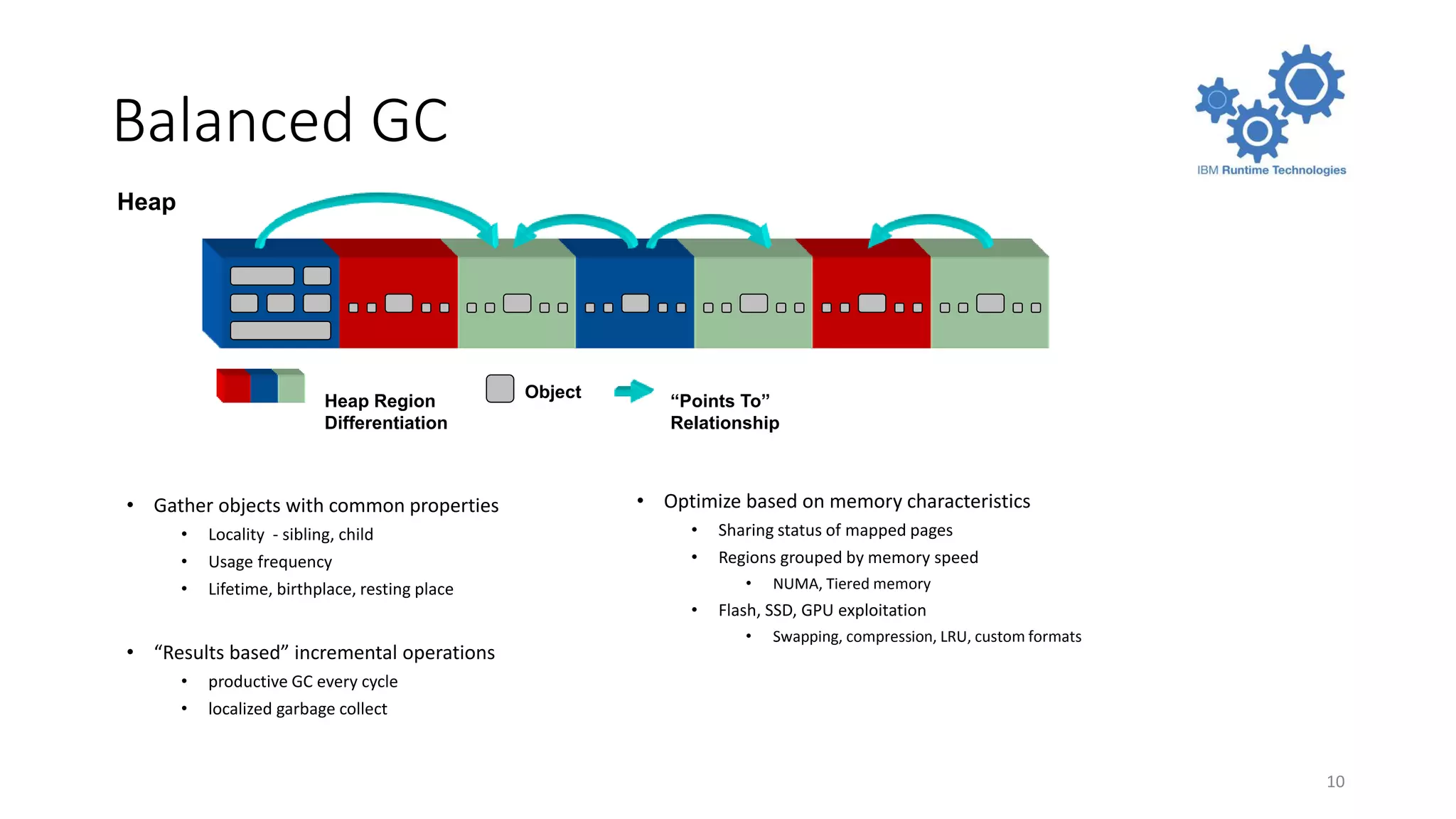
Balanced GC
10
“Points To”
Relationship
Heap Region
Differentiation
Heap
Object
• Gather objects with common properties
• Locality - sibling, child
• Usage frequency
• Lifetime, birthplace, resting place
• “Results based” incremental operations
• productive GC every cycle
• localized garbage collect
• Optimize based on memory characteristics
• Sharing status of mapped pages
• Regions grouped by memory speed
• NUMA, Tiered memory
• Flash, SSD, GPU exploitation
• Swapping, compression, LRU, custom formats
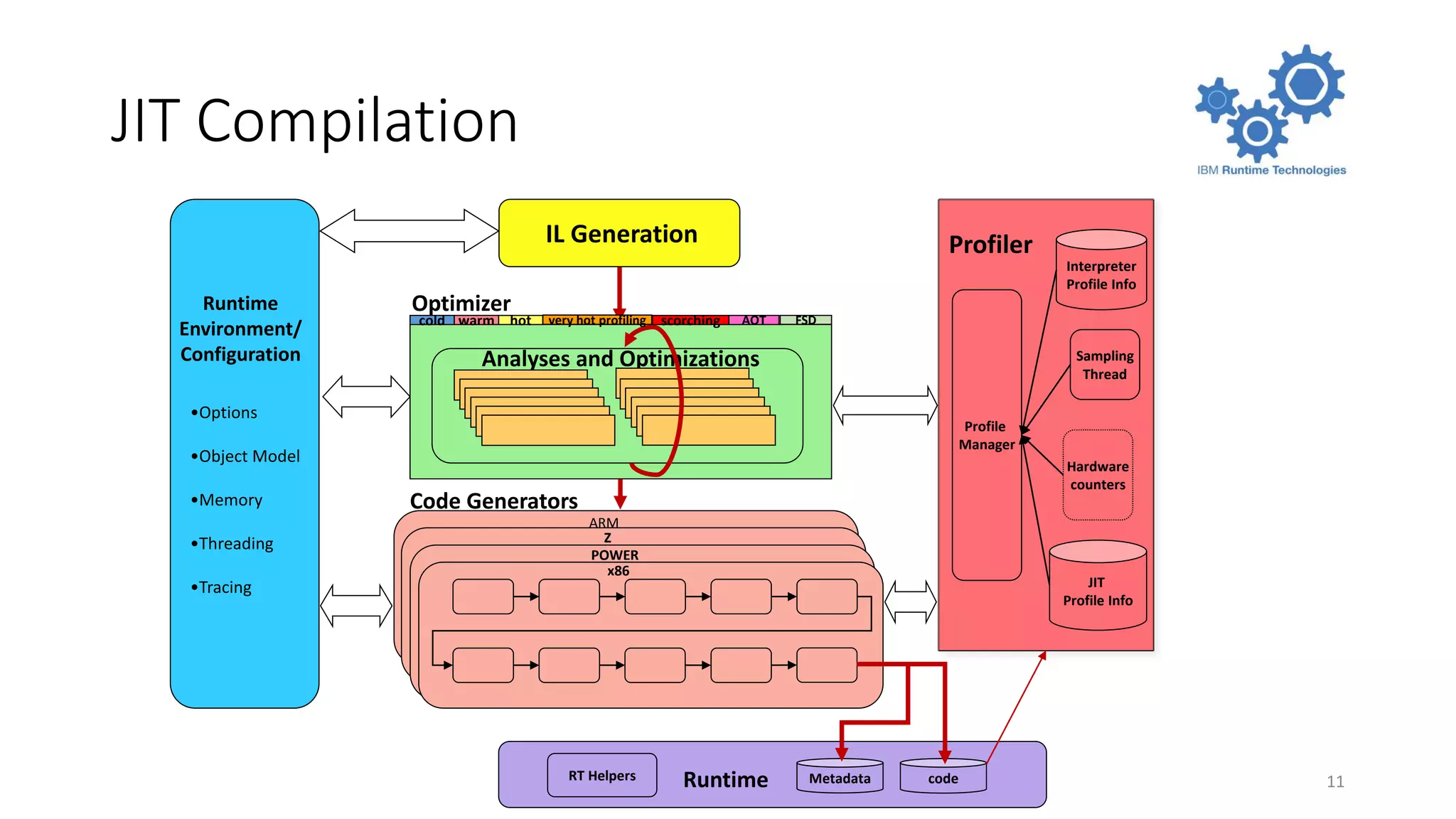
JIT Compilation
11
ARM
Optimizer
Analyses and Optimizations
cold warm hot FSDscorching AOT
IL Generation
x86
POWER
Z
Code Generators
Runtime
Environment/
Configuration
•Options
•Object Model
•Memory
•Threading
•Tracing
codeMetadataRuntimeRT Helpers
very hot profiling
Profile
Manager
Hardware
counters
Sampling
Thread
Interpreter
Profile Info
JIT
Profile Info
Profiler
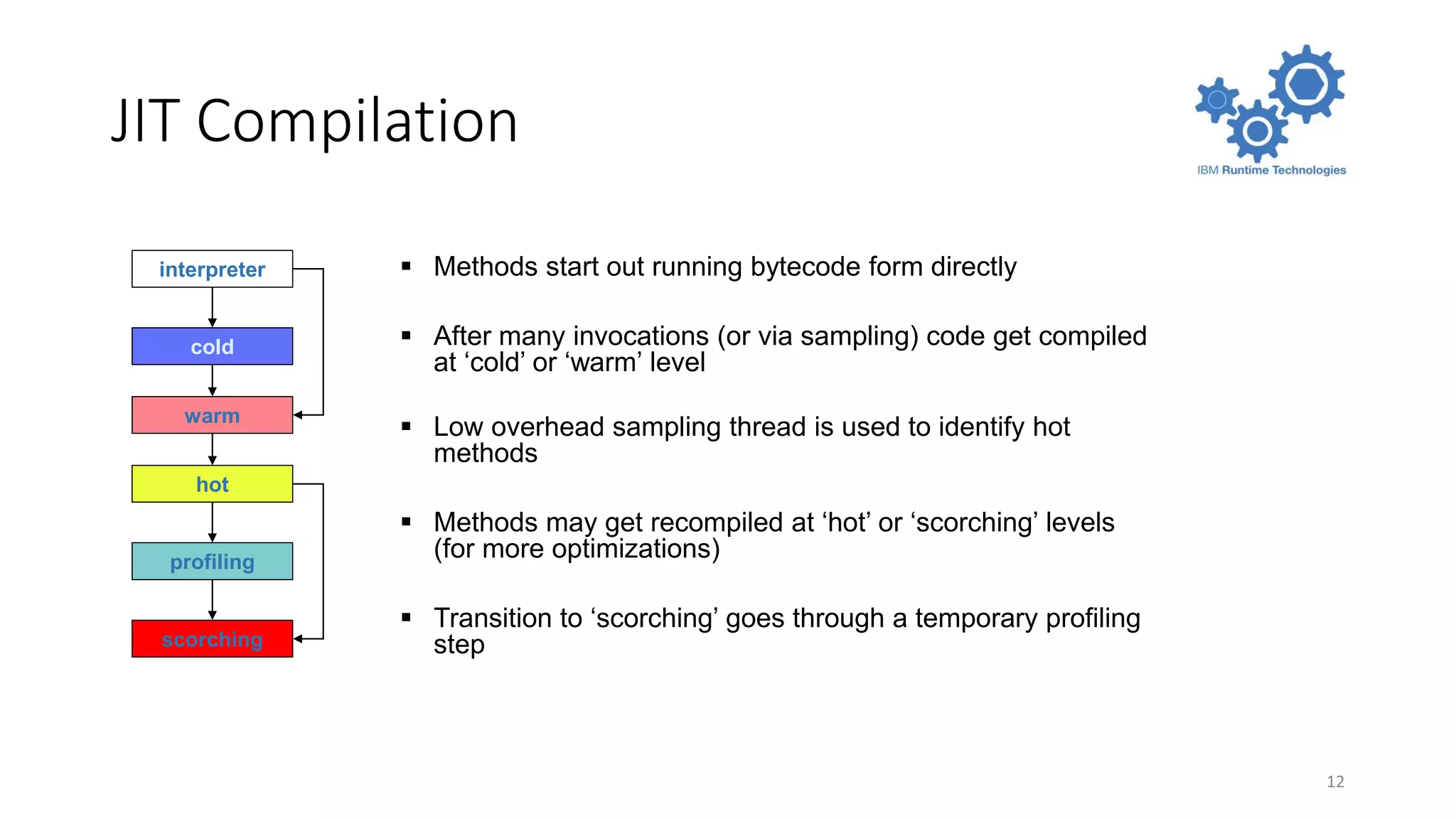
JIT Compilation
12
 Methods start out running bytecode form directly
 After many invocations (or via sampling) code get compiled
at ‘cold’ or ‘warm’ level
 Low overhead sampling thread is used to identify hot
methods
 Methods may get recompiled at ‘hot’ or ‘scorching’ levels
(for more optimizations)
 Transition to ‘scorching’ goes through a temporary profiling
step
cold
hot
scorching
profiling
interpreter
warm
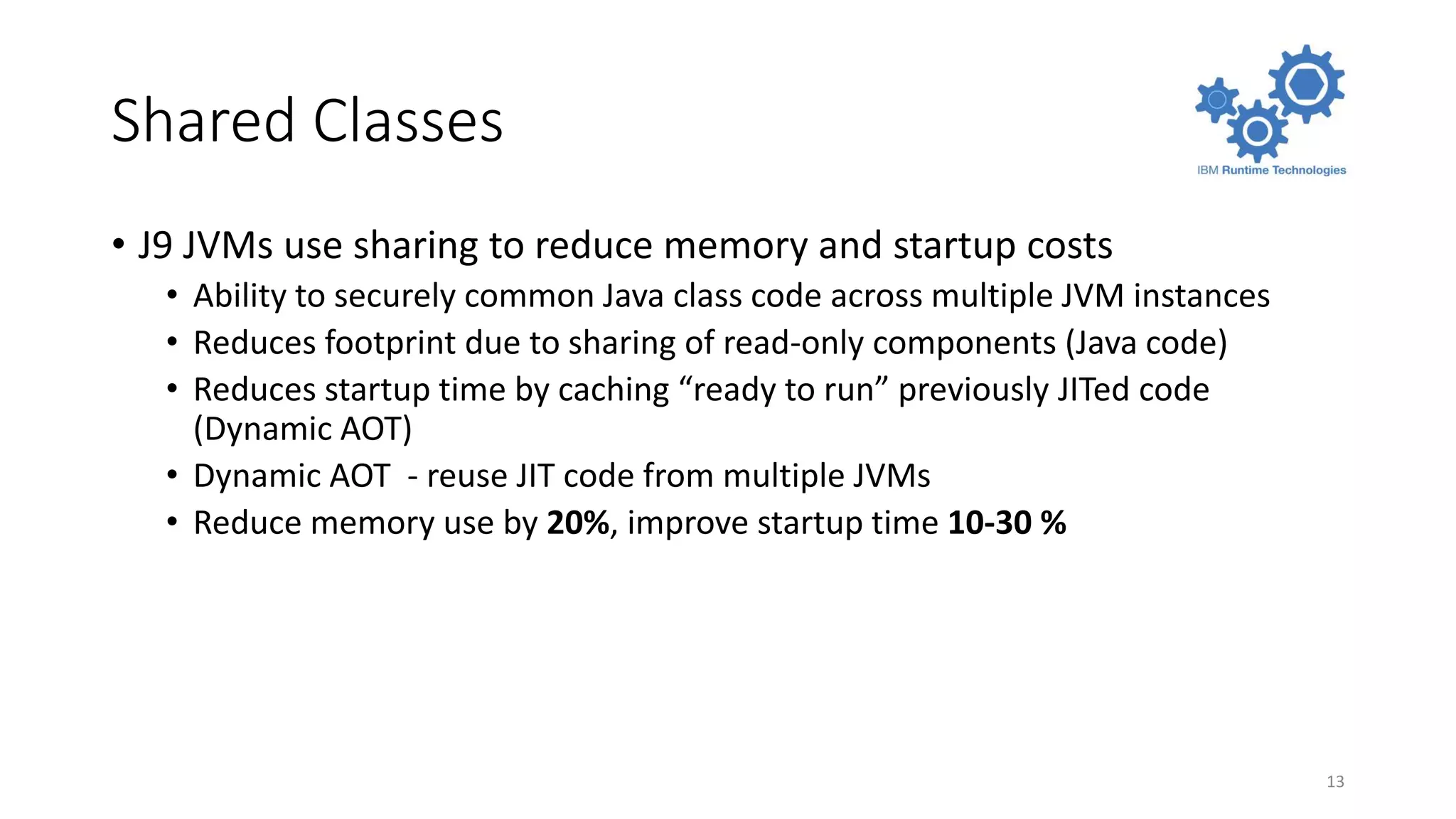
Shared Classes
• J9 JVMs use sharing to reduce memory and startup costs
• Ability to securely common Java class code across multiple JVM instances
• Reduces footprint due to sharing of read-only components (Java code)
• Reduces startup time by caching “ready to run” previously JITed code
(Dynamic AOT)
• Dynamic AOT - reuse JIT code from multiple JVMs
• Reduce memory use by 20%, improve startup time 10-30 %
13
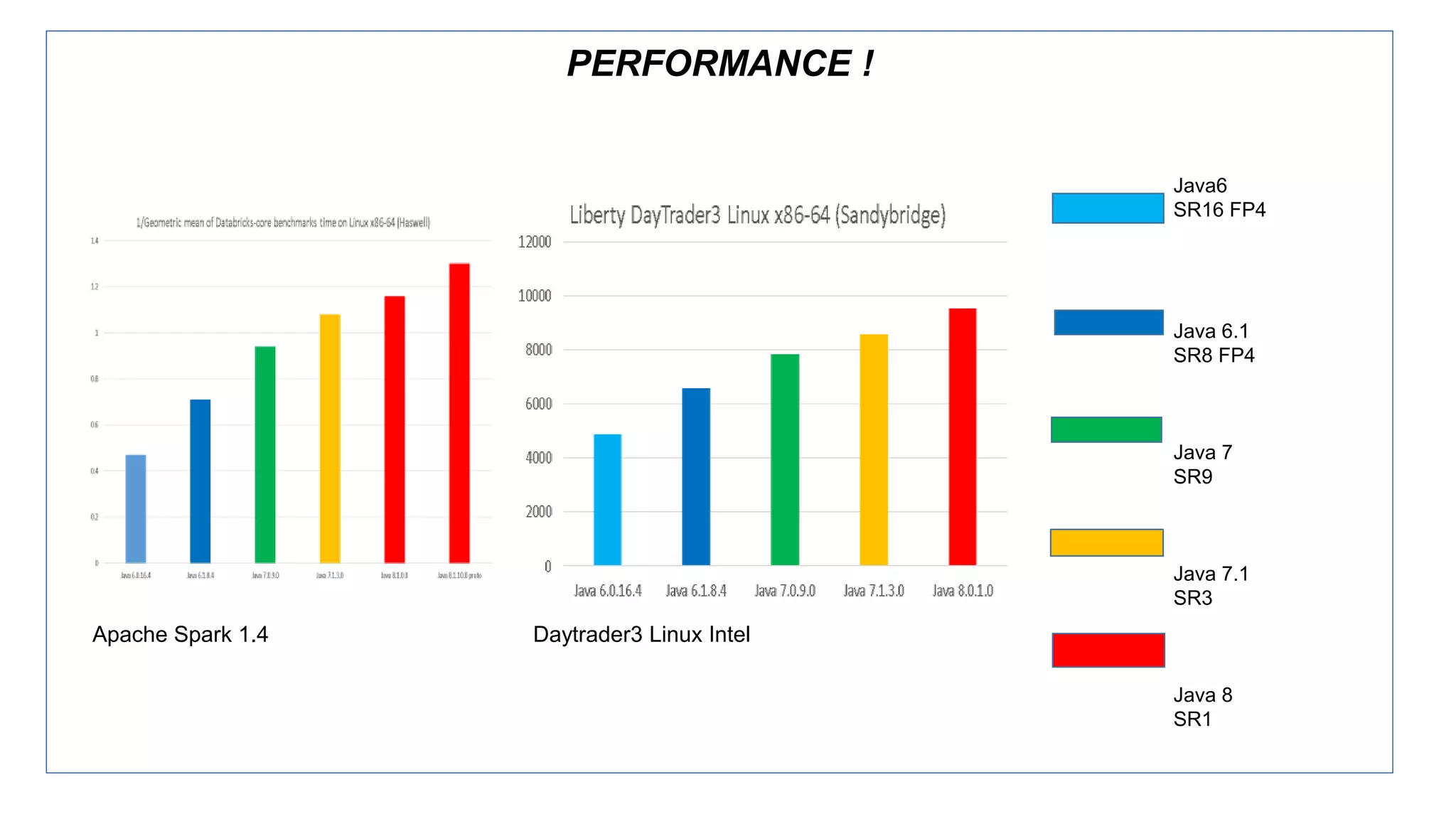
PERFORMANCE !
Java6
SR16 FP4
Java 6.1
SR8 FP4
Java 7
SR9
Java 7.1
SR3
Java 8
SR1
Apache Spark 1.4 Daytrader3 Linux Intel
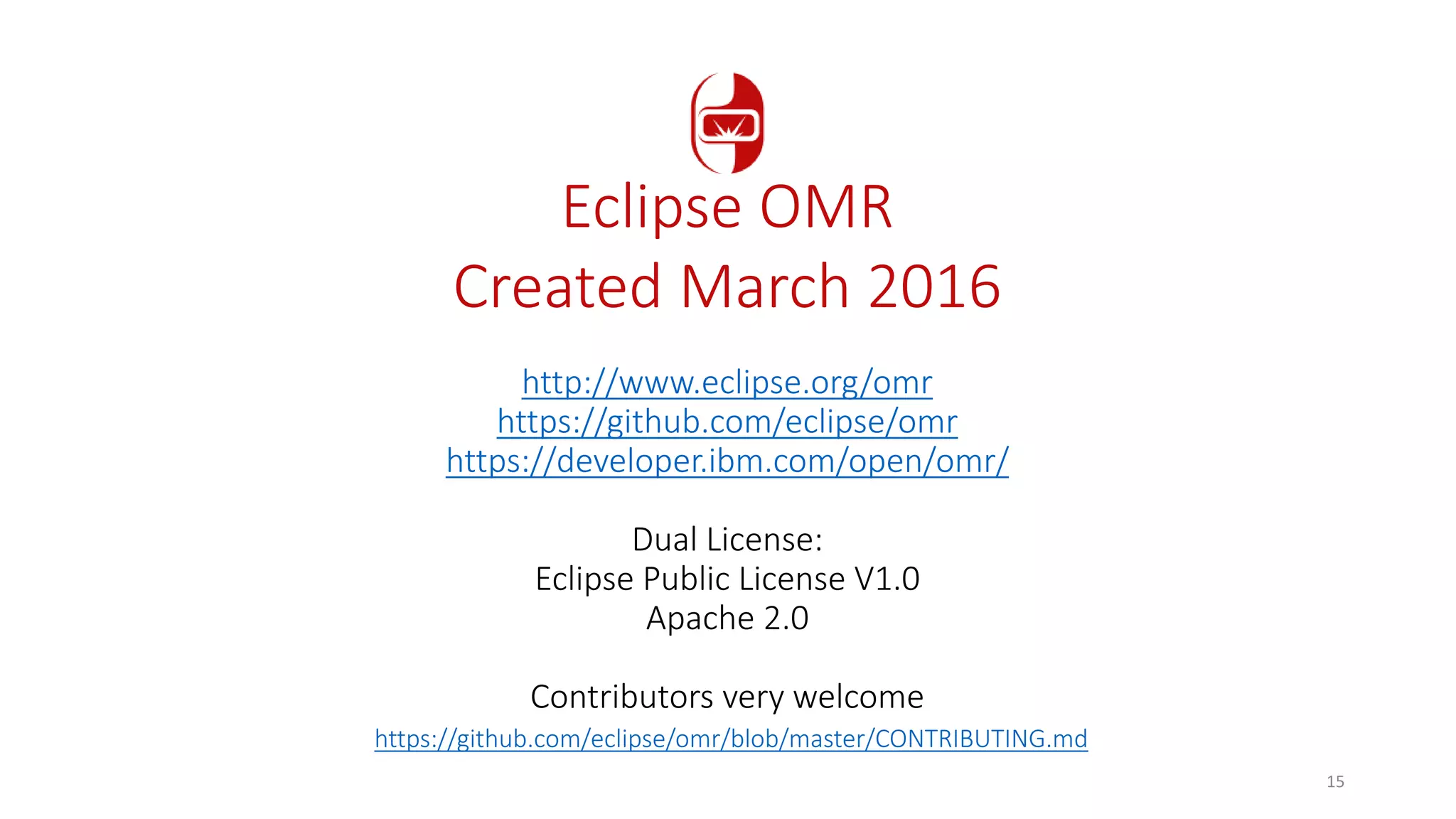
http://www.eclipse.org/omr
https://github.com/eclipse/omr
https://developer.ibm.com/open/omr/
Dual License:
Eclipse Public License V1.0
Apache 2.0
Contributors very welcome
https://github.com/eclipse/omr/blob/master/CONTRIBUTING.md
Eclipse OMR
Created March 2016
15
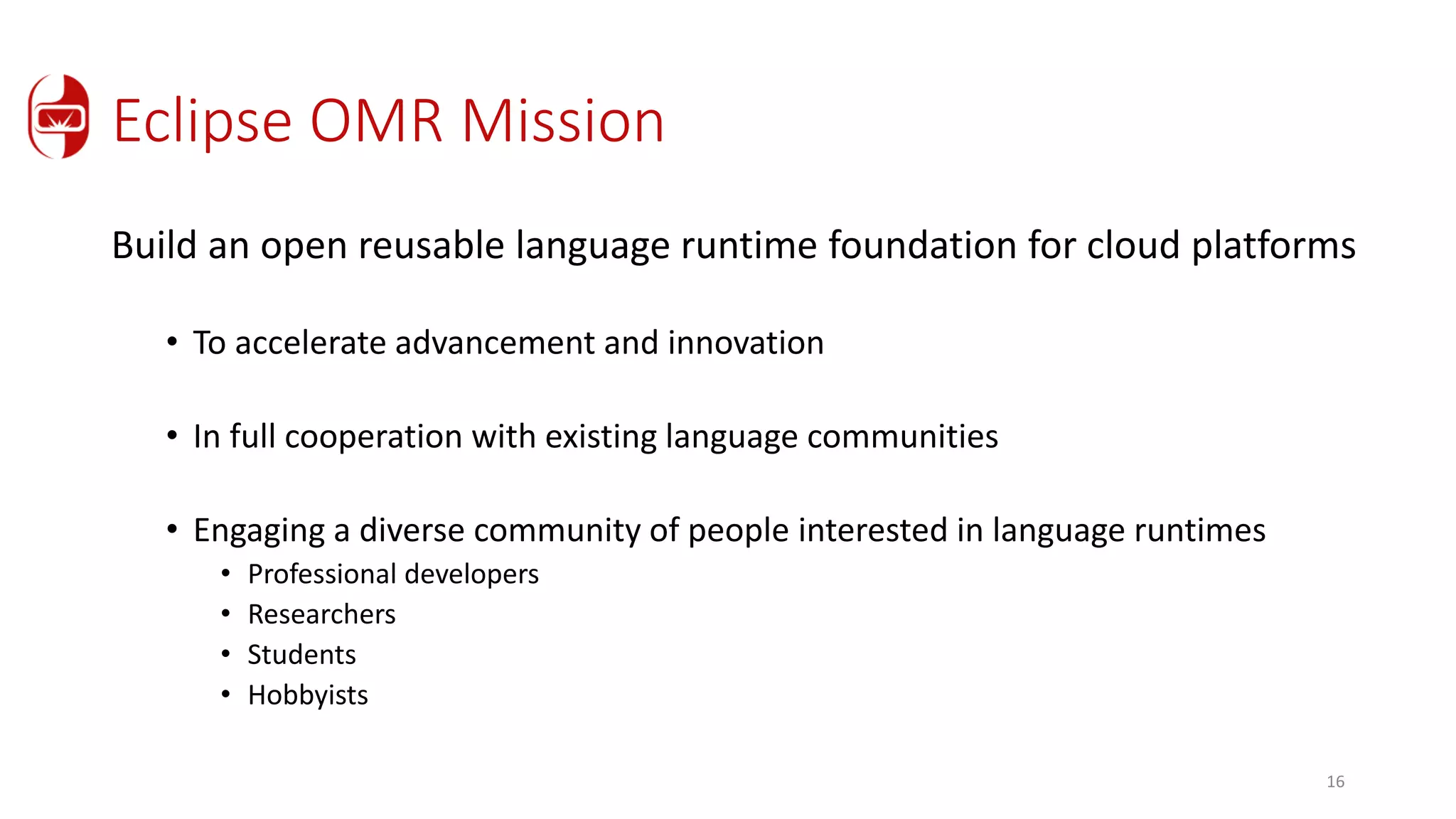
Eclipse OMR Mission
Build an open reusable language runtime foundation for cloud platforms
• To accelerate advancement and innovation
• In full cooperation with existing language communities
• Engaging a diverse community of people interested in language runtimes
• Professional developers
• Researchers
• Students
• Hobbyists
16
Eclipse OMR Components Currently Available
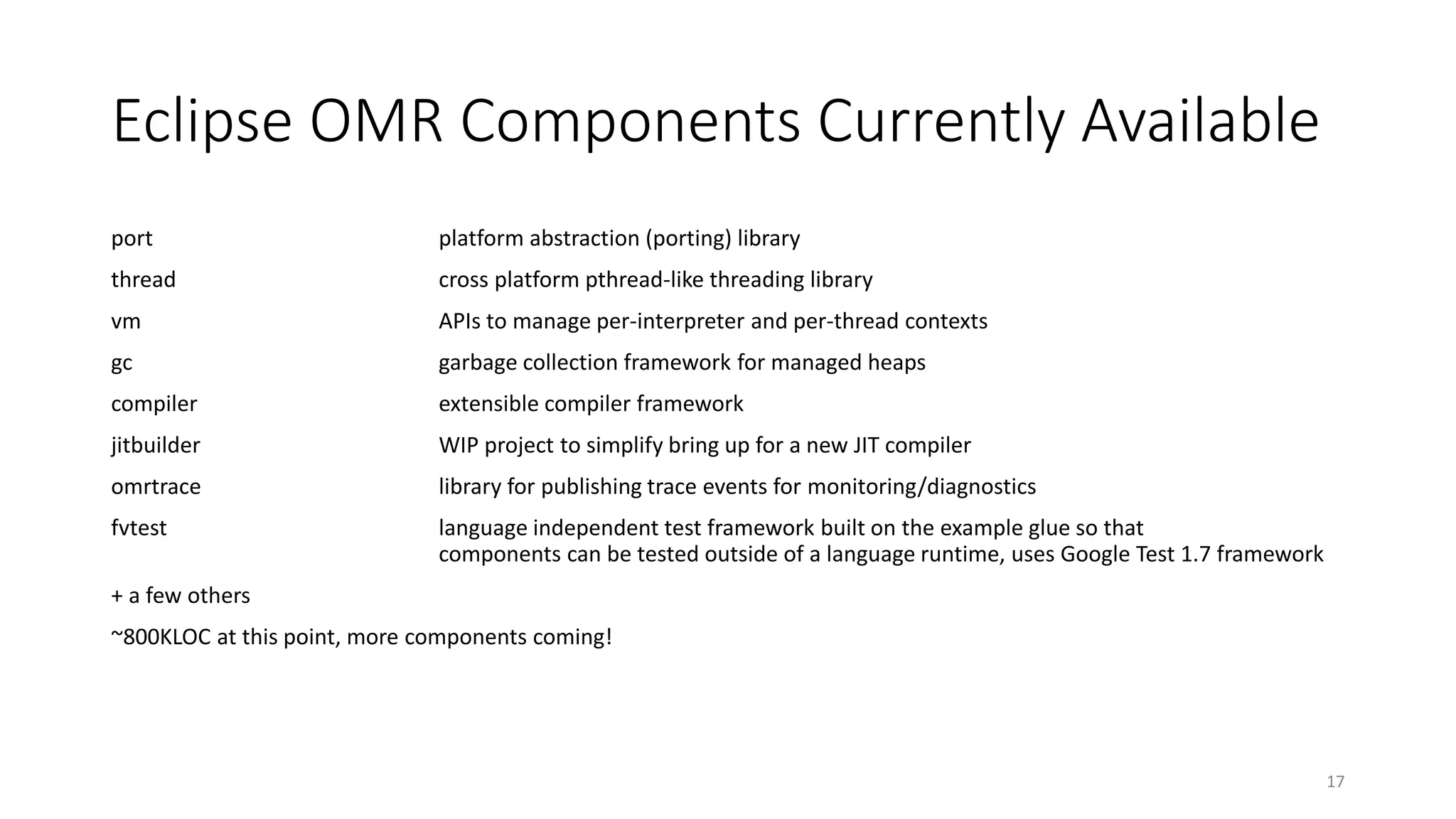
port platform abstraction (porting) library
thread cross platform pthread-like threading library
vm APIs to manage per-interpreter and per-thread contexts
gc garbage collection framework for managed heaps
compiler extensible compiler framework
jitbuilder WIP project to simplify bring up for a new JIT compiler
omrtrace library for publishing trace events for monitoring/diagnostics
fvtest language independent test framework built on the example glue so that
components can be tested outside of a language runtime, uses Google Test 1.7 framework
+ a few others
~800KLOC at this point, more components coming!
17
“We believe open ecosystems
and partnerships are key to our
future innovation.”
-- Ginni Rometty
(http://www.ibm.com/annualreport/2014/chairmans-letter.html)
18
Open J9 – Why?
19
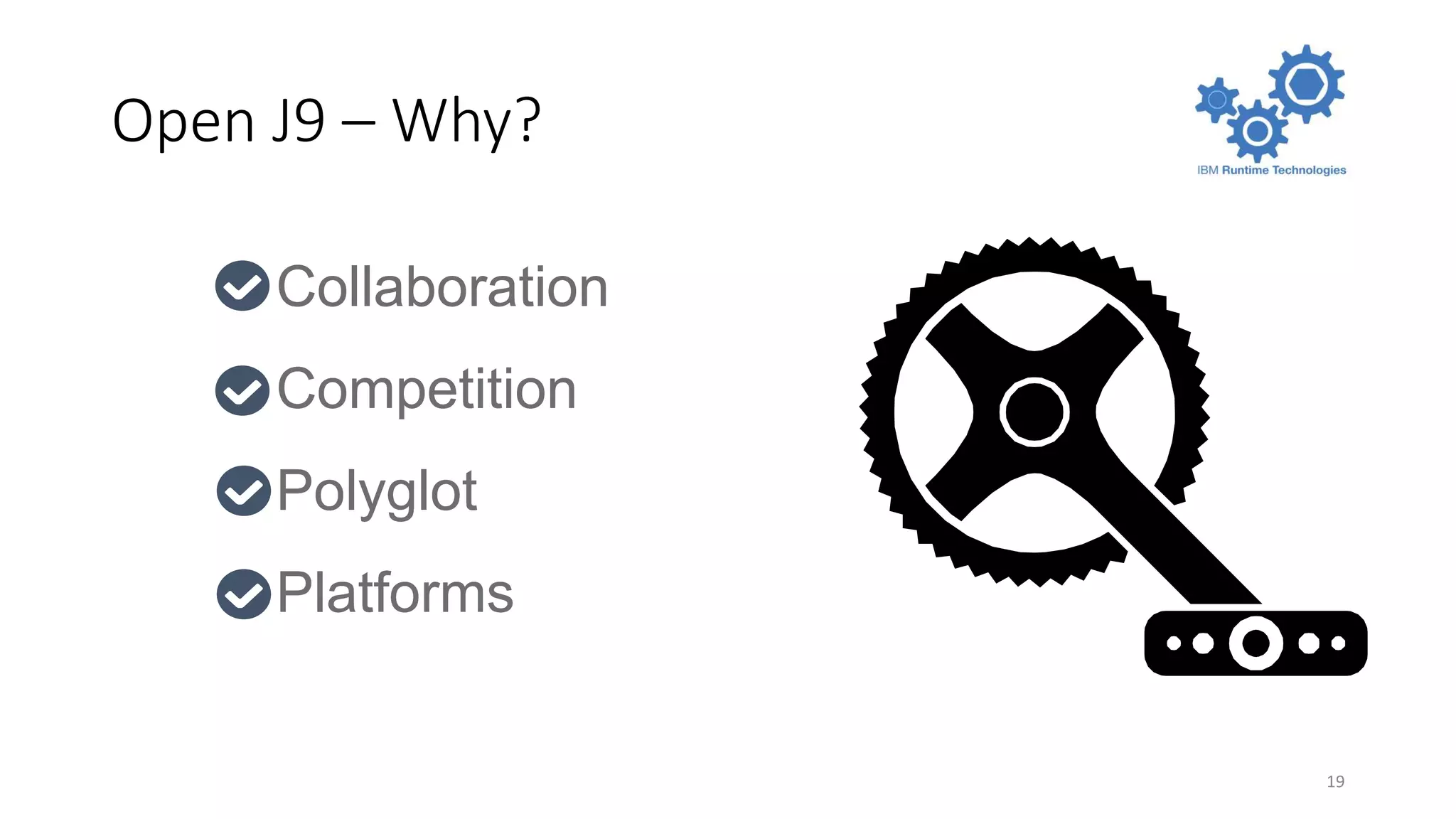
Collaboration
Competition
Polyglot
Platforms
Collaboration
Competition
Polyglot
Platforms
Open J9 – Where?
20
Open
JDK
HotSpot
Eclipse OMR
Open
JDK
Open J9
OMR
Open
JDK
Open J9
OMR
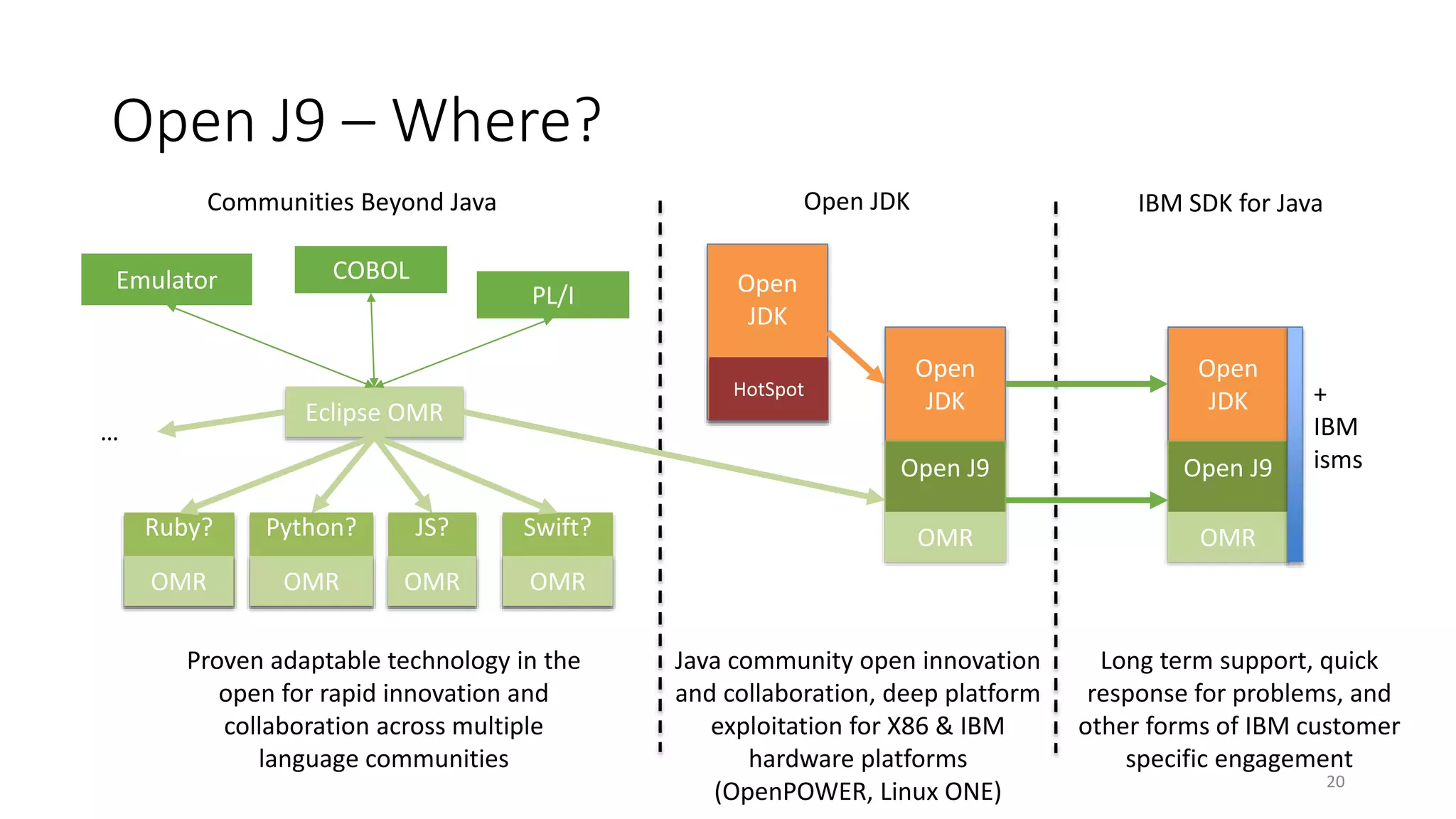
Proven adaptable technology in the
open for rapid innovation and
collaboration across multiple
language communities
Open JDK IBM SDK for Java
Java community open innovation
and collaboration, deep platform
exploitation for X86 & IBM
hardware platforms
(OpenPOWER, Linux ONE)
Ruby?
OMR
Communities Beyond Java
COBOL
PL/I
Emulator
Python?
OMR
JS?
OMR
Swift?
OMR
…
Long term support, quick
response for problems, and
other forms of IBM customer
specific engagement
+
IBM
isms
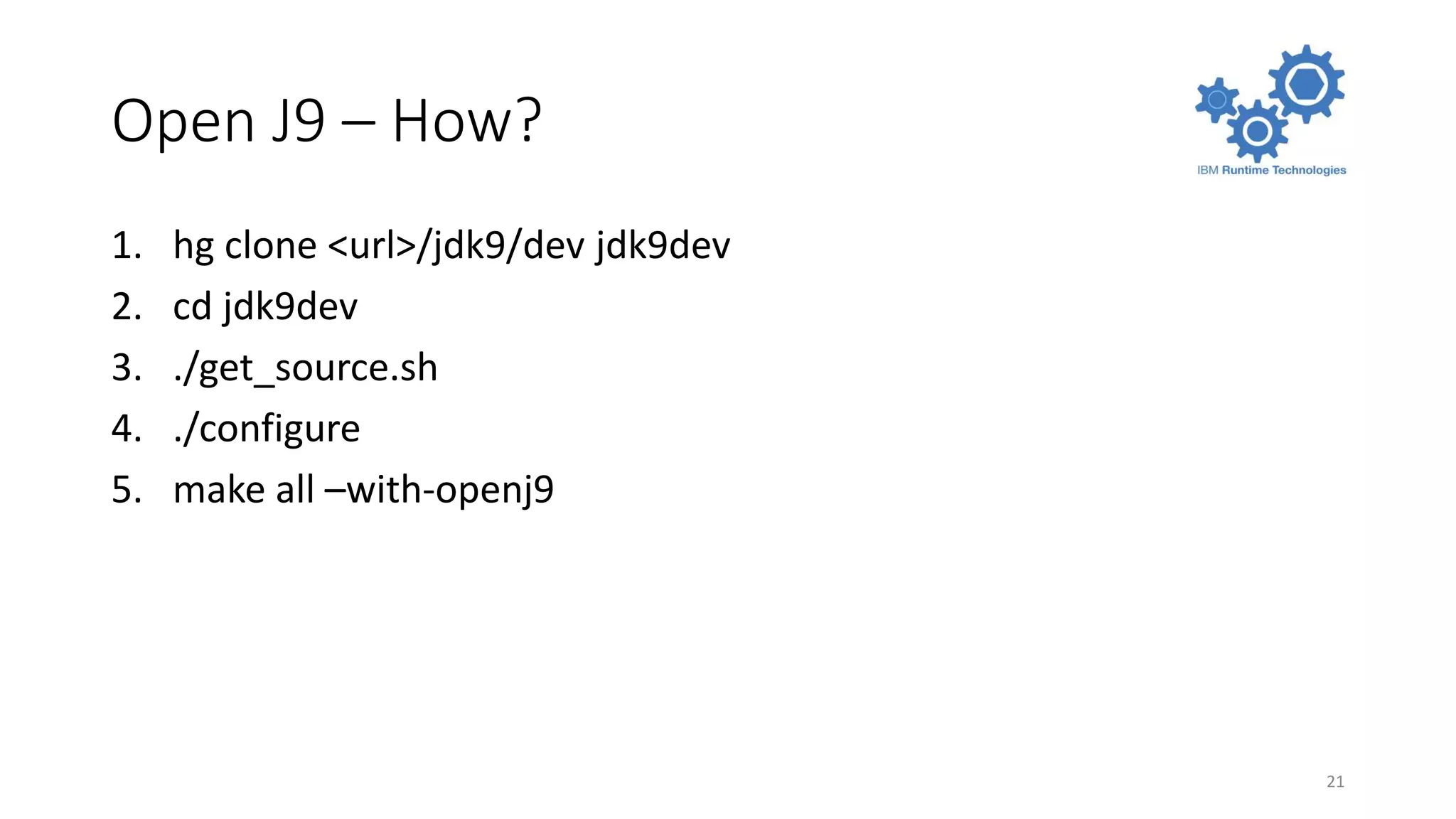
Open J9 – How?
1. hg clone <url>/jdk9/dev jdk9dev
2. cd jdk9dev
3. ./get_source.sh
4. ./configure
5. make all –with-openj9
21
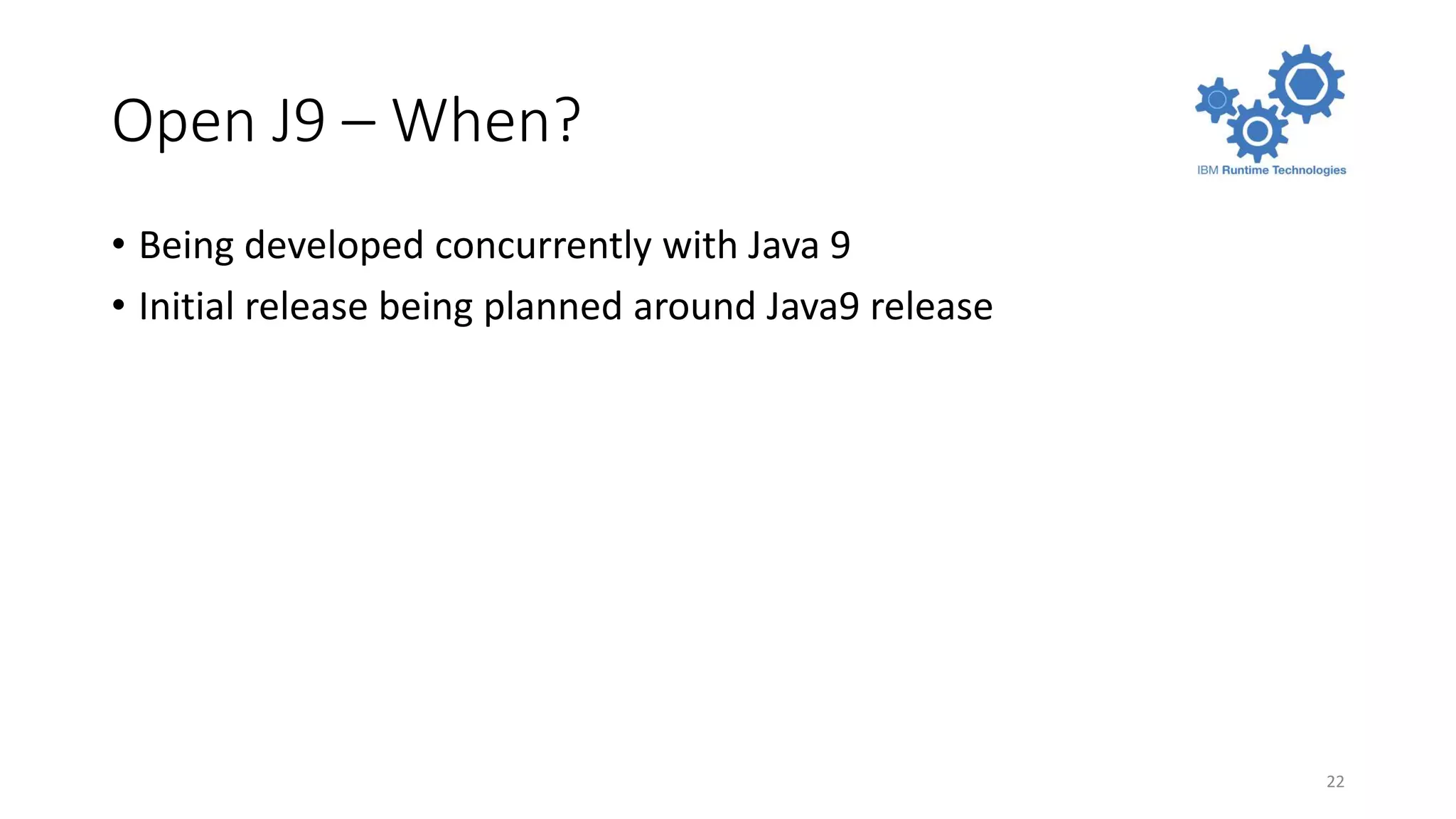
Open J9 – When?
• Being developed concurrently with Java 9
• Initial release being planned around Java9 release
22
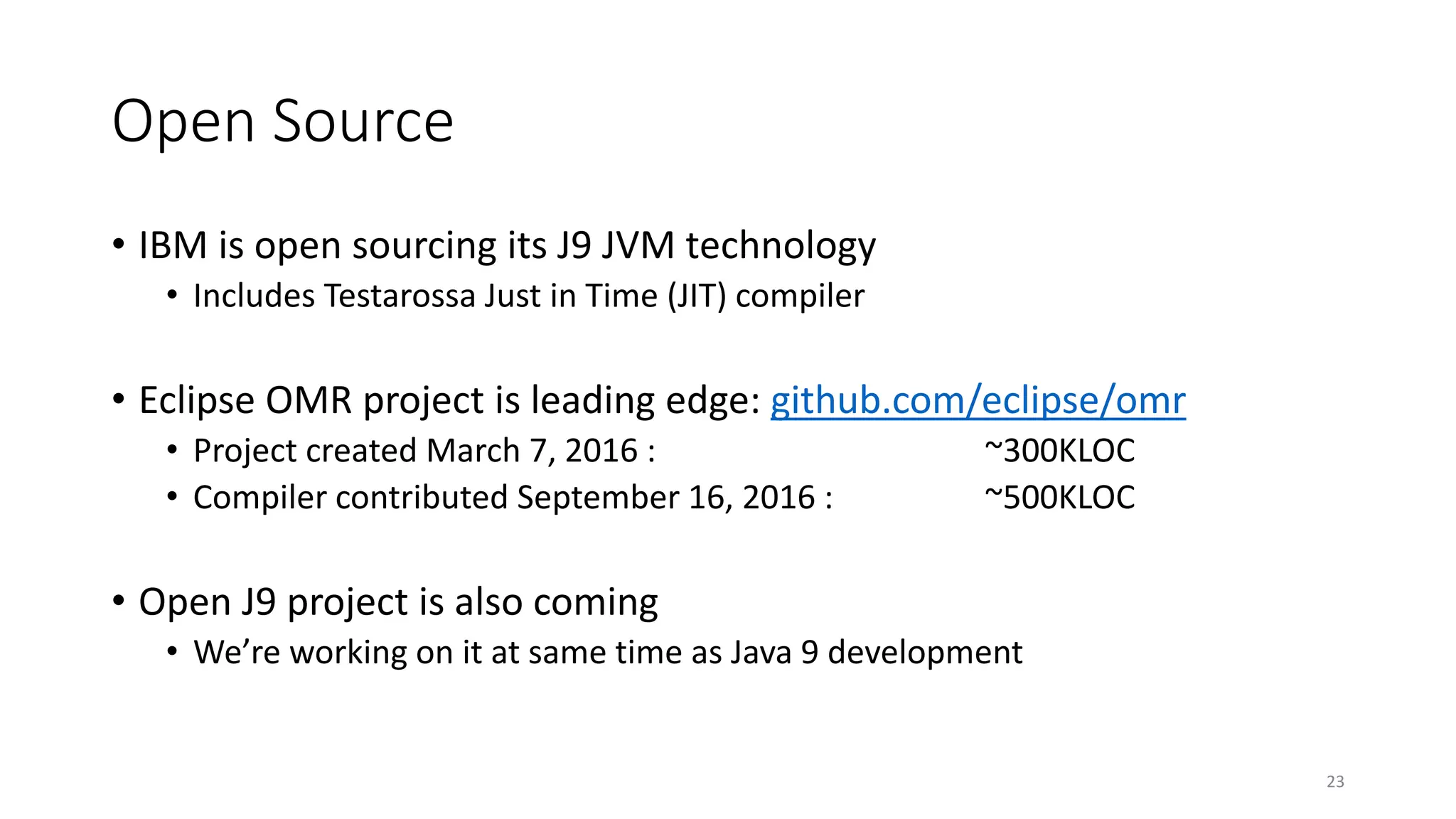
Open Source
• IBM is open sourcing its J9 JVM technology
• Includes Testarossa Just in Time (JIT) compiler
• Eclipse OMR project is leading edge: github.com/eclipse/omr
• Project created March 7, 2016 : ~300KLOC
• Compiler contributed September 16, 2016 : ~500KLOC
• Open J9 project is also coming
• We’re working on it at same time as Java 9 development
23
Questions?
24

FOSDEM 2017 - Open J9 The Next Free Java VM

  • 1.
    Open J9 The NextFree Java VM Charlie Gracie, Eclipse OMR Co-Project Lead IBM Advisory Software Developer 1
  • 2.
    Important Disclaimers • THEINFORMATION CONTAINED IN THIS PRESENTATION IS PROVIDED FOR INFORMATIONAL PURPOSES ONLY. • WHILST EFFORTS WERE MADE TO VERIFY THE COMPLETENESS AND ACCURACY OF THE INFORMATION CONTAINED IN THIS PRESENTATION, IT IS PROVIDED “AS IS”, WITHOUT WARRANTY OF ANY KIND, EXPRESS OR IMPLIED. • ALL PERFORMANCE DATA INCLUDED IN THIS PRESENTATION HAVE BEEN GATHERED IN A CONTROLLED ENVIRONMENT. YOUR OWN TEST RESULTS MAY VARY BASED ON HARDWARE, SOFTWARE OR INFRASTRUCTURE DIFFERENCES. • ALL DATA INCLUDED IN THIS PRESENTATION ARE MEANT TO BE USED ONLY AS A GUIDE. • IN ADDITION, THE INFORMATION CONTAINED IN THIS PRESENTATION IS BASED ON IBM’S CURRENT PRODUCT PLANS AND STRATEGY, WHICH ARE SUBJECT TO CHANGE BY IBM, WITHOUT NOTICE. • IBM AND ITS AFFILIATED COMPANIES SHALL NOT BE RESPONSIBLE FOR ANY DAMAGES ARISING OUT OF THE USE OF, OR OTHERWISE RELATED TO, THIS PRESENTATION OR ANY OTHER DOCUMENTATION. • NOTHING CONTAINED IN THIS PRESENTATION IS INTENDED TO, OR SHALL HAVE THE EFFECT OF: • CREATING ANY WARRANT OR REPRESENTATION FROM IBM, ITS AFFILIATED COMPANIES OR ITS OR THEIR SUPPLIERS AND/OR LICENSORS 2
  • 3.
    This Talk 1. J9Overview 2. Eclipse OMR 3. Open J9 4. Questions 3
  • 4.
    IBM’s Java VirtualMachine High performance High reliability Serviceability 4 OS JVM Middle ware User application
  • 5.
  • 6.
    Virtual machines onoscilloscopes? “Lots” of ROM, very little RAM https://upload.wikimedia.org/wikipedia/commons/7/7e/ Tektronix_TDS210_Oscilloscope.jpg
  • 7.
    J9 Architecture 7 SE 7 Operatingsystem Native applications OS-specific calls Virtual machine SE 6 Garbage collector Interpreter Exception handler Class loader Pluggable components that dynamically load into the virtual machine Thread model JVM Profiler Debugger Port Library (file IO, sockets, memory allocation) Uses 1 of many Java platform configurations JCL natives JNI Calls to C libraries CDC MIDP Java calls JNI, INL, Fastcall TR JIT CLDC VM Interface Zip, fdlibm Java VM Classes
  • 8.
    J9 Interpreter • Writtenin C++ • Switch statement / computed goto • Executes: • bytecodes • INLs • builds stack frames • Transition to the JIT 8
  • 9.
    Garbage Collection • Throughput(Optthruput) • Stop the world mark/sweep/compact (MSC) collector with all stages being parallel • Average Pause (Optavgpause) • MSC with concurrent mark and sweep phases to reduce average pause times • Generational Collector (Gencon) • Partial concurrent-mark for old-space and “semi-space” collected new area • Parallel Copy, Tilted New Spaces, Dynamic New Space resizing • Multi-region Large Heap (Balanced) • Region based collection supporting partial gc, high mobility, differentiated memory, goal based collections, with ROI heuristics • Reduces maximum pause times in very large heaps • Native memory aware reduces non-object heap consumption • Soft Realtime (Metronome) • Realtime GC with max cpu utilization, max pause, max memory 9
  • 10.
    Balanced GC 10 “Points To” Relationship HeapRegion Differentiation Heap Object • Gather objects with common properties • Locality - sibling, child • Usage frequency • Lifetime, birthplace, resting place • “Results based” incremental operations • productive GC every cycle • localized garbage collect • Optimize based on memory characteristics • Sharing status of mapped pages • Regions grouped by memory speed • NUMA, Tiered memory • Flash, SSD, GPU exploitation • Swapping, compression, LRU, custom formats
  • 11.
    JIT Compilation 11 ARM Optimizer Analyses andOptimizations cold warm hot FSDscorching AOT IL Generation x86 POWER Z Code Generators Runtime Environment/ Configuration •Options •Object Model •Memory •Threading •Tracing codeMetadataRuntimeRT Helpers very hot profiling Profile Manager Hardware counters Sampling Thread Interpreter Profile Info JIT Profile Info Profiler
  • 12.
    JIT Compilation 12  Methodsstart out running bytecode form directly  After many invocations (or via sampling) code get compiled at ‘cold’ or ‘warm’ level  Low overhead sampling thread is used to identify hot methods  Methods may get recompiled at ‘hot’ or ‘scorching’ levels (for more optimizations)  Transition to ‘scorching’ goes through a temporary profiling step cold hot scorching profiling interpreter warm
  • 13.
    Shared Classes • J9JVMs use sharing to reduce memory and startup costs • Ability to securely common Java class code across multiple JVM instances • Reduces footprint due to sharing of read-only components (Java code) • Reduces startup time by caching “ready to run” previously JITed code (Dynamic AOT) • Dynamic AOT - reuse JIT code from multiple JVMs • Reduce memory use by 20%, improve startup time 10-30 % 13
  • 14.
    PERFORMANCE ! Java6 SR16 FP4 Java6.1 SR8 FP4 Java 7 SR9 Java 7.1 SR3 Java 8 SR1 Apache Spark 1.4 Daytrader3 Linux Intel
  • 15.
    http://www.eclipse.org/omr https://github.com/eclipse/omr https://developer.ibm.com/open/omr/ Dual License: Eclipse PublicLicense V1.0 Apache 2.0 Contributors very welcome https://github.com/eclipse/omr/blob/master/CONTRIBUTING.md Eclipse OMR Created March 2016 15
  • 16.
    Eclipse OMR Mission Buildan open reusable language runtime foundation for cloud platforms • To accelerate advancement and innovation • In full cooperation with existing language communities • Engaging a diverse community of people interested in language runtimes • Professional developers • Researchers • Students • Hobbyists 16
  • 17.
    Eclipse OMR ComponentsCurrently Available port platform abstraction (porting) library thread cross platform pthread-like threading library vm APIs to manage per-interpreter and per-thread contexts gc garbage collection framework for managed heaps compiler extensible compiler framework jitbuilder WIP project to simplify bring up for a new JIT compiler omrtrace library for publishing trace events for monitoring/diagnostics fvtest language independent test framework built on the example glue so that components can be tested outside of a language runtime, uses Google Test 1.7 framework + a few others ~800KLOC at this point, more components coming! 17
  • 18.
    “We believe openecosystems and partnerships are key to our future innovation.” -- Ginni Rometty (http://www.ibm.com/annualreport/2014/chairmans-letter.html) 18
  • 19.
    Open J9 –Why? 19 Collaboration Competition Polyglot Platforms Collaboration Competition Polyglot Platforms
  • 20.
    Open J9 –Where? 20 Open JDK HotSpot Eclipse OMR Open JDK Open J9 OMR Open JDK Open J9 OMR Proven adaptable technology in the open for rapid innovation and collaboration across multiple language communities Open JDK IBM SDK for Java Java community open innovation and collaboration, deep platform exploitation for X86 & IBM hardware platforms (OpenPOWER, Linux ONE) Ruby? OMR Communities Beyond Java COBOL PL/I Emulator Python? OMR JS? OMR Swift? OMR … Long term support, quick response for problems, and other forms of IBM customer specific engagement + IBM isms
  • 21.
    Open J9 –How? 1. hg clone <url>/jdk9/dev jdk9dev 2. cd jdk9dev 3. ./get_source.sh 4. ./configure 5. make all –with-openj9 21
  • 22.
    Open J9 –When? • Being developed concurrently with Java 9 • Initial release being planned around Java9 release 22
  • 23.
    Open Source • IBMis open sourcing its J9 JVM technology • Includes Testarossa Just in Time (JIT) compiler • Eclipse OMR project is leading edge: github.com/eclipse/omr • Project created March 7, 2016 : ~300KLOC • Compiler contributed September 16, 2016 : ~500KLOC • Open J9 project is also coming • We’re working on it at same time as Java 9 development 23
  • 24.

Editor's Notes

  • #2 Hi I am Charlie Gracie Today I will be talking to you about OpenJ9 I have been a software developer at IBM for over 13 years working on the IBM J9 Java VM I have worked on most areas of the VM but I have been focused on garbage collection for most of my career. Currently I am the garbage collection architect and I am also the co-project lead on the Eclipse OMR project.
  • #5 IBM provides the OS for our hardware: power and s390 / Z IBM provides the middleware: be it websphere, liberty or others It only makes sense for us to implement the pieces of the stack That sit in the middle. And we’ve done it in a way that provides a new, clean implementation J9 is an independent implementation of the JVM.
  • #6 Scales from cell phones (embedded platforms) to servers, and mainfraimes Multiplatform: x86, ppc, zOS, arm Big & little endian 32, 64 & compressedrefs
  • #7 https://upload.wikimedia.org/wikipedia/commons/7/7e/Tektronix_TDS210_Oscilloscope.jpg
  • #8 This is an old slide, but the key idea it conveys is that J9 Has been developed as components Pieces that can be added / removed at runtime where possible Highly configurable with pluggable interfaces for alternative implementations of GC, JIT
  • #9 Interpreter used to be written in assembly code that was generated from Smalltalk. This was a big barrier to entry and made it hard for everyone to modify the critical parts of the code In Java 7.0.1, we replaced it with the C++ code. This came at a slight performance hit, particularly to Startup but we’ve recovered the loss through other improvements. In Java 9, we will complete the removal of all Smalltalk generated assembly, preferring C/C++ and minimal amounts of handwritten assembly.
  • #11 Improved cache locality by placing related objects closer together Allocation efficiency Reduces working set size Allows you to take more advantage of HW features like SSD, NUMA, etc This can provide more scaling and sharing of memory Can focus GC efforts on areas with high ROI
  • #12 A JIT is not *just* a compiler. It’s also a profile management, runtime assumptions and a high performance runtime collection system.
  • #13 Java's bytecodes are compiled as required, optimized based on runtime profiling Dynamic compilation determines the target machine capabilities and app demands Multiple phases, enable adaptive response to changing environment
  • #15 I have this slide here to show that performance continually improves from release to release on workloads that matter Apache Spark and Daytrader for example But this isn’t really the interesting part, let’s look at the details of J9.
  • #18 The next step for us is OpenJ9. Where we open up the rest of the J9 code base and build a fully open source JVM, continuing to leverage OpenJDK and OMR.
  • #20 Collaboration: Hard to collaborate when no one can see the source Want to make it easy for everyone to work together on the code Community members, customers, partners Whether prototyping some new feature, have people try it, test out a new idea Together we’re smarter than alone Rapid innovation One JVM good, multiple JVMs better Competition makes runtimes better. It’s driven the perf improvements in Java for many years Having two major ones enables more innovation & healthy competition. Collaboration / Competition are the push-pull that drives rapid innovation Absolutely necessary in the cloud age. Polyglot In IBM Runtimes, when we enable some feature for Java, say RDMA, We’re immediately asked when Javascript, Swift, Go, Ruby will get it. Flexible runtime components will benefit every language, including Java And this gives rise to new functionality – better interop, portability, common debug / diagnostics Platforms Whether you run on X, or P, or Z, or ARM. This is good for you. Cross platform capabilities makes your life easier as a dev when its The same everywhere. Enables HW producers – and not just cpus but gpus, fpga, etc Two words: Rapid innovation.
  • #21 Our intentions are to work directly in the open source projects. We feel that the best place would be to have the Open J9 project located at OpenJDK This would give us the best opportunity to collaborate. IBM already does JCL work at OpenJDK so it just makes sense to do our VM work there as well.
  • #22 The goal is to have it be integrated seamlessly into OpenJDK. get_source.sh could be modified to only pull OpenJ9 if you were going to use it by adding a –with-openj9 option A first step would be just compiling OpenJ9 if it is asked for. In theory both HotSpot and OpenJ9 could be compiled and you could pick either one at runtime via a command line option but I am not sure this is something we want to pursue immediately
  • #23 The development of getting ready for Open J9 is happening along side our Java 9 development By doing it at the same time it keeps us honest and makes sure that everything works for both the open source project and for our internal JDK product This means development is slower than we would like We are hoping to have the initial drop ready around Java 9 GA.