Form-Based Codes
City of Johnson City: Planning Department 601 E. Main Street Johnson City, TN 37601 T (423) 434-6071 www.johnsoncitytn.org
City of Johnson City
Table of Contents
Alternatives to Overlay Zoning 		 	 	 	 	 	 	 1
	 Atlanta Regional Commission 		 	 	 	 	 	 	 1
	 Form-Based Code Overview 	 	 	 	 	 	 	 	 1
	 Euclidean vs. Form-Based Zoning 	 	 	 	 	 	 	 5
Case Study		 	 	 	 	 	 	 	 	 	 6
	 Columbia Pike Findings 	 	 	 	 	 	 6
	 Columbia Pike Breakdown 	 	 	 	 	 	 	 8
	 	 Regulating Plan 	 	 	 	 	 	 	 	 8
	 	 Building Envelope Standards 	 	 	 	 	 	 11
	 	 Architectural Standards 	 	 	 	 	 	 13
Creating Form-Based	 	 	 	 	 	 	 	 	 16
	 Hybrid Codes Versus Form-Based Codes	 	 	 	 16
	 Form-Based Codes Checklist 		 	 	 	 	 	 	 17
	 SmartCode 	 	 	 	 	 	 	 	 	 18
	 Table 1		 	 	 	 	 	 	 	 	 18-19
	 Planning Ahead 	 	 	 	 	 	 	 	 19
	 General Look at SmartCode Text	 	 	 	 	 	 	 20
	 Table 2		 	 	 	 	 	 	 	 	 21-22
Form-Based Codes 
 i
Alternatives to Overlay Zoning
Atlanta Regional Commission
Atlanta Regional Commission alternative suggestions to overlay design:
1) Apply the restrictive standards everywhere (not limited to overly district)
2) Private covenants
a. encourages developers to impose covenants and review the residents them-
selves rather than have Design Review Board
b. however, the covenants may only run for 20 years and the only way to enforce
may be for property owners to sue for damages
3) Creating small Euclidean zoning (which may increase the complexity of zoning)
4) Special Exceptions (best if used when standards are less restrictive than underlying
zoning district)
Form-Based Codes

 “Form-Based Codes: A Cure for the Cancer Called Euclidean Zoning?” by Jason T. Burdette
• Focus is physical design rather than use
• In contrast to the more traditionally Euclidean zoning, Form-Based is more flexible, focusing
on what has been deemed as having a heightened importance (example: building appear-
ance’s affect on the facing street)
• Graphic illustrations are heavily relied upon to relay to potential developers what is expected
of them
• Focusing, traditionally, upon height regulations, space between buildings, and alignment,
research suggests that Form-Based Codes lead to a more predictable development plan;
whereas Euclidean zoning has been characterized as unpredictable.
• The theory is to allow the market determine the use. However, there is some room for influ-
ence (such as: commercial strip to consist of buildings between two and six stories closely
abutting the street which will most likely produce retail on the bottom floor and residential
on the remaining)
• Charrette
o Process to bring community’s vision into fruition by establishing a physical plan
o Experienced code practitioners lead stakeholders (particularly in achieving feasible
goals)
o Participating community members are given maps and divided into work groups
Form-Based Codes 
 1
o Practitioners also help facilitate a mutual meeting ground (for residents, major insti-
tutions, government officials, developers, and builders)
o Finally, the physical plan must be codified
• Typically, code-based involves three aspects and one optional aspect: Regulating Plan,
Building Envelope Standards, Definitions, and the optional Architectural Standards
• Regulating Plan
o Provides a coding key and specific character of each building
o Distinguished from a zoning map, the regulating plan gives specific details sur-
rounding ALL streets and blocks in the proposed area.
o Furthermore, the Regulating Plan goes beyond traditional zoning maps by including:
property lines, a “required building line,” a street tree alignment line, the location of
public places such as parks and squares, as well as the predicted footprints of
planned public buildings
o Regulating plan encourages the review of the entire community, not individual units
o Regulating plan encourages efficiency; instead of going through pages of codes to
understand all the “in and outs” of what is allowed, the regulating plan/map is sim-
pler.
o *Most significantly, the regulating plan outlines a specific plan in place and not just
the different aspects allowed and disallowed.
o Examples: stacked flats, courtyard buildings, shop-houses, live-works, town-
houses, detached villas, and high-rise towers
• Building Envelope Standards
o Typically addresses height, siting, elements, and sometimes uses
o Regarding Height: generally reflects a minimum number which would be required to
maintain a street wall and also a maximum number beyond which would be out of
context.
• With traditional zoning, developers would sometimes attempt the “cheat the
system” by minimizing floor to ceiling heights to increase the number of
floors. Through Form-Based this is avoided by implementation of
“maximum-height-to-the-eave dimension and range of acceptable number
of stories.”
• Also, minimum above grade dimensions can be added for different building
types (example: ensuring town homes are high enough to give privacy)
o Regarding Siting: generally refers to the placement of a building in relation to sur-
rounding buildings and fronting street. Also, can go into placement of parking lots,
yards, building entrances, etc…
• Architectural elements may include: windows, doors, porches, stoops, bal-
conies, and chimneys; regarding these aspects, the specifics concerning
quantity, configuration, and size may also be included.
• While the philosophy of Form-Based zoning generally discourages specifi-
cally allowing/disallowing a certain use, Form-Base does encourage mixed
uses (retail stores on the bottom and residential above).
• Glossary: should include key terms utilized within the plan and comprehensive definitions
• Architectural Standards: (optional at the discretion of local stakeholders) focuses primarily
on aesthetic features
o Because of the subjective nature of aesthetic features, many local stakeholders are
weary of implementing these standards.
o Generally regulated by homeowner’s association or community covenant
Form-Based Codes 
 2
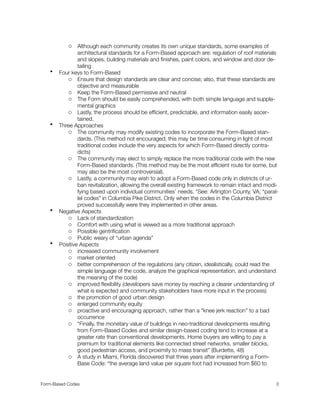
o Although each community creates its own unique standards, some examples of
architectural standards for a Form-Based approach are: regulation of roof materials
and slopes, building materials and finishes, paint colors, and window and door de-
tailing
• Four keys to Form-Based
o Ensure that design standards are clear and concise; also, that these standards are
objective and measurable
o Keep the Form-Based permissive and neutral
o The Form should be easily comprehended, with both simple language and supple-
mental graphics
o Lastly, the process should be efficient, predictable, and information easily ascer-
tained.
• Three Approaches
o The community may modify existing codes to incorporate the Form-Based stan-
dards. (This method not encouraged; this may be time consuming in light of most
traditional codes include the very aspects for which Form-Based directly contra-
dicts)
o The community may elect to simply replace the more traditional code with the new
Form-Based standards. (This method may be the most efficient route for some, but
may also be the most controversial).
o Lastly, a community may wish to adopt a Form-Based code only in districts of ur-
ban revitalization, allowing the overall existing framework to remain intact and modi-
fying based upon individual communities’ needs. *See: Arlington County, VA; “paral-
lel codes” in Columbia Pike District. Only when the codes in the Columbia District
proved successfully were they implemented in other areas.
• Negative Aspects
o Lack of standardization
o Comfort with using what is viewed as a more traditional approach
o Possible gentrification
o Public weary of “urban agenda”
• Positive Aspects
o increased community involvement
o market oriented
o better comprehension of the regulations (any citizen, idealistically, could read the
simple language of the code, analyze the graphical representation, and understand
the meaning of the code)
o improved flexibility (developers save money by reaching a clearer understanding of
what is expected and community stakeholders have more input in the process)
o the promotion of good urban design
o enlarged community equity
o proactive and encouraging approach, rather than a “knee jerk reaction” to a bad
occurrence
o “Finally, the monetary value of buildings in neo-traditional developments resulting
from Form-Based Codes and similar design-based coding tend to increase at a
greater rate than conventional developments. Home buyers are willing to pay a
premium for traditional elements like connected street networks, smaller blocks,
good pedestrian access, and proximity to mass transit” (Burdette, 48)
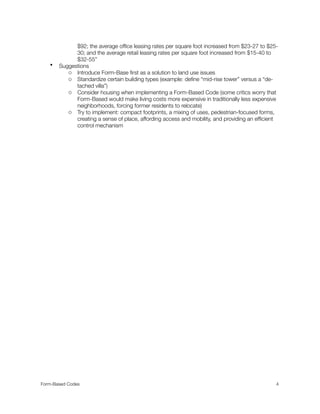
o A study in Miami, Florida discovered that three years after implementing a Form-
Base Code: “the average land value per square foot had increased from $60 to
Form-Based Codes 
 3
$92; the average office leasing rates per square foot increased from $23-27 to $25-
30; and the average retail leasing rates per square foot increased from $15-40 to
$32-55”
• Suggestions
o Introduce Form-Base first as a solution to land use issues
o Standardize certain building types (example: define “mid-rise tower” versus a “de-
tached villa”)
o Consider housing when implementing a Form-Based Code (some critics worry that
Form-Based would make living costs more expensive in traditionally less expensive
neighborhoods, forcing former residents to relocate)
o Try to implement: compact footprints, a mixing of uses, pedestrian-focused forms,
creating a sense of place, affording access and mobility, and providing an efficient
control mechanism
Form-Based Codes 
 4
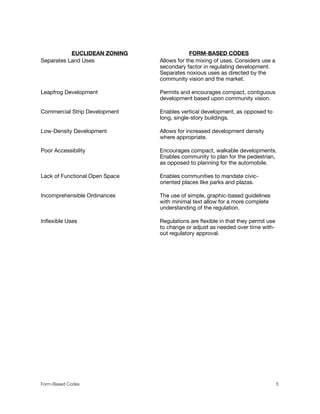
EUCLIDEAN ZONING FORM-BASED CODES
Separates Land Uses Allows for the mixing of uses. Considers use a
secondary factor in regulating development.
Separates noxious uses as directed by the
community vision and the market.
Leapfrog Development Permits and encourages compact, contiguous
development based upon community vision.
Commercial Strip Development Enables vertical development, as opposed to
long, single-story buildings.
Low-Density Development Allows for increased development density
where appropriate.
Poor Accessibility Encourages compact, walkable developments.
Enables community to plan for the pedestrian,
as opposed to planning for the automobile.
Lack of Functional Open Space Enables communities to mandate civic-
oriented places like parks and plazas.
Incomprehensible Ordinances The use of simple, graphic-based guidelines
with minimal text allow for a more complete
understanding of the regulation.
Inflexible Uses Regulations are flexible in that they permit use
to change or adjust as needed over time with-
out regulatory approval.
Form-Based Codes 
 5
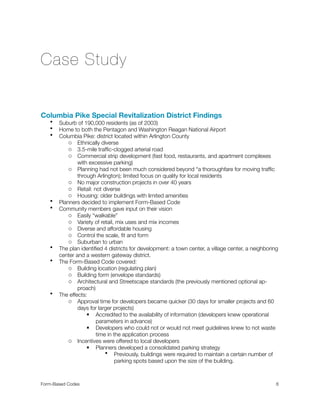
Case Study
Columbia Pike Special Revitalization District Findings
• Suburb of 190,000 residents (as of 2003)
• Home to both the Pentagon and Washington Reagan National Airport
• Columbia Pike: district located within Arlington County
o Ethnically diverse
o 3.5-mile traffic-clogged arterial road
o Commercial strip development (fast food, restaurants, and apartment complexes
with excessive parking)
o Planning had not been much considered beyond “a thoroughfare for moving traffic
through Arlington); limited focus on quality for local residents
o No major construction projects in over 40 years
o Retail: not diverse
o Housing: older buildings with limited amenities
• Planners decided to implement Form-Based Code
• Community members gave input on their vision
o Easily “walkable”
o Variety of retail, mix uses and mix incomes
o Diverse and affordable housing
o Control the scale, fit and form
o Suburban to urban
• The plan identified 4 districts for development: a town center, a village center, a neighboring
center and a western gateway district.
• The Form-Based Code covered:
o Building location (regulating plan)
o Building form (envelope standards)
o Architectural and Streetscape standards (the previously mentioned optional ap-
proach)
• The effects:
o Approval time for developers became quicker (30 days for smaller projects and 60
days for larger projects)
 Accredited to the availability of information (developers knew operational
parameters in advance)
 Developers who could not or would not meet guidelines knew to not waste
time in the application process
o Incentives were offered to local developers
 Planners developed a consolidated parking strategy
• Previously, buildings were required to maintain a certain number of
parking spots based upon the size of the building.
Form-Based Codes 
 6
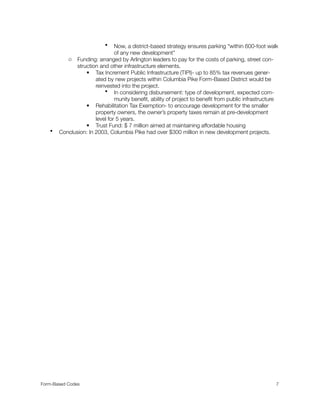
• Now, a district-based strategy ensures parking “within 600-foot walk
of any new development”
o Funding: arranged by Arlington leaders to pay for the costs of parking, street con-
struction and other infrastructure elements.
 Tax Increment Public Infrastructure (TIPI)- up to 85% tax revenues gener-
ated by new projects within Columbia Pike Form-Based District would be
reinvested into the project.
• In considering disbursement: type of development, expected com-
munity benefit, ability of project to benefit from public infrastructure
 Rehabilitation Tax Exemption- to encourage development for the smaller
property owners, the owner’s property taxes remain at pre-development
level for 5 years.
 Trust Fund: $ 7 million aimed at maintaining affordable housing
• Conclusion: In 2003, Columbia Pike had over $300 million in new development projects.
Form-Based Codes 
 7
Columbia Pike Special Revitalization District Breakdown
Regulating Plan
The Columbia Pike Urban Design Charrette in
cooperation with citizen planning workshops created
the Regulating Plan in order to organize the growth of
the Columbia Pike Special Revitalization District in
Arlington County, Virginia.
The plan specifically targets the nature of each lot within the
context of surrounding lots and streets.
Form-Based Codes 
 8
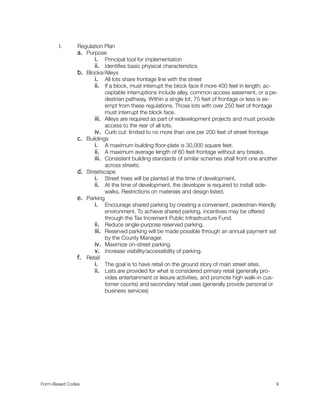
I. Regulation Plan
a. Purpose
i. Principal tool for implementation
ii. Identifies basic physical characteristics
b. Blocks/Alleys
i. All lots share frontage line with the street
ii. If a block, must interrupt the block face if more 400 feet in length; ac-
ceptable interruptions include alley, common access easement, or a pe-
destrian pathway. Within a single lot, 75 feet of frontage or less is ex-
empt from these regulations. Those lots with over 250 feet of frontage
must interrupt the block face.
iii. Alleys are required as part of redevelopment projects and must provide
access to the rear of all lots.
iv. Curb cut: limited to no more than one per 200 feet of street frontage
c. Buildings
i. A maximum building floor-plate is 30,000 square feet.
ii. A maximum average length of 60 feet frontage without any breaks.
iii. Consistent building standards of similar schemes shall front one another
across streets.
d. Streetscape
i. Street trees will be planted at the time of development.
ii. At the time of development, the developer is required to install side-
walks. Restrictions on materials and design listed.
e. Parking
i. Encourage shared parking by creating a convenient, pedestrian-friendly
environment. To achieve shared parking, incentives may be offered
through the Tax Increment Public Infrastructure Fund.
ii. Reduce single-purpose reserved parking.
iii. Reserved parking will be made possible through an annual payment set
by the County Manager.
iv. Maximize on-street parking.
v. Increase visibility/accessibility of parking.
f. Retail
i. The goal is to have retail on the ground story of main street sites.
ii. Lists are provided for what is considered primary retail (generally pro-
vides entertainment or leisure activities, and promote high walk-in cus-
tomer counts) and secondary retail uses (generally provide personal or
business services)
Form-Based Codes 
 9
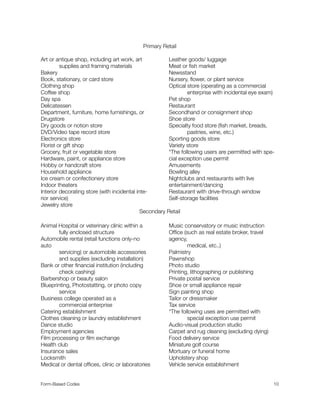
Primary Retail
Art or antique shop, including art work, art
supplies and framing materials
Bakery
Book, stationary, or card store
Clothing shop
Coffee shop
Day spa
Delicatessen
Department, furniture, home furnishings, or
Drugstore
Dry goods or notion store
DVD/Video tape record store
Electronics store
Florist or gift shop
Grocery, fruit or vegetable store
Hardware, paint, or appliance store
Hobby or handcraft store
Household appliance
Ice cream or confectionery store
Indoor theaters
Interior decorating store (with incidental inte-
rior service)
Jewelry store
Leather goods/ luggage
Meat or fish market
Newsstand
Nursery, flower, or plant service
Optical store (operating as a commercial
enterprise with incidental eye exam)
Pet shop
Restaurant
Secondhand or consignment shop
Shoe store
Specialty food store (fish market, breads,
pastries, wine, etc.)
Sporting goods store
Variety store
*The following users are permitted with spe-
cial exception use permit
Amusements
Bowling alley
Nightclubs and restaurants with live
entertainment/dancing
Restaurant with drive-through window
Self-storage facilities
Secondary Retail
Animal Hospital or veterinary clinic within a
fully enclosed structure
Automobile rental (retail functions only-no
auto
servicing) or automobile accessories
and supplies (excluding installation)
Bank or other financial institution (including
check cashing)
Barbershop or beauty salon
Blueprinting, Photostatting, or photo copy
service
Business college operated as a
commercial enterprise
Catering establishment
Clothes cleaning or laundry establishment
Dance studio
Employment agencies
Film processing or film exchange
Health club
Insurance sales
Locksmith
Medical or dental offices, clinic or laboratories
Music conservatory or music instruction
Office (such as real estate broker, travel
agency,
medical, etc..)
Palmistry
Pawnshop
Photo studio
Printing, lithographing or publishing
Private postal service
Shoe or small appliance repair
Sign painting shop
Tailor or dressmaker
Tax service
*The following uses are permitted with
special exception use permit
Audio-visual production studio
Carpet and rug cleaning (excluding dying)
Food delivery service
Miniature golf course
Mortuary or funeral home
Upholstery shop
Vehicle service establishment
Form-Based Codes 
 10
Building Envelope Standards
This portion of the plan regulates the buildings within the
district. The goal is to create a vibrant public area through
utilizing “street space” principles. These principles include the basic
limitations and requirements of construction.
Specifically addressed are: balconies, stoops and street walls.
A Special Exception Process exists in order to allow a reasonable
approach to these restrictions.
Form-Based Codes 
 11
II. Building Envelope Standards
a. General Principles
i. Buildings are aligned and close to the street with active fronts.
ii. Uniformity creates public space and community identity.
iii. Property lines are physically defined by buildings or street walls.
iv. Buildings are designed for city setting, not suburban areas. The build-
ings should face the general public area, not necessarily towards neigh-
bors.
v. Service areas should be kept away from the street face.
vi. Retail on the ground floor is greatly encouraged in order to keep the
area interesting and open to the public.
vii. Encourage on street parking.
viii. Parking lots should corroborate into shared parking.
b. Building Standards
i. Measure building heights by story.
1. Measuring by just height leads to manipulation of floor heights
by developer.
2. Each building should be between 3-6 stories.
ii. The ground floor should be at least 15 feet tall (measuring floor to ceil-
ing).
iii. All stories above the ground level should be no taller than 14 feet. The
uppermost story should be at least 10 feet tall.
iv. Aside from specially approved balconies, bay windows, stoops and
shop fronts, the Required Building Line is not to be encroached.
c. Ground story façade shall have between 60% and 90% fenestration [an open-
ing in the building wall allowing light and views between interior and exterior.
FENESTRATION is measured as glass area (excluding window frame elements
with a dimension greater than 1 inch for conditioned space and as open area
for parking structures or other un-conditioned, enclosed space)].
d. Upper story facades shall have between 30% and 70% FENSTRATION.
e. Ground stories should be used for retail; entry doors should be spaced out no
greater than 60 feet within any site.
f. Retail should not be located on any floors beyond the ground floor. Allowed
uses for upper floors are restaurants and business professional offices.
Form-Based Codes 
 12
Architectural Standards
Outside research refers to this section of Arlington County’s
Form Based Code as “optional.” This approach deviates somewhat
from form based codes by exploring different aesthetic features.
The Columbia Pike Revitalization District Code establishes an
Administrative Review Team which must approve a developer’s
design and give assistance in order to achieve the code’s goals.
The intent is to preserve traditional features in order to stabilize
a consistent form in the district.
Form-Based Codes 
 13
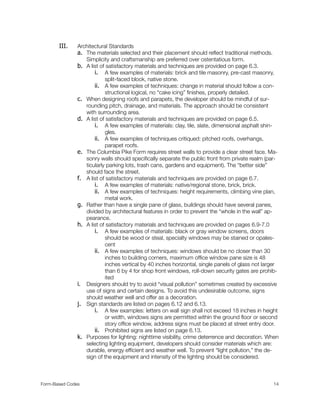
III. Architectural Standards
a. The materials selected and their placement should reflect traditional methods.
Simplicity and craftsmanship are preferred over ostentatious form.
b. A list of satisfactory materials and techniques are provided on page 6.3.
i. A few examples of materials: brick and tile masonry, pre-cast masonry,
split-faced block, native stone.
ii. A few examples of techniques: change in material should follow a con-
structional logical, no “cake icing” finishes, properly detailed.
c. When designing roofs and parapets, the developer should be mindful of sur-
rounding pitch, drainage, and materials. The approach should be consistent
with surrounding area.
d. A list of satisfactory materials and techniques are provided on page 6.5.
i. A few examples of materials: clay, tile, slate, dimensional asphalt shin-
gles.
ii. A few examples of techniques critiqued: pitched roofs, overhangs,
parapet roofs.
e. The Columbia Pike Form requires street walls to provide a clear street face. Ma-
sonry walls should specifically separate the public front from private realm (par-
ticularly parking lots, trash cans, gardens and equipment). The “better side”
should face the street.
f. A list of satisfactory materials and techniques are provided on page 6.7.
i. A few examples of materials: native/regional stone, brick, brick.
ii. A few examples of techniques: height requirements, climbing vine plan,
metal work.
g. Rather than have a single pane of glass, buildings should have several panes,
divided by architectural features in order to prevent the “whole in the wall” ap-
pearance.
h. A list of satisfactory materials and techniques are provided on pages 6.9-7.0
i. A few examples of materials: black or gray window screens, doors
should be wood or steal, specialty windows may be stained or opales-
cent
ii. A few examples of techniques: windows should be no closer than 30
inches to building corners, maximum office window pane size is 48
inches vertical by 40 inches horizontal, single panels of glass not larger
than 6 by 4 for shop front windows, roll-down security gates are prohib-
ited
i. Designers should try to avoid “visual pollution” sometimes created by excessive
use of signs and certain designs. To avoid this undesirable outcome, signs
should weather well and offer as a decoration.
j. Sign standards are listed on pages 6.12 and 6.13.
i. A few examples: letters on wall sign shall not exceed 18 inches in height
or width, windows signs are permitted within the ground floor or second
story office window, address signs must be placed at street entry door.
ii. Prohibited signs are listed on page 6.13.
k. Purposes for lighting: nighttime visibility, crime deterrence and decoration. When
selecting lighting equipment, developers should consider materials which are:
durable, energy efficient and weather well. To prevent “light pollution,” the de-
sign of the equipment and intensity of the lighting should be considered.
Form-Based Codes 
 14
l. A list of satisfactory lighting standards and equipment are one pages 6.15 and
6.16. 	
i. A few examples of lighting: direct lights downward and away from living
quarters, exterior lights at the front of a building should be mounted be-
tween 6 and 14 feet above adjacent grade.
ii. Prohibited: flashing, traveling, animated or intermittent lighting.
Form-Based Codes 
 15
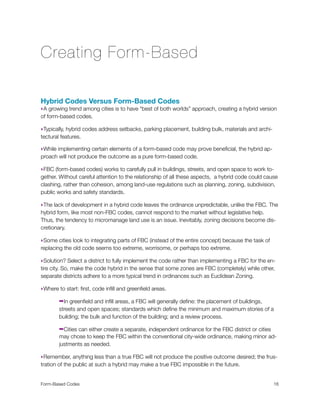
Creating Form-Based
Hybrid Codes Versus Form-Based Codes
‣A growing trend among cities is to have “best of both worlds” approach, creating a hybrid version
of form-based codes.
‣Typically, hybrid codes address setbacks, parking placement, building bulk, materials and archi-
tectural features.
‣While implementing certain elements of a form-based code may prove beneficial, the hybrid ap-
proach will not produce the outcome as a pure form-based code.
‣FBC (form-based codes) works to carefully pull in buildings, streets, and open space to work to-
gether. Without careful attention to the relationship of all these aspects, a hybrid code could cause
clashing, rather than cohesion, among land-use regulations such as planning, zoning, subdivision,
public works and safety standards.
‣The lack of development in a hybrid code leaves the ordinance unpredictable, unlike the FBC. The
hybrid form, like most non-FBC codes, cannot respond to the market without legislative help.
Thus, the tendency to micromanage land use is an issue. Inevitably, zoning decisions become dis-
cretionary.
‣Some cities look to integrating parts of FBC (instead of the entire concept) because the task of
replacing the old code seems too extreme, worrisome, or perhaps too extreme.
‣Solution? Select a district to fully implement the code rather than implementing a FBC for the en-
tire city. So, make the code hybrid in the sense that some zones are FBC (completely) while other,
separate districts adhere to a more typical trend in ordinances such as Euclidean Zoning.
‣Where to start: first, code infill and greenfield areas.
➡In greenfield and infill areas, a FBC will generally define: the placement of buildings,
streets and open spaces; standards which define the minimum and maximum stories of a
building; the bulk and function of the building; and a review process.
➡Cities can either create a separate, independent ordinance for the FBC district or cities
may chose to keep the FBC within the conventional city-wide ordinance, making minor ad-
justments as needed.
‣Remember, anything less than a true FBC will not produce the positive outcome desired; the frus-
tration of the public at such a hybrid may make a true FBC impossible in the future.
Form-Based Codes 
 16
‣Also, if a city is proposing implementation of a FBC in a designated district, the city should plan
ahead and prepare a frame work to implement FBC in the remaining districts in the case that a
FBC proves to be a desirable solution to city-wide zoning issues.
Form-Based Codes Check List
	 Form-Based Codes Institute, http://www.formbasedcodes.org
Identifying Form-Based Codes
✓Is the code's focus primarily on regulating urban form and less on land use?
✓Is the code regulatory rather than advisory?
✓Does the code emphasize standards and parameters for form with predictable physical out
	 comes (build-to lines, frontage type requirements, etc.) rather than relying on numerical 	
	 parameters (FAR, density, etc.) whose outcomes are impossible to predict?
✓Does the code require private buildings to shape public space through the use of building form
	 standards with specific requirements for building placement?
✓Does the code require private buildings to shape public space through the use of building form
	 standards with specific requirements for building placement?
✓Does the code promote and/or conserve an interconnected street network and pedestrian-
	 scaled blocks?
✓Are regulations and standards keyed to specific locations on a regulating plan?
✓Are the diagrams in the code unambiguous, clearly labeled, and accurate in their presentation of
	 spatial configurations?
Evaluating Form-Based Codes
✓Is the code enforceable?
➡Does the code implement a plan that reflects specific community intentions?
➡Are the procedures for code administration clearly described?
➡Is the form-based code effectively coordinated with other applicable policies and
	 	 regulations that control development on the same property?
✓Is the code easy to use?
➡Is the overall format and structure of the code readily discernible so that users can easily
	 	 find what is pertinent to their interest?
➡Can users readily understand and execute the physical form intended by the code?
➡Are technical terms used in the code defined in a clear and understandable manner?
➡Does the code format lend itself to convenient public distribution and use?
➡Are the intentions of each regulation clearly described and apparent even to planning staff
	 	 and citizens who did not participate in its preparation?
✓Will the code produce functional and vital urbanism?
➡Will the code shape the public realm to invite pedestrian use and social interaction?
➡Will the code produce walkable, identifiable neighborhoods that provide for daily needs?
➡Are parking requirements compatible with pedestrian-scaled urbanism?
➡Is the code based on a sufficiently detailed physical plan and/or other clear community
	 	 vision that directs development and aids implementation?
Form-Based Codes 
 17
SmartCode
	
	 The SmartCode is a well developed approach to creating a Form-Based Code. The re-
search below is a brief overview of information condensed from of available materials from the Cen-
ter for Applied Transect Studies. The SmartCode promotes growth that is compact, walkable, and
contains mixed uses within a given area. The theory that drives the SmartCode is humans need
different environments. In the past, planning has approached this concept with sprawled growth,
meaning areas were rigidly developed to meet a certain use standard. Over time, these areas be-
came incapable of blending with surrounding uses and areas. The new approach is to accept hu-
mans desire different surroundings and, instead of segregating each community from one another,
incorporate these different desire within a single community.
A Background

 Certain factors combined over the past few decades to create the “sprawled” approach to
planning. These factors include: automobiles, cheap petroleum, cheap land, and generalized
wealth.
	 Based upon these societal trends, design standards incorporated a strict use separation
policy (designated areas for residential, retail, schools, etc...). As a result, automobiles were rein-
forced as more preferred than walking. As a result, society became accustomed to: strip malls, trite
subdivisions, downtowns lacking in character, pedestrian unfriendly streets, increase in billboards,
and overall sprawl.
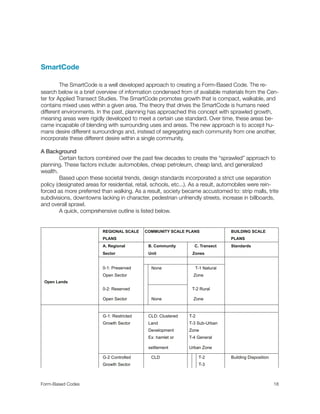
	 A quick, comprehensive outline is listed below.
REGIONAL SCALE COMMUNITY SCALE PLANSCOMMUNITY SCALE PLANSCOMMUNITY SCALE PLANSCOMMUNITY SCALE PLANSCOMMUNITY SCALE PLANS BUILDING SCALE
PLANS PLANS
A. Regional B. Community C. TransectC. Transect Standards
Sector Unit ZonesZones
0-1: Preserved None T-1 NaturalT-1 Natural
Open Sector ZoneZone
Open Lands
0-2: Reserved T-2 RuralT-2 Rural
Open Sector None ZoneZone
G-1: Restricted CLD: Clustered T-2T-2T-2
Growth Sector Land T-3 Sub-UrbanT-3 Sub-UrbanT-3 Sub-Urban
Development ZoneZoneZone
Ex: hamlet or T-4 GeneralT-4 GeneralT-4 General
settlement Urban ZoneUrban ZoneUrban Zone
G-2 Controlled CLD T-2 Building Disposition
Growth Sector T-3
Form-Based Codes 
 18
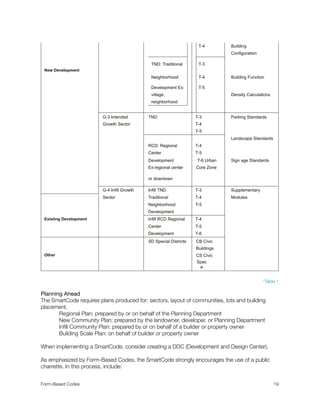
T-4 Building
Configuration
New Development
TND: Traditional T-3
New Development
Neighborhood T-4 Building Function
Development Ex: T-5
village, Density Calculations
neighborhood
G-3 Intended TND T-3T-3 Parking Standards
Growth Sector T-4T-4
T-5T-5
Landscape Standards
RCD: Regional T-4T-4
Center T-5T-5
Development T-6 UrbanT-6 Urban Sign age Standards
Ex:regional center Core ZoneCore Zone
or downtown
G-4 Infill Growth Infill TND T-3T-3 Supplementary
Sector Traditional T-4T-4 Modules
Neighborhood T-5T-5
Development
Existing Development Infill RCD Regional T-4T-4
Center T-5T-5
Development T-6T-6
SD Special Districts CB Civic
Buildings
Other CS Civic
Spac
e
*Table 1
Planning Ahead
The SmartCode requires plans produced for: sectors, layout of communities, lots and building
placement.
	 Regional Plan: prepared by or on behalf of the Planning Department
	 New Community Plan: prepared by the landowner, developer, or Planning Department
	 Infill Community Plan: prepared by or on behalf of a builder or property owner
	 Building Scale Plan: on behalf of builder or property owner
When implementing a SmartCode, consider creating a DDC (Development and Design Center).
As emphasized by Form-Based Codes, the SmartCode strongly encourages the use of a public
charrette. In this process, include:
Form-Based Codes 
 19
urban designers, architects, landscape architects, planners, civil engineers,
	 	 attorneys who are familiar with SmartCode
General Look at SmartCode Text
• Authority
• Applicability.
o Code.takes.precedence.when.in.conflict.with.other.ordinances,.except.Local.Health.and.
Safety.Codes
• Defini?ons
o See.table.of.defini?ons.as.provided.by.the.Code
o Accept.common.meanings.when.not.specifically.defined.by.Code
o If.defini?ons.in.conflict,.accept.the.Code’s.defini?on
• Specifically.list.which.tables/graphs.are.legally.binding
• Intent.of.the.SmartCode.(a.theme.which.is.consistently.referenced.throughout.the.Code)
o Regarding.the.region
 Retain.natural.infrastructure.and.visual.character.considering.the.topography,.
woodlands,.farmlands,.etc…
 Encourage.growth.(especially.within.infill.sec?ons)
 Distribute.affordable.housing.throughout.region.(job.opportuni?es.and.decenM
tralize.poverty).
 Provide.easy.alterna?ve.to.automobiles.
o Regarding.the.Community
 Compact,.mixedMuse,.pedestrian.friendly
 Provide.daily.living.ac?vi?es.within.walking.distance.of.homes
 Thoroughfares.designed.to.reduce.volume.of.traffic
 Civic.and.Commercial.ac?vi?es.centralized.in.downMtown
 Schools.within.walking.or.biking.distance
 Variety.of.parks,.squares,.and.playgrounds.dispersed.throughout.region.
• Block.and.Building.
o Architecture.and.landscape.should.grow.from.local.climate,.topography,.history,.seUng.
o Energy.efficient.methods
o Civic.building.loca?ons.to.support.selfMgovernment.and.iden?fy.
• Process
o Municipality.creates.CRC.(Consolidated.Review.CommiWee).
 which.has.a.representa?ve.from.each.agency.of.permiUng.authority.
 also.includes.a.representa?ve.from.Development.and.Design.Center.
 also.includes.town.architect.
o In.the.case.of.no.warrants,.no.variance,.or.ONLY.warrants:.administra?ve.process
 Appeals.go.to.BZA
o Enforcement.
 If.devia?on.from.approved.plan.or.fail.to.complete.approval.process,.BAZ.retains.
right.to.halt.project,.remove.viola?on,.mi?gate.viola?on.or.issue.a.variance.
• Warrants.and.Variances
o .CRC.final.word.on.whether.a.warrant.or.variance.is.needed
Form-Based Codes 
 20
 Warrant:.not.consistent.with.Code.but.jus?fied.under.the.Intent.provision
• CRC.determines.if.granted.upon.request
 Variance:.devia?on.other.than.warrant
• Legal.defini?on.(not.provided.in.research.materials).generally.a.use.or.
structure.that.is.allowed.because.it.was.already.in.place.before.regulaM
?on.went.into.place.
 Outline.CRC’s.authority
 Can.decide.if.public.hearings.are.an.approach.appropriate.in.given.municipality.
o Certain.aspects.are.excluded.from.warrants.and.variance.approaches..Meaning,.the.rule.
is.the.rule,.no.excep?on.
 Maximum.dimensions.for.traffic.lanes
 Required.provisions.for.rear.alleyways
 Minimum.Base.Residen?al.Densi?es.
 Permission.to.build.accessory.buildings.
 Minimum.requirements.for.parking.
o Zoning.Cycle
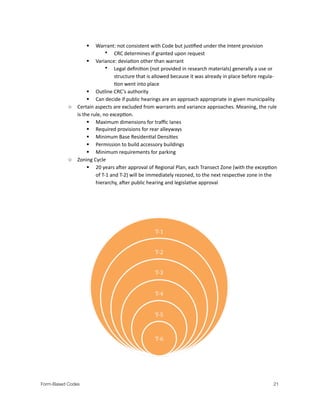
 20.years.aaer.approval.of.Regional.Plan,.each.Transect.Zone.(with.the.excep?on.
of.TM1.and.TM2).will.be.immediately.rezoned,.to.the.next.respec?ve.zone.in.the.
hierarchy,.aaer.public.hearing.and.legisla?ve.approval..
Form-Based Codes 
 21
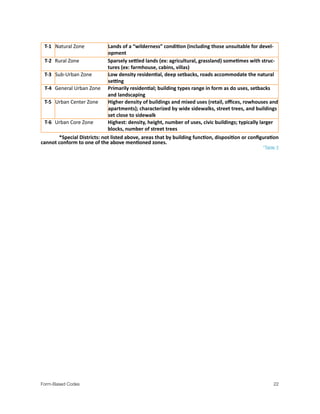
T"1 Natural.Zone Lands)of)a)“wilderness”)condi4on)(including)those)unsuitable)for)devel"
opment)
T"2 Rural.Zone Sparsely)seAled)lands)(ex:)agricultural,)grassland))some4mes)with)struc"
tures)(ex:)farmhouse,)cabins,)villas))
T"3 SubMUrban.Zone Low)density)residen4al,)deep)setbacks,)roads)accommodate)the)natural)
seHng)
T"4 General.Urban.Zone Primarily)residen4al;)building)types)range)in)form)as)do)uses,)setbacks)
and)landscaping)
T"5 Urban.Center.Zone Higher)density)of)buildings)and)mixed)uses)(retail,)offices,)rowhouses)and)
apartments);)characterized)by)wide)sidewalks,)street)trees,)and)buildings)
set)close)to)sidewalk)
T"6 Urban.Core.Zone. Highest:)density,)height,)number)of)uses,)civic)buildings;)typically)larger)
blocks,)number)of)street)trees)
*Special)Districts:)not)listed)above,)areas)that)by)building)func4on,)disposi4on)or)configura4on)
cannot)conform)to)one)of)the)above)men4oned)zones.)
*Table 2
.
Form-Based Codes 
 22

Form-Based Design Ord.

  • 1.
    Form-Based Codes City ofJohnson City: Planning Department 601 E. Main Street Johnson City, TN 37601 T (423) 434-6071 www.johnsoncitytn.org City of Johnson City
  • 2.
    Table of Contents Alternativesto Overlay Zoning 1 Atlanta Regional Commission 1 Form-Based Code Overview 1 Euclidean vs. Form-Based Zoning 5 Case Study 6 Columbia Pike Findings 6 Columbia Pike Breakdown 8 Regulating Plan 8 Building Envelope Standards 11 Architectural Standards 13 Creating Form-Based 16 Hybrid Codes Versus Form-Based Codes 16 Form-Based Codes Checklist 17 SmartCode 18 Table 1 18-19 Planning Ahead 19 General Look at SmartCode Text 20 Table 2 21-22 Form-Based Codes i
  • 3.
    Alternatives to OverlayZoning Atlanta Regional Commission Atlanta Regional Commission alternative suggestions to overlay design: 1) Apply the restrictive standards everywhere (not limited to overly district) 2) Private covenants a. encourages developers to impose covenants and review the residents them- selves rather than have Design Review Board b. however, the covenants may only run for 20 years and the only way to enforce may be for property owners to sue for damages 3) Creating small Euclidean zoning (which may increase the complexity of zoning) 4) Special Exceptions (best if used when standards are less restrictive than underlying zoning district) Form-Based Codes “Form-Based Codes: A Cure for the Cancer Called Euclidean Zoning?” by Jason T. Burdette • Focus is physical design rather than use • In contrast to the more traditionally Euclidean zoning, Form-Based is more flexible, focusing on what has been deemed as having a heightened importance (example: building appear- ance’s affect on the facing street) • Graphic illustrations are heavily relied upon to relay to potential developers what is expected of them • Focusing, traditionally, upon height regulations, space between buildings, and alignment, research suggests that Form-Based Codes lead to a more predictable development plan; whereas Euclidean zoning has been characterized as unpredictable. • The theory is to allow the market determine the use. However, there is some room for influ- ence (such as: commercial strip to consist of buildings between two and six stories closely abutting the street which will most likely produce retail on the bottom floor and residential on the remaining) • Charrette o Process to bring community’s vision into fruition by establishing a physical plan o Experienced code practitioners lead stakeholders (particularly in achieving feasible goals) o Participating community members are given maps and divided into work groups Form-Based Codes 1
  • 4.
    o Practitioners alsohelp facilitate a mutual meeting ground (for residents, major insti- tutions, government officials, developers, and builders) o Finally, the physical plan must be codified • Typically, code-based involves three aspects and one optional aspect: Regulating Plan, Building Envelope Standards, Definitions, and the optional Architectural Standards • Regulating Plan o Provides a coding key and specific character of each building o Distinguished from a zoning map, the regulating plan gives specific details sur- rounding ALL streets and blocks in the proposed area. o Furthermore, the Regulating Plan goes beyond traditional zoning maps by including: property lines, a “required building line,” a street tree alignment line, the location of public places such as parks and squares, as well as the predicted footprints of planned public buildings o Regulating plan encourages the review of the entire community, not individual units o Regulating plan encourages efficiency; instead of going through pages of codes to understand all the “in and outs” of what is allowed, the regulating plan/map is sim- pler. o *Most significantly, the regulating plan outlines a specific plan in place and not just the different aspects allowed and disallowed. o Examples: stacked flats, courtyard buildings, shop-houses, live-works, town- houses, detached villas, and high-rise towers • Building Envelope Standards o Typically addresses height, siting, elements, and sometimes uses o Regarding Height: generally reflects a minimum number which would be required to maintain a street wall and also a maximum number beyond which would be out of context. • With traditional zoning, developers would sometimes attempt the “cheat the system” by minimizing floor to ceiling heights to increase the number of floors. Through Form-Based this is avoided by implementation of “maximum-height-to-the-eave dimension and range of acceptable number of stories.” • Also, minimum above grade dimensions can be added for different building types (example: ensuring town homes are high enough to give privacy) o Regarding Siting: generally refers to the placement of a building in relation to sur- rounding buildings and fronting street. Also, can go into placement of parking lots, yards, building entrances, etc… • Architectural elements may include: windows, doors, porches, stoops, bal- conies, and chimneys; regarding these aspects, the specifics concerning quantity, configuration, and size may also be included. • While the philosophy of Form-Based zoning generally discourages specifi- cally allowing/disallowing a certain use, Form-Base does encourage mixed uses (retail stores on the bottom and residential above). • Glossary: should include key terms utilized within the plan and comprehensive definitions • Architectural Standards: (optional at the discretion of local stakeholders) focuses primarily on aesthetic features o Because of the subjective nature of aesthetic features, many local stakeholders are weary of implementing these standards. o Generally regulated by homeowner’s association or community covenant Form-Based Codes 2
  • 5.
    o Although eachcommunity creates its own unique standards, some examples of architectural standards for a Form-Based approach are: regulation of roof materials and slopes, building materials and finishes, paint colors, and window and door de- tailing • Four keys to Form-Based o Ensure that design standards are clear and concise; also, that these standards are objective and measurable o Keep the Form-Based permissive and neutral o The Form should be easily comprehended, with both simple language and supple- mental graphics o Lastly, the process should be efficient, predictable, and information easily ascer- tained. • Three Approaches o The community may modify existing codes to incorporate the Form-Based stan- dards. (This method not encouraged; this may be time consuming in light of most traditional codes include the very aspects for which Form-Based directly contra- dicts) o The community may elect to simply replace the more traditional code with the new Form-Based standards. (This method may be the most efficient route for some, but may also be the most controversial). o Lastly, a community may wish to adopt a Form-Based code only in districts of ur- ban revitalization, allowing the overall existing framework to remain intact and modi- fying based upon individual communities’ needs. *See: Arlington County, VA; “paral- lel codes” in Columbia Pike District. Only when the codes in the Columbia District proved successfully were they implemented in other areas. • Negative Aspects o Lack of standardization o Comfort with using what is viewed as a more traditional approach o Possible gentrification o Public weary of “urban agenda” • Positive Aspects o increased community involvement o market oriented o better comprehension of the regulations (any citizen, idealistically, could read the simple language of the code, analyze the graphical representation, and understand the meaning of the code) o improved flexibility (developers save money by reaching a clearer understanding of what is expected and community stakeholders have more input in the process) o the promotion of good urban design o enlarged community equity o proactive and encouraging approach, rather than a “knee jerk reaction” to a bad occurrence o “Finally, the monetary value of buildings in neo-traditional developments resulting from Form-Based Codes and similar design-based coding tend to increase at a greater rate than conventional developments. Home buyers are willing to pay a premium for traditional elements like connected street networks, smaller blocks, good pedestrian access, and proximity to mass transit” (Burdette, 48) o A study in Miami, Florida discovered that three years after implementing a Form- Base Code: “the average land value per square foot had increased from $60 to Form-Based Codes 3
  • 6.
    $92; the averageoffice leasing rates per square foot increased from $23-27 to $25- 30; and the average retail leasing rates per square foot increased from $15-40 to $32-55” • Suggestions o Introduce Form-Base first as a solution to land use issues o Standardize certain building types (example: define “mid-rise tower” versus a “de- tached villa”) o Consider housing when implementing a Form-Based Code (some critics worry that Form-Based would make living costs more expensive in traditionally less expensive neighborhoods, forcing former residents to relocate) o Try to implement: compact footprints, a mixing of uses, pedestrian-focused forms, creating a sense of place, affording access and mobility, and providing an efficient control mechanism Form-Based Codes 4
  • 7.
    EUCLIDEAN ZONING FORM-BASEDCODES Separates Land Uses Allows for the mixing of uses. Considers use a secondary factor in regulating development. Separates noxious uses as directed by the community vision and the market. Leapfrog Development Permits and encourages compact, contiguous development based upon community vision. Commercial Strip Development Enables vertical development, as opposed to long, single-story buildings. Low-Density Development Allows for increased development density where appropriate. Poor Accessibility Encourages compact, walkable developments. Enables community to plan for the pedestrian, as opposed to planning for the automobile. Lack of Functional Open Space Enables communities to mandate civic- oriented places like parks and plazas. Incomprehensible Ordinances The use of simple, graphic-based guidelines with minimal text allow for a more complete understanding of the regulation. Inflexible Uses Regulations are flexible in that they permit use to change or adjust as needed over time with- out regulatory approval. Form-Based Codes 5
  • 8.
    Case Study Columbia PikeSpecial Revitalization District Findings • Suburb of 190,000 residents (as of 2003) • Home to both the Pentagon and Washington Reagan National Airport • Columbia Pike: district located within Arlington County o Ethnically diverse o 3.5-mile traffic-clogged arterial road o Commercial strip development (fast food, restaurants, and apartment complexes with excessive parking) o Planning had not been much considered beyond “a thoroughfare for moving traffic through Arlington); limited focus on quality for local residents o No major construction projects in over 40 years o Retail: not diverse o Housing: older buildings with limited amenities • Planners decided to implement Form-Based Code • Community members gave input on their vision o Easily “walkable” o Variety of retail, mix uses and mix incomes o Diverse and affordable housing o Control the scale, fit and form o Suburban to urban • The plan identified 4 districts for development: a town center, a village center, a neighboring center and a western gateway district. • The Form-Based Code covered: o Building location (regulating plan) o Building form (envelope standards) o Architectural and Streetscape standards (the previously mentioned optional ap- proach) • The effects: o Approval time for developers became quicker (30 days for smaller projects and 60 days for larger projects)  Accredited to the availability of information (developers knew operational parameters in advance)  Developers who could not or would not meet guidelines knew to not waste time in the application process o Incentives were offered to local developers  Planners developed a consolidated parking strategy • Previously, buildings were required to maintain a certain number of parking spots based upon the size of the building. Form-Based Codes 6
  • 9.
    • Now, adistrict-based strategy ensures parking “within 600-foot walk of any new development” o Funding: arranged by Arlington leaders to pay for the costs of parking, street con- struction and other infrastructure elements.  Tax Increment Public Infrastructure (TIPI)- up to 85% tax revenues gener- ated by new projects within Columbia Pike Form-Based District would be reinvested into the project. • In considering disbursement: type of development, expected com- munity benefit, ability of project to benefit from public infrastructure  Rehabilitation Tax Exemption- to encourage development for the smaller property owners, the owner’s property taxes remain at pre-development level for 5 years.  Trust Fund: $ 7 million aimed at maintaining affordable housing • Conclusion: In 2003, Columbia Pike had over $300 million in new development projects. Form-Based Codes 7
  • 10.
    Columbia Pike SpecialRevitalization District Breakdown Regulating Plan The Columbia Pike Urban Design Charrette in cooperation with citizen planning workshops created the Regulating Plan in order to organize the growth of the Columbia Pike Special Revitalization District in Arlington County, Virginia. The plan specifically targets the nature of each lot within the context of surrounding lots and streets. Form-Based Codes 8
  • 11.
    I. Regulation Plan a.Purpose i. Principal tool for implementation ii. Identifies basic physical characteristics b. Blocks/Alleys i. All lots share frontage line with the street ii. If a block, must interrupt the block face if more 400 feet in length; ac- ceptable interruptions include alley, common access easement, or a pe- destrian pathway. Within a single lot, 75 feet of frontage or less is ex- empt from these regulations. Those lots with over 250 feet of frontage must interrupt the block face. iii. Alleys are required as part of redevelopment projects and must provide access to the rear of all lots. iv. Curb cut: limited to no more than one per 200 feet of street frontage c. Buildings i. A maximum building floor-plate is 30,000 square feet. ii. A maximum average length of 60 feet frontage without any breaks. iii. Consistent building standards of similar schemes shall front one another across streets. d. Streetscape i. Street trees will be planted at the time of development. ii. At the time of development, the developer is required to install side- walks. Restrictions on materials and design listed. e. Parking i. Encourage shared parking by creating a convenient, pedestrian-friendly environment. To achieve shared parking, incentives may be offered through the Tax Increment Public Infrastructure Fund. ii. Reduce single-purpose reserved parking. iii. Reserved parking will be made possible through an annual payment set by the County Manager. iv. Maximize on-street parking. v. Increase visibility/accessibility of parking. f. Retail i. The goal is to have retail on the ground story of main street sites. ii. Lists are provided for what is considered primary retail (generally pro- vides entertainment or leisure activities, and promote high walk-in cus- tomer counts) and secondary retail uses (generally provide personal or business services) Form-Based Codes 9
  • 12.
    Primary Retail Art orantique shop, including art work, art supplies and framing materials Bakery Book, stationary, or card store Clothing shop Coffee shop Day spa Delicatessen Department, furniture, home furnishings, or Drugstore Dry goods or notion store DVD/Video tape record store Electronics store Florist or gift shop Grocery, fruit or vegetable store Hardware, paint, or appliance store Hobby or handcraft store Household appliance Ice cream or confectionery store Indoor theaters Interior decorating store (with incidental inte- rior service) Jewelry store Leather goods/ luggage Meat or fish market Newsstand Nursery, flower, or plant service Optical store (operating as a commercial enterprise with incidental eye exam) Pet shop Restaurant Secondhand or consignment shop Shoe store Specialty food store (fish market, breads, pastries, wine, etc.) Sporting goods store Variety store *The following users are permitted with spe- cial exception use permit Amusements Bowling alley Nightclubs and restaurants with live entertainment/dancing Restaurant with drive-through window Self-storage facilities Secondary Retail Animal Hospital or veterinary clinic within a fully enclosed structure Automobile rental (retail functions only-no auto servicing) or automobile accessories and supplies (excluding installation) Bank or other financial institution (including check cashing) Barbershop or beauty salon Blueprinting, Photostatting, or photo copy service Business college operated as a commercial enterprise Catering establishment Clothes cleaning or laundry establishment Dance studio Employment agencies Film processing or film exchange Health club Insurance sales Locksmith Medical or dental offices, clinic or laboratories Music conservatory or music instruction Office (such as real estate broker, travel agency, medical, etc..) Palmistry Pawnshop Photo studio Printing, lithographing or publishing Private postal service Shoe or small appliance repair Sign painting shop Tailor or dressmaker Tax service *The following uses are permitted with special exception use permit Audio-visual production studio Carpet and rug cleaning (excluding dying) Food delivery service Miniature golf course Mortuary or funeral home Upholstery shop Vehicle service establishment Form-Based Codes 10
  • 13.
    Building Envelope Standards Thisportion of the plan regulates the buildings within the district. The goal is to create a vibrant public area through utilizing “street space” principles. These principles include the basic limitations and requirements of construction. Specifically addressed are: balconies, stoops and street walls. A Special Exception Process exists in order to allow a reasonable approach to these restrictions. Form-Based Codes 11
  • 14.
    II. Building EnvelopeStandards a. General Principles i. Buildings are aligned and close to the street with active fronts. ii. Uniformity creates public space and community identity. iii. Property lines are physically defined by buildings or street walls. iv. Buildings are designed for city setting, not suburban areas. The build- ings should face the general public area, not necessarily towards neigh- bors. v. Service areas should be kept away from the street face. vi. Retail on the ground floor is greatly encouraged in order to keep the area interesting and open to the public. vii. Encourage on street parking. viii. Parking lots should corroborate into shared parking. b. Building Standards i. Measure building heights by story. 1. Measuring by just height leads to manipulation of floor heights by developer. 2. Each building should be between 3-6 stories. ii. The ground floor should be at least 15 feet tall (measuring floor to ceil- ing). iii. All stories above the ground level should be no taller than 14 feet. The uppermost story should be at least 10 feet tall. iv. Aside from specially approved balconies, bay windows, stoops and shop fronts, the Required Building Line is not to be encroached. c. Ground story façade shall have between 60% and 90% fenestration [an open- ing in the building wall allowing light and views between interior and exterior. FENESTRATION is measured as glass area (excluding window frame elements with a dimension greater than 1 inch for conditioned space and as open area for parking structures or other un-conditioned, enclosed space)]. d. Upper story facades shall have between 30% and 70% FENSTRATION. e. Ground stories should be used for retail; entry doors should be spaced out no greater than 60 feet within any site. f. Retail should not be located on any floors beyond the ground floor. Allowed uses for upper floors are restaurants and business professional offices. Form-Based Codes 12
  • 15.
    Architectural Standards Outside researchrefers to this section of Arlington County’s Form Based Code as “optional.” This approach deviates somewhat from form based codes by exploring different aesthetic features. The Columbia Pike Revitalization District Code establishes an Administrative Review Team which must approve a developer’s design and give assistance in order to achieve the code’s goals. The intent is to preserve traditional features in order to stabilize a consistent form in the district. Form-Based Codes 13
  • 16.
    III. Architectural Standards a.The materials selected and their placement should reflect traditional methods. Simplicity and craftsmanship are preferred over ostentatious form. b. A list of satisfactory materials and techniques are provided on page 6.3. i. A few examples of materials: brick and tile masonry, pre-cast masonry, split-faced block, native stone. ii. A few examples of techniques: change in material should follow a con- structional logical, no “cake icing” finishes, properly detailed. c. When designing roofs and parapets, the developer should be mindful of sur- rounding pitch, drainage, and materials. The approach should be consistent with surrounding area. d. A list of satisfactory materials and techniques are provided on page 6.5. i. A few examples of materials: clay, tile, slate, dimensional asphalt shin- gles. ii. A few examples of techniques critiqued: pitched roofs, overhangs, parapet roofs. e. The Columbia Pike Form requires street walls to provide a clear street face. Ma- sonry walls should specifically separate the public front from private realm (par- ticularly parking lots, trash cans, gardens and equipment). The “better side” should face the street. f. A list of satisfactory materials and techniques are provided on page 6.7. i. A few examples of materials: native/regional stone, brick, brick. ii. A few examples of techniques: height requirements, climbing vine plan, metal work. g. Rather than have a single pane of glass, buildings should have several panes, divided by architectural features in order to prevent the “whole in the wall” ap- pearance. h. A list of satisfactory materials and techniques are provided on pages 6.9-7.0 i. A few examples of materials: black or gray window screens, doors should be wood or steal, specialty windows may be stained or opales- cent ii. A few examples of techniques: windows should be no closer than 30 inches to building corners, maximum office window pane size is 48 inches vertical by 40 inches horizontal, single panels of glass not larger than 6 by 4 for shop front windows, roll-down security gates are prohib- ited i. Designers should try to avoid “visual pollution” sometimes created by excessive use of signs and certain designs. To avoid this undesirable outcome, signs should weather well and offer as a decoration. j. Sign standards are listed on pages 6.12 and 6.13. i. A few examples: letters on wall sign shall not exceed 18 inches in height or width, windows signs are permitted within the ground floor or second story office window, address signs must be placed at street entry door. ii. Prohibited signs are listed on page 6.13. k. Purposes for lighting: nighttime visibility, crime deterrence and decoration. When selecting lighting equipment, developers should consider materials which are: durable, energy efficient and weather well. To prevent “light pollution,” the de- sign of the equipment and intensity of the lighting should be considered. Form-Based Codes 14
  • 17.
    l. A listof satisfactory lighting standards and equipment are one pages 6.15 and 6.16. i. A few examples of lighting: direct lights downward and away from living quarters, exterior lights at the front of a building should be mounted be- tween 6 and 14 feet above adjacent grade. ii. Prohibited: flashing, traveling, animated or intermittent lighting. Form-Based Codes 15
  • 18.
    Creating Form-Based Hybrid CodesVersus Form-Based Codes ‣A growing trend among cities is to have “best of both worlds” approach, creating a hybrid version of form-based codes. ‣Typically, hybrid codes address setbacks, parking placement, building bulk, materials and archi- tectural features. ‣While implementing certain elements of a form-based code may prove beneficial, the hybrid ap- proach will not produce the outcome as a pure form-based code. ‣FBC (form-based codes) works to carefully pull in buildings, streets, and open space to work to- gether. Without careful attention to the relationship of all these aspects, a hybrid code could cause clashing, rather than cohesion, among land-use regulations such as planning, zoning, subdivision, public works and safety standards. ‣The lack of development in a hybrid code leaves the ordinance unpredictable, unlike the FBC. The hybrid form, like most non-FBC codes, cannot respond to the market without legislative help. Thus, the tendency to micromanage land use is an issue. Inevitably, zoning decisions become dis- cretionary. ‣Some cities look to integrating parts of FBC (instead of the entire concept) because the task of replacing the old code seems too extreme, worrisome, or perhaps too extreme. ‣Solution? Select a district to fully implement the code rather than implementing a FBC for the en- tire city. So, make the code hybrid in the sense that some zones are FBC (completely) while other, separate districts adhere to a more typical trend in ordinances such as Euclidean Zoning. ‣Where to start: first, code infill and greenfield areas. ➡In greenfield and infill areas, a FBC will generally define: the placement of buildings, streets and open spaces; standards which define the minimum and maximum stories of a building; the bulk and function of the building; and a review process. ➡Cities can either create a separate, independent ordinance for the FBC district or cities may chose to keep the FBC within the conventional city-wide ordinance, making minor ad- justments as needed. ‣Remember, anything less than a true FBC will not produce the positive outcome desired; the frus- tration of the public at such a hybrid may make a true FBC impossible in the future. Form-Based Codes 16
  • 19.
    ‣Also, if acity is proposing implementation of a FBC in a designated district, the city should plan ahead and prepare a frame work to implement FBC in the remaining districts in the case that a FBC proves to be a desirable solution to city-wide zoning issues. Form-Based Codes Check List Form-Based Codes Institute, http://www.formbasedcodes.org Identifying Form-Based Codes ✓Is the code's focus primarily on regulating urban form and less on land use? ✓Is the code regulatory rather than advisory? ✓Does the code emphasize standards and parameters for form with predictable physical out comes (build-to lines, frontage type requirements, etc.) rather than relying on numerical parameters (FAR, density, etc.) whose outcomes are impossible to predict? ✓Does the code require private buildings to shape public space through the use of building form standards with specific requirements for building placement? ✓Does the code require private buildings to shape public space through the use of building form standards with specific requirements for building placement? ✓Does the code promote and/or conserve an interconnected street network and pedestrian- scaled blocks? ✓Are regulations and standards keyed to specific locations on a regulating plan? ✓Are the diagrams in the code unambiguous, clearly labeled, and accurate in their presentation of spatial configurations? Evaluating Form-Based Codes ✓Is the code enforceable? ➡Does the code implement a plan that reflects specific community intentions? ➡Are the procedures for code administration clearly described? ➡Is the form-based code effectively coordinated with other applicable policies and regulations that control development on the same property? ✓Is the code easy to use? ➡Is the overall format and structure of the code readily discernible so that users can easily find what is pertinent to their interest? ➡Can users readily understand and execute the physical form intended by the code? ➡Are technical terms used in the code defined in a clear and understandable manner? ➡Does the code format lend itself to convenient public distribution and use? ➡Are the intentions of each regulation clearly described and apparent even to planning staff and citizens who did not participate in its preparation? ✓Will the code produce functional and vital urbanism? ➡Will the code shape the public realm to invite pedestrian use and social interaction? ➡Will the code produce walkable, identifiable neighborhoods that provide for daily needs? ➡Are parking requirements compatible with pedestrian-scaled urbanism? ➡Is the code based on a sufficiently detailed physical plan and/or other clear community vision that directs development and aids implementation? Form-Based Codes 17
  • 20.
    SmartCode The SmartCodeis a well developed approach to creating a Form-Based Code. The re- search below is a brief overview of information condensed from of available materials from the Cen- ter for Applied Transect Studies. The SmartCode promotes growth that is compact, walkable, and contains mixed uses within a given area. The theory that drives the SmartCode is humans need different environments. In the past, planning has approached this concept with sprawled growth, meaning areas were rigidly developed to meet a certain use standard. Over time, these areas be- came incapable of blending with surrounding uses and areas. The new approach is to accept hu- mans desire different surroundings and, instead of segregating each community from one another, incorporate these different desire within a single community. A Background Certain factors combined over the past few decades to create the “sprawled” approach to planning. These factors include: automobiles, cheap petroleum, cheap land, and generalized wealth. Based upon these societal trends, design standards incorporated a strict use separation policy (designated areas for residential, retail, schools, etc...). As a result, automobiles were rein- forced as more preferred than walking. As a result, society became accustomed to: strip malls, trite subdivisions, downtowns lacking in character, pedestrian unfriendly streets, increase in billboards, and overall sprawl. A quick, comprehensive outline is listed below. REGIONAL SCALE COMMUNITY SCALE PLANSCOMMUNITY SCALE PLANSCOMMUNITY SCALE PLANSCOMMUNITY SCALE PLANSCOMMUNITY SCALE PLANS BUILDING SCALE PLANS PLANS A. Regional B. Community C. TransectC. Transect Standards Sector Unit ZonesZones 0-1: Preserved None T-1 NaturalT-1 Natural Open Sector ZoneZone Open Lands 0-2: Reserved T-2 RuralT-2 Rural Open Sector None ZoneZone G-1: Restricted CLD: Clustered T-2T-2T-2 Growth Sector Land T-3 Sub-UrbanT-3 Sub-UrbanT-3 Sub-Urban Development ZoneZoneZone Ex: hamlet or T-4 GeneralT-4 GeneralT-4 General settlement Urban ZoneUrban ZoneUrban Zone G-2 Controlled CLD T-2 Building Disposition Growth Sector T-3 Form-Based Codes 18
  • 21.
    T-4 Building Configuration New Development TND:Traditional T-3 New Development Neighborhood T-4 Building Function Development Ex: T-5 village, Density Calculations neighborhood G-3 Intended TND T-3T-3 Parking Standards Growth Sector T-4T-4 T-5T-5 Landscape Standards RCD: Regional T-4T-4 Center T-5T-5 Development T-6 UrbanT-6 Urban Sign age Standards Ex:regional center Core ZoneCore Zone or downtown G-4 Infill Growth Infill TND T-3T-3 Supplementary Sector Traditional T-4T-4 Modules Neighborhood T-5T-5 Development Existing Development Infill RCD Regional T-4T-4 Center T-5T-5 Development T-6T-6 SD Special Districts CB Civic Buildings Other CS Civic Spac e *Table 1 Planning Ahead The SmartCode requires plans produced for: sectors, layout of communities, lots and building placement. Regional Plan: prepared by or on behalf of the Planning Department New Community Plan: prepared by the landowner, developer, or Planning Department Infill Community Plan: prepared by or on behalf of a builder or property owner Building Scale Plan: on behalf of builder or property owner When implementing a SmartCode, consider creating a DDC (Development and Design Center). As emphasized by Form-Based Codes, the SmartCode strongly encourages the use of a public charrette. In this process, include: Form-Based Codes 19
  • 22.
    urban designers, architects,landscape architects, planners, civil engineers, attorneys who are familiar with SmartCode General Look at SmartCode Text • Authority • Applicability. o Code.takes.precedence.when.in.conflict.with.other.ordinances,.except.Local.Health.and. Safety.Codes • Defini?ons o See.table.of.defini?ons.as.provided.by.the.Code o Accept.common.meanings.when.not.specifically.defined.by.Code o If.defini?ons.in.conflict,.accept.the.Code’s.defini?on • Specifically.list.which.tables/graphs.are.legally.binding • Intent.of.the.SmartCode.(a.theme.which.is.consistently.referenced.throughout.the.Code) o Regarding.the.region  Retain.natural.infrastructure.and.visual.character.considering.the.topography,. woodlands,.farmlands,.etc…  Encourage.growth.(especially.within.infill.sec?ons)  Distribute.affordable.housing.throughout.region.(job.opportuni?es.and.decenM tralize.poverty).  Provide.easy.alterna?ve.to.automobiles. o Regarding.the.Community  Compact,.mixedMuse,.pedestrian.friendly  Provide.daily.living.ac?vi?es.within.walking.distance.of.homes  Thoroughfares.designed.to.reduce.volume.of.traffic  Civic.and.Commercial.ac?vi?es.centralized.in.downMtown  Schools.within.walking.or.biking.distance  Variety.of.parks,.squares,.and.playgrounds.dispersed.throughout.region. • Block.and.Building. o Architecture.and.landscape.should.grow.from.local.climate,.topography,.history,.seUng. o Energy.efficient.methods o Civic.building.loca?ons.to.support.selfMgovernment.and.iden?fy. • Process o Municipality.creates.CRC.(Consolidated.Review.CommiWee).  which.has.a.representa?ve.from.each.agency.of.permiUng.authority.  also.includes.a.representa?ve.from.Development.and.Design.Center.  also.includes.town.architect. o In.the.case.of.no.warrants,.no.variance,.or.ONLY.warrants:.administra?ve.process  Appeals.go.to.BZA o Enforcement.  If.devia?on.from.approved.plan.or.fail.to.complete.approval.process,.BAZ.retains. right.to.halt.project,.remove.viola?on,.mi?gate.viola?on.or.issue.a.variance. • Warrants.and.Variances o .CRC.final.word.on.whether.a.warrant.or.variance.is.needed Form-Based Codes 20
  • 23.
     Warrant:.not.consistent.with.Code.but.jus?fied.under.the.Intent.provision • CRC.determines.if.granted.upon.request Variance:.devia?on.other.than.warrant • Legal.defini?on.(not.provided.in.research.materials).generally.a.use.or. structure.that.is.allowed.because.it.was.already.in.place.before.regulaM ?on.went.into.place.  Outline.CRC’s.authority  Can.decide.if.public.hearings.are.an.approach.appropriate.in.given.municipality. o Certain.aspects.are.excluded.from.warrants.and.variance.approaches..Meaning,.the.rule. is.the.rule,.no.excep?on.  Maximum.dimensions.for.traffic.lanes  Required.provisions.for.rear.alleyways  Minimum.Base.Residen?al.Densi?es.  Permission.to.build.accessory.buildings.  Minimum.requirements.for.parking. o Zoning.Cycle  20.years.aaer.approval.of.Regional.Plan,.each.Transect.Zone.(with.the.excep?on. of.TM1.and.TM2).will.be.immediately.rezoned,.to.the.next.respec?ve.zone.in.the. hierarchy,.aaer.public.hearing.and.legisla?ve.approval.. Form-Based Codes 21
  • 24.
    T"1 Natural.Zone Lands)of)a)“wilderness”)condi4on)(including)those)unsuitable)for)devel" opment) T"2Rural.Zone Sparsely)seAled)lands)(ex:)agricultural,)grassland))some4mes)with)struc" tures)(ex:)farmhouse,)cabins,)villas)) T"3 SubMUrban.Zone Low)density)residen4al,)deep)setbacks,)roads)accommodate)the)natural) seHng) T"4 General.Urban.Zone Primarily)residen4al;)building)types)range)in)form)as)do)uses,)setbacks) and)landscaping) T"5 Urban.Center.Zone Higher)density)of)buildings)and)mixed)uses)(retail,)offices,)rowhouses)and) apartments);)characterized)by)wide)sidewalks,)street)trees,)and)buildings) set)close)to)sidewalk) T"6 Urban.Core.Zone. Highest:)density,)height,)number)of)uses,)civic)buildings;)typically)larger) blocks,)number)of)street)trees) *Special)Districts:)not)listed)above,)areas)that)by)building)func4on,)disposi4on)or)configura4on) cannot)conform)to)one)of)the)above)men4oned)zones.) *Table 2 . Form-Based Codes 22