
Form 990:
            Making It Work for Your Organization

                     Harmon Burstyn
                        August 8, 2012


A Service
   Of:                             Sponsored by:
INTEGRATED PLANNING
            Advising nonprofits in:        www.synthesispartnership.com
            • Strategy
            • Planning                                    (617) 969-1881
            • Organizational Development   info@synthesispartnership.com


A Service
   Of:                                            Sponsored by:
www.mission.do


A Service
   Of:                  Sponsored by:
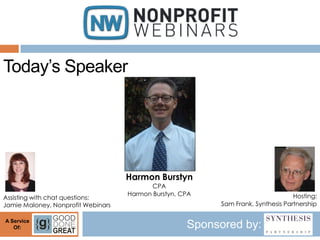
Today’s Speaker


                                    Harmon Burstyn
                                           CPA
                                    Harmon Burstyn, CPA                           Hosting:
Assisting with chat questions:
Jamie Maloney, Nonprofit Webinars                         Sam Frank, Synthesis Partnership

A Service
   Of:                                               Sponsored by:
The Not so New Form 990: Make It Work for
                Your Organization

       Harmon Burstyn, CPA
        hburstyn@harmonburstyncpa.com
       www.irs.gov
       www.guidestar.org
       Attorney General
       Secretary of State
       www.foundationcenter.org
       www.boardsource.org


5                                       Harmon Burstyn, CPA
The Not so New Form 990: Make It Work for
                Your Organization

       Form 990 had not been significantly revised since
        1979.
       Exempt organizations (EO) have increased in size,
        diversity, and complexity.
       Emphasis on the EO governing body, governance
        and management policies, and its disclosure
        practices.
       More schedules, no attachments.
       Form structured to allow EO to tell their story.

6                                           Harmon Burstyn, CPA
Exempt organizations have increased in
           size, diversity, and complexity.

       Nonprofit groups account for 5% of the U.S.
        gross domestic product
       Contribute $666 billion to the economy
        through their actions
       Many charitable nonprofit organizations have
        international operations
       Multiple revenue streams

7                                      Harmon Burstyn, CPA
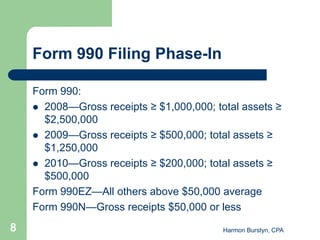
Form 990 Filing Phase-In

    Form 990:
     2008—Gross receipts ≥ $1,000,000; total assets ≥
      $2,500,000
     2009—Gross receipts ≥ $500,000; total assets ≥
      $1,250,000
     2010—Gross receipts ≥ $200,000; total assets ≥
      $500,000
    Form 990EZ—All others above $50,000 average
    Form 990N—Gross receipts $50,000 or less
8                                         Harmon Burstyn, CPA
Emphasis on governance, management
         policies, and its disclosure practices.

       Sarbanes-Oxley’s impact
       Sen. Charles Grassley, Senate Finance
        Committee
       Sarah Hall Ingram, Commissioner, Tax
        Exempt and Government Entities, IRS
       Mismanagement, fraud, unrelated business
        income tax (UBIT)

9                                    Harmon Burstyn, CPA
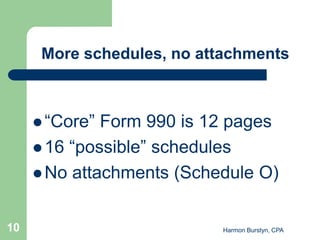
More schedules, no attachments


      “Core” Form 990 is 12 pages
      16 “possible” schedules
      No attachments (Schedule O)


10                         Harmon Burstyn, CPA
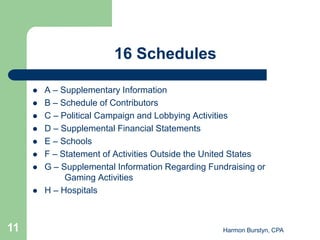
16 Schedules

        A – Supplementary Information
        B – Schedule of Contributors
        C – Political Campaign and Lobbying Activities
        D – Supplemental Financial Statements
        E – Schools
        F – Statement of Activities Outside the United States
        G – Supplemental Information Regarding Fundraising or
              Gaming Activities
        H – Hospitals


11                                                 Harmon Burstyn, CPA
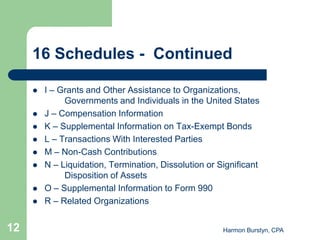
16 Schedules - Continued

        I – Grants and Other Assistance to Organizations,
              Governments and Individuals in the United States
        J – Compensation Information
        K – Supplemental Information on Tax-Exempt Bonds
        L – Transactions With Interested Parties
        M – Non-Cash Contributions
        N – Liquidation, Termination, Dissolution or Significant
              Disposition of Assets
        O – Supplemental Information to Form 990
        R – Related Organizations


12                                                     Harmon Burstyn, CPA
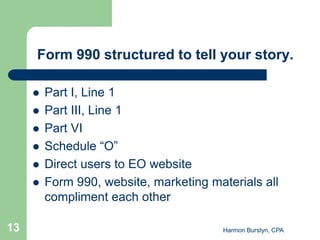
Form 990 structured to tell your story.

        Part I, Line 1
        Part III, Line 1
        Part VI
        Schedule “O”
        Direct users to EO website
        Form 990, website, marketing materials all
         compliment each other

13                                       Harmon Burstyn, CPA
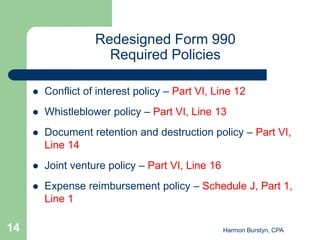
Redesigned Form 990
                      Required Policies

        Conflict of interest policy – Part VI, Line 12
        Whistleblower policy – Part VI, Line 13
        Document retention and destruction policy – Part VI,
         Line 14
        Joint venture policy – Part VI, Line 16
        Expense reimbursement policy – Schedule J, Part 1,
         Line 1

14                                                 Harmon Burstyn, CPA
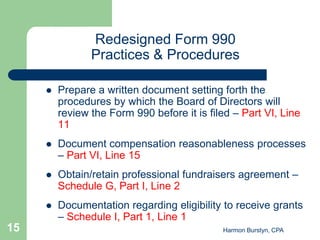
Redesigned Form 990
                Practices & Procedures

        Prepare a written document setting forth the
         procedures by which the Board of Directors will
         review the Form 990 before it is filed – Part VI, Line
         11
        Document compensation reasonableness processes
         – Part VI, Line 15
        Obtain/retain professional fundraisers agreement –
         Schedule G, Part I, Line 2
        Documentation regarding eligibility to receive grants
         – Schedule I, Part 1, Line 1
15                                           Harmon Burstyn, CPA
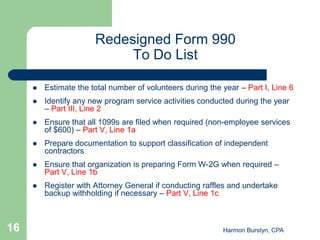
Redesigned Form 990
                            To Do List

        Estimate the total number of volunteers during the year – Part I, Line 6
        Identify any new program service activities conducted during the year
         – Part III, Line 2
        Ensure that all 1099s are filed when required (non-employee services
         of $600) – Part V, Line 1a
        Prepare documentation to support classification of independent
         contractors
        Ensure that organization is preparing Form W-2G when required –
         Part V, Line 1b
        Register with Attorney General if conducting raffles and undertake
         backup withholding if necessary – Part V, Line 1c


16                                                          Harmon Burstyn, CPA
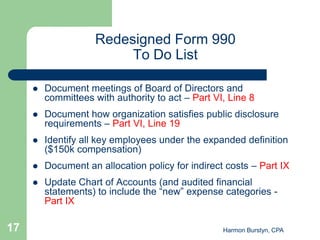
Redesigned Form 990
                          To Do List

        Document meetings of Board of Directors and
         committees with authority to act – Part VI, Line 8
        Document how organization satisfies public disclosure
         requirements – Part VI, Line 19
        Identify all key employees under the expanded definition
         ($150k compensation)
        Document an allocation policy for indirect costs – Part IX
        Update Chart of Accounts (and audited financial
         statements) to include the “new” expense categories -
         Part IX

17                                                 Harmon Burstyn, CPA
Automatic Lose of Tax-Exempt
                    Status

        Beginning in 2007 EO’s were required to file a return with the
         IRS, even if revenues were under $25,000.
        No filings for 3 consecutive years led to automatic lose of tax-
         exempt status.
        As of October 2010 275,000 EO’s lost their exempt status.
        IRS believes the vast majority of these are defunct.
        EO’s with $50,000 or less in gross receipts can re-apply for tax-
         exempt status retroactive to the date of revocation.
        Application (Form 1023) fee reduced to $100.


18                                                     Harmon Burstyn, CPA
Common Mistakes

        “Weak” program service accomplishment descriptions.
        Not filing the RRF-1 with the Attorney General.
        No careful review of the 990 prior to filing.
        Board not understanding the 990 and its importance.
        Non/late filing of the SI-100 with the Secretary of State.
        Taking “risk” with pro bono preparation.
        Not tracking volunteer hours.
        Not tracking expenses for each program.


19                                                      Harmon Burstyn, CPA
Find listings for our current season
          of webinars and register at:

            NonprofitWebinars.com


A Service
   Of:                     Sponsored by:

Form 990: Making It Work for Your Organization

  • 1.
    Form 990: Making It Work for Your Organization Harmon Burstyn August 8, 2012 A Service Of: Sponsored by:
  • 2.
    INTEGRATED PLANNING Advising nonprofits in: www.synthesispartnership.com • Strategy • Planning (617) 969-1881 • Organizational Development info@synthesispartnership.com A Service Of: Sponsored by:
  • 3.
    www.mission.do A Service Of: Sponsored by:
  • 4.
    Today’s Speaker Harmon Burstyn CPA Harmon Burstyn, CPA Hosting: Assisting with chat questions: Jamie Maloney, Nonprofit Webinars Sam Frank, Synthesis Partnership A Service Of: Sponsored by:
  • 5.
    The Not soNew Form 990: Make It Work for Your Organization  Harmon Burstyn, CPA hburstyn@harmonburstyncpa.com  www.irs.gov  www.guidestar.org  Attorney General  Secretary of State  www.foundationcenter.org  www.boardsource.org 5 Harmon Burstyn, CPA
  • 6.
    The Not soNew Form 990: Make It Work for Your Organization  Form 990 had not been significantly revised since 1979.  Exempt organizations (EO) have increased in size, diversity, and complexity.  Emphasis on the EO governing body, governance and management policies, and its disclosure practices.  More schedules, no attachments.  Form structured to allow EO to tell their story. 6 Harmon Burstyn, CPA
  • 7.
    Exempt organizations haveincreased in size, diversity, and complexity.  Nonprofit groups account for 5% of the U.S. gross domestic product  Contribute $666 billion to the economy through their actions  Many charitable nonprofit organizations have international operations  Multiple revenue streams 7 Harmon Burstyn, CPA
  • 8.
    Form 990 FilingPhase-In Form 990:  2008—Gross receipts ≥ $1,000,000; total assets ≥ $2,500,000  2009—Gross receipts ≥ $500,000; total assets ≥ $1,250,000  2010—Gross receipts ≥ $200,000; total assets ≥ $500,000 Form 990EZ—All others above $50,000 average Form 990N—Gross receipts $50,000 or less 8 Harmon Burstyn, CPA
  • 9.
    Emphasis on governance,management policies, and its disclosure practices.  Sarbanes-Oxley’s impact  Sen. Charles Grassley, Senate Finance Committee  Sarah Hall Ingram, Commissioner, Tax Exempt and Government Entities, IRS  Mismanagement, fraud, unrelated business income tax (UBIT) 9 Harmon Burstyn, CPA
  • 10.
    More schedules, noattachments  “Core” Form 990 is 12 pages  16 “possible” schedules  No attachments (Schedule O) 10 Harmon Burstyn, CPA
  • 11.
    16 Schedules  A – Supplementary Information  B – Schedule of Contributors  C – Political Campaign and Lobbying Activities  D – Supplemental Financial Statements  E – Schools  F – Statement of Activities Outside the United States  G – Supplemental Information Regarding Fundraising or Gaming Activities  H – Hospitals 11 Harmon Burstyn, CPA
  • 12.
    16 Schedules -Continued  I – Grants and Other Assistance to Organizations, Governments and Individuals in the United States  J – Compensation Information  K – Supplemental Information on Tax-Exempt Bonds  L – Transactions With Interested Parties  M – Non-Cash Contributions  N – Liquidation, Termination, Dissolution or Significant Disposition of Assets  O – Supplemental Information to Form 990  R – Related Organizations 12 Harmon Burstyn, CPA
  • 13.
    Form 990 structuredto tell your story.  Part I, Line 1  Part III, Line 1  Part VI  Schedule “O”  Direct users to EO website  Form 990, website, marketing materials all compliment each other 13 Harmon Burstyn, CPA
  • 14.
    Redesigned Form 990 Required Policies  Conflict of interest policy – Part VI, Line 12  Whistleblower policy – Part VI, Line 13  Document retention and destruction policy – Part VI, Line 14  Joint venture policy – Part VI, Line 16  Expense reimbursement policy – Schedule J, Part 1, Line 1 14 Harmon Burstyn, CPA
  • 15.
    Redesigned Form 990 Practices & Procedures  Prepare a written document setting forth the procedures by which the Board of Directors will review the Form 990 before it is filed – Part VI, Line 11  Document compensation reasonableness processes – Part VI, Line 15  Obtain/retain professional fundraisers agreement – Schedule G, Part I, Line 2  Documentation regarding eligibility to receive grants – Schedule I, Part 1, Line 1 15 Harmon Burstyn, CPA
  • 16.
    Redesigned Form 990 To Do List  Estimate the total number of volunteers during the year – Part I, Line 6  Identify any new program service activities conducted during the year – Part III, Line 2  Ensure that all 1099s are filed when required (non-employee services of $600) – Part V, Line 1a  Prepare documentation to support classification of independent contractors  Ensure that organization is preparing Form W-2G when required – Part V, Line 1b  Register with Attorney General if conducting raffles and undertake backup withholding if necessary – Part V, Line 1c 16 Harmon Burstyn, CPA
  • 17.
    Redesigned Form 990 To Do List  Document meetings of Board of Directors and committees with authority to act – Part VI, Line 8  Document how organization satisfies public disclosure requirements – Part VI, Line 19  Identify all key employees under the expanded definition ($150k compensation)  Document an allocation policy for indirect costs – Part IX  Update Chart of Accounts (and audited financial statements) to include the “new” expense categories - Part IX 17 Harmon Burstyn, CPA
  • 18.
    Automatic Lose ofTax-Exempt Status  Beginning in 2007 EO’s were required to file a return with the IRS, even if revenues were under $25,000.  No filings for 3 consecutive years led to automatic lose of tax- exempt status.  As of October 2010 275,000 EO’s lost their exempt status.  IRS believes the vast majority of these are defunct.  EO’s with $50,000 or less in gross receipts can re-apply for tax- exempt status retroactive to the date of revocation.  Application (Form 1023) fee reduced to $100. 18 Harmon Burstyn, CPA
  • 19.
    Common Mistakes  “Weak” program service accomplishment descriptions.  Not filing the RRF-1 with the Attorney General.  No careful review of the 990 prior to filing.  Board not understanding the 990 and its importance.  Non/late filing of the SI-100 with the Secretary of State.  Taking “risk” with pro bono preparation.  Not tracking volunteer hours.  Not tracking expenses for each program. 19 Harmon Burstyn, CPA
  • 20.
    Find listings forour current season of webinars and register at: NonprofitWebinars.com A Service Of: Sponsored by: