Simple Chemical Reactions
7F Simple Chemical Reactions
Word equations
Reactions with oxygen
Chemical reactions everywhere
Summary activities
Reactions with acid
Contents
Physical and chemical changes
How many physical and chemical changes can you spot?
What is a chemical reaction?
cooking rusting sticking
burning making metals living!
Can you think of any other chemical reactions?
Chemical reactions do not only happen in the laboratory.
Chemical reactions happen anywhere that new substances
are made:
Useful chemical reactions
Non-useful chemical reactions
Reactants and products
The starting substances used in a reaction are reactants.
The new substances formed in a reaction are products.
In a chemical reaction, one or more new substances are formed.
The arrow means “change into”. In a chemical reaction,
all the reactants change into the products.
It is difficult to reverse a chemical reaction and change the
products back into the reactants.
More about chemical changes
Chemical changes are usually
difficult to reverse.
Magnesium burns in oxygen to form
magnesium oxide. It is not possible
to “un-burn” the magnesium once it
has been burnt.
Many reactions need energy to get them started.
Many reactions (like the burning of magnesium) give out
heat energy once the reaction has started.
Heat energy being given out is one sign of a chemical
reaction. What other signs of a chemical reaction are there?
magnesium oxide
oxygen
magnesium
7F Simple Chemical Reactions
Word equations
Reactions with oxygen
Chemical reactions everywhere
Summary activities
Reactions with acid
Contents
Reaction of acid with metals
magnesium
+ acid
hydrogen
burning
splint
Many metals react with acids.
When this happens the metal
fizzes as bubbles are produced.
What do the bubbles mean?
A gas is produced.
How can you test to find out if the gas produced is hydrogen?
Place a burning splint next to the mouth of test tube.
A ‘squeaky pop’ as the gas ignites shows that hydrogen
is the gas produced in this reaction.
Test for hydrogen
Reaction of acid with a metal carbonate
When a metal carbonate reacts with acid it fizzes and then
seems to disappear. The carbonate and the acid have
reacted and changed into a salt, water and carbon dioxide.
When carbon dioxide gas is bubbled
through limewater, it turns the
limewater cloudy or milky white.
Test for carbon dioxide
a salt
metal
carbonate acid water
carbon
dioxide
Carbon dioxide can be tested for using
the limewater test.
7F Simple Chemical Reactions
Word equations
Reactions with oxygen
Contents
Chemical reactions everywhere
Summary activities
Reactions with acid
Contents
3. The names of the products.
A word equation is used as a quick, shorthand way of
writing a chemical reaction.
There are always three parts to a word equation:
1. The names of the reactants.
2. An arrow.
Word equations
What is the word equation for hydrogen reacting with oxygen
to form water?
water
oxygen
hydrogen
Substance Reactant or Product?
magnesium oxide
magnesium
copper oxide
copper
product
reactant
reactant
product
Reactant or product?
magnesium
oxide
magnesium
copper
oxide copper
In this chemical reaction, which substances are the
reactants and which substances are products?
What are the word equations for the following reactions?
2. Calcium hydroxide reacts with hydrochloric acid to form
calcium chloride and water.
3. Sodium reacts with hydrochloric acid to form sodium
chloride and hydrogen.
Write the word equations
magnesium oxide
oxygen
calcium
chloride
calcium
hydroxide
hydrochloric
acid water
1. Magnesium burns brightly in oxygen to form
magnesium oxide.
magnesium
sodium
chloride
sodium
hydrochloric
acid hydrogen
7F Simple Chemical Reactions
Word equations
Reactions with oxygen
Contents
Chemical reactions everywhere
Summary activities
Reactions with acid
Contents
What is combustion?
Combustion is the scientific word for burning and is a
type of chemical reaction.
Combustion is the reaction when a substance burns and
reacts with oxygen to produce heat and light energy.
Burning has been an important source of energy since
primitive man and is still a hugely important process today.
Using combustion
How different would life be without combustion?
Burning fuel, like coal, petrol and natural gas, provides > 90%
of the energy needed for transport, factories and in the home.
Fire triangle
3. Methane burns and forms carbon dioxide and water:
Equations for combustion
1. Coal (made from carbon) burns and forms carbon dioxide:
When substance burns and react with oxygen the new
substances formed are called “oxides”.
What are the word equations for these combustion reactions?
carbon
dioxide
oxygen
carbon
2. Hydrogen burns and forms dihydrogen oxide (i.e water!):
water
oxygen
hydrogen
carbon
dioxide
oxygen
methane water
Combustion of methane
The natural gas, methane, is often burnt for cooking.
Methane is made up of carbon and hydrogen.
What gas does methane react with
when it burns?
What substance will the carbon in methane
change into when it burns in oxygen?
What substance will the hydrogen in methane
change into when it burns in oxygen?
What is the word equation for the combustion of methane?
carbon
dioxide
oxygen
methane water
Candle burning in bell jar
7F Simple Chemical Reactions
Acid reactions
Reactions with oxygen
Contents
Chemical reactions everywhere
Summary activities
Reactions with acid
Contents
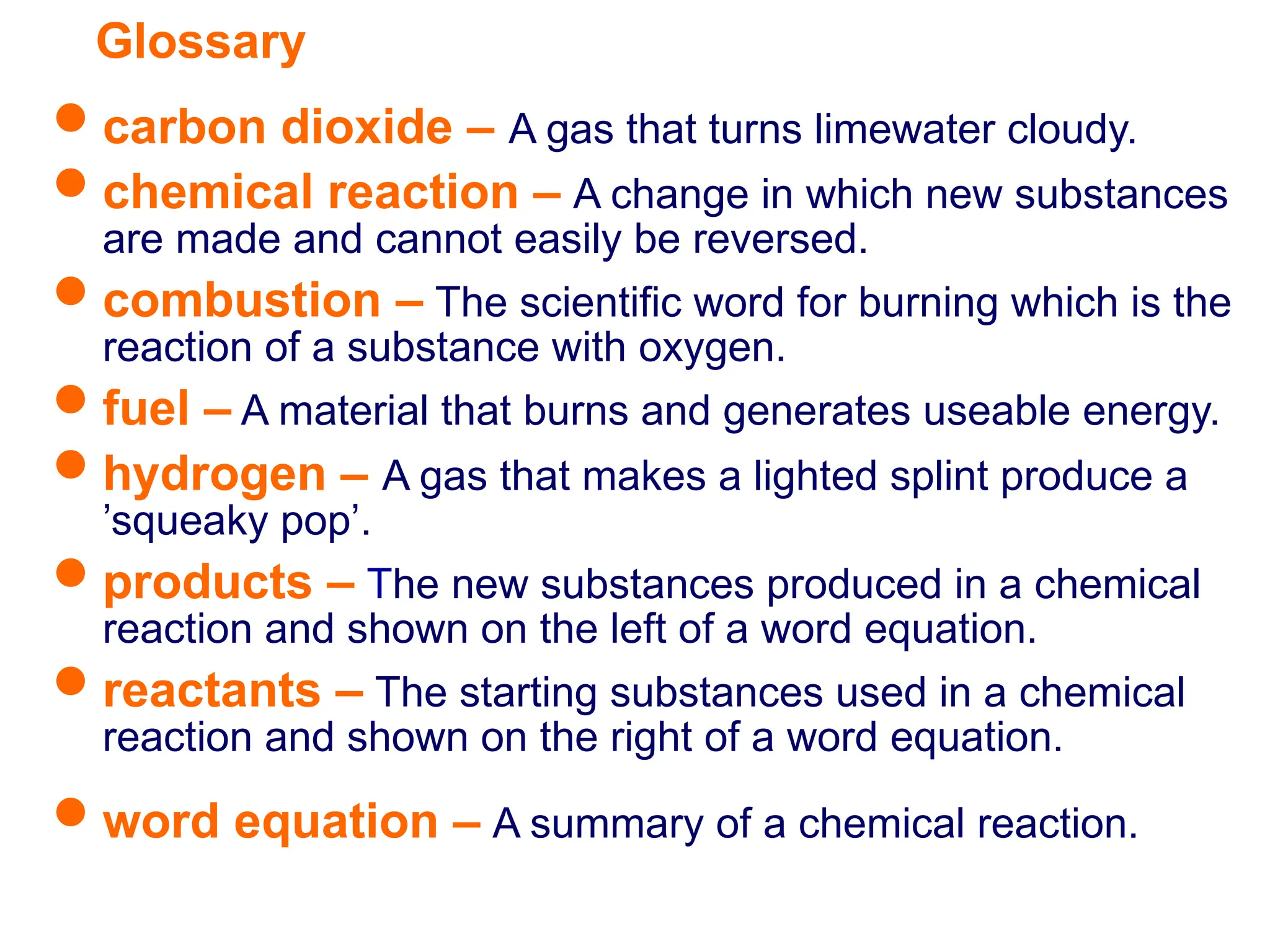
Glossary
carbon dioxide – A gas that turns limewater cloudy.
chemical reaction – A change in which new substances
are made and cannot easily be reversed.
combustion – The scientific word for burning which is the
reaction of a substance with oxygen.
fuel – A material that burns and generates useable energy.
hydrogen – A gas that makes a lighted splint produce a
’squeaky pop’.
products – The new substances produced in a chemical
reaction and shown on the left of a word equation.
reactants – The starting substances used in a chemical
reaction and shown on the right of a word equation.
word equation – A summary of a chemical reaction.

FORM-1-2-SIMPLE-CHEMICALs-REACTIONS.pptx

  • 1.
  • 2.
    7F Simple ChemicalReactions Word equations Reactions with oxygen Chemical reactions everywhere Summary activities Reactions with acid Contents
  • 3.
    Physical and chemicalchanges How many physical and chemical changes can you spot?
  • 4.
    What is achemical reaction? cooking rusting sticking burning making metals living! Can you think of any other chemical reactions? Chemical reactions do not only happen in the laboratory. Chemical reactions happen anywhere that new substances are made:
  • 5.
  • 6.
  • 7.
    Reactants and products Thestarting substances used in a reaction are reactants. The new substances formed in a reaction are products. In a chemical reaction, one or more new substances are formed. The arrow means “change into”. In a chemical reaction, all the reactants change into the products. It is difficult to reverse a chemical reaction and change the products back into the reactants.
  • 8.
    More about chemicalchanges Chemical changes are usually difficult to reverse. Magnesium burns in oxygen to form magnesium oxide. It is not possible to “un-burn” the magnesium once it has been burnt. Many reactions need energy to get them started. Many reactions (like the burning of magnesium) give out heat energy once the reaction has started. Heat energy being given out is one sign of a chemical reaction. What other signs of a chemical reaction are there? magnesium oxide oxygen magnesium
  • 9.
    7F Simple ChemicalReactions Word equations Reactions with oxygen Chemical reactions everywhere Summary activities Reactions with acid Contents
  • 10.
    Reaction of acidwith metals
  • 11.
    magnesium + acid hydrogen burning splint Many metalsreact with acids. When this happens the metal fizzes as bubbles are produced. What do the bubbles mean? A gas is produced. How can you test to find out if the gas produced is hydrogen? Place a burning splint next to the mouth of test tube. A ‘squeaky pop’ as the gas ignites shows that hydrogen is the gas produced in this reaction. Test for hydrogen
  • 12.
    Reaction of acidwith a metal carbonate
  • 13.
    When a metalcarbonate reacts with acid it fizzes and then seems to disappear. The carbonate and the acid have reacted and changed into a salt, water and carbon dioxide. When carbon dioxide gas is bubbled through limewater, it turns the limewater cloudy or milky white. Test for carbon dioxide a salt metal carbonate acid water carbon dioxide Carbon dioxide can be tested for using the limewater test.
  • 14.
    7F Simple ChemicalReactions Word equations Reactions with oxygen Contents Chemical reactions everywhere Summary activities Reactions with acid Contents
  • 15.
    3. The namesof the products. A word equation is used as a quick, shorthand way of writing a chemical reaction. There are always three parts to a word equation: 1. The names of the reactants. 2. An arrow. Word equations What is the word equation for hydrogen reacting with oxygen to form water? water oxygen hydrogen
  • 16.
    Substance Reactant orProduct? magnesium oxide magnesium copper oxide copper product reactant reactant product Reactant or product? magnesium oxide magnesium copper oxide copper In this chemical reaction, which substances are the reactants and which substances are products?
  • 17.
    What are theword equations for the following reactions? 2. Calcium hydroxide reacts with hydrochloric acid to form calcium chloride and water. 3. Sodium reacts with hydrochloric acid to form sodium chloride and hydrogen. Write the word equations magnesium oxide oxygen calcium chloride calcium hydroxide hydrochloric acid water 1. Magnesium burns brightly in oxygen to form magnesium oxide. magnesium sodium chloride sodium hydrochloric acid hydrogen
  • 18.
    7F Simple ChemicalReactions Word equations Reactions with oxygen Contents Chemical reactions everywhere Summary activities Reactions with acid Contents
  • 19.
    What is combustion? Combustionis the scientific word for burning and is a type of chemical reaction. Combustion is the reaction when a substance burns and reacts with oxygen to produce heat and light energy.
  • 20.
    Burning has beenan important source of energy since primitive man and is still a hugely important process today. Using combustion How different would life be without combustion? Burning fuel, like coal, petrol and natural gas, provides > 90% of the energy needed for transport, factories and in the home.
  • 21.
  • 22.
    3. Methane burnsand forms carbon dioxide and water: Equations for combustion 1. Coal (made from carbon) burns and forms carbon dioxide: When substance burns and react with oxygen the new substances formed are called “oxides”. What are the word equations for these combustion reactions? carbon dioxide oxygen carbon 2. Hydrogen burns and forms dihydrogen oxide (i.e water!): water oxygen hydrogen carbon dioxide oxygen methane water
  • 23.
    Combustion of methane Thenatural gas, methane, is often burnt for cooking. Methane is made up of carbon and hydrogen. What gas does methane react with when it burns? What substance will the carbon in methane change into when it burns in oxygen? What substance will the hydrogen in methane change into when it burns in oxygen? What is the word equation for the combustion of methane? carbon dioxide oxygen methane water
  • 24.
  • 25.
    7F Simple ChemicalReactions Acid reactions Reactions with oxygen Contents Chemical reactions everywhere Summary activities Reactions with acid Contents
  • 26.
    Glossary carbon dioxide –A gas that turns limewater cloudy. chemical reaction – A change in which new substances are made and cannot easily be reversed. combustion – The scientific word for burning which is the reaction of a substance with oxygen. fuel – A material that burns and generates useable energy. hydrogen – A gas that makes a lighted splint produce a ’squeaky pop’. products – The new substances produced in a chemical reaction and shown on the left of a word equation. reactants – The starting substances used in a chemical reaction and shown on the right of a word equation. word equation – A summary of a chemical reaction.