“Forgetting” Evaluation

     By Ryan Rheeston
Comparison to Real Media Product
                     Film Trailers
Our media film trailer first of all used the forms and conventions of real media products because we as a group analysed
real film trailers of the best trailers and we analysed the structure of these trailers so we could see what has to be included
in our film trailer. What we gathered from watching for the structure is that every trailer no matter what genre has to have a
beginning to the trailer where the brief story is introduced and the middle section where everything begins to go wrong
which is key because then the audience know what the character goes up against in a film, finally there is the last section
that consists of fast paced montage editing which is where the trailer really begins to grasp the audiences attention. We
used the form of these trailers when we planned out the trailer but before we could do that we had to once again as a
group analyse real film trailers but this time only for our specific genre and sub-genre, in our case it was psychological
thrillers. When we researched these film trailers we looked at the conventions it contained such as complexness and just
the right amount of fast paced shots but the key thin to have in a psychological thriller is a shot that is intended to crawl
under the audiences skin. Me and my group used these conventions in our film trailer I believe although it was not an easy
genre therefore making it an uneasy task we used those conventions well in the shots that we had, of course what we lack is
the budget of a real media product so of course it was not up to the standard of one but it contained the correct structure.
If I had to roll the key conventions of film trailers into 3 conventions then I believe it would be the structure, text and music
to a trailer. As mentioned we used the structure convention well enough and broke the trailer down into 3 acts but the text
was necessary because it broke up scenes and highlighted the key scenes that relate to the text, once again we included
these into our trailer. Finally there is the music which has to be paid attention to as it is one of the most important thins in a
trailer because a silent trailer is boring, we found the music very difficult to find as it can be seen from the two drafts that
there are but the final product was done specifically to build up tempo as the trailer progressed which is what it is meant to
do as it signals the change in acts and change of pace to the trailer. Our film trailer possesses all of these conventions
because as I said they are key and are used in every professional film trailer out there so it is essential for us to use them.
http://www.todayifoundout.com/index.php/2011/08/why-short-movie-advertisement-clips-are-called-trailers/
The above link tells about the 3 act structure of film trailers and is shown as proof on the internet and is a relevant source.
Comparison to Real Media Product
               Film Trailers
Next our film trailer developed on the forms and conventions of a general psychological thriller trailer by
coming up with unique ideas for the plot of the film and combining them with the typical conventions of a
psychological thriller such as darkness, confusion, insanity and many others because there are so many thins
involved in it. We took the original conventions and developed on top of them to build them up to a whole new
meaning.


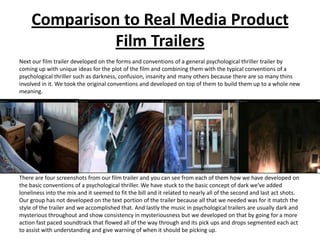
There are four screenshots from our film trailer and you can see from each of them how we have developed on
the basic conventions of a psychological thriller. We have stuck to the basic concept of dark we've added
loneliness into the mix and it seemed to fit the bill and it related to nearly all of the second and last act shots.
Our group has not developed on the text portion of the trailer because all that we needed was for it match the
style of the trailer and we accomplished that. And lastly the music in psychological trailers are usually dark and
mysterious throughout and show consistency in mysteriousness but we developed on that by going for a more
action fast paced soundtrack that flowed all of the way through and its pick ups and drops segmented each act
to assist with understanding and give warning of when it should be picking up.
Comparison to Real Media Product
          Film Trailers
    Finally our media film trailer had to challenge the conventions and forms of
    real media product film trailers, this involved us adding our own little
    touches into it and it was successfully done, however there is no doubt
    that a lot of the conventions are similar because it just seems as though
    they are absolutely essential for this type of genre so we used them. In the
    pre-production of our film we compared our film trailer to two
    psychological thrillers ‘Shutter Island’ and ‘Donnie Darko’, these were
    compared in our logline, because of this we tried to challenge the
    conventions of these films and create an original idea from it. Both of
    these films are huge well renowned films and even the film trailers show a
    lot of good promise. In our trailer we challenged the convention of
    loneliness and insanity and even confusion to appeal to an audience who
    would be fans of these two films.
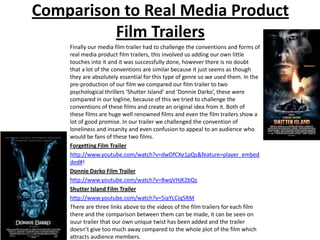
    Forgetting Film Trailer
    http://www.youtube.com/watch?v=dwDfCXe1pQs&feature=player_embed
    ded#!
    Donnie Darko Film Trailer
    http://www.youtube.com/watch?v=8wqVHjK2bQs
    Shutter Island Film Trailer
    http://www.youtube.com/watch?v=5iaYLCiq5RM
    There are three links above to the videos of the film trailers for each film
    there and the comparison between them can be made, it can be seen on
    ouur trailer that our own unique twist has been added and the trailer
    doesn’t give too much away compared to the whole plot of the film which
    attracts audience members.
Ancillary Texts
Firstly there is an order of production for a film, in my production I have produced a trailer, a poster and a
magazine cover. The order of production should be exactly this.

Trailer >> Poster >> Magazine Cover
The reason this is effective in my production because the trailer is designed in itself to intrigue the audience
and get their attention so that when they see the poster that comes after it they can pick the key bits of
information that they want from it, whereas if the poster was released first then the audience wouldn’t see the
meaning of the film and judge properly whether it would be worth their time or not. Finally the magazine cover
which is a more in depth view to the film such as the directors, release date and other information, this is
simply due to the fact that the audience are now aware of the existence of the film and can look more into the
product. This is effective because with each of the production steps it helps the audience understand the film a
bit more and they work with each other to give the best possible understanding without actually watching the
film.
All three aspects of the ancillary text relate to each other through details such as font, images, colour etc. The
font in all three is relatively similar and the images are all of the main character and the colour is dark. The
reason for all these similarities is because it shows a sense of consistency and professionalism helping the main
product appeal a lot more.
Ancillary Texts
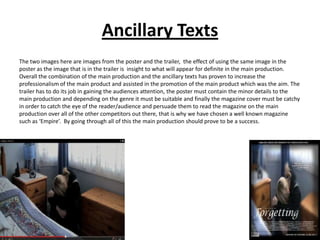
The two images here are images from the poster and the trailer, the effect of using the same image in the
poster as the image that is in the trailer is insight to what will appear for definite in the main production.
Overall the combination of the main production and the ancillary texts has proven to increase the
professionalism of the main product and assisted in the promotion of the main product which was the aim. The
trailer has to do its job in gaining the audiences attention, the poster must contain the minor details to the
main production and depending on the genre it must be suitable and finally the magazine cover must be catchy
in order to catch the eye of the reader/audience and persuade them to read the magazine on the main
production over all of the other competitors out there, that is why we have chosen a well known magazine
such as ‘Empire’. By going through all of this the main production should prove to be a success.
Media Technologies in Construction
             and Research
For the research for main production we used computers and the internet, we used sites such as;
•     www.imdb.co.uk
•     www.youtube.com
We used these sites for research as they gave us lists of films that were of our specific genre and we were able
to compare and look for the qualities that our genre needed for example our genre was psychological thrillers
in a wide range of films they were complex, dark and mysterious. Of course we took note of these conventions
but furthermore for help we were able to watch how they were put into use in real movie production trailers
and this gave us a lot of insight to the kind of material we needed for our film trailer. Without these websites it
would have been a lot harder to come up with the ideas and observe how they have been used professionally.
For the construction of the main production we used apple Macs and the software's ‘iMovie’, ‘Final Cut’ and
‘Adobe Photoshop’. Any other software used was used on a normal computer such as ‘After effects’, these
media technologies allowed us to put the trailer together with all of the shots done. The text for the trailer was
created in iMovie with the effects that were wanted, the opening production logo was created in Adobe
Photoshop along with the poster and the magazine cover which were also done in Photoshop, the motion in
the production logo intro was created using after effects and finally the whole thing was put together using
final cut express which was the most important and vital software needed for the production and it worked
more than impressively. A video camera was used to shoot all of the shots and these shots had to be kept still
using a tripod to make the shots look more professional and to restrain shaking of the camera which shows a
low level of amateurism.
Media Technologies in Planning


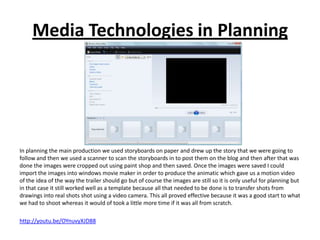
In planning the main production we used storyboards on paper and drew up the story that we were going to
follow and then we used a scanner to scan the storyboards in to post them on the blog and then after that was
done the images were cropped out using paint shop and then saved. Once the images were saved I could
import the images into windows movie maker in order to produce the animatic which gave us a motion video
of the idea of the way the trailer should go but of course the images are still so it is only useful for planning but
in that case it still worked well as a template because all that needed to be done is to transfer shots from
drawings into real shots shot using a video camera. This all proved effective because it was a good start to what
we had to shoot whereas it would of took a little more time if it was all from scratch.

http://youtu.be/OYnuvyXJD88
Media Technologies in Evaluation
In evaluation of the media production students we post them up to the blog that each student has and once it
has been posted anyone is able to comment on it as well, when the trailer, poster and magazine cover audience
are able to comment and in the evaluation the audiences comments are classed as audience feedback meaning
that the feedback can be used for improvements. The commenting page is very useful because it isn't always
negative feedback it can be positive feedback as well which is just as good because it means that there are
some positive results and there are bits that don’t have to be changed. We also use a video diary entry of a
member of an audience that have watched the product and we have asked them questions about it such as
“Do you believe it was suitable for the target audience?”, when these questions have been answered we can
deduct whether or not the production was success or not in what we were aiming for as a response from the
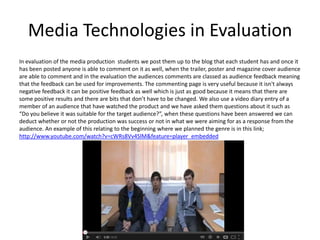
audience. An example of this relating to the beginning where we planned the genre is in this link;
http://www.youtube.com/watch?v=cWRs8Vv4SlM&feature=player_embedded
Bibliography
•   http://youtu.be/OYnuvyXJD88 (accessed 25/02/13)
•   http://www.youtube.com/watch?v=5iaYLCiq5RM (accessed 25/02/13)
•   http://www.youtube.com/watch?v=8wqVHjK2bQs (accessed 25/02/13)
•   http://www.youtube.com/watch?v=dwDfCXe1pQs&feature=player_embedded#! (accessed 25/02/13)
•   http://www.todayifoundout.com/index.php/2011/08/why-short-movie-advertisement-clips-are-called-
    trailers/ (accessed 25/02/13)
•   http://uk.imdb.com/title/tt0246578/?ref_=sr_1 (accessed 25/02/13)
•   http://uk.imdb.com/title/tt1130884/?ref_=sr_1 (accessed 25/02/13)
•   http://mediablogs.keshacademy.com/ryanra2blog/ (accessed 25/02/13)
•   http://uk.imdb.com/genre/thriller (accessed 25/02/13)
•   http://www.youtube.com/ (accessed 25/02/13)
•   http://www.slideshare.net/marklavery/how-effective-is-the-combination-of-your-main-product-and-
    ancillary-texts-3982645 (accessed 25/02/13)

Forgetting evaluation

  • 1.
  • 2.
    Comparison to RealMedia Product Film Trailers Our media film trailer first of all used the forms and conventions of real media products because we as a group analysed real film trailers of the best trailers and we analysed the structure of these trailers so we could see what has to be included in our film trailer. What we gathered from watching for the structure is that every trailer no matter what genre has to have a beginning to the trailer where the brief story is introduced and the middle section where everything begins to go wrong which is key because then the audience know what the character goes up against in a film, finally there is the last section that consists of fast paced montage editing which is where the trailer really begins to grasp the audiences attention. We used the form of these trailers when we planned out the trailer but before we could do that we had to once again as a group analyse real film trailers but this time only for our specific genre and sub-genre, in our case it was psychological thrillers. When we researched these film trailers we looked at the conventions it contained such as complexness and just the right amount of fast paced shots but the key thin to have in a psychological thriller is a shot that is intended to crawl under the audiences skin. Me and my group used these conventions in our film trailer I believe although it was not an easy genre therefore making it an uneasy task we used those conventions well in the shots that we had, of course what we lack is the budget of a real media product so of course it was not up to the standard of one but it contained the correct structure. If I had to roll the key conventions of film trailers into 3 conventions then I believe it would be the structure, text and music to a trailer. As mentioned we used the structure convention well enough and broke the trailer down into 3 acts but the text was necessary because it broke up scenes and highlighted the key scenes that relate to the text, once again we included these into our trailer. Finally there is the music which has to be paid attention to as it is one of the most important thins in a trailer because a silent trailer is boring, we found the music very difficult to find as it can be seen from the two drafts that there are but the final product was done specifically to build up tempo as the trailer progressed which is what it is meant to do as it signals the change in acts and change of pace to the trailer. Our film trailer possesses all of these conventions because as I said they are key and are used in every professional film trailer out there so it is essential for us to use them. http://www.todayifoundout.com/index.php/2011/08/why-short-movie-advertisement-clips-are-called-trailers/ The above link tells about the 3 act structure of film trailers and is shown as proof on the internet and is a relevant source.
  • 3.
    Comparison to RealMedia Product Film Trailers Next our film trailer developed on the forms and conventions of a general psychological thriller trailer by coming up with unique ideas for the plot of the film and combining them with the typical conventions of a psychological thriller such as darkness, confusion, insanity and many others because there are so many thins involved in it. We took the original conventions and developed on top of them to build them up to a whole new meaning. There are four screenshots from our film trailer and you can see from each of them how we have developed on the basic conventions of a psychological thriller. We have stuck to the basic concept of dark we've added loneliness into the mix and it seemed to fit the bill and it related to nearly all of the second and last act shots. Our group has not developed on the text portion of the trailer because all that we needed was for it match the style of the trailer and we accomplished that. And lastly the music in psychological trailers are usually dark and mysterious throughout and show consistency in mysteriousness but we developed on that by going for a more action fast paced soundtrack that flowed all of the way through and its pick ups and drops segmented each act to assist with understanding and give warning of when it should be picking up.
  • 4.
    Comparison to RealMedia Product Film Trailers Finally our media film trailer had to challenge the conventions and forms of real media product film trailers, this involved us adding our own little touches into it and it was successfully done, however there is no doubt that a lot of the conventions are similar because it just seems as though they are absolutely essential for this type of genre so we used them. In the pre-production of our film we compared our film trailer to two psychological thrillers ‘Shutter Island’ and ‘Donnie Darko’, these were compared in our logline, because of this we tried to challenge the conventions of these films and create an original idea from it. Both of these films are huge well renowned films and even the film trailers show a lot of good promise. In our trailer we challenged the convention of loneliness and insanity and even confusion to appeal to an audience who would be fans of these two films. Forgetting Film Trailer http://www.youtube.com/watch?v=dwDfCXe1pQs&feature=player_embed ded#! Donnie Darko Film Trailer http://www.youtube.com/watch?v=8wqVHjK2bQs Shutter Island Film Trailer http://www.youtube.com/watch?v=5iaYLCiq5RM There are three links above to the videos of the film trailers for each film there and the comparison between them can be made, it can be seen on ouur trailer that our own unique twist has been added and the trailer doesn’t give too much away compared to the whole plot of the film which attracts audience members.
  • 5.
    Ancillary Texts Firstly thereis an order of production for a film, in my production I have produced a trailer, a poster and a magazine cover. The order of production should be exactly this. Trailer >> Poster >> Magazine Cover The reason this is effective in my production because the trailer is designed in itself to intrigue the audience and get their attention so that when they see the poster that comes after it they can pick the key bits of information that they want from it, whereas if the poster was released first then the audience wouldn’t see the meaning of the film and judge properly whether it would be worth their time or not. Finally the magazine cover which is a more in depth view to the film such as the directors, release date and other information, this is simply due to the fact that the audience are now aware of the existence of the film and can look more into the product. This is effective because with each of the production steps it helps the audience understand the film a bit more and they work with each other to give the best possible understanding without actually watching the film. All three aspects of the ancillary text relate to each other through details such as font, images, colour etc. The font in all three is relatively similar and the images are all of the main character and the colour is dark. The reason for all these similarities is because it shows a sense of consistency and professionalism helping the main product appeal a lot more.
  • 6.
    Ancillary Texts The twoimages here are images from the poster and the trailer, the effect of using the same image in the poster as the image that is in the trailer is insight to what will appear for definite in the main production. Overall the combination of the main production and the ancillary texts has proven to increase the professionalism of the main product and assisted in the promotion of the main product which was the aim. The trailer has to do its job in gaining the audiences attention, the poster must contain the minor details to the main production and depending on the genre it must be suitable and finally the magazine cover must be catchy in order to catch the eye of the reader/audience and persuade them to read the magazine on the main production over all of the other competitors out there, that is why we have chosen a well known magazine such as ‘Empire’. By going through all of this the main production should prove to be a success.
  • 7.
    Media Technologies inConstruction and Research For the research for main production we used computers and the internet, we used sites such as; • www.imdb.co.uk • www.youtube.com We used these sites for research as they gave us lists of films that were of our specific genre and we were able to compare and look for the qualities that our genre needed for example our genre was psychological thrillers in a wide range of films they were complex, dark and mysterious. Of course we took note of these conventions but furthermore for help we were able to watch how they were put into use in real movie production trailers and this gave us a lot of insight to the kind of material we needed for our film trailer. Without these websites it would have been a lot harder to come up with the ideas and observe how they have been used professionally. For the construction of the main production we used apple Macs and the software's ‘iMovie’, ‘Final Cut’ and ‘Adobe Photoshop’. Any other software used was used on a normal computer such as ‘After effects’, these media technologies allowed us to put the trailer together with all of the shots done. The text for the trailer was created in iMovie with the effects that were wanted, the opening production logo was created in Adobe Photoshop along with the poster and the magazine cover which were also done in Photoshop, the motion in the production logo intro was created using after effects and finally the whole thing was put together using final cut express which was the most important and vital software needed for the production and it worked more than impressively. A video camera was used to shoot all of the shots and these shots had to be kept still using a tripod to make the shots look more professional and to restrain shaking of the camera which shows a low level of amateurism.
  • 8.
    Media Technologies inPlanning In planning the main production we used storyboards on paper and drew up the story that we were going to follow and then we used a scanner to scan the storyboards in to post them on the blog and then after that was done the images were cropped out using paint shop and then saved. Once the images were saved I could import the images into windows movie maker in order to produce the animatic which gave us a motion video of the idea of the way the trailer should go but of course the images are still so it is only useful for planning but in that case it still worked well as a template because all that needed to be done is to transfer shots from drawings into real shots shot using a video camera. This all proved effective because it was a good start to what we had to shoot whereas it would of took a little more time if it was all from scratch. http://youtu.be/OYnuvyXJD88
  • 9.
    Media Technologies inEvaluation In evaluation of the media production students we post them up to the blog that each student has and once it has been posted anyone is able to comment on it as well, when the trailer, poster and magazine cover audience are able to comment and in the evaluation the audiences comments are classed as audience feedback meaning that the feedback can be used for improvements. The commenting page is very useful because it isn't always negative feedback it can be positive feedback as well which is just as good because it means that there are some positive results and there are bits that don’t have to be changed. We also use a video diary entry of a member of an audience that have watched the product and we have asked them questions about it such as “Do you believe it was suitable for the target audience?”, when these questions have been answered we can deduct whether or not the production was success or not in what we were aiming for as a response from the audience. An example of this relating to the beginning where we planned the genre is in this link; http://www.youtube.com/watch?v=cWRs8Vv4SlM&feature=player_embedded
  • 10.
    Bibliography • http://youtu.be/OYnuvyXJD88 (accessed 25/02/13) • http://www.youtube.com/watch?v=5iaYLCiq5RM (accessed 25/02/13) • http://www.youtube.com/watch?v=8wqVHjK2bQs (accessed 25/02/13) • http://www.youtube.com/watch?v=dwDfCXe1pQs&feature=player_embedded#! (accessed 25/02/13) • http://www.todayifoundout.com/index.php/2011/08/why-short-movie-advertisement-clips-are-called- trailers/ (accessed 25/02/13) • http://uk.imdb.com/title/tt0246578/?ref_=sr_1 (accessed 25/02/13) • http://uk.imdb.com/title/tt1130884/?ref_=sr_1 (accessed 25/02/13) • http://mediablogs.keshacademy.com/ryanra2blog/ (accessed 25/02/13) • http://uk.imdb.com/genre/thriller (accessed 25/02/13) • http://www.youtube.com/ (accessed 25/02/13) • http://www.slideshare.net/marklavery/how-effective-is-the-combination-of-your-main-product-and- ancillary-texts-3982645 (accessed 25/02/13)