© 2023, IRJET | Impact Factor value: 8.226 | ISO 9001:2008 Certified Journal | Page 852
FOODINDAHUD
Tanish Jain1, Rakshit Shetty2, Ayush Yelne3, Vatsal Mehta4, Prof. Renuka Nagpure5
1Tanish Jain, Dept of Information Technology Engineering, Atharva College of Engineering, 2Rakshit Shetty, Dept of
Information Technology Engineering, Atharva College of Engineering, 3Ayush Yelne, Dept of Information
Technology Engineering, Atharva College of Engineering, 4Vatsal Mehta, Dept of Information Technology
Engineering, Atharva College of Engineering,
5Prof. Renuka Nagpure, Dept of Information Technology Engineering, Atharva College of Engineering, Maharashtra,
India
--------------------------------------------------------------------***-------------------------------------------------------------------
Abstract -"FoodinDaHud" is a project conceptualised with
the aim of giving users recipe-level control over what they
want to eat in a particular dish. Users can create, share, and
use other people's recipes on this platform. Also, this
platform provides in-depth nutrition details for a particular
food ingredient and the overall dish. This project consists of
a mobile application capable of running on both Android
and iOS. This project is designed to be the easiest way to
control what we eat and doesn't eat in a particular food
dish.
Key Words: Online platform, nutritional analysis, diet &
health regulation, food service, nutrition data repository.
1. INTRODUCTION
“FoodInDaHud” is an online platform specifically designed
to raise food nutritional standards and motivate people to
eat healthily. This project consists of two main types of
interactions. Firstly it acts as a repository of recipes
created by the community, offering detailed nutritional
insights, and giving users access to a library of healthy and
nutritious recipes, and detailed nutrition information for
specific food ingredients and dishes. Secondly, it acts as a
food chain where users can browse these recipes and have
them made locally and delivered to them. The lack of
customization options offered by current Quick Service
Restaurants (QSR) denies customers their freedom of
choice. FoodInDaHud seeks to reclaim this option for
individuals and to inform people about the importance of
making informed dietary decisions.
1.1 Need
The rising need for healthy food options is one of the
primary needs. There is an increasing need for tools that
can assist people in making educated decisions about their
diet as they become more health-conscious and aware of
the effects of food on their overall well-being. The idea can
also satisfy the need for more control over the ingredients
in our food. Many people are worried about the quality of
the food they eat and want the option to alter their meals
to accommodate their dietary preferences and
requirements. A platform that offers precise and thorough
nutritional data for certain food components and dishes is
also required. It can be challenging for consumers to know
what to believe and how to make informed decisions about
their diet when there is so much contradictory nutrition
information available online. Overall, the FoodinDaHud
project can help meet these demands by giving users access
to a library of wholesome and nutrient-dense recipes,
recipe-level control over their meals, andcomprehensive
nutrition information for particular food items and dishes.
2. APPLICATION
The platform is intended to be simple and user-friendly,
with a simple and intuitive interface that anyone can use.
FoodInDaHud offers a variety of recipes and resources to
assist you in creating healthy and delicious meals, whether
you're a highly experienced home cook or a newbie in the
kitchen. The system has been developed to serve as a food
& nutrition repository driven by the community. This
repository is a data store that can be used to simply browse
and gather information on commonly made dishes, and/or
to have them made locally. All this is provided in anintuitive
interface, making it a pleasant experience for the user to get
into nutritional details and build a healthy diet for
themselves without getting overwhelmed and exhausted in
trying to manually find all this data. Each user can
contribute to the community by sharing a unique recipe or
a modification of another’s recipe.
3. LITERATURE SURVEY
Numerous articles have been reviewed and their
conclusions are summarised in this section. Documents that
were looked at both before and during project development
are presented in this section. The documents provided a
better understanding of existing solutions and how the
system architecture can be designed for optimal quality.
1. “A Food Recommender System Considering
Nutritional Information and User Preferences”
by Raciel Yera Toledo, Ahmad A. Alzahrani and
Luis Martínez
The first paper we examined is titled "A Food Recommender
System considering Nutritional Information and User
Preferences" published in the IEEE Journal in 2019. This
International Research Journal of Engineering and Technology (IRJET) e-ISSN: 2395-0056
Volume: 10 Issue: 04 | Apr 2023 www.irjet.net p-ISSN: 2395-0072
© 2023, IRJET | Impact Factor value: 8.226 | ISO 9001:2008 Certified Journal | Page 853
paper goes into detail on building an intelligent meal plan
recommendation system that gathers and profiles
nutritional data according to the user’s nutritional
requirements. This data is processed through an intelligent
layer that identifies food sources that can fulfil the user’s
nutritional requirements and generates a customised meal
plan for the user. It uses AHPSort to classify foods as
appropriate or inappropriate for the user.
2. “Personalised Nutrition Recommendation in
Food services” by Katerina Giazitz, Vaios T.
Karathanos & George Boskou
The second paper, "Personalised Nutrition Recommendation
in Food Services" is a study conducted in 2020. This paper
discusses the implementation of an application for
restaurant menus called Electronic Intelligent System of
Personalized Dietary Advice, or "DISYS". By taking into
account the user's personal nutritional profile and health
considerations, it recommends healthier options on
restaurant menus. This paper also includes a report that
describes a survey of DISYS users which found that,
although subtly raising the population's nutritional
standards, more than 40% of respondents were satisfied
with the food recommendations offered by DISYS.
3. “KitcheNette: Predicting and Recommending
Food Ingredient Pairings using Siamese
Neural Networks” by Donghyeon Park,
Keonwoo Kim, Yonggyu Park, Jungwoon Shin,
Jaewoo Kang
The third research paper we reviewed is titled
"KitcheNette: Predicting and Recommending Food
Ingredient Pairings Using a Siamese Neural Network."
published in 2019. This paper focuses on how to use
Siamese neural networks to give recommendations and
predict food ingredients based on the similarity of two
input ingredients. This paper also includes how they
trained their model based on existing datasets.
4. EXISTING SYSTEM
Fig 2: Existing System
● Quick Service Restaurants
Quick Service Restaurants(QSRs) like McDonald's,
KFC, Subway, etc. serve pre-made meals that are
typically not very customisable and have no
information listed regarding their nutritional
values.
● HealthifyMe
Designed for the mobile platform, HealthifyMe is a
diet and fitness tracker that enables users to log
their daily calorie intake as well as their diet. It
also enables users to query nutritional data on
popular food products.
● Manually logging and querying nutrition data
from the web
The majority of consumers still use online
nutritional data search engines and either consult
nutritionists or create their manual meal planning.
Finding complete foods that have these elements
in the right amounts requires searching for each
ingredient's nutritional benefits, which takes
some time. There is a potential that some of these
ingredients won't be accessible locally.
5. PROPOSED SYSTEM
Fig 2: Proposed System
The FoodInDaHud system that is being proposed will have
the following features: First, it will consist of a Recipe
Browser that will be used to create, share, modify, and
delete recipes from the community. The second feature,
Nutrition Profiler, is the heart of the entire application,
generating recipe recommendations based on the user’s
nutritional preferences. The third feature is the Nutrition
Query Engine, which is used to retrieve complete nutrition
details for any particular ingredient. The last feature is
Order & Delivery, which allows the user to order the
recipes, track deliveries, and make payments.
International Research Journal of Engineering and Technology (IRJET) e-ISSN: 2395-0056
Volume: 10 Issue: 04 | Apr 2023 www.irjet.net p-ISSN: 2395-0072
© 2023, IRJET | Impact Factor value: 8.226 | ISO 9001:2008 Certified Journal | Page 854
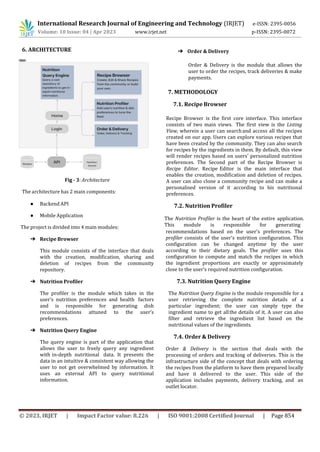
6. ARCHITECTURE
Fig - 3: Architecture
The architecture has 2 main components:
● Backend API
● Mobile Application
The project is divided into 4 main modules:
➔ Recipe Browser
This module consists of the interface that deals
with the creation, modification, sharing and
deletion of recipes from the community
repository.
➔ Nutrition Profiler
The profiler is the module which takes in the
user’s nutrition preferences and health factors
and is responsible for generating dish
recommendations attuned to the user’s
preferences.
➔ Nutrition Query Engine
The query engine is part of the application that
allows the user to freely query any ingredient
with in-depth nutritional data. It presents the
data in an intuitive & consistent way allowing the
user to not get overwhelmed by information. It
uses an external API to query nutritional
information.
➔ Order & Delivery
Order & Delivery is the module that allows the
user to order the recipes, track deliveries & make
payments.
7. METHODOLOGY
7.1. Recipe Browser
Recipe Browser is the first core interface. This interface
consists of two main views. The first view is the Listing
View, wherein a user can searchand access all the recipes
created on our app. Users can explore various recipes that
have been created by the community. They can also search
for recipes by the ingredients in them. By default, this view
will render recipes based on users' personalized nutrition
preferences. The Second part of the Recipe Browser is
Recipe Editor. Recipe Editor is the main interface that
enables the creation, modification and deletion of recipes.
A user can also clone a community recipe and can make a
personalised version of it according to his nutritional
preferences.
7.2. Nutrition Profiler
recommendations based on the user's preferences. The
profiler consists of the user's nutrition configuration. This
configuration can be changed anytime by the user
according to their dietary goals. The profiler uses this
configuration to compute and match the recipes in which
the ingredient proportions are exactly or approximately
close to the user’s required nutrition configuration.
7.3. Nutrition Query Engine
The Nutrition Query Engine is the module responsible for a
user retrieving the complete nutrition details of a
particular ingredient; the user can simply type the
ingredient name to get allthe details of it. A user can also
filter and retrieve the ingredient list based on the
nutritional values of the ingredients.
7.4. Order & Delivery
Order & Delivery is the section that deals with the
processing of orders and tracking of deliveries. This is the
infrastructure side of the concept that deals with ordering
the recipes from the platform to have them prepared locally
and have it delivered to the user. This side of the
application includes payments, delivery tracking, and an
outlet locator.
The Nutrition Profiler is the heart of the entire application.
This module is responsible for generating
International Research Journal of Engineering and Technology (IRJET) e-ISSN: 2395-0056
Volume: 10 Issue: 04 | Apr 2023 www.irjet.net p-ISSN: 2395-0072
© 2023, IRJET | Impact Factor value: 8.226 | ISO 9001:2008 Certified Journal | Page 855
8. FUURE SCOPE
FoodInDaHud can expand its platform by incorporating
advanced data analytics and artificial intelligence to offer
more personalised meal plans and dietary
recommendations. The platform can collaborate with
healthcare providers and fitness experts to provide users
with a holistic approach to their health and well-being.
Moreover, FoodInDaHud can integrate gamification
techniques to engage and motivate users to make healthier
food choices, while also providing incentives to users who
reach their dietary goals.
FoodInDaHud can also expand its services to cater to
special dietary requirements, such as vegan, gluten-free, or
keto diets. It can collaborate with local suppliers and
farmers to promote locally sourced and sustainable food
options that align with users' dietary needs and
preferences.
Additionally, users can add a new recipe by speaking
through their phone instead of typing the entire recipe.
This will save users time by efficiently adding the new
recipe through voice recognition.
Overall, FoodInDaHud has the potential to become a
leading online platform that promotes healthy eating
habits, which informs users about the importance of
making informed dietary decisions and helps individuals
achieve healthier lifestyles.
9. CONCLUSION
FoodInDaHud is an online platform that aims to improve
people's nutrition and encourage healthy eating habits by
providing a community-driven database of healthy
recipesand detailed nutritional information. Additionally,
it offers a food delivery service for users to order locally-
made healthy meals. FoodInDaHud seeks to empower
individuals with the freedom of choice that is often absent
in traditional quick-service restaurants, while also
educating them about the importance of making informed
dietary decisions. In conclusion, FoodInDaHud provides a
unique and holistic approach to promoting healthy eating
habits by combining an online recipe repository with a
convenient food delivery service.
10. REFERENCES
pp. 64–75, Nov. 2017.
[2] Giazitzi, Katerina & Karathanos, Vaios & Boskou,
George. (2020). Personalized Nutrition
Recommendations in Food Services.
10.4018/978-1- 7998-2390-2.ch006.
[3] T. N. Trang-Tran, M. Atas, A. Felfernig, and M.
Stettinger,‘‘An overview of recommender systems in
the healthy food domain,’’ J. Intell. Inf. Syst., vol. 50,
pp. 501–526, Jun. 2018.
[4] L. Yang, C.-K. Hsieh, H. Yang, J. P. Pollak, N. Dell, S.
Belongie, C. Cole, and D. Estrin, ‘‘Yum-Me: A
personalized nutrient-based meal recommender
system,’’ ACM Trans. Inf. Syst., vol. 36, no. 1, p. 7, 2017.
[5] C. Trattner and D. Elsweiler, ‘‘Investigating the
healthiness of Internet Sourced recipes: Implications
for meal planning and recommender systems,’’ in
Proc.26th Int. Conf. World Wide Web, 2017, pp. 489–
498.
[6] Donghyeon Park, et al. "KitcheNette: Predicting and
Ranking Food Ingredient Pairings using Siamese
Neural Network." Proceedings of the Twenty-Eighth
International Joint Conference on Artificial Intelligence.
International Joint Conferences on Artificial
Intelligence Organization, 2019.
[7] F. Rehman, O. Khalid, N. ul Haq, A. ur Rehman Khan, K.
Bilal, and S. A. Madani, ‘‘Diet-right: A smart food
recommendation system,’’ KSII Trans. Internet Inf.
Syst., vol. 11, no. 6, pp. 2910–2925, 2017.
[8] Balasubramanian, K., Balraj, A., Kumar, J., & Jaykumar.
(2015). Customer Preferences to Select a Restaurant
Through Smart Phone Applications: An Exploratory
Study. Advanced Science Letters, 21(5), 1489–1493.
doi:10.1166/asl.2015.6081
[9] Coughlin, S., Whitehead, M., Sheats, J., Mastromonico, J.,
Hardy, D., & Smith, S. (2015). Smartphone Applications
for Promoting Healthy Diet and Nutrition: A Literature
Review. Jacobs Journal of Food and Nutrition, 2(3), 21.
[10]Dimitriou, M., Giazitzi, K., Stavridi, E., Palisidis, G.,
Karathanos, V., & Boskou, G. (2017). Evaluation of an
Electronic Application for Nutritional Information in
Food Service Outlets: A Pilot mHealth Application.
International Journal of Reliable and Quality
E-Healthcare, 6(1), 46–58.
doi:10.4018/IJRQEH.2017010104
[1] D. Bianchini, V. De Antonellis, N. De Franceschi, and M.
Melchiori, ‘‘PREFer A prescription-based food
recommender system,’’ Comput. Standards Inter., vol.
54,
[11]Hebden, L., Cook, A., Van der Ploeg, H., & Allman-
Farinelli, M. (2012). Development of Smartphone
Applications for Nutrition and Physical Activity
Behavior Change. JMIR Research Protocols, 1(2), e9.
doi:10.2196/resprot.2205
[12]Okumus, B., Ali, F., Bilgihan, A., & Ozturk, A. B. (2018).
Psychological factors influencing customers’
acceptance of smartphone diet apps when ordering
food at restaurants. International Journal of
Hospitality Management, 72, 67–77.
doi:10.1016/j.ijhm.2018.01.001
International Research Journal of Engineering and Technology (IRJET) e-ISSN: 2395-0056
Volume: 10 Issue: 04 | Apr 2023 www.irjet.net p-ISSN: 2395-0072
© 2023, IRJET | Impact Factor value: 8.226 | ISO 9001:2008 Certified Journal | Page 856
[13]
research2guidance.com/325000-mobile-health-apps-
available-in-2017/
Pohl, M. (2017). 325,000 mobile health apps available
in 2017, Android is now the leading mHealthplatform.
Retrieved from: Research 2 Guidance https://
[14]Schroder, H., Fıto, M., & Covas, M. I. (2007).
Association of fast food consumption with energy
intake, diet quality, body mass index and the risk of
obesity in a representative Mediterranean population.
British Journal of Nutrition, 98(6), 1274–1280.
doi:10.1017/S0007114507781436 PMID:17625027
[15]Okumus, B., & Bilgihan, A. (2014). Proposing a model
to test smartphone users’ intention to use smart
applications when ordering food in restaurants.
Journal of Hospitality and Tourism Technology, 5(1),
31–49. doi:10.1108/JHTT-01-2013-0003
International Research Journal of Engineering and Technology (IRJET) e-ISSN: 2395-0056
Volume: 10 Issue: 04 | Apr 2023 www.irjet.net p-ISSN: 2395-0072

FOODINDAHUD

  • 1.
    © 2023, IRJET| Impact Factor value: 8.226 | ISO 9001:2008 Certified Journal | Page 852 FOODINDAHUD Tanish Jain1, Rakshit Shetty2, Ayush Yelne3, Vatsal Mehta4, Prof. Renuka Nagpure5 1Tanish Jain, Dept of Information Technology Engineering, Atharva College of Engineering, 2Rakshit Shetty, Dept of Information Technology Engineering, Atharva College of Engineering, 3Ayush Yelne, Dept of Information Technology Engineering, Atharva College of Engineering, 4Vatsal Mehta, Dept of Information Technology Engineering, Atharva College of Engineering, 5Prof. Renuka Nagpure, Dept of Information Technology Engineering, Atharva College of Engineering, Maharashtra, India --------------------------------------------------------------------***------------------------------------------------------------------- Abstract -"FoodinDaHud" is a project conceptualised with the aim of giving users recipe-level control over what they want to eat in a particular dish. Users can create, share, and use other people's recipes on this platform. Also, this platform provides in-depth nutrition details for a particular food ingredient and the overall dish. This project consists of a mobile application capable of running on both Android and iOS. This project is designed to be the easiest way to control what we eat and doesn't eat in a particular food dish. Key Words: Online platform, nutritional analysis, diet & health regulation, food service, nutrition data repository. 1. INTRODUCTION “FoodInDaHud” is an online platform specifically designed to raise food nutritional standards and motivate people to eat healthily. This project consists of two main types of interactions. Firstly it acts as a repository of recipes created by the community, offering detailed nutritional insights, and giving users access to a library of healthy and nutritious recipes, and detailed nutrition information for specific food ingredients and dishes. Secondly, it acts as a food chain where users can browse these recipes and have them made locally and delivered to them. The lack of customization options offered by current Quick Service Restaurants (QSR) denies customers their freedom of choice. FoodInDaHud seeks to reclaim this option for individuals and to inform people about the importance of making informed dietary decisions. 1.1 Need The rising need for healthy food options is one of the primary needs. There is an increasing need for tools that can assist people in making educated decisions about their diet as they become more health-conscious and aware of the effects of food on their overall well-being. The idea can also satisfy the need for more control over the ingredients in our food. Many people are worried about the quality of the food they eat and want the option to alter their meals to accommodate their dietary preferences and requirements. A platform that offers precise and thorough nutritional data for certain food components and dishes is also required. It can be challenging for consumers to know what to believe and how to make informed decisions about their diet when there is so much contradictory nutrition information available online. Overall, the FoodinDaHud project can help meet these demands by giving users access to a library of wholesome and nutrient-dense recipes, recipe-level control over their meals, andcomprehensive nutrition information for particular food items and dishes. 2. APPLICATION The platform is intended to be simple and user-friendly, with a simple and intuitive interface that anyone can use. FoodInDaHud offers a variety of recipes and resources to assist you in creating healthy and delicious meals, whether you're a highly experienced home cook or a newbie in the kitchen. The system has been developed to serve as a food & nutrition repository driven by the community. This repository is a data store that can be used to simply browse and gather information on commonly made dishes, and/or to have them made locally. All this is provided in anintuitive interface, making it a pleasant experience for the user to get into nutritional details and build a healthy diet for themselves without getting overwhelmed and exhausted in trying to manually find all this data. Each user can contribute to the community by sharing a unique recipe or a modification of another’s recipe. 3. LITERATURE SURVEY Numerous articles have been reviewed and their conclusions are summarised in this section. Documents that were looked at both before and during project development are presented in this section. The documents provided a better understanding of existing solutions and how the system architecture can be designed for optimal quality. 1. “A Food Recommender System Considering Nutritional Information and User Preferences” by Raciel Yera Toledo, Ahmad A. Alzahrani and Luis Martínez The first paper we examined is titled "A Food Recommender System considering Nutritional Information and User Preferences" published in the IEEE Journal in 2019. This International Research Journal of Engineering and Technology (IRJET) e-ISSN: 2395-0056 Volume: 10 Issue: 04 | Apr 2023 www.irjet.net p-ISSN: 2395-0072
  • 2.
    © 2023, IRJET| Impact Factor value: 8.226 | ISO 9001:2008 Certified Journal | Page 853 paper goes into detail on building an intelligent meal plan recommendation system that gathers and profiles nutritional data according to the user’s nutritional requirements. This data is processed through an intelligent layer that identifies food sources that can fulfil the user’s nutritional requirements and generates a customised meal plan for the user. It uses AHPSort to classify foods as appropriate or inappropriate for the user. 2. “Personalised Nutrition Recommendation in Food services” by Katerina Giazitz, Vaios T. Karathanos & George Boskou The second paper, "Personalised Nutrition Recommendation in Food Services" is a study conducted in 2020. This paper discusses the implementation of an application for restaurant menus called Electronic Intelligent System of Personalized Dietary Advice, or "DISYS". By taking into account the user's personal nutritional profile and health considerations, it recommends healthier options on restaurant menus. This paper also includes a report that describes a survey of DISYS users which found that, although subtly raising the population's nutritional standards, more than 40% of respondents were satisfied with the food recommendations offered by DISYS. 3. “KitcheNette: Predicting and Recommending Food Ingredient Pairings using Siamese Neural Networks” by Donghyeon Park, Keonwoo Kim, Yonggyu Park, Jungwoon Shin, Jaewoo Kang The third research paper we reviewed is titled "KitcheNette: Predicting and Recommending Food Ingredient Pairings Using a Siamese Neural Network." published in 2019. This paper focuses on how to use Siamese neural networks to give recommendations and predict food ingredients based on the similarity of two input ingredients. This paper also includes how they trained their model based on existing datasets. 4. EXISTING SYSTEM Fig 2: Existing System ● Quick Service Restaurants Quick Service Restaurants(QSRs) like McDonald's, KFC, Subway, etc. serve pre-made meals that are typically not very customisable and have no information listed regarding their nutritional values. ● HealthifyMe Designed for the mobile platform, HealthifyMe is a diet and fitness tracker that enables users to log their daily calorie intake as well as their diet. It also enables users to query nutritional data on popular food products. ● Manually logging and querying nutrition data from the web The majority of consumers still use online nutritional data search engines and either consult nutritionists or create their manual meal planning. Finding complete foods that have these elements in the right amounts requires searching for each ingredient's nutritional benefits, which takes some time. There is a potential that some of these ingredients won't be accessible locally. 5. PROPOSED SYSTEM Fig 2: Proposed System The FoodInDaHud system that is being proposed will have the following features: First, it will consist of a Recipe Browser that will be used to create, share, modify, and delete recipes from the community. The second feature, Nutrition Profiler, is the heart of the entire application, generating recipe recommendations based on the user’s nutritional preferences. The third feature is the Nutrition Query Engine, which is used to retrieve complete nutrition details for any particular ingredient. The last feature is Order & Delivery, which allows the user to order the recipes, track deliveries, and make payments. International Research Journal of Engineering and Technology (IRJET) e-ISSN: 2395-0056 Volume: 10 Issue: 04 | Apr 2023 www.irjet.net p-ISSN: 2395-0072
  • 3.
    © 2023, IRJET| Impact Factor value: 8.226 | ISO 9001:2008 Certified Journal | Page 854 6. ARCHITECTURE Fig - 3: Architecture The architecture has 2 main components: ● Backend API ● Mobile Application The project is divided into 4 main modules: ➔ Recipe Browser This module consists of the interface that deals with the creation, modification, sharing and deletion of recipes from the community repository. ➔ Nutrition Profiler The profiler is the module which takes in the user’s nutrition preferences and health factors and is responsible for generating dish recommendations attuned to the user’s preferences. ➔ Nutrition Query Engine The query engine is part of the application that allows the user to freely query any ingredient with in-depth nutritional data. It presents the data in an intuitive & consistent way allowing the user to not get overwhelmed by information. It uses an external API to query nutritional information. ➔ Order & Delivery Order & Delivery is the module that allows the user to order the recipes, track deliveries & make payments. 7. METHODOLOGY 7.1. Recipe Browser Recipe Browser is the first core interface. This interface consists of two main views. The first view is the Listing View, wherein a user can searchand access all the recipes created on our app. Users can explore various recipes that have been created by the community. They can also search for recipes by the ingredients in them. By default, this view will render recipes based on users' personalized nutrition preferences. The Second part of the Recipe Browser is Recipe Editor. Recipe Editor is the main interface that enables the creation, modification and deletion of recipes. A user can also clone a community recipe and can make a personalised version of it according to his nutritional preferences. 7.2. Nutrition Profiler recommendations based on the user's preferences. The profiler consists of the user's nutrition configuration. This configuration can be changed anytime by the user according to their dietary goals. The profiler uses this configuration to compute and match the recipes in which the ingredient proportions are exactly or approximately close to the user’s required nutrition configuration. 7.3. Nutrition Query Engine The Nutrition Query Engine is the module responsible for a user retrieving the complete nutrition details of a particular ingredient; the user can simply type the ingredient name to get allthe details of it. A user can also filter and retrieve the ingredient list based on the nutritional values of the ingredients. 7.4. Order & Delivery Order & Delivery is the section that deals with the processing of orders and tracking of deliveries. This is the infrastructure side of the concept that deals with ordering the recipes from the platform to have them prepared locally and have it delivered to the user. This side of the application includes payments, delivery tracking, and an outlet locator. The Nutrition Profiler is the heart of the entire application. This module is responsible for generating International Research Journal of Engineering and Technology (IRJET) e-ISSN: 2395-0056 Volume: 10 Issue: 04 | Apr 2023 www.irjet.net p-ISSN: 2395-0072
  • 4.
    © 2023, IRJET| Impact Factor value: 8.226 | ISO 9001:2008 Certified Journal | Page 855 8. FUURE SCOPE FoodInDaHud can expand its platform by incorporating advanced data analytics and artificial intelligence to offer more personalised meal plans and dietary recommendations. The platform can collaborate with healthcare providers and fitness experts to provide users with a holistic approach to their health and well-being. Moreover, FoodInDaHud can integrate gamification techniques to engage and motivate users to make healthier food choices, while also providing incentives to users who reach their dietary goals. FoodInDaHud can also expand its services to cater to special dietary requirements, such as vegan, gluten-free, or keto diets. It can collaborate with local suppliers and farmers to promote locally sourced and sustainable food options that align with users' dietary needs and preferences. Additionally, users can add a new recipe by speaking through their phone instead of typing the entire recipe. This will save users time by efficiently adding the new recipe through voice recognition. Overall, FoodInDaHud has the potential to become a leading online platform that promotes healthy eating habits, which informs users about the importance of making informed dietary decisions and helps individuals achieve healthier lifestyles. 9. CONCLUSION FoodInDaHud is an online platform that aims to improve people's nutrition and encourage healthy eating habits by providing a community-driven database of healthy recipesand detailed nutritional information. Additionally, it offers a food delivery service for users to order locally- made healthy meals. FoodInDaHud seeks to empower individuals with the freedom of choice that is often absent in traditional quick-service restaurants, while also educating them about the importance of making informed dietary decisions. In conclusion, FoodInDaHud provides a unique and holistic approach to promoting healthy eating habits by combining an online recipe repository with a convenient food delivery service. 10. REFERENCES pp. 64–75, Nov. 2017. [2] Giazitzi, Katerina & Karathanos, Vaios & Boskou, George. (2020). Personalized Nutrition Recommendations in Food Services. 10.4018/978-1- 7998-2390-2.ch006. [3] T. N. Trang-Tran, M. Atas, A. Felfernig, and M. Stettinger,‘‘An overview of recommender systems in the healthy food domain,’’ J. Intell. Inf. Syst., vol. 50, pp. 501–526, Jun. 2018. [4] L. Yang, C.-K. Hsieh, H. Yang, J. P. Pollak, N. Dell, S. Belongie, C. Cole, and D. Estrin, ‘‘Yum-Me: A personalized nutrient-based meal recommender system,’’ ACM Trans. Inf. Syst., vol. 36, no. 1, p. 7, 2017. [5] C. Trattner and D. Elsweiler, ‘‘Investigating the healthiness of Internet Sourced recipes: Implications for meal planning and recommender systems,’’ in Proc.26th Int. Conf. World Wide Web, 2017, pp. 489– 498. [6] Donghyeon Park, et al. "KitcheNette: Predicting and Ranking Food Ingredient Pairings using Siamese Neural Network." Proceedings of the Twenty-Eighth International Joint Conference on Artificial Intelligence. International Joint Conferences on Artificial Intelligence Organization, 2019. [7] F. Rehman, O. Khalid, N. ul Haq, A. ur Rehman Khan, K. Bilal, and S. A. Madani, ‘‘Diet-right: A smart food recommendation system,’’ KSII Trans. Internet Inf. Syst., vol. 11, no. 6, pp. 2910–2925, 2017. [8] Balasubramanian, K., Balraj, A., Kumar, J., & Jaykumar. (2015). Customer Preferences to Select a Restaurant Through Smart Phone Applications: An Exploratory Study. Advanced Science Letters, 21(5), 1489–1493. doi:10.1166/asl.2015.6081 [9] Coughlin, S., Whitehead, M., Sheats, J., Mastromonico, J., Hardy, D., & Smith, S. (2015). Smartphone Applications for Promoting Healthy Diet and Nutrition: A Literature Review. Jacobs Journal of Food and Nutrition, 2(3), 21. [10]Dimitriou, M., Giazitzi, K., Stavridi, E., Palisidis, G., Karathanos, V., & Boskou, G. (2017). Evaluation of an Electronic Application for Nutritional Information in Food Service Outlets: A Pilot mHealth Application. International Journal of Reliable and Quality E-Healthcare, 6(1), 46–58. doi:10.4018/IJRQEH.2017010104 [1] D. Bianchini, V. De Antonellis, N. De Franceschi, and M. Melchiori, ‘‘PREFer A prescription-based food recommender system,’’ Comput. Standards Inter., vol. 54, [11]Hebden, L., Cook, A., Van der Ploeg, H., & Allman- Farinelli, M. (2012). Development of Smartphone Applications for Nutrition and Physical Activity Behavior Change. JMIR Research Protocols, 1(2), e9. doi:10.2196/resprot.2205 [12]Okumus, B., Ali, F., Bilgihan, A., & Ozturk, A. B. (2018). Psychological factors influencing customers’ acceptance of smartphone diet apps when ordering food at restaurants. International Journal of Hospitality Management, 72, 67–77. doi:10.1016/j.ijhm.2018.01.001 International Research Journal of Engineering and Technology (IRJET) e-ISSN: 2395-0056 Volume: 10 Issue: 04 | Apr 2023 www.irjet.net p-ISSN: 2395-0072
  • 5.
    © 2023, IRJET| Impact Factor value: 8.226 | ISO 9001:2008 Certified Journal | Page 856 [13] research2guidance.com/325000-mobile-health-apps- available-in-2017/ Pohl, M. (2017). 325,000 mobile health apps available in 2017, Android is now the leading mHealthplatform. Retrieved from: Research 2 Guidance https:// [14]Schroder, H., Fıto, M., & Covas, M. I. (2007). Association of fast food consumption with energy intake, diet quality, body mass index and the risk of obesity in a representative Mediterranean population. British Journal of Nutrition, 98(6), 1274–1280. doi:10.1017/S0007114507781436 PMID:17625027 [15]Okumus, B., & Bilgihan, A. (2014). Proposing a model to test smartphone users’ intention to use smart applications when ordering food in restaurants. Journal of Hospitality and Tourism Technology, 5(1), 31–49. doi:10.1108/JHTT-01-2013-0003 International Research Journal of Engineering and Technology (IRJET) e-ISSN: 2395-0056 Volume: 10 Issue: 04 | Apr 2023 www.irjet.net p-ISSN: 2395-0072