International Research Journal of Engineering and Technology (IRJET) e-ISSN: 2395-0056
Volume: 09 Issue: 01 | Jan 2022 www.irjet.net p-ISSN: 2395-0072
© 2022, IRJET | Impact Factor value: 7.529 | ISO 9001:2008 Certified Journal | Page 174
FOOD RECOGNITION USING DEEP CONVOLUTIONAL NEURAL NETWORK
PRIYANKA N1, Dr. GEETHA V2
1PG Scholar,Department of Electronics and Communication, UBDT College of Engineering, Davanagere-577004,
Karnataka, India
2Associate Professor, Department of Electronics and Communication, UBDT College of Engineering, Davanagere-
577004, Karnataka, India
---------------------------------------------------------------------***----------------------------------------------------------------------
Abstract -Food monitoringandnutritional analysisassumes
a main part in health-related issues; it is getting more
essential in our everyday lives. In this paper, we apply a
convolutional neural network (CNN) to the task of detecting
and recognizing food pictures and to estimate nutrition in
the food. Considering the wide variety of food, image
recognition of food items is extremely troublesome. Food-
101 dataset are used for train and test the model, we are
using 101 different classes of food images in order to
improve accuracy of model. The proposed model provides
more than 80% of accuracy.
Key Words: convolutional neural network (CNN), food
recognition, deep learning, convolution layers, nutrition
information
1.INTRODUCTION
In an era of mobility, individuals become more conscious
about their diet and stay away from coming or existing
infections. Accurate assessmentofdietarycalorie estimation
is essential for proper analysis of dietary intake. The
importance of these individual structures lies in the proper
classification of food. Over the past two decades, research
has focused on computer vision and artificial intelligence
programs to capture images from food and its health data.
An automated vision-based traditional meal assessment
system based on image analysis starts with four basic steps:
food detection, food type classification, Estimating quantity
or weight, and finally food information. the development of
image processing andobject detection,machinelearning and
deep learning methods and their application to
convolutional neural networks (CNN) has improved the
accuracy of image recognition. In recentyears,CNN hasbeen
widely used in food recognition applications, improving
traditional machine learning methods.
1.1 Objectives
The main objective of this is to recognize and detecting food.
1.To implement suitable Preprocessing of Image.
2.To Implement suitable method for Feature extraction
3.To design and implement suitable method for
classification of food using CNN.
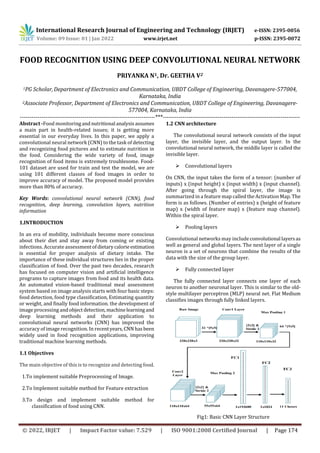
1.2 CNN architecture
The convolutional neural network consists of the input
layer, the invisible layer, and the output layer. In the
convolutional neural network, the middle layer is called the
invisible layer.
 Convolutional layers
On CNN, the input takes the form of a tensor: (number of
inputs) x (input height) x (input width) x (input channel).
After going through the spiral layer, the image is
summarized in a feature map called the Activation Map. The
form is as follows. (Number of entries) x (height of feature
map) x (width of feature map) x (feature map channel).
Within the spiral layer.
 Pooling layers
Convolutional networks may include convolutional layersas
well as general and global layers. The next layer of a single
neuron is a set of neurons that combine the results of the
data with the size of the group layer.
 Fully connected layer
The fully connected layer connects one layer of each
neuron to another neuronal layer. This is similar to the old-
style multilayer perceptron (MLP) neural net. Flat Medium
classifies images through fully linked layers.
Fig1: Basic CNN Layer Structure
International Research Journal of Engineering and Technology (IRJET) e-ISSN: 2395-0056
Volume: 09 Issue: 01 | Jan 2022 www.irjet.net p-ISSN: 2395-0072
© 2022, IRJET | Impact Factor value: 7.529 | ISO 9001:2008 Certified Journal | Page 175
2. SYSTEM DESIGN
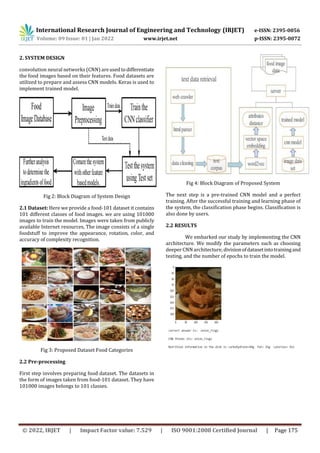
convolution neural networks (CNN) areusedtodifferentiate
the food images based on their features. Food datasets are
utilized to prepare and assess CNN models. Keras is used to
implement trained model.
Fig 2: Block Diagram of System Design
2.1 Dataset: Here we provide a food-101 dataset it contains
101 different classes of food images. we are using 101000
images to train the model. Images were taken from publicly
available Internet resources, The image consists of a single
foodstuff to improve the appearance, rotation, color, and
accuracy of complexity recognition.
Fig 3: Proposed Dataset Food Categories
2.2 Pre-processing
First step involves preparing food dataset. The datasets in
the form of images taken from food-101 dataset. They have
101000 images belongs to 101 classes.
Fig 4: Block Diagram of Proposed System
The next step is a pre-trained CNN model and a perfect
training. After the successful training and learning phase of
the system, the classification phase begins. Classification is
also done by users.
2.2 RESULTS
We embarked our study by implementing the CNN
architecture. We modify the parameters such as choosing
deeper CNN architecture, divisionofdatasetintotrainingand
testing, and the number of epochs to train the model.
International Research Journal of Engineering and Technology (IRJET) e-ISSN: 2395-0056
Volume: 09 Issue: 01 | Jan 2022 www.irjet.net p-ISSN: 2395-0072
© 2022, IRJET | Impact Factor value: 7.529 | ISO 9001:2008 Certified Journal | Page 176
The proposed classification and characteristic
extraction method achieve a high degree of accuracy of 80%.
We also describe possible and future improvements to
improve system usability and accuracy.
3. CONCLUSION
In this we have implemented convolution neural network to
identifying food images and nutrition information. we have
presented dataset from food-101 for classifying images. we
can classify different images among 101 classes of image
which were trained. then identify nutrition information for
each image for each training andtestingwegotabout 80%of
accuracy. For the future work have to recognize nutrition
according to the quantity of each food item.
REFERENCES
1.H. Kagaya and K. Aizawa, “Highly accuratefood/non-food
image classification based on a deep convolutional
neural network,” in International ConferenceonImage
Analysis and Processing, 2015, pp. 350–357.
2. Gianluigi Ciocca, Paolo Napoletano, and Raimondo
Schettini” Food Recognition: A N e w Dataset,
Experiments, and Results” IEEE 2017.
3. Shamay Jahan, Shashi Rekha. H, Shah Ayyub Quadri
“Bird’s Eye Review on Food Image Classification using
Supervised Machine Learning” IJLTEMAS 2018
4. Amatul Bushra Akhil, Farzana Akter Tania Khatun &
Mohammad Shorif Uddin “Recognition and
Classification of Fast Food Images” Global Journal of
Computer Science and Technology 2018.
5. W R SAM EMMANUEL and S JASMINE MINIJA” Fuzzy
clustering and Whale-based neural network to food
recognition and calorie estimation for daily dietary
assessment” Sådhanå 2018.
6. Akshada Gade, Dr. Arati Vyavahare “Dietary Assessment
Methods Based on Image Processing: A Review”
International Journal ofInnovativeResearchinScience,
Engineering and Technology 2017.

FOOD RECOGNITION USING DEEP CONVOLUTIONAL NEURAL NETWORK

  • 1.
    International Research Journalof Engineering and Technology (IRJET) e-ISSN: 2395-0056 Volume: 09 Issue: 01 | Jan 2022 www.irjet.net p-ISSN: 2395-0072 © 2022, IRJET | Impact Factor value: 7.529 | ISO 9001:2008 Certified Journal | Page 174 FOOD RECOGNITION USING DEEP CONVOLUTIONAL NEURAL NETWORK PRIYANKA N1, Dr. GEETHA V2 1PG Scholar,Department of Electronics and Communication, UBDT College of Engineering, Davanagere-577004, Karnataka, India 2Associate Professor, Department of Electronics and Communication, UBDT College of Engineering, Davanagere- 577004, Karnataka, India ---------------------------------------------------------------------***---------------------------------------------------------------------- Abstract -Food monitoringandnutritional analysisassumes a main part in health-related issues; it is getting more essential in our everyday lives. In this paper, we apply a convolutional neural network (CNN) to the task of detecting and recognizing food pictures and to estimate nutrition in the food. Considering the wide variety of food, image recognition of food items is extremely troublesome. Food- 101 dataset are used for train and test the model, we are using 101 different classes of food images in order to improve accuracy of model. The proposed model provides more than 80% of accuracy. Key Words: convolutional neural network (CNN), food recognition, deep learning, convolution layers, nutrition information 1.INTRODUCTION In an era of mobility, individuals become more conscious about their diet and stay away from coming or existing infections. Accurate assessmentofdietarycalorie estimation is essential for proper analysis of dietary intake. The importance of these individual structures lies in the proper classification of food. Over the past two decades, research has focused on computer vision and artificial intelligence programs to capture images from food and its health data. An automated vision-based traditional meal assessment system based on image analysis starts with four basic steps: food detection, food type classification, Estimating quantity or weight, and finally food information. the development of image processing andobject detection,machinelearning and deep learning methods and their application to convolutional neural networks (CNN) has improved the accuracy of image recognition. In recentyears,CNN hasbeen widely used in food recognition applications, improving traditional machine learning methods. 1.1 Objectives The main objective of this is to recognize and detecting food. 1.To implement suitable Preprocessing of Image. 2.To Implement suitable method for Feature extraction 3.To design and implement suitable method for classification of food using CNN. 1.2 CNN architecture The convolutional neural network consists of the input layer, the invisible layer, and the output layer. In the convolutional neural network, the middle layer is called the invisible layer.  Convolutional layers On CNN, the input takes the form of a tensor: (number of inputs) x (input height) x (input width) x (input channel). After going through the spiral layer, the image is summarized in a feature map called the Activation Map. The form is as follows. (Number of entries) x (height of feature map) x (width of feature map) x (feature map channel). Within the spiral layer.  Pooling layers Convolutional networks may include convolutional layersas well as general and global layers. The next layer of a single neuron is a set of neurons that combine the results of the data with the size of the group layer.  Fully connected layer The fully connected layer connects one layer of each neuron to another neuronal layer. This is similar to the old- style multilayer perceptron (MLP) neural net. Flat Medium classifies images through fully linked layers. Fig1: Basic CNN Layer Structure
  • 2.
    International Research Journalof Engineering and Technology (IRJET) e-ISSN: 2395-0056 Volume: 09 Issue: 01 | Jan 2022 www.irjet.net p-ISSN: 2395-0072 © 2022, IRJET | Impact Factor value: 7.529 | ISO 9001:2008 Certified Journal | Page 175 2. SYSTEM DESIGN convolution neural networks (CNN) areusedtodifferentiate the food images based on their features. Food datasets are utilized to prepare and assess CNN models. Keras is used to implement trained model. Fig 2: Block Diagram of System Design 2.1 Dataset: Here we provide a food-101 dataset it contains 101 different classes of food images. we are using 101000 images to train the model. Images were taken from publicly available Internet resources, The image consists of a single foodstuff to improve the appearance, rotation, color, and accuracy of complexity recognition. Fig 3: Proposed Dataset Food Categories 2.2 Pre-processing First step involves preparing food dataset. The datasets in the form of images taken from food-101 dataset. They have 101000 images belongs to 101 classes. Fig 4: Block Diagram of Proposed System The next step is a pre-trained CNN model and a perfect training. After the successful training and learning phase of the system, the classification phase begins. Classification is also done by users. 2.2 RESULTS We embarked our study by implementing the CNN architecture. We modify the parameters such as choosing deeper CNN architecture, divisionofdatasetintotrainingand testing, and the number of epochs to train the model.
  • 3.
    International Research Journalof Engineering and Technology (IRJET) e-ISSN: 2395-0056 Volume: 09 Issue: 01 | Jan 2022 www.irjet.net p-ISSN: 2395-0072 © 2022, IRJET | Impact Factor value: 7.529 | ISO 9001:2008 Certified Journal | Page 176 The proposed classification and characteristic extraction method achieve a high degree of accuracy of 80%. We also describe possible and future improvements to improve system usability and accuracy. 3. CONCLUSION In this we have implemented convolution neural network to identifying food images and nutrition information. we have presented dataset from food-101 for classifying images. we can classify different images among 101 classes of image which were trained. then identify nutrition information for each image for each training andtestingwegotabout 80%of accuracy. For the future work have to recognize nutrition according to the quantity of each food item. REFERENCES 1.H. Kagaya and K. Aizawa, “Highly accuratefood/non-food image classification based on a deep convolutional neural network,” in International ConferenceonImage Analysis and Processing, 2015, pp. 350–357. 2. Gianluigi Ciocca, Paolo Napoletano, and Raimondo Schettini” Food Recognition: A N e w Dataset, Experiments, and Results” IEEE 2017. 3. Shamay Jahan, Shashi Rekha. H, Shah Ayyub Quadri “Bird’s Eye Review on Food Image Classification using Supervised Machine Learning” IJLTEMAS 2018 4. Amatul Bushra Akhil, Farzana Akter Tania Khatun & Mohammad Shorif Uddin “Recognition and Classification of Fast Food Images” Global Journal of Computer Science and Technology 2018. 5. W R SAM EMMANUEL and S JASMINE MINIJA” Fuzzy clustering and Whale-based neural network to food recognition and calorie estimation for daily dietary assessment” Sådhanå 2018. 6. Akshada Gade, Dr. Arati Vyavahare “Dietary Assessment Methods Based on Image Processing: A Review” International Journal ofInnovativeResearchinScience, Engineering and Technology 2017.