A Report From
2 MEDIA 2015: The Future of Media
The past decade has been one of unmatched
media change. Big-name media companies
have come under consolidated ownership only
to have their distribution and content rivaled
by upstarts and user-generated content.
Consumers have come to rely on multiple
sources and are more active participants in
their media consumption than ever before. The
number of people online has ballooned and
the advent of web-enabled mobile devices has
brought portability to the Internet.
The increasingly fragmented nature of the in-
dustry has made it more difficult to target
consumers en masse. And the proliferation of
digital communications and social applications
has accelerated the online advertising and mar-
keting sector—not without questions, however,
about privacy and consumers’ relationships
with media.
Operating within this uncertain environment,
Unilever, ESPN and Mindshare forged a unique
three-way partnership to understand today’s
media industry and unearth its likely evolution
and consequent implications in the next half
of the decade. The partners set out to define
Media 2015 and answer the question:
How and where will consumers engage with,
consume and experience media in 2015 and
how will marketers and the communications
industry need to evolve in order to succeed?
Each of the companies approached the question
from a different vantage point, aiming, in
the end, to, create a collective definition of
the future of media. To faciliate the effort,
the partners engaged trend consultancy The
Futures Company. The group worked through
the practiced and proven prediction process
of Scenario Planning, a strategic planning
approach based on the assumption that though
the future may be unpredictable, it is not usually
random or chaotic.
The findings gave Unilever, ESPN and Mindshare
a set of usable insights into the future of
media, with implications for their own strategic
planning.
This short report details the Scenario Planning
process, the direct findings and the implications
for the three partners and the media industry
as a whole. Welcome to Media 2015.
“The purpose of looking at
the future is to disturb the
present.”
— Gaston Berger,
Futures Pioneer
Media 2015
At the heart of the Media 2015 approach is
Scenario Planning, a technique adapted from
military strategy for corporate use by the big
oil companies in the 1970s. Scenario Planning
is now an oft-used tool of corporate strategic
planners to predict probable future realities
and rehearse responses and tactics to mitigate
risks and take advantage of opportunities.
What sets Media 2015 apart is its application of
the technique—a unique three-way partnership
between:
Unilever: a consumer packaged goods com-
pany of top consumer brands like Dove, Axe,
Hellmann’s and Lipton that conceives concepts
and content (advertisements, interactive expe-
riences, media storylines, etc.) to reach its con-
sumer base.
ESPN: is the leading multinational, multimedia
sports entertainment company featuring the
broadest portfolio of multimedia sports assets
with over 50 business entities.
Mindshare: a global media and marketing ser-
vices company with expertise in strategic plan-
ning, media implementation, and multimedia
content creation in both traditional and digital
media formats.
The three companies combined their expertise
in Media 2015 to address the future beyond a
single organization‘s priority area—to forecast
the future holistically across the entire media
industry life cycle—from start to finish—con-
ception to implementation to consumption.
INTRODUCTION
3 MEDIA 2015: The Future of Media
Prediction in Practice
In practice, Scenario Planning combines relative
certainties about the future—such as the prolif-
eration of broadband—with plausible uncertain
technological, social, economic and regulatory
factors. At this intersection of certainty and un-
certainty, the factors that are judged to be the
most important yet the most uncertain emerge
as the scenario builders.
For Media 2015, Unilever, ESPN and Mindshare
unearthed the factors that will influence how
consumers engage with, consume and
experience media in 2015. This involved a
combined analysis of existing third-party
research and primary-sourced interviews with
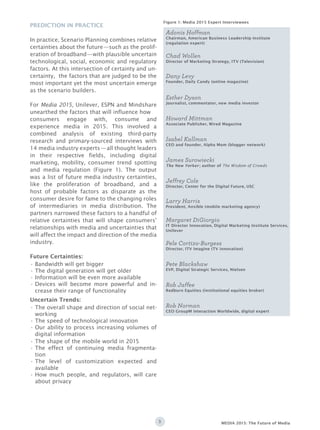
14 media industry experts—all thought leaders
in their respective fields, including digital
marketing, mobility, consumer trend spotting
and media regulation (Figure 1). The output
was a list of future media industry certainties,
like the proliferation of broadband, and a
host of probable factors as disparate as the
consumer desire for fame to the changing roles
of intermediaries in media distribution. The
partners narrowed these factors to a handful of
relative certainties that will shape consumers’
relationships with media and uncertainties that
will affect the impact and direction of the media
industry.
Future Certainties:
Uncertain Trends:
Bandwidth will get bigger•	
The digital generation will get older•	
Information will be even more available•	
Devices will become more powerful and in-•	
crease their range of functionality
The overall shape and direction of social net-•	
working
The speed of technological innovation•	
Our ability to process increasing volumes of•	
digital information
The shape of the mobile world in•	 2015
The effect of continuing media fragmenta-•	
tion
The level of customization expected and•	
available
How much people, and regulators, will care•	
about privacy
Figure 1: Media 2015 Expert Interviewees
Rob Norman
CEO GroupM Interaction Worldwide, digital expert
Isabel Kallman
CEO and founder, Alpha Mom (blogger network)
Adonis Hoffman
Chairman, American Business Leadership Institute
(regulation expert)
Margaret DiGiorgio
IT Director Innovation, Digital Marketing Institute Services,
Unilever
Chad Wollen
Director of Marketing Strategy, ITV (Television)
Howard Mittman
Associate Publisher, Wired Magazine
Jeffrey Cole
Director, Center for the Digital Future, USC
Pete Blackshaw
EVP, Digital Strategic Services, Nielsen
Pele Cortizo-Burgess
Director, ITV Imagine (TV innovation)
James Surowiecki
The New Yorker ; author of The Wisdom of Crowds
Rob Jaffee
Redburn Equities (institutional equities broker)
Esther Dyson
Journalist, commentator, new media investor
Larry Harris
President, Ansible (mobile marketing agency)
Dany Levy
Founder, Daily Candy (online magazine)
4 MEDIA 2015: The Future of Media
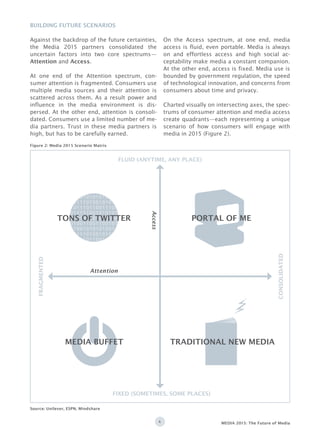
Against the backdrop of the future certainties,
the Media 2015 partners consolidated the
uncertain factors into two core spectrums—
Attention and Access.
At one end of the Attention spectrum, con-
sumer attention is fragmented. Consumers use
multiple media sources and their attention is
scattered across them. As a result power and
influence in the media environment is dis-
persed. At the other end, attention is consoli-
dated. Consumers use a limited number of me-
dia partners. Trust in these media partners is
high, but has to be carefully earned.
On the Access spectrum, at one end, media
access is fluid, even portable. Media is always
on and effortless access and high social ac-
ceptability make media a constant companion.
At the other end, access is fixed. Media use is
bounded by government regulation, the speed
of technological innovation, and concerns from
consumers about time and privacy.
Charted visually on intersecting axes, the spec-
trums of consumer attention and media access
create quadrants—each representing a unique
scenario of how consumers will engage with
media in 2015 (Figure 2).
Building Future Scenarios
0100101010100111110
0011101001010101010
1011101100111001101
0111110010101010010
0101010010101001001
0100110011001010011
0100101010100111110
0011101001010101010
1011101100111001101
0111110010101010010
0101010010101001001
0100110011001010011
FLUID (ANYTIME, ANY PLACE)
FIXED (SOMETIMES, SOME PLACES)
FRAGMENTED
CONSOLIDATED
Source: Unilever, ESPN, Mindshare
Access
Attention
MEDIA BUFFET TRADITIONAL NEW MEDIA
TONS OF TWITTER
Figure 2: Media 2015 Scenario Matrix
PORTAL OF ME
5 MEDIA 2015: The Future of Media
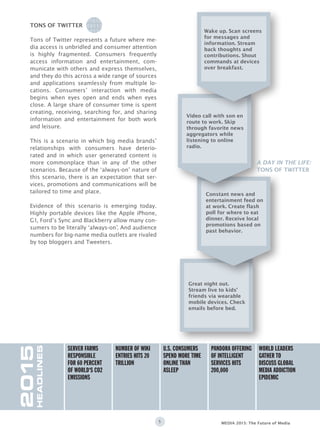
Tons of Twitter represents a future where me-
dia access is unbridled and consumer attention
is highly fragmented. Consumers frequently
access information and entertainment, com-
municate with others and express themselves,
and they do this across a wide range of sources
and applications seamlessly from multiple lo-
cations. Consumers’ interaction with media
begins when eyes open and ends when eyes
close. A large share of consumer time is spent
creating, receiving, searching for, and sharing
information and entertainment for both work
and leisure.
This is a scenario in which big media brands’
relationships with consumers have deterio-
rated and in which user generated content is
more commonplace than in any of the other
scenarios. Because of the ‘always-on’ nature of
this scenario, there is an expectation that ser-
vices, promotions and communications will be
tailored to time and place.
Evidence of this scenario is emerging today.
Highly portable devices like the Apple iPhone,
G1, Ford’s Sync and Blackberry allow many con-
sumers to be literally ‘always-on’. And audience
numbers for big-name media outlets are rivaled
by top bloggers and Tweeters.
tons of twitter
A DAY IN THE LIFE:
TONS OF TWITTER
2015
HEADLINES
Server farms
responsible
for 60 percent
of world‘s CO2
emissions
number of wiki
entries hits 20
trillion
U.S. CONSUMERS
SPEND MORE TIME
ONLINE THAN
ASLEEP
pandora offering
of intelligent
services hits
200,000
World leaders
gather to
discuss global
media addiction
epidemic
0100101010100111110
0011101001010101010
1011101100111001101
0111110010101010010
0101010010101001001
0100110011001010011
0100101010100111110
0011101001010101010
1011101100111001101
0111110010101010010
0101010010101001001
0100110011001010011
Great night out.
Stream live to kids’
friends via wearable
mobile devices. Check
emails before bed.
Constant news and
entertainment feed on
at work. Create flash
poll for where to eat
dinner. Receive local
promotions based on
past behavior.
Video call with son en
route to work. Skip
through favorite news
aggregators while
listening to online
radio.
Wake up. Scan screens
for messages and
information. Stream
back thoughts and
contributions. Shout
commands at devices
over breakfast.
6 MEDIA 2015: The Future of Media
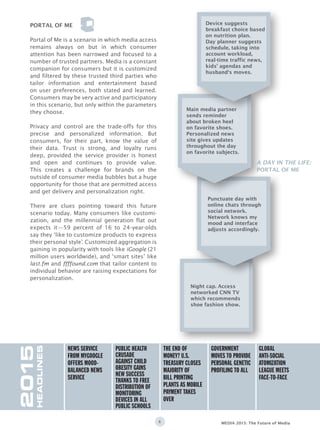
Portal of Me is a scenario in which media access
remains always on but in which consumer
attention has been narrowed and focused to a
number of trusted partners. Media is a constant
companion for consumers but it is customized
and filtered by these trusted third parties who
tailor information and entertainment based
on user preferences, both stated and learned.
Consumers may be very active and participatory
in this scenario, but only within the parameters
they choose.
Privacy and control are the trade-offs for this
precise and personalized information. But
consumers, for their part, know the value of
their data. Trust is strong, and loyalty runs
deep, provided the service provider is honest
and open and continues to provide value.
This creates a challenge for brands on the
outside of consumer media bubbles but a huge
opportunity for those that are permitted access
and get delivery and personalization right.
There are clues pointing toward this future
scenario today. Many consumers like customi-
zation, and the millennial generation flat out
expects it—59 percent of 16 to 24-year-olds
say they ‘like to customize products to express
their personal style’. Customized aggregation is
gaining in popularity with tools like iGoogle (21
million users worldwide), and ‘smart sites’ like
last.fm and ffffound.com that tailor content to
individual behavior are raising expectations for
personalization.
PORTAL OF ME
2015
HEADLINES
News service
from mygoogle
offers mood-
balanced news
service
Global
anti-social
atomization
league meets
face-to-face
Government
moves to provide
personal genetic
profiling to all
The end of
money? U.S.
Treasury closes
majority of
bill printing
plants as mobile
payment takes
over
Public health
crusade
against child
obesity gains
new success
thanks to free
distribution of
monitoring
devices in all
public schools
Night cap. Access
networked CNN TV
which recommends
shoe fashion show.
Punctuate day with
online chats through
social network.
Network knows my
mood and interface
adjusts accordingly.
Main media partner
sends reminder
about broken heel
on favorite shoes.
Personalized news
site gives updates
throughout the day
on favorite subjects.
Device suggests
breakfast choice based
on nutrition plan.
Day planner suggests
schedule, taking into
account workload,
real-time traffic news,
kids’ agendas and
husband‘s moves.
A DAY IN THE LIFE:
PORTAL OF ME
7 MEDIA 2015: The Future of Media
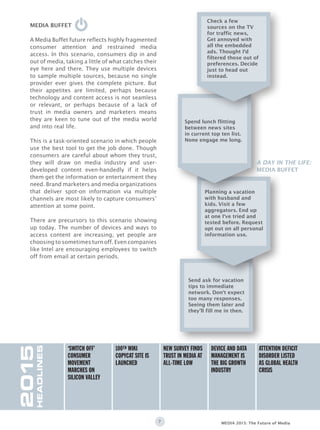
A Media Buffet future reflects highly fragmented
consumer attention and restrained media
access. In this scenario, consumers dip in and
out of media, taking a little of what catches their
eye here and there. They use multiple devices
to sample multiple sources, because no single
provider ever gives the complete picture. But
their appetites are limited, perhaps because
technology and content access is not seamless
or relevant, or perhaps because of a lack of
trust in media owners and marketers means
they are keen to tune out of the media world
and into real life.
This is a task-oriented scenario in which people
use the best tool to get the job done. Though
consumers are careful about whom they trust,
they will draw on media industry and user-
developed content even-handedly if it helps
them get the information or entertainment they
need. Brand marketers and media organizations
that deliver spot-on information via multiple
channels are most likely to capture consumers’
attention at some point.
There are precursors to this scenario showing
up today. The number of devices and ways to
access content are increasing, yet people are
choosing to sometimes turn off. Even companies
like Intel are encouraging employees to switch
off from email at certain periods.
MEDIA BUFFET
Send ask for vacation
tips to immediate
network. Don‘t expect
too many responses.
Seeing them later and
they’ll fill me in then.
Planning a vacation
with husband and
kids. Visit a few
aggregators. End up
at one I‘ve tried and
tested before. Request
opt out on all personal
information use.
Spend lunch flitting
between news sites
in current top ten list.
None engage me long.
Check a few
sources on the TV
for traffic news,
Get annoyed with
all the embedded
ads. Thought I‘d
filtered those out of
preferences. Decide
just to head out
instead.
2015
HEADLINES
‘switch off’
consumer
movement
marches on
silicon valley
Attention deficit
disorder listed
as global health
crisis
device and data
management is
the big growth
industry
New survey finds
trust in media at
all-time low
100th wiki
copycat site is
launched
A DAY IN THE LIFE:
media buffet
8 MEDIA 2015: The Future of Media
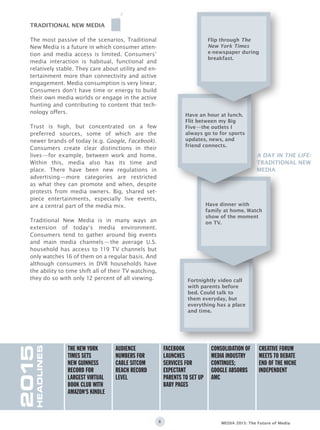
The most passive of the scenarios, Traditional
New Media is a future in which consumer atten-
tion and media access is limited. Consumers’
media interaction is habitual, functional and
relatively stable. They care about utility and en-
tertainment more than connectivity and active
engagement. Media consumption is very linear.
Consumers don‘t have time or energy to build
their own media worlds or engage in the active
hunting and contributing to content that tech-
nology offers.
Trust is high, but concentrated on a few
preferred sources, some of which are the
newer brands of today (e.g. Google, Facebook).
Consumers create clear distinctions in their
lives—for example, between work and home.
Within this, media also has its time and
place. There have been new regulations in
advertising—more categories are restricted
as what they can promote and when, despite
protests from media owners. Big, shared set-
piece entertainments, especially live events,
are a central part of the media mix.
Traditional New Media is in many ways an
extension of today‘s media environment.
Consumers tend to gather around big events
and main media channels—the average U.S.
household has access to 119 TV channels but
only watches 16 of them on a regular basis. And
although consumers in DVR households have
the ability to time shift all of their TV watching,
they do so with only 12 percent of all viewing.
TRADITIONAL NEW MEDIA
Fortnightly video call
with parents before
bed. Could talk to
them everyday, but
everything has a place
and time.
Have dinner with
family at home. Watch
show of the moment
on TV.
Have an hour at lunch.
Flit between my Big
Five—the outlets I
always go to for sports
updates, news, and
friend connects.
Flip through The
New York Times
e-newspaper during
breakfast.
2015
HEADLINES
The New York
Times sets
new Guinness
Record for
largest virtual
book club with
Amazon‘s Kindle
Creative forum
meets to debate
end of the niche
independent
Consolidation of
media industry
continues;
Google absorbs
AMC
Facebook
launches
services for
expectant
parents to set up
baby pages
Audience
numbers for
cable sitcom
reach record
level
A DAY IN THE LIFE:
traditional new
media
9 MEDIA 2015: The Future of Media
Interpreting Implications
It is worth reiterating that the purpose of sce-
nario planning is not to come up with a single
prediction of the future. It is very unlikely that
the future will entirely resemble a single sce-
nario. Instead, the future is most likely to be
an amalgamation of scenarios, evolving differ-
ently for varied sectors, audience groups and
geographies.
The purpose of exploring these possible future
scenarios is to stretch our understanding of
possible change and to challenge our assump-
tions about the world so that we make better,
more informed decisions in the present.
Looking across Media 2015’s four future media
scenarios, there are four broad implications that
will significantly impact the entire life cycle of
the media industry and how the players within
each space—advertisers, media agencies and
content distributors—will interact with the new
media consumer.
Creating Dynamic Content
Across the scenarios, the relationship between
the occasion and the consumer and his or her
location and motivation for engaging with
content at that moment, becomes central. No
longer is the 30-second advertisement king,
nor are audience numbers guaranteed. People
watch, listen and interact with what they want,
when they want and where they want. Media
providers have a deeper insight into consumers’
media lives and needs. High value consumer
experiences are based on the media moment:
the right experience, on the right platform,
responding to the right need. One size does not
fit all. A broader canvas of content and tailored
messages are required. Sometimes this involves
consumers pulling something from a network
or media provider; sometimes it involves the
media provider pushing something to the
consumer at the right time.
Aggregating to Meet Demand
On the face of it, only some of the Media 2015
scenarios positively encourage aggregation.
However, uniformly, the complexity and sheer
glut of content needed by media providers to
compete effectively are too much for a single
organization to deliver on its own. The largest
may have enough material but not sufficient
flexibility to respond to consumer demands.
The smallest may have the agility to reach
consumers where they are in meaningful
ways but not deep and varied content. The
solution is aggregation of assets via strategic
partnerships between advertisers, distributors
and implementers—with big-name and no-
name match-ups, high and low connections.
Balancing Data with TrusT
The consumer is president of the new republic.
The consolation? Media providers know more
about consumers than ever before. Consumers
leave data trails wherever they go. The pieces
of individual behavior synthesized are a pow-
erful tool, but used carelessly create distrust
in brands and media providers. In a world in
which consumers increasingly hold the strong
cards, they will punish companies they believe
are abusing them.
Integrating Media Consumption Early
The rising complexity and volume of media re-
quires brand communications be introduced
early in the product development process. Me-
dia and consumer communications move to
the beginning of the supply chain and are at
the center of strategic planning. Message de-
velopment comes first—defined by consumers’
mindsets and preferences—and creative assets
are varied and complex. Only after that is the
distribution method selected.
Scenarios are a way to structure thinking about
the future—a way of creating rational, well-
thought through perspectives grounded in
the evidence available today. They are realistic
stories about how the world will look and why
it will look that way. Media 2015 creates a
probable answer to the question of how and
where consumers will engage with, consume
and experience media five years from now.
Some of the predictions are even emerging as
reality already. These scenarios, now developed,
are not end points but rather starting points
to help the media industry define how it will
respond.
SCENARIOS
10 MEDIA 2015: The Future of Media
Scenario Implications
TONS OF TWITTER
Advertisers (Creators)
Develop flexible media mix to reach consumers•	
who are everywhere
Echo the fragmented and niche mediascape•	
with fragmented and niche marketing tactics
Tell brand stories in snippets, with different•	
narrative styles and a balance of information
and entertainment, allowing consumers to find
different pieces in different places
Up-level listening and observation skills, as•	
WOM and social networks gain influence
Media Owners (Distributors)
Create content that is seamless, optimized to•	
devices, customized and customizable
Develop good relationships with device•	
owners/producers and advanced mechanisms
to understand and adapt to consumer behavior
Be everywhere all the time—may need new•	
distribution partnerships to deliver this
Media Agencies (Implementers)
Turn the enormous amount of data that is•	
generated into meaning
This means sophisticated data analytics and•	
interpretation skills are key
Develop a set of new standardized metrics•	
Establish ways to be culturally tapped in,•	
helping clients navigate the speed of change
MEDIA BUFFET
Advertisers (Creators)
Develop brands that stand for something and•	
can deliver high-quality, differentiated content
Cut through media clutter and short consumer•	
attention spans with catchy marketing
initiatives
Media Owners (Distributors)
Onus on authenticity and quality in respect to•	
content or consumers will go elsewhere
Stand for something unique in order to•	
differentiate
Portfolio management becomes more critical•	
Big players need to deliver innovation—and•	
pick up tricks from smaller, niche players
Media Agencies (Implementers)
Target understanding becomes even more•	
critical—here it‘s harder to connect to
consumers
Work more closely with those creating the•	
messages to ensure fit with media channel
Translate ideas and messages for different•	
audiences and customize the content
accordingly—figure out how to do this in a cost
efficient way
PORTAL OF ME
Advertisers (Creators)
Build relationships with different partners to•	
access different consumer groups and their
protected, niche worlds
Provide utility and build trust in marketing•	
initiatives so consumers choose to opt in based
on relevancy to their world
Media Owners (Distributors)
Look to new sources for distribution—the•	
new consumer portals and partners—develop
relationships with them
Offer additional services and provide additional•	
utilities—e.g. discovery, guidance, news,
healthcare, fantasy leagues
An increased intermediary relationship•	 /enable
discovery between customer and advertisers
Media Agencies (Implementers)
Develop and lead consumer permission•	
strategies
Establish skills and tools around the re-•	
aggregation of data
Focus on creative content as a way in to the•	
niche world—permission will follow desire
Media owner partnerships are key—media•	
owners have a heavier center of power in this
scenario
TRADITIONAL NEW MEDIA
Advertisers (Creators)
Deliver authentic information in a genuine and•	
credible way to build trust with the consumer
Develop strong brand identities for long-term•	
consumer relationships
Master pull communication strategy•	
Media Owners (Distributors)
Understand how permission works•	
May need to invest more to maintain audiences•	
Become synonymous with an area of expertise•	
Relationships with studios•	 /studio contracts key
owners as the total portal to show‘s success
Media Agencies (Implementers)
Better understand the passions and the big•	
ticket events which we have to connect to
Create strong relationships and opportunities•	
with the new media owners—means starting
relationship now with the emerging players
Retain much of the current planning and•	
investment structure
0100101010100111110
0011101001010101010
1011101100111001101
0111110010101010010
0101010010101001001
0100110011001010011
0100101010100111110
0011101001010101010
1011101100111001101
0111110010101010010
0101010010101001001
0100110011001010011
11 MEDIA 2015: The Future of Media
CONTACTS
Rob Master, Unilever
rob.master@unilever.com
Peter Leimbach, ESPN
Peter.Leimbach@espn.com
Mark Potts, Mindshare
mark.potts@mindshareworld.com
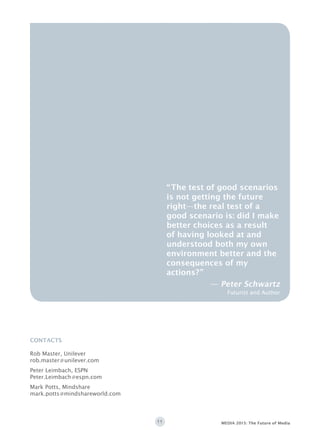
“The test of good scenarios
is not getting the future
right—the real test of a
good scenario is: did I make
better choices as a result
of having looked at and
understood both my own
environment better and the
consequences of my
actions?”
— Peter Schwartz
Futurist and Author

Fom final 09_tcm23-206938

  • 1.
  • 2.
    2 MEDIA 2015:The Future of Media The past decade has been one of unmatched media change. Big-name media companies have come under consolidated ownership only to have their distribution and content rivaled by upstarts and user-generated content. Consumers have come to rely on multiple sources and are more active participants in their media consumption than ever before. The number of people online has ballooned and the advent of web-enabled mobile devices has brought portability to the Internet. The increasingly fragmented nature of the in- dustry has made it more difficult to target consumers en masse. And the proliferation of digital communications and social applications has accelerated the online advertising and mar- keting sector—not without questions, however, about privacy and consumers’ relationships with media. Operating within this uncertain environment, Unilever, ESPN and Mindshare forged a unique three-way partnership to understand today’s media industry and unearth its likely evolution and consequent implications in the next half of the decade. The partners set out to define Media 2015 and answer the question: How and where will consumers engage with, consume and experience media in 2015 and how will marketers and the communications industry need to evolve in order to succeed? Each of the companies approached the question from a different vantage point, aiming, in the end, to, create a collective definition of the future of media. To faciliate the effort, the partners engaged trend consultancy The Futures Company. The group worked through the practiced and proven prediction process of Scenario Planning, a strategic planning approach based on the assumption that though the future may be unpredictable, it is not usually random or chaotic. The findings gave Unilever, ESPN and Mindshare a set of usable insights into the future of media, with implications for their own strategic planning. This short report details the Scenario Planning process, the direct findings and the implications for the three partners and the media industry as a whole. Welcome to Media 2015. “The purpose of looking at the future is to disturb the present.” — Gaston Berger, Futures Pioneer Media 2015 At the heart of the Media 2015 approach is Scenario Planning, a technique adapted from military strategy for corporate use by the big oil companies in the 1970s. Scenario Planning is now an oft-used tool of corporate strategic planners to predict probable future realities and rehearse responses and tactics to mitigate risks and take advantage of opportunities. What sets Media 2015 apart is its application of the technique—a unique three-way partnership between: Unilever: a consumer packaged goods com- pany of top consumer brands like Dove, Axe, Hellmann’s and Lipton that conceives concepts and content (advertisements, interactive expe- riences, media storylines, etc.) to reach its con- sumer base. ESPN: is the leading multinational, multimedia sports entertainment company featuring the broadest portfolio of multimedia sports assets with over 50 business entities. Mindshare: a global media and marketing ser- vices company with expertise in strategic plan- ning, media implementation, and multimedia content creation in both traditional and digital media formats. The three companies combined their expertise in Media 2015 to address the future beyond a single organization‘s priority area—to forecast the future holistically across the entire media industry life cycle—from start to finish—con- ception to implementation to consumption. INTRODUCTION
  • 3.
    3 MEDIA 2015:The Future of Media Prediction in Practice In practice, Scenario Planning combines relative certainties about the future—such as the prolif- eration of broadband—with plausible uncertain technological, social, economic and regulatory factors. At this intersection of certainty and un- certainty, the factors that are judged to be the most important yet the most uncertain emerge as the scenario builders. For Media 2015, Unilever, ESPN and Mindshare unearthed the factors that will influence how consumers engage with, consume and experience media in 2015. This involved a combined analysis of existing third-party research and primary-sourced interviews with 14 media industry experts—all thought leaders in their respective fields, including digital marketing, mobility, consumer trend spotting and media regulation (Figure 1). The output was a list of future media industry certainties, like the proliferation of broadband, and a host of probable factors as disparate as the consumer desire for fame to the changing roles of intermediaries in media distribution. The partners narrowed these factors to a handful of relative certainties that will shape consumers’ relationships with media and uncertainties that will affect the impact and direction of the media industry. Future Certainties: Uncertain Trends: Bandwidth will get bigger• The digital generation will get older• Information will be even more available• Devices will become more powerful and in-• crease their range of functionality The overall shape and direction of social net-• working The speed of technological innovation• Our ability to process increasing volumes of• digital information The shape of the mobile world in• 2015 The effect of continuing media fragmenta-• tion The level of customization expected and• available How much people, and regulators, will care• about privacy Figure 1: Media 2015 Expert Interviewees Rob Norman CEO GroupM Interaction Worldwide, digital expert Isabel Kallman CEO and founder, Alpha Mom (blogger network) Adonis Hoffman Chairman, American Business Leadership Institute (regulation expert) Margaret DiGiorgio IT Director Innovation, Digital Marketing Institute Services, Unilever Chad Wollen Director of Marketing Strategy, ITV (Television) Howard Mittman Associate Publisher, Wired Magazine Jeffrey Cole Director, Center for the Digital Future, USC Pete Blackshaw EVP, Digital Strategic Services, Nielsen Pele Cortizo-Burgess Director, ITV Imagine (TV innovation) James Surowiecki The New Yorker ; author of The Wisdom of Crowds Rob Jaffee Redburn Equities (institutional equities broker) Esther Dyson Journalist, commentator, new media investor Larry Harris President, Ansible (mobile marketing agency) Dany Levy Founder, Daily Candy (online magazine)
  • 4.
    4 MEDIA 2015:The Future of Media Against the backdrop of the future certainties, the Media 2015 partners consolidated the uncertain factors into two core spectrums— Attention and Access. At one end of the Attention spectrum, con- sumer attention is fragmented. Consumers use multiple media sources and their attention is scattered across them. As a result power and influence in the media environment is dis- persed. At the other end, attention is consoli- dated. Consumers use a limited number of me- dia partners. Trust in these media partners is high, but has to be carefully earned. On the Access spectrum, at one end, media access is fluid, even portable. Media is always on and effortless access and high social ac- ceptability make media a constant companion. At the other end, access is fixed. Media use is bounded by government regulation, the speed of technological innovation, and concerns from consumers about time and privacy. Charted visually on intersecting axes, the spec- trums of consumer attention and media access create quadrants—each representing a unique scenario of how consumers will engage with media in 2015 (Figure 2). Building Future Scenarios 0100101010100111110 0011101001010101010 1011101100111001101 0111110010101010010 0101010010101001001 0100110011001010011 0100101010100111110 0011101001010101010 1011101100111001101 0111110010101010010 0101010010101001001 0100110011001010011 FLUID (ANYTIME, ANY PLACE) FIXED (SOMETIMES, SOME PLACES) FRAGMENTED CONSOLIDATED Source: Unilever, ESPN, Mindshare Access Attention MEDIA BUFFET TRADITIONAL NEW MEDIA TONS OF TWITTER Figure 2: Media 2015 Scenario Matrix PORTAL OF ME
  • 5.
    5 MEDIA 2015:The Future of Media Tons of Twitter represents a future where me- dia access is unbridled and consumer attention is highly fragmented. Consumers frequently access information and entertainment, com- municate with others and express themselves, and they do this across a wide range of sources and applications seamlessly from multiple lo- cations. Consumers’ interaction with media begins when eyes open and ends when eyes close. A large share of consumer time is spent creating, receiving, searching for, and sharing information and entertainment for both work and leisure. This is a scenario in which big media brands’ relationships with consumers have deterio- rated and in which user generated content is more commonplace than in any of the other scenarios. Because of the ‘always-on’ nature of this scenario, there is an expectation that ser- vices, promotions and communications will be tailored to time and place. Evidence of this scenario is emerging today. Highly portable devices like the Apple iPhone, G1, Ford’s Sync and Blackberry allow many con- sumers to be literally ‘always-on’. And audience numbers for big-name media outlets are rivaled by top bloggers and Tweeters. tons of twitter A DAY IN THE LIFE: TONS OF TWITTER 2015 HEADLINES Server farms responsible for 60 percent of world‘s CO2 emissions number of wiki entries hits 20 trillion U.S. CONSUMERS SPEND MORE TIME ONLINE THAN ASLEEP pandora offering of intelligent services hits 200,000 World leaders gather to discuss global media addiction epidemic 0100101010100111110 0011101001010101010 1011101100111001101 0111110010101010010 0101010010101001001 0100110011001010011 0100101010100111110 0011101001010101010 1011101100111001101 0111110010101010010 0101010010101001001 0100110011001010011 Great night out. Stream live to kids’ friends via wearable mobile devices. Check emails before bed. Constant news and entertainment feed on at work. Create flash poll for where to eat dinner. Receive local promotions based on past behavior. Video call with son en route to work. Skip through favorite news aggregators while listening to online radio. Wake up. Scan screens for messages and information. Stream back thoughts and contributions. Shout commands at devices over breakfast.
  • 6.
    6 MEDIA 2015:The Future of Media Portal of Me is a scenario in which media access remains always on but in which consumer attention has been narrowed and focused to a number of trusted partners. Media is a constant companion for consumers but it is customized and filtered by these trusted third parties who tailor information and entertainment based on user preferences, both stated and learned. Consumers may be very active and participatory in this scenario, but only within the parameters they choose. Privacy and control are the trade-offs for this precise and personalized information. But consumers, for their part, know the value of their data. Trust is strong, and loyalty runs deep, provided the service provider is honest and open and continues to provide value. This creates a challenge for brands on the outside of consumer media bubbles but a huge opportunity for those that are permitted access and get delivery and personalization right. There are clues pointing toward this future scenario today. Many consumers like customi- zation, and the millennial generation flat out expects it—59 percent of 16 to 24-year-olds say they ‘like to customize products to express their personal style’. Customized aggregation is gaining in popularity with tools like iGoogle (21 million users worldwide), and ‘smart sites’ like last.fm and ffffound.com that tailor content to individual behavior are raising expectations for personalization. PORTAL OF ME 2015 HEADLINES News service from mygoogle offers mood- balanced news service Global anti-social atomization league meets face-to-face Government moves to provide personal genetic profiling to all The end of money? U.S. Treasury closes majority of bill printing plants as mobile payment takes over Public health crusade against child obesity gains new success thanks to free distribution of monitoring devices in all public schools Night cap. Access networked CNN TV which recommends shoe fashion show. Punctuate day with online chats through social network. Network knows my mood and interface adjusts accordingly. Main media partner sends reminder about broken heel on favorite shoes. Personalized news site gives updates throughout the day on favorite subjects. Device suggests breakfast choice based on nutrition plan. Day planner suggests schedule, taking into account workload, real-time traffic news, kids’ agendas and husband‘s moves. A DAY IN THE LIFE: PORTAL OF ME
  • 7.
    7 MEDIA 2015:The Future of Media A Media Buffet future reflects highly fragmented consumer attention and restrained media access. In this scenario, consumers dip in and out of media, taking a little of what catches their eye here and there. They use multiple devices to sample multiple sources, because no single provider ever gives the complete picture. But their appetites are limited, perhaps because technology and content access is not seamless or relevant, or perhaps because of a lack of trust in media owners and marketers means they are keen to tune out of the media world and into real life. This is a task-oriented scenario in which people use the best tool to get the job done. Though consumers are careful about whom they trust, they will draw on media industry and user- developed content even-handedly if it helps them get the information or entertainment they need. Brand marketers and media organizations that deliver spot-on information via multiple channels are most likely to capture consumers’ attention at some point. There are precursors to this scenario showing up today. The number of devices and ways to access content are increasing, yet people are choosing to sometimes turn off. Even companies like Intel are encouraging employees to switch off from email at certain periods. MEDIA BUFFET Send ask for vacation tips to immediate network. Don‘t expect too many responses. Seeing them later and they’ll fill me in then. Planning a vacation with husband and kids. Visit a few aggregators. End up at one I‘ve tried and tested before. Request opt out on all personal information use. Spend lunch flitting between news sites in current top ten list. None engage me long. Check a few sources on the TV for traffic news, Get annoyed with all the embedded ads. Thought I‘d filtered those out of preferences. Decide just to head out instead. 2015 HEADLINES ‘switch off’ consumer movement marches on silicon valley Attention deficit disorder listed as global health crisis device and data management is the big growth industry New survey finds trust in media at all-time low 100th wiki copycat site is launched A DAY IN THE LIFE: media buffet
  • 8.
    8 MEDIA 2015:The Future of Media The most passive of the scenarios, Traditional New Media is a future in which consumer atten- tion and media access is limited. Consumers’ media interaction is habitual, functional and relatively stable. They care about utility and en- tertainment more than connectivity and active engagement. Media consumption is very linear. Consumers don‘t have time or energy to build their own media worlds or engage in the active hunting and contributing to content that tech- nology offers. Trust is high, but concentrated on a few preferred sources, some of which are the newer brands of today (e.g. Google, Facebook). Consumers create clear distinctions in their lives—for example, between work and home. Within this, media also has its time and place. There have been new regulations in advertising—more categories are restricted as what they can promote and when, despite protests from media owners. Big, shared set- piece entertainments, especially live events, are a central part of the media mix. Traditional New Media is in many ways an extension of today‘s media environment. Consumers tend to gather around big events and main media channels—the average U.S. household has access to 119 TV channels but only watches 16 of them on a regular basis. And although consumers in DVR households have the ability to time shift all of their TV watching, they do so with only 12 percent of all viewing. TRADITIONAL NEW MEDIA Fortnightly video call with parents before bed. Could talk to them everyday, but everything has a place and time. Have dinner with family at home. Watch show of the moment on TV. Have an hour at lunch. Flit between my Big Five—the outlets I always go to for sports updates, news, and friend connects. Flip through The New York Times e-newspaper during breakfast. 2015 HEADLINES The New York Times sets new Guinness Record for largest virtual book club with Amazon‘s Kindle Creative forum meets to debate end of the niche independent Consolidation of media industry continues; Google absorbs AMC Facebook launches services for expectant parents to set up baby pages Audience numbers for cable sitcom reach record level A DAY IN THE LIFE: traditional new media
  • 9.
    9 MEDIA 2015:The Future of Media Interpreting Implications It is worth reiterating that the purpose of sce- nario planning is not to come up with a single prediction of the future. It is very unlikely that the future will entirely resemble a single sce- nario. Instead, the future is most likely to be an amalgamation of scenarios, evolving differ- ently for varied sectors, audience groups and geographies. The purpose of exploring these possible future scenarios is to stretch our understanding of possible change and to challenge our assump- tions about the world so that we make better, more informed decisions in the present. Looking across Media 2015’s four future media scenarios, there are four broad implications that will significantly impact the entire life cycle of the media industry and how the players within each space—advertisers, media agencies and content distributors—will interact with the new media consumer. Creating Dynamic Content Across the scenarios, the relationship between the occasion and the consumer and his or her location and motivation for engaging with content at that moment, becomes central. No longer is the 30-second advertisement king, nor are audience numbers guaranteed. People watch, listen and interact with what they want, when they want and where they want. Media providers have a deeper insight into consumers’ media lives and needs. High value consumer experiences are based on the media moment: the right experience, on the right platform, responding to the right need. One size does not fit all. A broader canvas of content and tailored messages are required. Sometimes this involves consumers pulling something from a network or media provider; sometimes it involves the media provider pushing something to the consumer at the right time. Aggregating to Meet Demand On the face of it, only some of the Media 2015 scenarios positively encourage aggregation. However, uniformly, the complexity and sheer glut of content needed by media providers to compete effectively are too much for a single organization to deliver on its own. The largest may have enough material but not sufficient flexibility to respond to consumer demands. The smallest may have the agility to reach consumers where they are in meaningful ways but not deep and varied content. The solution is aggregation of assets via strategic partnerships between advertisers, distributors and implementers—with big-name and no- name match-ups, high and low connections. Balancing Data with TrusT The consumer is president of the new republic. The consolation? Media providers know more about consumers than ever before. Consumers leave data trails wherever they go. The pieces of individual behavior synthesized are a pow- erful tool, but used carelessly create distrust in brands and media providers. In a world in which consumers increasingly hold the strong cards, they will punish companies they believe are abusing them. Integrating Media Consumption Early The rising complexity and volume of media re- quires brand communications be introduced early in the product development process. Me- dia and consumer communications move to the beginning of the supply chain and are at the center of strategic planning. Message de- velopment comes first—defined by consumers’ mindsets and preferences—and creative assets are varied and complex. Only after that is the distribution method selected. Scenarios are a way to structure thinking about the future—a way of creating rational, well- thought through perspectives grounded in the evidence available today. They are realistic stories about how the world will look and why it will look that way. Media 2015 creates a probable answer to the question of how and where consumers will engage with, consume and experience media five years from now. Some of the predictions are even emerging as reality already. These scenarios, now developed, are not end points but rather starting points to help the media industry define how it will respond. SCENARIOS
  • 10.
    10 MEDIA 2015:The Future of Media Scenario Implications TONS OF TWITTER Advertisers (Creators) Develop flexible media mix to reach consumers• who are everywhere Echo the fragmented and niche mediascape• with fragmented and niche marketing tactics Tell brand stories in snippets, with different• narrative styles and a balance of information and entertainment, allowing consumers to find different pieces in different places Up-level listening and observation skills, as• WOM and social networks gain influence Media Owners (Distributors) Create content that is seamless, optimized to• devices, customized and customizable Develop good relationships with device• owners/producers and advanced mechanisms to understand and adapt to consumer behavior Be everywhere all the time—may need new• distribution partnerships to deliver this Media Agencies (Implementers) Turn the enormous amount of data that is• generated into meaning This means sophisticated data analytics and• interpretation skills are key Develop a set of new standardized metrics• Establish ways to be culturally tapped in,• helping clients navigate the speed of change MEDIA BUFFET Advertisers (Creators) Develop brands that stand for something and• can deliver high-quality, differentiated content Cut through media clutter and short consumer• attention spans with catchy marketing initiatives Media Owners (Distributors) Onus on authenticity and quality in respect to• content or consumers will go elsewhere Stand for something unique in order to• differentiate Portfolio management becomes more critical• Big players need to deliver innovation—and• pick up tricks from smaller, niche players Media Agencies (Implementers) Target understanding becomes even more• critical—here it‘s harder to connect to consumers Work more closely with those creating the• messages to ensure fit with media channel Translate ideas and messages for different• audiences and customize the content accordingly—figure out how to do this in a cost efficient way PORTAL OF ME Advertisers (Creators) Build relationships with different partners to• access different consumer groups and their protected, niche worlds Provide utility and build trust in marketing• initiatives so consumers choose to opt in based on relevancy to their world Media Owners (Distributors) Look to new sources for distribution—the• new consumer portals and partners—develop relationships with them Offer additional services and provide additional• utilities—e.g. discovery, guidance, news, healthcare, fantasy leagues An increased intermediary relationship• /enable discovery between customer and advertisers Media Agencies (Implementers) Develop and lead consumer permission• strategies Establish skills and tools around the re-• aggregation of data Focus on creative content as a way in to the• niche world—permission will follow desire Media owner partnerships are key—media• owners have a heavier center of power in this scenario TRADITIONAL NEW MEDIA Advertisers (Creators) Deliver authentic information in a genuine and• credible way to build trust with the consumer Develop strong brand identities for long-term• consumer relationships Master pull communication strategy• Media Owners (Distributors) Understand how permission works• May need to invest more to maintain audiences• Become synonymous with an area of expertise• Relationships with studios• /studio contracts key owners as the total portal to show‘s success Media Agencies (Implementers) Better understand the passions and the big• ticket events which we have to connect to Create strong relationships and opportunities• with the new media owners—means starting relationship now with the emerging players Retain much of the current planning and• investment structure 0100101010100111110 0011101001010101010 1011101100111001101 0111110010101010010 0101010010101001001 0100110011001010011 0100101010100111110 0011101001010101010 1011101100111001101 0111110010101010010 0101010010101001001 0100110011001010011
  • 11.
    11 MEDIA 2015:The Future of Media CONTACTS Rob Master, Unilever rob.master@unilever.com Peter Leimbach, ESPN Peter.Leimbach@espn.com Mark Potts, Mindshare mark.potts@mindshareworld.com “The test of good scenarios is not getting the future right—the real test of a good scenario is: did I make better choices as a result of having looked at and understood both my own environment better and the consequences of my actions?” — Peter Schwartz Futurist and Author