ABCIS CIE 9705 AS Level Design and Technology (2025 6 7)
Non Examined Assessment (NEA) (Coursework) Folio guidance
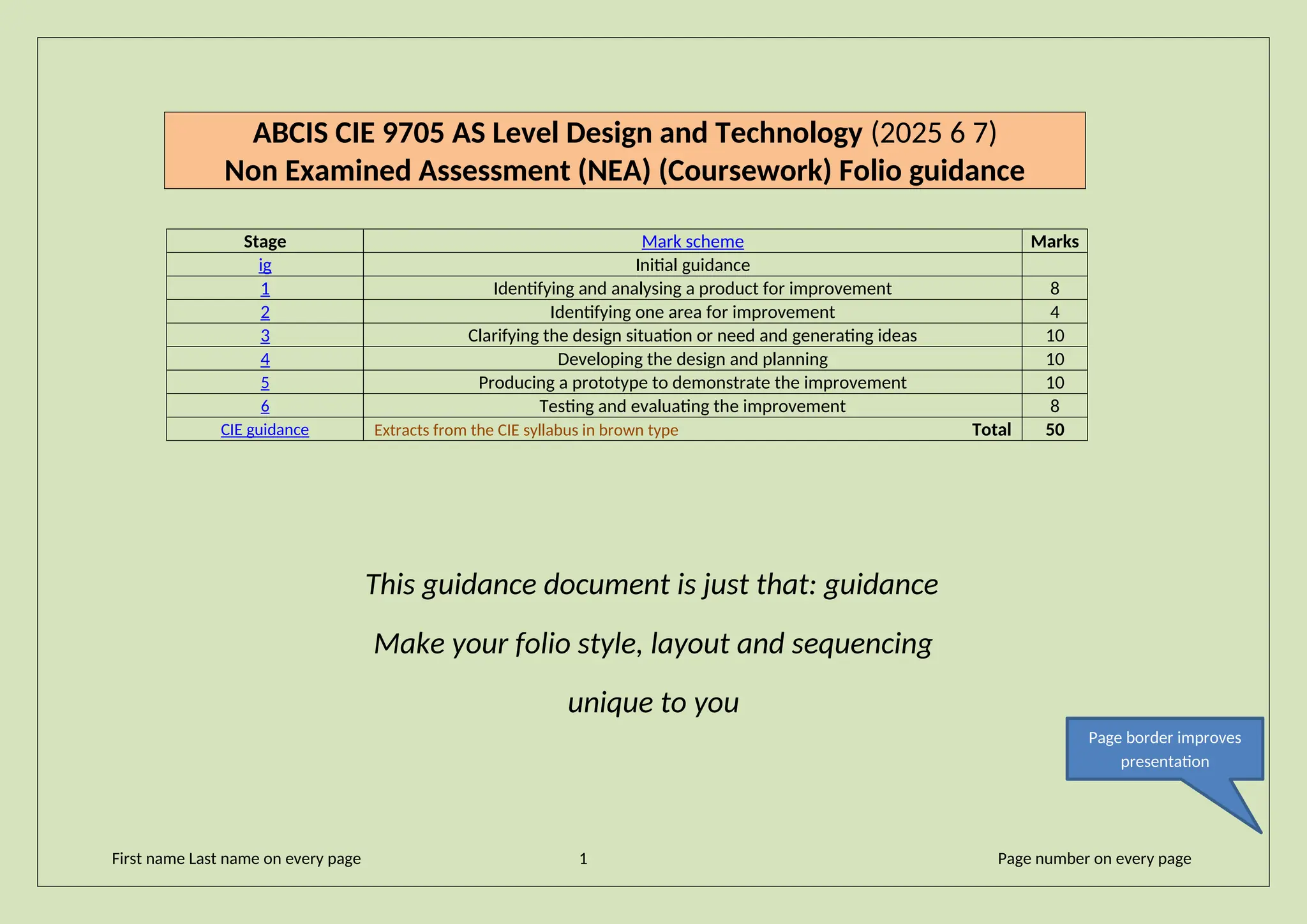
Stage Mark scheme Marks
ig Initial guidance
1 Identifying and analysing a product for improvement 8
2 Identifying one area for improvement 4
3 Clarifying the design situation or need and generating ideas 10
4 Developing the design and planning 10
5 Producing a prototype to demonstrate the improvement 10
6 Testing and evaluating the improvement 8
CIE guidance Extracts from the CIE syllabus in brown type Total 50
This guidance document is just that: guidance
Make your folio style, layout and sequencing
unique to you
First name Last name on every page 1 Page number on every page
Page border improves
presentation
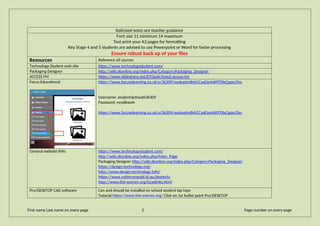
Italicised notes are teacher guidance
Font size 11 minimum 14 maximum
Test print your A3 pages for formatting
Key Stage 4 and 5 students are advised to use Powerpoint or Word for faster processing
Ensure robust back up of your files
Resources Reference all sources
Technology Student web site https://www.technologystudent.com/
Packaging Designer http://wiki.dtonline.org/index.php/Category:Packaging_Designer
ACCESS FM https://www.slideshare.net/DTGeek/how2-access-fm
Focus Educational https://www.focuselearning.co.uk/u/36309/wyduptmBshCCaaEteAdtFFDleCgqscCko
Username: student@theabi36309
Password: vyyidkwoh
https://www.focuselearning.co.uk/u/36309/wyduptmBshCCaaEteAdtFFDleCgqscCko
General website links https://www.technologystudent.com/
http://wiki.dtonline.org/index.php/Main_Page
Packaging Designer http://wiki.dtonline.org/index.php/Category:Packaging_Designer
https://design-technology.org/
http://www.design-technology.info/
https://www.ruthtrumpold.id.au/destech/
http://www.the-warren.org/Gcselinks.html
Pro/DESKTOP CAD software Can and should be installed on school student lap tops
Tutorial https://www.the-warren.org/ Click on 1st bullet point Pro/DESKTOP
First name Last name on every page 2 Page number on every page
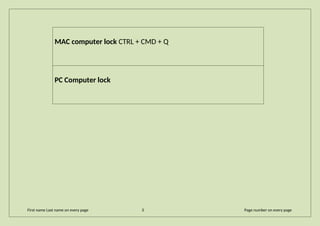
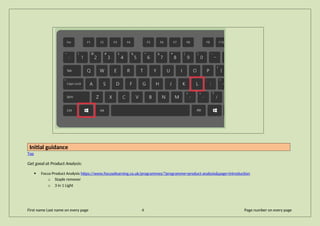
MAC computer lock CTRL + CMD + Q
PC Computer lock
First name Last name on every page 3 Page number on every page
Initial guidance
Top
Get good at Product Analysis:
 Focus Product Analysis https://www.focuselearning.co.uk/programmes/?programme=product-analysis&page=introduction
o Staple remover
o 3 in 1 Light
First name Last name on every page 4 Page number on every page
First name Last name on every page 5 Page number on every page
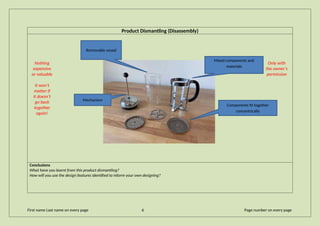
Product Dismantling (Disassembly)
Nothing
expensive
or valuable
It won’t
matter if
it doesn’t
go back
together
again!
Only with
the owner’s
permission
Conclusions
What have you learnt from this product dismantling?
How will you use the design features identified to inform your own designing?
First name Last name on every page 6 Page number on every page
Mixed components and
materials
Components fit together
concentrically
Removable vessel
Mechanism
e mail dialogue with the CIE Assessment manager 8 March 2024
For the AS Level Component 2 Product analysis and improvement project, do CIE have any examples/exemplars
please?
We will not be in a position to publish a Coursework Handbook until after we have some exemplar coursework, which may
take until 2026.
This project is completely different to the more typical Design and Technology designing and making
coursework projects and I have no idea of what the expectations might be.
This is a Product Study component/project. The project is designed to build on candidates’ experiences at IGCSE. Candidates
will be familiar with many of the elements, such as research, specification, generation of ideas…, even though these are
presented in a different context.
Does the product analysed have to be commercial?
Could it be something that the candidate has made him/herself during a previous academic year?
I was thinking that the candidate could analyse his/her GCSE coursework project.
The syllabus states an existing product. However, the GCSE product may not provide the opportunity to access the full range
of marks, as stated in the marking grids. The syllabus includes detailed guidance on what is required in each section of the
project and marking grids. Centres should use this information in their planning.
Examples include, when identifying a product for improvement, candidates must provide evidence for the chosen product
including poor sales/not a popular product and whether the product is outdated – newer technology would improve the
product.
First name Last name on every page 7 Page number on every page
Stage 1: Identifying and analysing a product for improvement
Top
From the CIE syllabus (specification):
1 Identifying and analysing a product for improvement
Candidates are encouraged to identify a product to improve that they can examine from personal experience, rather than remotely. Candidates need to
provide a justification for the chosen product. The justification will include supporting evidence to explain the choice of product to be improved.
Candidates must support their choice of product with an analysis of the product in terms of the functions, users, materials used, production processes, safety
features and wider issues in design and technology impacting on the design, manufacture and use of the identified product (cultural, economic, environmental
and social).
Candidates must provide more than a simple description of the above features and consider the strengths and weaknesses of the chosen product.
Candidates are recommended to spend around 6 guided learning hours on Stage 1.
Evidence to be submitted
The candidate’s portfolio must provide the following evidence for the chosen product:
(a) Identification of a suitable product to improve, with supporting justified evidence
• description of the product identified, including photographs and/or sketches
• evidence to justify the selection of the product. This evidence could include:
– the product does not work well/function as intended
– additional features can be added to the product identified
– poor sales/not a popular product
– the product is outdated – newer technology would improve the product
(b) Analysis of the product and how it functions
• consideration of the original design situation or need
• analysis of intended functions of the product for potential users
First name Last name on every page 8 Page number on every page
(c) Analysis of the users
• identification of users/target group
• identification of user needs
• ergonomic features
• aesthetics
(d) Analysis of the materials used
• properties required
• cost and availability (if relevant)
• recyclable alternatives
• sustainable alternatives
(e) Analysis of the production processes
• production processes
• scale of production (individual (one-off), batch or mass)
• cost considerations
• environmental considerations
(f) Analysis of the safety features
• health and safety considerations, both during manufacture and in the use of the product
• quality control standards applicable (such as use of non-toxic paints or electricity safety) and quality assurance
(g) Analysis of the cultural and social factors
• variations to the product to meet different customer needs
• fashion and trends
• inclusive design
• impact/influence from cultural and social factors/values
• impact/influence from design movements
(h) Analysis of the economic factors
• costs involved in the production of the product
• resources/materials used to produce the product
First name Last name on every page 9 Page number on every page
• energy used to produce the product
• workforce costs to produce the product
(i) Analysis of the environmental factors
• sustainable/recyclable alternative materials
• conservation issues, including extraction, processing and disposal
• sustainability
• energy used during production and in use
• end of life disposal implications
First name Last name on every page 10 Page number on every page
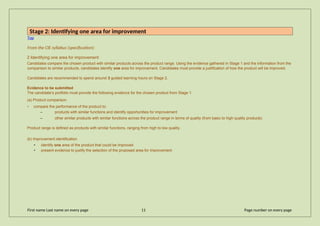
Stage 2: Identifying one area for improvement
Top
From the CIE syllabus (specification):
2 Identifying one area for improvement
Candidates compare the chosen product with similar products across the product range. Using the evidence gathered in Stage 1 and the information from the
comparison to similar products, candidates identify one area for improvement. Candidates must provide a justification of how the product will be improved.
Candidates are recommended to spend around 3 guided learning hours on Stage 2.
Evidence to be submitted
The candidate’s portfolio must provide the following evidence for the chosen product from Stage 1:
(a) Product comparison
• compare the performance of the product to:
– products with similar functions and identify opportunities for improvement
– other similar products with similar functions across the product range in terms of quality (from basic to high quality products)
Product range is defined as products with similar functions, ranging from high to low quality.
(b) Improvement identification
• identify one area of the product that could be improved
• present evidence to justify the selection of the proposed area for improvement
First name Last name on every page 11 Page number on every page
Stage 3: Clarifying the design situation or need and generating ideas
Top
(a) Design brief
• A design brief for one proposed improvement of a product.
• A concise design brief that accurately describes a design situation or need.
• The design brief can include sketches.
• The design brief and design specification are only for the area of improvement, not the entire product.
Example of a completed design brief
Design and make a child’s toy suitable for boys and girls aged 3 – 5 years to promote learning opportunities that can be used in the home safely without
the need for direct adult supervision
Design and make a [beginning of the sentence] child’s toy [product] suitable for boys and girls aged 3 – 5 years [users’ profile] to promote learning
opportunities [effect on their lives] that can be used in the home safely [environment] without the need for direct adult supervision [target market]
First name Last name on every page 12 Page number on every page
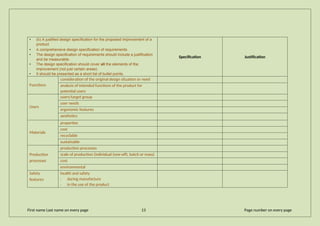
• (b) A justified design specification for the proposed improvement of a
product
• A comprehensive design specification of requirements
• The design specification of requirements should include a justification
and be measurable.
• The design specification should cover all the elements of the
improvement (not just certain areas).
• It should be presented as a short list of bullet points.
Specification Justification
Functions
consideration of the original design situation or need
analysis of intended functions of the product for
potential users
Users
users/target group
user needs
ergonomic features
aesthetics
Materials
properties
cost
recyclable
sustainable
Production
processes
production processes
scale of production (individual (one-off), batch or mass)
cost
environmental
Safety
features
health and safety
· during manufacture
· in the use of the product
First name Last name on every page 13 Page number on every page
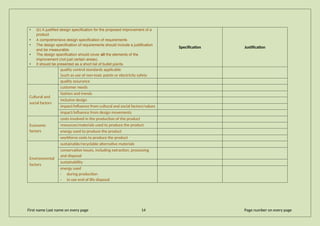
• (b) A justified design specification for the proposed improvement of a
product
• A comprehensive design specification of requirements
• The design specification of requirements should include a justification
and be measurable.
• The design specification should cover all the elements of the
improvement (not just certain areas).
• It should be presented as a short list of bullet points.
Specification Justification
quality control standards applicable
(such as use of non-toxic paints or electricity safety
quality assurance
Cultural and
social factors
customer needs
fashion and trends
inclusive design
impact/influence from cultural and social factors/values
impact/influence from design movements
Economic
factors
costs involved in the production of the product
resources/materials used to produce the product
energy used to produce the product
workforce costs to produce the product
Environmental
factors
sustainable/recyclable alternative materials
conservation issues, including extraction, processing
and disposal
sustainability
energy used
· during production
· in use end of life disposal
First name Last name on every page 14 Page number on every page
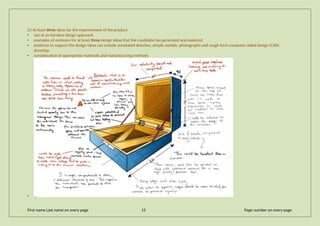
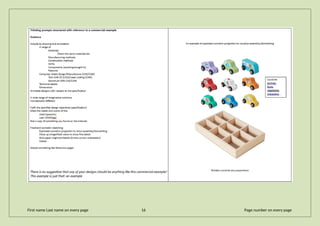
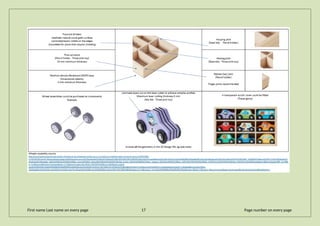
(c) At least three ideas for the improvement of the product
• use of an iterative design approach
• examples of evidence for at least three design ideas that the candidate has generated and explored
• evidence to support the design ideas can include annotated sketches, simple models, photographs and rough form computer-aided design (CAD)
drawings
• consideration of appropriate materials and manufacturing methods
•
First name Last name on every page 15 Page number on every page
First name Last name on every page 16 Page number on every page
First name Last name on every page 17 Page number on every page
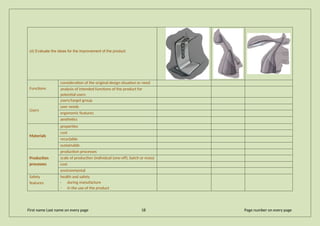
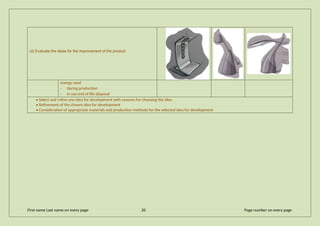
(d) Evaluate the ideas for the improvement of the product
Functions
consideration of the original design situation or need
analysis of intended functions of the product for
potential users
Users
users/target group
user needs
ergonomic features
aesthetics
Materials
properties
cost
recyclable
sustainable
Production
processes
production processes
scale of production (individual (one-off), batch or mass)
cost
environmental
Safety
features
health and safety
· during manufacture
· in the use of the product
First name Last name on every page 18 Page number on every page
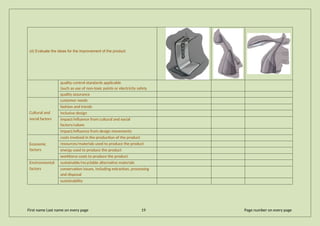
(d) Evaluate the ideas for the improvement of the product
quality control standards applicable
(such as use of non-toxic paints or electricity safety
quality assurance
Cultural and
social factors
customer needs
fashion and trends
inclusive design
impact/influence from cultural and social
factors/values
impact/influence from design movements
Economic
factors
costs involved in the production of the product
resources/materials used to produce the product
energy used to produce the product
workforce costs to produce the product
Environmental
factors
sustainable/recyclable alternative materials
conservation issues, including extraction, processing
and disposal
sustainability
First name Last name on every page 19 Page number on every page
(d) Evaluate the ideas for the improvement of the product
energy used
· during production
· in use end of life disposal
• Select and refine one idea for development with reasons for choosing the idea
• Refinement of the chosen idea for development
• Consideration of appropriate materials and production methods for the selected idea for development
First name Last name on every page 20 Page number on every page
Top
Annotate the use of materials, construction, components, surface finishes
First name Last name on every page 21 Page number on every page
Finger joints
M D F
Castors
Spray painting
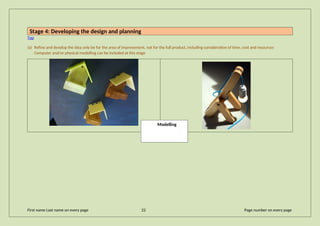
Stage 4: Developing the design and planning
Top
(a) Refine and develop the idea only be for the area of improvement, not for the full product, including consideration of time, cost and resources
Computer and/or physical modelling can be included at this stage
First name Last name on every page 22 Page number on every page
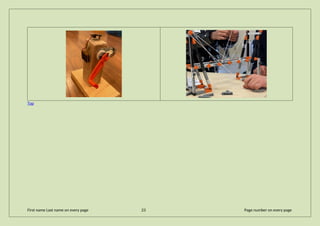
Modelling
Top
First name Last name on every page 23 Page number on every page
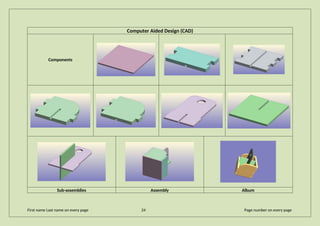
Computer Aided Design (CAD)
Components
Sub-assemblies Assembly Album
First name Last name on every page 24 Page number on every page
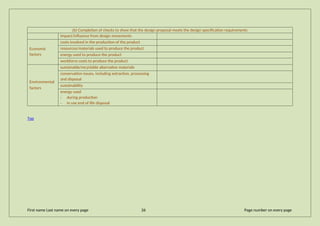
(b) Completion of checks to show that the design proposal meets the design specification requirements
Functions
consideration of the original design situation or need
analysis of intended functions of the product for
potential users
Users
users/target group
user needs
ergonomic features
aesthetics
Materials
properties
cost
recyclable
sustainable
Production
processes
production processes
scale of production (individual (one-off), batch or mass)
cost
environmental
Safety
features
health and safety
· during manufacture
· in the use of the product
quality control standards applicable
(such as use of non-toxic paints or electricity safety
quality assurance
Cultural and
social factors
customer needs
fashion and trends
inclusive design
impact/influence from cultural and social
factors/values
First name Last name on every page 25 Page number on every page
(b) Completion of checks to show that the design proposal meets the design specification requirements
impact/influence from design movements
Economic
factors
costs involved in the production of the product
resources/materials used to produce the product
energy used to produce the product
workforce costs to produce the product
Environmental
factors
sustainable/recyclable alternative materials
conservation issues, including extraction, processing
and disposal
sustainability
energy used
· during production
· in use end of life disposal
Top
First name Last name on every page 26 Page number on every page
First name Last name on every page 27 Page number on every page
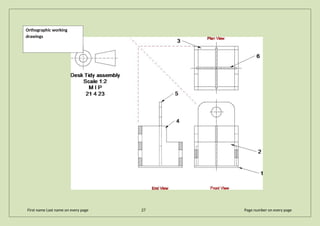
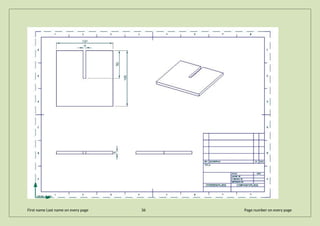
Orthographic working
drawings
Top
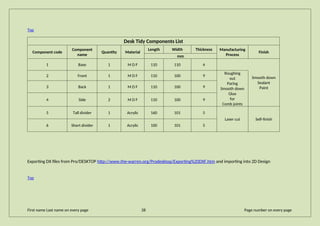
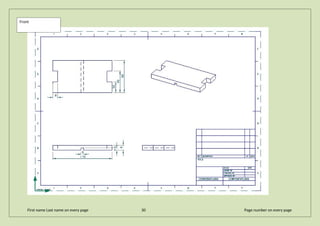
Desk Tidy Components List
Component code
Component
name
Quantity Material
Length Width Thickness Manufacturing
Process
Finish
mm
1 Base 1 M D F 110 110 4
Smooth down
Sealant
Paint
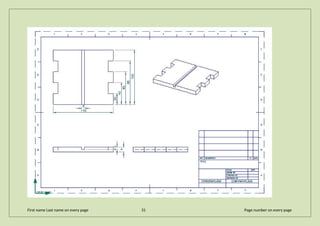
2 Front 1 M D F 110 100 9
Roughing
out
Paring
Smooth down
Glue
for
Comb joints
3 Back 1 M D F 110 100 9
4 Side 2 M D F 110 100 9
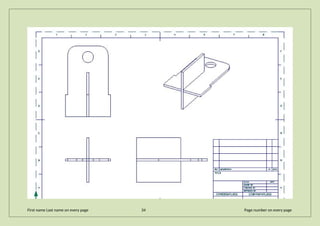
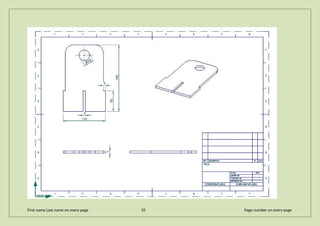
5 Tall divider 1 Acrylic 160 101 5
Laser cut Self-finish
6 Short divider 1 Acrylic 100 101 5
Exporting DX files from Pro/DESKTOP http://www.the-warren.org/Prodesktop/Exporting%20DXF.htm and importing into 2D Design
Top
First name Last name on every page 28 Page number on every page
First name Last name on every page 29 Page number on every page
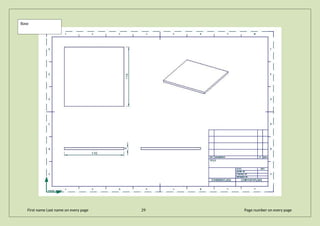
Base
First name Last name on every page 30 Page number on every page
Front
First name Last name on every page 31 Page number on every page
First name Last name on every page 32 Page number on every page
Left
First name Last name on every page 33 Page number on every page
First name Last name on every page 34 Page number on every page
First name Last name on every page 35 Page number on every page
First name Last name on every page 36 Page number on every page
Top
First name Last name on every page 37 Page number on every page
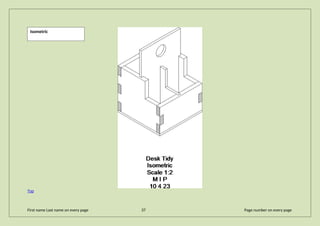
Isometric
First name Last name on every page 38 Page number on every page
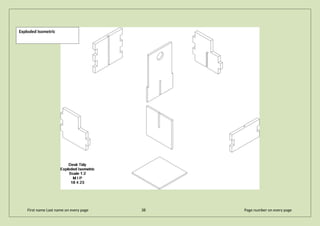
Exploded Isometric
(c) Cutting list Top
First name Last name on every page 39 Page number on every page
Cost materials using
Materials costing.xlsx
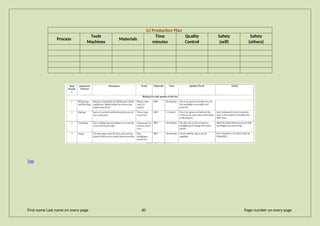
(c) Production Plan
Process
Tools
Machines
Materials
Time
minutes
Quality
Control
Safety
(self)
Safety
(others)
Top
First name Last name on every page 40 Page number on every page
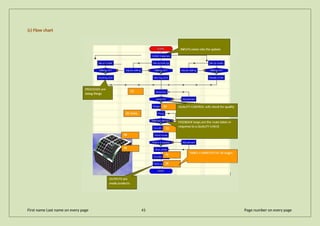
(c) Flow chart
First name Last name on every page 41 Page number on every page
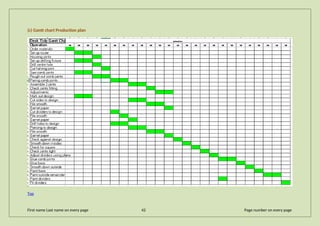
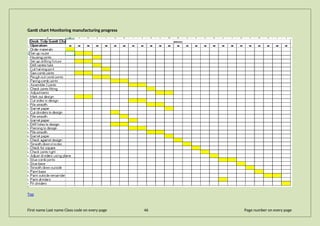
(c) Gantt chart Production plan
Top
First name Last name on every page 42 Page number on every page
Stage 5: Producing a prototype to demonstrate the improvement
Top
Health and Safety in the School Workshop
• Bags away
• No chairs
• Nothing around your neck
• Wear your cardigan fastened (sleeves rolled up) or place it in
your bag
• Apron fastened behind you with a bow (ask a friend to help)
• Substantial footwear
• Hair tied high
• No jewellery
• If you are wearing a plaster, bandage or surgical dressing, see
your teacher
• Wear safety spectacles with
o machines
o chemical and heat hazards
o when directed so to do
• Store tools in the middle of the bench
o Sharp end inwards – they are sharp; don’t touch!
• Clamp your work
o in the vice (low down) or
o to the bench or
o use a bench hook clamped to the bench
• Keep both hands behind the cutting edge
• Leave the vice slack when not in use
• Return tools to the correct locations
 Wash your hands before eating, drinking or visiting the toilet
 Keep your hands away from your face
Comply
or
Seek assistance
No exceptions
First name Last name on every page 43 Page number on every page
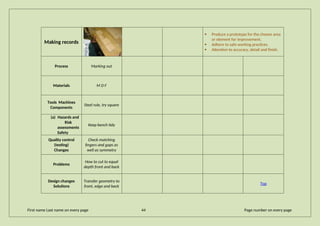
Making records
 Produce a prototype for the chosen area
or element for improvement.
 Adhere to safe working practices.
 Attention to accuracy, detail and finish.
Process Marking out
Materials M D F
Tools Machines
Components
Steel rule, try square
(a) Hazards and
Risk
assessments
Safety
Keep bench tidy
Quality control
(testing)
Changes
Check matching
fingers and gaps as
well as symmetry
Problems
How to cut to equal
depth front and back
Design changes
Solutions
Transfer geometry to
front, edge and back
Top
First name Last name on every page 44 Page number on every page
First name Last name Class code on every page 45 Page number on every page
Gantt chart Monitoring manufacturing progress
Top
First name Last name Class code on every page 46 Page number on every page
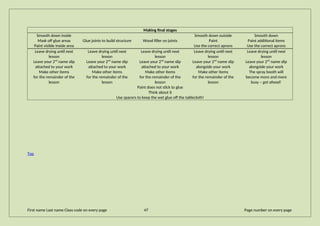
Making final stages
Smooth down inside
Mask off glue areas
Paint visible inside area
Glue joints to build structure Wood filler on joints
Smooth down outside
Paint
Use the correct aprons
Smooth down
Paint additional items
Use the correct aprons
Leave drying until next
lesson
Leave drying until next
lesson
Leave drying until next
lesson
Leave drying until next
lesson
Leave drying until next
lesson
Leave your 2nd
name slip
attached to your work
Leave your 2nd
name slip
attached to your work
Leave your 2nd
name slip
attached to your work
Leave your 2nd
name slip
alongside your work
Leave your 2nd
name slip
alongside your work
Make other items
for the remainder of the
lesson
Make other items
for the remainder of the
lesson
Make other items
for the remainder of the
lesson
Make other items
for the remainder of the
lesson
The spray booth will
become more and more
busy – get ahead!
Paint does not stick to glue
Think about it
Use spacers to keep the wet glue off the tablecloth!
Top
First name Last name Class code on every page 47 Page number on every page
Spray paint colour swatch
and A 243 white beige
First name Last name Class code on every page 48 Page number on every page
Top
First name Last name Class code on every page 49 Page number on every page
Stage 6: Testing and evaluating the improvement
Top
First name Last name Class code on every page 50 Page number on every page
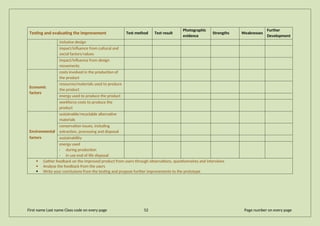
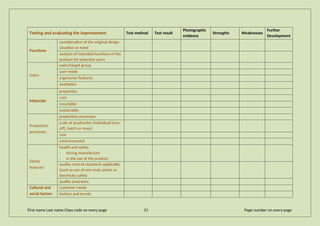
Testing and evaluating the improvement Test method Test result
Photographic
evidence
Strengths Weaknesses
Further
Development
Functions
consideration of the original design
situation or need
analysis of intended functions of the
product for potential users
Users
users/target group
user needs
ergonomic features
aesthetics
Materials
properties
cost
recyclable
sustainable
Production
processes
production processes
scale of production (individual (one-
off), batch or mass)
cost
environmental
Safety
features
health and safety
· during manufacture
· in the use of the product
quality control standards applicable
(such as use of non-toxic paints or
electricity safety
quality assurance
Cultural and
social factors
customer needs
fashion and trends
First name Last name Class code on every page 51 Page number on every page
Testing and evaluating the improvement Test method Test result
Photographic
evidence
Strengths Weaknesses
Further
Development
inclusive design
impact/influence from cultural and
social factors/values
impact/influence from design
movements
Economic
factors
costs involved in the production of
the product
resources/materials used to produce
the product
energy used to produce the product
workforce costs to produce the
product
Environmental
factors
sustainable/recyclable alternative
materials
conservation issues, including
extraction, processing and disposal
sustainability
energy used
· during production
· in use end of life disposal
 Gather feedback on the improved product from users through observations, questionnaires and interviews
 Analyse the feedback from the users
 Write your conclusions from the testing and propose further improvements to the prototype
First name Last name Class code on every page 52 Page number on every page
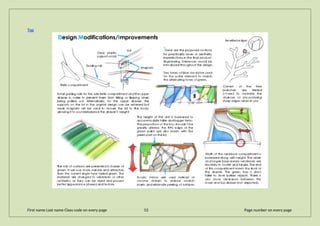
Top
First name Last name Class code on every page 53 Page number on every page
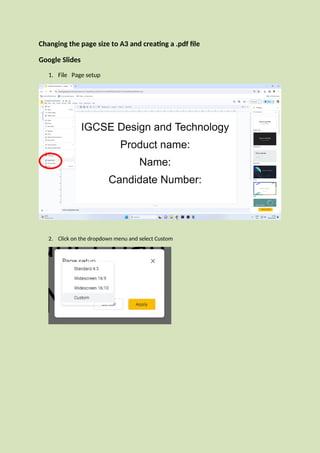
Changing the page size to A3 and creating a .pdf file
Google Slides
1. File Page setup
2. Click on the dropdown menu and select Custom
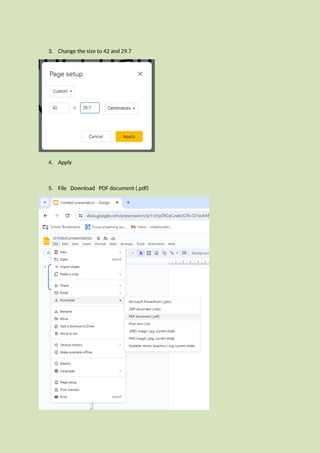
3. Change the size to 42 and 29.7
4. Apply
5. File Download PDF document (.pdf)
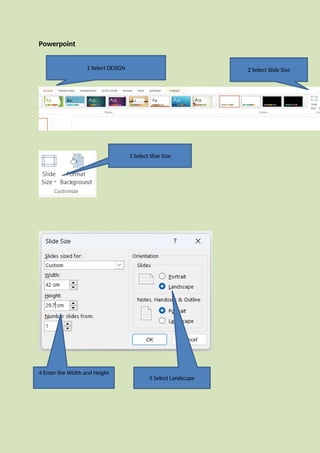
Powerpoint
1 Select DESIGN 2 Select Slide Size
3 Select Slize Size
4 Enter the Width and Height
5 Select Landscape
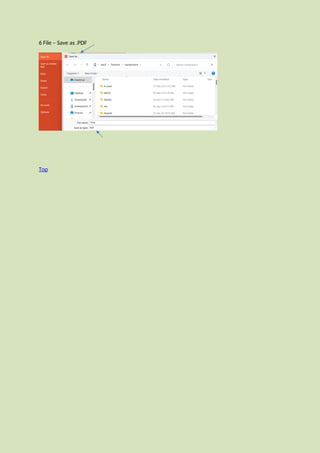
6 File – Save as .PDF
Top
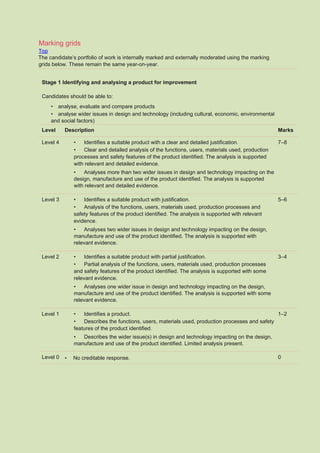
Marking grids
Top
The candidate’s portfolio of work is internally marked and externally moderated using the marking
grids below. These remain the same year-on-year.
Stage 1 Identifying and analysing a product for improvement
Candidates should be able to:
• analyse, evaluate and compare products
• analyse wider issues in design and technology (including cultural, economic, environmental
and social factors)
Level Description Marks
Level 4 • Identifies a suitable product with a clear and detailed justification.
• Clear and detailed analysis of the functions, users, materials used, production
processes and safety features of the product identified. The analysis is supported
with relevant and detailed evidence.
• Analyses more than two wider issues in design and technology impacting on the
design, manufacture and use of the product identified. The analysis is supported
with relevant and detailed evidence.
7–8
Level 3 • Identifies a suitable product with justification.
• Analysis of the functions, users, materials used, production processes and
safety features of the product identified. The analysis is supported with relevant
evidence.
• Analyses two wider issues in design and technology impacting on the design,
manufacture and use of the product identified. The analysis is supported with
relevant evidence.
5–6
Level 2 • Identifies a suitable product with partial justification.
• Partial analysis of the functions, users, materials used, production processes
and safety features of the product identified. The analysis is supported with some
relevant evidence.
• Analyses one wider issue in design and technology impacting on the design,
manufacture and use of the product identified. The analysis is supported with some
relevant evidence.
3–4
Level 1 • Identifies a product.
• Describes the functions, users, materials used, production processes and safety
features of the product identified.
• Describes the wider issue(s) in design and technology impacting on the design,
manufacture and use of the product identified. Limited analysis present.
1–2
Level 0 • No creditable response. 0
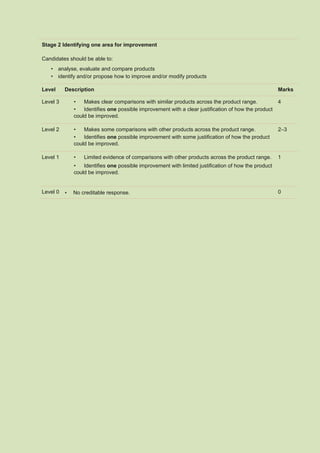
Stage 2 Identifying one area for improvement
Candidates should be able to:
• analyse, evaluate and compare products
• identify and/or propose how to improve and/or modify products
Level Description Marks
Level 3 • Makes clear comparisons with similar products across the product range.
• Identifies one possible improvement with a clear justification of how the product
could be improved.
4
Level 2 • Makes some comparisons with other products across the product range.
• Identifies one possible improvement with some justification of how the product
could be improved.
2–3
Level 1 • Limited evidence of comparisons with other products across the product range.
• Identifies one possible improvement with limited justification of how the product
could be improved.
1
Level 0 • No creditable response. 0
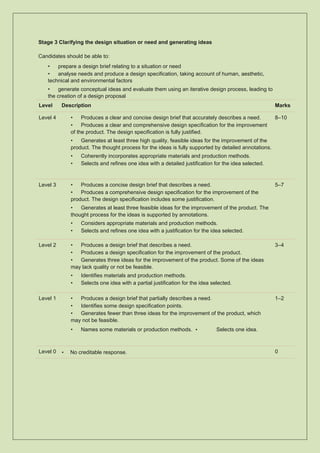
Stage 3 Clarifying the design situation or need and generating ideas
Candidates should be able to:
• prepare a design brief relating to a situation or need
• analyse needs and produce a design specification, taking account of human, aesthetic,
technical and environmental factors
• generate conceptual ideas and evaluate them using an iterative design process, leading to
the creation of a design proposal
Level Description Marks
Level 4 • Produces a clear and concise design brief that accurately describes a need.
• Produces a clear and comprehensive design specification for the improvement
of the product. The design specification is fully justified.
• Generates at least three high quality, feasible ideas for the improvement of the
product. The thought process for the ideas is fully supported by detailed annotations.
• Coherently incorporates appropriate materials and production methods.
• Selects and refines one idea with a detailed justification for the idea selected.
8–10
Level 3 • Produces a concise design brief that describes a need.
• Produces a comprehensive design specification for the improvement of the
product. The design specification includes some justification.
• Generates at least three feasible ideas for the improvement of the product. The
thought process for the ideas is supported by annotations.
• Considers appropriate materials and production methods.
• Selects and refines one idea with a justification for the idea selected.
5–7
Level 2 • Produces a design brief that describes a need.
• Produces a design specification for the improvement of the product.
• Generates three ideas for the improvement of the product. Some of the ideas
may lack quality or not be feasible.
• Identifies materials and production methods.
• Selects one idea with a partial justification for the idea selected.
3–4
Level 1 • Produces a design brief that partially describes a need.
• Identifies some design specification points.
• Generates fewer than three ideas for the improvement of the product, which
may not be feasible.
• Names some materials or production methods. • Selects one idea.
1–2
Level 0 • No creditable response. 0
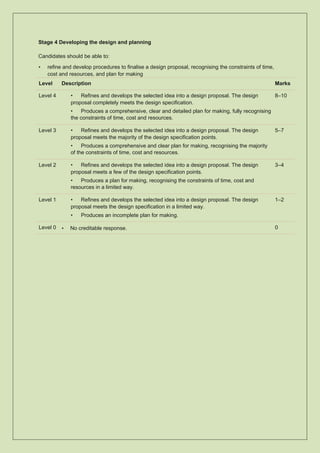
Stage 4 Developing the design and planning
Candidates should be able to:
• refine and develop procedures to finalise a design proposal, recognising the constraints of time,
cost and resources, and plan for making
Level Description Marks
Level 4 • Refines and develops the selected idea into a design proposal. The design
proposal completely meets the design specification.
• Produces a comprehensive, clear and detailed plan for making, fully recognising
the constraints of time, cost and resources.
8–10
Level 3 • Refines and develops the selected idea into a design proposal. The design
proposal meets the majority of the design specification points.
• Produces a comprehensive and clear plan for making, recognising the majority
of the constraints of time, cost and resources.
5–7
Level 2 • Refines and develops the selected idea into a design proposal. The design
proposal meets a few of the design specification points.
• Produces a plan for making, recognising the constraints of time, cost and
resources in a limited way.
3–4
Level 1 • Refines and develops the selected idea into a design proposal. The design
proposal meets the design specification in a limited way.
• Produces an incomplete plan for making.
1–2
Level 0 • No creditable response. 0
Stage 5 Producing a prototype to demonstrate the improvement
Candidates should be able to:
• realise a design proposal safely and demonstrate proficiency in a range of practical skills with
attention to fine detail
Level Description Marks
Level 4 • Produces a high quality prototype that addresses the design brief, fulfils all
points of the design specification and is fit for purpose.
• Demonstrates meticulous, consistently good attention to accuracy, detail and
finish.
• Consistently demonstrates proficient working practices within a wide range of
practical skills.
• Consistently demonstrates safe working practices.
8–10
Level 3 • Produces a good quality prototype that addresses the design brief, meets the
majority of points of the design specification and is fit for purpose.
• Demonstrates good attention to accuracy, detail and finish.
• Demonstrates proficient working practices within a range of practical skills. •
Demonstrates safe working practices.
5–7
Level 2 • Produces a prototype that partially addresses the design brief, meets some
points of the design specification and is largely fit for purpose.
• Demonstrates some attention to accuracy, detail and finish.
• Usually demonstrates proficient working practices within a range of practical
skills.
• Demonstrates safe working practices with some teacher supervision.
3–4
Level 1 • Produces a prototype that partially addresses the design brief and meets the
design specification in a limited way.
• Demonstrates limited attention to accuracy, detail and finish.
• Demonstrates limited proficient working practices within a limited range of
practical skills.
• Demonstrates safe working practices with significant teacher supervision.
1–2
Level 0 • No creditable response. 0
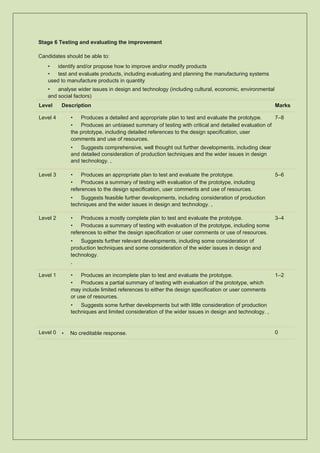
Stage 6 Testing and evaluating the improvement
Candidates should be able to:
• identify and/or propose how to improve and/or modify products
• test and evaluate products, including evaluating and planning the manufacturing systems
used to manufacture products in quantity
• analyse wider issues in design and technology (including cultural, economic, environmental
and social factors)
Level Description Marks
Level 4 • Produces a detailed and appropriate plan to test and evaluate the prototype.
• Produces an unbiased summary of testing with critical and detailed evaluation of
the prototype, including detailed references to the design specification, user
comments and use of resources.
• Suggests comprehensive, well thought out further developments, including clear
and detailed consideration of production techniques and the wider issues in design
and technology. ,
7–8
Level 3 • Produces an appropriate plan to test and evaluate the prototype.
• Produces a summary of testing with evaluation of the prototype, including
references to the design specification, user comments and use of resources.
• Suggests feasible further developments, including consideration of production
techniques and the wider issues in design and technology. ,
5–6
Level 2 • Produces a mostly complete plan to test and evaluate the prototype.
• Produces a summary of testing with evaluation of the prototype, including some
references to either the design specification or user comments or use of resources.
• Suggests further relevant developments, including some consideration of
production techniques and some consideration of the wider issues in design and
technology.
,
3–4
Level 1 • Produces an incomplete plan to test and evaluate the prototype.
• Produces a partial summary of testing with evaluation of the prototype, which
may include limited references to either the design specification or user comments
or use of resources.
• Suggests some further developments but with little consideration of production
techniques and limited consideration of the wider issues in design and technology. ,
1–2
Level 0 • No creditable response. 0
Component 2 Product analysis and improvement project Top
Coursework, 50 marks, internally assessed and externally moderated, approx. 45 hours
Overview
Candidates identify an existing product on which they will base their improvement project. Candidates
then create a coursework portfolio containing detailed research and analysis of the existing product
and how that product could be improved in terms of function, ergonomics, safety or sustainability.
They must identify a series of problems or opportunities for improvement through the analysis and
focus on one of these areas to improve the design of the product. This component has been designed
to be flexible so that candidates can choose an existing product that reflects the area of design and
technology that appeals to them.
Candidates have a choice of materials to make their improvement. For example, it could be made
from resistant materials such as wood, metal or plastics, or it could be made from paper, card, thin
sheet plastic or modelling materials, or it could bring in the use of systems and control technology
such as electronics where appropriate. Candidates can go beyond the materials listed in Topic 8
Materials and components.
Candidates select a single, named, specific product that they have some familiarity with.
Candidates are free to choose their own product to improve. However, they must ensure that the
chosen product has scope for the improvement project and that candidates will be able to fulfill the
requirements of the coursework improvement project.
Candidates should then design a suitable proposal for one improvement. The area or element chosen
for improvement will need to give enough scope for it to be redesigned to, for instance, improve the
design for product usage or lifespan or for it to be disposed of in a more sustainable way. Only
changing one element of the product such as the colour or the material it is made from is not sufficient
to fully meet the requirements of the project; there must be sufficient scope for it to be redesigned in a
substantive way.
The iterative design process should be clearly documented with annotated sketches, photographs or
screenshots. The model with its improvements should be constructed, tested and evaluated and the
construction, tests and evaluation should be recorded as part of the portfolio.
This is not a complete redesign of a product but an opportunity for the candidate to develop or
improve the product in some way.
Candidates need to submit their project in a portfolio format. This could include freehand sketches on
A3 paper as well as screenshots of computer-aided design (CAD) packages as evidence of the
design process.
Candidates are recommended to spend around 45 guided learning hours on their Component 2
Product analysis and improvement project. Guidance on the recommended time to be spent on each
stage is provided. Please note this is only guidance and there may be variations depending on the
chosen project.
The project is internally assessed and externally moderated.
Project stages and evidence to include in the portfolio
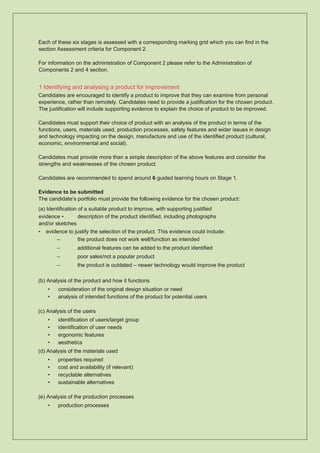
The Component 2 project is divided into six stages.
Each of these six stages is assessed with a corresponding marking grid which you can find in the
section Assessment criteria for Component 2.
For information on the administration of Component 2 please refer to the Administration of
Components 2 and 4 section.
1 Identifying and analysing a product for improvement
Candidates are encouraged to identify a product to improve that they can examine from personal
experience, rather than remotely. Candidates need to provide a justification for the chosen product.
The justification will include supporting evidence to explain the choice of product to be improved.
Candidates must support their choice of product with an analysis of the product in terms of the
functions, users, materials used, production processes, safety features and wider issues in design
and technology impacting on the design, manufacture and use of the identified product (cultural,
economic, environmental and social).
Candidates must provide more than a simple description of the above features and consider the
strengths and weaknesses of the chosen product.
Candidates are recommended to spend around 6 guided learning hours on Stage 1.
Evidence to be submitted
The candidate’s portfolio must provide the following evidence for the chosen product:
(a) Identification of a suitable product to improve, with supporting justified
evidence • description of the product identified, including photographs
and/or sketches
• evidence to justify the selection of the product. This evidence could include:
– the product does not work well/function as intended
– additional features can be added to the product identified
– poor sales/not a popular product
– the product is outdated – newer technology would improve the product
(b) Analysis of the product and how it functions
• consideration of the original design situation or need
• analysis of intended functions of the product for potential users
(c) Analysis of the users
• identification of users/target group
• identification of user needs
• ergonomic features
• aesthetics
(d) Analysis of the materials used
• properties required
• cost and availability (if relevant)
• recyclable alternatives
• sustainable alternatives
(e) Analysis of the production processes
• production processes
• scale of production (individual (one-off), batch or mass)
• cost considerations
• environmental considerations
(f) Analysis of the safety features
• health and safety considerations, both during manufacture and in the use of the product
• quality control standards applicable (such as use of non-toxic paints or electricity safety) and
quality assurance
(g) Analysis of the cultural and social factors
• variations to the product to meet different customer needs
• fashion and trends
• inclusive design
• impact/influence from cultural and social factors/values
• impact/influence from design movements
(h) Analysis of the economic factors
• costs involved in the production of the product
• resources/materials used to produce the product
• energy used to produce the product
• workforce costs to produce the product
(i) Analysis of the environmental factors
• sustainable/recyclable alternative materials
• conservation issues, including extraction, processing and disposal
• sustainability
• energy used during production and in use
• end of life disposal implications
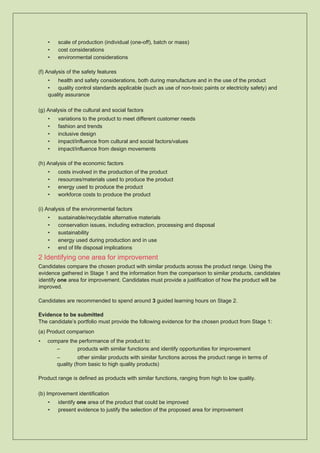
2 Identifying one area for improvement
Candidates compare the chosen product with similar products across the product range. Using the
evidence gathered in Stage 1 and the information from the comparison to similar products, candidates
identify one area for improvement. Candidates must provide a justification of how the product will be
improved.
Candidates are recommended to spend around 3 guided learning hours on Stage 2.
Evidence to be submitted
The candidate’s portfolio must provide the following evidence for the chosen product from Stage 1:
(a) Product comparison
• compare the performance of the product to:
– products with similar functions and identify opportunities for improvement
– other similar products with similar functions across the product range in terms of
quality (from basic to high quality products)
Product range is defined as products with similar functions, ranging from high to low quality.
(b) Improvement identification
• identify one area of the product that could be improved
• present evidence to justify the selection of the proposed area for improvement
3 Clarifying the design situation or need and generating ideas
Once candidates have identified the area for improvement, they complete a design brief and a design
specification for the improvement. The design brief and design specification are only for the area of
improvement, not the entire product.
Candidates generate at least three ideas for the improvement using an iterative design process. They
evaluate the ideas before selecting one idea for development.
Candidates are recommended to spend around 10 guided learning hours on Stage 3.
Evidence to be submitted
The candidate’s portfolio must provide the following evidence for the chosen improvement:
(a) A design brief for one proposed improvement of a product
• a concise design brief that accurately describes a design
situation or need The design brief can include sketches.
(b) A justified design specification for the proposed improvement of a product
• a comprehensive design specification of requirements
The design specification of requirements should include a justification and be measurable.
The design specification should cover all the elements of the improvement (not just certain areas). It
should be presented as a short list of bullet points.
(c) At least three ideas for the improvement of the product
• use of an iterative design approach
• examples of evidence for at least three design ideas that the candidate has generated and
explored
• evidence to support the design ideas can include annotated sketches, simple models,
photographs and computer-aided design (CAD) drawings
• consideration of appropriate materials and manufacturing methods
We recommend that candidates include at least three ideas for the improvement of the product.
Candidates can submit more than three ideas but they should focus on the quality of the ideas rather
than the quantity.
The sketches or CAD models to show the candidates’ ideas can be in rough form. They are used to
support the candidates’ thought process.
(d) Evaluate the ideas for the improvement of the product and select and refine one idea for
development
• evaluation of at least three ideas against the design specification
• selection of one idea for development with reasons for choosing the idea
• refinement of the chosen idea for development
• consideration of appropriate materials and production methods for the selected idea for
development
4 Developing the design and planning
Candidates further refine and develop the idea they have chosen in Stage 3 to create a design
proposal. The design proposal must meet the design specification requirements outlined in Stage 3.
Candidates plan the making of the prototype for the improvement. The prototype will only be for the
area of improvement, not for the full product.
Candidates are recommended to spend around 10 guided learning hours on Stage 4.
Evidence to be submitted
The candidate’s portfolio must provide the following evidence for the chosen idea:
(a) Refine and develop a design idea into a design proposal
• refine and develop the idea chosen in Stage 3, including consideration of time, cost and
resources, into a design proposal. Computer and/or physical modelling can be included at this
stage
The working drawings can be accurately hand-drawn and/or screenshots from drawings produced
using CAD software programs.
The working drawings should contain sufficient detail for a skilled person to make the design proposal.
(b) Completion of checks to show that the design proposal meets the design specification
requirements
• a record of checks to show that the design proposal meets the design specification created in Stage
3
(c) Clear and comprehensive plan for making a prototype to demonstrate an improvement to a product
• working drawings, to a suitable scale, for the making of a prototype of the design proposal
• materials or cutting lists to show the resources needed to make the prototype
• a plan for making the prototype for the proposed improvement (this could include scheduling
tools such as flowcharts or Gantt charts)
• a plan for making the prototype for the improvement that fully recognises the constraints of
time, cost and resources
Candidates plan how they are going to make the improvement by producing a prototype. A prototype
is a functional model built to test an idea.
A clear and comprehensive plan for making a prototype is one that provides sufficient detail for a
skilled person to make the prototype.
5 Producing a prototype to demonstrate the improvement
Candidates produce a prototype for the chosen area or element for improvement. The prototype will
only be for the improvement, not for the full product. Candidates need to demonstrate that they
adhere to safe working practices.
Candidates need to show good attention to accuracy, detail and finish.
Candidates need to physically make the improvement by producing the prototype they have planned
in Stage 4.
Candidates are recommended to spend around 10 guided learning hours on Stage 5.
Evidence to be submitted
The candidate’s portfolio must provide the following evidence in the making of their chosen idea:
(a) Record the stages in the making process
• photographs of each stage in the making process, with annotations that briefly explain the
processes
• evidence of the practical skills accomplished in the making of the prototype. This could
include photographs of the candidate while completing a range of skills safely and/or a skill record
sheet with a teacher/supervisor signature
(b) Show evidence of consideration of safe working practices during the making process
• notes and high resolution photographs that refer to consideration of safe working practices
during the making process
• a teacher’s sign-off sheet to show observations made of the candidate performing safe
working practices during the making of the prototype
(c) Present evidence to show they have monitored progress during making
• evidence of monitoring of progress in making against the plan for making the prototype for the
improvement produced in Stage 4, with variations explained
• evidence of checking during the making that the improvement meets the design brief and
design specification produced in Stage 3
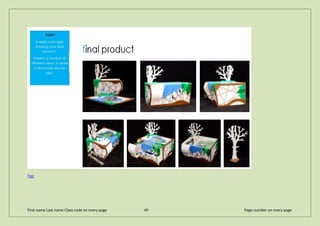
(d) Present high resolution photographs of the prototype
• a series of high resolution photographs showing the completed prototype from all angles with
close-ups of all its features. The photographs must be clear and of good quality
6 Testing and evaluating the improvement
Candidates produce a plan for testing the improvement they made in Stage 5. Once the plan is
complete, they test the functionality of the prototype and complete an evaluation against their design
specification. They evaluate the effective and appropriate use of resources and consider the wider
issues in design and technology (cultural, economic, environmental and social factors).
Candidates must gather feedback on the improved product from users through observations,
questionnaires and interviews.
Once the results from testing and evaluating the prototype and the feedback from the users have
been analysed, candidates write their conclusions from the testing and propose further improvements
to the prototype.
Candidates are recommended to spend around 6 guided learning hours on Stage 6.
Evidence to be submitted
The candidate’s portfolio must provide the following evidence of testing and evaluating their chosen
idea:
(a) Produce a plan for testing and evaluating the prototype
• a detailed plan to test and evaluate the prototype produced at Stage 5
(b) Test and evaluate the prototype
• a test of the functionality of the prototype
• an evaluation of the prototype produced in Stage 5 against the design specification created in
Stage 3
• a summary of the comments from users. Feedback could be gathered through observations,
questionnaires and/or interviews. The summary of feedback should be unbiased, objective and
balanced, including any areas for improvement or further investigation as well as positive
comments
• an evaluation of the effective and appropriate use of resources
• a summary of the findings from the testing, with conclusions of the tests performed and
information on what those tests show about the prototype
(c) Produce proposals for the further development of the prototype
• use the results of the testing and evaluation to propose how to further develop the prototype
• include consideration of production techniques and cultural, economic, environmental and
social factors in the suggestions for further improvements
Top

Folio guidance NEA AS----level 9705.docx

  • 1.
    ABCIS CIE 9705AS Level Design and Technology (2025 6 7) Non Examined Assessment (NEA) (Coursework) Folio guidance Stage Mark scheme Marks ig Initial guidance 1 Identifying and analysing a product for improvement 8 2 Identifying one area for improvement 4 3 Clarifying the design situation or need and generating ideas 10 4 Developing the design and planning 10 5 Producing a prototype to demonstrate the improvement 10 6 Testing and evaluating the improvement 8 CIE guidance Extracts from the CIE syllabus in brown type Total 50 This guidance document is just that: guidance Make your folio style, layout and sequencing unique to you First name Last name on every page 1 Page number on every page Page border improves presentation
  • 2.
    Italicised notes areteacher guidance Font size 11 minimum 14 maximum Test print your A3 pages for formatting Key Stage 4 and 5 students are advised to use Powerpoint or Word for faster processing Ensure robust back up of your files Resources Reference all sources Technology Student web site https://www.technologystudent.com/ Packaging Designer http://wiki.dtonline.org/index.php/Category:Packaging_Designer ACCESS FM https://www.slideshare.net/DTGeek/how2-access-fm Focus Educational https://www.focuselearning.co.uk/u/36309/wyduptmBshCCaaEteAdtFFDleCgqscCko Username: student@theabi36309 Password: vyyidkwoh https://www.focuselearning.co.uk/u/36309/wyduptmBshCCaaEteAdtFFDleCgqscCko General website links https://www.technologystudent.com/ http://wiki.dtonline.org/index.php/Main_Page Packaging Designer http://wiki.dtonline.org/index.php/Category:Packaging_Designer https://design-technology.org/ http://www.design-technology.info/ https://www.ruthtrumpold.id.au/destech/ http://www.the-warren.org/Gcselinks.html Pro/DESKTOP CAD software Can and should be installed on school student lap tops Tutorial https://www.the-warren.org/ Click on 1st bullet point Pro/DESKTOP First name Last name on every page 2 Page number on every page
  • 3.
    MAC computer lockCTRL + CMD + Q PC Computer lock First name Last name on every page 3 Page number on every page
  • 4.
    Initial guidance Top Get goodat Product Analysis:  Focus Product Analysis https://www.focuselearning.co.uk/programmes/?programme=product-analysis&page=introduction o Staple remover o 3 in 1 Light First name Last name on every page 4 Page number on every page
  • 5.
    First name Lastname on every page 5 Page number on every page
  • 6.
    Product Dismantling (Disassembly) Nothing expensive orvaluable It won’t matter if it doesn’t go back together again! Only with the owner’s permission Conclusions What have you learnt from this product dismantling? How will you use the design features identified to inform your own designing? First name Last name on every page 6 Page number on every page Mixed components and materials Components fit together concentrically Removable vessel Mechanism
  • 7.
    e mail dialoguewith the CIE Assessment manager 8 March 2024 For the AS Level Component 2 Product analysis and improvement project, do CIE have any examples/exemplars please? We will not be in a position to publish a Coursework Handbook until after we have some exemplar coursework, which may take until 2026. This project is completely different to the more typical Design and Technology designing and making coursework projects and I have no idea of what the expectations might be. This is a Product Study component/project. The project is designed to build on candidates’ experiences at IGCSE. Candidates will be familiar with many of the elements, such as research, specification, generation of ideas…, even though these are presented in a different context. Does the product analysed have to be commercial? Could it be something that the candidate has made him/herself during a previous academic year? I was thinking that the candidate could analyse his/her GCSE coursework project. The syllabus states an existing product. However, the GCSE product may not provide the opportunity to access the full range of marks, as stated in the marking grids. The syllabus includes detailed guidance on what is required in each section of the project and marking grids. Centres should use this information in their planning. Examples include, when identifying a product for improvement, candidates must provide evidence for the chosen product including poor sales/not a popular product and whether the product is outdated – newer technology would improve the product. First name Last name on every page 7 Page number on every page
  • 8.
    Stage 1: Identifyingand analysing a product for improvement Top From the CIE syllabus (specification): 1 Identifying and analysing a product for improvement Candidates are encouraged to identify a product to improve that they can examine from personal experience, rather than remotely. Candidates need to provide a justification for the chosen product. The justification will include supporting evidence to explain the choice of product to be improved. Candidates must support their choice of product with an analysis of the product in terms of the functions, users, materials used, production processes, safety features and wider issues in design and technology impacting on the design, manufacture and use of the identified product (cultural, economic, environmental and social). Candidates must provide more than a simple description of the above features and consider the strengths and weaknesses of the chosen product. Candidates are recommended to spend around 6 guided learning hours on Stage 1. Evidence to be submitted The candidate’s portfolio must provide the following evidence for the chosen product: (a) Identification of a suitable product to improve, with supporting justified evidence • description of the product identified, including photographs and/or sketches • evidence to justify the selection of the product. This evidence could include: – the product does not work well/function as intended – additional features can be added to the product identified – poor sales/not a popular product – the product is outdated – newer technology would improve the product (b) Analysis of the product and how it functions • consideration of the original design situation or need • analysis of intended functions of the product for potential users First name Last name on every page 8 Page number on every page
  • 9.
    (c) Analysis ofthe users • identification of users/target group • identification of user needs • ergonomic features • aesthetics (d) Analysis of the materials used • properties required • cost and availability (if relevant) • recyclable alternatives • sustainable alternatives (e) Analysis of the production processes • production processes • scale of production (individual (one-off), batch or mass) • cost considerations • environmental considerations (f) Analysis of the safety features • health and safety considerations, both during manufacture and in the use of the product • quality control standards applicable (such as use of non-toxic paints or electricity safety) and quality assurance (g) Analysis of the cultural and social factors • variations to the product to meet different customer needs • fashion and trends • inclusive design • impact/influence from cultural and social factors/values • impact/influence from design movements (h) Analysis of the economic factors • costs involved in the production of the product • resources/materials used to produce the product First name Last name on every page 9 Page number on every page
  • 10.
    • energy usedto produce the product • workforce costs to produce the product (i) Analysis of the environmental factors • sustainable/recyclable alternative materials • conservation issues, including extraction, processing and disposal • sustainability • energy used during production and in use • end of life disposal implications First name Last name on every page 10 Page number on every page
  • 11.
    Stage 2: Identifyingone area for improvement Top From the CIE syllabus (specification): 2 Identifying one area for improvement Candidates compare the chosen product with similar products across the product range. Using the evidence gathered in Stage 1 and the information from the comparison to similar products, candidates identify one area for improvement. Candidates must provide a justification of how the product will be improved. Candidates are recommended to spend around 3 guided learning hours on Stage 2. Evidence to be submitted The candidate’s portfolio must provide the following evidence for the chosen product from Stage 1: (a) Product comparison • compare the performance of the product to: – products with similar functions and identify opportunities for improvement – other similar products with similar functions across the product range in terms of quality (from basic to high quality products) Product range is defined as products with similar functions, ranging from high to low quality. (b) Improvement identification • identify one area of the product that could be improved • present evidence to justify the selection of the proposed area for improvement First name Last name on every page 11 Page number on every page
  • 12.
    Stage 3: Clarifyingthe design situation or need and generating ideas Top (a) Design brief • A design brief for one proposed improvement of a product. • A concise design brief that accurately describes a design situation or need. • The design brief can include sketches. • The design brief and design specification are only for the area of improvement, not the entire product. Example of a completed design brief Design and make a child’s toy suitable for boys and girls aged 3 – 5 years to promote learning opportunities that can be used in the home safely without the need for direct adult supervision Design and make a [beginning of the sentence] child’s toy [product] suitable for boys and girls aged 3 – 5 years [users’ profile] to promote learning opportunities [effect on their lives] that can be used in the home safely [environment] without the need for direct adult supervision [target market] First name Last name on every page 12 Page number on every page
  • 13.
    • (b) Ajustified design specification for the proposed improvement of a product • A comprehensive design specification of requirements • The design specification of requirements should include a justification and be measurable. • The design specification should cover all the elements of the improvement (not just certain areas). • It should be presented as a short list of bullet points. Specification Justification Functions consideration of the original design situation or need analysis of intended functions of the product for potential users Users users/target group user needs ergonomic features aesthetics Materials properties cost recyclable sustainable Production processes production processes scale of production (individual (one-off), batch or mass) cost environmental Safety features health and safety · during manufacture · in the use of the product First name Last name on every page 13 Page number on every page
  • 14.
    • (b) Ajustified design specification for the proposed improvement of a product • A comprehensive design specification of requirements • The design specification of requirements should include a justification and be measurable. • The design specification should cover all the elements of the improvement (not just certain areas). • It should be presented as a short list of bullet points. Specification Justification quality control standards applicable (such as use of non-toxic paints or electricity safety quality assurance Cultural and social factors customer needs fashion and trends inclusive design impact/influence from cultural and social factors/values impact/influence from design movements Economic factors costs involved in the production of the product resources/materials used to produce the product energy used to produce the product workforce costs to produce the product Environmental factors sustainable/recyclable alternative materials conservation issues, including extraction, processing and disposal sustainability energy used · during production · in use end of life disposal First name Last name on every page 14 Page number on every page
  • 15.
    (c) At leastthree ideas for the improvement of the product • use of an iterative design approach • examples of evidence for at least three design ideas that the candidate has generated and explored • evidence to support the design ideas can include annotated sketches, simple models, photographs and rough form computer-aided design (CAD) drawings • consideration of appropriate materials and manufacturing methods • First name Last name on every page 15 Page number on every page
  • 16.
    First name Lastname on every page 16 Page number on every page
  • 17.
    First name Lastname on every page 17 Page number on every page
  • 18.
    (d) Evaluate theideas for the improvement of the product Functions consideration of the original design situation or need analysis of intended functions of the product for potential users Users users/target group user needs ergonomic features aesthetics Materials properties cost recyclable sustainable Production processes production processes scale of production (individual (one-off), batch or mass) cost environmental Safety features health and safety · during manufacture · in the use of the product First name Last name on every page 18 Page number on every page
  • 19.
    (d) Evaluate theideas for the improvement of the product quality control standards applicable (such as use of non-toxic paints or electricity safety quality assurance Cultural and social factors customer needs fashion and trends inclusive design impact/influence from cultural and social factors/values impact/influence from design movements Economic factors costs involved in the production of the product resources/materials used to produce the product energy used to produce the product workforce costs to produce the product Environmental factors sustainable/recyclable alternative materials conservation issues, including extraction, processing and disposal sustainability First name Last name on every page 19 Page number on every page
  • 20.
    (d) Evaluate theideas for the improvement of the product energy used · during production · in use end of life disposal • Select and refine one idea for development with reasons for choosing the idea • Refinement of the chosen idea for development • Consideration of appropriate materials and production methods for the selected idea for development First name Last name on every page 20 Page number on every page
  • 21.
    Top Annotate the useof materials, construction, components, surface finishes First name Last name on every page 21 Page number on every page Finger joints M D F Castors Spray painting
  • 22.
    Stage 4: Developingthe design and planning Top (a) Refine and develop the idea only be for the area of improvement, not for the full product, including consideration of time, cost and resources Computer and/or physical modelling can be included at this stage First name Last name on every page 22 Page number on every page Modelling
  • 23.
    Top First name Lastname on every page 23 Page number on every page
  • 24.
    Computer Aided Design(CAD) Components Sub-assemblies Assembly Album First name Last name on every page 24 Page number on every page
  • 25.
    (b) Completion ofchecks to show that the design proposal meets the design specification requirements Functions consideration of the original design situation or need analysis of intended functions of the product for potential users Users users/target group user needs ergonomic features aesthetics Materials properties cost recyclable sustainable Production processes production processes scale of production (individual (one-off), batch or mass) cost environmental Safety features health and safety · during manufacture · in the use of the product quality control standards applicable (such as use of non-toxic paints or electricity safety quality assurance Cultural and social factors customer needs fashion and trends inclusive design impact/influence from cultural and social factors/values First name Last name on every page 25 Page number on every page
  • 26.
    (b) Completion ofchecks to show that the design proposal meets the design specification requirements impact/influence from design movements Economic factors costs involved in the production of the product resources/materials used to produce the product energy used to produce the product workforce costs to produce the product Environmental factors sustainable/recyclable alternative materials conservation issues, including extraction, processing and disposal sustainability energy used · during production · in use end of life disposal Top First name Last name on every page 26 Page number on every page
  • 27.
    First name Lastname on every page 27 Page number on every page Orthographic working drawings
  • 28.
    Top Desk Tidy ComponentsList Component code Component name Quantity Material Length Width Thickness Manufacturing Process Finish mm 1 Base 1 M D F 110 110 4 Smooth down Sealant Paint 2 Front 1 M D F 110 100 9 Roughing out Paring Smooth down Glue for Comb joints 3 Back 1 M D F 110 100 9 4 Side 2 M D F 110 100 9 5 Tall divider 1 Acrylic 160 101 5 Laser cut Self-finish 6 Short divider 1 Acrylic 100 101 5 Exporting DX files from Pro/DESKTOP http://www.the-warren.org/Prodesktop/Exporting%20DXF.htm and importing into 2D Design Top First name Last name on every page 28 Page number on every page
  • 29.
    First name Lastname on every page 29 Page number on every page Base
  • 30.
    First name Lastname on every page 30 Page number on every page Front
  • 31.
    First name Lastname on every page 31 Page number on every page
  • 32.
    First name Lastname on every page 32 Page number on every page Left
  • 33.
    First name Lastname on every page 33 Page number on every page
  • 34.
    First name Lastname on every page 34 Page number on every page
  • 35.
    First name Lastname on every page 35 Page number on every page
  • 36.
    First name Lastname on every page 36 Page number on every page
  • 37.
    Top First name Lastname on every page 37 Page number on every page Isometric
  • 38.
    First name Lastname on every page 38 Page number on every page Exploded Isometric
  • 39.
    (c) Cutting listTop First name Last name on every page 39 Page number on every page Cost materials using Materials costing.xlsx
  • 40.
  • 41.
    (c) Flow chart Firstname Last name on every page 41 Page number on every page
  • 42.
    (c) Gantt chartProduction plan Top First name Last name on every page 42 Page number on every page
  • 43.
    Stage 5: Producinga prototype to demonstrate the improvement Top Health and Safety in the School Workshop • Bags away • No chairs • Nothing around your neck • Wear your cardigan fastened (sleeves rolled up) or place it in your bag • Apron fastened behind you with a bow (ask a friend to help) • Substantial footwear • Hair tied high • No jewellery • If you are wearing a plaster, bandage or surgical dressing, see your teacher • Wear safety spectacles with o machines o chemical and heat hazards o when directed so to do • Store tools in the middle of the bench o Sharp end inwards – they are sharp; don’t touch! • Clamp your work o in the vice (low down) or o to the bench or o use a bench hook clamped to the bench • Keep both hands behind the cutting edge • Leave the vice slack when not in use • Return tools to the correct locations  Wash your hands before eating, drinking or visiting the toilet  Keep your hands away from your face Comply or Seek assistance No exceptions First name Last name on every page 43 Page number on every page
  • 44.
    Making records  Producea prototype for the chosen area or element for improvement.  Adhere to safe working practices.  Attention to accuracy, detail and finish. Process Marking out Materials M D F Tools Machines Components Steel rule, try square (a) Hazards and Risk assessments Safety Keep bench tidy Quality control (testing) Changes Check matching fingers and gaps as well as symmetry Problems How to cut to equal depth front and back Design changes Solutions Transfer geometry to front, edge and back Top First name Last name on every page 44 Page number on every page
  • 45.
    First name Lastname Class code on every page 45 Page number on every page
  • 46.
    Gantt chart Monitoringmanufacturing progress Top First name Last name Class code on every page 46 Page number on every page
  • 47.
    Making final stages Smoothdown inside Mask off glue areas Paint visible inside area Glue joints to build structure Wood filler on joints Smooth down outside Paint Use the correct aprons Smooth down Paint additional items Use the correct aprons Leave drying until next lesson Leave drying until next lesson Leave drying until next lesson Leave drying until next lesson Leave drying until next lesson Leave your 2nd name slip attached to your work Leave your 2nd name slip attached to your work Leave your 2nd name slip attached to your work Leave your 2nd name slip alongside your work Leave your 2nd name slip alongside your work Make other items for the remainder of the lesson Make other items for the remainder of the lesson Make other items for the remainder of the lesson Make other items for the remainder of the lesson The spray booth will become more and more busy – get ahead! Paint does not stick to glue Think about it Use spacers to keep the wet glue off the tablecloth! Top First name Last name Class code on every page 47 Page number on every page
  • 48.
    Spray paint colourswatch and A 243 white beige First name Last name Class code on every page 48 Page number on every page
  • 49.
    Top First name Lastname Class code on every page 49 Page number on every page
  • 50.
    Stage 6: Testingand evaluating the improvement Top First name Last name Class code on every page 50 Page number on every page
  • 51.
    Testing and evaluatingthe improvement Test method Test result Photographic evidence Strengths Weaknesses Further Development Functions consideration of the original design situation or need analysis of intended functions of the product for potential users Users users/target group user needs ergonomic features aesthetics Materials properties cost recyclable sustainable Production processes production processes scale of production (individual (one- off), batch or mass) cost environmental Safety features health and safety · during manufacture · in the use of the product quality control standards applicable (such as use of non-toxic paints or electricity safety quality assurance Cultural and social factors customer needs fashion and trends First name Last name Class code on every page 51 Page number on every page
  • 52.
    Testing and evaluatingthe improvement Test method Test result Photographic evidence Strengths Weaknesses Further Development inclusive design impact/influence from cultural and social factors/values impact/influence from design movements Economic factors costs involved in the production of the product resources/materials used to produce the product energy used to produce the product workforce costs to produce the product Environmental factors sustainable/recyclable alternative materials conservation issues, including extraction, processing and disposal sustainability energy used · during production · in use end of life disposal  Gather feedback on the improved product from users through observations, questionnaires and interviews  Analyse the feedback from the users  Write your conclusions from the testing and propose further improvements to the prototype First name Last name Class code on every page 52 Page number on every page
  • 53.
    Top First name Lastname Class code on every page 53 Page number on every page
  • 54.
    Changing the pagesize to A3 and creating a .pdf file Google Slides 1. File Page setup 2. Click on the dropdown menu and select Custom
  • 55.
    3. Change thesize to 42 and 29.7 4. Apply 5. File Download PDF document (.pdf)
  • 56.
    Powerpoint 1 Select DESIGN2 Select Slide Size 3 Select Slize Size 4 Enter the Width and Height 5 Select Landscape
  • 57.
    6 File –Save as .PDF Top
  • 58.
    Marking grids Top The candidate’sportfolio of work is internally marked and externally moderated using the marking grids below. These remain the same year-on-year. Stage 1 Identifying and analysing a product for improvement Candidates should be able to: • analyse, evaluate and compare products • analyse wider issues in design and technology (including cultural, economic, environmental and social factors) Level Description Marks Level 4 • Identifies a suitable product with a clear and detailed justification. • Clear and detailed analysis of the functions, users, materials used, production processes and safety features of the product identified. The analysis is supported with relevant and detailed evidence. • Analyses more than two wider issues in design and technology impacting on the design, manufacture and use of the product identified. The analysis is supported with relevant and detailed evidence. 7–8 Level 3 • Identifies a suitable product with justification. • Analysis of the functions, users, materials used, production processes and safety features of the product identified. The analysis is supported with relevant evidence. • Analyses two wider issues in design and technology impacting on the design, manufacture and use of the product identified. The analysis is supported with relevant evidence. 5–6 Level 2 • Identifies a suitable product with partial justification. • Partial analysis of the functions, users, materials used, production processes and safety features of the product identified. The analysis is supported with some relevant evidence. • Analyses one wider issue in design and technology impacting on the design, manufacture and use of the product identified. The analysis is supported with some relevant evidence. 3–4 Level 1 • Identifies a product. • Describes the functions, users, materials used, production processes and safety features of the product identified. • Describes the wider issue(s) in design and technology impacting on the design, manufacture and use of the product identified. Limited analysis present. 1–2 Level 0 • No creditable response. 0
  • 59.
    Stage 2 Identifyingone area for improvement Candidates should be able to: • analyse, evaluate and compare products • identify and/or propose how to improve and/or modify products Level Description Marks Level 3 • Makes clear comparisons with similar products across the product range. • Identifies one possible improvement with a clear justification of how the product could be improved. 4 Level 2 • Makes some comparisons with other products across the product range. • Identifies one possible improvement with some justification of how the product could be improved. 2–3 Level 1 • Limited evidence of comparisons with other products across the product range. • Identifies one possible improvement with limited justification of how the product could be improved. 1 Level 0 • No creditable response. 0
  • 60.
    Stage 3 Clarifyingthe design situation or need and generating ideas Candidates should be able to: • prepare a design brief relating to a situation or need • analyse needs and produce a design specification, taking account of human, aesthetic, technical and environmental factors • generate conceptual ideas and evaluate them using an iterative design process, leading to the creation of a design proposal Level Description Marks Level 4 • Produces a clear and concise design brief that accurately describes a need. • Produces a clear and comprehensive design specification for the improvement of the product. The design specification is fully justified. • Generates at least three high quality, feasible ideas for the improvement of the product. The thought process for the ideas is fully supported by detailed annotations. • Coherently incorporates appropriate materials and production methods. • Selects and refines one idea with a detailed justification for the idea selected. 8–10 Level 3 • Produces a concise design brief that describes a need. • Produces a comprehensive design specification for the improvement of the product. The design specification includes some justification. • Generates at least three feasible ideas for the improvement of the product. The thought process for the ideas is supported by annotations. • Considers appropriate materials and production methods. • Selects and refines one idea with a justification for the idea selected. 5–7 Level 2 • Produces a design brief that describes a need. • Produces a design specification for the improvement of the product. • Generates three ideas for the improvement of the product. Some of the ideas may lack quality or not be feasible. • Identifies materials and production methods. • Selects one idea with a partial justification for the idea selected. 3–4 Level 1 • Produces a design brief that partially describes a need. • Identifies some design specification points. • Generates fewer than three ideas for the improvement of the product, which may not be feasible. • Names some materials or production methods. • Selects one idea. 1–2 Level 0 • No creditable response. 0
  • 61.
    Stage 4 Developingthe design and planning Candidates should be able to: • refine and develop procedures to finalise a design proposal, recognising the constraints of time, cost and resources, and plan for making Level Description Marks Level 4 • Refines and develops the selected idea into a design proposal. The design proposal completely meets the design specification. • Produces a comprehensive, clear and detailed plan for making, fully recognising the constraints of time, cost and resources. 8–10 Level 3 • Refines and develops the selected idea into a design proposal. The design proposal meets the majority of the design specification points. • Produces a comprehensive and clear plan for making, recognising the majority of the constraints of time, cost and resources. 5–7 Level 2 • Refines and develops the selected idea into a design proposal. The design proposal meets a few of the design specification points. • Produces a plan for making, recognising the constraints of time, cost and resources in a limited way. 3–4 Level 1 • Refines and develops the selected idea into a design proposal. The design proposal meets the design specification in a limited way. • Produces an incomplete plan for making. 1–2 Level 0 • No creditable response. 0
  • 62.
    Stage 5 Producinga prototype to demonstrate the improvement Candidates should be able to: • realise a design proposal safely and demonstrate proficiency in a range of practical skills with attention to fine detail Level Description Marks Level 4 • Produces a high quality prototype that addresses the design brief, fulfils all points of the design specification and is fit for purpose. • Demonstrates meticulous, consistently good attention to accuracy, detail and finish. • Consistently demonstrates proficient working practices within a wide range of practical skills. • Consistently demonstrates safe working practices. 8–10 Level 3 • Produces a good quality prototype that addresses the design brief, meets the majority of points of the design specification and is fit for purpose. • Demonstrates good attention to accuracy, detail and finish. • Demonstrates proficient working practices within a range of practical skills. • Demonstrates safe working practices. 5–7 Level 2 • Produces a prototype that partially addresses the design brief, meets some points of the design specification and is largely fit for purpose. • Demonstrates some attention to accuracy, detail and finish. • Usually demonstrates proficient working practices within a range of practical skills. • Demonstrates safe working practices with some teacher supervision. 3–4 Level 1 • Produces a prototype that partially addresses the design brief and meets the design specification in a limited way. • Demonstrates limited attention to accuracy, detail and finish. • Demonstrates limited proficient working practices within a limited range of practical skills. • Demonstrates safe working practices with significant teacher supervision. 1–2 Level 0 • No creditable response. 0
  • 63.
    Stage 6 Testingand evaluating the improvement Candidates should be able to: • identify and/or propose how to improve and/or modify products • test and evaluate products, including evaluating and planning the manufacturing systems used to manufacture products in quantity • analyse wider issues in design and technology (including cultural, economic, environmental and social factors) Level Description Marks Level 4 • Produces a detailed and appropriate plan to test and evaluate the prototype. • Produces an unbiased summary of testing with critical and detailed evaluation of the prototype, including detailed references to the design specification, user comments and use of resources. • Suggests comprehensive, well thought out further developments, including clear and detailed consideration of production techniques and the wider issues in design and technology. , 7–8 Level 3 • Produces an appropriate plan to test and evaluate the prototype. • Produces a summary of testing with evaluation of the prototype, including references to the design specification, user comments and use of resources. • Suggests feasible further developments, including consideration of production techniques and the wider issues in design and technology. , 5–6 Level 2 • Produces a mostly complete plan to test and evaluate the prototype. • Produces a summary of testing with evaluation of the prototype, including some references to either the design specification or user comments or use of resources. • Suggests further relevant developments, including some consideration of production techniques and some consideration of the wider issues in design and technology. , 3–4 Level 1 • Produces an incomplete plan to test and evaluate the prototype. • Produces a partial summary of testing with evaluation of the prototype, which may include limited references to either the design specification or user comments or use of resources. • Suggests some further developments but with little consideration of production techniques and limited consideration of the wider issues in design and technology. , 1–2 Level 0 • No creditable response. 0
  • 64.
    Component 2 Productanalysis and improvement project Top Coursework, 50 marks, internally assessed and externally moderated, approx. 45 hours Overview Candidates identify an existing product on which they will base their improvement project. Candidates then create a coursework portfolio containing detailed research and analysis of the existing product and how that product could be improved in terms of function, ergonomics, safety or sustainability. They must identify a series of problems or opportunities for improvement through the analysis and focus on one of these areas to improve the design of the product. This component has been designed to be flexible so that candidates can choose an existing product that reflects the area of design and technology that appeals to them. Candidates have a choice of materials to make their improvement. For example, it could be made from resistant materials such as wood, metal or plastics, or it could be made from paper, card, thin sheet plastic or modelling materials, or it could bring in the use of systems and control technology such as electronics where appropriate. Candidates can go beyond the materials listed in Topic 8 Materials and components. Candidates select a single, named, specific product that they have some familiarity with. Candidates are free to choose their own product to improve. However, they must ensure that the chosen product has scope for the improvement project and that candidates will be able to fulfill the requirements of the coursework improvement project. Candidates should then design a suitable proposal for one improvement. The area or element chosen for improvement will need to give enough scope for it to be redesigned to, for instance, improve the design for product usage or lifespan or for it to be disposed of in a more sustainable way. Only changing one element of the product such as the colour or the material it is made from is not sufficient to fully meet the requirements of the project; there must be sufficient scope for it to be redesigned in a substantive way. The iterative design process should be clearly documented with annotated sketches, photographs or screenshots. The model with its improvements should be constructed, tested and evaluated and the construction, tests and evaluation should be recorded as part of the portfolio. This is not a complete redesign of a product but an opportunity for the candidate to develop or improve the product in some way. Candidates need to submit their project in a portfolio format. This could include freehand sketches on A3 paper as well as screenshots of computer-aided design (CAD) packages as evidence of the design process. Candidates are recommended to spend around 45 guided learning hours on their Component 2 Product analysis and improvement project. Guidance on the recommended time to be spent on each stage is provided. Please note this is only guidance and there may be variations depending on the chosen project. The project is internally assessed and externally moderated. Project stages and evidence to include in the portfolio The Component 2 project is divided into six stages.
  • 65.
    Each of thesesix stages is assessed with a corresponding marking grid which you can find in the section Assessment criteria for Component 2. For information on the administration of Component 2 please refer to the Administration of Components 2 and 4 section. 1 Identifying and analysing a product for improvement Candidates are encouraged to identify a product to improve that they can examine from personal experience, rather than remotely. Candidates need to provide a justification for the chosen product. The justification will include supporting evidence to explain the choice of product to be improved. Candidates must support their choice of product with an analysis of the product in terms of the functions, users, materials used, production processes, safety features and wider issues in design and technology impacting on the design, manufacture and use of the identified product (cultural, economic, environmental and social). Candidates must provide more than a simple description of the above features and consider the strengths and weaknesses of the chosen product. Candidates are recommended to spend around 6 guided learning hours on Stage 1. Evidence to be submitted The candidate’s portfolio must provide the following evidence for the chosen product: (a) Identification of a suitable product to improve, with supporting justified evidence • description of the product identified, including photographs and/or sketches • evidence to justify the selection of the product. This evidence could include: – the product does not work well/function as intended – additional features can be added to the product identified – poor sales/not a popular product – the product is outdated – newer technology would improve the product (b) Analysis of the product and how it functions • consideration of the original design situation or need • analysis of intended functions of the product for potential users (c) Analysis of the users • identification of users/target group • identification of user needs • ergonomic features • aesthetics (d) Analysis of the materials used • properties required • cost and availability (if relevant) • recyclable alternatives • sustainable alternatives (e) Analysis of the production processes • production processes
  • 66.
    • scale ofproduction (individual (one-off), batch or mass) • cost considerations • environmental considerations (f) Analysis of the safety features • health and safety considerations, both during manufacture and in the use of the product • quality control standards applicable (such as use of non-toxic paints or electricity safety) and quality assurance (g) Analysis of the cultural and social factors • variations to the product to meet different customer needs • fashion and trends • inclusive design • impact/influence from cultural and social factors/values • impact/influence from design movements (h) Analysis of the economic factors • costs involved in the production of the product • resources/materials used to produce the product • energy used to produce the product • workforce costs to produce the product (i) Analysis of the environmental factors • sustainable/recyclable alternative materials • conservation issues, including extraction, processing and disposal • sustainability • energy used during production and in use • end of life disposal implications 2 Identifying one area for improvement Candidates compare the chosen product with similar products across the product range. Using the evidence gathered in Stage 1 and the information from the comparison to similar products, candidates identify one area for improvement. Candidates must provide a justification of how the product will be improved. Candidates are recommended to spend around 3 guided learning hours on Stage 2. Evidence to be submitted The candidate’s portfolio must provide the following evidence for the chosen product from Stage 1: (a) Product comparison • compare the performance of the product to: – products with similar functions and identify opportunities for improvement – other similar products with similar functions across the product range in terms of quality (from basic to high quality products) Product range is defined as products with similar functions, ranging from high to low quality. (b) Improvement identification • identify one area of the product that could be improved • present evidence to justify the selection of the proposed area for improvement
  • 67.
    3 Clarifying thedesign situation or need and generating ideas Once candidates have identified the area for improvement, they complete a design brief and a design specification for the improvement. The design brief and design specification are only for the area of improvement, not the entire product. Candidates generate at least three ideas for the improvement using an iterative design process. They evaluate the ideas before selecting one idea for development. Candidates are recommended to spend around 10 guided learning hours on Stage 3. Evidence to be submitted The candidate’s portfolio must provide the following evidence for the chosen improvement: (a) A design brief for one proposed improvement of a product • a concise design brief that accurately describes a design situation or need The design brief can include sketches. (b) A justified design specification for the proposed improvement of a product • a comprehensive design specification of requirements The design specification of requirements should include a justification and be measurable. The design specification should cover all the elements of the improvement (not just certain areas). It should be presented as a short list of bullet points. (c) At least three ideas for the improvement of the product • use of an iterative design approach • examples of evidence for at least three design ideas that the candidate has generated and explored • evidence to support the design ideas can include annotated sketches, simple models, photographs and computer-aided design (CAD) drawings • consideration of appropriate materials and manufacturing methods We recommend that candidates include at least three ideas for the improvement of the product. Candidates can submit more than three ideas but they should focus on the quality of the ideas rather than the quantity. The sketches or CAD models to show the candidates’ ideas can be in rough form. They are used to support the candidates’ thought process. (d) Evaluate the ideas for the improvement of the product and select and refine one idea for development • evaluation of at least three ideas against the design specification • selection of one idea for development with reasons for choosing the idea • refinement of the chosen idea for development • consideration of appropriate materials and production methods for the selected idea for development 4 Developing the design and planning Candidates further refine and develop the idea they have chosen in Stage 3 to create a design proposal. The design proposal must meet the design specification requirements outlined in Stage 3.
  • 68.
    Candidates plan themaking of the prototype for the improvement. The prototype will only be for the area of improvement, not for the full product. Candidates are recommended to spend around 10 guided learning hours on Stage 4. Evidence to be submitted The candidate’s portfolio must provide the following evidence for the chosen idea: (a) Refine and develop a design idea into a design proposal • refine and develop the idea chosen in Stage 3, including consideration of time, cost and resources, into a design proposal. Computer and/or physical modelling can be included at this stage The working drawings can be accurately hand-drawn and/or screenshots from drawings produced using CAD software programs. The working drawings should contain sufficient detail for a skilled person to make the design proposal. (b) Completion of checks to show that the design proposal meets the design specification requirements • a record of checks to show that the design proposal meets the design specification created in Stage 3 (c) Clear and comprehensive plan for making a prototype to demonstrate an improvement to a product • working drawings, to a suitable scale, for the making of a prototype of the design proposal • materials or cutting lists to show the resources needed to make the prototype • a plan for making the prototype for the proposed improvement (this could include scheduling tools such as flowcharts or Gantt charts) • a plan for making the prototype for the improvement that fully recognises the constraints of time, cost and resources Candidates plan how they are going to make the improvement by producing a prototype. A prototype is a functional model built to test an idea. A clear and comprehensive plan for making a prototype is one that provides sufficient detail for a skilled person to make the prototype. 5 Producing a prototype to demonstrate the improvement Candidates produce a prototype for the chosen area or element for improvement. The prototype will only be for the improvement, not for the full product. Candidates need to demonstrate that they adhere to safe working practices. Candidates need to show good attention to accuracy, detail and finish. Candidates need to physically make the improvement by producing the prototype they have planned in Stage 4. Candidates are recommended to spend around 10 guided learning hours on Stage 5. Evidence to be submitted The candidate’s portfolio must provide the following evidence in the making of their chosen idea:
  • 69.
    (a) Record thestages in the making process • photographs of each stage in the making process, with annotations that briefly explain the processes • evidence of the practical skills accomplished in the making of the prototype. This could include photographs of the candidate while completing a range of skills safely and/or a skill record sheet with a teacher/supervisor signature (b) Show evidence of consideration of safe working practices during the making process • notes and high resolution photographs that refer to consideration of safe working practices during the making process • a teacher’s sign-off sheet to show observations made of the candidate performing safe working practices during the making of the prototype (c) Present evidence to show they have monitored progress during making • evidence of monitoring of progress in making against the plan for making the prototype for the improvement produced in Stage 4, with variations explained • evidence of checking during the making that the improvement meets the design brief and design specification produced in Stage 3 (d) Present high resolution photographs of the prototype • a series of high resolution photographs showing the completed prototype from all angles with close-ups of all its features. The photographs must be clear and of good quality 6 Testing and evaluating the improvement Candidates produce a plan for testing the improvement they made in Stage 5. Once the plan is complete, they test the functionality of the prototype and complete an evaluation against their design specification. They evaluate the effective and appropriate use of resources and consider the wider issues in design and technology (cultural, economic, environmental and social factors). Candidates must gather feedback on the improved product from users through observations, questionnaires and interviews. Once the results from testing and evaluating the prototype and the feedback from the users have been analysed, candidates write their conclusions from the testing and propose further improvements to the prototype. Candidates are recommended to spend around 6 guided learning hours on Stage 6. Evidence to be submitted The candidate’s portfolio must provide the following evidence of testing and evaluating their chosen idea: (a) Produce a plan for testing and evaluating the prototype • a detailed plan to test and evaluate the prototype produced at Stage 5 (b) Test and evaluate the prototype • a test of the functionality of the prototype • an evaluation of the prototype produced in Stage 5 against the design specification created in Stage 3 • a summary of the comments from users. Feedback could be gathered through observations, questionnaires and/or interviews. The summary of feedback should be unbiased, objective and
  • 70.
    balanced, including anyareas for improvement or further investigation as well as positive comments • an evaluation of the effective and appropriate use of resources • a summary of the findings from the testing, with conclusions of the tests performed and information on what those tests show about the prototype (c) Produce proposals for the further development of the prototype • use the results of the testing and evaluation to propose how to further develop the prototype • include consideration of production techniques and cultural, economic, environmental and social factors in the suggestions for further improvements Top