Good Morning
Role of Fluoride in Dental Biofilm
Presented By
Prerna Jadhav (Third Year BDS)
Roll No. 20
Contents
• What is Fluoride?
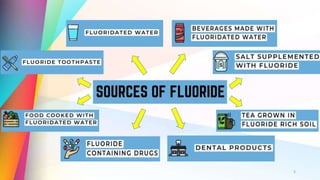
• Sources of Fluoride
• What is Oral Biofilm?
• Dental Decay Process
• Fluoride and Plaque
3
• Mechanism of action of
fluoride
• Role of Fluoride
• Fluoride Toxicity
• Conclusion
• References
What is Fluoride ?
• The Federal Register of United States Food and Drug Administration
describes Fluoride as an essential element of halogen family with
atomic weight 19
• Estimated daily intake of Fluoride:
- Average daily intake of fluoride from dry food substance-0.2
to1.8mg
- Average daily intake of water containing 1ppm fluoride-1.5 mg
- Total daily intake for adults-1.7 to 3.3 mg
- Total fluoride intake in younger children-0.7 mg/day
4
5
What is Oral Biofilm / Dental Plaque
6
Soft deposits that form the biofilm adhering to tooth surface or
other hard surfaces in oral cavity including removable & fixed
restoration
- Bowen
1976
• Biofilms plays an important role in
development of caries, gingivitis and
periodontitis
• A major constituent of biofilm is
Streptococcus mutans.
Dental Decay Process
7
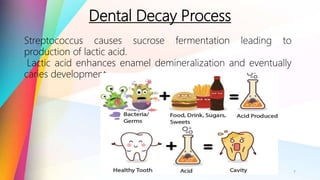
Streptococcus causes sucrose fermentation leading to
production of lactic acid.
Lactic acid enhances enamel demineralization and eventually
caries development
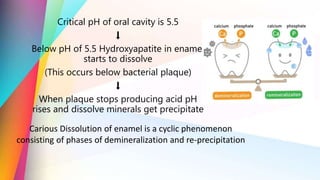
Critical pH of oral cavity is 5.5
⬇️
Below pH of 5.5 Hydroxyapatite in enamel
starts to dissolve
(This occurs below bacterial plaque)
⬇️
When plaque stops producing acid pH
rises and dissolve minerals get precipitate
Carious Dissolution of enamel is a cyclic phenomenon
consisting of phases of demineralization and re-precipitation
FLUORIDE & PLAQUE
• Fluoride introduced in the oral cavity is partly taken up by
plaque (95% bound form)
• At low pH, fluoride combines with hydrogen ions and diffuses
into oral bacteria as hydrogen fluoride(HF). Inside the cell HF
dissociates, acidifying the cell and releasing fluoride ions.
• Fluoride in plaque inhibits glycolysis.
• Higher concentrations of fluoride gels aid in the destruction of
cariogenic bacteria in dental plaque.
9
• Fluorapatite is present in teeth that have been
exposed to fluoride ions
• Fluorapatite starts to dissolve when the pH drops
below 4.5.
• If biofilm pH is higher than 4.5 and fluoride is
available in low concentrations, fluorapatite forms on
the surface layers of enamel.
10
Mechanism of Action of Fluoride
Reduced Demineralization and Enhanced
Remineralization
11
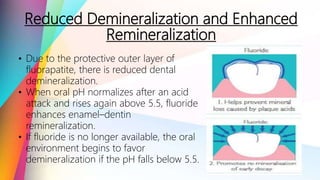
• Due to the protective outer layer of
fluorapatite, there is reduced dental
demineralization.
• When oral pH normalizes after an acid
attack and rises again above 5.5, fluoride
enhances enamel–dentin
remineralization.
• If fluoride is no longer available, the oral
environment begins to favor
demineralization if the pH falls below 5.5.
Mechanisms by which fluorides
increase caries resistance
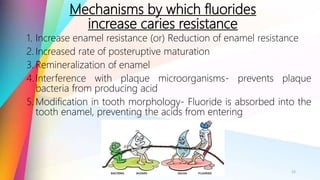
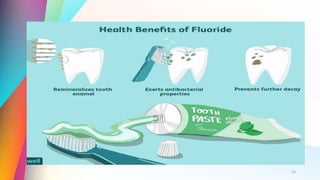
1. Increase enamel resistance (or) Reduction of enamel resistance
2. Increased rate of posteruptive maturation
3. Remineralization of enamel
4. Interference with plaque microorganisms- prevents plaque
bacteria from producing acid
5. Modification in tooth morphology- Fluoride is absorbed into the
tooth enamel, preventing the acids from entering
12
13
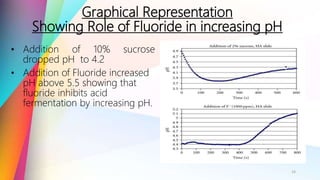
Graphical Representation
Showing Role of Fluoride in increasing pH
• Addition of 10% sucrose
dropped pH to 4.2
• Addition of Fluoride increased
pH above 5.5 showing that
fluoride inhibits acid
fermentation by increasing pH.
14
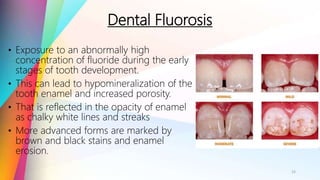
Dental Fluorosis
• Exposure to an abnormally high
concentration of fluoride during the early
stages of tooth development.
• This can lead to hypomineralization of the
tooth enamel and increased porosity.
• That is reflected in the opacity of enamel
as chalky white lines and streaks
• More advanced forms are marked by
brown and black stains and enamel
erosion.
15
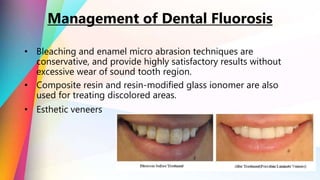
• Bleaching and enamel micro abrasion techniques are
conservative, and provide highly satisfactory results without
excessive wear of sound tooth region.
• Composite resin and resin-modified glass ionomer are also
used for treating discolored areas.
• Esthetic veneers
Management of Dental Fluorosis
Skeletal Fluorosis
• Skeletal fluorosis is a bone and joint condition causing increases
bone density and changes in the bone that lead to joint stiffness
and pain due to prolonged exposure to high concentrations of
fluoride.
• In India, disease first reported by Vishwanathan (1935) to be
prevalent in Madras city.
Medical management of Skeletal Fluorosis
• Calcium, Magnesium, Aluminium salts decrease fluoride
absorption and increase excretion.
• Mg. hydroxide has also been found effective
Conclusion
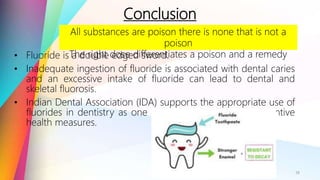
• Fluoride is a double edged sword.
• Inadequate ingestion of fluoride is associated with dental caries
and an excessive intake of fluoride can lead to dental and
skeletal fluorosis.
• Indian Dental Association (IDA) supports the appropriate use of
fluorides in dentistry as one of the most successful preventive
health measures.
18
All substances are poison there is none that is not a
poison
The right dose differentiates a poison and a remedy
References
• Essentials of Public Health Dentistry
– Soben Peter
• https://ida.org.in/
• https://www.ncbi.nlm.nih.gov
19
20

fluorides in dentistry.pptx

  • 1.
  • 2.
    Role of Fluoridein Dental Biofilm Presented By Prerna Jadhav (Third Year BDS) Roll No. 20
  • 3.
    Contents • What isFluoride? • Sources of Fluoride • What is Oral Biofilm? • Dental Decay Process • Fluoride and Plaque 3 • Mechanism of action of fluoride • Role of Fluoride • Fluoride Toxicity • Conclusion • References
  • 4.
    What is Fluoride? • The Federal Register of United States Food and Drug Administration describes Fluoride as an essential element of halogen family with atomic weight 19 • Estimated daily intake of Fluoride: - Average daily intake of fluoride from dry food substance-0.2 to1.8mg - Average daily intake of water containing 1ppm fluoride-1.5 mg - Total daily intake for adults-1.7 to 3.3 mg - Total fluoride intake in younger children-0.7 mg/day 4
  • 5.
  • 6.
    What is OralBiofilm / Dental Plaque 6 Soft deposits that form the biofilm adhering to tooth surface or other hard surfaces in oral cavity including removable & fixed restoration - Bowen 1976 • Biofilms plays an important role in development of caries, gingivitis and periodontitis • A major constituent of biofilm is Streptococcus mutans.
  • 7.
    Dental Decay Process 7 Streptococcuscauses sucrose fermentation leading to production of lactic acid. Lactic acid enhances enamel demineralization and eventually caries development
  • 8.
    Critical pH oforal cavity is 5.5 ⬇️ Below pH of 5.5 Hydroxyapatite in enamel starts to dissolve (This occurs below bacterial plaque) ⬇️ When plaque stops producing acid pH rises and dissolve minerals get precipitate Carious Dissolution of enamel is a cyclic phenomenon consisting of phases of demineralization and re-precipitation
  • 9.
    FLUORIDE & PLAQUE •Fluoride introduced in the oral cavity is partly taken up by plaque (95% bound form) • At low pH, fluoride combines with hydrogen ions and diffuses into oral bacteria as hydrogen fluoride(HF). Inside the cell HF dissociates, acidifying the cell and releasing fluoride ions. • Fluoride in plaque inhibits glycolysis. • Higher concentrations of fluoride gels aid in the destruction of cariogenic bacteria in dental plaque. 9
  • 10.
    • Fluorapatite ispresent in teeth that have been exposed to fluoride ions • Fluorapatite starts to dissolve when the pH drops below 4.5. • If biofilm pH is higher than 4.5 and fluoride is available in low concentrations, fluorapatite forms on the surface layers of enamel. 10 Mechanism of Action of Fluoride
  • 11.
    Reduced Demineralization andEnhanced Remineralization 11 • Due to the protective outer layer of fluorapatite, there is reduced dental demineralization. • When oral pH normalizes after an acid attack and rises again above 5.5, fluoride enhances enamel–dentin remineralization. • If fluoride is no longer available, the oral environment begins to favor demineralization if the pH falls below 5.5.
  • 12.
    Mechanisms by whichfluorides increase caries resistance 1. Increase enamel resistance (or) Reduction of enamel resistance 2. Increased rate of posteruptive maturation 3. Remineralization of enamel 4. Interference with plaque microorganisms- prevents plaque bacteria from producing acid 5. Modification in tooth morphology- Fluoride is absorbed into the tooth enamel, preventing the acids from entering 12
  • 13.
  • 14.
    Graphical Representation Showing Roleof Fluoride in increasing pH • Addition of 10% sucrose dropped pH to 4.2 • Addition of Fluoride increased pH above 5.5 showing that fluoride inhibits acid fermentation by increasing pH. 14
  • 15.
    Dental Fluorosis • Exposureto an abnormally high concentration of fluoride during the early stages of tooth development. • This can lead to hypomineralization of the tooth enamel and increased porosity. • That is reflected in the opacity of enamel as chalky white lines and streaks • More advanced forms are marked by brown and black stains and enamel erosion. 15
  • 16.
    • Bleaching andenamel micro abrasion techniques are conservative, and provide highly satisfactory results without excessive wear of sound tooth region. • Composite resin and resin-modified glass ionomer are also used for treating discolored areas. • Esthetic veneers Management of Dental Fluorosis
  • 17.
    Skeletal Fluorosis • Skeletalfluorosis is a bone and joint condition causing increases bone density and changes in the bone that lead to joint stiffness and pain due to prolonged exposure to high concentrations of fluoride. • In India, disease first reported by Vishwanathan (1935) to be prevalent in Madras city. Medical management of Skeletal Fluorosis • Calcium, Magnesium, Aluminium salts decrease fluoride absorption and increase excretion. • Mg. hydroxide has also been found effective
  • 18.
    Conclusion • Fluoride isa double edged sword. • Inadequate ingestion of fluoride is associated with dental caries and an excessive intake of fluoride can lead to dental and skeletal fluorosis. • Indian Dental Association (IDA) supports the appropriate use of fluorides in dentistry as one of the most successful preventive health measures. 18 All substances are poison there is none that is not a poison The right dose differentiates a poison and a remedy
  • 19.
    References • Essentials ofPublic Health Dentistry – Soben Peter • https://ida.org.in/ • https://www.ncbi.nlm.nih.gov 19
  • 20.