CFD OF BATCH
REACTOR IN
FLUENT ANSYS
AND DWSIM
Group Members
Om Varma
Aryan Patil
Mustafa Khan
Under Guidance of
Prof. M. A. Suryawanshi
Abstract
In this project, a 3D geometry of the batch reactor is modeled to
simulate the fluid flow, temperature distribution, within the reactor.
The CFD analysis involves solving the Navier-Stokes equations along
with turbulence and energy models to capture complex flow
patterns, heat transfer, and chemical reactions.
INTRODUCTION
Computational Fluid Dynamics (CFD) is a technology that simulates fluid flow and heat transfer
using numerical methods. It helps engineers optimize designs and predict system performance
in various applications.
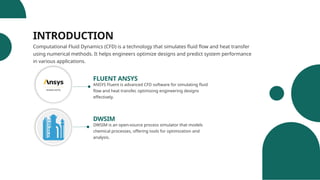
FLUENT ANSYS
ANSYS Fluent is advanced CFD software for simulating fluid
flow and heat transfer, optimizing engineering designs
effectively.
DWSIM
DWSIM is an open-source process simulator that models
chemical processes, offering tools for optimization and
analysis.
About Us
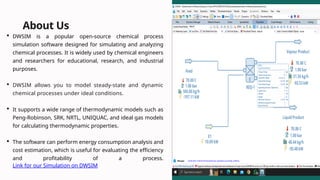
 DWSIM is a popular open-source chemical process
simulation software designed for simulating and analyzing
chemical processes. It is widely used by chemical engineers
and researchers for educational, research, and industrial
purposes.
 DWSIM allows you to model steady-state and dynamic
chemical processes under ideal conditions.
 It supports a wide range of thermodynamic models such as
Peng-Robinson, SRK, NRTL, UNIQUAC, and ideal gas models
for calculating thermodynamic properties.
 The software can perform energy consumption analysis and
cost estimation, which is useful for evaluating the efficiency
and profitability of a process.
Link for our Simulation on DWSIM
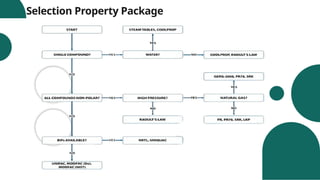
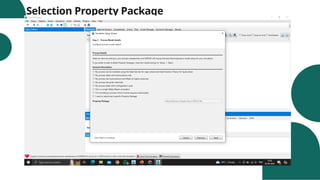
Selection Property Package
Equilibrium Reactor
An equilibrium reactor is a model or conceptual framework used in chemical engineering
to simulate reactions that are governed by chemical equilibrium.
In such reactors, the composition of the reactants and products reaches a state where the
forward and reverse reaction rates are equal, meaning no net change occurs in the
concentrations of the species involved.
The main principle behind an equilibrium reactor is that it assumes the system achieves
equilibrium under the given conditions, allowing for the prediction of the final mixture of
products and reactants.
In process simulation tools, equilibrium reactors are used to model systems where the
reaction does not go to completion but reaches a balanced state. The software calculates
the composition of the outlet stream based on thermodynamic principles.
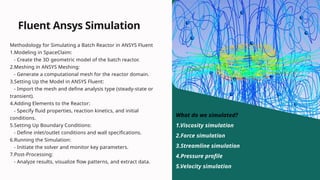
Fluent Ansys Simulation
Methodology for Simulating a Batch Reactor in ANSYS Fluent
1.Modeling in SpaceClaim:
- Create the 3D geometric model of the batch reactor.
2.Meshing in ANSYS Meshing:
- Generate a computational mesh for the reactor domain.
3.Setting Up the Model in ANSYS Fluent:
- Import the mesh and define analysis type (steady-state or
transient).
4.Adding Elements to the Reactor:
- Specify fluid properties, reaction kinetics, and initial
conditions.
5.Setting Up Boundary Conditions:
- Define inlet/outlet conditions and wall specifications.
6.Running the Simulation:
- Initiate the solver and monitor key parameters.
7.Post-Processing:
- Analyze results, visualize flow patterns, and extract data.
What do we simulated?
1.Viscosity simulation
2.Force simulation
3.Streamline simulation
4.Pressure profile
5.Velocity simulation
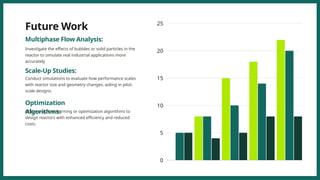
Future Work
Multiphase Flow Analysis:
Investigate the effects of bubbles or solid particles in the
reactor to simulate real industrial applications more
accurately
Conduct simulations to evaluate how performance scales
with reactor size and geometry changes, aiding in pilot-
scale designs.
Optimization
Algorithms:
Utilize machine learning or optimization algorithms to
design reactors with enhanced efficiency and reduced
costs.
Scale-Up Studies:

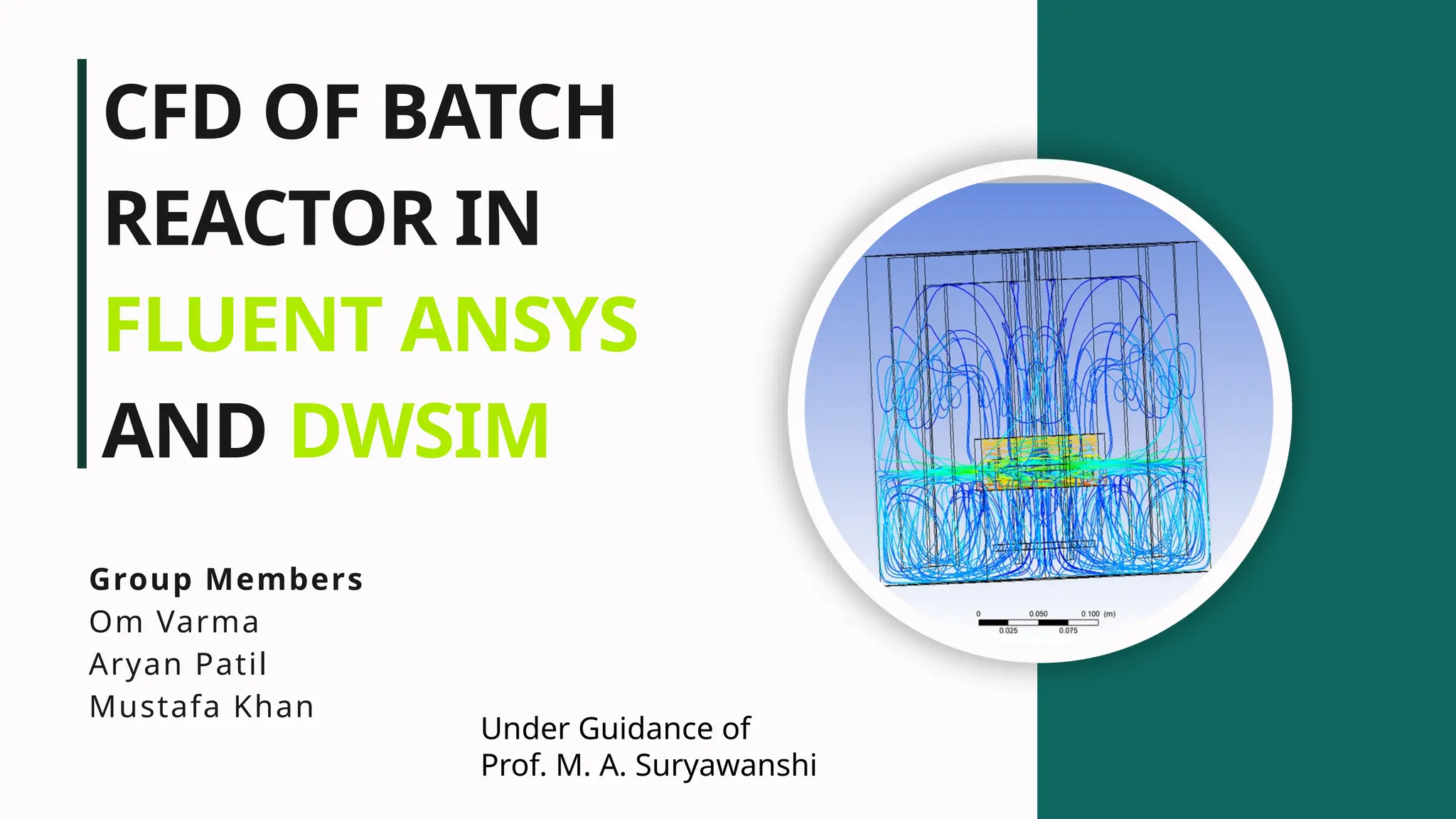
Fluent Ansys Simulation of Batch reactor

  • 1.
    CFD OF BATCH REACTORIN FLUENT ANSYS AND DWSIM Group Members Om Varma Aryan Patil Mustafa Khan Under Guidance of Prof. M. A. Suryawanshi
  • 2.
    Abstract In this project,a 3D geometry of the batch reactor is modeled to simulate the fluid flow, temperature distribution, within the reactor. The CFD analysis involves solving the Navier-Stokes equations along with turbulence and energy models to capture complex flow patterns, heat transfer, and chemical reactions.
  • 3.
    INTRODUCTION Computational Fluid Dynamics(CFD) is a technology that simulates fluid flow and heat transfer using numerical methods. It helps engineers optimize designs and predict system performance in various applications. FLUENT ANSYS ANSYS Fluent is advanced CFD software for simulating fluid flow and heat transfer, optimizing engineering designs effectively. DWSIM DWSIM is an open-source process simulator that models chemical processes, offering tools for optimization and analysis.
  • 4.
    About Us  DWSIMis a popular open-source chemical process simulation software designed for simulating and analyzing chemical processes. It is widely used by chemical engineers and researchers for educational, research, and industrial purposes.  DWSIM allows you to model steady-state and dynamic chemical processes under ideal conditions.  It supports a wide range of thermodynamic models such as Peng-Robinson, SRK, NRTL, UNIQUAC, and ideal gas models for calculating thermodynamic properties.  The software can perform energy consumption analysis and cost estimation, which is useful for evaluating the efficiency and profitability of a process. Link for our Simulation on DWSIM
  • 5.
  • 6.
  • 7.
    Equilibrium Reactor An equilibriumreactor is a model or conceptual framework used in chemical engineering to simulate reactions that are governed by chemical equilibrium. In such reactors, the composition of the reactants and products reaches a state where the forward and reverse reaction rates are equal, meaning no net change occurs in the concentrations of the species involved. The main principle behind an equilibrium reactor is that it assumes the system achieves equilibrium under the given conditions, allowing for the prediction of the final mixture of products and reactants. In process simulation tools, equilibrium reactors are used to model systems where the reaction does not go to completion but reaches a balanced state. The software calculates the composition of the outlet stream based on thermodynamic principles.
  • 8.
    Fluent Ansys Simulation Methodologyfor Simulating a Batch Reactor in ANSYS Fluent 1.Modeling in SpaceClaim: - Create the 3D geometric model of the batch reactor. 2.Meshing in ANSYS Meshing: - Generate a computational mesh for the reactor domain. 3.Setting Up the Model in ANSYS Fluent: - Import the mesh and define analysis type (steady-state or transient). 4.Adding Elements to the Reactor: - Specify fluid properties, reaction kinetics, and initial conditions. 5.Setting Up Boundary Conditions: - Define inlet/outlet conditions and wall specifications. 6.Running the Simulation: - Initiate the solver and monitor key parameters. 7.Post-Processing: - Analyze results, visualize flow patterns, and extract data. What do we simulated? 1.Viscosity simulation 2.Force simulation 3.Streamline simulation 4.Pressure profile 5.Velocity simulation
  • 9.
    Future Work Multiphase FlowAnalysis: Investigate the effects of bubbles or solid particles in the reactor to simulate real industrial applications more accurately Conduct simulations to evaluate how performance scales with reactor size and geometry changes, aiding in pilot- scale designs. Optimization Algorithms: Utilize machine learning or optimization algorithms to design reactors with enhanced efficiency and reduced costs. Scale-Up Studies: