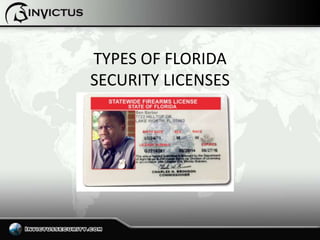
TYPES OF FLORIDA
SECURITY LICENSES
Florida Security
Florida Security License
• Security Officer Class “D” License
– Any individual who performs security services
must have a Class “D” Security Officer License
and must own or be employed by a licensed Class
“B” Security Agency or branch office.
– Class “D” licensees may not enter into
subcontractor agreements with any licensed
agency or other business entity.
Florida Security License
• Statewide Firearms Class “G” License
– Any security officer or private investigator who
carries a firearm while on duty must have a Class
“G” license in addition to their Security Class “D”
License and or Private Investigator Class C
License.
Florida Security License
• Security Agency Class “B” License
– Any business which advertises as, or is engaged in,
the business of furnishing the following services
for compensation is a security agency and must
possess a Class “B” Security Agency License.
• Security guard services
• Armored car services
• Transporting prisoners
• Bodyguards
Florida Security License
• Class “BB” License
– Each additional location of a security agency
where security business is actively conducted must
obtain a Class “BB” Branch Office License.
Florida Security License
• Agency Managers Class “M” or “MB” License
– Any person who directs the activities of licensed security
officers at any agency or branch office must have a Class
“M” or Class “MB” Manager License.
– A Class “D” licensee, who has been so licensed for a
minimum of two (2) years, may be designated as the
manager
– The manager assigned to an agency or branch office must
operate primarily from the location for which he has been
designated as manager.
– Each licensed location must have a designated, properly
licensed manager and a licensed manager may only be
designated as manager for one location.
Florida Security License
• Security Officer Instructor Class “DI” License
– Any individual who teaches or instructs at a Class
“DS” Security Officer School or Training Facility
shall have a Class “DI” license.
Florida Security License
• Security Officer School Class “DS” License
– Any school or training facility that teaches or
instructs applicants for the Class “D” licensure
must have a Class “DS” license.
Florida Security License
• Class “K” license
– Any individual who provides classroom or range
instruction to applicants for a Class “G” license
must have a Class “K” license.
– Class “K” licensees must follow the standards and
procedures in the Division of Licensing Firearms
Instructor’s Training Manual.
Florida Security License
• Private Investigator Class “C” license
– Any individual who performs investigative services,
except an “in-house” investigator, must have a Class
“C” Private Investigator license and must own or be
employed by a licensed Class “A” Private
Investigative Agency or Class “AA” or “AB” branch
office.
– Class “C” licensees may not engage in investigative
services except through a licensed agency.
– Class “C” licensees may not subcontract.
Florida Security License
• Private Investigator Intern Class “CC” license
– Any individual who performs investigative
services as an intern under the direction and
control of a designated sponsoring Class “C”
licensee or designated sponsoring Class “M” or
“MA” Agency Manager licensee.
– Class “CC” licensees may not subcontract; they
must work for a Class “A” agency or branch
office.

Florida Security License Types

  • 1.
    TYPES OF FLORIDA SECURITYLICENSES Florida Security
  • 2.
    Florida Security License •Security Officer Class “D” License – Any individual who performs security services must have a Class “D” Security Officer License and must own or be employed by a licensed Class “B” Security Agency or branch office. – Class “D” licensees may not enter into subcontractor agreements with any licensed agency or other business entity.
  • 3.
    Florida Security License •Statewide Firearms Class “G” License – Any security officer or private investigator who carries a firearm while on duty must have a Class “G” license in addition to their Security Class “D” License and or Private Investigator Class C License.
  • 4.
    Florida Security License •Security Agency Class “B” License – Any business which advertises as, or is engaged in, the business of furnishing the following services for compensation is a security agency and must possess a Class “B” Security Agency License. • Security guard services • Armored car services • Transporting prisoners • Bodyguards
  • 5.
    Florida Security License •Class “BB” License – Each additional location of a security agency where security business is actively conducted must obtain a Class “BB” Branch Office License.
  • 6.
    Florida Security License •Agency Managers Class “M” or “MB” License – Any person who directs the activities of licensed security officers at any agency or branch office must have a Class “M” or Class “MB” Manager License. – A Class “D” licensee, who has been so licensed for a minimum of two (2) years, may be designated as the manager – The manager assigned to an agency or branch office must operate primarily from the location for which he has been designated as manager. – Each licensed location must have a designated, properly licensed manager and a licensed manager may only be designated as manager for one location.
  • 7.
    Florida Security License •Security Officer Instructor Class “DI” License – Any individual who teaches or instructs at a Class “DS” Security Officer School or Training Facility shall have a Class “DI” license.
  • 8.
    Florida Security License •Security Officer School Class “DS” License – Any school or training facility that teaches or instructs applicants for the Class “D” licensure must have a Class “DS” license.
  • 9.
    Florida Security License •Class “K” license – Any individual who provides classroom or range instruction to applicants for a Class “G” license must have a Class “K” license. – Class “K” licensees must follow the standards and procedures in the Division of Licensing Firearms Instructor’s Training Manual.
  • 10.
    Florida Security License •Private Investigator Class “C” license – Any individual who performs investigative services, except an “in-house” investigator, must have a Class “C” Private Investigator license and must own or be employed by a licensed Class “A” Private Investigative Agency or Class “AA” or “AB” branch office. – Class “C” licensees may not engage in investigative services except through a licensed agency. – Class “C” licensees may not subcontract.
  • 11.
    Florida Security License •Private Investigator Intern Class “CC” license – Any individual who performs investigative services as an intern under the direction and control of a designated sponsoring Class “C” licensee or designated sponsoring Class “M” or “MA” Agency Manager licensee. – Class “CC” licensees may not subcontract; they must work for a Class “A” agency or branch office.